Non-Face-to-Face Onboarding, Digital Identity and Impersonation Risk
Remote onboarding changes how a bank establishes confidence in a customer. In a branch, a staff member may inspect a physical document, see the person presenting it, ask follow-up questions and notice inconsistencies in one interaction. In a digital journey, those assurance steps are separated across document capture, database checks, device signals, biometric or other identity proofing, fraud controls and automated decisioning. That does not make remote onboarding inherently unsafe. It means the bank must understand what each digital control proves, what it does not prove, and how the controls combine into an evidence chain strong enough for the customer, product and risk involved.
This distinction matters because global standards do not say that every non-face-to-face relationship is automatically high risk. FATF's Guidance on Digital Identity explains that reliable, independent digital identity systems with appropriate risk mitigation can support customer identification and verification and may, depending on the circumstances, present standard or even lower risk. The bank therefore should not begin with the assumption that "remote equals high risk" or, at the opposite extreme, that a vendor pass score equals identity certainty. The practical task is to assess the assurance of the technology and process, the fraud and impersonation threats, the reliability and independence of the evidence, the customer's ML/TF risk, and the legal rules applicable to the institution and jurisdiction.
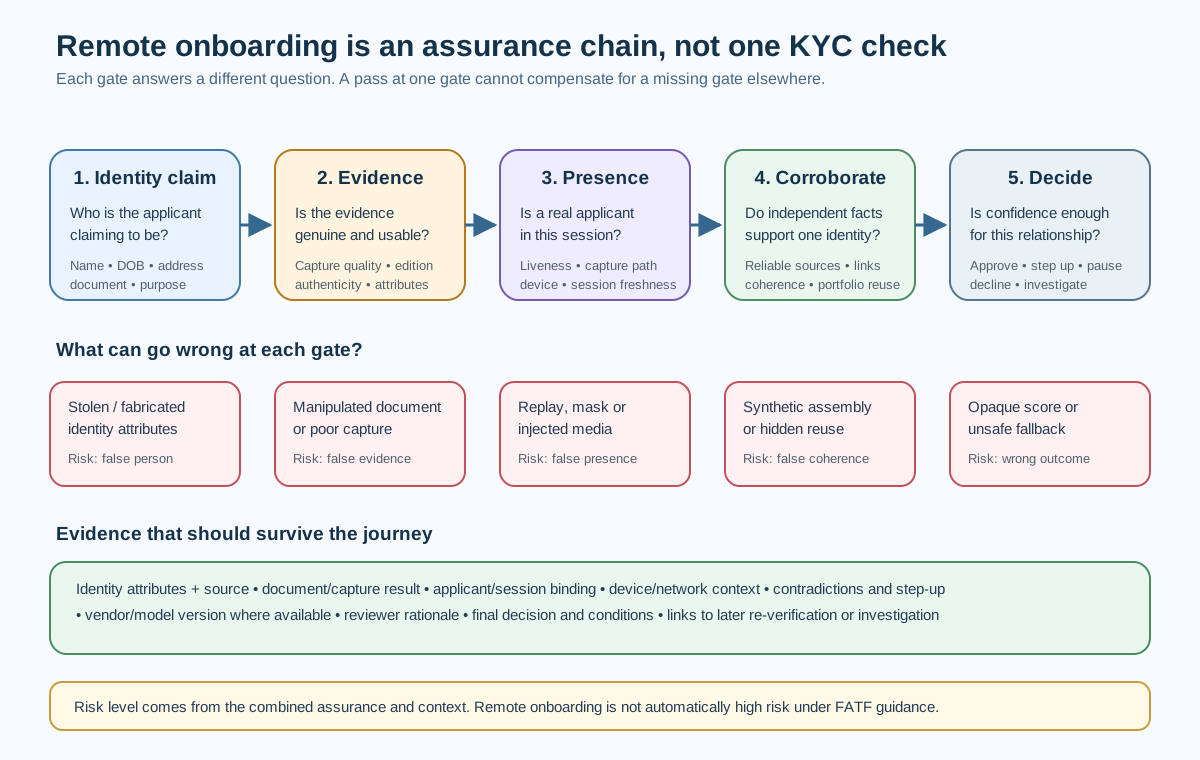
A useful mental model: resolve, validate, verify and bind
Remote identity work becomes easier to reason about when four questions are kept separate. Resolution asks whether the bank has enough attributes and evidence to identify a unique real-world identity. Validation asks whether the evidence and attributes are genuine, current where required and supported by authoritative or credible sources. Verification asks whether the applicant is the person to whom that evidence belongs. Binding asks whether the verified identity, the live session, the device or authenticator and the newly created customer record are connected strongly enough that another person cannot reuse or splice the evidence.
Those questions overlap with modern digital identity frameworks. NIST SP 800-63A-4, published in 2025 for U.S. federal digital identity systems, separates identity resolution, validation and verification and defines several identity assurance levels. It is useful as a technical reference for banks because it explains threats, proofing options, evidence quality and fraud controls, but it is not a universal AML rule and should not be presented as one. A bank must map any technical assurance framework to its own legal obligations, customer risk methodology and policy.
The mental model also exposes weak designs. A genuine passport can validate successfully while being used by an impostor. A live face can be present while the person is a recruited mule or is using a fabricated identity. A database match can confirm that the claimed person exists without proving that the applicant controls that identity legitimately. Remote onboarding is therefore not one check. It is the controlled accumulation of corroborating evidence, with clear treatment of contradictions and uncertainty.
Why banks care beyond onboarding conversion
Identity failure at account opening propagates through the relationship. If a bank opens an account for an impostor, synthetic identity or controlled mule, subsequent transaction monitoring starts from a false customer profile. Screening may be technically correct against the wrong person. Fraud controls may learn the attacker's behaviour as the customer's normal pattern. Credit, payments and limits may be granted using a relationship history that was manufactured from the beginning. Investigators later have to reconstruct not only suspicious transactions but also whether the person who opened the account ever existed as described.
The customer impact runs in the other direction. Overly rigid identity controls can exclude genuine customers who have older documents, low-end devices, accessibility needs, weak connectivity or non-standard identity evidence. A well-designed risk-based journey therefore has alternatives: re-capture, additional independent corroboration, assisted digital support, video review where lawful and useful, or another approved channel. The objective is not maximum friction. It is sufficient confidence with proportionate customer burden.
The threat model: presentation, injection, impersonation and fabrication
Remote onboarding faces several different attack families and they require different controls. A presentation attack places an artefact in front of a genuine capture device, such as a printed photograph, replayed video or mask. An injection attack attempts to bypass or manipulate the capture path, for example through virtual cameras, emulators, instrumented applications or direct API submission. Third-party impersonation uses another person's identity evidence. Synthetic identity combines real and fabricated elements into a new profile. First-party misrepresentation occurs when the real applicant lies about material facts while their identity itself is genuine. Mule recruitment may involve a real person who passes identity checks but intends, or is manipulated, to make the account available for criminal flows.
These categories should not be collapsed into a single "KYC fraud" score. The evidence that detects a screen replay is different from the evidence that detects a synthetic identity factory. The action also differs. A weak document image may call for re-capture. A confirmed injection attempt may justify stopping the session and investigating linked infrastructure. A genuine but vulnerable applicant showing signs of coercion may need safeguarding rather than a punitive fraud label. Requirements should therefore preserve the reason for concern rather than reducing every control output to one opaque number.
Document capture and authenticity
Document verification begins with acquisition quality. Blur, glare, cropping and low resolution can remove the very features needed to assess authenticity. Good journeys give immediate, accessible feedback and request another capture when the evidence is not examinable. They also record the capture method, document type and edition where relevant, because identity documents change over time and verification libraries must distinguish an unsupported new edition from a counterfeit document.
Where policy requires live document capture, the architecture should prevent a simple gallery upload from being treated as equivalent evidence. However, metadata alone should not be considered proof that an image came directly from a camera; metadata can be absent, transformed or manipulated. Stronger designs combine capture-channel controls, application integrity, image forensics, document-template checks, data extraction, machine-readable zone or chip validation where available, and independent corroboration of key identity attributes.
Authenticity results should be explainable enough for operations. A reviewer needs to know whether a document failed because the image was unreadable, a security feature was inconsistent, the document was expired under policy, an identity attribute did not match an independent source, or the document type was unsupported. Those outcomes lead to different customer messages and different risk decisions.
Presence and liveness are evidence, not certainty
Liveness controls seek evidence that a real person is participating in the current session rather than a static or replayed artefact. Passive approaches analyse images or short video sequences without asking the customer to perform actions. Active approaches issue unpredictable challenges or interactions. The right combination depends on the attack model, product risk, accessibility, customer experience and the strength of other proofing controls.
Deepfake and injection detection should be treated as probabilistic and fast-moving. There is no single visual artefact that will remain reliable as generation and injection techniques change. Banks should combine several layers: session freshness, server-generated challenges where appropriate, device and application integrity, capture-path controls, biometric presentation-attack detection, rate and velocity signals, independent identity evidence, and post-onboarding monitoring. A vendor claiming a high model score still needs bank-controlled validation against realistic attacks and legitimate customer populations.
The most important design principle is evidence binding. The bank needs confidence that the person who completed the liveness step is the person represented by the identity evidence and that both belong to the same protected onboarding session. Session identifiers, timestamps, nonces, signed assertions or equivalent controls should prevent an attacker from reusing a valid artefact from one session in another. Binding does not make the evidence infallible, but corroborated and session-bound evidence is substantially stronger than independent pass/fail results that can be replayed or spliced.
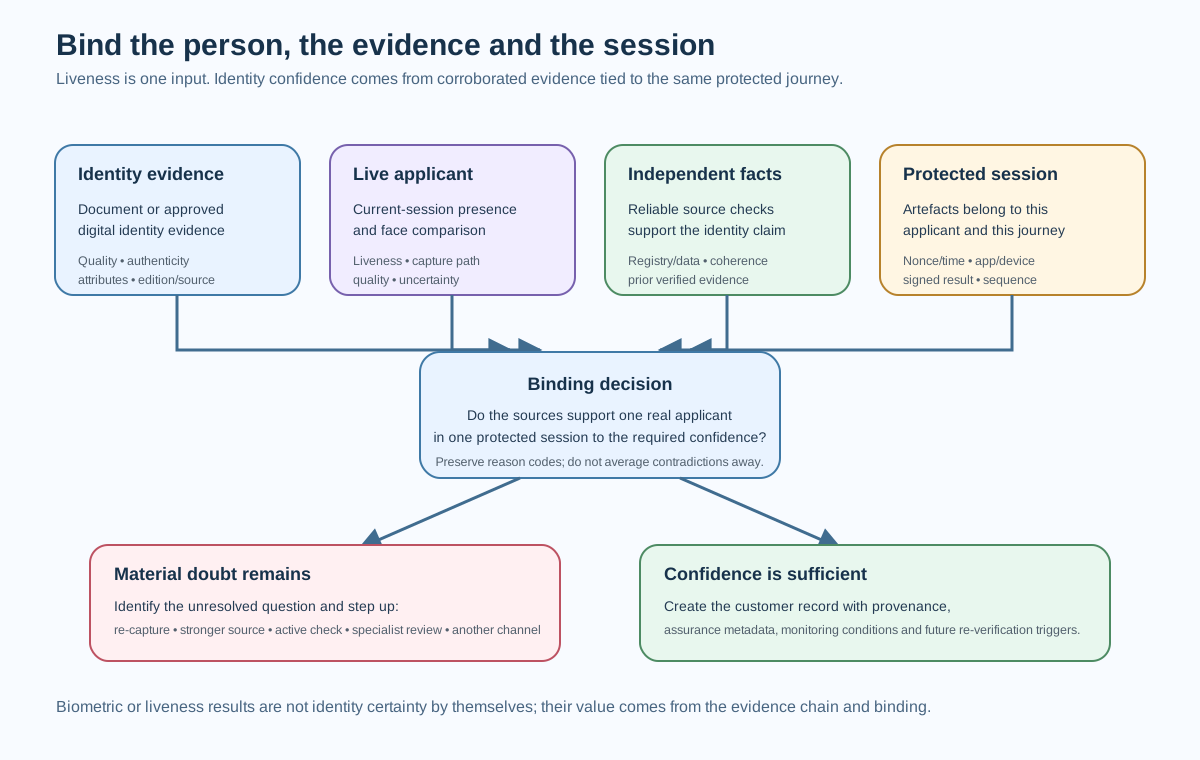
Biometric comparison and fairness
Facial comparison is commonly used to compare a live capture with an identity-document portrait or another lawful reference image. Matching must account for image quality, ageing, lighting, camera characteristics and legitimate appearance variation. A threshold should not be treated as a magic number. The bank needs evidence of false-match and false-non-match behaviour under conditions that resemble its customers and devices, and it needs a fallback when the model is uncertain.
Performance should be tested across relevant demographic groups where it is lawful and ethical to do so, because aggregate accuracy can conceal uneven error rates. The mitigation should focus on better capture quality, suitable model selection, conservative thresholds, accessible alternatives and human review where necessary. Protected characteristics should not quietly become decision variables merely because the model performs differently across groups. Any use of sensitive attributes must have a lawful purpose, governance and documented justification.
External facial references also require jurisdictional care. Government image databases, national identity services, previous bank enrolments or other references may be available in some markets and prohibited, restricted or unavailable in others. The control design should therefore say "where legally permitted and operationally available" rather than assume a universal source. Data minimisation, retention and purpose limitation should be designed with privacy and biometric-data obligations from the start.
Synthetic identity: when every individual field looks plausible
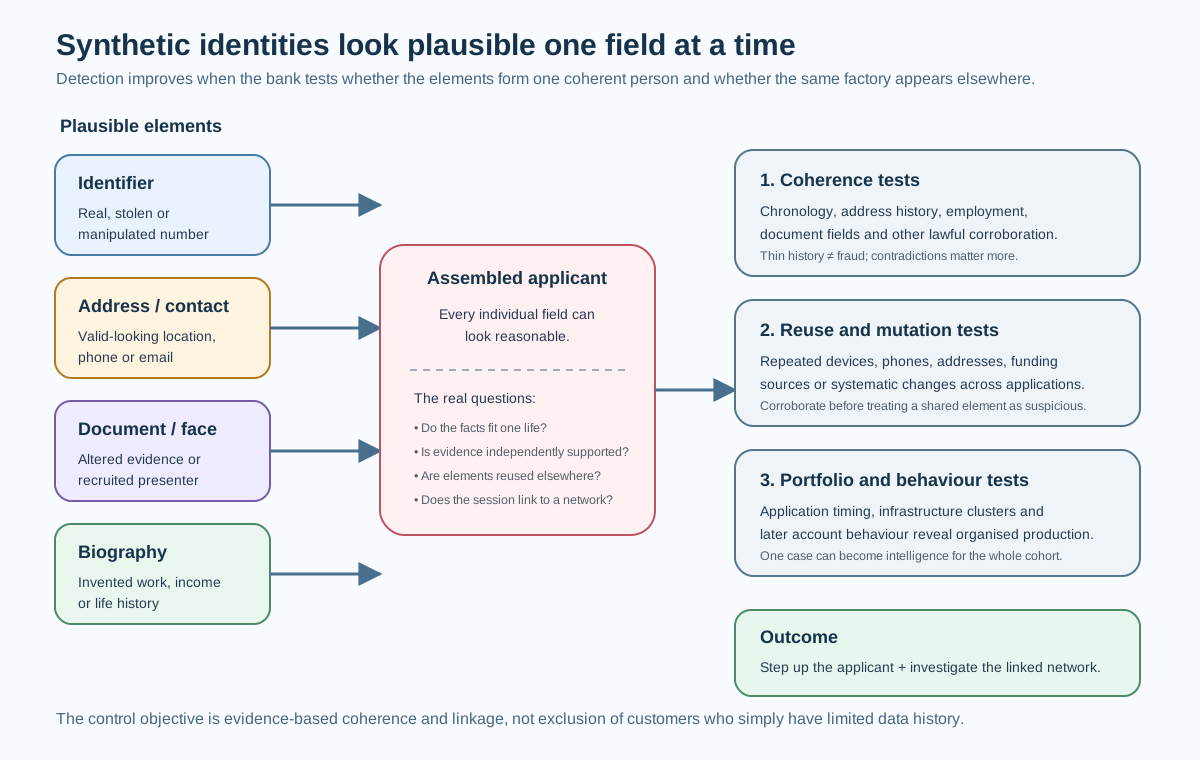
A synthetic identity may contain genuine identifiers, valid addresses or other real elements combined with invented or manipulated facts. No single field has to be obviously false. This is why portfolio and coherence analysis matter. The bank can ask whether age, address history, phone tenure, employment, credit history and other lawful data form a plausible chronology for one person. It can also look for reuse patterns across supposedly unrelated applications: common devices, contact points, addresses, funding sources, document templates, application timing or systematic mutations of identifiers.
The purpose is not to infer criminality from thin data. New-to-country customers, young adults and people with limited credit history can be entirely legitimate. The control should distinguish "little history" from "contradictory or manufactured history" and route uncertainty to proportionate verification rather than automatic exclusion. Network evidence becomes persuasive when several independent features point toward coordinated manufacturing.
First-party misrepresentation and mule risk
Remote identity proofing cannot solve every onboarding risk. A genuine person can provide genuine documents and still misstate income, business purpose, expected activity or intended use. Material assertions should be verified when required by law, policy or risk, using reliable independent information appropriate to the claim. The more consequential the decision, the stronger the bank's need to understand which facts were self-declared and which were corroborated.
Mule recruitment shows the same limitation from another angle. A recruited customer may be exactly who they claim to be. The risk sits in purpose, coercion, control of the account and subsequent behaviour. Onboarding can capture useful baseline information about expected use and can identify concerning device or network links, but post-onboarding controls are essential. First credits, rapid onward transfers, sudden beneficiary growth, device changes, credential sharing indicators and links to known scam or mule networks may reveal misuse that identity checks could not have established at account opening.
Vulnerability should be handled carefully. A bank may encounter indicators of coercion, financial distress, unfamiliarity with the product or third-party control. Those indicators can justify supportive questions or safeguarding under local policy, but broad demographic proxies such as being a student, a recent arrival or an older customer should not automatically create a fraud label. The evidence should be specific, relevant and proportionate.
Device, network and behavioural evidence
Device signals can add useful context: application integrity, emulator or automation indicators, device reputation, repeated use across accounts, or unexpected device changes. Network signals can show hosting infrastructure, impossible geography, high application velocity or clusters of supposedly unrelated customers. None of these signals is conclusive. VPN use can be legitimate, shared devices can reflect household or economic circumstances, and geolocation can be inaccurate. The architecture should make it possible to combine these signals with identity evidence rather than turning them into hard decline rules without context.
Behavioural signals such as typing rhythm, navigation sequence or unusual repetition may help detect automation or coached applications, but they require especially careful governance. Accessibility tools, language differences, low digital literacy, stress and unfamiliar devices can all change interaction patterns. Behavioural models should be validated for legitimate variation and ordinarily used to inform step-up or review rather than silently making irreversible decisions based on opaque behaviour alone.
Step-up decisioning: respond to the type of doubt
A useful step-up model asks what remains uncertain. If the document is unreadable, ask for a new capture. If authenticity is uncertain, use a stronger independent source or specialist document review. If presence is uncertain, use an approved higher-assurance liveness or assisted process. If the face-to-document comparison is marginal, obtain another capture or manual review rather than simply lowering the threshold. If device integrity is poor, move the customer to an alternative trusted channel. If independent attributes conflict, investigate the contradiction rather than adding more biometric checks that do not answer it.
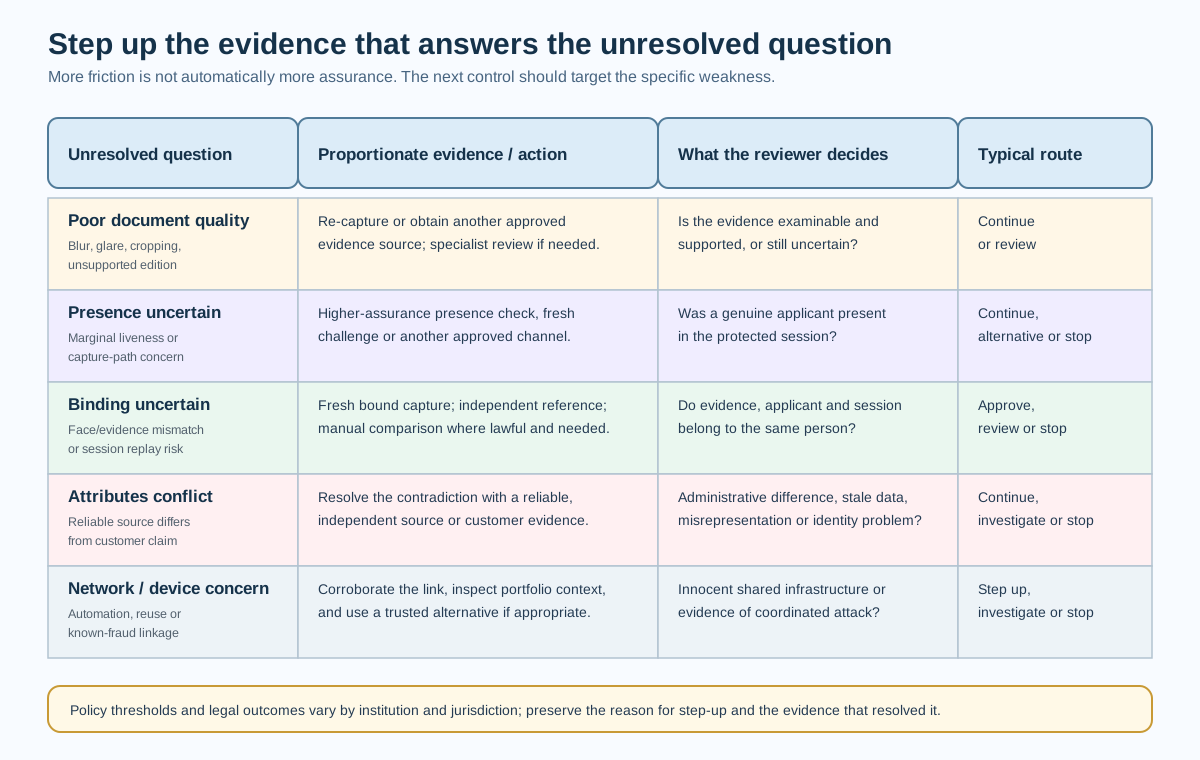
The possible outcomes should be explicit: approve, approve with documented monitoring conditions where policy allows, request more information, pause for specialist review, decline, or escalate for investigation. A sanctions or fraud concern, for example, should not be disguised as a generic KYC failure if the evidence supports a different control process. Reason codes should remain available to case management and audit so that the institution can explain why a customer was accepted or rejected and can learn from downstream outcomes.
Alert, case and investigation hand-off
Remote onboarding needs a case model, not just an API response. The case should preserve the identity claim, evidence used, document type and edition, capture and session details, vendor versions, scores with reason codes, device and network context, independent data sources, manual-review notes and final decision. If a customer later becomes linked to fraud or financial crime, investigators need to reconstruct what the bank knew at onboarding and which evidence was considered reliable at the time.
Link analysis should support a second question: what else is connected? A confirmed synthetic or injection case may share infrastructure, contact details or document patterns with other applications. The investigation should be able to pivot from the customer to those common elements and identify a wider campaign. Conversely, a weak link such as a shared public IP should not cause mass action without corroboration. Network evidence should be weighted and explainable.
Suspicious transaction or suspicious activity reporting remains jurisdiction-specific. Identity fraud, mule activity or impersonation may create a reporting obligation in some circumstances, but the threshold, reporting body, confidentiality rule and timing come from local law. The onboarding system should therefore route facts and evidence to the appropriate financial-crime process without pretending that one global rule determines the report.
Re-verification and ongoing identity confidence
Identity assurance is not a one-time certificate. Re-verification may become appropriate when the bank has reason to doubt previously obtained information, when a material account recovery event occurs, when identity data has been compromised, when control of a legal relationship changes, or when local rules and bank policy require a refreshed check. The trigger should determine the scope. An expired identity document by itself does not always mean the customer's identity must be re-proved; AUSTRAC's current guidance, for example, explicitly notes that an expired verification document does not by itself change the customer's identity or ML/TF risk.
The same principle helps after a data breach. Stolen identity attributes increase impersonation risk, but a bank should not automatically force every affected customer through a full onboarding journey again. It should assess what evidence was compromised, which authenticators or recovery routes rely on it, whether the bank now doubts the customer's identity, and what proportionate re-verification or monitoring is needed.
Regulatory and supervisory context
FATF Recommendation 10 requires customer identification and verification using reliable, independent source documents, data or information. FATF's 2020 Guidance on Digital Identity explains how digital identity can support that requirement and makes an important risk-based point: reliable digital identity with suitable assurance and mitigants can be standard or lower risk rather than automatically high risk merely because it is remote.
In the European Union, the EBA Guidelines on the use of remote customer onboarding solutions are in force and apply to relevant credit and financial institutions within their stated scope. They address governance, pre-implementation assessment of the remote solution, information and document acquisition, authenticity and integrity, matching the customer to the evidence, reliance on third parties, and ICT/security risk. They are an EU supervisory framework, not a global rulebook.
In the United Kingdom, HM Treasury and the Department for Science, Innovation and Technology published approved guidance on 26 February 2026 explaining how digital verification services can be used for identity verification under the Money Laundering Regulations. It supplements rather than replaces the MLR obligations and sets conditions around services certified against the UK digital verification services trust framework and listed on the GOV.UK register. A bank using that route still owns the regulated obligation.
Australia's AUSTRAC guidance, updated in March 2026, provides another jurisdiction-specific example. It expects KYC information to be verified as appropriate to ML/TF risk using independent and reliable data and permits use of third-party digital identity services where the data received is reliable and independent, subject to the reporting entity's assessment and obligations. These examples illustrate a common design lesson: digital identity can be used, but the regulated institution remains responsible for understanding the assurance and complying with its applicable law.
NIST SP 800-63-4 and SP 800-63A-4, both current from 2025, are useful technical references for identity proofing, fraud controls, privacy, usability and assurance. They govern U.S. federal digital identity contexts and should be cited as technical guidance, not as an AML/CFT mandate on banks in other jurisdictions.
Data, architecture and vendor control
From a business-analysis perspective, the hardest requirement is often provenance. Every identity decision should be traceable to the source, version, time and context of the evidence. Vendor scores without model/version information are difficult to reconstruct after a model update. Database matches without source identifiers cannot be challenged. A biometric match without capture-quality data may be meaningless. Data lineage therefore belongs in the control design, not only in audit documentation.
Architecture should separate evidence from decision policy. Vendors can provide document, biometric or device signals, but the bank should own the orchestration and the policy that turns those signals into outcomes. This makes vendor replacement possible, prevents a vendor threshold from becoming an undocumented bank risk appetite, and allows jurisdiction-specific rules to be applied without rebuilding the whole journey.
Third-party management should cover security, availability, model changes, data handling, sub-processors, testing rights, evidence access, exit and historical reconstruction. A vendor outage also needs a defined response. Some journeys may pause; others may use a previously approved alternative or lower-risk fallback with compensating controls where legally and policy-permitted. "Fail open" should never be the accidental result of an unavailable verification API.
Testing what matters
Testing should cover legitimate users and adversarial scenarios. Positive testing includes different document editions, camera qualities, devices, languages, accessibility tools and reasonable customer behaviour. Negative testing includes presentation attacks, injection attempts, replay, synthetic identity patterns, repeated infrastructure, manipulated documents and session-splicing attempts. Failure-mode testing covers vendor outages, timeouts, retry storms, duplicate applications and manual-review backlogs.
A model or vendor benchmark is not sufficient by itself. The bank should define its own test populations, known ground truth, acceptance thresholds, sampling approach and re-testing triggers. False acceptance, false rejection, customer abandonment, manual referral, downstream fraud and complaint outcomes should be monitored together. Improving one metric while hiding deterioration in another is not control optimisation.
For a BA, architect or tester, the key acceptance question is: what evidence will prove this control works in our population, under our attack model, with our legal constraints? That question produces better requirements than "implement liveness" or "use digital ID" because it forces the team to specify the threat, the evidence, the decision, the fallback and the audit trail.
Practical takeaways
Remote onboarding should be treated as an assurance architecture rather than a collection of vendor checks. Reliable digital identity can improve control quality and inclusion, but only when the bank understands the evidence, binds it to the applicant and session, preserves provenance, manages uncertainty and monitors what happens after onboarding. Strong document verification cannot compensate for absent applicant binding; strong biometrics cannot validate a fabricated biography; and perfect identity proofing cannot detect a genuine person who later acts as a mule.
The best operating model joins KYC, fraud, cyber security, product, operations, data and financial-crime investigation. Each function sees part of the risk. The customer experiences one journey, so the bank's controls need to operate as one joined system.
References and further reading
- FATF, Guidance on Digital Identity (2020): https://www.fatf-gafi.org/content/dam/fatf/documents/recommendations/Guidance-on-Digital-Identity.pdf
- European Banking Authority, Guidelines on the use of remote customer onboarding solutions (in force; application date 2 October 2023): https://www.eba.europa.eu/legacy/regulation-and-policy/regulatory-activities/anti-money-laundering-and-countering-financing-4
- NIST, SP 800-63-4 Digital Identity Guidelines (2025): https://csrc.nist.gov/pubs/sp/800/63/4/final
- NIST, SP 800-63A-4 Digital Identity Guidelines: Identity Proofing and Enrollment (2025): https://csrc.nist.gov/pubs/sp/800/63/a/4/final
- HM Treasury, Using digital identities with the Money Laundering Regulations (26 February 2026): https://www.gov.uk/government/publications/using-digital-identities-with-the-money-laundering-regulations/using-digital-identities-with-the-money-laundering-regulations
- AUSTRAC, Overview of initial customer due diligence (last updated 27 March 2026): https://www.austrac.gov.au/industry-and-business/obligations-and-guidance/your-amlctf-program/customer-due-diligence/initial-customer-due-diligence/overview-initial-customer-due-diligence
Operational deep dive: injection attacks, biometric protection and manufacturing detection
The base chapter establishes the remote-onboarding assurance chain. This deep dive focuses on the attack surfaces that are easiest to under-design: manipulated capture paths, biometric-template exposure, behavioural evidence and portfolio-scale identity manufacturing. None of these controls should be treated as a stand-alone proof. They are stronger when they corroborate document, identity, session and transaction evidence and when uncertainty routes to a controlled alternative rather than an unexplained automated decision.
Injection attacks: the capture path itself is under attack
Presentation attacks put an artefact in front of a genuine camera. Injection attacks try to replace or manipulate what the bank's application receives from the camera or verification service. The difference matters because a presentation-attack model can perform well against photographs and screen replays while still being blind to a fabricated stream inserted after camera capture.
At the application layer, a fraudster may use a virtual camera or screen-sharing mechanism to feed pre-created media into a genuine application. Useful controls include application integrity checks, detection of virtual or unusual capture devices, server-generated session challenges, freshness controls and analysis of whether the capture sequence is plausible. None of those signals is permanent: tooling evolves, benign software can look unusual, and attackers can imitate expected metadata. The bank therefore needs several independent signals and an escalation path for uncertain sessions rather than one hard rule such as "virtual camera detected equals fraud."
At the system layer, emulators, hooking frameworks, rooted or otherwise instrumented devices can interfere with camera APIs or application logic. Device attestation and runtime integrity signals can raise confidence that the bank is talking to an expected application on an expected device state. They should be calibrated carefully because device integrity is contextual evidence, not identity proof. A customer using an unsupported or modified device may still be legitimate and can be offered another approved verification route rather than being silently treated as a criminal actor.
At the API layer, an attacker may try to bypass the client journey and submit fabricated verification results or replay previously valid artefacts. This is why server-side session binding is fundamental. Verification results should be tied to the correct session, applicant, evidence and time window using protected identifiers, nonces, signed assertions or equivalent controls. Sequence validation can reject impossible journeys such as a completed biometric result arriving before the challenge was issued. API security testing should deliberately attempt replay, out-of-order calls, token reuse, result substitution and direct submission rather than assuming that a secure user interface protects the underlying service.
The design principle is simple: capture security, liveness and session binding solve different problems. A strong control stack needs all three in proportion to risk.
Biometric template protection and breach planning
Biometric systems create a different breach problem from passwords. A password can be reset; a face or other biometric characteristic cannot simply be reissued. Banks should therefore minimise retention of raw biometric data, understand what their vendor stores, separate biometric templates from encryption keys, and consider protection techniques that reduce reuse value if a template store is compromised. The exact technical method depends on the vendor and use case, but procurement should ask how templates are generated, encrypted, segregated, retained, deleted and made unusable after compromise.
Cross-system reuse deserves special attention. If the same representation of a biometric is reusable across products or organisations, one compromise can have a wider effect. Context-specific transformations or tokenised representations can reduce that risk. Where matching can be performed without maintaining a large central repository, that may also reduce exposure, although architecture choices should be assessed for security, fraud prevention, performance, privacy and legal requirements rather than following one universal pattern.
Incident procedures need to answer what happens if biometric or identity-proofing data is exposed. The bank may need to increase monitoring, invalidate particular proofing artefacts, require a new protected enrolment or route customers through another verification process. Notification and breach-response duties depend on applicable privacy, cyber-security and sector law. A bank should map those duties before an incident rather than discover them after a vendor reports a compromise.
Behavioural evidence without behavioural determinism
Behavioural signals can help detect automation, coaching and account takeover, but they are also easy to over-interpret. Typing cadence, navigation order, cursor movement, pauses and correction patterns can vary because of disability, language, age, stress, unfamiliarity with the device, accessibility software or poor connectivity. A good control therefore asks whether behaviour adds corroborating evidence to an already concerning pattern rather than whether a person behaves like a statistical average.
Model development should use representative legitimate and attack populations, document which features influence the decision, and test whether error rates or referrals concentrate unfairly on particular groups. Where lawful and appropriate, demographic performance analysis can reveal disparate outcomes, but sensitive attributes should not quietly become decision variables. Safer mitigations include better capture design, accessible journey alternatives, lower reliance on weak behavioural features, manual review and clearer reasons for step-up.
Reviewer tooling matters. A bare behavioural risk score gives a human little basis to challenge the model. Better presentations show the reason categories, relevant session events and the relationship between behavioural evidence and other signals, while avoiding unnecessary exposure of highly sensitive raw data. Human review should remain evidence-based; it should not become a licence for subjective profiling.
Evaluating liveness and presentation-attack controls
Vendor accuracy claims are meaningful only in the context of the test population and attack instruments. A bank's evaluation should separate genuine-user rejection from attack acceptance because those errors create different harms. Commodity attacks such as printed photographs and straightforward replay should be tested, but evaluation should also include stronger artefacts and adaptive attacks appropriate to the bank's threat model. The goal is not to reproduce every conceivable future attack; it is to understand where the control currently fails and what compensating layers exist.
Testing populations should resemble real deployment across document types, devices, image quality, lighting conditions and customer characteristics. A model validated only in laboratory conditions may degrade materially when customers use older phones or poor connectivity. Results should include uncertainty and limitations rather than one headline percentage. A bank-controlled challenge set is especially useful when a proprietary vendor cannot expose internal model design.
Performance should be re-evaluated after material vendor changes and periodically as attack techniques evolve. Model retraining, threshold changes, new liveness modes or major application changes can alter the bank's risk posture even when the commercial product name remains unchanged. Contracts should require enough change notification and test cooperation for the bank to decide whether revalidation is necessary.
Session-risk scoring and explainable fusion
A remote-onboarding decision commonly uses many weak-to-moderate signals: document confidence, evidence validation, liveness result, face match, device integrity, network reputation, velocity, behavioural indicators and portfolio linkages. A fusion layer can combine them, but the output should remain explainable enough to identify what caused a step-up or decline.
The bank should know whether a score reflects identity assurance, fraud risk, customer ML/TF risk or a mixture. Mixing them carelessly creates governance problems because the same number can drive decisions with different legal and operational consequences. A high fraud risk may require a different investigation path from high ML/TF risk; a low biometric confidence may simply require another capture. Architecture should therefore preserve the underlying reasons even when a model produces a combined score.
Thresholds should be governed against measured outcomes. Lowering a threshold may improve completion while increasing false acceptance; raising it may reduce fraud while excluding more legitimate customers. The decision should be documented in risk terms and monitored using downstream outcomes, not accepted because it is the vendor default. Challenger testing and controlled experiments can help, provided customer harm, legal requirements and fraud risk are considered together.
Document-edition awareness
Identity documents evolve. New editions can appear while old editions remain valid, and verification libraries may not support both equally on day one. The bank should maintain or obtain an inventory of supported document types and versions, understand transition periods, and have a controlled route when a genuine document cannot be reliably assessed by automation.
A new design should not be treated as suspicious merely because the verification engine has not learned it. Equally, an unknown edition should not silently bypass authenticity checks. A sensible response is a different evidence path: independent database validation, a specialist document review, an alternative supported document, or another approved verification channel. The particular route depends on the jurisdiction and the evidence available.
Manufacturing-signature detection at portfolio scale
Synthetic identity factories and organised mule recruitment often leave signals that do not exist inside one application. Reused phone numbers, addresses, devices or funding sources can connect apparently unrelated applicants. Timing may reveal application bursts or regular submission rhythms. Document or identity elements may change in systematic ways. Behavioural sequences can become suspiciously uniform. These patterns are most useful when several independent features align; a single shared address or device can have innocent explanations.
Portfolio analytics should therefore represent relationships explicitly. An application can be linked to devices, network identifiers, contact points, documents, source accounts and other applications, with confidence and time recorded for each link. Investigators can then distinguish a strong manufacturing cluster from a loose coincidence. Historical reconstruction matters because a network that looks harmless at onboarding may become meaningful after one member is confirmed fraudulent.
Response should operate at both case and network level. The individual application may be declined, stepped up or investigated, while common infrastructure and reused elements are assessed across the portfolio. Controls can then be tuned to the actual attack path instead of simply adding more generic friction for all customers. This feedback loop is one of the main advantages of digital onboarding: the same telemetry that creates privacy and governance responsibilities can, when lawfully used and well controlled, reveal industrialised attacks that branch-by-branch review would struggle to connect.
Advanced practice: orchestration, inclusion and vendor control
The base chapter and deep dive explain the evidence and attacks. This supplement turns them into an operating capability: several specialist services working as one controlled journey, measurable trade-offs between assurance and customer friction, inclusive alternatives for customers who cannot complete the default flow, and governance that keeps the bank accountable when third parties provide critical proofing components.
Orchestration across specialist services
Remote onboarding often combines document verification, identity-data corroboration, liveness or other presence checks, biometric comparison, device intelligence, fraud analytics and case workflow. The bank should design the sequence intentionally. A poor-quality document can be re-captured before an expensive biometric step. Independent checks can run in parallel where they do not depend on one another. Higher-assurance checks can be reserved for cases where initial evidence leaves material uncertainty. Each decision affects latency, cost, fraud resistance and customer abandonment, so journey analytics should measure the contribution of individual stages rather than reporting only a final conversion rate.
Evidence consolidation is as important as orchestration. Vendor outputs use different scales and meanings, so a numerical score from one provider should not be assumed equivalent to the same number from another. The bank needs a documented translation from provider outputs to its own reason codes and decision policy. Contradictions should be visible: a strong document result combined with failed liveness, or a good face match combined with a material attribute mismatch, is not a reason to average two scores into a comfortable middle. It is a reason to identify which fact remains unresolved and select a control that answers that question.
Provenance should survive model and vendor changes. The case record should identify the service, version where available, time, evidence input, result, reason and decision policy used. Years later, an investigator or auditor should be able to reconstruct what the bank relied on even if the vendor's current model behaves differently.
Designing controlled fallback
Vendor outages are an operational-risk issue and a financial-crime issue. The journey should define which checks are essential before account opening, which may have an approved alternative, and which activities must pause if the required assurance cannot be obtained. The answer can differ by product, customer and jurisdiction.
Fallback should be pre-approved rather than improvised during an incident. Examples include routing to another assessed provider, moving the customer to assisted review, postponing activation of higher-risk functionality, or pausing onboarding. Any degraded mode needs evidence that the residual risk remains within policy and applicable law. An unavailable verification API should never cause an accidental fail-open path simply because the product team is protecting conversion.
Testing should include failure conditions: provider timeout, partial response, inconsistent results between primary and backup providers, repeated retries, and manual-review queues under load. The objective is to prove that the journey remains controlled when dependencies fail, not merely when the happy path works.
Measuring friction honestly
Every identity step has a legitimate-customer cost as well as a control benefit. The bank should measure both. Step-level analytics can show where customers abandon, how often re-capture succeeds, which devices or document types generate repeated failure, and whether manual review resolves uncertainty or simply delays a decision. Fraud outcome data can show whether a control actually prevents the attack it was designed for.
A useful business case does not invent a generic percentage for what "good" looks like. It compares observed completion, fraud penetration, false rejection, manual referral, complaint and remediation outcomes against institution-approved thresholds for the specific journey. A control that creates material friction but adds little measurable assurance should be redesigned. A control that causes some additional effort but materially reduces high-consequence impersonation may be justified. The trade-off belongs to risk governance, not to a vendor benchmark or a product conversion target alone.
Risk-tiering can reduce unnecessary friction, but the tiering itself needs validation. If weak data pushes legitimate customers into the highest-friction route while sophisticated fraud is classified as low risk, the design simply concentrates harm in the wrong population. Outcome monitoring should therefore test both protection and inclusion.
Assisted digital journeys and inclusion
Some genuine applicants cannot complete a self-service remote journey because of disability, literacy, device limitations, connectivity, unfamiliarity with digital services or inability to present standard evidence. A mature design provides controlled alternatives rather than forcing repeated failure. Options can include trained remote assistance, accessible document capture, video-supported verification where appropriate, or another approved channel.
Assistance introduces its own risks. Staff or third parties should not obtain passwords, one-time codes or other credentials they do not need. Co-browsing should record which actions were performed by the customer and which were guided by the assistant. Where community or specialist partners are involved, access, training, oversight and escalation should be defined so that support cannot quietly become a route for coercion or credential capture.
Inclusion monitoring should focus on outcomes and barriers rather than demographic stereotyping. The bank can examine whether certain customer groups experience materially higher failure or referral rates where such analysis is lawful and appropriate, then investigate the cause: capture design, language, device compatibility, model performance, document support or process complexity. The response should improve the control or provide an equivalent alternative, not weaken identity assurance without understanding why the original path failed.
Cross-product assurance portability
Customers often open one product and later add others. The bank needs rules for how far the original onboarding assurance can travel. A strongly verified identity with clean subsequent behaviour may support another standard product without repeating the entire journey. A product with materially higher fraud, credit or regulatory consequences may require additional evidence. A weak initial proofing path should not become permanently trusted simply because the account has existed for a period of time.
Product-pivot monitoring is useful because organised fraud can enter through the easiest available product and then seek higher-value facilities. Rapid product expansion soon after onboarding, major limit requests, new devices or unusual control changes can justify fresh verification when combined with other risk. These are risk-based triggers, not universal rules, and should be documented in product governance.
Model-risk governance
Document classifiers, biometric comparison, liveness detection, device-risk engines, behavioural models and score-fusion logic can materially influence who receives banking access. They should therefore sit in a governed inventory with ownership, versioning, validation evidence, change controls and monitoring proportionate to their impact.
Validation should use representative legitimate users and realistic attacks, with separate measurement of false acceptance and false rejection. Where a vendor does not disclose proprietary internals, the bank can still perform outcome-based validation using controlled populations, require enough contractual support to understand material changes, and maintain an exit plan if the assurance cannot be demonstrated. Opacity does not transfer the regulated institution's accountability to the vendor.
Model changes deserve explicit attention. A vendor may retrain a model, alter a threshold or introduce a new capture technique without changing the product name. The bank should know which changes require re-testing before or after deployment and what performance movement triggers review. Monitoring should also detect drift caused by customer-population changes or adversary adaptation.
Vendor management for the identity supply chain
Provider selection should evaluate security, privacy, reliability, attack resistance, accessibility, evidence quality, sub-processors, data location and operational resilience alongside commercial price and headline accuracy. Contracts should support appropriate audit or assurance rights, material-change notification, incident reporting, data-return or deletion obligations, historical evidence access and exit.
Ongoing monitoring should compare vendor claims with bank-observed outcomes. Sampling approved applications for independent review, tracking downstream fraud by decision cohort, investigating repeated failure by document or device type and monitoring referral patterns can reveal degradation that aggregate vendor dashboards miss. Where lawful and appropriate, performance analysis should also look for unfair exclusion patterns.
The governing principle is straightforward: a bank may outsource components of identity proofing, but it does not outsource the decision that those components are adequate for its obligations and risk appetite.
Practice close: requirements, acceptance criteria and testing
This supplement converts the chapter into delivery artefacts. The purpose is not to prescribe one vendor stack or one set of global thresholds. It is to show what a BA, architect, tester, control owner and operations team should make explicit before a remote-onboarding journey is accepted into production.
Requirements should describe evidence, not product names
Document-capture requirements should define supported document categories and editions, image-quality expectations, the re-capture experience, how unsupported or uncertain documents are handled, and which independent sources are used to corroborate key attributes. If live capture is required, specify what the bank means by live capture and how the application distinguishes it from gallery upload or replay. Avoid requirements such as "use vendor X document check" because they say nothing about the control outcome the bank expects.
Presence and liveness requirements should identify the attack classes the bank intends to address, including straightforward presentation attacks and relevant injection scenarios. They should specify how challenges are generated where active liveness is used, how evidence is tied to the protected session, how uncertain results route to another process, and what happens when the service is unavailable. Accessibility and legitimate-user performance belong in the requirement alongside attack resistance.
Binding requirements should explain how the bank connects identity evidence, the applicant, the session and the customer record. If biometric comparison is used, the design should record quality, match outcome and reason information sufficient for review. Independent references should be described by source and reliability rather than treated as interchangeable database matches. Retention and deletion should follow applicable law and policy, with enough evidence kept to reconstruct the decision without retaining unnecessary sensitive data.
Step-up requirements should map the source of doubt to the next evidence needed. Poor image quality calls for another capture; uncertain authenticity calls for stronger document or independent-source assessment; uncertain applicant presence calls for a stronger presence check; inconsistent identity data calls for contradiction resolution; compromised device integrity may require another approved channel. A generic "high score goes to manual review" rule is weaker because it hides what the reviewer is expected to resolve.
Acceptance criteria that can actually be tested
Good acceptance criteria name the scenario, expected outcome, measurement and evidence. For example: a replayed biometric sample submitted through an approved red-team test path must not result in automated onboarding; a session-bound verification result replayed into a different session must be rejected; an unsupported document edition must route to the defined alternative rather than being automatically accepted or permanently failed; a legitimate user with an accessibility tool must have an approved path to complete verification without surrendering credentials to an assistant.
Performance thresholds should come from the institution's risk appetite, legal requirements and validated test evidence. There is no responsible global rule saying that every remote journey must achieve the same customer-completion percentage or the same biometric error rate. Test plans should therefore record the approved threshold and the reason for it instead of inserting an arbitrary benchmark into requirements.
Weak acceptance criteria describe implementation rather than outcome: "liveness is enabled," "documents are checked," "fraud vendor is connected," or "manual review exists." Those statements can all be true while the control fails. Acceptance should demonstrate that the relevant attacks are detected, legitimate customers have viable paths, uncertain evidence routes correctly, outages fail safely and decisions can be reconstructed.
Manual reviewer capability
Automation should send reviewers a coherent evidence package, not a score and a red icon. Reviewers need the reason for referral, relevant document or capture evidence, data contradictions, session and device context, any portfolio links, and the policy question they are being asked to resolve. Evidence should be presented with source and time so that stale or low-quality information is not mistaken for a current authoritative fact.
Training should use realistic examples of genuine and manipulated documents, uncertain biometric outcomes, coached applications and network linkages. Seeded cases with known ground truth can help measure whether reviewers apply the same policy consistently. Blind double-review sampling can identify interpretation drift, while downstream fraud and complaint outcomes can show whether a team is systematically too permissive or too restrictive.
Human review itself needs controls. Throughput targets should not pressure staff to clear cases they have not understood. Escalation routes should exist for document specialists, fraud investigators, financial-crime compliance, privacy or legal teams where the question exceeds the reviewer's authority. The final rationale should be specific enough for another competent reviewer to understand why the outcome followed from the evidence.
Incident response for onboarding-control failures
Remote-onboarding incidents can begin with a confirmed fraud account, a cluster of synthetic identities, a vendor security notification, an injection technique that bypasses a control, or a supervisory finding. The first response is containment proportional to the evidence. That may mean stronger checks for affected journeys, temporary restrictions on a vulnerable path, additional monitoring of recent cohorts or pausing a control whose integrity cannot be established.
Exposure analysis should identify which customers, sessions, document types, devices, providers or time windows may have been affected. Link analysis can find other applications sharing the exploited infrastructure, but mass action should require enough evidence to avoid harming unrelated customers who happen to share weak links such as a public network or household device.
Customer remediation should distinguish fraudsters from legitimate customers caught in the affected cohort. Re-verification may be appropriate where the bank now doubts identity or binding, but a broad technical incident does not automatically mean every customer must repeat full onboarding. The response should follow the evidence and applicable law.
Post-incident review should ask why the weakness existed: an untested fallback, an accepted model limitation, a deferred security fix, an ambiguous requirement, insufficient manual capacity or a vendor change that was not revalidated. Actions should then update controls across other journeys exposed to the same failure mode rather than treating the event as a single-product anomaly.
End-to-end test model
Positive testing proves that legitimate customers can complete the journey across realistic document types, devices, connectivity conditions, languages and accessibility needs. It should include edge cases such as older but valid documents, name changes, low-quality cameras and customers who require assistance. The purpose is to understand which failures represent fraud controls working and which represent avoidable exclusion.
Adversarial testing covers the threats the architecture claims to resist: printed-photo and replay attacks, manipulated documents, session replay, injection attempts, automated application velocity, synthetic identity element reuse, device or network clustering and evidence splicing. Each test should identify which layer is expected to detect the attack and what should happen if that layer is uncertain rather than successful.
Failure-mode testing covers dependency outages, timeouts, partial vendor responses, duplicated callbacks, retries, manual-review backlog and inconsistent primary/backup-provider results. A journey is not production-ready if it is secure only while every dependency responds normally.
Regression testing should preserve representative attacks and legitimate edge cases across releases. Fraud controls often weaken accidentally when teams optimise conversion, change vendors or reduce latency. A reusable test pack makes that deterioration visible before customers or criminals discover it in production.
BA and architecture sign-off questions
Before sign-off, a delivery team should be able to answer five practical questions in plain language. What identity fact are we trying to establish? What evidence supports it? What can defeat that evidence? What happens when the evidence is uncertain or unavailable? What audit trail proves the final decision? If any answer depends on "the vendor score says pass," the design is not finished.
Masterclass: a synthetic identity campaign from manufacture to bust-out
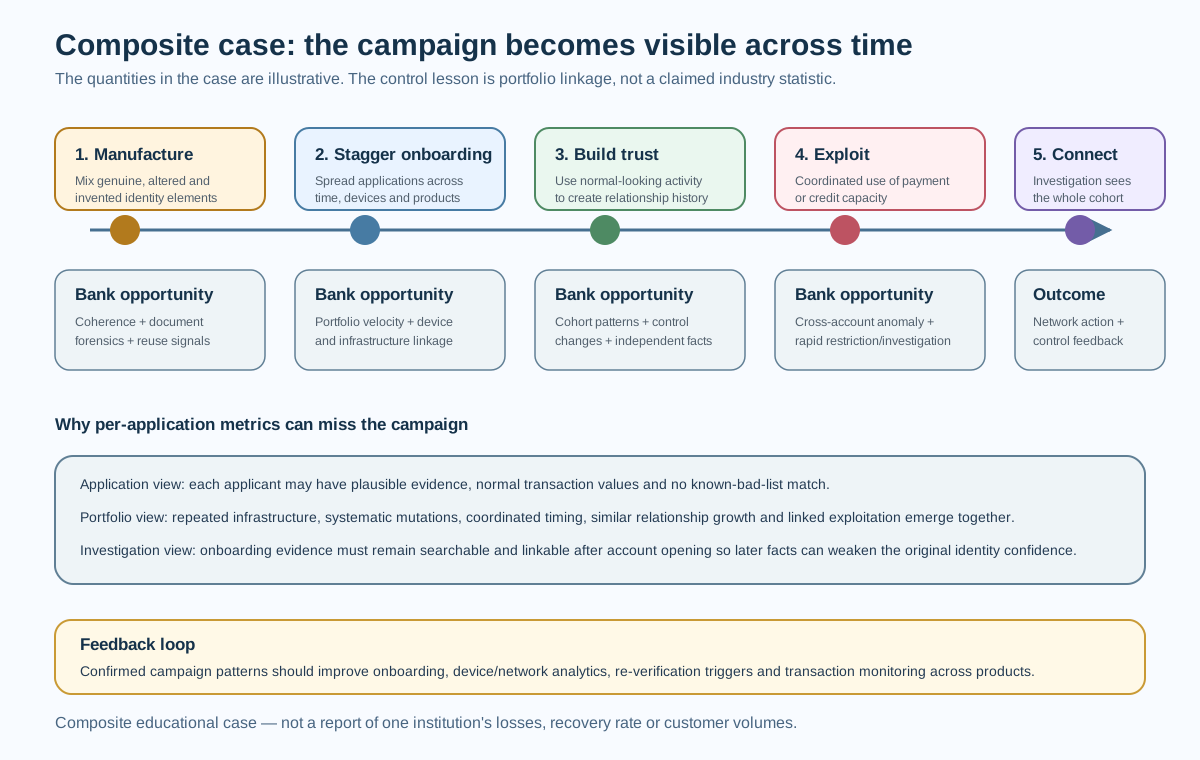
This is a composite training case assembled from recurring fraud mechanics rather than a report of one bank incident. The people, quantities, timing and losses are illustrative. The purpose is to show how a remote-onboarding control stack can look healthy application by application while a coordinated campaign becomes visible only when the bank links identity evidence, infrastructure and later account behaviour across the portfolio.
Phase 1: manufacturing plausible applicants
An organised group starts with a pool of identity elements from several sources. Some attributes are genuine, some manipulated and some invented. Addresses include locations that can receive correspondence without tying the applicant strongly to a resident. Phone numbers and email addresses are newly created. Document images are prepared to resemble supported document types. The objective is not to create a spectacular counterfeit; it is to create an identity package in which every individual field looks ordinary enough to pass a narrow check.
For some applications, real people are recruited to complete live biometric steps. They may understand the purpose or may believe they are performing a legitimate paid task. This defeats a control assumption that "a live face means a genuine customer." The liveness system can correctly establish that a real person is present while the broader identity or intended account control remains false.
Applications are spread over time, devices and products to avoid simple velocity thresholds. Some use residential networks. Others use devices that are reset or otherwise made to appear unrelated. The declared customer stories are deliberately unremarkable and internally consistent. A rules engine that checks only one application at a time sees little reason to object.
The bank's first opportunity is coherence and portfolio analysis. Are the identity attributes plausible together? Are supposedly unrelated applicants using the same device family, network infrastructure, contact patterns or document artefacts? Are application times unusually regular? Are values being mutated systematically across applications? None of these observations alone proves fabrication, but several aligned signals can justify step-up and network investigation.
Phase 2: creating a clean behavioural history
Accounts that survive onboarding are used conservatively. Credits and payments are arranged to resemble the declared profile. Credit facilities, where available, are serviced normally. The goal is to teach the bank's monitoring and product systems that these are stable customers.
This is where onboarding assurance and ongoing monitoring meet. A customer profile built from fabricated facts can generate perfectly "expected" behaviour if the attacker controls both the declared expectation and the subsequent transactions. Monitoring therefore cannot rely only on deviation from the onboarding profile. It also needs independent signals, network relationships and cohort behaviour.
The campaign gradually develops shared infrastructure outside the bank: receiving accounts, additional controlled identities, devices and value-extraction routes. Account-control changes may also appear, such as new devices, credentials or contact points. Those changes are useful re-verification triggers when combined with other risk, because the person who completed the original proofing step may no longer control the account.
Phase 3: coordinated exploitation
After the accounts have accumulated trust, the group exploits several of them within a short period. Credit or payment capacity is used aggressively and funds are dispersed through pre-arranged routes. Individual monitoring may initially describe the events as unrelated defaults or unusual transfers. The pattern becomes clear only when investigation links onboarding and transaction evidence across accounts.
Investigators find repeated infrastructure, similar document artefacts, related application timing and comparable account-development patterns. The important evidence is not one dramatic indicator. It is the alignment of multiple weak signals across a cohort.
Replaying the case as a red-team exercise
A bank can translate the case into a controlled test without creating real fraudulent identities or contaminating customer systems. In a ring-fenced environment, the test team can create approved synthetic test profiles containing known coherence defects, reused infrastructure and staged behavioural patterns. Every profile should have a documented expected outcome at each control gate.
The first test asks whether the onboarding journey recognises contradictions and reuse without overreacting to innocent similarities. A shared household address should not automatically fail two applicants, while a cluster sharing a device, contact pattern and manipulated document characteristics should create stronger concern. The second test asks whether the bank can connect applications over time rather than resetting its memory for every new session.
The third test moves beyond onboarding. Simulated accounts can follow normal-looking activity and then change devices, products or usage rapidly. The bank can measure whether re-verification, fraud and transaction-monitoring controls share enough context to recognise the emerging campaign. This is more valuable than testing onboarding in isolation because real attacks cross organisational boundaries.
Red-team governance matters. Test identities, devices and accounts should be clearly controlled, segregated from real customers and removed from analytical datasets when the exercise ends unless deliberately retained in a labelled test corpus. Findings need owners and remediation dates. A red-team report that demonstrates a bypass without changing production controls is intelligence for the next attacker rather than assurance for the bank.
What the case teaches about loss prevention
The economic lesson is not a claim that every campaign produces a particular loss or recovery rate. It is that identity-manufacturing attacks can create correlated exposure across many accounts, so the value of prevention should be assessed at portfolio level. A small improvement in detecting coordinated manufacturing may protect more value than an expensive control that marginally improves one document check but misses the network entirely.
Control investment should therefore compare the cost and customer impact of prevention with observed or scenario-based exposure using transparent assumptions. The analysis should include operational review, customer remediation, investigation and recovery costs as well as direct financial loss. Hypothetical scenarios can support planning, but they should be labelled as scenarios rather than presented as industry statistics.
Remediation after the campaign
A weak response would add a stricter document threshold to every customer. A better response closes the attack paths the investigation actually established. That may include stronger application-to-session binding, improved device or infrastructure linkage, portfolio-level reuse detection, re-verification on material account-control changes, and better data sharing between onboarding, fraud and transaction monitoring.
The bank should also review whether its metrics hid the problem. High automated approval accuracy can coexist with a growing manufacturing campaign if measurement is performed only per application. Governance should see both individual decision quality and portfolio indicators such as linked-application clusters, reuse rates, confirmed synthetic cohorts and downstream fraud by onboarding pathway.
The enduring lesson is that remote onboarding is not complete when an account is opened. The evidence created at onboarding needs to remain connected to the relationship so that later behaviour can confirm, weaken or invalidate the bank's original confidence in who the customer is and who controls the account.
Knowledge check and glossary
Use these questions to test whether the control logic is understood rather than memorised.
Is non-face-to-face onboarding automatically high risk? No. FATF's digital identity guidance makes clear that reliable, independent digital ID with appropriate assurance and risk mitigation may support standard or even lower-risk customer identification and verification. The bank still has to assess the technology, process, customer, product, geography and fraud threat and apply the law of the relevant jurisdiction.
What is the difference between validation and verification? Validation asks whether identity evidence and attributes are genuine or supported by authoritative or credible sources. Verification asks whether the applicant is the rightful person associated with that evidence. A genuine document can validate while still being presented by an impostor.
What does liveness contribute? It provides evidence that a real person is participating in the current capture or session, depending on the method used. It does not by itself prove the person's claimed identity, honesty or future control of the account. Liveness is stronger when bound to identity evidence and a protected session.
What separates a presentation attack from an injection attack? A presentation attack places an artefact such as a photograph or replay in front of a genuine capture device. An injection attack attempts to manipulate or replace the digital stream or verification result through virtual devices, instrumented applications, emulators or direct API abuse. They overlap operationally but need different defensive layers.
Why is session binding important? A valid document result, biometric result or liveness result can be dangerous if it can be replayed in another session. Binding connects the applicant, evidence, challenge and customer record so that valid artefacts cannot be reused or spliced silently.
Why do synthetic identities require portfolio analysis? Individual fields can be plausible. The stronger indicators often sit across applications: reused or systematically mutated identity elements, common devices or infrastructure, coordinated timing and similar post-onboarding behaviour. Those relationships are invisible if every application is reviewed in isolation.
How should the bank treat a thin credit or data history? As limited evidence, not as proof of fraud. Young adults, new-to-country customers and people outside mainstream data sources can have legitimate thin files. Concern should come from contradictions, fabrication indicators or corroborated network patterns rather than absence of data alone.
How does mule risk differ from impersonation risk? A mule may be a genuine person using genuine identity evidence. The risk lies in purpose, coercion, third-party control or subsequent transaction behaviour. Identity proofing can establish who opened the account without establishing how the account will later be used.
When should step-up verification trigger? When the bank can identify a material unresolved question: document authenticity, applicant presence, identity binding, conflicting attributes, compromised device integrity or suspicious network linkage. The next step should be chosen to answer that question rather than simply adding generic friction.
How should device and network intelligence influence decisions? As contextual evidence combined with other facts. VPNs, shared devices and unusual locations can have legitimate explanations. Stronger concern comes from corroborated patterns such as repeated infrastructure across fraudulent applications, automation indicators or impossible sequences.
Why does behavioural evidence need careful governance? Legitimate behaviour varies with disability, language, stress, device quality and digital familiarity. Behavioural signals can support step-up or investigation, but opaque models should not turn difference from an average user into automatic suspicion.
What makes manual review effective? Reviewers receive the reason for referral and the evidence needed to resolve it, not merely a score. Their decisions use defined evidence standards, are quality sampled, and can be reconstructed by another competent reviewer.
When might re-verification be needed? When the bank has reason to doubt existing identity evidence or account control, after relevant compromise events, on material recovery or control changes, or when law and policy require it. The trigger should determine the scope; not every expired document or data breach requires full re-onboarding.
What is the bank's responsibility when it uses a digital identity vendor? The vendor may provide evidence or assurance services, but the bank remains responsible for determining whether those services are adequate for its applicable AML/CFT, fraud, privacy and risk obligations. Vendor outsourcing does not outsource accountability.
Glossary for delivery teams
Identity resolution: collecting enough evidence and attributes to distinguish a unique real-world identity within the population relevant to the service.
Validation: confirming that identity evidence and attributes are genuine, accurate or supported by authoritative or credible sources to the required level.
Verification: confirming that the applicant is the person associated with the validated identity evidence.
Presentation attack: an attempt to fool a capture or biometric process using an artefact such as a photograph, replay or mask.
Injection attack: manipulation or substitution of the capture stream, application or API result so that the verification service receives fabricated evidence without a normal genuine capture path.
Liveness: evidence intended to establish that a real person is present in the current biometric capture or interaction; its strength depends on the method and attack resistance.
Binding: connecting identity evidence, applicant, live session and customer record so that valid artefacts cannot be replayed or combined across unrelated sessions.
Synthetic identity: a fabricated customer profile assembled from a mixture of genuine, manipulated or invented identity elements.
Manufacturing signature: repeated or systematically related elements across applications that indicate coordinated identity production or mule recruitment rather than isolated cases.
Step-up verification: a proportionate additional check selected because a specific material uncertainty remains unresolved.
Re-verification: renewed identity or account-control verification after a relevant trigger weakens the bank's previous assurance.
References and further reading
These sources were used to check the chapter's legal and technical framing. Jurisdiction-specific material is labelled deliberately; it should not be read as a universal rule.
Global AML/CFT standard and digital identity
-
Financial Action Task Force (FATF), Guidance on Digital Identity (2020): https://www.fatf-gafi.org/content/dam/fatf/documents/recommendations/Guidance-on-Digital-Identity.pdf
The main global reference used for the distinction between reliable, independent digital identity and the assumption that every non-face-to-face relationship is automatically high risk. It explains how digital identity can support customer identification, verification and ongoing due diligence under a risk-based approach. -
FATF, Digital Transformation of AML/CFT: https://www.fatf-gafi.org/en/publications/Digitaltransformation/Digital-transformation.html
Useful background on responsible use of technology, digital ID, data and privacy in AML/CFT.
European Union remote onboarding
-
European Banking Authority, Guidelines on the use of remote customer onboarding solutions. Final guidelines are in force; application date 2 October 2023: https://www.eba.europa.eu/legacy/regulation-and-policy/regulatory-activities/anti-money-laundering-and-countering-financing-4
Covers governance, assessment of remote onboarding solutions, acquisition and authenticity of documents and information, customer matching, third-party reliance, ICT and security risk within the stated EU scope. -
European Banking Authority, EBA publishes guidelines on remote customer onboarding (22 November 2022): https://www.eba.europa.eu/publications-and-media/press-releases/eba-publishes-guidelines-remote-customer-onboarding
Official summary of the risk-sensitive and technology-neutral objectives of the guidelines.
United Kingdom digital identity and the Money Laundering Regulations
- HM Treasury and Department for Science, Innovation and Technology, Using digital identities with the Money Laundering Regulations (published 26 February 2026): https://www.gov.uk/government/publications/using-digital-identities-with-the-money-laundering-regulations/using-digital-identities-with-the-money-laundering-regulations
Approved UK guidance explaining how qualifying digital verification services can support identity verification under the MLRs. The guidance expressly supplements rather than supersedes the regulated entity's MLR obligations.
Technical identity-proofing benchmark
-
National Institute of Standards and Technology, NIST SP 800-63-4: Digital Identity Guidelines (2025): https://csrc.nist.gov/pubs/sp/800/63/4/final
Current NIST digital identity suite overview. It superseded SP 800-63-3 and provides technical requirements and risk-management context for identity proofing, authentication and federation in U.S. federal digital identity systems. -
NIST, SP 800-63A-4: Digital Identity Guidelines — Identity Proofing and Enrollment (2025): https://csrc.nist.gov/pubs/sp/800/63/a/4/final
Current technical reference for identity resolution, evidence validation, identity verification, fraud controls and assurance levels. It is used here as a technical benchmark, not as a global banking AML requirement. -
NIST, online SP 800-63A-4: https://pages.nist.gov/800-63-4/sp800-63a.html
Searchable version of the current identity-proofing requirements and implementation considerations.
Australia customer identification and ongoing confidence
-
AUSTRAC, Overview of initial customer due diligence (last updated 27 March 2026): https://www.austrac.gov.au/industry-and-business/obligations-and-guidance/your-amlctf-program/customer-due-diligence/initial-customer-due-diligence/overview-initial-customer-due-diligence
Current Australian guidance on establishing identity and ML/TF risk, verifying information with independent and reliable data, and use of third-party digital identity services. -
AUSTRAC, Reviewing and updating customers' ML/TF risk and KYC information (last updated 25 March 2026): https://www.austrac.gov.au/industry-and-business/obligations-and-guidance/your-amlctf-program/customer-due-diligence/ongoing-customer-due-diligence/reviewing-and-updating-customers-mltf-risk-and-kyc-information
Useful for the chapter's distinction between risk-based updating and automatic re-verification merely because an identity document has expired. -
AUSTRAC, Data breaches and AML/CTF considerations: https://www.austrac.gov.au/industry-and-business/obligations-and-guidance/additional-guidance/data-breaches-and-amlctf-considerations
Used for the discussion of identity doubt, re-verification and ongoing customer risk after compromise events. -
AUSTRAC, Updated guidance to assist customers who don't have standard forms of identification (15 July 2025): https://www.austrac.gov.au/news-and-media/article/updated-guidance-assist-customers-who-dont-have-standard-forms-identification
Supports the inclusion principle that alternative identity pathways can be designed while maintaining appropriate ML/TF controls.