Trade-Based Money Laundering
Trade-based money laundering, usually shortened to TBML, is the misuse of trade transactions, trade documentation, goods, services, pricing, shipping routes, companies and payment flows to move, disguise or legitimise illicit value. The critical point is that the criminal objective is not necessarily to move money directly from one suspicious bank account to another. Instead, value can be transferred through the apparent purchase or sale of goods and services.
That makes TBML fundamentally different from a simple transaction-monitoring problem. A bank can see a payment that appears commercially ordinary while the underlying invoice overstates the price of goods, describes goods that were never shipped, hides the real buyer or seller, or routes value through unnecessary intermediaries. Conversely, international trade is naturally complex. Multiple currencies, freight forwarders, agents, customs brokers, financing banks, insurers and transhipment ports are normal features of legitimate commerce.
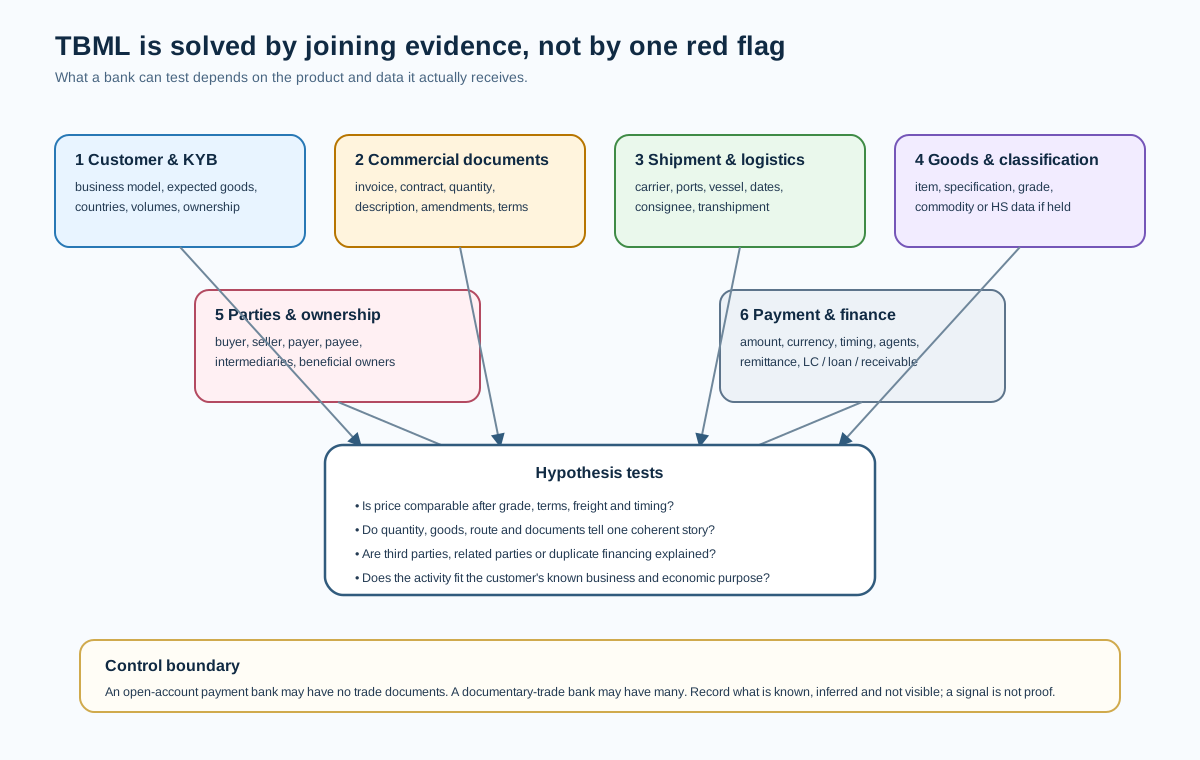
The professional question is therefore not “Is international trade suspicious?” It is: does the commercial story, documentary evidence, customer profile, goods, price, route, parties and payment flow make economic sense when considered together?
Why TBML is difficult for banks
TBML sits between financial crime, trade operations, customs, shipping, sanctions, export controls and ordinary commercial behaviour. No single party necessarily sees the whole transaction. The buyer knows why it wants the goods. The seller knows what it claims to be shipping. A freight carrier knows the route. Customs may inspect declarations. A trade-finance bank may see invoices and transport documents. A payment bank may see only the money transfer.
This fragmented visibility matters. A bank processing an open-account payment should not write as though it has verified the shipment if it has never seen the shipping documents. A bank issuing a documentary credit may have more information, but even then document checking is not the same as proving the underlying goods, price or commercial purpose are genuine.
Strong TBML control starts with an explicit statement of what the bank can and cannot observe.
The difference between trade finance and trade-related payments
Trade finance includes products such as letters of credit, documentary collections, guarantees and certain supply-chain or receivables-finance arrangements. These products often bring documentary information into the bank’s process.
Trade-related payments can also occur outside formal trade finance. A corporate customer may simply send a cross-border payment referencing an invoice. In that case, the payment bank may have little or no documentary evidence.
The risk model should reflect the product. A control requiring bill-of-lading comparison cannot be applied to a flow in which the bank never receives a bill of lading.
Over-invoicing
Over-invoicing can transfer value from buyer to seller by charging more than the goods or services are genuinely worth. If goods worth EUR 100,000 are invoiced at EUR 160,000, the additional EUR 60,000 can transfer value under a commercial label.
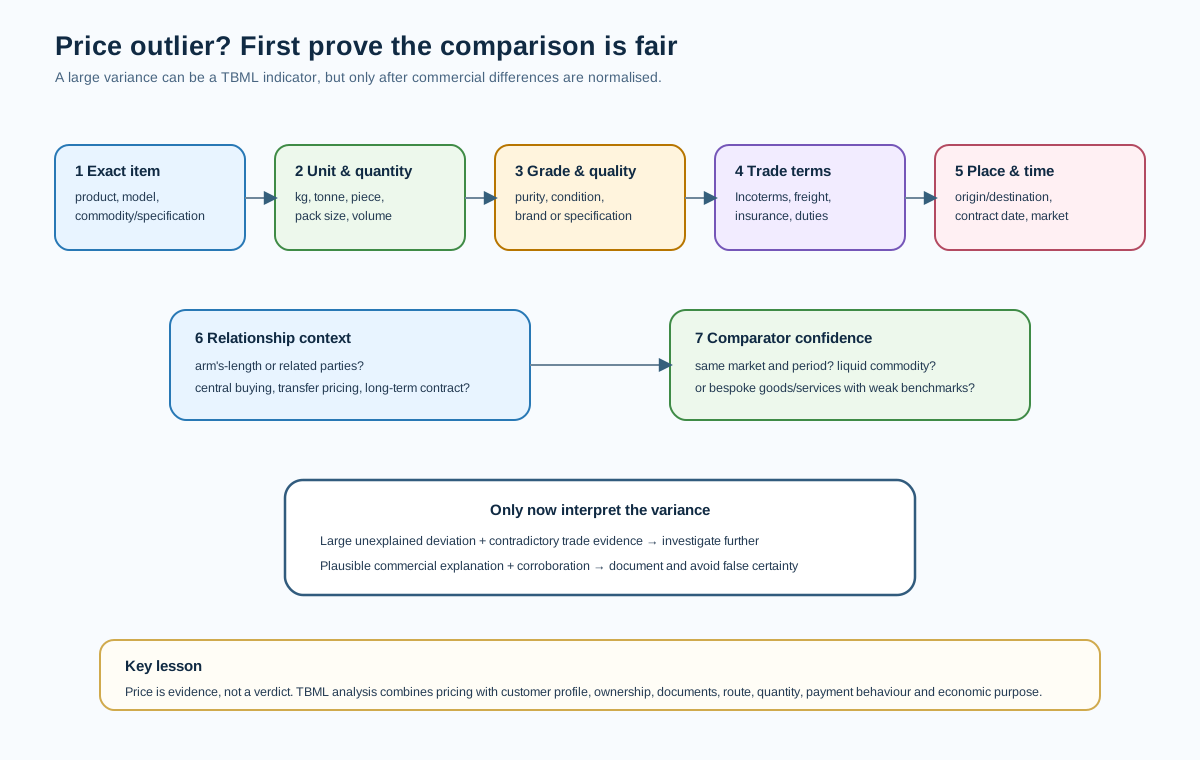
Price comparison sounds simple but is often difficult. Commodity prices vary by quality, quantity, freight terms, timing, insurance, market conditions and contractual arrangements. Bespoke machinery, software, consulting or intellectual property can be even harder to benchmark.
Banks should therefore avoid treating any price variance as proof. Stronger concern arises when price inconsistency is material, repeated, unsupported and combined with other risk factors such as opaque parties, unusual routes or customer behaviour inconsistent with the declared business.
Under-invoicing
Under-invoicing can shift value in the opposite direction. Goods may be sold below market value so that the buyer receives economic value that is not fully reflected in the payment.
A bank may not be able to detect this reliably from payment data alone. Trade-finance teams with documentary information may identify inconsistencies, but pricing expertise and external data can still be limited.
The control should be proportionate to what can reasonably be established.
Multiple invoicing
The same shipment can potentially be used to justify more than one payment or financing event. Different banks may finance or pay against copies of the same invoice without knowing that another institution has already acted on it.
Duplicate invoice numbers, identical values, repeated shipping details and recurring counterparties can be useful signals when available. However, legitimate recurring invoices or staged payments can produce similar patterns.
Cross-system and cross-bank visibility is a major limitation, so internal controls should at least ensure the institution can identify duplicate use within its own data.
Phantom shipments
A phantom shipment is one in which documentation or payment suggests goods moved when they did not. The bank may receive invoices, transport documents or customer explanations that appear plausible.
Banks are not customs authorities and cannot independently inspect every shipment. Where risk is elevated, the bank can compare available documents, route logic, counterparties, timing, financing requests and payment behaviour. Obvious contradictions can justify escalation.
The important discipline is to say “shipment not independently established” rather than “goods never existed” unless the evidence supports that stronger conclusion.
Misdescription of goods
Goods can be described inaccurately to conceal value, avoid controls, disguise sanctions exposure or mislead the bank about the nature of the transaction.
A low-risk description such as “industrial parts” may hide dual-use equipment, controlled technology or another restricted item. Trade-finance operations may need access to more detailed product descriptions, harmonised-system codes where available, export-control information and sanctions guidance.
AML and sanctions or export-control decisions should remain distinct. A goods description can create AML concern, sanctions concern, export-control concern or several at once, but the legal outcomes may differ.
Quantity manipulation
A shipment can be invoiced for more or fewer units than were actually moved. Again, the bank may have limited ability to verify physical quantity.
Where documentary evidence is available, consistency between invoice, packing list, transport document, insurance and financing amount can be checked. Repeated inconsistencies can become a customer-level signal.
Service-based trade laundering
TBML is not limited to physical goods. Services can also transfer value. Consulting, marketing, software development, licensing, management fees and professional services can be difficult to verify because there may be no physical shipment.
A bank should consider whether the customer has the capacity to provide or receive the service, whether the counterparties are related, whether fees are commercially plausible and whether repeated vague service descriptions are consistent with the business model.
A contract is evidence of an agreement; it is not automatic proof that the service was genuinely performed.
Third-party payments
Trade transactions sometimes involve payment by or to a party not named as the buyer or seller. This can be legitimate in group-company structures, agency arrangements, factoring, supply chains and treasury operations.
Unexplained third-party settlement can also obscure who is actually funding or benefiting from the trade. Banks should therefore understand the relationship among payer, buyer, seller and beneficiary.
Third-party payment is a risk factor to explain, not a conclusion.
Transhipment and routing
Goods often move through hubs and transhipment ports. Complex routing can reflect logistics, cost, free-trade zones, storage, consolidation or customs arrangements.
Risk increases when routes appear inconsistent with the goods, counterparties or commercial rationale, particularly where routing creates sanctions or export-control exposure. Banks should avoid simplistic geography rules and instead assess whether the route makes sense.
Free-trade zones
Free-trade zones can support legitimate logistics and manufacturing. They can also create opacity where customs, re-export and company-registration arrangements differ from ordinary domestic trade.
A bank should understand the customer’s use of a free-trade zone and avoid treating the zone itself as evidence of wrongdoing.
Trade finance products and risk visibility
Different products provide different evidence.
A documentary credit can expose the bank to invoices, transport documents, certificates and counterparties. A guarantee may expose the bank to contract and beneficiary information. Open-account payments may expose very little beyond the transfer.
Control design should map the available data to the risk hypothesis rather than pretend all trade products offer the same visibility.
Letters of credit
Letters of credit can support legitimate international trade by giving the seller assurance of payment against compliant documents. They can also be misused if documents are false, prices are manipulated or parties are concealed.
Document examination under trade rules is not equivalent to an AML investigation. A document may comply with the terms of the credit yet still raise financial-crime concerns.
Trade operations and financial-crime teams therefore need clear escalation paths.
Documentary collections
In documentary collections, banks handle documents but usually take a different level of payment risk than under letters of credit. The AML visibility still depends on what documents and party information are available.
Guarantees and standby instruments
Guarantees and standby letters can be legitimate risk-management tools. They can also be used in transactions with unclear commercial purpose or related parties.
Banks should understand underlying purpose, applicant, beneficiary, jurisdictions and unusually complex structures.
Supply-chain finance
Supply-chain finance and receivables financing can involve buyers, suppliers, invoices, financiers and platforms. Fraudulent or duplicated invoices can create both credit and financial-crime risks.
The bank should connect invoice identity, supplier identity, buyer confirmation and payment settlement where the product model permits.
Customer profile is central
A bank cannot assess trade plausibility without understanding the customer’s business. A textile importer should have expected goods, suppliers, countries and payment patterns that differ from a software firm.
KYB should capture products, markets, supply-chain structure, expected trade volumes, common counterparties and relevant geographies where proportionate.
A vague profile such as “general trading” weakens every later control.
Counterparty analysis
Trade counterparties can include manufacturers, distributors, agents, freight companies, brokers and related entities. Investigators should understand ownership and relationship where risk warrants it.
A buyer and seller under common beneficial ownership can be legitimate in a corporate group, but the relationship changes the economic interpretation of the transaction.
Beneficial ownership
Corporate opacity can make TBML difficult to interpret. An apparently independent supplier may actually be controlled by the buyer. An intermediary may be connected to a sanctioned person or public official.
Effective-dated beneficial-ownership data is valuable because ownership can change over time.
Invoice credibility
An invoice provides information about seller, buyer, goods or services, amount, currency, date and terms. It should be treated as one piece of evidence.
Useful checks can include consistency with customer profile, prior invoices, counterparties, goods description, value, financing amount and payment timing.
The bank should avoid the weak closure rationale “invoice provided” when the invoice does not resolve the risk question.
Transport documents
Bills of lading, airway bills and other transport documents can provide information about shipper, consignee, ports, vessel or carrier, dates and goods.
Documentary data should be interpreted carefully. Amendments, transhipments and legitimate routing changes are common. Apparent mismatch does not automatically mean fraud or laundering.
Vessel and port information
Trade involving maritime transport can intersect with sanctions and proliferation risk. Vessel identity, ownership, flag, port calls and routing can matter.
Banks should use reliable sources and avoid treating commercial vessel-risk scores as legal conclusions. A sanctions match or deceptive-shipping indicator requires investigation under the applicable legal framework.
Pricing data
External price data can help identify extreme anomalies, but it has limitations. The bank should understand whether the benchmark reflects comparable goods, grade, quantity, incoterms, freight, insurance and date.
A statistical outlier can prioritise review. It does not prove manipulation.
Benchmarks must compare like with like before any outlier earns attention — then the outlier prioritises, never proves.
Trade corridors
High-risk corridors may reflect predicate-crime exposure, sanctions evasion, corruption, smuggling or weak controls. But country risk should not replace transaction analysis.
A corridor can be commercially normal for a particular industry. The bank should understand customer-specific rationale.
Circular trade
Circular trade can occur where goods or invoices move through related parties and value returns to the original economic group. Legitimate commodity, distribution or tax structures can also create circularity.
The bank should identify common ownership and test economic purpose before concluding that circularity is suspicious.
Back-to-back transactions
Back-to-back buying and selling can be normal for intermediaries and traders. Concern increases when margins, parties or routes lack commercial explanation or appear designed only to move value.
Trade and sanctions
Sanctions screening in trade extends beyond customer names. Vessels, ports, goods, ownership, end users, intermediaries and jurisdictions can all matter depending on the applicable regime.
The AML investigation should not collapse sanctions analysis into a generic high-risk score. Legal prohibitions can require specific outcomes.
Trade and proliferation financing
Proliferation financing can involve procurement networks, front companies, transhipment, dual-use goods, deceptive shipping, brokers and payments that appear commercially normal.
Trade-finance institutions may have important visibility into goods and routes, but they are not expected to become weapons experts. Escalation to specialist sanctions, export-control or proliferation teams is essential where relevant.
Payment-message data
Payments can include originator, beneficiary, intermediary, remittance and purpose data. Structured ISO 20022 fields can improve traceability if preserved.
A trade payment should be linkable to the customer instruction, invoice or trade-finance object where possible. Fragmented identifiers make investigation slower and weaker.
Payment repair
If a trade payment is repaired, the bank should preserve original and amended party data, user, reason and timestamp. Changes to beneficiary or address data can affect screening and later reconstruction.
Transaction monitoring
TBML monitoring can use transaction patterns, counterparty changes, corridor risk, third-party payments, round values, unusual payment descriptions, pass-through behaviour and deviations from expected business.
However, pure payment monitoring cannot detect every invoice or goods manipulation. Control claims should match data reality.
Document analytics
Optical character recognition, document extraction and machine learning can help compare invoice fields, identify duplicates and detect anomalies. They also create data-quality and model-governance risks.
Extracted values should retain provenance and confidence. Investigators should be able to see the original document where needed.
Scenario: over-invoicing concern
A customer normally imports industrial components at stable prices. A new supplier invoices similar goods at roughly three times the historic unit value. The route, quantity and customer explanation do not explain the difference.
The bank should not conclude over-invoicing from price alone. It should compare specifications, freight terms, supplier relationship, market data and payment structure. If inconsistencies remain, escalation may be appropriate.
Scenario: legitimate intermediary
A trading company buys goods from one country and sells them to another without ever taking physical possession. Payments pass through quickly and margins are small.
This can resemble layering or TBML. The customer’s documented business model, contracts, ownership, counterparties and historic behaviour may provide a coherent explanation.
Scenario: third-party payer
An importer’s invoice is settled by another company in the same corporate group. The payer relationship is documented and consistent with centralised treasury arrangements.
Third-party payment is therefore explainable. Monitoring should avoid repeatedly treating the same known relationship as unexplained.
Scenario: suspicious service fees
A small manufacturer begins paying large “consultancy fees” to newly incorporated offshore companies unrelated to its supply chain. Services are described vaguely and no credible business rationale is provided.
The bank can investigate economic substance, beneficial ownership, contracts and payment history without claiming the services are fictitious unless evidence supports that conclusion.
Case narrative quality
A strong TBML case describes what the bank actually observed. It identifies the customer business, parties, goods or services, documents reviewed, payment flow, ownership, anomalies, explanations and unresolved questions.
Avoid generic phrases such as “trade red flags present.” Explain the red flags.
Business analyst view
A BA should model trade objects separately: customer, trade transaction, invoice, shipment, goods, counterparty, vessel, payment, financing object, screening event, alert and case.
Requirements should preserve relationships among these objects. If an invoice can be linked only by free text, duplicate detection and investigation become harder.
The BA should also define what happens when data is unavailable. Can a payment proceed if goods classification is missing? Does the trade-finance product require manual review? Which decisions belong to trade operations, AML, sanctions or export-control specialists?
Data lineage
Trade systems frequently transform or re-key data. Goods descriptions can be shortened, names transliterated and documents scanned. Data lineage should show original source, transformations and final values used by controls.
Quality assurance
QA should test whether investigators distinguish document presence from document credibility, whether they overstate what the bank verified, and whether closures explain economic rationale rather than merely list documents.
Common mistakes
The most common mistake is equating international trade with high risk. Another is assuming that an invoice proves legitimacy. Banks also overstate their visibility when a payment bank has no access to underlying trade documents.
A further mistake is treating a price anomaly as proof without considering specifications, freight and market context.
Learning checkpoint
A reader should be able to explain TBML as value transfer through trade rather than just suspicious payments, distinguish trade-finance visibility from open-account payments, identify over-invoicing, under-invoicing, multiple invoicing and phantom-shipment risks, and describe how documents, ownership, goods, routes and payment data combine in a defensible investigation.
Reference links
- FATF — Trade Based Money Laundering: https://www.fatf-gafi.org/en/publications/Methodsandtrends/Trade-basedmoneylaundering.html
- FATF and Egmont Group — Trade-Based Money Laundering: Trends and Developments: https://www.fatf-gafi.org/en/publications/Methodsandtrends/Trade-based-money-laundering-trends-and-developments.html
- FATF — The FATF Recommendations: https://www.fatf-gafi.org/en/publications/Fatfrecommendations/Fatf-recommendations.html
- Wolfsberg Group — Trade Finance Principles: https://wolfsberg-group.org/resources
Educational note: customs, export-control, sanctions, trade-document and suspicious-reporting obligations vary by jurisdiction and product. The chapter explains bank-practical control principles, not legal advice.
Deep dive: how a bank sees trade risk end to end
A trade transaction can touch relationship management, KYC, trade operations, sanctions screening, credit, payments, correspondent banking, treasury, document processing and AML investigations. A strong curriculum therefore needs to teach the hand-offs between those functions rather than present TBML as a list of invoice red flags.
Customer onboarding and expected trade profile
For a trading customer, onboarding should establish more than an industry code. The bank should understand the goods or services traded, major markets, expected buyers and suppliers, typical currencies, payment terms, use of agents, trade-finance products and expected volumes. That profile becomes the baseline against which later transactions are interpreted.
A customer importing agricultural commodities from three long-standing suppliers should not be analysed in the same way as a newly formed intermediary trading dual-use electronics through several jurisdictions. The risk model should reflect the actual business.
Product-specific visibility
A letter of credit can place invoice, transport and insurance documents in front of the bank. A documentary collection may provide a different set of documents. A guarantee may expose the underlying contract and beneficiary. Open-account payments may provide only remittance text and party data.
This difference should be visible in the control framework. The same red flag cannot be implemented identically across every product.
Trade-operation review versus AML investigation
Trade operations often review documents for compliance with product terms. AML investigation asks a different question: does the transaction make economic sense and is there evidence of misuse?
A document can be technically compliant yet still contribute to a suspicious pattern. Conversely, a documentary discrepancy can be a clerical issue with no financial-crime significance.
The bank needs a controlled escalation path rather than forcing trade staff to make AML conclusions outside their role.
Document consistency
Where documents are available, useful comparisons include buyer and seller names, goods description, quantity, amount, dates, shipment ports, vessel or carrier, currency, payment terms and financing amount.
The objective is to identify contradictions that matter. Minor formatting differences, abbreviations or expected documentary variations should not create unnecessary alerts.
Duplicate-document logic
Duplicate invoices can arise legitimately through amendments, partial financing, repeated orders or resubmission. Detection should therefore compare invoice number, issuer, buyer, amount, date and linked trade object, and should distinguish exact duplicate, near duplicate and related document.
A duplicate signal should create an investigation question, not an automatic fraud conclusion.
Goods classification
Where the bank receives product descriptions or commodity codes, classification can help sanctions and export-control review. Descriptions such as “parts,” “equipment” or “electronics” may be too vague for meaningful risk assessment.
The bank should avoid inventing classifications that are not supported by customer or trade documentation. If a goods code is missing, a specialist may need to request clarification.
Dual-use and controlled goods
Some goods and technologies can have both civilian and military applications. Financial institutions do not replace export-control authorities, but trade and sanctions controls should have a route for identifying potentially restricted goods, end users or destinations.
This is a specialist control question, not a generic AML scoring problem.
End-user and end-use risk
A transaction may involve a permitted buyer but a concerning end user or end use. Where the bank has relevant information, screening and due diligence should capture it. Where the bank does not have that information, the institution should not imply it verified it.
Incoterms and commercial terms
Pricing should be interpreted alongside freight and insurance responsibilities. Two invoices for similar goods can differ materially because one price includes transport, insurance or other costs.
Analysts do not need to become trade-law specialists, but they should know enough to avoid calling a normal commercial difference “over-invoicing.”
Shipping-route reconstruction
For maritime trade, route analysis can compare loading port, transhipment points, destination, vessel and timing. A complex route can be commercially normal because of shipping schedules or hub economics.
Risk strengthens when routing is inconsistent with customer explanation, goods, destination or sanctions exposure and no credible rationale emerges.
Vessel information
Vessel name alone may be insufficient because names can change. Where available and relevant, persistent identifiers such as IMO numbers can improve matching. Screening tools should preserve the distinction between a vessel name match and a confirmed vessel identity.
Free-trade-zone activity
Free-trade zones can support storage, assembly, re-export and logistics. They can also create additional intermediaries. The bank should understand the customer’s role in the zone and whether activity matches that role.
Related-party trade
Transactions between related companies can be entirely legitimate. Related-party status changes how price, margin and third-party independence should be interpreted.
Ownership data should therefore be available to trade investigations.
Transfer pricing versus laundering
Multinational groups can price intercompany transactions for tax, accounting and commercial reasons. Banks should not treat any related-party price difference as laundering. Where criminal tax evasion or sham activity is suspected, the issue should be handled under the appropriate legal and financial-crime framework.
Trade finance and correspondent banks
Cross-border trade payments may pass through correspondent institutions. Each bank may see a different part of the chain. Payment transparency and preservation of originator, beneficiary and intermediary data help later investigation.
A correspondent bank often does not hold the underlying commercial documents. Its control design should reflect that limitation.
ISO 20022 and trade payments
Structured payment data can preserve party names, addresses, ultimate parties and remittance information. Rich data helps only if upstream systems populate it and downstream systems retain it.
A migration that truncates remittance or party fields can weaken trade investigations even if the new message format is technically richer.
UETR and transaction linkage
For relevant cross-border payments, UETR can support payment traceability. It should be linked with internal channel, trade, booking and case identifiers.
UETR is not a universal identifier for every payment rail, so requirements should remain scheme-specific.
Payment repair
Trade payments often require repair when data is incomplete or invalid. If a beneficiary name, account, address or remittance field changes, the original and amended values should be preserved with user, reason and timestamp.
Controls should define when re-screening is required.
Open-account trade monitoring
For customers not using trade-finance products, monitoring may rely on payment and customer data. Useful patterns include new or unusual suppliers, unexplained third-party payment, sudden corridor changes, round-value flows, repeated vague descriptions and activity outside expected business.
The bank should not claim that these scenarios “detect TBML” in a complete sense. They detect behaviour that may warrant investigation.
Trade-finance monitoring
Trade-finance products can support more specific scenarios such as document reuse, price anomalies, inconsistent shipment information, unusual amendments, suspicious counterparties and repeated discrepancies.
Alert design should reflect operational capacity and data quality.
Alert payload
A TBML alert should give the investigator enough context to avoid searching across several systems. Useful fields include customer profile, trade product, invoice, counterparties, ownership, goods, route, payments, prior alerts and document links.
Investigation chronology
A strong case begins with timeline: when was the customer onboarded, when was the trade agreed, when were documents issued, when did goods move, when did payment occur, when were amendments made and when did the bank receive new information?
Chronology can reveal whether documentation was created after the fact or whether payment and shipment timing are commercially plausible.
Economic-substance questions
Who is providing value to whom? What does each intermediary contribute? Why is the payment routed this way? Is the margin plausible? Does the customer have capability to perform the claimed service or trade?
These questions often reveal more than a checklist of generic red flags.
Customer explanations
A customer explanation should be recorded as a statement and, where appropriate, corroborated. A plausible explanation can resolve concern. A changing or contradictory explanation can increase it.
Adverse media
Adverse media about smuggling, sanctions evasion, corruption or trade fraud can alter risk, but source quality and identity match matter. The bank should not treat an allegation as a conviction.
Sanctions and AML interaction
A trade case may contain both AML and sanctions issues. Sanctions specialists may need to determine whether a legal prohibition applies. AML investigators may assess suspicious value movement. The same facts can feed both without collapsing the decisions.
Proliferation financing
Procurement networks can use front companies, intermediaries, transhipment and dual-use goods. Banks should know when to escalate to specialist proliferation or export-control expertise.
Fraud and trade
Trade fraud, invoice fraud and duplicate financing can create losses and criminal proceeds. Fraud teams and AML teams should exchange relevant information where permitted.
Credit risk interaction
A fraudulent invoice can be both a credit problem and a financial-crime problem. Product teams should avoid assuming that a credit loss automatically proves laundering or that a good credit performance proves legitimacy.
Data-quality dependencies
Entity resolution, invoice identifiers, goods descriptions, customer profiles, route data and ownership information all affect control performance. Data-quality issues should be logged as control weaknesses, not merely operational inconveniences.
Model governance
If machine learning or document analytics prioritises trade cases, governance should cover training data, feature meaning, validation, false positives, drift and explainability. A model score should be an investigative input.
Operational capacity
Trade alerts can be document-heavy. A model that generates more cases than skilled analysts can review can reduce effectiveness. Capacity, queue ageing and expertise are therefore control considerations.
Quality assurance
QA should examine whether analysts understood trade context, whether document discrepancies were meaningful, whether pricing comparisons were comparable, whether sanctions and AML conclusions were separated, and whether closures were evidence-based.
Regulatory examination readiness
The bank should be able to show risk assessment, customer segmentation, scenario rationale, data lineage, alert outcomes, tuning, QA and remediation. A list of red flags is not a control framework.
Final deep-dive exercise
Take one customer importing industrial machinery through an intermediary. Build the complete customer profile, ownership map, invoice comparison, route, payment lineage and evidence matrix. Then write two conclusions: one in which the commercial explanation is credible, and one in which significant inconsistencies remain. The exercise demonstrates that the same surface pattern can lead to different outcomes depending on evidence.
Advanced practice: TBML controls when the bank never sees the whole trade
Trade-based money-laundering investigations become more realistic when learners stop assuming that every bank receives the same commercial evidence. A documentary-credit bank, an open-account payment bank, a supply-chain-finance provider and a correspondent bank can all support the same trade while seeing very different information. Control design should begin by identifying the institution's actual evidence.
Case 1: open-account payment with generic remittance text
A long-standing importer sends a large payment to a new supplier. The payment instruction contains the supplier name, account, amount, currency and a short invoice reference, but no invoice document is provided to the bank.
The bank cannot verify quantity, shipping route or goods description from the payment alone. It can still compare the supplier country, value, frequency, customer business, historic counterparties and any beneficial-ownership links. If risk warrants, investigators can request supporting information under policy.
The key lesson is that an open-account monitoring rule should not claim to have validated documents that never entered the bank.
Case 2: documentary credit with a price concern
A bank receives an invoice and transport documents under a letter of credit. Price analytics indicate that the unit price is materially above a market benchmark.
That result should trigger analysis, not a conclusion. Commodity grade, volume, delivery terms, freight, insurance, contract timing and market conditions can explain variation. For bespoke goods, a benchmark may be unreliable.
The investigator should combine price variance with customer profile, counterparty relationship, route, ownership and whether the documents themselves contain inconsistencies. A statistical outlier is useful prioritisation evidence; it is not proof of over-invoicing.
Case 3: service invoice
A technology company pays an overseas consultancy for strategic services. There is no shipment or customs record. The contract is genuine, but the service description is broad.
Service-based value transfer can be difficult to assess because deliverables may be intangible. The bank can examine whether the customer and provider have capacity to perform the service, whether they are related parties, whether fees are commercially plausible, whether payments follow contractual milestones and whether other evidence supports delivery.
The bank should not pretend it can independently certify consulting work. The objective is to understand whether the commercial explanation is credible.
Case 4: third-party settlement
Buyer A purchases goods from Seller B, but payment is made by Company C to Company D. This can be legitimate in factoring, group treasury, platform settlement or agency arrangements.
The investigation should identify each party's role and beneficial ownership. If the third-party arrangement is expected and documented, it may be normal. If payer and payee are unrelated to the trade and the customer cannot explain them, the pattern can support a TBML or underground-settlement concern.
Case 5: possible duplicate financing
An invoice is presented for financing and internal systems identify a very similar invoice used previously. The bank can compare invoice number, date, seller, buyer, value, goods and shipping reference.
Even a strong internal match does not prove that the invoice has been financed at another institution. Conversely, no internal match does not prove uniqueness across the market. Control documentation should be explicit about that coverage limitation.
Beneficial ownership changes the interpretation of trade
A transaction described as arm's-length trade can look different when buyer and seller are under common control. Related parties can trade legitimately, but hidden common ownership can affect pricing, economic purpose and risk.
TBML investigations should therefore be able to retrieve effective-dated beneficial ownership for both customers and significant counterparties where the bank has reliable data. Current ownership alone may misrepresent an older transaction.
Shipping routes and transhipment
Complex routes, free-trade zones and transhipment hubs are common in global commerce. Route complexity should be assessed against the goods, commercial model and logistics rather than treated as suspicious by itself.
Concern grows where routing is economically implausible, documentation conflicts, ownership changes unexpectedly, or credible sanctions, smuggling or proliferation indicators exist.
AML, sanctions and proliferation-financing handoff
Trade controls often discover issues relevant to several disciplines. A payment can raise AML concern because the economic purpose is unclear; sanctions concern because a party or route is restricted; export-control concern because goods require authorisation; or proliferation-financing concern because the trade supports a prohibited WMD-related network.
The institution should share facts while preserving distinct legal decisions. A sanctions match does not prove TBML, and an unusual invoice does not prove sanctions evasion.
ISO 20022 and trade-data limits
Structured payment messages can improve debtor, creditor, agent and remittance data. They do not normally contain the full invoice, transport record, ownership chain or physical evidence needed for a TBML conclusion.
A strong architecture links payment data to trade-finance or invoice platforms where available, customer/KYB records, beneficial ownership and case management. The value comes from joining evidence with preserved lineage, not from assuming an ISO 20022 field can identify trade laundering by itself.
Investigation-writing standard
A strong TBML case states which product the bank provided, which trade documents or data it actually saw, the customer and counterparty business model, ownership relationships, the specific pricing/quantity/route/payment inconsistency, the customer's explanation and the evidence that leaves the concern unresolved.
That level of precision prevents both overclaiming and under-investigation and makes the case useful to operations, compliance, auditors and FIUs.
Practitioner close: TBML, documentary visibility and decision discipline
Trade-based money laundering is difficult because legitimate trade naturally contains complex pricing, intermediaries, shipping routes, credit terms and third-party service providers. A bank should therefore avoid treating every price difference or unusual route as proof of TBML. The central question is whether the trade and payment story is economically coherent given the information the bank actually holds.
Open-account trade versus documentary trade
A trade-finance bank handling a letter of credit may see invoices, transport documents, goods descriptions and counterparties. A bank processing an open-account payment may see little more than payer, payee, amount and narrative. The control framework should distinguish those visibility levels.
It is inaccurate to say that every payment bank verifies shipment, price or goods. Where data is absent, the bank can use customer profile, counterparty behaviour, corridor and payment patterns, and request additional information when risk justifies it.
Price anomalies need context
Over- and under-invoicing are classic TBML methods, but market prices can vary because of quality, volume, delivery terms, insurance, seasonality and bespoke specifications. A price outside a benchmark range is therefore a reason for review rather than an automatic suspicious conclusion.
Investigators should understand the comparison source, product specificity and commercial terms before describing a price anomaly as evidence of laundering.
Service invoices and intangible trade
Services can be harder to validate because there may be no shipment or customs trail. Consulting, licensing, software, intellectual property and management fees can all be legitimate. Concern can arise when large service payments involve opaque related parties, lack credible economic purpose or are inconsistent with the customer’s business.
Documents should be considered with ownership, counterparties, timing and actual commercial rationale rather than accepted at face value.
Third-party settlement
A buyer paying a supplier through an unrelated third party can have legitimate explanations, including group treasury or financing arrangements. Repeated unexplained third-party settlement, especially across opaque entities and jurisdictions, can also support a TBML hypothesis.
The investigation should identify the relationship among payer, buyer, seller and beneficiary and determine whether the settlement structure is commercially plausible.
Final practitioner checkpoint
A strong learner distinguishes what the bank observes from what it assumes, treats price and routing anomalies as indicators rather than proof, understands the difference between open-account and documentary visibility, investigates third-party settlement and service trade carefully, and writes a TBML conclusion that is proportional to the evidence.
Practitioner masterclass: reconstructing value through trade
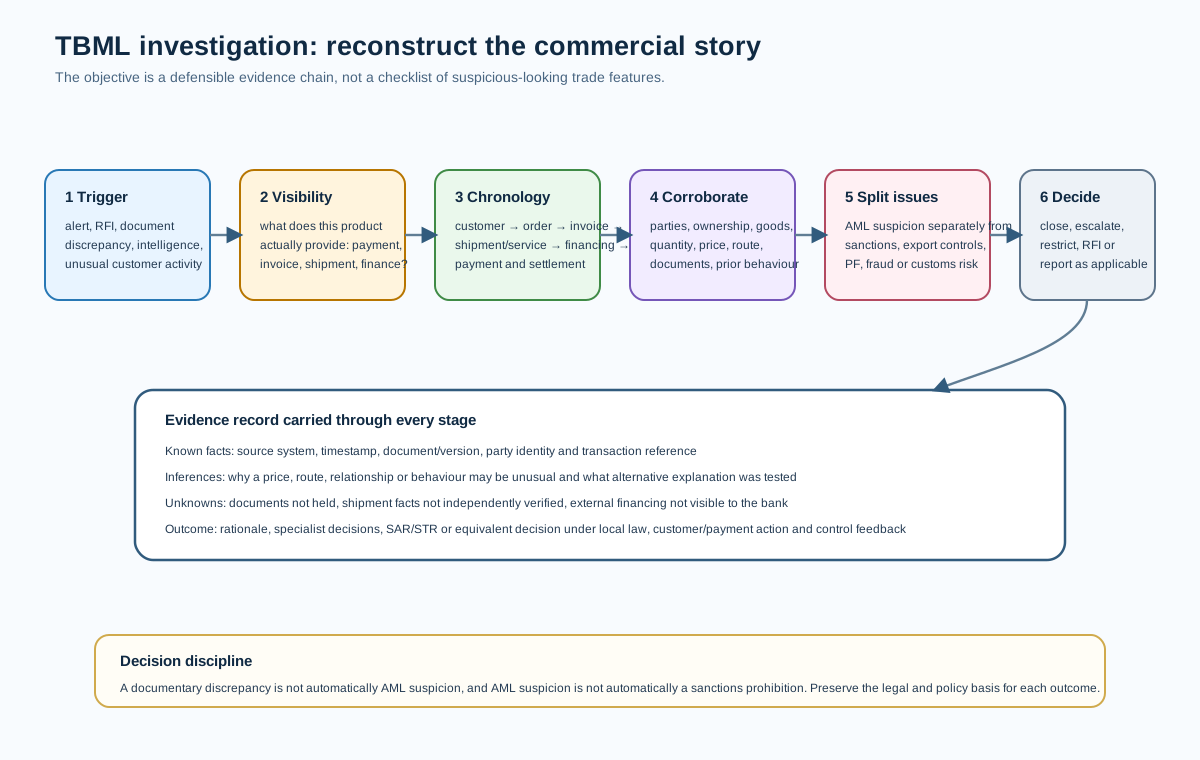
Trade-based money-laundering analysis becomes useful when the investigator stops treating the invoice, payment and shipment as separate artefacts and instead reconstructs one commercial story. The customer says goods or services were bought or sold. The bank should ask whether the parties, ownership, price, quantity, route, financing, timing and payment behaviour support that story.
Start with the economic purpose
Before looking for red flags, establish what the customer says the transaction is for. What is being sold? Who is buyer and seller? Why are intermediaries involved? Which country supplies the goods and which country receives them? Who pays whom? Which party ultimately benefits?
Without that baseline, ordinary complexity can look suspicious.
Build an evidence matrix
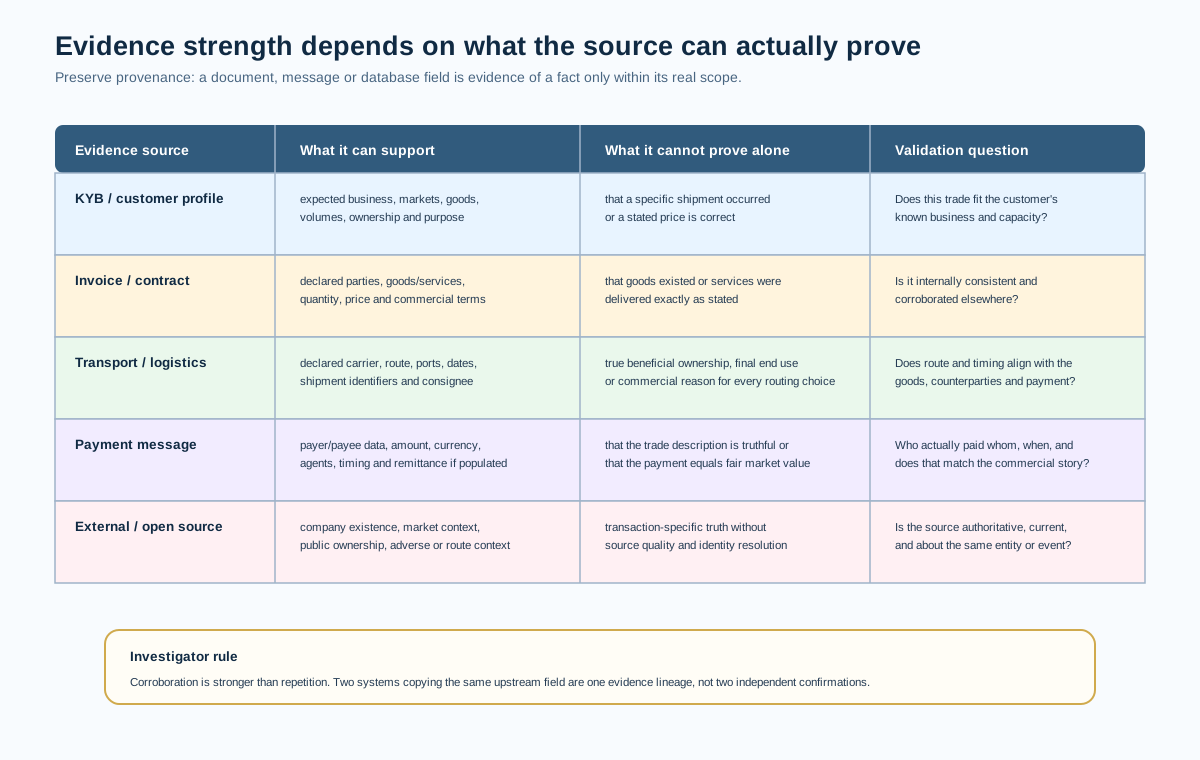
Create columns for customer profile, invoice, transport evidence, counterparties, beneficial ownership, payment data, goods description, route and external intelligence. Mark each point as verified, customer-provided, inferred or unavailable.
This prevents one document from dominating the decision.
Pricing exercise
A customer imports machine components for EUR 500 each and suddenly pays EUR 1,500 each to a new supplier. Before calling this over-invoicing, compare model, specification, quantity, freight terms, insurance, delivery terms and market timing.
If those factors do not explain the difference, the anomaly becomes stronger. The investigation should describe the unsupported variance rather than state that the goods were over-invoiced as a fact.
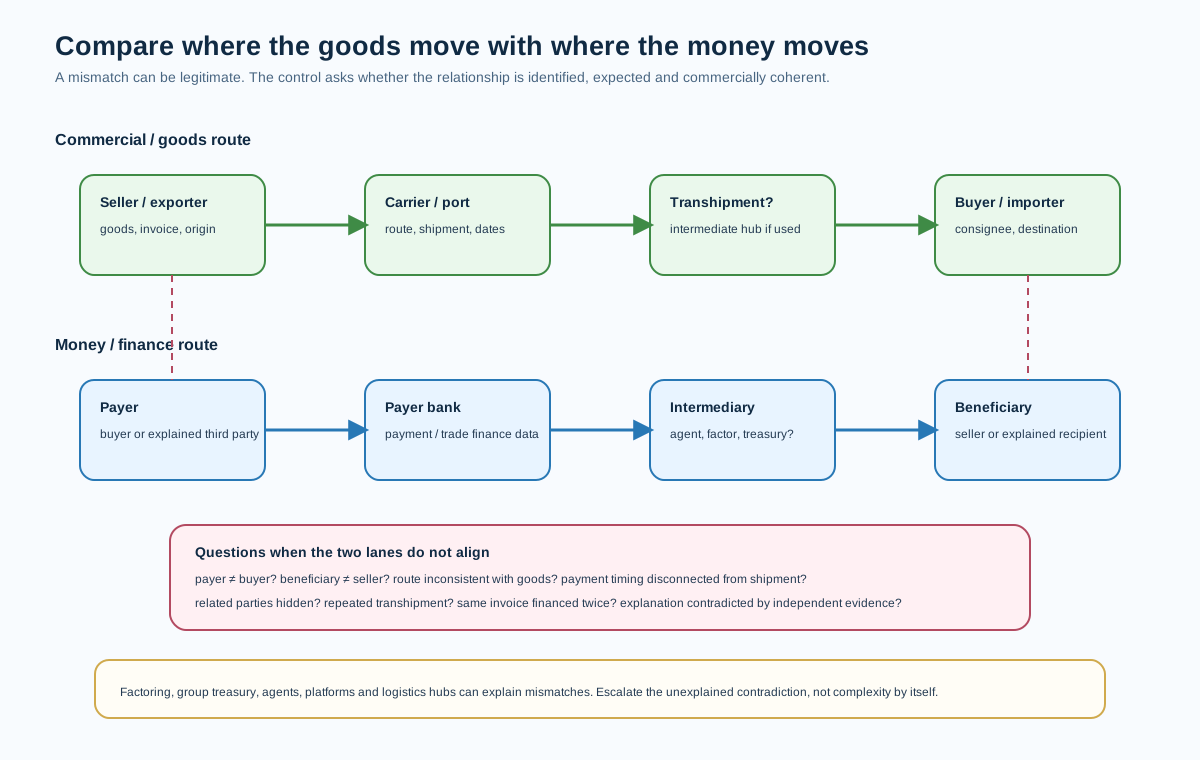
Service-trade exercise
A consulting company pays EUR 400,000 for “strategic advisory services” to an offshore entity. There is a contract, but the service description is generic and the recipient has no obvious staff or capability.
The bank can examine ownership, contract timing, payment history, customer activity and business rationale. A contract proves an agreement was documented; it does not prove economic substance.
Third-party settlement exercise
Buyer A imports goods from Seller B, but Group Treasury C settles the invoice. The bank should determine whether C is a documented treasury entity and whether the arrangement is consistent with historical behaviour.
A known group settlement should not repeatedly be treated as unexplained third-party payment.
Multiple-invoice exercise
Two financing applications use invoices with the same seller, buyer, amount and invoice number but different dates. The bank should determine whether this reflects an amendment, duplicate submission, staged financing or attempted double financing.
System design should help identify duplicates without assuming every repeated invoice is fraudulent.
Phantom-shipment discipline
If transport evidence cannot be corroborated, the correct wording may be “shipment not independently established” rather than “shipment did not occur.” This distinction is important in regulated case writing.
Trade route analysis
Map origin, transhipment, destination and payment route separately. Goods and money do not always travel through the same countries. That mismatch can be legitimate.
Risk becomes more meaningful when routing has no commercial explanation, creates sanctions or export-control exposure, or repeatedly involves unrelated intermediaries.
Connected ownership
If buyer, seller and intermediary share beneficial owners, the economic interpretation changes. The structure may still be legitimate, but apparent third-party trade can actually be related-party value movement.
Ownership should be effective-dated because historical transactions may predate current ownership.
Documentary-credit case
A letter of credit contains compliant documents but unusual pricing and a recently incorporated supplier. Trade-document compliance is not the same as AML clearance. The transaction can satisfy documentary rules while still requiring financial-crime review.
Open-account limitation
An open-account payment team may see only payer, beneficiary, amount and remittance text. Do not design controls that require documents the bank never receives. Instead use customer profile, counterparties, payment behaviour and risk-based requests for information.
Sanctions and export-control handoff
If goods, vessel, port, ownership or end-user information indicates possible restrictions, hand off to the appropriate specialist control. AML should not make a legal sanctions determination from a generic risk score.
BA delivery exercise
Define entities for trade case, invoice, shipment, goods, counterparty, payment, screening event and investigation. Then define the keys that join them. Add cases for invoice amendment, payment repair, split shipment, partial payment, multiple currencies and a shipment with no formal trade-finance product.
Audit test
Pick ten closed TBML cases. Ask whether investigators stated what the bank actually knew, whether document presence was confused with verification, whether price comparisons were comparable, and whether ownership or route questions were answered.
Final practitioner test
A strong learner should be able to reconstruct the commercial story, distinguish trade complexity from unexplained value movement, explain what the bank can and cannot observe, and document conclusions without overstating the evidence.
60-minute mastery extension: trade-based money laundering
This extension is designed to make the chapter a minimum 60-minute guided learning experience. Spend around 25 minutes on the core lesson and diagrams, 15 minutes reconstructing a trade case, 10 minutes on evidence and pricing analysis and 10 minutes on the final TBML test.
Trade-based laundering is about value disguised through commerce
Trade-based money laundering can use legitimate-looking trade structures to move or disguise value. Common teaching examples include over-invoicing, under-invoicing, multiple invoicing, over- or under-shipment and false description of goods or services. Those are useful concepts, but a bank should not treat an unusual invoice or route as proof of TBML. Prices vary for legitimate reasons, goods specifications differ, freight and insurance matter, and supply chains can be complex.
The analyst's task is to reconstruct the commercial story and identify where the evidence does not support it.
Worked case: pricing anomaly
A customer historically imports machine components at approximately EUR 500 per unit. A new supplier charges EUR 1,450 per unit. Before describing this as over-invoicing, the bank should compare model, specification, quantity, Incoterms, freight, insurance, commodity or input-price movement, warranty and market timing. If the products are not comparable, the apparent price gap may be meaningless.
If comparable goods are repeatedly priced far above credible market ranges and the supplier is related to the buyer through common ownership, the anomaly becomes stronger. The case should document the comparison methodology rather than simply state "over-invoicing detected."
Multiple invoicing and duplicate financing
The same invoice can appear in several financing requests because of amendment, staged shipment, administrative duplication or attempted double financing. Controls should compare invoice number, parties, amount, dates, goods, purchase order, shipment and prior financing records. A duplicate indicator should route the item for review; it should not silently create a fraud or laundering conclusion.
Goods route versus money route
Goods and money do not always move through the same countries. A buyer in one jurisdiction can pay a treasury centre in another for goods shipped from a third country to a fourth. That structure can be legitimate in multinational groups. Risk increases when routing is inconsistent with the business model, counterparties have no clear role, ownership links are hidden or the arrangement creates sanctions/export-control concerns.
Investigators should map physical goods, contractual parties, financial settlement and beneficial ownership as separate layers.
Services and intangible trade
TBML is not limited to physical goods. Consulting, licensing, intellectual property, digital services and management fees can move value with limited observable physical evidence. Banks should understand the customer's business model and assess whether the service relationship, capability and payment pattern are plausible. A contract shows that an agreement was documented; it does not automatically prove economic substance.
Documentary trade versus open-account payments
A trade-finance bank may see invoices, bills of lading, letters of credit, insurance and shipping documents. A bank processing an ordinary customer transfer may see only payer, beneficiary, amount and remittance. Controls should reflect actual visibility. A payment bank should not write a requirement to "verify bill of lading" when the bank never receives one.
Where risk justifies deeper review, the bank can request additional information, but the case should distinguish what was available routinely from what was obtained during investigation.
Evidence-matrix exercise
Build a matrix with columns for customer profile, buyer, seller, ownership, goods/services, price, quantity, route, transport evidence, payment, financing, sanctions/export-control screening and external intelligence. Mark each item as verified, customer-provided, inferred or unavailable.
Then identify which gaps are material. Missing transport evidence can be highly relevant in one case and irrelevant in a service transaction. The purpose is to connect evidence to the risk hypothesis.
Sanctions and export-control handoff
Trade activity can create AML, sanctions and export-control questions at the same time. Restricted goods, end users, vessels, ports, ownership or jurisdictions may require specialist legal analysis. An AML analyst should not convert a generic trade-risk score into a sanctions legal decision.
Systems should allow shared evidence while preserving separate decision types.
BA design exercise
Model invoice, shipment, goods, buyer, seller, beneficial owner, payment, trade-finance instrument, screening event and investigation as separate objects. Define the keys that link them and how amendments are versioned. Include partial shipments, split payments, multiple currencies, invoice amendments and payments without a trade-finance product.
Final TBML test
For each signal—unusual price, third-party payer, complex route, recently incorporated supplier, missing document, duplicate invoice and high-risk commodity—write one legitimate explanation, one risk hypothesis and one additional evidence item that would help distinguish them.
A strong learner should finish able to reconstruct commercial purpose without assuming that international trade complexity equals laundering.
Worked case: commodity pricing tested against the market
A trade-operations team reviews a series of documentary collections for metallurgical-grade silicon shipped from an illustrative Central Asian origin to a buyer in an illustrative Gulf jurisdiction, with settlement through the bank by transfer following document presentation. The unit prices across six shipments vary by up to 40 percent without any corresponding movement in published benchmark prices for the grade, and the highest-priced shipments coincide with prepayment amendments agreed outside the original sales contracts. The trading company, a customer for three years, explains the variance as quality differentials and urgent-delivery premiums.
Pricing analysis is the evidentiary core of over- and under-invoicing cases, and it must be done properly rather than impressionistically. The team constructs the comparison with discipline: identical grade and specification, contemporaneous shipment dates, comparable volumes, equivalent Incoterms with freight and insurance adjustments made explicitly, and payment terms normalised for the time value of prepayment. Against this constructed benchmark, the quality-differential explanation is tested rather than accepted: the claimed purity differences would need to be extraordinary to support observed spreads, and the inspection certificates on file, issued by a little-known surveyor, describe the goods in terms too generic to support grade differentiation.
The investigation then follows the value rather than debating chemistry. The buyer's payments exceed the plausible market value by an illustrative 2.1 million across the six shipments; that excess is the value transferred under trade cover. Ownership analysis shows the buyer shares logistics infrastructure with the seller's principals. Shipping documents show routing through a free-trade zone where the goods ostensibly change hands between related intermediaries, each adding a margin without adding any logistics function. The prepayment amendments, agreed bilaterally and undocumented beyond email, accelerate value movement before any price verification is possible.
Alternatives are addressed in the case record. Quality variation remains insufficiently supported by the available certificates and does not adequately explain the spreads; residual uncertainty should be recorded. Genuine urgency premiums are tested against the shipping timeline, which shows no compression justifying premiums. Market volatility is excluded by benchmark stability over the period. The remaining explanation, value transfer disguised as trade pricing, is corroborated by the related-party routing and the functionless intermediaries. The outcome combines transaction-level action on the pending presentation with relationship-level review of the trading company, reporting under the applicable framework, and a monitoring rule capturing the corridor, commodity and intermediary pattern for the wider portfolio.
The methodological lesson is that pricing cases stand or fall on benchmark construction. An analyst who asserts mispricing without specifying grade, date, volume, Incoterms and adjustments produces an opinion that collapses under customer challenge or audit review. An analyst who builds the comparison transparently, documents each adjustment, and acknowledges the residual uncertainty range produces evidence. Banks should invest in the data foundations this requires: commodity-price subscriptions for relevant corridors, Incoterms-adjustment guidance, and surveyor-credibility assessment, because pricing analysis without market data is guesswork.
Free-trade zones: legitimate facilitation with specific risks
Free-trade zones offer genuine commercial benefits, duty deferral, streamlined customs, logistics consolidation, that explain why legitimate trade routes through them. The same features create specific laundering affordances: relaxed oversight environments where goods can be relabelled or substituted, zone-based intermediaries that add transactional layers without economic function, and documentation practices where zone paperwork obscures origin or ownership. Controls should reflect this duality: zone routing is a risk factor requiring contextual examination, never an automatic suspicion flag that would penalise legitimate regional trade.
Zone-aware investigation examines several dimensions. The commercial logic of zone use is tested first: does the zone lie on a sensible route, do zone operations add genuine logistics value such as consolidation, processing or repackaging, and are zone charges proportionate to claimed activity. Intermediary analysis identifies every entity taking title or margin within the zone and tests each for substance, with functionless intermediaries treated as layering indicators. Document consistency is verified across the full set, with particular attention to origin declarations, since zones facilitate origin obscuration with sanctions and preference-duty implications beyond money laundering. Goods-flow corroboration uses transport data, vessel and port information, warehouse receipts and inspection records to verify that goods claimed to move through the zone actually did.
Monitoring design should incorporate zone intelligence without crude zone blacklists. Corridor-zone-commodity combinations can be risk-rated based on observed typologies and external assessments, with enhanced document and pricing review applied to higher-risk combinations. Relationship managers serving traders with heavy zone activity need enough zone literacy to ask sensible questions at onboarding and review; a customer whose entire trade passes through zones with no clear logistics rationale should face persistent, documented challenge rather than passive acceptance.
Detecting duplicate financing and multiple invoicing
The same trade receivable or inventory pledged to multiple lenders, or the same shipment presented for payment more than once, creates fraud and laundering exposure that single-transaction review cannot see. Detection requires cross-transaction and increasingly cross-institution visibility. Within the bank, the foundations are document registries that fingerprint presented instruments, invoices, bills of lading, warehouse receipts, by number, amount, parties and dates, with fuzzy matching that catches altered duplicates where a fraudster changes one field to evade exact-match controls. Financing registers should link every advance to its underlying trade asset, so that a second financing request against the same asset triggers an immediate flag rather than a fresh credit decision in ignorance.
Behavioural indicators supplement registry controls. Financing requests that follow rejections elsewhere, urgency inconsistent with the trade cycle, invoice amounts that shift between presentations, and bills of lading with inconsistent vessel or voyage details all warrant verification before advance. Verification means independent confirmation with the counterparty, the carrier or the warehouse, not merely requesting another copy of the same document from the same customer. For significant exposures, physical inspection or trusted third-party verification of goods existence and ownership may be proportionate.
Industry-level developments toward shared trade-finance registries and document-registry utilities address the fundamental limitation that duplicates often span institutions. Banks should participate in available registry initiatives in their markets, understand their coverage limits, and design controls that do not assume universal coverage. Where registries are unavailable, correspondent and interbank communication channels, used lawfully and with appropriate confidentiality, can resolve specific suspicions. The control standard is proportionate verification effort: the larger the exposure and the stronger the duplicate indicators, the more independent the verification must be.
Service trade: intangibles need different evidence
Service-based trade laundering, consultancy fees, software licences, marketing services, intellectual-property royalties, exploits the reality that services leave no goods to inspect. An invoice alone may not verify performance, price benchmarks can be weak, and delivery may be asserted without corroboration. Banks should apply evidence standards fitted to intangibles rather than reject service trade as a category.
The core technique is substance testing of the service itself. Contracts should specify deliverables with enough precision to permit verification: named personnel, time records, work product, milestones, acceptance records. Payment patterns should match the claimed service rhythm: monthly retainers produce monthly invoices, project fees follow milestones, and success fees follow demonstrable outcomes. Provider capability should match the service claimed: a two-person entity billing illustrative millions for specialised engineering services needs explanation, as does a newly formed company receiving its first contract from an unrelated foreign multinational without any procurement trail.
Beneficiary and purpose analysis carries extra weight where goods evidence is absent. Round-figure service fees between related parties, service descriptions that evolve to match whatever documentation is requested, fees grossly disproportionate to either party's scale, and service relationships that begin and end with single large payments all indicate value transfer wearing service documentation as camouflage. Investigation should seek external corroboration aggressively: the recipient's business footprint, the provider's other clients and reputation, industry rate benchmarks, and any tangible outputs of the claimed work. Where none exists, the bank should say so plainly in its assessment rather than filling the void with the customer's narrative.
Worked case: the shipment that never sailed
A documentary-credit team examines a presentation for containerised textiles valued at an illustrative 1.6 million, shipped from an illustrative South Asian port to an illustrative West African port. Documents appear compliant: commercial invoice, packing list, certificate of origin, insurance certificate and an ocean bill of lading showing on-board notation with container numbers. The advising bank has added its confirmation, and the beneficiary presses for honour before the credit's expiry in six days. A junior examiner notices that the bill of lading's vessel name corresponds to a general-cargo vessel rather than a container carrier, and queries the presentation.
Phantom-shipment investigation tests physical reality against paper compliance, because compliant documents prove nothing where the underlying goods do not exist. The team verifies the vessel's identity, type, position and port calls through commercial maritime data: the named vessel is indeed a general-cargo carrier operating in a different region during the claimed loading window, and no record shows it calling at the loading port. The container numbers follow an invalid format inconsistent with the stated line's numbering scheme. The port authority at the loading port, approached through correspondent channels, has no record of the claimed export declaration. The insurance certificate names an insurer that, when contacted, has no record of the policy.
Each verification is pursued through independent sources rather than through the beneficiary, because a potentially implicated party’s explanation needs independent corroboration. The shipping line is asked to confirm the bill of lading's authenticity directly; it disavows the document, noting formatting deviations from its issued stationery. The inspection certificate, re-examined, carries a surveyor's stamp matching a firm dissolved two years earlier. The accumulation is decisive: no goods, no voyage, no insurance, only paper manufactured to trigger payment under the credit.
The outcome combines immediate transaction action with structural response. Trade operations and Legal urgently assess the payment obligations, documentary examination and notice deadlines, and the applicable law’s fraud exception or court-order requirements. A suspected fraud is not itself a universal UCP 600 ground for refusing an otherwise complying presentation. Any documentary refusal must follow the credit rules; withholding on a fraud basis requires the relevant legal authority. The confirming bank is engaged on the shared exposure, reporting follows the applicable fraud and suspicious-activity frameworks, and the applicant customer receives victim-support handling including guidance on its recovery position. The monitoring rule derived from the case targets the phantom signature for the wider portfolio: vessel-type mismatches, container-format validation, surveyor-status checks and high-risk-corridor document verification sampling.
The control lesson extends beyond examination technique to credit structure. Unconfirmed credits advising without engagement, open-account migration that abandons document discipline entirely, and confirmation decisions made without fraud-risk assessment each allocate phantom-shipment risk differently. Confirmation adds the bank's own funds to the fraud exposure and should therefore trigger enhanced document-verification standards proportionate to the corridor, customer history and amount. A confirmation decision that prices only country and bank risk while ignoring fraud risk is mispriced.
Back-to-back transactions and mirrored trade
Back-to-back or mirrored transactions, where matching trades flow in opposite directions between related parties, serve legitimate purposes in netting, hedging and supply-chain finance. The same structure transfers value under commercial cover: two entities trade identical or offsetting goods or services, with pricing differentials or fee structures moving value from one side to the other while the goods themselves may never move or may circulate pointlessly. Detection requires joining transactions the bank's systems naturally separate: the outward and return legs book to different accounts, different products or different time periods, and only counterparty and pattern analysis reveals the mirror.
The investigative method reconstructs both legs completely before interpreting either. Each leg's commercial logic is tested independently: goods plausibility, pricing against benchmarks, logistics reality, counterparty substance. Then the legs are tested against each other: timing correlation, value correlation with unexplained differentials, shared intermediaries or infrastructure, and the net economic effect once both legs settle. Genuine back-to-back commerce shows independent commercial logic in each leg with transparent netting benefits; value-transfer mirroring shows legs that make sense only together, with the differential or fee as the transferred value.
Circular trade involving three or more parties extends the same logic into networks, where goods or invoices circulate through chains of related entities with each adding margin. Network-level margin analysis reveals the pattern: total margins extracted across the chain exceed any plausible distribution economics, and the chain's membership shows common control. The investigation maps the full circle rather than examining bilateral pairs, since each pair in isolation can appear arm's-length while the circle as a whole manufactures value movement. Entity-resolution capability, joining records across spelling variations, shared infrastructure and ownership links, determines whether the bank can see circles at all.
Cultural property and antiquities: provenance as the control
Antiquities and cultural-property trafficking generates criminal proceeds through looting, theft, illegal excavation and fraudulent provenance, with the legitimate art market's discretion providing integration cover. Provenance analysis is the investigative core: documented ownership history reaching back before the 1970 UNESCO Convention threshold where applicable, excavation and export permits from origin countries, dealer and auction history consistency, and scientific testing where authenticity or age claims support value. Gaps concentrated in conflict periods, origin countries with known looting, or recently surfaced objects without exhibition history each indicate elevated risk.
Market-channel analysis distinguishes transparent from opaque disposition: established auction houses with provenance standards, documented dealer sales with verifiable records, and museum-acquisition-grade documentation present fundamentally different risk from social-media sales, freeport transfers without movement, and intermediaries specialising in undocumented objects. Price testing uses comparable sales while recognising that rarity supports wide ranges; prices detached from any comparable basis, rapid resale multiples without intervening recognition, and valuations from interested appraisers indicate manufactured value. Customs and import documentation provides independent grounding where declarations, permits and examinations can be verified against the object's characteristics.
Warehouse receipts and double-pledged commodities
Commodity inventory financed through warehouse receipts creates distinctive double-financing risk: the same physical stock pledged to multiple lenders through duplicated, forged or reissued receipts, with each lender believing it holds exclusive security. High-profile commodity frauds have demonstrated the pattern at scale, and the control lessons generalise to all inventory-backed trade finance. The vulnerability concentrates in receipt issuance and verification: warehouse operators issuing receipts without holding the goods, receipts circulating without central registration, and lenders advancing against receipt copies without verifying with the warehouse directly and independently.
The verification standard must be independent and physical rather than documentary. Lenders should confirm holdings directly with warehouse operators through authenticated channels, not through customer-provided contacts, and should verify the operator's own credibility, licensing, insurance and operational capacity. For significant exposures, independent inspection of the goods, practically feasible for metals, agricultural stocks and containerised goods, provides assurance no document review can match. Collateral-management agreements with reputable operators, giving the lender control over release, convert unsecured trust into structured security. Price and quantity reconciliation tests pledged volumes against the borrower's credible trade scale: inventory wildly exceeding the customer's throughput indicates either fraud or a financing structure the lender does not understand, both requiring resolution before advance.
Electronic warehouse-receipt systems and commodity registries, where available, reduce duplicate-pledging risk through central recording and transfer controls. Banks should use available registry infrastructure, understand its coverage limits, and avoid assuming universal participation. Where goods move between warehouses or jurisdictions, receipt-cancellation and reissuance chains must be tracked to prevent the same stock supporting sequential financings presented as independent. Staff structuring commodity finance need commodity-specific literacy: the fraud mechanics differ between exchange-graded metals with verifiable stocks, agricultural goods with seasonal and perishable characteristics, and energy products moving through pipeline and storage systems, and generic trade-finance expertise does not transfer automatically.
Intellectual-property royalties as value-transfer channels
Royalty and licence-fee payments for intellectual property, brands, software and know-how transfer value across borders with minimal verifiable substance: the underlying asset is intangible, its value is inherently subjective, and its use is difficult to observe independently. Related-party royalty structures serve legitimate tax and business purposes widely, which provides cover for value-transfer manipulation through inflated royalty rates, payments for IP with dubious ownership or value, and circular licensing where fees flow between controlled entities without genuine technology transfer.
Analysis tests the IP economics rather than accepting licence documentation at face value. Ownership verification establishes whether the licensor genuinely owns valuable IP: patent and trademark registrations, development history, R and D expenditure commensurate with claimed value, and third-party licensing of the same IP at comparable rates. Rate benchmarking compares the royalty percentage against industry norms for the technology class, with significant premiums requiring justification through demonstrable IP strength. Use verification examines whether the licensee's business plausibly employs the licensed IP: manufacturing processes consistent with the technology, products embodying the brand, software deployment matching licence counts. A manufacturer paying substantial royalties for technology absent from its products, or a distributor paying brand royalties for unbranded commodity sales, exhibits the characteristic disconnect of value-transfer licensing.
Transfer-pricing documentation, where it exists, provides a starting framework rather than conclusive assurance, since aggressive but lawful transfer pricing occupies the same structures as abusive value transfer. The bank's analysis distinguishes tax-efficiency questions, properly the domain of tax authorities, from money-laundering indicators: circular royalty flows returning value to origin, royalties funded by unexplained third-party injections, IP valuations commissioned from interested valuers, and licensing relationships that begin and end with single large payments. Where indicators point to value transfer rather than tax planning, the standard financial-crime response follows regardless of the transfer-pricing paperwork's polish.
Authoritative anchors
FATF — Trade Based Money Laundering: https://www.fatf-gafi.org/en/publications/Methodsandtrends/Trade-based-money-laundering-trends-and-developments.html
FATF Recommendations: https://www.fatf-gafi.org/en/publications/Fatfrecommendations/Fatf-recommendations.html
Boundary cases: when unusual trade is not enough
Trade-based money laundering controls are most useful at the boundary between a credible commercial explanation and an unresolved contradiction. International trade is naturally messy. Prices change, shipments are amended, goods pass through hubs, invoices are split, group companies settle for one another and banks often see only one fragment of the commercial chain. A control that labels every unusual feature as suspicious will generate noise, customer friction and weak investigations. A control that accepts every explanation without corroboration will miss deliberate value transfer.
The cases below are designed to sharpen that judgement. They do not provide legal conclusions. Suspicious-transaction reporting thresholds, sanctions duties, customs offences, tax rules and export-control requirements depend on the applicable jurisdiction and facts.
1. A commodity price is far above the bank's benchmark
A metals trader pays substantially more per tonne than the bank's reference range. The numerical deviation is real, but that is only the start of the analysis. The investigator should establish whether the benchmark uses the same metal grade, purity, delivery location, contract month, quantity and trade terms. Freight, insurance, storage, scarcity premiums, hedging arrangements and a contract agreed months earlier can materially change the apparent unit price.
If the customer can provide a consistent contract history, the price is compatible with the relevant market period and the shipment and counterparty data align, the variance may have an ordinary explanation. If the customer cannot explain the premium, the seller is newly created, ownership links were not disclosed and the payment amount is followed by rapid onward transfers to unrelated parties, the price signal becomes much more meaningful.
The lesson is that a price outlier is a prioritisation device, not proof. The comparison must be commercially like-for-like before the variance is interpreted.
2. The same invoice number appears more than once
A duplicate-invoice control finds the same supplier invoice identifier in two financing requests. Multiple invoicing is a recognised TBML technique, but invoice reuse is not automatically criminal. Documentary amendments, staged drawdowns, partial shipments, corrected invoices, receivables substitutions and operational resubmission can create repeated identifiers.
The bank should compare buyer, seller, amount, currency, goods, shipment reference, financing product, amendment history and prior utilisation. A legitimate second draw should show a coherent relationship to the first. A second request that seeks full financing again, changes the buyer without commercial explanation or appears in a different branch or legal entity may indicate duplicate financing risk.
The control also needs a coverage statement. An internal search can show whether the invoice appears elsewhere in the bank's own searchable systems. It generally cannot establish that the invoice has never been financed by another institution.
3. Goods move through a free-trade zone or transhipment hub
A shipment passes through a free-trade zone before reaching the buyer. FATF-Egmont and national authorities recognise that complex routing and trade zones can be relevant risk context, but such locations are also normal parts of international logistics. Consolidation, re-export, warehousing, customs processes, carrier schedules and regional distribution can all explain the route.
The investigator should ask whether the route is economically plausible for the goods and counterparties, whether ownership or consignee changes occur during transit, whether the route conflicts with the customer's declared business, and whether sanctions, smuggling or proliferation indicators are present. The control should escalate an unexplained pattern, not the existence of a logistics hub by itself.
4. The payment bank has no invoice
A corporate customer sends an international open-account payment with a short remittance reference. The AML team sees no invoice, bill of lading or purchase order. That does not mean the payment is uncontrolled; it means the bank's evidence boundary is narrower.
The bank may still compare the payment with customer profile, prior counterparties, expected countries, amount patterns, ownership, account behaviour, purpose information and available remittance data. It can request additional information where policy and risk justify it. What it should not do is describe a document-validation control as if an invoice was already in the payment system.
This distinction matters for business analysts and architects. Requirements should specify which product or channel supplies a data element and the fallback behaviour when it is absent. A trade-finance platform and a general payment hub should not be assumed to have identical visibility.
5. Related companies trade at a price that differs from the market
A parent company buys components from a controlled subsidiary at a price materially different from a public benchmark. Related-party transactions can reflect transfer-pricing policies, cost allocation, intellectual property, long-term procurement terms or group funding arrangements. The fact that the parties are related changes the analysis but does not itself establish laundering.
The bank should determine whether the relationship was disclosed, whether the transaction is consistent with the group's known business, whether supporting documentation is coherent and whether the funds ultimately behave as expected. If entities are presented as independent but beneficial-ownership data shows common control, the inconsistency is more significant because the commercial story itself is misleading.
Tax or transfer-pricing concerns may require a different specialist or legal analysis. An AML case should not turn a tax question into a laundering conclusion without evidence and the applicable legal basis.
6. A letter of credit has documentary discrepancies
A documentary credit presentation contains differences between the invoice, transport document and other presented documents. Trade operations may need to resolve the discrepancies under the product rules and transaction terms. That operational finding is not the same as an AML determination.
The financial-crime question is whether the discrepancies, together with customer, counterparty and transaction context, suggest deliberate misrepresentation or unexplained value transfer. A typographical error, minor shipment-date difference or permitted amendment is different from inconsistent quantities, contradictory parties, materially altered goods descriptions or repeated suspicious changes across a customer's trade history.
Document examination also has an important boundary. Banks handling documentary trade examine documents within the product framework; they do not thereby certify that physical goods exist or that every statement in a document is factually true. AML reasoning should avoid turning documentary compliance into physical verification.
7. A third party pays on behalf of the buyer
The seller receives money from a company that is not the named buyer. That can be a red flag, but legitimate structures are common. A group treasury centre may settle liabilities centrally. A factor may purchase receivables. A platform or agent may collect money. A supply-chain-finance provider may pay the supplier before receiving settlement from the buyer.
The investigator should identify the third party, understand its relationship to the buyer and seller, establish whether the arrangement was expected, and compare it with contract or financing information where available. Repeated payments from unrelated entities with no disclosed commercial role, especially when followed by rapid onward movement, merit a different level of scrutiny.
The practical rule is to explain the payer-payee relationship rather than simply require that payment-party names always equal commercial-party names.
8. A shipment includes a potentially sensitive good
A payment relates to specialised industrial equipment. The goods description could also have export-control or proliferation relevance. The AML team should recognise the possible overlap without collapsing the disciplines.
The sanctions or export-control specialist may need to determine whether a legal restriction, licence or end-use requirement applies. A proliferation-financing team may consider designated parties, procurement networks, dual-use characteristics and destination. The AML investigator may separately consider whether the customer is disguising value or activity, whether documents are false and whether the payment pattern is suspicious.
One control outcome must not substitute for the other. A payment can be prohibited without evidence of money laundering, and a payment can be suspicious for AML purposes without involving a sanctioned party or controlled good.
9. A consultancy invoice has no physical shipment
A technology company pays a foreign affiliate for consulting, software integration and licensing. Physical-shipment checks are irrelevant because the transaction concerns services and intangible value. Service-based trade can still be abused, but the evidence model must change.
The bank can consider the customer's business, the counterparty's apparent capability, contractual deliverables, payment timing, related-party relationships, recurring fee patterns and whether the expenditure is economically plausible. It should also recognise its limits: a contract proves that parties documented an agreement, not that every hour of consulting work occurred exactly as billed.
A generic rule that treats missing shipping documents as suspicious would be badly designed for this transaction. The control should first classify what type of commercial activity it is evaluating.
10. Goods description and payment data are both structured, but still wrong
A modern payment arrives with well-populated structured party and remittance data. The trade platform also contains structured goods fields. Structured data improves searchability and linkage, but it does not guarantee truth. An upstream customer or system can populate an inaccurate description consistently across several downstream messages.
The investigator should preserve data lineage: who supplied the field, which system transformed it, whether another source independently corroborates it and whether the same upstream value simply appears repeatedly. Two databases containing copied data are not two independent confirmations.
This is especially important for ISO 20022 implementation. Richer message structure can improve screening, tracing and case enrichment, but it cannot by itself establish that an invoice price is fair, goods exist, or a shipment happened.
11. A Recommendation 16 field is discussed as if it is already mandatory everywhere
A project team proposes a control requirement stating that all cross-border payment participants must already comply with every element of the revised FATF Recommendation 16 requirements. That is too broad in 2026.
FATF agreed revisions to Recommendation 16 in June 2025 and is developing implementation guidance. In June 2026 FATF stated that countries are expected to be ready to implement the strengthened changes by the end of 2030. National law, payment-scheme rules and implementation timing will vary during that transition.
The correct requirement separates the current legal and scheme obligations applicable to the bank from the future FATF implementation trajectory. A global standard can drive architecture preparation without being misrepresented as a universally effective statute today.
12. The shipment route looks odd, but the customer has a strong explanation
A food importer ships goods through an apparently indirect route. The customer explains that a direct service was cancelled and provides carrier notices, revised booking details and a consistent new arrival date. Payment value, invoice, supplier, quantity and customer history remain coherent.
The initial route anomaly was a valid trigger. The explanation and corroborating evidence reduce concern. A mature control should be capable of reaching that conclusion. Closing an alert after good investigation is not a control failure; it is the point of a risk-based review.
By contrast, if the explanation changes repeatedly, the supporting documents conflict, the consignee changes to an unrelated entity and the payment is redirected, the same initial trigger becomes part of a stronger pattern. TBML detection depends on relationships between facts, not on accumulating red flags mechanically.
Practical close
A strong TBML case record should distinguish four things: the observable fact, the source of that fact, the interpretation placed on it and the alternative explanation tested. That discipline improves analyst judgement, model tuning, quality assurance, regulatory defensibility and technical requirements.
The central control principle is simple: international trade is complex by design. The bank's job is not to eliminate complexity. It is to identify when the movement of money, goods, documents and ownership no longer forms a credible commercial story and to act under the legal and policy framework that actually applies.
Practitioner note: distinguish evidence from inference
A defensible TBML investigation joins the money route, goods or service, documents, parties and ownership. Record each observable fact, its source, the interpretation and the legitimate explanation tested. An unusual price, route, third-party payment or repeated invoice is a reason to examine the commercial story, not a standalone finding of laundering.
State the bank’s visibility boundary. An open-account payment may provide no invoice or shipment evidence, and documentary compliance does not establish that goods exist. Internal duplicate checks cover the bank’s searchable records; copied fields in several systems remain one evidence lineage.
Keep the decision paths distinct. Trade operations apply the product rules, Legal assesses any fraud exception and payment restriction, sanctions specialists apply the relevant prohibitions, and the AML team assesses suspicion and reporting. Current local law and scheme rules govern action; the revised FATF Recommendation 16 implementation trajectory does not make every new field universally mandatory in 2026.
2026 practitioner enhancement: TBML as an evidence-fusion problem
Trade-based money laundering is difficult because a payment can look ordinary while manipulation sits elsewhere in the commercial story: the goods or service, price, quantity, ownership, shipping route, counterparty relationship, financing structure or supporting documents. A sound bank control model therefore begins with visibility. It asks what evidence this institution actually holds for this product, which other systems can enrich that evidence, and which conclusions remain outside the bank's direct knowledge.
The chapter uses FATF and Egmont material as the global typology baseline. FATF standards are international standards for countries to implement; they are not themselves a universal bank statute. Binding customer due diligence, suspicious-transaction reporting, sanctions, customs and export-control obligations still depend on the law and supervisory framework applicable to the bank, legal entity and transaction.
Open-account trade and documentary trade are different evidence environments
A bank processing an open-account payment may see payer, payee, amount, currency, agents and remittance text but no invoice or transport document. A bank issuing or advising a documentary credit can receive invoices, transport documents, certificates and contractual terms. A supply-chain-finance platform may receive invoice, buyer-confirmation and receivables data. These are materially different evidence sets.
Controls must not claim document verification where no document is collected. Conversely, where a bank does receive documents, relevant data should be captured in a reusable form so invoice identifiers, parties, goods, ports, vessels, shipment references and financing requests can be compared across transactions and cases. The Wolfsberg Group, ICC and BAFT Trade Finance Principles are useful public industry guidance for this product-specific control perspective.
Trade manipulation is about value transfer, not a single red flag
FATF and Egmont identify established techniques such as over- and under-invoicing, over- and under-shipment, multiple invoicing and falsely described or phantom trade. Those techniques can overlap with legitimate commercial complexity. A price difference, amendment, transhipment or third-party payment is an investigative signal only when the surrounding facts make the explanation weak or inconsistent.
Price analytics are most useful when the comparator is genuinely comparable. A reviewer should establish the exact item or commodity, specification or grade, unit and quantity, contract date, Incoterms, freight and insurance treatment, origin and destination, market conditions and whether the parties are related before interpreting a variance. For bespoke machinery, software, intellectual property or professional services, market-price comparison may be intrinsically weak. The appropriate conclusion may be that price evidence is inconclusive and that economic-purpose, delivery and counterparty evidence matters more.
Multiple invoicing and duplicate financing need coverage honesty
The same invoice or shipment can potentially support more than one payment or financing request. An institution can compare invoice number, invoice date, amount, buyer, seller, goods, shipping reference and financing records within its own estate. It normally cannot prove that an invoice has never been financed at another institution unless a trusted external mechanism supplies that information.
A control result should therefore preserve scope. "No duplicate found in this bank's searchable data" is a defensible statement. "The invoice has not been financed elsewhere" may not be.
Third-party payments and related parties require explanation, not automatic rejection
The payer may differ from the buyer, or the beneficiary from the seller, for legitimate reasons such as central treasury, factoring, agency, platform settlement, receivables purchase or supply-chain arrangements. The bank should determine who each party is, why the arrangement exists and whether it fits the customer's known business model.
Related-party ownership can also change how a trade flow should be interpreted. A transfer between commonly controlled entities is not automatically suspicious, but a claimed arm's-length sale can become less credible if ownership data shows undisclosed common control. Effective-dated beneficial-ownership and control data is particularly useful because investigators may need to reconstruct the relationship as it existed when the transaction occurred.
TBML, trade fraud, sanctions and proliferation financing must stay analytically separate
The same transaction can raise more than one issue. False invoices can support fraud, tax or customs offences as well as money laundering. A restricted counterparty, vessel, jurisdiction, good or end use can create sanctions or export-control consequences. Dual-use goods and procurement networks can create proliferation-financing risk. These disciplines share data but do not share identical legal tests or outcomes.
The AML investigator should not treat a sanctions concern as proof of laundering, and a sanctions analyst should not wait for an AML suspicion threshold if applicable law requires a separate legal action. Case architecture should preserve the reason for each alert, the governing rule or policy, the evidence considered and the specialist decision path.
Payment transparency helps, but it does not prove the trade
Structured payment data can improve party identification, traceability and linkage. It normally does not prove that goods existed, that their quantity or quality was as declared, that an invoice price was commercially reasonable, or that a service was performed. Payment data should therefore be joined with KYB, ownership, trade, logistics and historical-behaviour data where the bank lawfully holds those sources.
FATF revised Recommendation 16 in June 2025 and is developing implementation guidance. FATF stated in June 2026 that countries are expected to be ready to implement the strengthened requirements by the end of 2030. The chapter therefore treats the revised payment-transparency standard as an implementation trajectory, not as a claim that every new requirement is already legally effective in every jurisdiction in 2026.
False-positive discipline
International trade is naturally complex. Back-to-back trading, intermediaries, group companies, partial shipments, amendments, currency conversion, transhipment and third-party settlement can all have legitimate explanations. FATF-Egmont risk indicators and national supervisory indicators are prompts for investigation, not proof of criminality. The reviewer should record what is known, what is inferred, what is contradicted and what the bank cannot see.
References and further reading
Global standards and typology material
-
FATF and Egmont Group, Trade-Based Money Laundering: Trends and Developments (December 2020). This is the principal global typology source used for the chapter's explanation of TBML techniques, the exploitation of legitimate trade processes, professional money laundering and the need to combine public- and private-sector information. Direct FATF report: https://www.fatf-gafi.org/content/dam/fatf-gafi/reports/Trade-Based-Money-Laundering-Trends-and-Developments.pdf
-
FATF and Egmont Group, Trade-Based Money Laundering: Risk Indicators (11 March 2021). Used for indicators relating to company structure, trade activity, documents and commodities, and account or transaction behaviour. The indicators are used as hypotheses for review rather than automatic findings of laundering. Direct FATF report: https://www.fatf-gafi.org/content/dam/fatf-gafi/reports/Trade-Based-Money-Laundering-Risk-Indicators.pdf
-
FATF, The FATF Recommendations (current consolidated standards, last updated June 2026). Used as the global AML/CFT/proliferation-financing standards baseline. National or regional implementation remains necessary before a particular obligation is treated as binding on a bank. https://www.fatf-gafi.org/en/publications/Fatfrecommendations/Fatf-recommendations.html
Trade-finance control practice
-
The Wolfsberg Group, International Chamber of Commerce and BAFT, Trade Finance Principles (2019 update). Used for the distinction between product types, customer due diligence, transaction review and the practical control role of financial institutions in documentary and open-account trade. https://wolfsberg-group.org/resources/correspondent-banking/54
-
The Wolfsberg Group, International Trade Organizations Release Additional Compliance Guidance for Trade Transactions (27 March 2019). Provides public context for the open-account trade and financial-institution trade-loan appendices to the Trade Finance Principles. https://wolfsberg-group.org/news/17/
Jurisdiction-specific supervisory examples
-
US Federal Financial Institutions Examination Council, BSA/AML Manual: Trade Finance Activities — Overview. Used only as a U.S. supervisory example for trade-finance risk assessment, customer due diligence, monitoring and suspicious-activity controls. It is not presented as a global legal rule. https://bsaaml.ffiec.gov/manual/RisksAssociatedWithMoneyLaunderingAndTerroristFinancing/17
-
US Federal Financial Institutions Examination Council, BSA/AML Manual: Trade Finance Activities — Examination Procedures. Used for the U.S. supervisory view that examiners assess policies, due diligence, monitoring and management information for trade-finance risk. https://bsaaml.ffiec.gov/manual/RisksAssociatedWithMoneyLaunderingAndTerroristFinancing/17_ep
-
AUSTRAC, Indicators of suspicious activity for the banking sector. Used only as an Australian regulatory example. The page includes TBML indicators such as over- or under-invoicing, activity inconsistent with customer profile, unexplained complex relationships, document gaps, connected parties and rapid split or U-turn funds movement. AUSTRAC itself states that the list is not exhaustive and must be considered with the reporting entity's risk profile and circumstances. https://www.austrac.gov.au/industry-and-business/education-and-resources/publications-and-resources/indicators-suspicious-activity-banking-sector
Payment transparency and implementation timing
- FATF, Public consultation on guidance to increase payment transparency (24 June 2026). Used for the current implementation context of the Recommendation 16 revisions agreed in June 2025. FATF states that countries are expected to be ready to implement the strengthened changes by the end of 2030. This is why the chapter does not describe every revised requirement as universally live in 2026. https://www.fatf-gafi.org/en/publications/Fatfrecommendations/R16-Public-Consultation-June-2026.html
The sources above are public and authoritative or industry-standard materials. They are used to support the chapter's control concepts and jurisdiction distinctions. No proprietary ACAMS course or examination material is reproduced or relied upon.