Shell, Front and Shelf Companies
Companies are essential to normal economic life. They hold assets, employ people, raise capital, trade, invest, borrow and enter contracts. The same legal forms can also be misused to hide beneficial ownership, disguise criminal proceeds, create artificial transactions, evade sanctions or make value appear to come from legitimate business activity. For a bank, the challenge is not to treat complexity as criminality. It is to understand whether the entity has a credible purpose, who ultimately owns or controls it, where its money comes from and whether its transactions make sense for the business it claims to conduct.
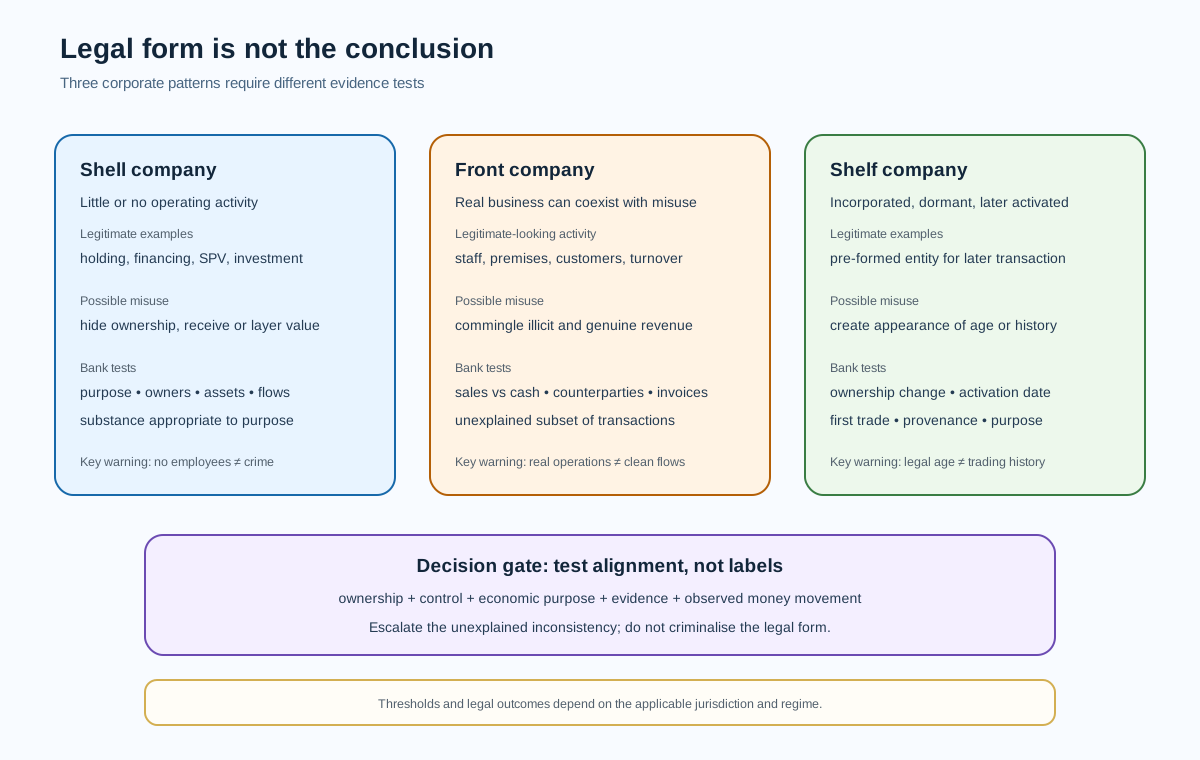
The terms shell company, front company and shelf company are often used loosely. They are not interchangeable, and none automatically means criminal activity.
Shell companies
A shell company generally has little or no active operating business of its own. It may exist mainly to hold assets, facilitate a transaction, issue securities, own intellectual property or sit within a corporate structure. Many shell companies are legitimate.
Risk increases when a shell has no clear commercial rationale, opaque ownership, nominee directors, unexplained transactions, frequent pass-through activity or links to high-risk counterparties, sanctioned persons or criminal investigations.
The bank should therefore ask what the entity is for, not simply whether it has employees or premises.
Front companies
A front company has an apparently legitimate operating business that can be used to conceal or support illicit activity. A restaurant, logistics company, consultancy or trading business can conduct genuine business while also receiving criminal proceeds or moving value for a criminal network.
This makes front companies harder to identify than pure shells because real customers, invoices and business expenses exist. The bank may need to understand whether turnover, counterparties, margins and transaction patterns make sense for the stated business.
A cash-intensive business can be legitimate and profitable. The presence of cash is not proof of a front operation. Concern comes from the combination of unexplained income, unusual counterparties, ownership links, inconsistent activity or other evidence.
Shelf companies
A shelf company is incorporated and left dormant until later sold or activated. It may have an older incorporation date even though the current owner or business activity is new.
Shelf companies can be used legitimately where parties want an already-established legal entity. They can also be misused to create an appearance of corporate history or longevity.
Banks should therefore distinguish incorporation date from the date ownership and activity actually began. A ten-year-old company acquired last month by new owners should not automatically be treated as having ten years of operating history.
Beneficial ownership is the core question
The central control question is often not who is listed on the account, but who ultimately owns or controls the entity.
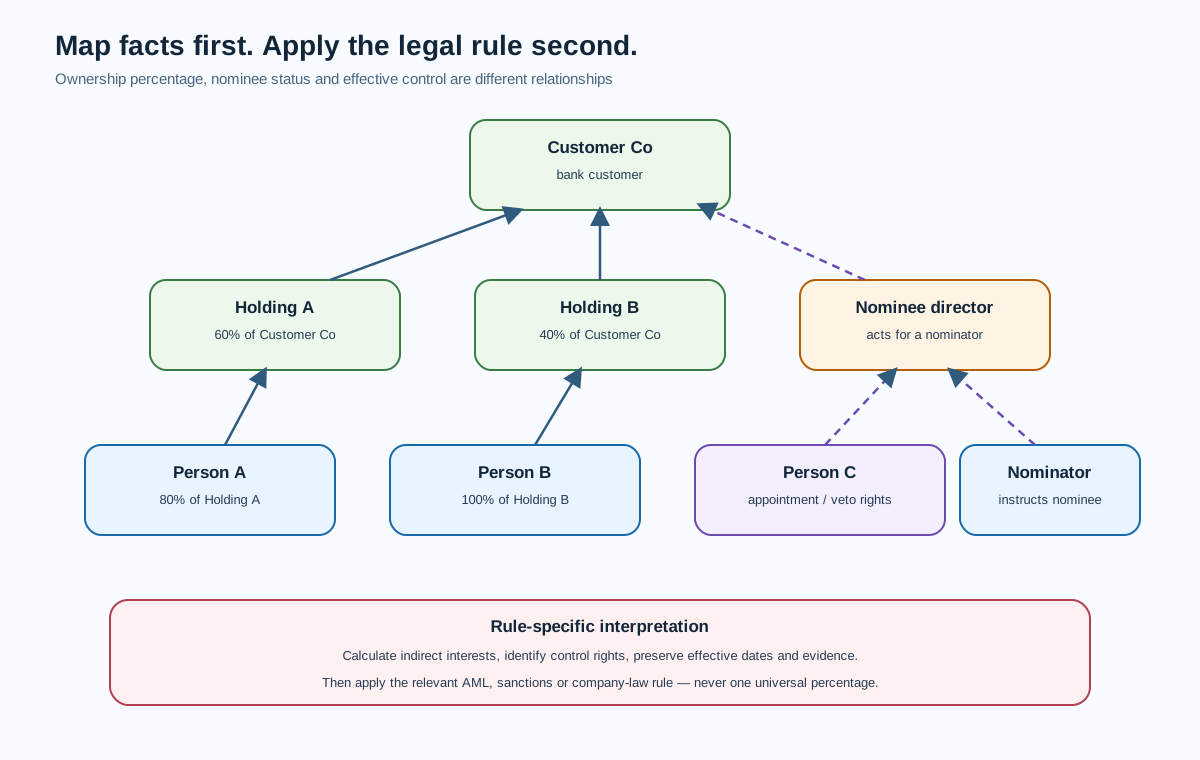
Legal ownership can be layered through multiple companies. Control can arise through voting rights, contractual powers, appointment rights or other arrangements. Nominees can appear on registers while another person exercises real control.
FATF Recommendation 24 requires countries to ensure competent authorities can access adequate, accurate and up-to-date beneficial-ownership information for legal persons. FATF’s 2023 guidance explains that a multi-pronged approach is more effective than relying on a single source.
For banks, registry data is therefore important but not always sufficient. The bank may also use company documents, ownership declarations, reliable databases, customer explanations and independent evidence according to law and risk.
Ownership versus control
A common analytical error is to equate ownership percentage with control. A person can control a company without owning the largest shareholding. Shareholder agreements, voting arrangements, director appointment rights or informal influence can matter.
Sanctions regimes can also apply different ownership or control tests. Banks should not assume one percentage threshold works across all legal contexts.
Requirements should preserve the difference between direct ownership, indirect ownership, ultimate beneficial ownership and control.
Nominee shareholders and directors
Nominee arrangements can have legitimate uses, including professional company administration. They can also obscure the person directing the entity.
A nominee relationship should not automatically be treated as suspicious. The bank should understand who appointed the nominee, whose instructions are followed and who ultimately benefits.
Where the customer cannot explain these relationships or evidence is inconsistent, enhanced due diligence may be appropriate.
Corporate service providers
Trust and company service providers can form companies, provide registered offices, directors or administrative services. They are part of legitimate corporate infrastructure and are regulated differently across jurisdictions.
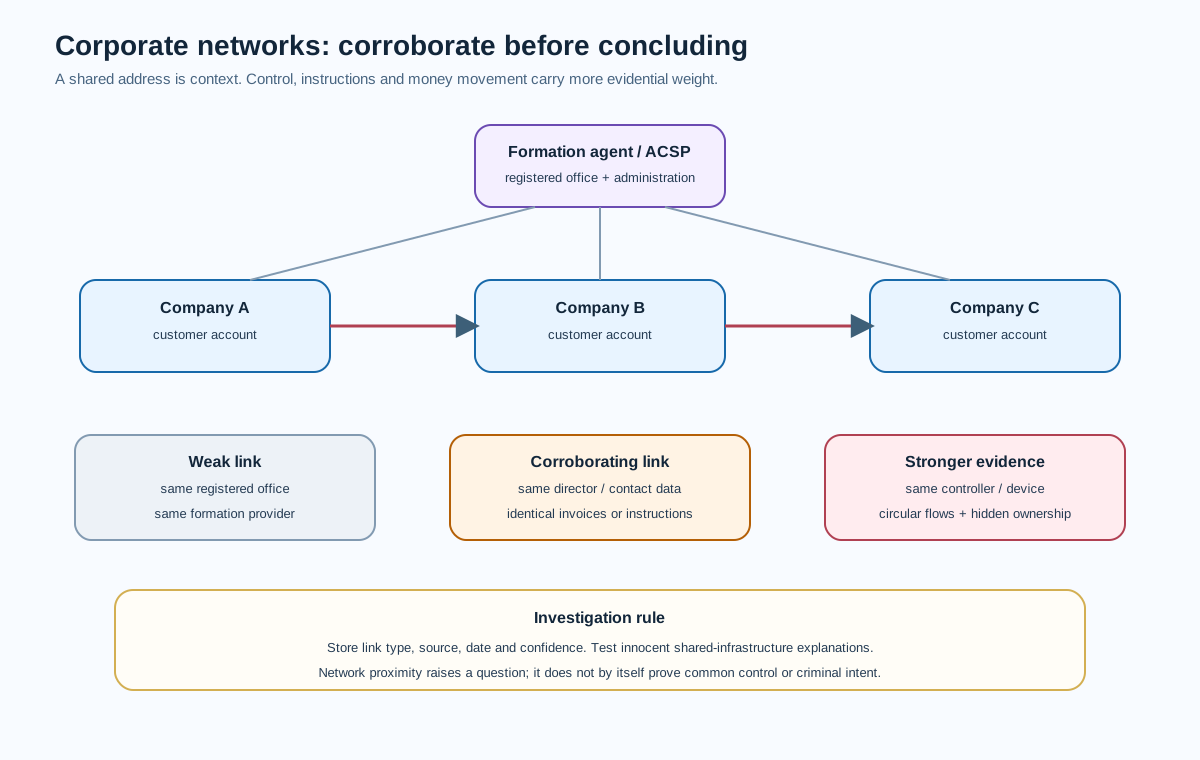
A bank may see many companies sharing the same registered address or service provider. That alone is not suspicious. Large professional service providers can legitimately host thousands of entities.
Risk is more meaningful when common service-provider links combine with opaque ownership, unusual transactions, high-risk jurisdictions or repeated connections to concerning activity.
Registered office versus operating location
The registered address of a company may be a lawyer, accountant or corporate-service office rather than a place where business operations occur.
KYC should therefore distinguish legal registered office from principal place of business where relevant. A company claiming to manufacture goods but operating only from a mailbox may require explanation. A holding company using a professional registered office may be entirely normal.
Context is essential.
Business purpose and economic substance
The bank should understand what the entity does and why it needs the account and products requested.
Economic substance can be assessed through employees, premises, websites, contracts, customers, suppliers, licensing, tax presence, financial statements and transaction behaviour, depending on risk and available information.
No single factor is decisive. A technology startup may have few employees and no physical office. An investment holding company may legitimately have no operating staff. The purpose of due diligence is to understand the business model, not enforce one model of what a “real company” must look like.
Transaction patterns
Shell and front-company misuse can appear through high pass-through activity, round-value transfers, payments among connected entities, unexplained international corridors, vague consulting fees, rapid movement after receipt, large shareholder loans, unusual capital contributions or turnover inconsistent with known business scale.
The same patterns can be legitimate in treasury, investment or group-company structures. Investigators should compare activity with the economic purpose and ownership relationships.
Entity-resolution capability is especially important because connected companies may use slightly different names, addresses or registration details.
Circular corporate flows
Value can move through several related companies and return to the original group as a loan, dividend, investment or payment. Circularity can be part of legitimate treasury or tax structures, but unexplained circular flows can obscure the true source of funds.
A bank should identify related parties and beneficial ownership before interpreting the transaction pattern.
A transaction that looks third-party at account level may actually be intra-group when ownership is resolved.
Invoice-based activity
Companies can create invoices that give transfers an apparently commercial explanation. Invoices can be genuine, inflated, false or related to goods and services different from those described.
Banks should not assume an invoice proves legitimacy. At the same time, ordinary payment banks cannot verify every commercial transaction in detail.
The depth of review should reflect risk, product and visibility. Trade-finance banks may have more documentation than banks processing ordinary customer transfers.
Shell companies and sanctions evasion
Corporate structures can be used to hide ownership by designated persons or route transactions through non-designated intermediaries.
This makes beneficial ownership and control important to sanctions screening. Screening only the legal company name may miss a restricted owner or controller.
Sanctions analysis is legally distinct from AML. A structure can trigger sanctions restrictions even if money laundering is not suspected, and a suspicious shell structure may raise AML concerns without any sanctions nexus.
Systems should preserve these separate decision paths.
Shell companies and corruption
Bribery proceeds may be routed through companies described as consultants, agents or advisers. A public official may not appear directly; relatives, associates or controlled entities may receive funds.
PEP information, beneficial ownership, contract purpose, payment timing and government-procurement exposure can provide context.
PEP status is a risk factor, not proof of corruption. Investigations should remain factual.
Shell companies and tax crime
Offshore companies and complex structures can be lawful. They should not be treated as suspicious simply because they are tax-efficient or incorporated in another jurisdiction.
Where evidence suggests sham transactions, concealed beneficial ownership, false documentation or criminal tax evasion under applicable law, AML concerns may arise.
Banks should distinguish lawful tax planning from criminal conduct and avoid unsupported conclusions.
Company networks
Criminal networks may use multiple companies to create apparent counterparties and distance value from beneficial owners. Graph analysis can connect companies through directors, shareholders, addresses, phone numbers, email domains, bank accounts and transaction relationships.
A network view can reveal that apparently independent entities are controlled by the same people.
Again, shared professional addresses or service providers can be legitimate. The network needs interpretation.
Shelf-company activation
A shelf company may remain inactive for years and then suddenly change directors, shareholders, address and business activity. The older incorporation date can create a misleading impression of established history.
Banks should capture material corporate changes and consider event-driven KYC review. Activation followed by immediate high-value cross-border activity can warrant stronger understanding.
The key is not age of company but continuity of ownership and business.
Corporate account opening
KYB should establish legal existence, ownership, control, directors, authorised persons, business purpose, expected activity and relevant jurisdictions. The exact evidence depends on legal entity type and risk.
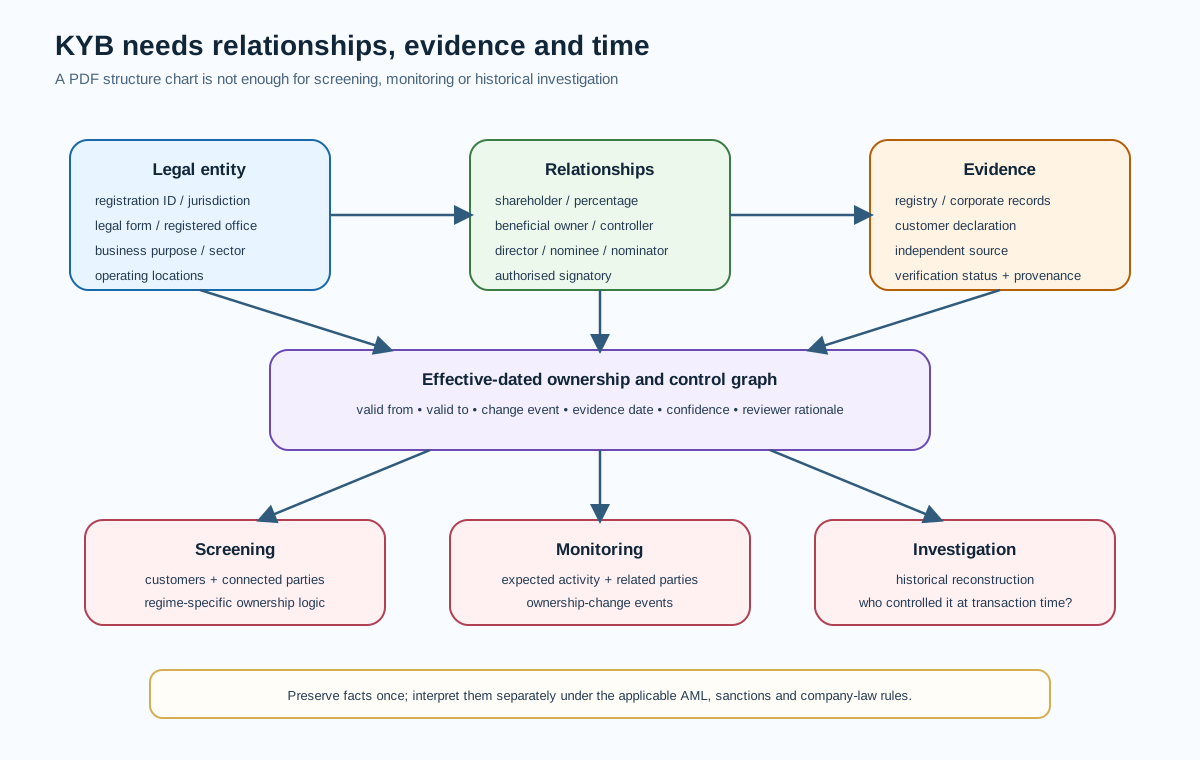
The bank should avoid collecting documents without converting them into usable data. If beneficial ownership exists only in a PDF, sanctions screening and network analytics may not see it.
Structured ownership data with effective dates is much more useful.
Changes after onboarding
Corporate risk changes over time. Shareholders change, directors resign, companies acquire subsidiaries, industries change and new countries enter the business model.
Banks need triggers for material changes. Not every registry update requires full due diligence, but ownership and control changes can be particularly significant.
Event-driven review complements periodic review.
Source of funds and source of wealth for companies
For higher-risk companies, banks may need to understand how initial capital was funded, where major investments come from and how beneficial owners accumulated relevant wealth.
A corporate account can receive legitimate investment from an owner, but the source of that investment may still matter.
Source-of-funds and source-of-wealth questions should be risk-based and tied to specific uncertainties.
Scenario: legitimate holding company
A family creates a company solely to hold investments. It has no employees, no trading revenue and uses a professional registered office.
Those features resemble a shell company, but the purpose, ownership, source of wealth and investment activity are transparent and consistent.
The correct conclusion is not that shell structure equals suspicious activity. The structure is understandable.
Scenario: opaque consulting company
A newly acquired shelf company begins receiving high-value consulting payments from unrelated overseas entities. The company has no employees with relevant expertise, no clear operating location and sends most funds to entities controlled by the same beneficial owner.
The bank should examine ownership changes, contracts, services, counterparties, source of funds and economic rationale. The pattern creates concern because multiple factors are inconsistent, not because the company is old or offshore.
Scenario: nominee director
A company lists a professional nominee director. The customer provides clear evidence of the ultimate owner and explains the administrative arrangement. Transactions match a passive investment-holding purpose.
The nominee relationship is a risk factor to understand, not a reason to assume concealment.
Scenario: sanctions ownership
A company is not itself named on a sanctions list, but due diligence indicates ownership by a designated person. The legal consequence depends on the applicable sanctions regime and ownership/control rules.
This scenario shows why screening only listed company names is insufficient.
Scenario: front business
A small restaurant has genuine sales but deposits cash far above plausible turnover and sends regular transfers to unrelated overseas trading companies. The restaurant’s tax and merchant records show materially lower legitimate revenue.
The bank should investigate whether the business is being used to mix illicit cash with genuine receipts. The presence of legitimate activity does not eliminate financial-crime risk.
Investigation method
A corporate investigation should first establish the legal and economic map. Identify the entity, owners, controllers, directors, authorised users, related companies, accounts and relevant jurisdictions. Then map transactions and counterparties.
The analyst should ask whether counterparties make sense for the business, whether funds stay within a related network, whether the company retains operating balances and whether payment purposes match known activity.
Customer explanations should be distinguished from independent evidence.
Registry data limitations
Company registries are valuable but can be incomplete, outdated or based on self-reported information. Different jurisdictions collect different data.
Banks should therefore understand the reliability and scope of the sources they use. A registry match is evidence, not absolute truth.
FATF’s guidance supports combining multiple information sources to improve beneficial-ownership transparency.
Data model
A strong corporate data model stores legal-entity identifier, registration number, jurisdiction, legal form, ownership percentages, control relationships, directors, authorised persons, addresses, business activity, expected turnover and effective dates.
Relationships should be versioned. If ownership changes, the bank should be able to reconstruct who controlled the company at the time of a historical transaction.
This is important for investigations and sanctions reviews.
Business analyst view
A BA should define corporate relationships explicitly. “Owner” is not enough. Systems may need direct shareholder, indirect shareholder, ultimate beneficial owner, controller, director, trustee, partner and authorised signatory roles.
Requirements should define how ownership percentages are calculated across layers, how changes trigger re-screening and how source evidence is recorded.
The BA should also ensure sanctions and AML systems receive the same relevant ownership data without collapsing their decision logic.
Screening considerations
Entity screening should consider names, aliases, registration numbers, addresses and ownership where required. Fuzzy matching can generate false positives, especially for common company names.
Analysts need enough identifiers to resolve matches efficiently.
Rescreening should occur when watchlists change and when material customer data changes according to policy.
Transaction monitoring considerations
Corporate monitoring should use business segmentation. A treasury company, construction firm, software business and holding company have different expected flows.
Scenarios can examine pass-through behaviour, counterparty concentration, unexplained international activity, circular payments, unusual cash, sudden turnover change and activity inconsistent with declared business.
Generic thresholds create noise and can miss meaningful patterns.
Control effectiveness
Effective corporate controls should be able to answer: who owns the customer, who controls it, why the entity exists, what activity is expected, whether current behaviour fits that purpose and whether changes are detected promptly.
Testing should include data completeness and lineage, not only policy compliance.
A bank can have excellent KYB procedures on paper but weak controls if ownership data never reaches screening or monitoring.
Common mistakes
The biggest mistake is assuming shell company means criminal company. Another is relying solely on incorporation age as evidence of legitimacy. Banks also confuse registered office with operating location and legal ownership with ultimate control.
Another common weakness is treating registry data as infallible or storing ownership only in documents.
Finally, investigators can overstate conclusions when a company has vague activity. “Economic purpose not established” is more defensible than “fake company” unless evidence supports the stronger statement.
Learning checkpoint
A reader should be able to distinguish shell, front and shelf companies, explain legitimate uses, identify conditions that increase risk, map beneficial ownership and control, describe how corporate structures interact with sanctions and AML, and write requirements for KYB data that support screening, monitoring and investigation.
Reference links
- FATF — Beneficial Ownership: https://www.fatf-gafi.org/en/topics/beneficial-ownership.html
- FATF — Guidance on Beneficial Ownership of Legal Persons, 2023: https://www.fatf-gafi.org/en/publications/Fatfrecommendations/Guidance-Beneficial-Ownership-Legal-Persons.html
- FATF — Best Practices on Beneficial Ownership for Legal Persons: https://www.fatf-gafi.org/en/publications/Methodsandtrends/Best-practices-beneficial-ownership-legal-persons.html
- FATF — Guidance on Beneficial Ownership and Transparency of Legal Arrangements, 2024: https://www.fatf-gafi.org/en/publications/Fatfrecommendations/Guidance-Beneficial-Ownership-Transparency-Legal-Arrangements.html
- FATF — The FATF Recommendations, amended June 2026: https://www.fatf-gafi.org/en/publications/Fatfrecommendations/Fatf-recommendations.html
Educational note: legal definitions of beneficial ownership, control, nominee arrangements and sanctions ownership vary by jurisdiction and regime. Always apply the rules relevant to the bank legal entity and customer relationship.
Advanced practice: corporate opacity, nominees and dynamic beneficial ownership
Complex companies become difficult to investigate when the bank treats corporate registry fields as the full economic reality. A legal entity can be genuine, dormant, newly activated, part of a normal group, a special-purpose vehicle, a shelf company, a front company or a vehicle for concealed control. Advanced corporate AML therefore combines legal ownership, effective control, operating substance, transaction purpose and history.
Case 1: a shelf company becomes active
Company A was incorporated eight years ago but had almost no financial activity. It changes directors and shareholders, opens a new bank account and within two months begins receiving large international transfers described as consulting income.
The age of the company can make it look established, but operating history is recent. The investigation should identify when ownership changed, who acquired the company, what business was purchased, whether there are employees or customers, and why the company was selected instead of a newly incorporated entity.
Aged companies are used legitimately for acquisitions, restructuring and market entry. Concern grows when company age is used to imply a trading record that does not exist, ownership is opaque and transaction activity is inconsistent with operating substance.
Case 2: nominee director with a genuine principal
Company B is owned by an individual but uses a professional nominee director provided by a corporate-service firm. The bank's onboarding data identifies the beneficial owner and explains the nominee arrangement.
The nominee is not automatically a red flag. The control question is whether the bank understands on whose instructions the nominee acts and whether the beneficial owner or another person exercises effective control.
Suppose later payment instructions consistently come from a third person who is not identified in KYC records, and corporate documents are amended so that person can direct transactions. That change may require reassessment of control even if formal share ownership is unchanged.
This is why beneficial ownership cannot be reduced to one percentage field.
Case 3: front company with real business activity
A logistics business has trucks, employees and legitimate customers. It also receives transfers from unrelated companies and sends equivalent amounts to overseas traders with no clear connection to logistics services.
The company can be both a genuine business and a laundering vehicle. The investigation should isolate suspicious flows rather than treat every customer payment or payroll expense as criminal.
Useful analysis includes transaction segmentation, related-party mapping, ownership, invoice purpose, payer/beneficiary relationships, cash activity and whether unexplained transfers correspond to actual services.
Case 4: layered ownership across jurisdictions
Company C is owned by Holding Company D, which is owned by a foundation and another company. A trust is involved in the final control structure. The bank should not assume complexity equals concealment. Multinational groups, investment funds, estate-planning structures and joint ventures can be legitimately complex.
The investigation should identify the natural persons who ultimately own or control the relationship under applicable rules, plus relevant trust or foundation roles. It should also record how that conclusion was reached and which sources were used.
Ownership thresholds and fallback rules differ by jurisdiction, so global training should focus on principles and direct learners to local requirements.
Case 5: control without majority ownership
An individual owns 15% of Company E but has contractual rights to appoint most directors and veto major decisions. Another shareholder owns 45% but is passive.
A system that identifies beneficial owners only by percentage can miss effective control. Customer due diligence should support control relationships that are not reducible to equity share.
Depending on local law and the entity type, voting rights, contractual arrangements, management control or other mechanisms can matter. The data model should store relationship type rather than force every controller into an ownership-percentage field.
Case 6: related parties hidden by corporate-service addresses
Several companies transact with one another and share the same registered office. A network engine marks them as highly connected.
The address belongs to a large corporate-service provider hosting thousands of businesses. Shared address alone is weak evidence. The investigator looks for stronger links: beneficial owners, directors, authorised signatories, devices, phone numbers, bank beneficiaries, contracts and transaction flows.
Graph analytics should therefore weight relationships by evidential strength and commonness. A rare shared device can be more informative than a common registered office.
Case 7: rapid ownership change before a large payment
Company F changes shareholders and directors two weeks before receiving a substantial international transfer. The customer explains that the company was acquired as part of a new investment strategy.
The bank should identify former and new owners, purchase agreement, source of acquisition funds, business purpose and whether the payment relates to pre- or post-acquisition activity. A legitimate acquisition can completely change expected account behaviour.
If monitoring continues using the old business profile, it can generate repeated false positives. Conversely, if the bank overwrites old ownership, it may lose evidence relevant to transactions before the change.
Effective dating solves both problems.
Historical beneficial ownership is an investigative requirement
For each ownership or control relationship, a robust data model should capture:
- person or entity identifier;
- relationship type;
- percentage where relevant;
- start date and end date;
- verification source;
- verification date;
- confidence or status;
- evidence document or registry source;
- reason for any override or manual conclusion.
This allows an investigator reviewing a 2023 transaction to see the 2023 ownership chain rather than today's chain.
Trusts, foundations and non-corporate arrangements
Not every structure has shareholders. Trusts can include settlors, trustees, protectors and beneficiaries; foundations and similar arrangements can have founders, councils or other controllers depending on jurisdiction.
The bank's data model should represent the legal form accurately. Forcing a trustee into a "25% owner" field creates bad data and weakens screening and investigation.
FATF's 2024 legal-arrangements guidance is useful precisely because transparency of legal arrangements requires a different understanding from ordinary company shareholding.
Company formation agents and professional intermediaries
Formation agents and trust/company-service providers can legitimately create and administer large numbers of entities. Their involvement is not suspicious. Banks should understand whether the intermediary is acting for the customer, providing registered office or directors, managing accounts or simply handling formation.
Risk increases when the bank cannot identify the underlying controller, the service provider refuses reasonable information, the customer uses unexplained layers of entities, or transaction activity is inconsistent with the stated structure.
Economic substance should be tested proportionately
Indicators of operating substance can include employees, premises, website, contracts, suppliers, tax filings, merchant activity, invoices and ordinary business expenses. No one indicator is decisive. Modern digital businesses can be highly valuable with few physical assets or employees.
The investigator should ask whether the evidence makes sense for the claimed business model, not whether the company looks like a traditional office-based firm.
Related-party transactions need economic context
Companies under common control can transfer funds for treasury, loans, dividends, cost sharing, tax, royalties or management services. Those flows can be entirely legitimate.
The bank should understand the group and the stated purpose. Repeated transfers among opaque entities can become more concerning where documentation is generic, values are circular, entities lack substance or money ultimately returns to the same controller through a different form.
Circular ownership and circular payments are different
Corporate structures can contain cross-shareholdings or investment arrangements that appear circular. Payments can also move in circles. These are separate concepts.
The investigator should map ownership independently from money flow, then overlay them. A circular payment among companies under common control can be normal treasury activity. A payment circle across apparently independent companies with hidden common ownership can have a different interpretation.
Dynamic KYB and event triggers
Corporate KYC should not wait for a periodic review when material events occur. Useful triggers can include:
- change in beneficial owner or controlling person;
- director or signatory change;
- major change in business activity;
- registered-address change to another jurisdiction;
- sudden dormant-to-active status;
- acquisition or merger;
- large new corridor or counterparty;
- adverse regulatory or law-enforcement information.
The appropriate response varies by risk and local rules. Event detection is valuable because ownership and purpose can change long before the next scheduled review.
Payment monitoring linked to ownership
Transaction monitoring becomes more powerful when it can identify that payer and beneficiary are related through common control. A transfer between two companies can look like third-party activity until ownership is resolved.
Conversely, a bank should not suppress all related-party transfers automatically. Related-party activity can itself require monitoring for circular flows, unexplained loans or value movement inconsistent with the group purpose.
Screening and ownership are not identical
Sanctions screening may require analysis of ownership and control under the applicable sanctions regime. AML beneficial-ownership rules may use different definitions or thresholds. The bank should not assume that an AML beneficial-owner field fully resolves sanctions ownership analysis.
The systems can share ownership data, but the legal tests and decisions should remain distinct.
ISO 20022 party data and KYB
Payment messages can carry structured debtor and creditor names, addresses and identifiers. They generally do not contain the full ownership chain of a corporate payer or beneficiary.
A strong architecture links payment-party identifiers to customer/legal-entity master data and makes beneficial ownership available to investigation and relevant screening processes. Names alone are unreliable identifiers because of spelling, transliteration and reuse.
Case-writing standard
A corporate AML narrative should be understandable to someone who has never seen the structure. Begin with the legal entity and declared purpose, then describe ownership and control, operating substance, relevant transactions, related parties, changes over time and customer explanation.
Avoid phrases such as "complex offshore shell structure" unless the narrative explains what is complex, why the structure lacks credible purpose and who actually controls it.
BA design exercise: build the ownership graph
Model separate objects for legal entity, natural person, legal arrangement, ownership relationship, control relationship, director/officer role, authorised signatory, registered office and service provider. Give relationships effective dates.
Then test three questions:
- Can the system calculate a current ownership chain?
- Can it reconstruct ownership on a historical date?
- Can an investigator see why a person was identified as beneficial owner or controller?
If any answer is no, the KYB data model is incomplete for serious financial-crime investigation.
Final professional standard
The goal is not to eliminate complex corporate structures. It is to understand them well enough that criminals cannot hide behind legal form. A good bank distinguishes legal title from beneficial ownership, ownership from control, current state from historical state and corporate complexity from actual suspicious behaviour.
Practitioner close: shell, front and shelf companies through a bank-control lens
A company with few employees, little physical presence or complex ownership is not automatically illegitimate. Holding companies, special-purpose vehicles, investment companies and dormant entities can be entirely lawful. The AML problem arises when legal form, ownership, business activity and financial behaviour do not fit together, or when the structure appears designed to conceal the people controlling or benefiting from value.
Case lab: aged company suddenly becomes active
A company incorporated eight years ago has had little account activity. It changes directors and beneficial owners, then immediately begins receiving large international payments described as consulting fees and sending most funds onward to unrelated entities.
The age of the company does not make it safe. A shelf company can acquire apparent history without genuine operating history. Investigators should examine the ownership change, reason for acquisition, current business, counterparties, contracts, website or operational footprint, expected turnover and whether payments make commercial sense.
A legitimate acquisition followed by business launch can produce the same sequence, so evidence of actual economic activity matters.
Front company with genuine revenue
A front company can conduct real business while also being used to move criminal proceeds. This makes simple “no business substance” tests insufficient. A restaurant, logistics firm or trading company may have customers, staff and premises yet still commingle illicit value.
The bank should therefore compare financial behaviour with the expected scale and economics of the genuine operation. Unexplained third-party funding, payment corridors unrelated to the business, sharp turnover changes, opaque related companies or pass-through activity can be more informative than the existence of premises.
Nominee directors and shareholders
Nominee services can be lawful. Their use should create a requirement to understand the ultimate ownership or control where applicable, not an automatic suspicion. Analysts should identify on whose behalf the nominee acts, whether the customer’s declarations and external records are consistent, and whether control rights sit elsewhere.
A professional corporate-service address or nominee appearing across many companies can be benign. Network analytics should therefore distinguish shared service providers from verified common control.
Ownership change is an event, not a static KYC field
A company can be low risk at onboarding and become materially different after a sale, restructuring or new controlling party. Event-driven KYC should capture ownership and director changes and route them to AML and sanctions controls where relevant.
Effective dates are essential. A historical payment should be analysed against the ownership structure that existed when it occurred, not the current cap table.
Business substance: use multiple dimensions
Substance can include employees, premises, licences, websites, customer and supplier relationships, financial statements, tax registration, operating expenses and management activity. No single dimension is conclusive. Digital businesses can operate with few physical assets, while sham entities can manufacture impressive documentation.
The analyst should ask whether the full economic story is coherent: does money enter from plausible customers, leave to plausible suppliers or owners, and generate margins consistent with the stated business?
Related-party networks
Shell-company structures often become visible only when multiple entities are mapped together. Shared beneficial owners, directors, accounts, addresses, phone numbers, devices or payment counterparties can reveal relationships.
Each graph edge needs evidential weight. A common company-formation agent is not equivalent to a common beneficial owner. Investigators should avoid turning incidental shared infrastructure into proof of a criminal network.
Dynamic KYB and monitoring
KYB should not be a one-time onboarding exercise. Material changes in ownership, company status, sector, address, directors, payment corridors or turnover can trigger review. Transaction monitoring can use those changes as context so that a dormant-to-active company is assessed differently from a mature operating business with the same payment volume.
Final practitioner checkpoint
A strong investigation distinguishes lawful holding or special-purpose entities from structures used to conceal control or move value. It examines ownership and effective dates, economic substance, related parties and transaction behaviour, treats nominees and shared service providers carefully, and avoids assuming that company age, incorporation or documentation proves genuine business activity.
Practitioner masterclass: understanding corporate vehicles without overcalling risk
Corporate-vehicle investigations require disciplined separation between legal form and economic reality. A holding company can be entirely legitimate. A trading company can be a front. A shelf company can be activated for a lawful acquisition. The bank’s job is to understand purpose, ownership, control and activity rather than classify customers by labels alone.
Build the corporate map first
Start with legal entity, incorporation jurisdiction, registration number, directors, shareholders, beneficial owners, controllers, authorised signatories and related companies. Record effective dates. Ownership today may differ from ownership when a historical transaction occurred.
The corporate map should distinguish verified relationships from customer-declared or inferred relationships. This is especially important when network analytics creates links through addresses, service providers or devices.
Ownership calculation exercise
Person A owns 60% of Company X. Company X owns 40% of Customer Y. Person A therefore has a 24% indirect economic interest through that chain, before considering any other holdings. If Person A also owns 30% of Company Z and Z owns 20% of Y, the aggregate indirect interest can change materially.
Banks should define how indirect ownership is calculated and when control analysis applies even if percentage ownership is below a threshold.
Control without majority ownership
A founder may own 20% of shares but retain the right to appoint most directors. A trust protector may have significant powers without owning trust assets. A shareholder agreement may give veto rights over major decisions.
This is why ownership and control should be separate data concepts.
Shelf-company exercise
A company incorporated in 2012 changes owner, director, address and business purpose in 2026, then opens a bank account and immediately receives large international payments. The incorporation date should not be interpreted as fourteen years of stable operating history.
The bank should consider when the current business actually began and whether the new activity is credible.
Front-company exercise
A logistics company has trucks, employees and real customers, but transaction monitoring shows cash deposits far above invoiced revenue and payments to unrelated offshore consultancies. Because real operations exist, simplistic “company has substance” checks will not identify the risk.
The investigation needs to compare legitimate activity with unexplained flows.
Shell-company exercise
A passive investment holding company has no employees, uses a professional registered office and receives dividends from subsidiaries. Those facts alone are consistent with its purpose. If ownership, source of wealth and investments are transparent, the absence of operating staff is not suspicious.
The exercise demonstrates why economic purpose matters more than physical footprint.
Corporate-service-provider links
A thousand companies may share the same registered office because a professional service provider administers them. Network tools should avoid treating that address as proof of common criminal control.
The link can still be useful if combined with common directors, beneficial owners, unusual payments or other evidence.
Sanctions ownership exercise
An entity is not named on a sanctions list but is owned through several companies by a designated person. The applicable sanctions regime may impose restrictions based on ownership or control.
The bank needs an ownership graph that sanctions screening can use. AML monitoring and sanctions decisioning can share ownership data while retaining different legal outcomes.
Corporate transaction monitoring
Scenarios should account for business type. A holding company can legitimately receive dividends and make investments. A payroll company can move funds rapidly. A trading company can have international suppliers.
Monitoring should look for deviations from the declared model rather than generic complexity.
Invoice credibility
An invoice is a claim about an economic event. The bank should consider whether the supplier, service, amount and customer activity are consistent. Where the bank has trade documentation, additional checks may be possible. Where it sees only the payment, the investigation should acknowledge that limitation.
Avoid writing “invoice verified goods” if the bank only verified that an invoice document was provided.
Beneficial-ownership source quality
Registry data can be useful but may be self-reported, outdated or incomplete. Customer declarations, corporate documents and reliable third-party sources can complement it.
FATF’s multi-pronged approach reflects the reality that no single source is always sufficient.
Event-driven review
Changes in ownership, control, directors, legal form, business activity or jurisdiction can alter risk. Systems should capture these events and determine which require re-screening, risk re-rating or enhanced review.
A material ownership change should not wait for the next periodic KYC cycle if it affects sanctions or financial-crime risk.
BA requirements exercise
Design an ownership service that stores direct and indirect ownership, control type, percentage, source, verification status and effective dates. Then define how sanctions screening consumes the data and how AML investigators view the ownership history.
Add test cases for circular ownership, missing percentages, trusts, nominee shareholders, dual-class voting rights and ownership changes while a case is open.
Investigator writing exercise
Compare two statements: “Customer is a shell company used to launder money” and “Customer has no identified operating activity; 96% of incoming funds were transferred within 24 hours to entities controlled by the same beneficial owner, and the customer did not provide a credible commercial explanation.” The second statement is stronger because it describes evidence before conclusion.
Final practitioner test
A strong learner should be able to distinguish shell, front and shelf companies, calculate and explain ownership chains, identify control beyond ownership percentage, interpret shared corporate-service addresses carefully and understand why beneficial-ownership data is a core dependency for both AML and sanctions controls.
60-minute mastery extension: shell, front and shelf companies
This extension is designed to make the chapter a minimum 60-minute guided learning experience. Spend around 25 minutes on the core chapter and diagrams, 15 minutes on the corporate-map cases, 10 minutes on ownership/control analysis and 10 minutes on the final KYB test.
Legal form is not criminal intent
A shell company can have little or no operating activity and still serve a legitimate holding, financing, investment or transaction purpose. A front company can conduct genuine business while also being used to conceal illicit activity. A shelf company can be incorporated and left dormant before later activation or sale. None of these labels should be treated as a finding of criminality.
The bank's task is to understand purpose, ownership, control, business activity, expected financial behaviour and source of funds. Risk increases when those elements do not fit together, when ownership is opaque or contradictory, or when transaction behaviour has no credible commercial explanation.
Worked case: passive holding company
A family investment company has no employees, uses a professional registered office and receives dividends from two operating subsidiaries. It then invests in securities and property. Superficially, it resembles a shell company. The structure is nevertheless understandable if ownership is transparent, source of wealth is credible and transaction behaviour fits the holding purpose.
Now change the facts. The company is newly acquired, ownership changes twice in a month, it receives high-value payments from unrelated overseas entities described as consulting fees, and most value moves immediately to companies controlled by the same beneficial owner. The risk arises from the combination of ownership changes, unexplained business model and pass-through behaviour—not simply from the absence of employees.
Shelf-company activation
An entity incorporated in 2010 can be purchased by new owners in 2026 and begin operations immediately. The incorporation date should not be treated as sixteen years of operating history. KYB should capture effective dates for ownership, directors, business purpose and activity so analysts can distinguish legal age from current-business age.
This can matter when customers use an older company to create an appearance of longevity. The correct response is to understand the change, not to declare the structure fraudulent because it was dormant.
Ownership and control
Direct ownership percentages do not always reveal control. Voting arrangements, appointment rights, shareholder agreements, trustees, protectors, general partners or other powers can matter. Systems should store ownership and control as separate relationship types.
Indirect ownership also needs calculation. If Person A owns 60% of Company X and X owns 40% of Customer Y, A has a 24% indirect economic interest through that chain before considering any other holdings. That arithmetic is not a universal beneficial-ownership threshold. The relevant AML and sanctions rules depend on jurisdiction and regime.
Corporate-service providers and common addresses
A professional service provider can administer thousands of companies from one registered address. A graph model that treats the address as proof of common control will generate false associations. The link can still be useful when combined with common directors, owners, unusual payments or other evidence.
The same caution applies to nominee directors and shareholders. Nominee arrangements can be legitimate; the bank should understand who appointed them, whose instructions are followed and who ultimately benefits or controls the entity.
Corporate-map exercise
Take a hypothetical customer owned by two holding companies, a trust and three natural persons. Draw legal ownership, indirect ownership and control rights separately. Add effective dates. Then identify which parties are screened for sanctions, which are considered for AML beneficial ownership and which are authorised to operate the account.
The exercise should expose where a single owner field is insufficient.
Transaction behaviour
Corporate misuse can appear through unexplained pass-through activity, vague consulting payments, circular flows, unusual shareholder loans, large capital contributions, third-party settlement or turnover inconsistent with the business. All of these patterns can also be legitimate in the right context.
The investigator should compare behaviour with the declared business model and related-party map. A payment that appears third-party at account level may actually be intra-group once beneficial ownership is resolved. That changes the interpretation.
Front-company case
A logistics company has trucks, employees and real customers. Bank records nevertheless show cash deposits far above invoiced revenue and payments to unrelated offshore consultancies. The presence of genuine operations does not eliminate risk. The investigation should compare legitimate turnover with unexplained flows, review counterparties and ownership, and test whether the payment purposes make economic sense.
This is why simple "substance" checks are insufficient. A front business can have substantial real activity.
KYB data-model exercise
Define structured fields for registration number, jurisdiction, legal form, registered office, operating address, business activity, expected turnover, shareholders, indirect owners, beneficial owners, controllers, directors, authorised signatories, evidence source, verification status and effective dates. Then identify which fields are required by screening, monitoring and investigations.
If ownership remains only inside a PDF, automated screening and graph analytics may not see it. KYB should turn evidence into governed, reusable data while retaining the original documents.
Final corporate-risk test
Explain why each statement is too strong: "shell company means fake company"; "old company means established business"; "registered office proves operating location"; "25% ownership always decides sanctions"; "nominee director means concealment"; and "shared address proves related parties." Rewrite each into a precise risk question.
A strong learner should finish able to understand corporate structures without criminalising legitimate legal forms, calculate ownership carefully, assess control separately and connect KYB data to real financial-crime controls.
Worked case: the formation agent's client book
A periodic review of a corporate-services introducer reveals that forty-one companies it formed hold accounts at the bank, all incorporated within an eighteen-month window, all with nominee directors from the same two individuals, all sharing the introducer's address as registered office, and all describing their business purpose in near-identical language around international consultancy. Individually, each company passed onboarding: documents were complete, the introducer was on the approved list, and initial activity was modest. Collectively, the book shows the signature of batch-formed corporate infrastructure available for sale or misuse.
The investigation treats the introducer relationship, not any single company, as the risk unit. The team samples transaction activity across the book and finds three distinct populations. Twelve companies are genuinely active businesses using the introducer for legitimate administration; their banking shows payroll, tax payments, real counterparties and coherent economics. Nineteen are largely dormant, showing only fee payments and occasional intra-group transfers; they represent latent capacity rather than active abuse, but capacity with no commercial explanation. Ten show concerning activity: round-figure transfers between book companies with invoice descriptions that do not withstand scrutiny, rapid onward movement to high-risk jurisdictions, and two instances of shared login credentials across supposedly independent entities.
The response is tiered accordingly, and the tiering is the point. The twelve genuine businesses continue with the introducer linkage noted as context for future monitoring; penalising legitimate companies for their formation agent's wider book would be unjust and would teach relationship teams to hide introducer information. The nineteen dormant entities receive proportionate requests to establish their purpose, ownership and expected use. Dormancy or absence of operating staff does not itself justify exit; unresolved mandatory CDD or material inconsistencies require the applicable escalation and relationship decision. The ten concerning entities enter full investigation with coordinated timing, reporting where thresholds are met, and the introducer relationship itself is suspended pending an enhanced due-diligence review of the agent's client-acceptance practices.
The introducer review examines whether the agent performs genuine due diligence on its own clients, whether it monitors for misuse of its appointments, and whether its commercial model depends on volume formation. An agent that forms hundreds of companies annually with nominee services and no ongoing oversight is a company factory, and the bank's approved-introducer status must reflect that assessment. The broader control lesson is that KYB controls evaluated company-by-company miss infrastructure risk visible only at portfolio level. Formation-agent, registered-office and nominee-director concentration analytics belong in the standard KYB monitoring suite, with thresholds that trigger book-level review before individual alerts accumulate into an unmanageable backlog.
Circular ownership: when companies own each other
Circular ownership structures, where Company A owns Company B which owns Company C which owns Company A, defeat naive beneficial-ownership calculation and often indicate deliberate opacity. Some circularity arises innocently through cross-holdings, employee-ownership trusts or historical transactions, but persistent circularity without commercial rationale deserves sceptical examination because it serves no legitimate governance purpose while effectively obscuring ultimate control.
The analytical method starts with complete graph construction rather than sampled ownership chains. Partial ownership data makes circularity invisible: each individual chain looks plausible while the loop only appears when all holdings are mapped together. Data sources must therefore be combined, customer declarations, registry filings across every relevant jurisdiction, audited statements with related-party notes, and banking activity showing actual control through payment authorisation and instruction patterns. Declared ownership that contradicts observed control, a 10-percent shareholder issuing all payment instructions while the 90-percent owner never appears, is itself a finding regardless of the formal structure.
Resolution requires identifying the natural persons exercising ultimate effective control and evidencing that identification to a standard that survives challenge. Where circularity cannot be resolved because jurisdictions in the loop disclose nothing and the customer cannot or will not provide verified structure charts with supporting registry evidence, the bank must distinguish residual risk from failure to meet mandatory CDD. Senior approval and monitoring cannot authorise failure to identify and reasonably verify beneficial ownership under applicable law. The bank must follow the relevant non-onboarding, transaction, restriction or termination requirements and consider suspicious reporting where required; approved risk treatment remains possible only where legal CDD requirements are met. What is not acceptable is recording a nominal shareholder from one point of the circle as the beneficial owner and proceeding as if the question were answered. Ownership analysis that stops at the first plausible name is decoration.
Technology support for circularity detection includes ultimate-beneficial-owner calculation engines that traverse full graphs, loop-detection analytics that flag circular paths above materiality thresholds, and effective-dated ownership stores that show when circularity was introduced. A structure that becomes circular shortly before a major transaction or designation event carries different meaning from decade-old cross-holdings, and only dated data reveals the difference.
Shelf-company activation monitoring
Shelf companies, entities incorporated and left dormant for later use, are legitimate commercial products: age can assist perceived credibility in contracting and licensing. The risk concentrates at activation, when a dormant company suddenly transacts, and in the provenance of the shelf itself, since shelves sold with nominee infrastructure and opacity features are marketed precisely for concealment. Activation monitoring therefore treats the dormant-to-active transition as a defined event triggering refreshed due diligence proportionate to the new activity.
Effective activation controls combine several signals. Age-velocity analysis compares the company's dormant period with the speed and scale of new activity; a five-year-dormant entity moving illustrative millions within weeks of activation warrants a different response from gradual business commencement. Ownership-change-at-activation review examines whether the shelf's shares, directors or controllers changed hands as activation began, since the combination of new controllers with aged incorporation is the classic purchased-shelf pattern. Purpose-consistency testing compares the original stated purpose with the actual new activity; a shelf formed for property holding that begins processing technology-service payments needs explanation. And documentation-refresh requirements ensure that activation triggers updated beneficial-ownership verification, source-of-funds analysis for initial credits, and expected-activity profiling, rather than allowing the company to transact on its dormant-era file.
Banks should also examine their own role in shelf ecosystems. Introducers specialising in aged companies, deposit products marketed toward shelf entities, and onboarding journeys that reward company age in risk scoring all create incentives the bank may not intend. Risk scoring should treat unexplained age without trading history as neutral at best, not as a positive trust signal, because purchased age is a concealment feature rather than evidence of reliability.
Triangulating registries, disclosures and behaviour
No single ownership data source is sufficient, and each fails in characteristic ways. Customer declarations are comprehensive but self-serving. Public registries are independent but vary enormously in verification, timeliness and accessibility; some verify filings rigorously while others publish whatever is submitted, and some jurisdictions disclose nothing meaningful at all. Commercial data providers aggregate usefully but propagate stale or merged records. Audited statements add assurance only where the auditor is itself credible and genuinely independent. Banking behaviour, who instructs, who benefits, whose lifestyle the funds support, is observed rather than declared, but requires interpretation.
Triangulation is the discipline of combining these sources so that each compensates for the others' weaknesses. A practical triangulation protocol specifies, for each customer risk tier, which sources are required, how conflicts between sources are resolved, and what happens when sources are unavailable. Conflict-resolution rules matter most: registry-versus-declaration mismatches, provider-data staleness, and behaviour-versus-structure contradictions each need defined handling rather than analyst improvisation. Common resolutions include preferring verified registry data over declarations while recording the discrepancy for follow-up, treating provider data as a lead requiring primary-source confirmation for material decisions, and treating sustained behaviour-structure contradiction as a risk finding rather than a data-quality footnote.
Unavailable sources require explicit treatment. Where a jurisdiction discloses no ownership information, the protocol should state the compensating measures: deeper behavioural analysis, stronger source-of-funds requirements, senior approval, activity restrictions, or relationship avoidance for higher-risk segments. Silent acceptance of opacity, proceeding on declarations alone where verification is possible elsewhere in the structure, is the failure mode triangulation exists to prevent. The triangulation record, showing which sources were consulted, what each showed, how conflicts were resolved and what remains unverified, becomes the ownership-evidence core of the customer file and the first exhibit in any later investigation or examination.
Worked case: layered ownership concealing a sanctioned interest
A trade-finance customer, a commodity-trading company with a five-year relationship, requests an increased facility to expand into a new corridor. Refresh due diligence maps the ownership: 40 percent held by a holding company in jurisdiction A, 35 percent by a foundation in jurisdiction B, and 25 percent by an individual with a clean background. The holding company is owned by two further entities in a 60-40 split, one of which is majority-owned by a trust whose protector is an individual matching a sanctions-list entry on name, date of birth and nationality. The foundation's council includes the same individual's close associate. The customer asserts no knowledge of any sanctioned connection and points to legal opinions obtained at onboarding that found no sanctioned ownership.
The investigation must navigate the precise legal question rather than the general smell. Sanctions ownership-and-control tests differ by regime: EU guidance uses 50 percent or more ownership and separate control analysis; UK guidance uses more than 50 percent of shares or voting rights, board-appointment rights or other control, and does not simply aggregate unrelated designated persons' holdings. OFAC's 50 Percent Rule aggregates blocked persons' ownership and generally blocks entities owned 50 percent or more; control alone does not automatically block an entity under that rule. Determining whether this structure breaches any applicable test requires applying each regime's own indirect-ownership and aggregation methodology through the layers, rather than assuming that multiplied economic interests determine every sanctions outcome, and assessing relevant control indicators beyond percentages, and obtaining legal advice on the specific regimes touching the bank and the transactions. Analysts must not freelance legal conclusions on sanctions tests; their role is evidence assembly to a standard lawyers can use.
Evidence assembly here means verifying every link rather than accepting the structure chart. Registry filings in each jurisdiction confirm the intermediate holdings; the trust deed, obtained through the customer with appropriate pressure, confirms the protector's powers, which include replacing the trustee and directing distributions, constituting strong control indicators under most guidance. The associate's role is corroborated through corporate records and transaction authorisation patterns showing the associate directing the trading company's major decisions. The onboarding legal opinions are reviewed and found to predate the foundation's formation and the trust restructuring, meaning the structure changed materially after the advice was given without triggering re-assessment.
In this fictional case the aggregated analysis supports a sanctioned-control finding under the applicable guidance, while a simple economic-interest percentage does not resolve the applicable control test. The response follows the sanctions playbook rather than the fraud playbook: immediate legal engagement, asset treatment per the applicable restriction, reporting to the competent authority, and no customer contact beyond legally approved communication. The facility request is declined, and the relationship enters the sanctions-response process. The control lesson is temporal: ownership is not an onboarding fact but a monitored variable, and restructuring events, new layers, new protectors, new associates, must trigger re-assessment automatically. A structure cleared in 2021 can be prohibited in 2024 without any change in the ultimate beneficiary, because the legal test applies to current facts.
Supervising trust and company service providers
Trust and company service providers sit at the centre of corporate-opacity risk as formation agents, directors, shareholders, trustees and administrators, and banks interact with them in three roles: as customers, as introducers, and as counterparties in customer structures. Each role needs distinct controls. As customers, TCSPs require assessment of their own AML programmes, client-acceptance standards, the jurisdictions and sectors they serve, and their supervisory status; a TCSP supervised robustly in a transparent jurisdiction presents a different proposition from an unsupervised former operating across secrecy jurisdictions. As introducers, they need the book-level supervision described in the formation-agent case, with approved status conditional on demonstrated diligence quality rather than historical relationship. As structural counterparties, their appointments in customer entities require substance examination: a TCSP director with hundreds of appointments may face capacity and governance questions; the bank should assess actual responsibilities, resources and oversight rather than infer ineffective governance from the appointment count alone.
Information-sharing with TCSPs during due diligence and investigation requires careful calibration. Legitimate providers cooperate with reasonable inquiries about their appointments, administrations and the principals behind structures; evasive, slow or formulaic responses are themselves risk information. The bank should define its inquiry standards, response-time expectations and escalation for non-cooperation, and should record provider responsiveness as part of the provider's risk profile. Providers that systematically obstruct legitimate inquiry while sheltering behind confidentiality should face the same relationship consequences as uncooperative customers.
Regulatory developments continue to tighten TCSP oversight globally, from beneficial-ownership register reforms to supervision of professional enablers, and the bank's standards should track the direction of travel rather than minimum current compliance. Proactive positioning includes preferring supervised providers, requiring transparency commitments as a condition of introducer status, and building the data infrastructure to monitor provider-linked concentration risk across the customer base. A provider's inability to supply information needs assessment against legal confidentiality, privilege, data-protection duties and the reasonableness of the request before a relationship decision.
Clubs, associations and non-profit vehicles as opacity layers
Unincorporated associations, social clubs, religious congregations' financial arms and small charities provide opacity through informality: minimal registration, collective decision-making that diffuses responsibility, cash-heavy operations normalising opaque flows, and community trust deterring inquiry. Criminal exploitation ranges from signatory capture, where organisers control an association's accounts behind figurehead officers, to entity misuse, where fictitious associations open accounts for collection purposes, to donation-stream diversion skimming legitimate charitable flows. The investigative approach respects genuine community organisation while testing substance: membership reality, activity evidence, signatory legitimacy and the correspondence between stated purpose and observed finance.
Signatory analysis is decisive: signatories with no plausible connection to the association's purpose, recent signatory changes coinciding with activity transformation, signatories shared across multiple unrelated associations, and officers who cannot describe the association's activities when contacted each indicate capture or fabrication. Activity testing examines whether the association does what it claims: event records, premises usage, supplier payments consistent with the purpose, and member-contribution patterns matching the claimed community. A cultural association with no events, no premises and no member activity that moves illustrative millions through its accounts is not a cultural association in any functional sense regardless of its registration documents.
Response must protect genuine community finance alongside addressing abuse: closure of exploited association accounts without support strands legitimate community activity and damages trust, while tolerance of captured vehicles enables laundering behind community cover. The differentiated approach combines signatory remediation where the association is genuine but compromised, with exit and reporting where the vehicle is fabricated or irredeemably captured. Community-engagement channels that explain the bank's requirements in accessible terms reduce both exploitation and exclusion.
Bearer shares, nominee layers and reactivated entities
Bearer-share structures, where ownership passes with physical possession of certificates, and their modern equivalents in nominee-heavy and warrant-based arrangements, defeat ownership analysis fundamentally: the recorded owner may have no connection to the true controller, and transfers occur without any registry footprint. Most jurisdictions have immobilised or abolished bearer shares following FATF pressure, but legacy structures persist, immobilisation regimes vary in effectiveness, and functional equivalents through layered nominees achieve similar opacity lawfully. Where customer structures involve jurisdictions or instruments permitting bearer-like anonymity, the bank should treat ownership verification as structurally impaired and apply compensating measures: behavioural control analysis identifying who actually instructs and benefits, senior approval for the opacity, activity restrictions limiting the relationship's utility for value movement, or avoidance where the risk exceeds appetite.
Reactivated and repurposed entities create parallel opacity through time rather than instruments. Long-dormant companies with clean histories, dissolved entities restored to the register, and struck-off companies continuing to transact each present banking activity disconnected from verifiable current substance. Reactivation review should examine who initiated the reactivation and why, whether controllers changed during dormancy, whether the stated business connects to the entity's history, and whether the timing correlates with external events such as designations, investigations or relationship exits elsewhere. A company dormant for a decade, reactivated with new controllers weeks before receiving large third-party inflows, exhibits the purchased-history pattern in temporal form.
Entities recorded as struck off but still transacting deserve immediate attention because their capacity and status depend on the jurisdiction, effective dissolution date and any restoration: the counterparty to the bank's transactions may lack legal capacity, contracts may be unenforceable, and the opacity is total. Discovery should trigger urgent review of the relationship's legal basis alongside the financial-crime assessment, since the bank may be providing services to a non-person. Registry-status monitoring, checking customer entities' standing on a defined cycle with alerts for dissolution, striking-off and restoration events, converts these discoveries from accident to process.
Foundations and non-corporate arrangements
Private foundations, common-law trusts, Anstalt-style entities and similar arrangements concentrate opacity risk through the separation of legal ownership from beneficial enjoyment, often across jurisdictions with limited disclosure. Foundations without shareholders or members, controlled by councils following founders' wishes expressed in non-public bylaws, can hold substantial assets with no identifiable owner in any register. The investigative response maps control rather than ownership: founder identity and source of contributed assets, council composition and appointment powers, protector or supervisory roles, beneficiary classes and actual distributions, and the correspondence between stated charitable or family purposes and observed activity.
Purpose-activity consistency testing is the core technique. A family foundation distributing to operating businesses owned by the founder's associates serves succession or control purposes requiring full beneficial analysis; a charitable foundation with no verifiable charitable expenditure serves no discernible purpose beyond asset holding, and its controllers' other activities become the investigative focus. Distribution analysis examines who actually receives value: foundations accumulating assets or distributing within the founder's network need assessment against their governing purpose and applicable law. Legitimate endowments, family foundations and long-term asset-holding arrangements can show these patterns; they do not alone establish misuse. Cross-border foundation structures add the dimension of regulatory arbitrage between foundation-friendly and disclosure-heavy jurisdictions, with the domicile choice itself requiring commercial explanation.
Authoritative anchors
FATF beneficial ownership: https://www.fatf-gafi.org/en/topics/beneficial-ownership.html
FATF Guidance on Beneficial Ownership of Legal Persons: https://www.fatf-gafi.org/en/publications/Fatfrecommendations/Guidance-Beneficial-Ownership-Legal-Persons.html
Boundary cases: legal form is not economic substance
The most dangerous shortcut in this topic is to treat a company label as a verdict. A special-purpose vehicle can have no employees, no public website and almost no day-to-day expenditure while performing a legitimate financing, investment, securitisation or asset-holding function. A front company can have premises, staff, customers and real turnover while criminal value is hidden inside otherwise genuine business. A shelf company can be acquired for a lawful transaction or used to create a misleading appearance of longevity. The label starts the inquiry; it does not finish it.
Passive holding company or unexplained shell?
Consider a company that receives dividends from two subsidiaries and pays almost nothing except professional fees, taxes and investment expenses. It has no employees because the operating activity sits in the subsidiaries. Its registered office is the address of a corporate-services provider. Those facts can look suspicious if viewed one at a time, but together they can describe an ordinary holding structure.
The bank should test whether ownership is transparent, the subsidiaries exist and operate, dividend flows match available financial information, the source of capital is credible and the customer's transactions fit the holding purpose. If that evidence aligns, lack of physical substance at the holding-company level is not itself a financial-crime conclusion.
Now change the facts. The company still claims to be a passive holding vehicle but receives recurring credits labelled consultancy fees from unrelated businesses, makes rapid payments to entities whose ownership was not disclosed, and its controller changes twice in six weeks. The concern is not that the company has no employees. It is that stated purpose, control history and financial behaviour no longer align.
Registered office, operating location and shared infrastructure
A registered office is an address for legal or administrative purposes. It is not necessarily where business is conducted. Formation agents, accountants, law firms and authorised corporate service providers may legitimately host many unrelated companies at one address. Treating a shared registered office as proof of common control would generate large numbers of false relationships.
The link becomes more meaningful when independent evidence accumulates. The same two directors appear across supposedly unrelated customers, several companies use the same telephone number and device, account instructions come from one person, invoices use identical templates, and funds circulate within the cluster. The address did not prove the network; it helped reveal a pattern that stronger evidence then corroborated.
Nominee director or hidden controller?
A nominee director can be a lawful administrative arrangement. The bank needs to understand whether the person is acting independently as a real director or acting on instructions from a nominator. FATF's beneficial-ownership guidance distinguishes nominee status from the underlying ownership or control relationship, which is why systems should not stop at the name shown in a director field.
Suppose a director signs incorporation documents but never communicates with the bank. Every material instruction comes from an adviser who has no recorded role. The adviser approves suppliers, negotiates financing and instructs distributions. The proper question is whether that evidence shows effective control under the relevant AML or legal framework and whether the customer file accurately records it. The bank should document the facts and applicable rule, not simply replace the director with the adviser in a generic owner field.
Shelf company: legal age versus current-business age
An entity incorporated in 2012 may be purchased in 2026 by entirely new owners and begin trading the next day. The incorporation date is true, but it does not prove fourteen years of operating history. A well-designed KYB record therefore distinguishes incorporation date from ownership-change date, activation date, first material transaction and the period for which the bank has evidence of actual business activity.
A purchased shelf company is not inherently suspicious. It becomes more interesting when aged incorporation is presented as evidence of an operating track record that cannot be substantiated, when ownership changes immediately before a high-value transaction, or when the new activity has no connection to the stated purpose. Review should be triggered by the transition and its economic context, not by age alone.
Front company: real business, mixed money
A restaurant chain, logistics company or wholesaler can be a genuine operating business and still be used to commingle illicit proceeds. This creates a harder analytical problem than a dormant shell because normal transactions provide cover.
Assume a logistics company has vehicles, payroll and established customers. Its operating revenue is broadly credible, but cash deposits rise sharply without a matching increase in invoices or deliveries. It also starts paying offshore consultancies that have no obvious connection to transport services. The investigator should separate the legitimate operating population from the unexplained activity, test the counterparties and contracts, and compare cash and payment patterns with the business model. Declaring the entire company fake would be inaccurate; ignoring the unexplained subset because the company has real trucks would be equally weak.
Registry verified does not mean bank verified
Corporate-register reform can improve data quality without eliminating the need for bank due diligence. In the United Kingdom, identity verification for directors and people with significant control became mandatory from 18 November 2025, with phased requirements for existing roles during 2026. That increases assurance about identity, but the bank still has to determine which persons meet its applicable beneficial-ownership and control requirements, whether the filing is current, and whether observed behaviour contradicts the formal record.
The same principle works in reverse. A jurisdiction with limited public beneficial-ownership information does not automatically make every company high risk. It means the bank may need different evidence and stronger verification where the customer's risk warrants it. Registry availability is one dimension of evidence quality, not a substitute for risk assessment.
U.S. CTA boundary: do not use stale reporting assumptions
The U.S. Corporate Transparency Act reporting regime changed significantly. FinCEN's August 2026 final rule exempts U.S. companies and U.S. persons from BOI reporting, while retaining reporting for certain foreign entities registered to do business in the United States. An investigator should therefore not treat the absence of a FinCEN BOI filing for a domestic U.S. company as an anomaly.
This does not remove the bank's separate CDD responsibilities. The boundary is important: government-company reporting rules and a financial institution's customer-understanding obligations are different controls with different scopes. Systems and procedures should avoid using CTA report present as a proxy for beneficial ownership verified.
AML ownership versus sanctions ownership
Another boundary case arises when a company is connected to a sanctioned person. An AML beneficial-owner determination and a sanctions ownership or control determination are not interchangeable.
For example, OFAC's published 50 Percent Rule aggregates ownership by blocked persons for the U.S. blocking analysis. UK financial-sanctions guidance applies a different ownership-and-control test and does not simply aggregate unrelated designated persons' holdings in the same way. A corporate graph can supply the facts for both analyses, but the legal decision engine or analyst must apply the correct regime-specific rule.
The practical architecture is therefore: store the ownership and control facts with percentages, rights, effective dates and evidence; then evaluate those facts against the applicable AML, sanctions or company-law rule. Never hard-code a single global 25% = beneficial owner = sanctioned owner shortcut.
Circular flow or legitimate treasury movement?
A payment that leaves Company A, passes through B and C and returns to A can look like layering. It can also result from cash pooling, intercompany financing, tax settlement, centralised procurement or treasury structures. The investigator should map ownership, purpose, contractual basis, timing and accounting treatment.
Circularity becomes more concerning when the entities' disclosed relationships are incomplete, payments are supported by vague or repeated invoices, the amounts are economically irrational, or value repeatedly returns to the same controller after apparently unrelated commercial steps. The conclusion should identify the inconsistency that remains after legitimate group-treasury explanations have been tested.
The final boundary test
Before escalating a corporate structure as suspicious, ask four separate questions. First, what is the legal structure? Second, who economically owns or controls it under the applicable rule? Third, what genuine business or asset-holding purpose does each entity perform? Fourth, does the movement of value fit that structure and purpose?
A defensible case records where those four answers align and where they do not. That discipline protects legitimate customers from crude profiling while making genuinely opaque corporate misuse easier to explain, investigate and report.
Final practitioner note: legal form is not the conclusion
A shell, front or shelf-company label should never substitute for evidence. Legitimate groups use holding companies, dormant entities, special-purpose vehicles, professional registered offices and nominee arrangements for lawful reasons. Equally, a company can have staff, customers and real turnover while part of its activity is used to conceal or move illicit value.
The defensible investigation therefore separates four propositions: legal form, beneficial ownership and effective control, economic purpose, and observed movement of value. Suspicion becomes meaningful when those propositions do not reconcile and plausible explanations fail under evidence testing.
Registry information is an evidence source, not a universal truth source. Current UK identity-verification reforms increase assurance about directors and PSCs but do not replace a bank's own CDD analysis. The current U.S. CTA position is also materially different from 2024-era training: FinCEN's August 2026 final rule exempts U.S. companies and U.S. persons from BOI reporting and retains reporting only for certain foreign entities registered in the United States. Absence of a U.S. domestic BOI filing must therefore not be treated as an anomaly.
AML beneficial-ownership analysis must also remain separate from sanctions ownership and control. OFAC and UK OFSI apply different published ownership/control approaches. The bank should preserve ownership facts, control rights, provenance and effective dates, then apply the relevant legal rule rather than encode one global percentage shortcut.
The chapter's final control principle is simple: describe the specific inconsistency that remains. “Shell company” is a label. “Undisclosed controller, purchased shelf entity, unexplained third-party receipts and immediate transfers to connected companies unsupported by contracts” is an investigable financial-crime case.
2026 practitioner enhancement: shell, front and shelf companies without shortcuts
Legal entities are indispensable to legitimate commerce. A shell company can have little or no operating activity for lawful holding, financing, investment, restructuring or special-purpose reasons. A shelf company may have been incorporated and left dormant before later sale or activation. A front company may conduct genuine business while also being used to conceal, receive, commingle or move illicit value. These labels are therefore investigation hypotheses, not findings of criminality.
The bank-practical question is whether the legal structure, ownership and control, economic purpose, counterparties and observed financial behaviour fit together. Risk rises when they do not, when material parts of the ownership or control chain cannot be verified, when the entity's history is presented misleadingly, or when credible intelligence changes the interpretation of otherwise ordinary corporate activity.
FATF: beneficial ownership is an information-quality problem as well as an identity problem
FATF Recommendation 24 and the 2023 Guidance on Beneficial Ownership of Legal Persons require countries to make adequate, accurate and up-to-date beneficial-ownership information available to competent authorities. FATF promotes a multi-pronged approach rather than reliance on a single source. For a bank, that is a useful design principle even though FATF standards are implemented through national law: customer declarations, registries, formation documents, independent sources and observed account behaviour should corroborate one another where risk justifies it.
FATF's guidance also treats nominee arrangements carefully. Nominee directors and shareholders can have legitimate business purposes, but they can also obstruct transparency. The relevant question is who the nominee acts for, who issues instructions, who receives the economic benefit and who can exercise effective control. A nominee should not be mistaken for the natural person who ultimately owns or controls the entity merely because the nominee's name appears in a corporate filing.
The 2018 FATF-Egmont report on concealment of beneficial ownership remains useful typology material. It describes combinations such as complex legal-person chains, nominee arrangements, professional intermediaries, inconsistent business records, rapid director or shareholder changes and structures without convincing commercial rationale. None of those indicators should be treated as proof in isolation.
Registries are evidence sources, not truth machines
Corporate and beneficial-ownership registers differ materially by jurisdiction. Some verify identity or selected filings; others primarily receive information supplied by companies or agents. Access, update frequency, verification standards and historical coverage also vary. A registry match is therefore valuable evidence, but it does not automatically answer who exercises effective control today.
The United Kingdom illustrates why analysts need effective dates. Companies House made identity verification a legal requirement for new directors and people with significant control from 18 November 2025 and began a 12-month transition for existing directors and PSCs. Current Companies House guidance, updated in 2026, explains how directors and PSCs provide their personal codes and when verification is due. This improves confidence in identity information, but it does not turn every Companies House field into a bank's complete AML beneficial-ownership conclusion. Banks still need to apply the customer-due-diligence rules and risk-based evidence requirements that apply to them.
The UK reform programme also shows that registry controls change over time. The Companies House transition plan updated on 5 August 2026 states that further limited-partnership and cross-checking measures are expected no earlier than the end of 2026, while some presenter requirements have moved later. Training content should therefore date UK registry statements instead of describing future reforms as if they were already fully operational.
Current United States BOI position must not be taught from 2024 material
The U.S. Corporate Transparency Act reporting position changed materially. FinCEN's final rule announced on 11 August 2026 permanently removed BOI reporting requirements for U.S. companies and U.S. persons. Under the current rule, only certain foreign entities registered to do business in the United States remain reporting companies, and those foreign reporting companies are not required to report U.S.-person beneficial owners. FinCEN states that the final rule became effective in August 2026.
This change is important for analysts because older articles, compliance guides and even superseded official pages may describe a much broader U.S. reporting population. A bank should not infer that a domestic U.S. company must have filed a current CTA BOI report. Equally, exemption from CTA reporting does not mean a financial institution can ignore its separate customer-due-diligence, sanctions, fraud or risk-management obligations. Corporate-registry reporting and bank CDD are different control layers.
AML beneficial ownership and sanctions ownership must remain separate
A recurring failure in corporate analysis is to take one ownership percentage and use it across AML, sanctions and company-law contexts. That is unsafe.
For U.S. sanctions, OFAC's 50 Percent Rule generally treats an entity as blocked when one or more blocked persons own, directly or indirectly, 50 percent or more in the aggregate. OFAC's published FAQs also make clear that control without 50 percent ownership does not, by itself, automatically block an entity under that rule, although transactions involving a blocked person or other sanctions authorities can still create restrictions and OFAC urges caution.
The UK sanctions test is different. OFSI's general guidance describes ownership or control where a designated person holds directly or indirectly more than 50 percent of shares or voting rights, has the right to appoint or remove a majority of the board, or can be expected to ensure that the entity's affairs are conducted in accordance with that person's wishes. OFSI also states that different designated persons' holdings are not simply aggregated in the same way as OFAC unless there is, for example, a joint arrangement or one controls another's rights.
These examples are included to teach a systems lesson, not to provide transaction-level legal advice: ownership facts should be stored once with provenance and effective dates, while the legal interpretation should be performed against the specific regime, jurisdiction, entity and date. A single field such as sanctionedOwner=true loses the information needed for a defensible decision.
What a bank-grade ownership record should preserve
For each ownership or control link, useful structured data includes the legal entity identifier or registry identifier where available, the natural or legal person at the other end of the relationship, relationship type, direct or indirect percentage where relevant, voting or appointment rights, other control indicators, effective-from and effective-to dates, evidence source, verification status and the analyst's rationale.
The source document should also be retained. Structured data makes screening, monitoring and graph analytics possible; the original evidence makes the conclusion auditable. Historical versions matter because an investigator reviewing a 2024 transaction may need the 2024 ownership position, not the current one.
Investigator closing test
Before describing a company structure as suspicious, the investigator should be able to explain which facts remain inconsistent after plausible legitimate explanations have been tested. That includes who legally owns the entities, who ultimately benefits or controls them, what each entity is meant to do, why value moves between them, whether a registered or professional address is merely administrative, whether apparent company age predates the current owners, and whether the observed behaviour fits the declared economic purpose.
The strongest conclusion is specific: not "this is a shell company," but, for example, "the customer declared a passive holding purpose, yet after a change of control it received unrelated consulting credits from four jurisdictions and transferred nearly all value within hours to entities controlled by the same undisclosed individual; the customer could not evidence the services or explain the control relationship." That is evidence a bank can investigate, challenge and govern.
References and further reading
- FATF — The FATF Recommendations, last updated June 2026: https://www.fatf-gafi.org/en/publications/Fatfrecommendations/Fatf-recommendations.html
- FATF — Guidance on Beneficial Ownership of Legal Persons, 10 March 2023: https://www.fatf-gafi.org/en/publications/Fatfrecommendations/Guidance-Beneficial-Ownership-Legal-Persons.html
- FATF — Guidance on Beneficial Ownership and Transparency of Legal Arrangements, 11 March 2024: https://www.fatf-gafi.org/en/publications/Fatfrecommendations/Guidance-Beneficial-Ownership-Transparency-Legal-Arrangements.html
- FATF and Egmont Group — Concealment of Beneficial Ownership: https://www.fatf-gafi.org/en/publications/Methodsandtrends/Concealment-beneficial-ownership.html
- FinCEN — Beneficial Ownership Information Reporting, current rule and notices: https://www.fincen.gov/boi
- FinCEN — Final rule announcement, 11 August 2026: https://www.fincen.gov/news/news-releases/fincen-permanently-ends-beneficial-ownership-reporting-requirements-millions
- Companies House — When you need to verify your identity for Companies House, updated 30 July 2026: https://www.gov.uk/guidance/when-you-need-to-verify-your-identity-for-companies-house
- Companies House — Economic Crime and Corporate Transparency Act transition plan, updated 5 August 2026: https://www.gov.uk/government/publications/economic-crime-and-corporate-transparency-act-outline-transition-plan-for-companies-house/economic-crime-and-corporate-transparency-act-outline-transition-plan-for-companies-house
- OFAC — Entities Owned by Blocked Persons, 50 Percent Rule FAQs: https://ofac.treasury.gov/faqs/topic/1521
- OFSI — UK financial sanctions general guidance, ownership and control section: https://www.gov.uk/government/publications/financial-sanctions-general-guidance/uk-financial-sanctions-general-guidance