Tax Evasion vs. Tax Avoidance in Banking
A bank is not a tax authority, but it cannot ignore tax crime. That distinction is the starting point for this chapter.
Customers are allowed to organise their affairs efficiently within the law. Companies use holding structures, treaty networks, financing arrangements, pension vehicles, investment funds and cross-border entities for many legitimate reasons. Individuals may choose tax-advantaged savings products or relocate assets and income lawfully. None of those facts, by themselves, proves criminality. At the same time, banks can be used to conceal undeclared income, move the proceeds of tax fraud, disguise beneficial ownership, support false invoicing, route assets through opaque structures, or provide services that an employee or intermediary knowingly uses to help a client evade tax.
The difficult part is therefore not memorising a slogan such as “evasion is illegal, avoidance is legal.” The difficult part is translating that distinction into evidence, customer risk decisions, payment monitoring, source-of-wealth analysis, escalation, suspicious-activity reporting and employee conduct controls. A mature bank asks a more disciplined question: what facts indicate intentional deception or criminal conduct, what facts indicate lawful tax planning, and what facts remain uncertain enough to require further enquiry?
This chapter uses that question throughout. It explains the global AML context, shows where tax risk appears in banking products and customer journeys, separates customer tax crime from employee or intermediary facilitation risk, and gives delivery teams a practical model for building controls that are proportionate, explainable and auditable.
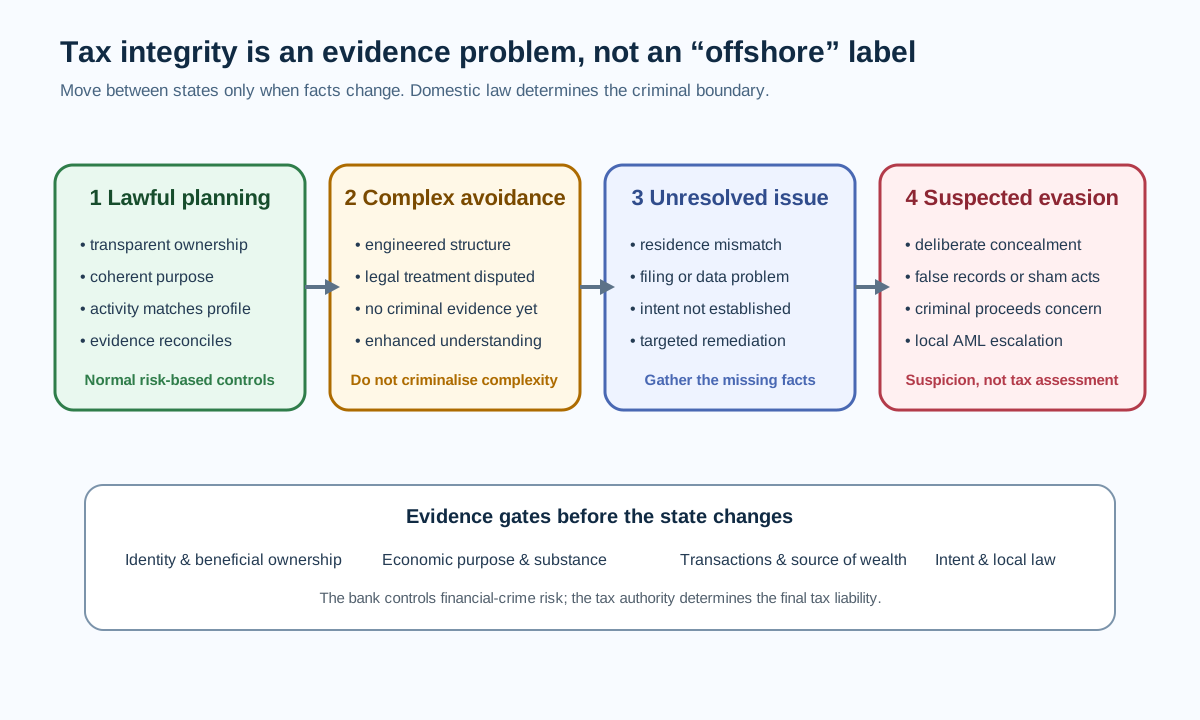
The core distinction: intent, law and evidence
In everyday conversation, tax avoidance is often used broadly to describe arrangements that reduce tax. In law and supervision, the terminology is more nuanced. Different jurisdictions distinguish lawful tax planning, avoidance, abusive avoidance, civil tax non-compliance and criminal tax evasion in different ways. A bank should therefore avoid assuming that one label has the same legal meaning everywhere.
For practical banking purposes, tax evasion should be understood as intentional conduct that violates tax law and can amount to a criminal offence under the relevant jurisdiction. Examples can include deliberately concealing taxable income, maintaining false books, using sham entities, submitting false documents, hiding beneficial ownership, fabricating expenses or intentionally failing to declare assets or gains where disclosure is legally required. The precise offence, mental element, monetary threshold and prosecution standard are matters of local law.
The OECD's Fighting Tax Crime: The Ten Global Principles deliberately uses a broad operational definition because countries differ. It describes tax crime as intentional conduct that violates a tax law and can be investigated, prosecuted and sentenced under criminal procedures. It also stresses that the boundary between administrative non-compliance and criminal conduct is jurisdiction-specific. That is an important discipline for banks: suspicious facts may justify enquiry or AML escalation without the bank pretending to decide the final tax offence.
Tax avoidance, by contrast, usually refers to arrangements designed to reduce tax while operating within the formal wording of the law. Some avoidance is ordinary and clearly contemplated by legislation, such as using a tax-advantaged retirement product. Some structures may be highly engineered or may exploit gaps, mismatches or technical interpretations that tax authorities challenge through anti-avoidance rules. An arrangement can be aggressive or disputed without automatically being criminal. Banks should not convert “complex” or “tax efficient” into “tax evasion” without evidence.
There is also a middle ground of civil tax non-compliance. A customer may make an incorrect return, miss a filing deadline, misunderstand tax residence, apply the wrong valuation method or underpay tax without the dishonesty or intent required for a criminal offence. The bank may still face risk, especially where the issue affects customer declarations or source-of-wealth credibility, but the response should reflect the evidence rather than assume deliberate fraud.
This is why intent matters. A false statement can be significant only after asking who made it, what they knew, what the law required, whether the statement was material, whether the inconsistency was accidental or deliberate, and whether later conduct supports or undermines the explanation. Banks rarely have all of those facts at the first alert. Good controls are built to gather them.
Why tax crime becomes a financial-crime issue
Tax crime matters to AML teams because the international AML framework treats tax crimes as a designated category of predicate offences. The FATF Glossary lists tax crimes related to direct and indirect taxes among the designated categories of offences, while allowing each country to define the relevant offences in domestic law. That means the underlying tax offence is not globally uniform, but serious tax crime can generate proceeds that are then concealed, transferred, converted or integrated through the financial system.
This creates an important analytical shift. The AML question is often not “did the customer pay the correct amount of tax?” It is “is there reasonable suspicion that assets or funds are the proceeds of criminal tax conduct, or that the banking relationship is being used to conceal or move them?” The difference protects the bank from drifting into unauthorised tax adjudication while still addressing money-laundering risk.
The OECD also treats tax crime as part of a broader economic-crime ecosystem. Its Ten Global Principles emphasise whole-of-government cooperation, international information exchange, professional enablers, asset recovery and the use of financial intelligence. This is relevant to banks because complex tax crime may overlap with fraud, corruption, false accounting, shell companies, trust structures, trade manipulation, securities activity, cryptoassets and cross-border payments.
In the European Union, the current criminal-law framework on money laundering includes tax crimes relating to direct and indirect taxes, as laid down in national law, among the relevant criminal activities. The EU supervisory perspective also makes a crucial distinction: AML/CFT and prudential supervisors are not tax investigators, but financial institutions are expected to have systems and controls that manage exposure to tax crime and laundering of its proceeds. The European Banking Authority's 2025 peer review on tax integrity is a useful example of this control-focused approach.
In the United States, FinCEN describes the Bank Secrecy Act framework as requiring financial institutions to help detect and report suspicious activity that may signify money laundering, tax evasion or other criminal activity. U.S. SAR obligations remain rule-specific by institution type and facts; this chapter does not transplant U.S. thresholds or filing rules into other jurisdictions.
In the United Kingdom, there is an additional and distinct corporate-risk dimension. Part 3 of the Criminal Finances Act 2017 created corporate offences for failure to prevent associated persons from criminally facilitating UK or foreign tax evasion, subject to the statutory framework and the defence relating to reasonable prevention procedures. The government guidance is built around six principles: risk assessment, proportionality of risk-based prevention procedures, top-level commitment, due diligence, communication and training, and monitoring and review. This is a UK-specific legal regime, not a universal global rule.
A useful four-state mental model
A bank can reduce confusion by thinking in four evidence states rather than two labels.
State 1: ordinary lawful tax planning. The structure has a credible commercial or personal purpose, ownership is transparent, documentation is coherent, tax residence and declarations are consistent, and the activity matches the customer's known profile. The bank does not need to prove that the arrangement is tax-optimal; it needs enough information to understand the relationship and its risk.
State 2: complex or aggressive avoidance with no evidence of criminality. The arrangement may be highly engineered, rely on multiple jurisdictions, or be under tax-authority challenge. The bank may need enhanced understanding, especially for reputational, conduct, product or tax-integrity reasons, but complexity alone does not justify a criminal label.
State 3: civil non-compliance or unresolved inconsistency. There may be late filings, inconsistent declarations, disputed residence, inaccurate self-certification or unexplained tax arrears. The bank should assess whether the facts create a KYC, source-of-funds, reporting or integrity issue and whether further evidence is needed.
State 4: suspected criminal tax evasion or facilitation. Indicators suggest intentional deception, concealment, falsification or knowing assistance. This can trigger AML investigation, legal escalation, employee-conduct review, restrictions, suspicious-activity reporting or other action according to local law and policy.
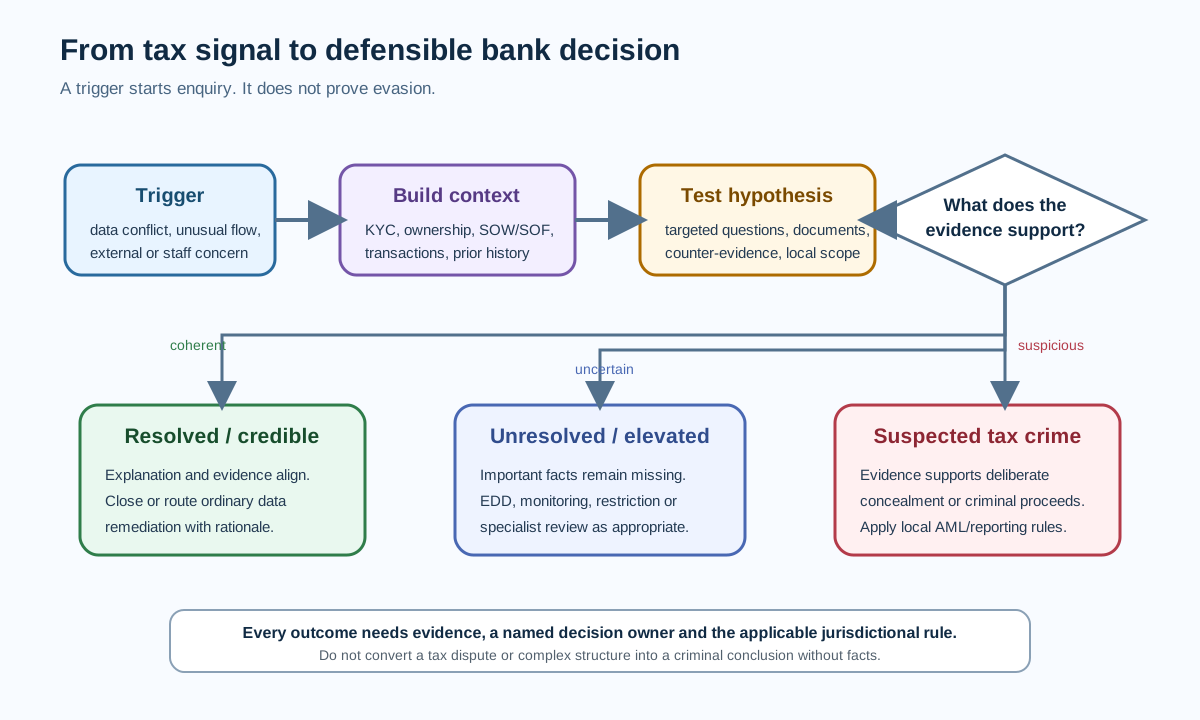
The value of this model is that it separates uncertainty from guilt. A case can move between states as evidence changes. A customer may begin in State 3 because tax residence data conflict, then return to State 1 after a credible explanation and documentary support. Another case may move from State 2 to State 4 when investigators discover falsified invoices, nominee ownership and deliberate concealment.
Where banks actually see tax risk
Tax risk appears differently across customer segments and products.
In retail banking, a bank may see salary credits, self-employment receipts, cash deposits, offshore transfers, investment income, property transactions or inheritance flows. A mismatch between declared occupation and account activity can be relevant, but it should be assessed together with source-of-funds evidence, customer history and reasonable explanations. A single overseas transfer is rarely enough.
In private banking and wealth management, tax integrity is closely linked to source of wealth, beneficial ownership, tax residence, trusts, foundations, holding companies and investment structures. Wealth advisers and relationship managers may possess more contextual information than transaction-monitoring systems. That creates both an opportunity and a control challenge: valuable knowledge must be captured and governed rather than remain in private conversations.
In corporate banking, tax risk can emerge through unusual intercompany payments, false invoices, circular financing, sham service fees, unexplained related-party flows, offshore entities without credible substance, or transactions inconsistent with the customer's operating model. Again, these patterns can have legitimate explanations. The control objective is to identify when the business rationale, tax position and economic activity do not align.
Trade finance can expose documentary inconsistencies that matter beyond customs or sanctions risk. Over- or under-invoicing, false description of goods, fabricated counterparties or manipulated documentation can intersect with tax fraud. Teams must distinguish tax-crime hypotheses from trade-based money-laundering, sanctions and fraud hypotheses while preserving shared evidence.
Securities and investment activity can raise separate tax-integrity concerns, including dividend-related schemes, manufactured payments, rapid ownership changes around record dates or arrangements designed to obtain tax refunds to which parties are not entitled. The EBA's work on dividend arbitrage schemes illustrates why banks need governance and control even though supervisors are not themselves tax investigators.
Payments are the connective tissue. Cross-border wires, correspondent banking, instant payments, cards and cryptoasset transfers may move proceeds or support concealment. Payment data alone is often insufficient to determine a tax offence, but it can reveal counterparties, jurisdictions, timing, references and patterns that become significant when combined with KYC and external information.
Customer tax information is not the same as tax advice
Banks collect tax-related information for different reasons. A tax-residency self-certification may be required for an automatic-exchange regime. A source-of-wealth form may ask how wealth was generated. A product process may capture tax treatment. A financial-crime team may ask questions because of suspicious behaviour. These are different control purposes and should not be collapsed into one field called taxRisk.
The system should preserve purpose, source and effective date. A customer's CRS self-certification is evidence of what the customer declared for a specific reporting framework. It is not, by itself, a legal opinion that the customer has no tax risk. Similarly, a relationship manager's note that a client is “tax compliant” is weak evidence unless the statement is supported by defined documentation and the bank is entitled to rely on it.
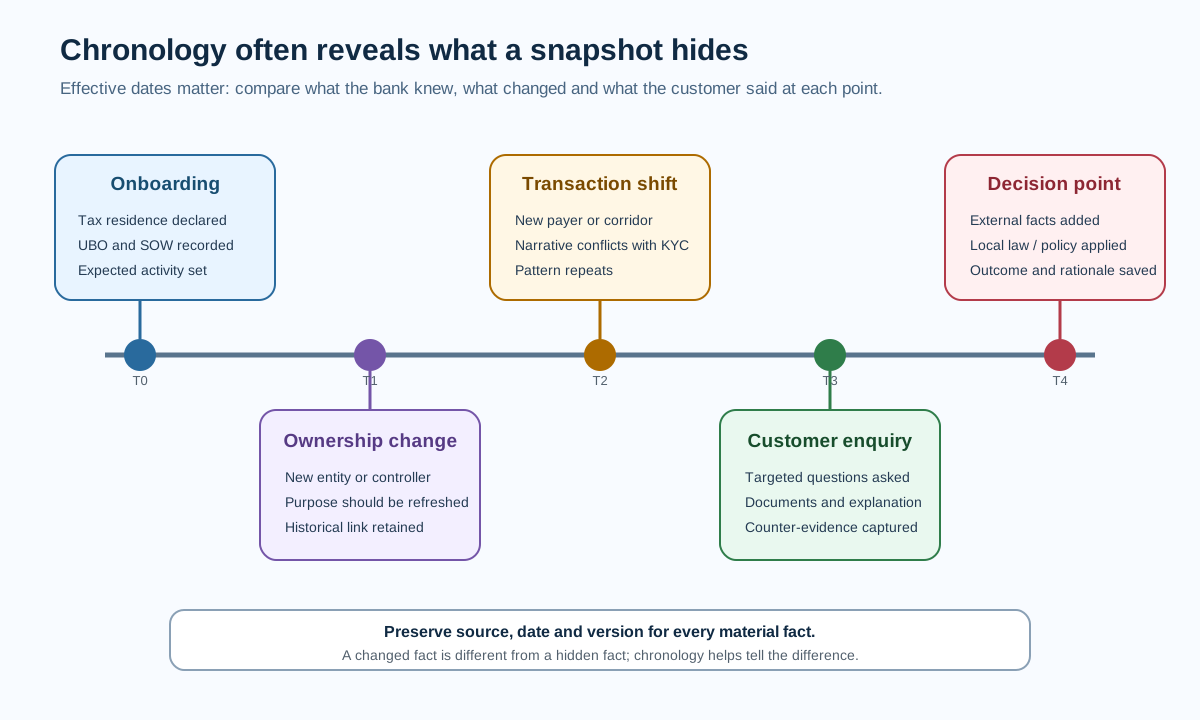
Data models should distinguish at least the customer or entity, tax-residence claims, taxpayer identifiers where lawfully collected, beneficial owners and controllers, source-of-wealth evidence, related entities, product holdings, transaction activity, alerts, case outcomes and relevant jurisdictional flags. Historical versions matter. If a customer changed tax residence two years ago, investigators may need to reconstruct what the bank knew at the time of an earlier transaction.
Source of wealth and source of funds
Tax evasion cases often surface through source-of-wealth or source-of-funds analysis because criminal tax conduct can undermine the credibility of the stated origin of assets.
Source of wealth asks how the customer accumulated overall wealth: salary, business ownership, property, inheritance, investment gains, sale of a company and so on. Source of funds asks where the money for a particular transaction came from. A customer can have legitimate overall wealth but still use funds connected to tax fraud, and the reverse can also be true: an unusual transaction may be fully legitimate even if it looks inconsistent at first.
Investigators should avoid circular reasoning. “The customer is wealthy, therefore the funds are legitimate” is unsafe. So is “the customer uses an offshore company, therefore the funds are illicit.” Evidence should connect the claimed wealth or funds to documents, counterparties, transaction history and the customer's economic story.
For business owners, useful evidence may include audited accounts, sale agreements, dividend records, company registries and bank statements. For inherited wealth, probate or estate documentation may help. For property sales, land registry and completion documents can be relevant. The bank should collect only what policy and law permit and should avoid demanding excessive tax documents without a defined control purpose.
Beneficial ownership and economic substance
Opaque ownership is a recurring tax-crime risk because a structure can be used to separate legal title from real control. But legal persons, trusts and foundations are also normal parts of commerce and wealth planning. The control objective is transparency, not suspicion by association.
A bank should understand the beneficial owners and controllers required under applicable law and policy, the purpose of intermediate entities, the relationship between counterparties and whether the observed activity is consistent with the stated business model. A company that receives millions in “consulting fees” but has no employees, premises, intellectual property or credible operating activity may warrant deeper enquiry. The issue is not that it is offshore; the issue is whether the economic story can be reconciled with the evidence.
Economic substance is not a universal binary test. Tax law may define substance differently across regimes. For AML purposes, it is better treated as an investigative lens: does the entity appear capable of performing the activity it claims, and do the money flows match that capability?
The bank's control architecture
A strong tax-integrity framework does not rely on one “tax evasion scenario.” It combines customer due diligence, product controls, transaction monitoring, employee conduct, escalation and reporting.
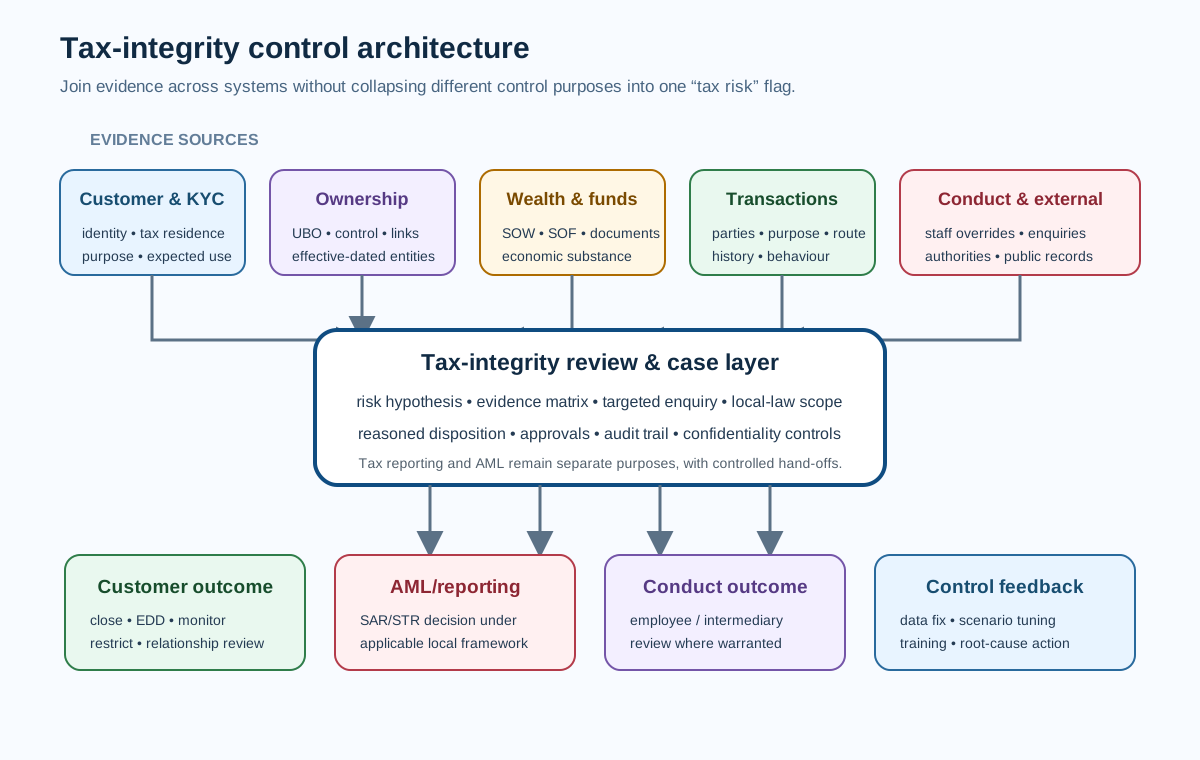
At onboarding, the bank establishes identity, beneficial ownership, purpose, expected activity and relevant tax information. During the relationship, event-driven review responds to material changes such as new jurisdictions, ownership changes, unusual wealth events, negative information, tax-authority enquiries or behaviour inconsistent with the profile.
Transaction monitoring can detect patterns such as unexplained pass-through flows, circular transfers, unusual cash activity, payments to apparently unrelated entities, offshore layering, or discrepancies between expected and actual behaviour. These are not “tax-evasion proof.” They are detection signals that may justify investigation.
Employee and intermediary controls matter because the bank can face a different risk where its own associated persons knowingly help customers evade tax. Segregation of duties, conflicts controls, approval rules, training, surveillance of sensitive activity, escalation channels and protected whistleblowing routes can all be relevant. In jurisdictions with specific failure-to-prevent regimes, the design must map to the legal requirements for that regime.
Case management should capture the hypothesis, evidence, enquiries, reasoning, disposition, reporting decision and follow-up actions. The case record should show why the bank believed the concern was resolved or remained suspicious. A dropdown outcome such as “false positive” is not enough.
Suspicion is not a tax assessment
When a bank investigates potential tax crime, it must resist two opposite errors.
The first is underreach: closing a case because the bank cannot calculate the tax loss. AML suspicion usually does not require the institution to complete a tax audit. If the evidence supports a reasonable suspicion of criminal conduct or criminal proceeds under local law, the case may need escalation even though the exact liability is unknown.
The second is overreach: treating every tax dispute, complex structure or offshore connection as criminal. A tax authority may later challenge an arrangement on technical grounds without alleging fraud. The bank should document what it knows and what it does not know.
The best investigation language is factual. Instead of “customer is evading tax,” the case might say: “The customer declared residence in Jurisdiction A, but account records show persistent residence indicators in Jurisdiction B; the customer declined to explain the discrepancy; funds were transferred from a company beneficially owned by the customer and described as consulting income; invoices provided contain inconsistencies; external records show no apparent operating activity at the company address. The case is escalated to assess potential tax-crime and money-laundering risk under applicable local law.”
That wording separates evidence from conclusion.
Reporting and confidentiality
Suspicious-activity or suspicious-transaction reporting obligations vary by jurisdiction. The trigger, filing body, timeline, confidentiality rule, consent or defence process, and treatment of transactions can differ significantly. A global bank therefore needs a jurisdictional rules layer rather than one universal workflow.
In the United States, FinCEN rules require covered financial institutions to file SARs when defined suspicious-activity criteria are met, and supporting documentation must be retained and made available in accordance with the BSA framework. In the EU and UK, reporting routes and legal terminology differ. Other jurisdictions use STR, SMR or similar terminology and may have different thresholds.
Employees should never tell a customer that a suspicious report has been filed where local law prohibits disclosure. Customer communication should instead use approved neutral language about review, documentation or service availability.
Customer impact and proportionality
Tax controls can create substantial customer harm if designed poorly. Legitimate expatriates, international businesses, family offices, migrant workers and cross-border investors naturally have multi-jurisdictional financial lives. Treating foreign addresses, offshore entities or complex ownership as inherently suspicious can create unfair outcomes and excessive de-risking.
The answer is not weaker control; it is better evidence and better segmentation. A private bank should expect more complex structures than a basic retail product. A multinational corporate should have more intercompany activity than a local sole trader. Monitoring thresholds, review questions and escalation expectations should reflect those differences.
Customers also deserve clear requests. Asking “prove you have paid all taxes everywhere” is usually too broad and may be impossible. Asking for defined evidence to resolve a specific inconsistency is more proportionate and operationally useful.
What a good analyst should be able to explain
At the end of a tax-integrity case, an analyst should be able to explain five things in plain language:
- What triggered concern?
- Which jurisdictional or policy risk is relevant?
- What evidence supports or weakens the hypothesis of criminal tax conduct?
- Why did the bank choose its outcome?
- What happens next: monitoring, reporting, remediation, restriction, relationship review or closure?
If those answers are missing, the control is probably relying too heavily on labels.
Key takeaways
Tax evasion and tax avoidance are not interchangeable. Tax evasion involves intentional unlawful conduct under the relevant jurisdiction; lawful planning and even aggressive avoidance can sit outside criminal law. Banks therefore need evidence-based decisioning rather than keyword-based suspicion.
Tax crime becomes an AML concern because serious tax offences can be predicate offences to money laundering, but the underlying offence remains defined by domestic law. A bank is not required to become a tax authority to recognise suspicious criminal patterns.
The strongest control model joins customer due diligence, beneficial ownership, source of wealth, transaction behaviour, employee conduct, case management and jurisdiction-specific reporting. It also protects legitimate customers by distinguishing complexity from concealment and uncertainty from proof.
The next sections deepen that model through typologies, data design, monitoring logic, investigation practice, delivery requirements and a realistic case study.
Operational deep dive: how tax-crime risk becomes visible
The base chapter separated lawful planning, avoidance, civil non-compliance and suspected evasion. In practice, investigators rarely receive a case labelled neatly. They receive fragments: a tax-residency inconsistency, an unexplained offshore transfer, a company with little apparent substance, a relationship manager's concern, a request from an authority, unusual cash activity, or a customer explanation that does not reconcile with the account history. This section shows how to turn those fragments into a disciplined investigation.
Start with a hypothesis, not a conclusion
A useful case hypothesis is narrow enough to test. “Tax risk” is too vague. “The customer may be concealing personally controlled business income through an offshore company and transferring the proceeds to a private account without a credible commercial explanation” is testable. It identifies the suspected conduct, the entities involved and the evidence that would strengthen or weaken the concern.
The analyst should then build an evidence matrix. One column records the fact. Another records the source and date. A third explains whether the fact supports, contradicts or is neutral to the hypothesis. A fourth identifies what still needs to be obtained. This simple discipline prevents confirmation bias because evidence against the suspicion is captured with the same care as evidence supporting it.
An example illustrates the point. A customer receives a large payment from a company in a low-tax jurisdiction. That fact alone is weak. The concern becomes stronger if the customer beneficially owns the company, the company has no apparent operations, the payment is described inconsistently across documents, and the customer previously told the bank that the company was dormant. It becomes weaker if the company is an active trading business, the payment is a documented dividend or sale distribution, the ownership chain is transparent and the transaction matches the customer's known wealth.
Red flags that need context
Tax-crime indicators are useful only when tied to a credible risk theory.
Repeated transfers to or from jurisdictions associated with secrecy can matter when ownership is unclear or explanations are inconsistent. The same transfers may be ordinary for a multinational group with documented operations.
Unexplained use of shell or nominee entities can matter where control is deliberately obscured. A holding company, special-purpose vehicle or trust is not inherently suspicious; the question is whether the structure has a credible legal and economic purpose and whether the bank can identify the people who ultimately own or control it.
False invoices, fabricated expenses or manipulated contracts are more direct concerns because they may evidence deliberate deception. Analysts should still verify provenance. A typo, an outdated invoice template or a disputed service description is not automatically fraud.
Cash-intensive activity can support a tax-evasion hypothesis where declared turnover, tax information and account activity diverge materially. But cash use varies by sector and geography. A restaurant, market trader or small retailer should not be assessed against the same behavioural baseline as a software company.
Transfers shortly before or after tax-reporting deadlines can be relevant, but timing alone is weak. The significance depends on the customer's tax residence, the applicable law and what the transaction is intended to achieve.
Requests from a customer to omit information, alter payment narratives, split transfers, route funds through unrelated parties or avoid normal documentation are more serious because they may evidence an intention to conceal. If an employee assists knowingly, the case may also raise internal conduct or facilitation risk.
Cross-border structures and the substance question
International structures require careful analysis because legitimate tax planning and criminal concealment can use similar legal building blocks. The difference often lies in transparency, consistency and purpose.
A practical investigation maps five layers: the legal entities; the beneficial owners and controllers; the jurisdictions; the contracts or declared business purpose; and the actual money flows. The analyst then asks whether those layers tell the same story.
Suppose a consultancy company in Jurisdiction X invoices a customer company in Jurisdiction Y. The owner of both companies is the same individual. The consultancy has no employees, website or evident premises, and the fees are large relative to the operating company's revenue. Those facts do not prove tax evasion, but they justify questions about the service provided, pricing, decision makers, economic activity and source of the funds. If the customer provides detailed contracts, evidence of specialist subcontractors and consistent accounting records, the risk picture can change.
The bank should avoid pretending to perform transfer-pricing analysis or determine treaty entitlement unless that is genuinely part of its regulated service and supported by specialists. The financial-crime task is to understand whether the structure is credible or whether there are signs of deliberate deception, sham activity or laundering of criminal tax proceeds.
Tax residence inconsistencies
Tax residence is a frequent source of false alarms because people can have genuine connections to several countries. Citizenship, nationality, domicile, residence and tax residence are not synonymous. Automatic-exchange frameworks use specific definitions and documentation rules that should not be generalised beyond their purpose.
When a bank finds conflicting residence indicators, the first step is to understand the source. Was the address captured for correspondence, legal residence, tax reporting or KYC? Is the data current? Did the customer move? Does the customer have multiple tax residences? Are different systems using different effective dates?
The second step is to resolve the inconsistency through the appropriate process. This may involve updated self-certification or other evidence required by the relevant reporting regime. A financial-crime case is appropriate when the facts suggest intentional misrepresentation, concealment or misuse, not merely because data sources disagree.
The distinction matters operationally. A poor design sends every data mismatch to AML investigators, creating noise and delay. A mature design routes straightforward tax-reporting data remediation to the specialist reporting process and escalates only cases with financial-crime indicators.
Professional enablers and intermediaries
The OECD has highlighted the role of professional enablers in tax and white-collar crime. Banks may encounter accountants, lawyers, company-service providers, wealth advisers or other intermediaries who establish or manage structures for customers. Most provide legitimate services. Risk arises when an intermediary appears to design or operate arrangements intended to conceal ownership, fabricate transactions, defeat reporting or obstruct authorities.
The bank should not infer complicity from profession alone. Instead, look for patterns: repeated use of the same opaque entities across unrelated clients, standardised explanations that do not match account behaviour, unexplained control over customer accounts, instructions designed to avoid documentation, or links to enforcement action.
Intermediary risk also affects onboarding. A customer introduced by a reputable professional does not eliminate the bank's own CDD obligations. Equally, an introduction by a high-risk intermediary does not automatically make the customer criminal. The intermediary is one part of the evidence picture.
From alert to investigation
A practical tax-crime workflow normally has five stages.
Triage establishes whether the signal is credible, whether the customer and relevant parties are correctly identified, and whether there is an obvious benign explanation. Duplicate alerts and known data-quality issues should be resolved here.
Context building brings together KYC, beneficial ownership, expected activity, source of wealth, product usage, transaction history, prior alerts, tax-related declarations, external information and relationship-manager knowledge.
Targeted enquiry seeks the minimum additional evidence needed to test the hypothesis. Questions should be specific: what was the purpose of this payment; what service did this entity provide; why did ownership change; what explains the source of these funds; why does the current tax-residence information differ from earlier records?
Decisioning separates resolved inconsistency, elevated but manageable risk, suspected criminal activity and other policy outcomes. The reporting decision should be made under the law of the relevant jurisdiction, not by copying a global threshold.
Feedback updates customer risk, monitoring, employee-conduct controls, typologies and data-quality fixes. A case that reveals a structural control gap should not end when the individual alert closes.
Transaction monitoring design
There is rarely a single reliable “tax evasion” rule. Effective detection combines scenarios and contextual data.
One scenario may look for rapid movement of business receipts from a company account to personally controlled accounts in other jurisdictions, especially where the business profile does not support the pattern. Another may focus on repeated cash deposits materially inconsistent with declared turnover. Another may detect circular intercompany payments with limited apparent business purpose. Wealth-management controls may focus more on source-of-wealth changes, ownership structures and unusual distributions.
Scenario design should document the risk hypothesis, required data, segmentation, threshold rationale, exclusions, expected false-positive drivers and downstream action. If a scenario uses a country-risk list, the bank should know who owns the list, what evidence supports it and how changes are governed. “Offshore” is not a sufficient risk definition.
Testing should include legitimate cross-border customers so that the model does not simply learn complexity as suspicion. Negative testing is as important as positive testing.
Employee facilitation risk
Customer tax crime and employee facilitation are related but distinct control problems.
An employee may notice suspicious facts and fail to escalate through negligence; that is primarily a control-performance issue. An employee may deliberately help a customer hide information, bypass checks or construct transactions designed to conceal tax liabilities; that may raise misconduct, criminal or corporate-liability concerns depending on the jurisdiction.
The UK Criminal Finances Act 2017 provides a concrete example. Its corporate offences concern a relevant body's failure to prevent an associated person from criminally facilitating tax evasion, subject to the statutory tests and reasonable-procedures defence. The official guidance makes clear that the regime does not make a company automatically responsible for its customers' crimes and does not turn aggressive avoidance, by itself, into the offence.
For a bank, practical controls include risk assessment of products and roles, staff training, conflict controls, escalation channels, surveillance of overrides, review of unusual exceptions, restrictions on employee access to sensitive customer data, and investigation of patterns where staff repeatedly help customers bypass normal processes.
Governance and decision rights
Tax-integrity cases often cross organisational boundaries: AML, tax reporting, legal, compliance, private banking, fraud, operations and employee relations. Without clear decision rights, cases can stall or be closed on incomplete assumptions.
The operating model should specify who owns the AML suspicion decision, who interprets tax-reporting obligations, who gives legal advice, who can restrict or exit a relationship, who manages employee misconduct, and who owns regulatory notifications outside the AML reporting process.
A committee should not be used to blur accountability. The case file should show the decision owner and the evidence relied on.
Management information should distinguish at least: alerts generated; cases opened; jurisdictions and products involved; ageing; reporting outcomes; employee-facilitation concerns; repeat customers; data-quality root causes; confirmed control breaches; customer-impact events; and remediation progress. Volumes without outcomes can hide weak effectiveness.
Common failure modes
The most common failure is binary thinking: lawful or criminal, with no room for unresolved evidence. That drives both over-escalation and premature closure.
The second is tax jargon without operational meaning. Terms such as “avoidance,” “substance,” “offshore” or “aggressive planning” are entered into systems without definitions, leading different teams to interpret them differently.
The third is fragmented data. Tax residence sits in one platform, beneficial ownership in another, source-of-wealth evidence in documents, and alerts in a case tool. Investigators spend more time reconciling systems than analysing risk.
The fourth is poorly scoped requests for information. Broad demands for “proof of tax compliance” create customer friction and weak evidence. Targeted questions resolve specific contradictions more effectively.
The fifth is assuming an external professional has done the bank's job. Advice from an accountant or lawyer may be relevant evidence, but it does not automatically resolve AML concerns or substitute for CDD.
The sixth is failure to learn from cases. If repeated alerts reveal that the same product allows manual overrides or incomplete ownership capture, the problem is no longer an individual customer issue; it is a control-design issue.
The goal of the deep dive is therefore not to teach bankers to calculate tax. It is to teach them to recognise when the financial story stops making sense, gather proportionate evidence, apply the right jurisdictional framework and preserve a defensible decision.
Advanced practice: data, architecture, BA requirements and testing
Tax-integrity controls become fragile when policy language is not translated into data, system behaviour and testable decisions. This section is aimed especially at business analysts, architects, developers, testers, product owners and control owners who need to make the chapter operational.
Design the data model around evidence
A useful tax-integrity data model should not attempt to calculate a universal “tax compliance score.” It should preserve evidence that different controls can interpret according to purpose and jurisdiction.
At customer level, the model may need legal name, customer type, country connections, tax-residence declarations where lawfully collected, beneficial owners, controllers, occupation or business activity, expected transaction behaviour, source of wealth, source of funds, linked entities, onboarding risk and review history.
At transaction level, the bank may need payer and payee, amount, currency, payment purpose, account, channel, counterparties, countries, intermediary institutions, related transaction identifiers and relevant free text. For trade or securities products, additional product-specific data may matter.
At case level, preserve the alert reason, hypothesis, evidence items, enquiries, responses, reviewer reasoning, legal or policy consultations, reporting outcome, restrictions, customer communication and remediation actions.
Every material data element should have provenance. A tax-residence value without source, effective date and status is dangerous because investigators cannot tell whether it is current, customer-declared, inferred or system-generated.
Entity resolution is also central. If an individual controls three companies, investigators should be able to see the relationship without manually searching unrelated systems. Relationships should be effective-dated so historical cases can be reconstructed accurately.
Separate tax reporting from financial-crime decisioning
One of the strongest architecture choices is to keep distinct control purposes distinct while allowing controlled information sharing.
A CRS or FATCA workflow has its own legal definitions, documentation and reporting rules. An AML investigation has different triggers and legal consequences. Employee-facilitation monitoring has another purpose again. The same fact may be relevant to all three, but the system should not assume that a failure in one process automatically determines the outcome in another.
For example, an invalid tax self-certification may require remediation under the reporting framework. It becomes a financial-crime concern when the surrounding facts suggest intentional deception, concealment or criminal proceeds. A good architecture allows the reporting platform to raise an event to AML without labelling the customer as a tax evader.
This separation also improves auditability. Reviewers can see which rule triggered which action and avoid circular logic where one internal risk label becomes evidence for another.
Business requirements that can actually be tested
A weak requirement says: “The system shall identify tax evasion.” That is not buildable.
A stronger requirement says: “Where a customer's active tax-residence declaration conflicts with two or more defined residence indicators and the discrepancy remains unresolved after the configured remediation period, the platform shall create a tax-integrity review event containing the conflicting data values, their sources, effective dates and prior remediation history. The event shall not set a criminal-risk outcome automatically.”
Another strong requirement might state: “Where a reviewer selects an outcome of suspected tax crime, the case cannot close until the reviewer records the relevant jurisdiction, risk hypothesis, evidence summary, reporting decision status and approver required by the jurisdictional rules table.”
For employee facilitation, a requirement might say: “Manual overrides of tax-related documentation controls by staff in designated high-risk roles shall be logged with employee ID, customer ID, timestamp, original value, revised value, reason and approver, and shall be available to surveillance rules without exposing SAR information to unauthorised users.”
These requirements make decision rights and evidence explicit.
Jurisdictional rules as controlled configuration
Global banks should avoid hard-coding one country's legal threshold into the common platform.
A jurisdictional rules service or controlled configuration can store fields such as reporting authority, filing terminology, decision owner, time limits, transaction-handling rules, confidentiality constraints, record-retention requirements and required approvals. Legal and compliance owners should govern changes with effective dates and version history.
The application should record which version of the rule set was applied to a decision. If legislation changes later, auditors can still reconstruct the decision against the rule in force at the time.
This architecture is particularly important for tax crime because the underlying offence itself varies by jurisdiction. FATF defines the category globally, but domestic law defines the offence.
Testing strategy
Positive testing should prove that meaningful risk reaches the right outcome. Test cases can include a customer who deliberately contradicts prior ownership information, a business using fabricated invoices, a private client routing undeclared income through a controlled offshore company, or an employee repeatedly overriding documentation controls for the same client.
Negative testing should prove that legitimate complexity does not create automatic suspicion. Cases should include multinational companies with documented intercompany payments, expatriates with multiple residence indicators, transparent family trusts, lawful tax-advantaged products and genuine cross-border inheritances.
Boundary testing is critical. What happens when one residence indicator conflicts but another does not? What happens when an ownership record changes on the same day as a high-value payment? What happens when the relevant jurisdiction cannot be determined? What happens when required external data is unavailable?
Failure-mode testing should simulate unavailable screening services, stale tax-residence data, duplicate customer records, missing beneficial-owner links, failed case routing, incomplete employee IDs and delayed ingestion of transactions.
Access-control testing should verify that tax documents, employee-investigation data and suspicious-reporting information are visible only to authorised roles. Privacy and secrecy requirements differ by jurisdiction, so the test pack should validate the bank's approved access model rather than invent a universal rule.
Regression testing should be mandatory when tax-reporting logic, customer master data, ownership services, transaction feeds, country-risk configuration or case-management rules change. A seemingly unrelated data migration can silently weaken tax-integrity detection.
Data-quality controls
Completeness checks should identify missing mandatory fields. Validity checks should confirm formats and allowed values. Consistency checks should compare related systems. Timeliness controls should identify stale records. Reconciliation should prove that expected events reached the monitoring platform.
Data lineage should answer a practical question: if a reviewer sees “tax residence: Jurisdiction A,” can the bank explain where that value came from and every transformation applied before it appeared in the case?
Quality metrics should be risk-weighted. A missing optional contact field is not equivalent to a missing beneficial owner or incorrectly mapped customer jurisdiction. Control owners should prioritise defects based on their impact on decisions.
Model and scenario governance
If analytics or machine learning is used to prioritise tax-integrity alerts, the bank still needs explainability appropriate to the decision. Analysts should know which features materially influenced prioritisation and whether those features create unfair proxies for nationality, residence or customer type.
Training data can embed historical bias. If prior investigators over-escalated offshore customers, a model trained on their decisions may reproduce that pattern. Validation should therefore examine not only predictive performance but also segment outcomes and false-positive drivers.
Scenario tuning should preserve the risk hypothesis. A threshold should not be raised merely to reduce workload if doing so removes the very behaviour the scenario was built to detect. Capacity problems should be addressed transparently rather than hidden through silent weakening of detection.
Governance and assurance
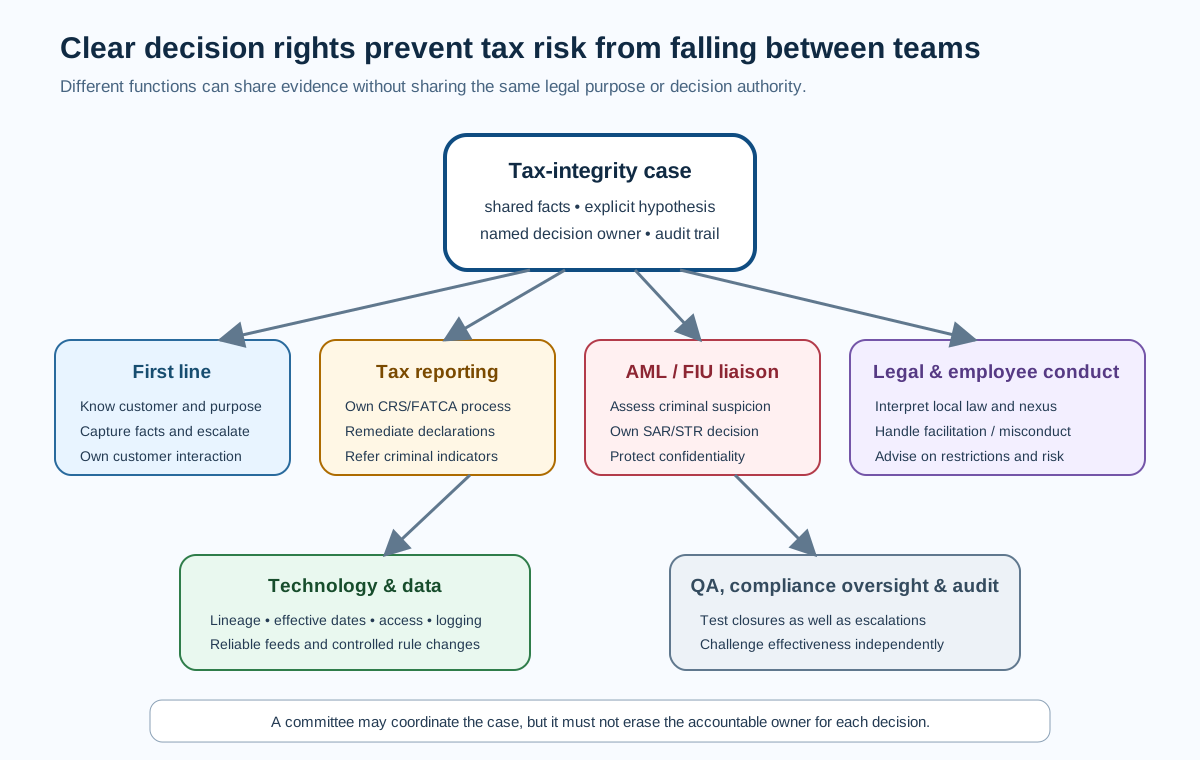
The first line owns accurate customer information and appropriate escalation. AML specialists own financial-crime interpretation and suspicious-activity decisions within their remit. Tax-reporting teams own the reporting frameworks assigned to them. Legal interprets law. Employee-relations or conduct teams handle internal misconduct under applicable rules. Technology owns implementation and data reliability. QA tests case quality. Internal audit independently assesses the framework.
The hand-offs should be explicit. A tax-reporting team may identify suspicious deception but should not silently close it as a documentation issue. An AML team may discover an invalid self-certification but should route the reporting remediation to the right owner rather than attempt to operate that framework itself.
Assurance should sample both escalated and non-escalated cases. Reviewing only SAR/STR cases can miss weak closures. It should also test whether evidence was current, whether customer explanations were challenged appropriately, whether legal conclusions were jurisdictionally correct, and whether follow-up actions actually occurred.
A mature control can answer not only “how many alerts did we close?” but “what tax-crime risks did we detect, what evidence drove outcomes, where did our controls fail, what customer harm did we avoid, and what changed because we learned from the cases?”
Practice close: analyst, BA and testing checklist
This closing section converts the chapter into a practical review pack. It is intentionally concise so it can be used during design workshops, case reviews and control testing.
For investigators
Before closing a tax-integrity case, confirm that the case states a specific risk hypothesis rather than a generic “tax concern.” Verify the relevant customer, entities and beneficial owners. Reconcile the customer's explanation with transaction history and known business activity. Capture evidence that weakens the suspicion as well as evidence that supports it. Identify the relevant jurisdictional framework before making a reporting decision. Record why the final outcome is proportionate.
Do not describe an offshore structure, trust, holding company, foreign address or complex transaction as criminal merely because it is unusual. Do not close a case merely because the exact tax loss cannot be calculated. The investigation is about credible suspicion and financial-crime risk, not completing a tax assessment.
For business analysts and product owners
A build-ready requirement should define the trigger, required data, evidence source, decision owner, exception path, jurisdictional rule and audit record. Avoid requirements that say only “identify suspicious tax activity.”
Confirm that tax-reporting data and AML outcomes are separated by purpose. Ensure residence, ownership and source-of-wealth records are effective-dated. Ensure case systems can preserve the hypothesis, evidence and reasoning. Confirm that manual overrides create auditable events and that employee-facilitation concerns can be routed to an authorised process.
Check customer communication. The user journey should request specific evidence to resolve a defined inconsistency, not demand impossible blanket proof of tax compliance.
For testers
A minimum test pack should include:
| Test family | Example | Expected control behaviour |
|---|---|---|
| Legitimate complexity | Transparent multinational with intercompany flows | No automatic criminal outcome; activity assessed against profile |
| Residence mismatch | Customer moves country and updates records late | Data remediation first unless other criminal indicators exist |
| Concealment pattern | Undisclosed controlled entity routes personal income | Investigation receives ownership, transaction and history context |
| False documents | Material invoice inconsistencies plus unexplained counterparties | Escalation according to risk and jurisdiction |
| Employee override | Staff member repeatedly bypasses documentation controls | Override logged and routed to surveillance or review |
| Data failure | Beneficial-owner feed unavailable | Defined fallback; case does not silently clear |
| Reporting rule change | Jurisdiction updates filing process | Effective-dated rule version applied and auditable |
Negative testing should be treated as a control requirement, not a nice-to-have. The bank must prove that legitimate expatriates, family structures, tax-advantaged products and cross-border businesses can pass without unnecessary escalation when the evidence is coherent.
Questions for a design review
Can the bank explain why a case was created?
Can the reviewer see the source and effective date of tax-related information?
Can the reviewer identify the real customer and connected entities without searching several disconnected systems?
Does the control distinguish customer criminality from employee facilitation?
Does the system allow uncertainty without forcing a false “clear” or “criminal” label?
Are jurisdiction-specific reporting rules configurable and versioned?
Can the bank prove that the five diagrams and linked evidence used in this chapter correspond to real control concepts rather than decoration?
Would an independent reviewer understand the outcome six months later without asking the original investigator?
If the answer to any of these questions is no, the control is not finished.
Final learning point
The professional skill in tax-integrity work is not spotting the word “offshore.” It is distinguishing lawful complexity from deliberate concealment through evidence, understanding where AML duties begin and end, applying the correct jurisdictional rules, and building systems that preserve the reasoning behind every material decision.
Masterclass: when an offshore structure becomes a financial-crime case
This case is fictional but built from recurring patterns described in public tax-crime, AML and professional-enabler guidance. The names, amounts and jurisdictions are illustrative. The point is to practise evidence-based decisioning, not to imply that any particular jurisdiction, structure or profession is suspicious.
The starting profile
A private-banking customer, Arun, has held accounts with the bank for eight years. His recorded source of wealth is the sale of a regional logistics business, followed by investment income. He is tax resident in Jurisdiction A according to the latest customer declaration. He also owns a residential property in Jurisdiction B and spends part of the year there.
At onboarding, Arun disclosed a family investment company, Meridian Holdings Ltd, incorporated in Jurisdiction C. The bank identified Arun as the ultimate beneficial owner. Meridian was described as an investment-holding vehicle funded from the documented business sale. Over several years, the account showed ordinary portfolio transactions and distributions consistent with that explanation.
Nothing in this profile, including the offshore company, is inherently suspicious.
The trigger
A monitoring alert is created after three payments totalling the equivalent of EUR 2.4 million arrive in Arun's personal account from a second company, Northstar Advisory Ltd, also incorporated in Jurisdiction C. The payment narratives say “consulting fee.” Northstar was not previously disclosed as part of Arun's structure.
The relationship manager says Arun mentioned “some advisory work” but does not know the details. The customer file still describes him as retired from active business.
The alert should not be closed merely because Arun is wealthy. Nor should it be escalated as tax evasion solely because the payer is offshore. The facts are inconsistent enough to justify enquiry.
Building the evidence
The investigator first confirms that the payments are genuine and identifies Northstar's available ownership information. Public records are limited. A corporate service provider appears as director, and no natural-person owner is visible from the public source.
The investigator reviews Arun's historic transactions. Over the previous eighteen months, Meridian has made six payments to Northstar labelled “management services.” Northstar then made payments to Arun personally several weeks later. The aggregate amount is material compared with Arun's previously declared annual investment income.
The customer is asked targeted questions: what service did Arun provide; what is his relationship with Northstar; why did Meridian pay Northstar; who ultimately owns or controls Northstar; and what documents support the consulting fees?
Arun replies that Northstar is an independent advisory firm and that the payments represent strategic advice he gave to several companies. He provides two invoices. The invoices contain generic descriptions and the same formatting as Meridian's internal documents. The bank also notices that the contact email on one invoice uses a domain registered to an entity connected with Arun's former business partner.
None of those facts alone proves criminality. Together, they strengthen the hypothesis that Northstar may be connected to Arun and that the stated consulting explanation may not reflect the real economic arrangement.
A critical counter-fact
Before escalating, the investigator finds evidence that weakens part of the suspicion. Arun has genuinely acted as an adviser to two portfolio companies, and board minutes confirm his participation. A portion of the consulting income therefore appears commercially plausible.
This is important. Good investigation does not discard evidence because it is inconvenient.
The case hypothesis is refined. The question is no longer “are all consulting payments sham?” It becomes: “Is Northstar being used to route income or distributions controlled by Arun in a way that conceals the true source, ownership or tax treatment of part of the funds?”
The employee-conduct dimension
A review of case notes shows that six months earlier Arun asked the relationship manager whether Northstar could be added as an “approved external adviser” without providing ownership information. The relationship manager created a free-text note stating that “tax advisers confirmed structure okay” and did not refer the request to the specialist team.
The investigator must not infer criminal facilitation from that weak control alone. The manager may have misunderstood the process. However, because the manager later approved two manual document exceptions related to Northstar, the matter is referred to employee conduct for an independent review.
This separation is important. The customer AML investigation and the employee-conduct investigation can share authorised evidence, but they should not contaminate each other with unsupported conclusions.
Jurisdictional analysis
Legal and compliance specialists determine which entities, transactions and bank branches are relevant to which jurisdictions. They also determine whether the facts potentially meet local suspicious-reporting tests and whether any additional tax-reporting remediation is required.
The bank does not attempt to calculate Arun's tax liability. It focuses on whether there is suspicion of deliberate concealment or criminal proceeds and whether the relationship remains within risk appetite.
The analysis also confirms that the UK corporate failure-to-prevent regime does not automatically apply merely because the bank group has a UK presence; the relevant legal nexus and associated-person facts must be assessed properly. This prevents careless globalisation of a jurisdiction-specific offence.
Outcome
The bank concludes that the inconsistencies cannot be satisfactorily resolved. The relationship between Arun, Meridian and Northstar is more connected than originally disclosed, the flow of funds is circular, the documentation is weak, and key ownership information remains unavailable. The authorised financial-crime decision maker determines that the local reporting threshold is met and files the required report under the applicable jurisdictional process.
Separately, the customer-risk committee places the relationship under enhanced monitoring while legal and business teams assess whether continued service is appropriate. The bank does not tell Arun that a suspicious report was filed where disclosure is prohibited.
The employee-conduct review finds no evidence that the relationship manager knowingly helped evade tax, but it identifies poor escalation and undocumented reliance on a customer's verbal statement about external tax advice. The manager receives remediation, and the control design is changed so that future attempts to add external advisers require structured ownership and purpose data.
What the case teaches
The decisive factor was not “offshore.” It was the accumulating mismatch between the declared structure and the observed economic relationships.
The case also shows why tax crime cannot be solved by a single monitoring rule. Transaction data raised the alert, KYC provided the baseline, beneficial-ownership work identified gaps, customer enquiry tested the explanation, employee records exposed a process weakness, and jurisdictional analysis determined the legal response.
Most importantly, the bank remained within its role. It did not decide the customer's final tax liability. It identified facts that supported suspicion of deliberate concealment, applied its AML and conduct frameworks, preserved evidence, reported where required and remediated the control weakness.
References and further reading
The chapter uses the sources below as public, authoritative anchors. Tax offences, filing duties, confidentiality rules and corporate-liability tests remain jurisdiction-specific, so banks should apply their approved local legal and compliance interpretation.
Global AML and tax-crime standards
-
Financial Action Task Force — The FATF Recommendations, as amended June 2026
Current global AML/CFT standard. The FATF Glossary includes tax crimes relating to direct and indirect taxes within the designated categories of offences, while leaving the definition of the relevant offences to domestic law. -
Financial Action Task Force — FATF Glossary
Useful for the current definition of designated categories of offences and the explicit tax-crime category. -
OECD — Fighting Tax Crime: The Ten Global Principles, Second Edition
Sets out a global operational framework for criminalising, detecting, investigating and prosecuting tax crime, including international cooperation, asset recovery and taxpayer rights. -
OECD — Overview of the Ten Global Principles
Explains the OECD's broad working definition of tax crime as intentional conduct violating tax law that can be investigated and prosecuted criminally, while recognising that domestic definitions differ. -
OECD — Ending the Shell Game: Cracking down on the Professionals who enable Tax and White Collar Crimes
Examines professional enablers, opaque structures and the distinction between legitimate professional advice and facilitation of illegal tax conduct.
European Union
-
European Banking Authority — Peer review on tax integrity and dividend arbitrage schemes, 6 February 2025
Clarifies the supervisory expectation that institutions manage tax-crime risks while supervisors themselves are not tax-crime investigators. -
European Banking Authority — 2025 Opinion and Report on ML/TF risks affecting the EU financial sector
Includes current EU supervisory observations on tax-related crime weaknesses and tax-integrity risk. -
Directive (EU) 2018/1673 on combating money laundering by criminal law, consolidated to 19 May 2024
Includes tax crimes relating to direct and indirect taxes, as laid down in national law, among relevant criminal activities. -
Regulation (EU) 2024/1624 — EU AML Regulation
Current EU AML rulebook adopted in 2024, with application dates specified in the Regulation. It should be read with the wider EU AML package and national transition arrangements.
United Kingdom
-
HM Revenue & Customs — Corporate offences for failing to prevent criminal facilitation of tax evasion
Official guidance on the two Criminal Finances Act 2017 corporate offences and the six guiding principles for reasonable prevention procedures. -
UK Criminal Finances Act 2017 — Explanatory Notes, Part 3
Explains relevant bodies, associated persons and the structure of the failure-to-prevent facilitation offences. -
HMRC Banking Manual — interaction with corporate offences for failing to prevent criminal facilitation of tax evasion
Updated 9 February 2026; useful banking-specific context explaining that the regime does not automatically make banks responsible for customer tax crimes or good-faith provision of legitimate products.
United States
-
Financial Crimes Enforcement Network — The Bank Secrecy Act
FinCEN's overview notes that BSA reporting can help detect suspicious activity that may signify money laundering, tax evasion or other criminal activity. -
FinCEN — Suspicious Activity Report Supporting Documentation
U.S.-specific guidance on maintaining and producing supporting documentation for SARs.
Scope note
Automatic exchange frameworks such as CRS and FATCA are intentionally not covered in depth here because they are the subject of the next dedicated chapter, FATCA, CRS and Global Tax Reporting. This chapter uses tax-residence and self-certification data only to explain how those data points can interact with financial-crime investigations.