FATCA, CRS and Global Tax Reporting
FATCA and the Common Reporting Standard are often spoken about together because both require financial institutions to identify certain account holders, collect tax-related information and support cross-border tax transparency. Operationally, however, they are not one rule. FATCA is a United States statutory regime under Chapter 4 of the Internal Revenue Code, supported by Treasury regulations and a network of intergovernmental agreements. The CRS is an OECD-developed standard that jurisdictions implement through their own domestic law and international exchange arrangements. A bank may use one onboarding journey and one customer-data platform to support both, but the legal tests, classifications, reporting routes and exception rules must remain separately traceable.
The simplest mental model is therefore one customer, two classification lenses, many local implementations. A relationship manager may see a single customer opening one account. The bank must decide, under the rules applicable to the booking entity and product, whether the customer is within FATCA, whether the customer or relevant controlling persons are reportable under CRS, whether the documentary evidence is valid, whether the data remains reliable after later changes, and what information must eventually be reported. The challenge is less about memorising labels than about preserving a defensible chain from customer fact to legal classification to data field to filing outcome.
This chapter focuses on that chain. It is written for people who need to operate or change the control: onboarding and tax-operations teams, compliance specialists, business analysts, architects, developers, testers, product owners, data teams, internal audit and financial-crime professionals. It does not give personal tax advice and it does not replace the domestic law, IGA, competent-authority guidance or approved bank policy that applies to a particular legal entity.
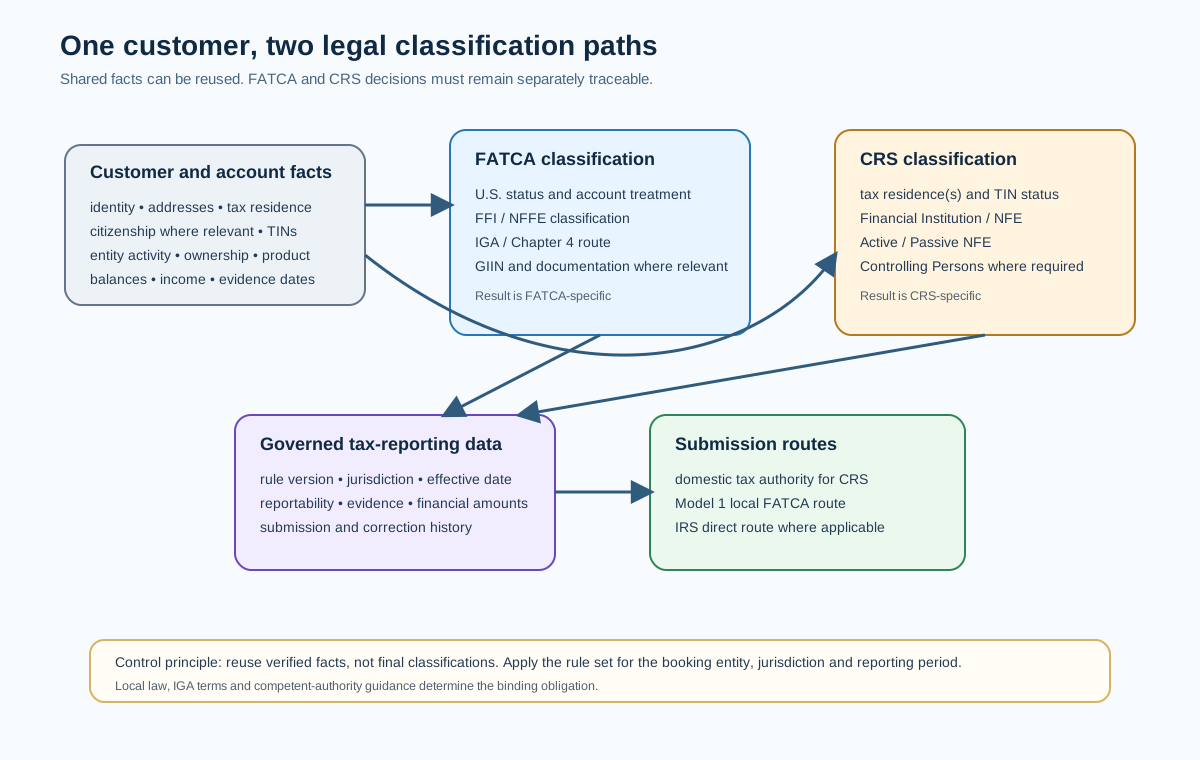
FATCA and CRS solve a similar problem in different ways
Both regimes respond to the risk that financial accounts held outside a taxpayer's home jurisdiction can be hidden from tax authorities. Their policy answer is to make financial institutions part of an information chain. Banks and other in-scope financial institutions identify reportable relationships, collect and maintain specified data, and transmit information through the route required by the applicable framework.
For FATCA, the underlying concern is U.S. tax compliance. Foreign financial institutions may be required to register, identify relevant U.S. accounts or owners, report information and, in some situations, support Chapter 4 withholding. Implementation depends heavily on whether the institution is operating under the U.S. Treasury regulations directly or under a Model 1 or Model 2 intergovernmental agreement. A Model 1 Reporting Financial Institution generally reports the required FATCA information to its local tax authority, which exchanges it with the IRS. A Model 2 Reporting Financial Institution generally reports specified information directly to the IRS, subject to the applicable agreement. The precise obligations come from the applicable IGA, domestic implementing law and U.S. rules; the label "FATCA" alone is not enough to determine the route.
For CRS, the central concept is residence for tax purposes. A Reporting Financial Institution identifies the tax residence or residences of account holders and, where required, controlling persons. Reportable information is provided to the domestic tax authority in accordance with local law. Competent authorities then exchange information with eligible partner jurisdictions under the applicable international arrangements. Financial institutions do not send CRS data to the OECD. The OECD defines the standard and technical framework; national authorities create and enforce the bank's legal reporting obligation.
The difference is important in customer conversations. A customer may reasonably ask why a bank is requesting nationality, tax residence, U.S. status, TINs, entity classification and controlling-person information at the same time. The answer is that several regulatory purposes can draw on overlapping facts. The bank should explain those purposes accurately rather than collapsing everything into "KYC" or "tax reporting".
| Question | FATCA lens | CRS lens |
|---|---|---|
| Core legal focus | U.S. Chapter 4 reporting and withholding framework | Automatic exchange of financial-account information based on tax residence |
| Main customer concept | U.S. account, specified U.S. person, FFI/NFFE status and related Chapter 4 classifications | Reportable Account, tax residence, Financial Institution/NFE status and Controlling Persons |
| Common reporting route | Depends on direct rules and applicable IGA; Model 1 commonly uses local tax authority, Model 2 commonly reports to IRS | Reporting Financial Institution to local tax authority, then competent-authority exchange |
| Institution identifier | GIIN is central for many FATCA registered entities and branches | No global CRS equivalent to a GIIN; local registration or reporting identifiers vary |
| Customer evidence | Forms, certifications and documentary evidence under applicable FATCA rules or IGA | Self-certification plus reasonableness checks and documentary evidence under local CRS implementation |
| Change handling | Re-document or reclassify where a change makes prior status unreliable | A change in circumstances can invalidate prior reliance and require cure under the applicable CRS rules |
FATCA: registration, status and the IGA architecture
FATCA cannot be implemented safely as a single global checklist because the bank first needs to know which FATCA framework applies to the entity and branch doing the business. A banking group may contain U.S. entities, foreign entities in Model 1 jurisdictions, foreign entities in Model 2 jurisdictions and branches with different registration positions. The same customer can therefore interact with different FATCA operating models across a group.
The IRS registration framework assigns a Global Intermediary Identification Number, or GIIN, to approved registered entities and branches that require one. The IRS publishes an FFI List on a monthly cycle. Banks use that list in their own registration governance and, where relevant, in counterparty or withholding-agent controls. A GIIN match is useful evidence of registration status; it is not a substitute for deciding what type of institution or payee is involved, whether an exemption applies, or which payment and reporting rule is relevant.
FATCA also introduced a withholding mechanism. Current IRS guidance explains that a withholding agent can be required to apply 30 percent Chapter 4 withholding to certain withholdable payments made to an FFI that does not satisfy the applicable FATCA conditions, and there are related rules for certain passive NFFEs and owner information. That statement should not be converted into the simplistic rule "30 percent withholding applies whenever documentation is missing." The scope depends on the payment, payee classification, account documentation, exemptions, IGA position, transitional or specific rules and the role of the institution in the payment chain. A bank therefore needs a controlled rules engine rather than a hard-coded missing-document flag.
Forms such as W-8BEN, W-8BEN-E and W-9 are familiar FATCA artefacts, but their use depends on context. In some IGA jurisdictions, financial institutions use local self-certification forms or combined forms designed around domestic implementation. The approved bank process should specify which documentation is acceptable for each customer type and legal entity. A business analyst should never write a requirement such as "collect W-8BEN-E from all foreign entities" without first establishing the applicable FATCA framework and customer population.
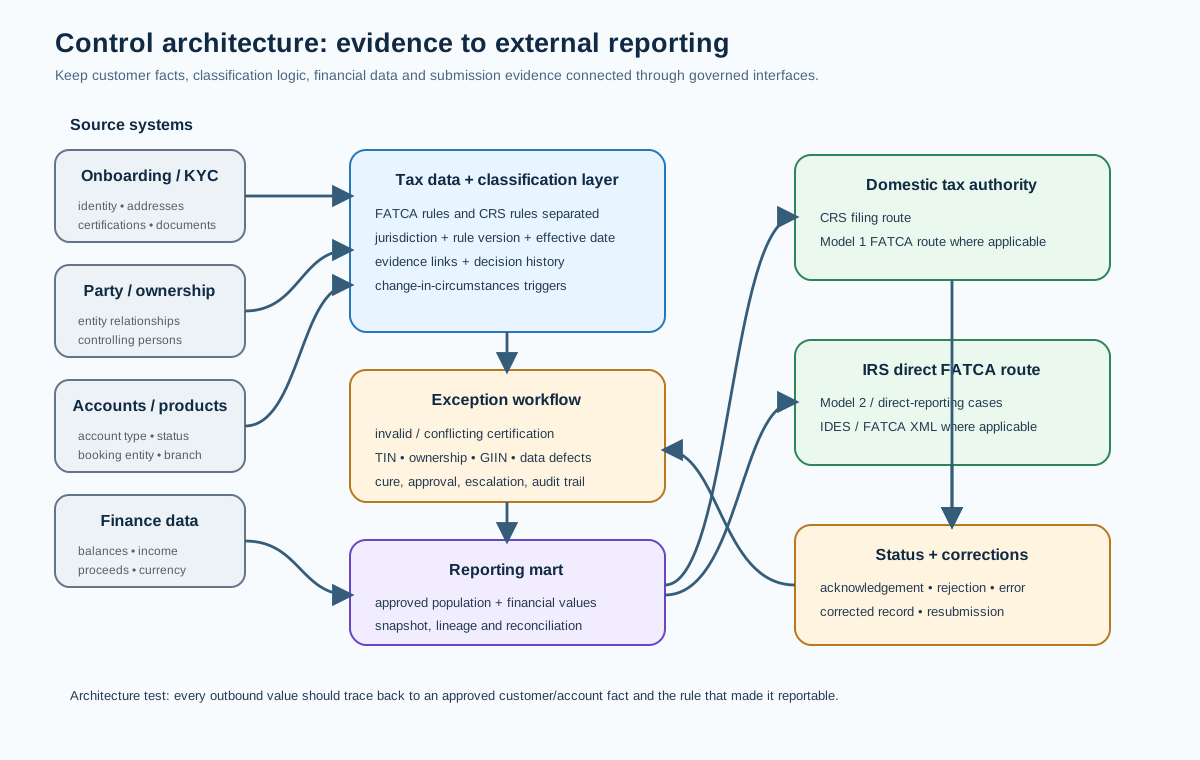
For reporting, IRS Form 8966 and the FATCA XML schema remain important reference points for institutions that report directly. The IRS instructions explain that Reporting Model 1 FFIs do not file Form 8966 directly with the IRS for the information that is reported through the Model 1 route, while Reporting Model 2 FFIs generally report directly to the IRS in line with the applicable IGA. This is one of the clearest examples of why a bank's data architecture should separate classification from submission route. The same conceptual field, such as a U.S. reportable status, can feed different outbound channels depending on the booking entity.
CRS: tax residence, financial institutions and reportable accounts
The CRS starts from a different legal centre. Reporting Financial Institutions must perform due diligence to identify Reportable Accounts and report specified information in accordance with the domestic rules that implement the standard. The OECD's 2025 consolidated CRS remains a key technical reference, but banks must apply the version enacted in the relevant jurisdiction and respect local effective dates.
A customer can be resident for tax purposes in more than one jurisdiction. The OECD's implementation material is explicit that all tax residences required under the CRS should be captured in the self-certification. This is operationally important because customer interfaces often encourage a single-country answer. The data model must allow multiple tax residences, multiple TINs and effective dates, and it must preserve the historical state used for each reporting year.
CRS classification also depends on the type of account holder. For individuals, the central question is normally tax residence supported by a valid self-certification and the reasonableness test. For entities, the bank first determines whether the entity is a Financial Institution or a Non-Financial Entity under the applicable CRS rules. If it is an NFE, the distinction between Active and Passive NFE can determine whether the bank must look through to Controlling Persons and establish their tax residences. The definitions are technical. Revenue, assets, business activity, holding-company status, investment-entity status and jurisdiction can all matter.
The words can look deceptively similar to FATCA. FATCA uses concepts such as FFI, NFFE, passive NFFE and substantial U.S. owner. CRS uses Financial Institution, NFE, Passive NFE and Controlling Person. A well-designed platform may reuse customer facts and ownership data, but it should not assume that the result of one regime is automatically the result of the other. Classification rules, ownership concepts, exemptions and reporting consequences differ.
Self-certification is a controlled evidence process
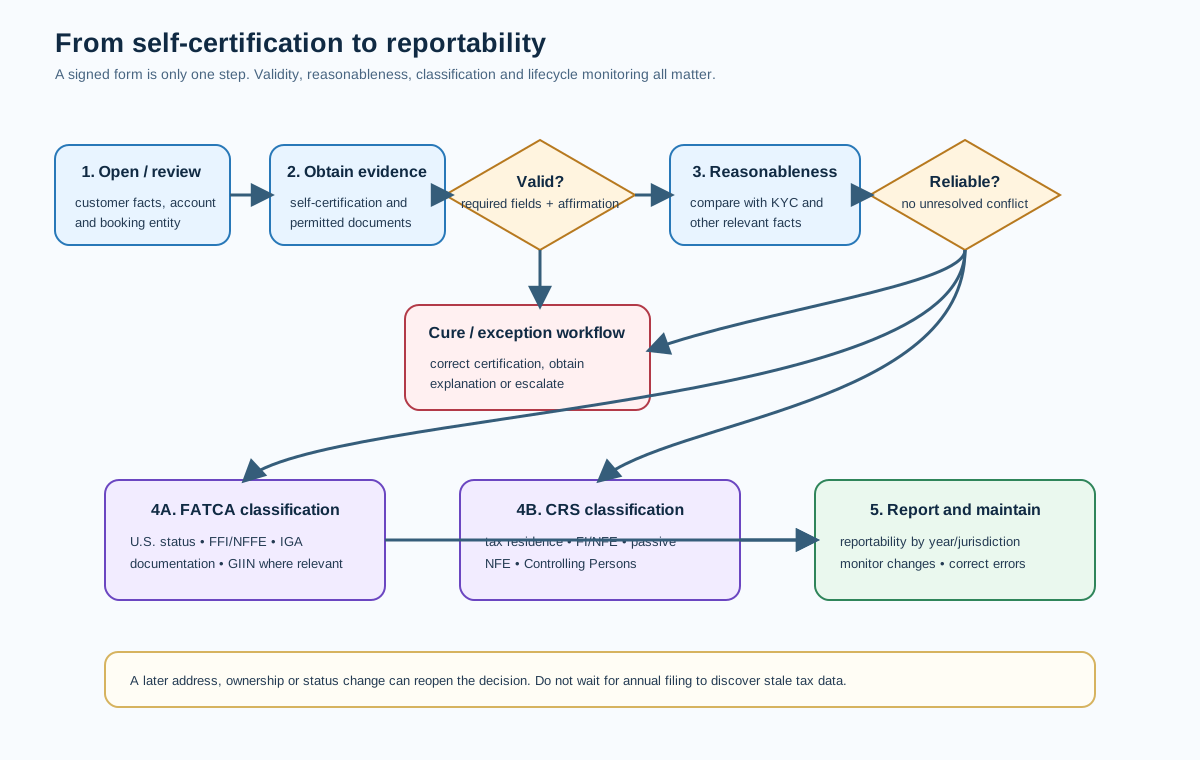
A CRS self-certification is not just another document image. It is structured evidence used to establish tax residence and, for entities, status information needed for due diligence. The OECD's current commentary states that a valid self-certification for a new individual account includes required identifying information such as name, residence address, jurisdiction or jurisdictions of residence for tax purposes, relevant TIN information and date of birth, and it must be signed or otherwise positively affirmed and dated within the required timeframe.
The bank must then perform a reasonableness test. It is not expected to conduct an independent legal analysis of every country's tax law. It is expected to compare the self-certification with information obtained in connection with account opening, including AML/KYC information, and determine whether it knows or has reason to know that the certification is incorrect or unreliable. If the claimed tax residence conflicts with the residence address in KYC records, that conflict cannot simply be ignored because a form is signed. The institution needs either a valid replacement certification or, where permitted by the rules, a reasonable explanation and supporting documentation that resolves the conflict.
That distinction is important for customer treatment. A mismatch is not proof of tax evasion. People can have legitimate cross-border facts: diplomats, students, frontier workers, internationally mobile employees, people with homes in more than one country, or entities with complex legal and tax-residence positions. The control objective is to resolve the evidence to the standard required by the reporting regime, not to accuse the customer of wrongdoing.
The OECD AEOI implementation portal provides jurisdiction-supplied tax-residency and TIN information that can help financial institutions and customers understand local formats and rules. It also makes clear that sample self-certification forms made available on the portal are illustrative; they are not mandatory OECD-approved forms. A bank's form design therefore remains a controlled local implementation decision.
New accounts, pre-existing accounts and change in circumstances
FATCA and CRS both distinguish populations and due-diligence paths. New accounts normally provide an opportunity to collect current certifications during onboarding. Pre-existing accounts can be subject to different review procedures, documentary-evidence rules, electronic indicia searches, thresholds or remediation steps depending on the applicable regime and jurisdiction. Banks should represent those distinctions explicitly in configuration rather than hiding them inside procedural notes.
A change in circumstances is one of the most important lifecycle controls. A previously reliable tax status can become unreliable when the bank learns new information: a new residence address, a change of country, a new controlling person, an entity restructuring, a change in activity, a change in citizenship or other facts relevant to the applicable rule. The exact cure period and consequence are jurisdiction-specific. The general design principle is stable: trigger the event, identify which prior classifications or certifications may have become unreliable, request the evidence required by the applicable rule, prevent stale data from silently feeding the next reporting cycle, and record how the exception was resolved.
This is why periodic tax-reporting remediation should not be built as a once-a-year spreadsheet exercise. The strongest control is event-driven. Customer master-data changes should publish events or create workflow tasks that can be consumed by the FATCA/CRS classification service. If a customer updates a home address in digital banking, the bank should know whether that field is relevant to tax-status reasonableness and whether a specialist review is required.
Entity due diligence and controlling persons
Entity classification produces some of the hardest operational cases because the customer often uses ordinary corporate-language labels that do not answer the regulatory question. "Holding company," "investment company," "family office," "charity," "treasury company" or "startup" may not map cleanly to a FATCA or CRS category. The bank needs structured questions about activities, income, assets, regulated status, management, ownership and jurisdiction, supported by documents appropriate to the risk and legal requirement.
For CRS, when an entity is a Passive NFE, the bank generally needs to identify relevant Controlling Persons and establish whether those persons are reportable. The concept is linked to the AML/KYC concept of beneficial ownership and control, but the CRS rules determine the tax-reporting consequence. In many implementations, existing AML/KYC ownership data can be reused as a starting point. Reuse is valuable only if the lineage is clear: which person was identified, on what basis, at what date, with what ownership or control relationship, and whether the person remains in scope for the reporting year.
For FATCA, passive NFFE rules can require information about substantial U.S. owners or, under some IGA formulations, controlling persons who are specified U.S. persons. Again, the bank should not treat FATCA and CRS look-through as a single shared result. The underlying ownership graph can be shared; the rule applied to that graph must remain regime-specific.
Complex structures also create a data-quality risk. A trust can involve settlors, trustees, protectors, beneficiaries and other persons exercising control. A fund or investment vehicle can change status depending on its activities and management. A multi-layer company may have ownership changes after onboarding. A robust platform therefore stores relationships as effective-dated records rather than a flat list copied into a report at year end.
Reporting data is built long before the annual file
Tax reporting is often described as an annual reporting exercise, but the report is the last stage of a year-long data process. The reportable population depends on the customer classification, account classification, controlling-person data, tax residences, TINs, account balances, income and proceeds data, account status and local reportability rules. If those inputs are wrong or not historically reconstructable, the annual file cannot repair them reliably.
Under CRS, the exact fields are defined by the standard and domestic implementation. Common elements include information identifying the reporting financial institution, account holder or controlling person, tax residence, TIN where required, account number or functional equivalent, account balance or value and specified categories of financial income or proceeds. The amended CRS introduces additional reporting information and scope changes, including specified electronic-money products and central bank digital currencies, as well as changes affecting indirect crypto-asset exposure. The bank must apply those changes only when and where the amended CRS has become effective in its jurisdiction.
The implementation timeline matters in 2026. OECD Global Forum monitoring describes 2027 as the commonly expected first exchange year under the amended CRS, with a coordinated move to the new CRS XML Schema 3.0 and transitional flexibility for some jurisdictions. That does not mean every bank everywhere switches on the same date. Banks need an effective-dated jurisdiction matrix showing domestic legislation, first reporting period, first exchange year, schema version, local filing channel, validation rules and any permitted transitional treatment.
For FATCA, direct reporters use the FATCA reporting schema and IRS transmission arrangements such as the International Data Exchange Service. The IRS maintains the FATCA XML schema and business rules. Model 1 institutions normally report through the domestic authority's channel instead. A global bank therefore needs separate outbound adapters even if both outputs originate from a common tax-reporting data store.
Corrections and status messages are part of the control, not post-processing noise
A report can be syntactically valid and still contain wrong customer information. It can also fail technical validation before acceptance. Mature tax-reporting operations distinguish these problems.
A technical rejection may arise from schema errors, invalid identifiers, missing mandatory elements or an incorrect message structure. A business correction may arise because the bank later learns that the tax residence was wrong, the TIN was transposed, the account holder changed, the wrong entity status was used, a controlling person was omitted or an account balance was sourced incorrectly. Each type requires a controlled response with ownership, root-cause classification, corrected data and evidence of resubmission.
The OECD's CRS Status Message mechanism exists so competent authorities can communicate file- and record-level errors in a structured way. The amended CRS technical framework introduces new schema versions for exchanges from 2027. FATCA similarly has IRS business rules, notifications and correction mechanics for direct submissions. These are not merely interface details. Repeated rejects can reveal weaknesses in upstream customer data, transformation rules or jurisdiction configuration.
A good management-information pack therefore tracks more than the percentage of files submitted on time. It tracks rejected records, corrections after submission, unresolved customer-documentation exceptions, TIN exceptions, change-in-circumstances ageing, reportable accounts added after cut-off, data-lineage defects and recurring root causes by product, entity and source system.
FATCA and CRS are not AML transaction monitoring
The course places FATCA and CRS inside a Financial Crime, AML & Sanctions learning card because tax crime can be a financial-crime predicate and because the controls share customer data, ownership information and escalation channels. But the regimes have different purposes and should not be merged operationally.
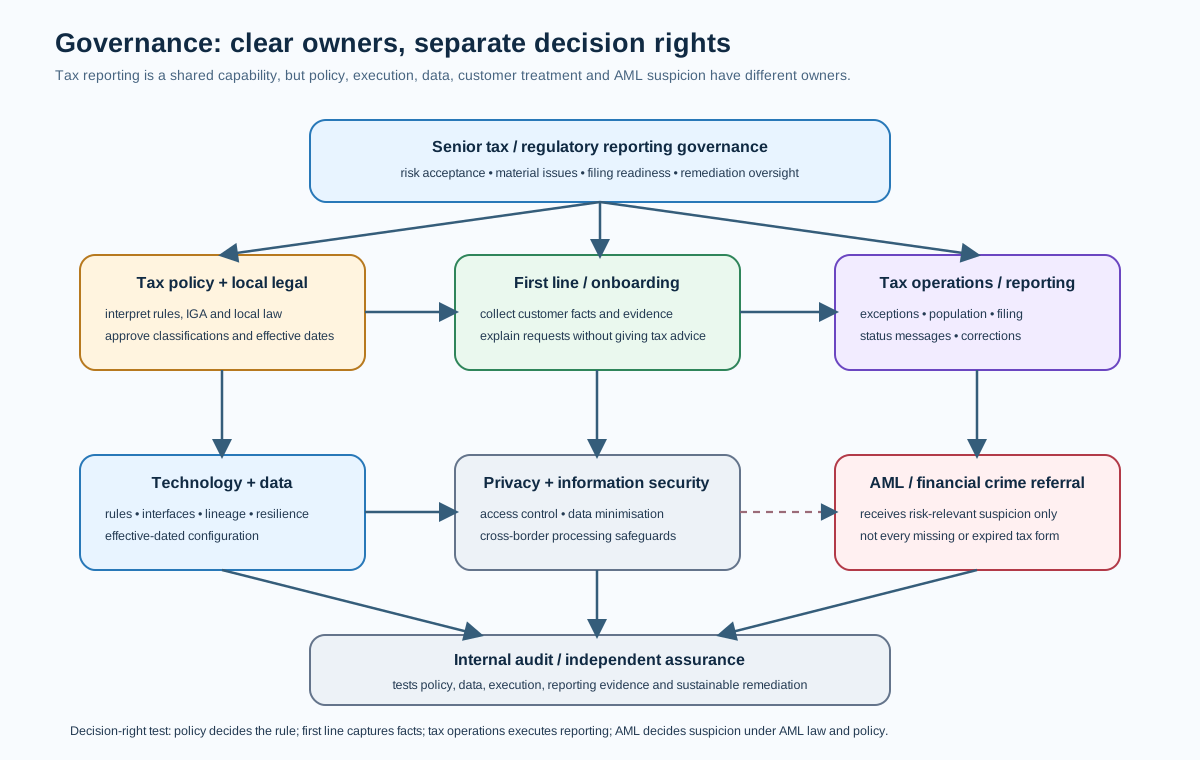
A missing CRS self-certification is a tax-reporting control issue. A FATCA documentation defect can create reporting or withholding consequences. Neither fact, by itself, proves tax evasion or money laundering. An AML investigation begins when the facts create a basis for suspicion under the applicable AML law and policy. A customer may have inconsistent tax information because of error, mobility, misunderstanding, outdated data or deliberate concealment. The bank should resolve the tax-reporting obligation and separately decide whether the behaviour creates a suspicious-activity concern.
The hand-off should therefore be evidence-based. Tax operations might escalate to AML when there are indicators such as intentionally false documents, unexplained offshore structures combined with concealment, repeated efforts to defeat reporting, sham residence claims, nominee arrangements with no credible purpose, or other facts consistent with tax crime. AML should not receive every expired tax form. Conversely, tax operations should not suppress a suspicious pattern simply because the annual reporting file can technically be completed.
Data model and system touchpoints
A bank-grade FATCA/CRS implementation normally touches more systems than the annual report suggests. At minimum, the architecture needs to connect customer onboarding, KYC, document management, customer and party master data, account/product systems, legal-entity and branch reference data, ownership and controlling-person relationships, tax-classification logic, exception workflow, financial balances and income, reporting engines, data-quality controls and external submission channels.
The critical design pattern is to store facts separately from decisions. "Customer has a residence address in Germany" is a fact. "Customer is tax resident in Germany for CRS" is a customer-certified status accepted under a rule. "Account is reportable to Germany for reporting year 2026" is a reportability decision derived from the customer status, account classification, jurisdiction partnership and effective law. If those concepts are collapsed into one flag, the bank will struggle when a customer has multiple residences, when law changes, when a report is corrected, or when audit asks why the 2024 result differs from the 2026 result.
The same separation applies to entities. Store activity, ownership, regulatory status and controlling-person relationships as reusable facts. Then run FATCA and CRS classification logic separately. Preserve the rule version, jurisdiction, effective date, evidence references and decision timestamp. A classification engine should be reproducible: given the same facts and the same rule version, an auditor or tester should be able to derive the same result.
Access control is equally important. Tax residence, TINs and cross-border financial-account information are sensitive personal and financial data. Teams should have only the access needed for their role. Production support should not need unrestricted access to customer tax data merely because it supports the reporting platform. Test environments should use synthetic or appropriately protected data. Cross-border support models must respect privacy, secrecy and data-localisation requirements.
Operational ownership and governance
The first line usually owns collection and maintenance of customer information. A central tax-compliance or regulatory-reporting function may own policy interpretation, classification standards and reporting. Technology and data teams own systems and transformations. Local tax teams or legal advisers interpret jurisdiction-specific rules. Operations resolve documentation exceptions and report rejects. Privacy and information-security functions govern sensitive-data use. Internal audit provides independent assurance.
The governance problem is not a lack of roles but unclear decision rights between them. Who can approve an exception when a self-certification conflicts with KYC data? Who decides whether a new product is a Financial Account? Who owns the classification of a new entity type? Who determines the local effective date of amended CRS? Who signs off a filing? Who decides whether a reporting defect needs regulatory notification? These questions should be answered before year-end pressure begins.
Customer impact and fair implementation
FATCA and CRS requests can frustrate customers because the questions are technical and the purpose is not always obvious. A good journey explains why the bank needs tax residence, why more than one jurisdiction may have to be declared, why a TIN is requested, why U.S. status is asked separately, and why controlling-person information can be required for an entity.
The bank should distinguish a customer explanation from tax advice. Staff can explain the bank's obligations and the fields required. They should not tell a customer where the customer is tax resident when that requires personal tax interpretation. Where the customer is uncertain, the bank can direct the customer to the relevant tax authority or professional adviser while keeping the account-opening or remediation workflow controlled.
Restrictions for missing information also require legal precision. Some jurisdictions or FATCA statuses may impose specific consequences; other cases may be governed by bank policy. A system should not automatically block, close or withhold simply because a field is blank unless the applicable rule and approved policy support that action. Customer-impact decisions need reason codes that distinguish legal prohibition, documentary deficiency, policy restriction and technical failure.
Mini case study: one entity, two regimes, conflicting evidence
A European bank is onboarding a privately owned investment holding company. The entity is incorporated in Jurisdiction A and will hold securities, cash and interests in several operating companies. The application states that the company is an Active NFE for CRS and an Active NFFE for FATCA. The bank's KYC file identifies two natural persons who ultimately control the entity. One person lives in Jurisdiction B. The second is a U.S. citizen who has recently moved to Jurisdiction C and provides a residential address there.
The tax self-certification for the entity states that it is tax resident only in Jurisdiction A. The first controlling person declares Jurisdiction B. The second controlling person declares Jurisdiction C but does not mention the United States. The bank also receives evidence that most of the entity's income in the previous year came from dividends and securities rather than operating revenue.
The correct response is not to jump to a tax-evasion conclusion. The bank has several different questions to resolve. First, the entity classification must be tested under the actual FATCA and CRS definitions rather than accepting the customer's labels. The income and asset profile may affect whether the entity is active or passive, but the classification depends on the detailed rule and applicable exceptions. Second, the CRS self-certifications must pass the reasonableness test against KYC information. Third, the second controlling person's U.S. citizenship is relevant to FATCA even though the person currently lives in Jurisdiction C. CRS, by contrast, focuses on tax residence rather than citizenship as such.
Operations routes the case to the tax-classification team. The bank requests the additional facts needed to classify the entity and asks the second controlling person to correct or explain the self-certification. The customer provides documentation showing the entity's activities and confirms that the second controlling person remains a U.S. person for FATCA while being tax resident in Jurisdiction C for CRS purposes. The classification engine records separate FATCA and CRS outcomes, links them to the evidence and preserves the controlling-person relationships.
Later in the year the second controlling person moves again and updates the residential address through digital banking. That event creates a change-in-circumstances task. The bank does not wait until annual reporting to notice it. The customer is asked to refresh tax-residence information, and the new status is effective-dated so reporting can use the correct state for the appropriate period.
At year end the reporting engine takes the approved classification, tax residence, TINs, controlling-person information, account balance and reportable income from governed sources. The local CRS file is transmitted to the domestic tax authority. The FATCA information follows the Model 1 route applicable to the bank's jurisdiction. A validation error on one TIN is returned. Operations corrects the data through the controlled workflow and re-files it. The correction is recorded against the original report so audit can reconstruct the sequence.
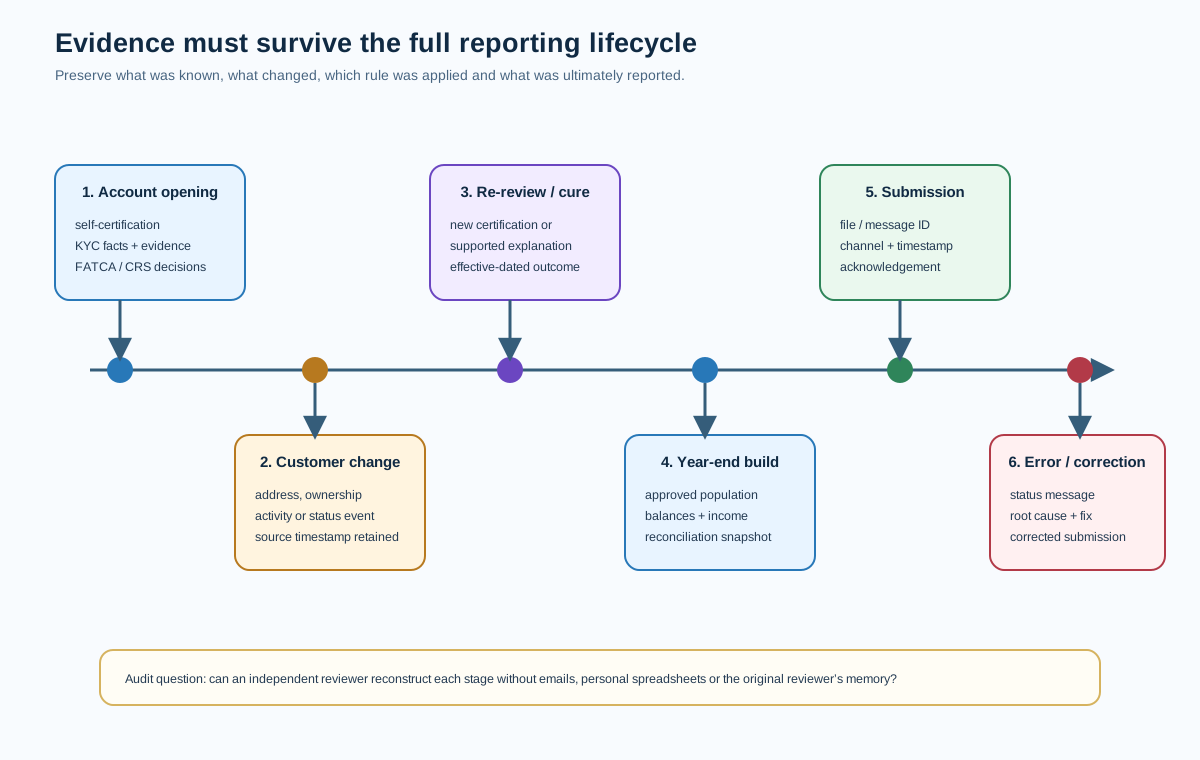
This case illustrates the real control objective: not merely collecting forms, but keeping legal classification, customer evidence, ownership data, system events and reporting outputs connected over time.
What good looks like
A mature FATCA and CRS capability has several recognisable qualities. Customer facts are captured once but classified separately under each regime. Jurisdiction rules are effective-dated. Self-certifications are validated rather than merely stored. Ownership and controlling-person relationships are reusable and historically reconstructable. Changes in circumstances trigger action before year end. Reporting outputs are traceable to source systems. Errors and corrections feed root-cause remediation. Staff can explain the process without giving personal tax advice. AML receives only risk-relevant referrals rather than every tax-documentation exception.
For business analysts and architects, the strongest requirements are those that can be tested. A requirement such as "the system must support CRS" is not testable. A stronger requirement says that when a customer changes a residence address, the system must identify every active tax status whose reliability could be affected, create a dated review task, prevent unresolved stale status from being treated as current under configured local rules, preserve the prior status for historical reporting and record the evidence supporting the new decision.
For operations and compliance, good control means being able to answer four questions quickly: what did the customer tell us, what did we independently know, which rule did we apply, and what did we report? If those answers require several teams to reconstruct spreadsheets and emails, the bank has a reporting process but not yet a controlled reporting capability.
Key takeaways
FATCA and CRS share data and operational infrastructure, but they are legally distinct regimes. FATCA is anchored in U.S. law and its IGA network; CRS is an international standard implemented through domestic law and competent-authority exchange. A global bank therefore needs regime-specific classification and jurisdiction-specific implementation even when it offers one customer journey.
Tax residence and self-certification are not static onboarding fields. They are lifecycle data that must be tested for reasonableness, refreshed when circumstances change and preserved historically. Entity classification and controlling-person analysis require separate FATCA and CRS logic. Annual reporting quality depends on customer and account data captured throughout the year, not just on year-end file generation.
Finally, tax-reporting exceptions are not automatically AML suspicion. The controls should share evidence and have a clear escalation path, but they should preserve their different legal purposes. The safest design is a joined data architecture with separated decision logic, transparent ownership and a complete audit trail.
Operational deep dive: classification, evidence and exception handling
The base chapter describes the overall operating model. This deep dive focuses on the points where real FATCA and CRS processes most often become unreliable: customer classification, documentary evidence, change handling, controlling-person data and annual population building. These are the areas where a bank can appear compliant at account opening but still produce a wrong report years later.
Classification should be reproducible, not dependent on reviewer memory
A classification decision should be explainable from stored facts and a known rule version. For an individual, the bank needs the facts required by the applicable FATCA or CRS procedure and enough information to test whether the certification is reliable. For an entity, the bank may need legal form, regulatory status, business activities, income and asset characteristics, ownership, management arrangements and the jurisdiction in which the entity operates. The reviewer should not be forced to reconstruct these facts from free text.
A useful design separates three layers. The fact layer stores what the customer or trusted source says: residence addresses, tax residences, citizenship where relevant, TINs, incorporation jurisdiction, activity, ownership and controlling persons. The classification layer stores the result under FATCA and CRS separately, with the rule version and evidence references. The reportability layer determines whether an account or controlling person is reportable for a particular year and partner jurisdiction. This separation makes corrections much safer because a later fact change does not overwrite the historic classification that supported a prior report.
For entities, one of the biggest risks is accepting customer terminology without mapping it to the defined terms. A company calling itself a "holding company" does not automatically establish Active NFE or Active NFFE status. A family investment vehicle may be an investment entity under one regime and a passive non-financial entity under another depending on the facts and definitions. The control should therefore ask questions that map to the legal criteria rather than ask the customer to select a category it may not understand.
Self-certification needs both validity and reasonableness
A signed form can still be unusable. The CRS commentary distinguishes validity of the self-certification from the reasonableness test. A bank should first confirm that the required fields and affirmation are present. It should then compare the certification with information obtained during account opening and other relevant data in its possession.
A common example is a customer who declares tax residence in one jurisdiction while the KYC residence address points to another. The correct result is not automatic rejection and not automatic acceptance. The bank needs a process to obtain a corrected certification or a reasonable explanation and supporting documentation where the rules permit. The evidence and reviewer conclusion should be retained so the same mismatch is not re-opened repeatedly without context.
TIN controls should also distinguish missing, not issued, not required, invalid format and failed verification where local systems support those distinctions. Treating all of them as one "TIN missing" status makes reporting and remediation inaccurate. The OECD AEOI portal contains jurisdiction-supplied TIN information that can support format and issuance logic, but the bank still needs local legal configuration and a controlled update process.
For FATCA, documentary evidence and forms must be interpreted under the applicable Chapter 4 or IGA framework. A W-8 or W-9 is not a universal substitute for every local FATCA self-certification requirement. The document engine should therefore know which form version, local certification or documentary evidence is permitted for the booking entity and customer type, and when it expires or becomes unreliable.
Pre-existing populations should not become permanent exceptions
Legacy accounts are difficult because original onboarding may not contain the structured tax data expected today. Banks often remediate these accounts through electronic searches, documentary review, outreach and exception queues. The control risk arises when a temporary remediation status becomes permanent and nobody knows whether the account should have moved to a stronger evidence standard after later customer contact.
A good legacy design records which due-diligence route was used and why. If a jurisdiction permits new-account procedures to be applied to pre-existing accounts, the system should record that election or policy choice. If indicia were cured by documentary evidence, the cure should be linked to the evidence and effective date. If a customer later opens another account, the bank should have an explicit rule for whether existing documentation can be reused or must be refreshed.
Changes in circumstances require an event catalogue
The phrase "change in circumstances" is easy to write in policy and hard to implement in technology. A bank needs to define which source-system events can affect tax classification. Typical candidates include address changes, country changes, new phone numbers, changes to entity activity, changes in ownership or controlling persons, mergers, changes in legal form, new documentation, new citizenship information where FATCA is relevant, and changes to regulatory or product status.
Not every change has the same consequence. Some events should immediately invalidate reliance. Others should create a review because the existing status may still be valid. The configuration should identify the affected regime, the rule that was triggered, the cure requirement and the permitted resolution. This allows operations to prioritise real risk instead of treating every profile update as the same tax event.
The event design also needs protection against silent failure. If the customer master updates an address but the tax engine does not receive the event, the bank can carry stale classification into the reporting year. Reconciliation between source-system changes and tax-review tasks is therefore a key control. A daily or periodic completeness check can compare relevant master-data changes with tax-workflow creation and surface dropped events.
Controlling-person data needs relationship history
Controlling-person reporting fails when systems store only a current list of people. The reporting question is time-sensitive: who controlled the entity during the relevant period, what was each person's tax residence, and what evidence supported that conclusion? The data model should therefore preserve relationship start and end dates, ownership or control basis, source, verification status and links to the related entity.
The same relationship graph can support AML, sanctions and tax reporting, but each control should apply its own rules. AML may use a beneficial-owner threshold and broader control concepts. CRS may require Controlling Persons for a Passive NFE. FATCA may require substantial U.S. owner or controlling-person analysis under the applicable framework. Reusing facts is efficient; reusing a final regulatory classification without checking the rule is dangerous.
Building the annual population
The annual reporting process should start with a governed population build, not with a spreadsheet export. The bank needs to determine which legal entities are Reporting Financial Institutions, which products are Financial Accounts, which customers and controlling persons are reportable, which partner jurisdictions are active for the reporting year, and which local exclusions or transitional rules apply.
The reporting engine should preserve the population criteria and the extract version. If a customer is added after the initial cut because a classification was corrected, that addition should be traceable. If an account is removed because the customer proved a different status, the removal should also be traceable. This is essential when tax authorities ask why the reported population changed between an original submission and a correction.
Financial amounts require their own lineage. Account balances, interest, dividends, gross proceeds or other reportable amounts should be sourced from controlled financial systems with clear currency handling and account-closure logic. Data teams should reconcile report totals to source populations and investigate material differences rather than assume schema validation proves financial completeness.
Exception queues should be designed around causes
A single queue named "FATCA/CRS exceptions" quickly becomes unmanageable. Better designs separate causes such as invalid self-certification, conflicting KYC information, missing TIN, entity-classification uncertainty, ownership ambiguity, failed GIIN verification, schema rejection, missing financial amount, change-in-circumstances cure and filing correction.
Cause-based queues improve ownership and MI. A documentation team can resolve missing certifications. A tax-policy team can decide classification questions. Data teams can investigate missing balances. Technology can fix schema defects. Management can see whether the underlying problem is customer response, policy ambiguity, system design or operational capacity.
Exception ageing should be measured against the applicable legal or policy deadline rather than one generic SLA. A technical reject close to a filing deadline may require immediate priority. A customer remediation with a longer permitted cure period may be less urgent but still needs proactive management. The risk model should therefore include deadline, reportability, customer value, jurisdiction and whether stale information is already feeding a report.
Practical control test
A useful end-to-end test is to choose one entity account and reconstruct the full chain without asking the original reviewer for help. Can the tester identify the booking entity and applicable FATCA/CRS rules? Can they find the customer's certifications and KYC evidence? Can they reproduce the entity and controlling-person classification? Can they see any change-in-circumstances events? Can they trace the year-end balance and income? Can they identify the outbound report and any later correction?
If the answer requires emails, personal spreadsheets or undocumented expert memory, the control is fragile even if the latest filing was accepted. A robust tax-reporting capability is one in which evidence, rules, data lineage and reporting history are connected strongly enough for an independent person to reconstruct the outcome.
Advanced practice: architecture, testing and 2027 CRS change readiness
A mature FATCA/CRS platform is not only a reporting engine. It is an effective-dated rules capability that must survive product launches, customer migration, legal change, schema change and data-platform change without silently changing who is reported. The implementation challenge in 2026 is especially visible because many jurisdictions are preparing for the amended CRS and the move to the new CRS XML Schema 3.0 from the commonly expected 2027 exchange cycle, while some jurisdictions are using the permitted transitional period.
Build the jurisdiction matrix before changing code
The most important design artefact is a jurisdiction matrix owned jointly by tax policy, operations and technology. For every booking entity it should identify the applicable FATCA route, IGA status where relevant, domestic CRS framework, reporting authority, filing calendar, local account and entity definitions where they differ, schema version, accepted identifier rules, TIN exceptions, local nil-report requirements if any, correction process and effective date of material changes.
This matrix should drive configuration. Hard-coding a single "CRS 2027" switch across a global bank is unsafe because domestic implementation is not perfectly synchronous. OECD monitoring describes a common 2027 implementation objective for the amended CRS, but some jurisdictions have additional time. The application should therefore resolve rules by legal entity, jurisdiction and reporting period rather than by calendar year alone.
Change governance should include legal effective date, first customer due-diligence date, first reporting period and first exchange year as separate fields. Those dates are often confused. A jurisdiction can enact legislation before the first reporting period, and banks may need to update onboarding before the first filing occurs. Testing must therefore cover both old and new rules across the transition boundary.
Separate policy rules from technical validation
A customer can be reportable even if the outbound XML has a technical defect. Conversely, an XML file can be technically valid while the customer classification is legally wrong. The platform should therefore maintain two control layers.
The policy layer decides classification and reportability. It uses customer facts, product facts, ownership, tax residence, rule versions and jurisdiction configuration. The technical layer maps approved reportable data into the local filing format or FATCA/CRS schema, validates syntax and codes, packages the file and handles status messages. Defects in one layer should not be hidden by success in the other.
For CRS schema migration, regression testing should prove that a customer classified under the same legal facts does not unexpectedly change status merely because the reporting schema changes. Where amended CRS rules genuinely change scope or reporting data, the test should demonstrate the exact rule that caused the change. This distinction is essential during 2027 readiness work.
Acceptance criteria for a bank-grade implementation
Business analysts should write acceptance criteria around observable control outcomes. Examples include:
- When a new individual customer declares two tax residences, the platform must store both residences and the associated TIN status separately and evaluate reportability for each applicable Reportable Jurisdiction.
- When KYC residence information conflicts with the CRS self-certification, the account-opening workflow must prevent the certification from being treated as reliable until the conflict is resolved in accordance with configured local rules.
- When a controlling person is added to a Passive NFE, the platform must trigger FATCA and CRS re-evaluation independently and preserve the prior ownership graph for historical reporting.
- When a relevant address changes after onboarding, the system must create a change-in-circumstances review, identify which certifications may be affected and record the cure outcome with effective dates.
- When a reporting file is rejected, the system must preserve the original submission identifier, rejection reason, corrected data, resubmission identifier and final status.
- When a jurisdiction moves to a new CRS schema version, the outbound interface must use the schema configured for that jurisdiction and reporting period without changing unrelated jurisdictions.
These criteria are stronger than statements such as "support FATCA" or "validate CRS" because they can be demonstrated through data and workflow evidence.
Positive, negative and boundary testing
Positive testing proves expected reportable cases are identified. Test individuals with one and multiple tax residences, U.S. persons under FATCA, passive entities with reportable controlling persons, and accounts that become reportable after a change in circumstances. Include branches and legal entities with different FATCA reporting routes.
Negative testing is equally important. Test legitimate non-reportable cases, exempt or excluded populations where applicable, active entities, customers with residence facts that look unusual but are properly explained, and accounts outside the configured reporting relationship. The objective is to prove the control does not over-report simply because data looks complex.
Boundary testing should focus on effective dates and reporting periods. Open an account just before and just after a rule change. Change a tax residence near year end. Close an account mid-year. Migrate an account between products. Change a controlling person after the reporting cut-off but before filing. These cases expose assumptions about which state the reporting engine uses.
Data-quality testing should follow lineage, not only field format
TIN format validation, mandatory-field checks and schema validation are useful, but they do not prove the data is correct. A stronger test selects a report field and traces it back through transformations to the source. If the CRS report contains a year-end balance, the tester should identify the source account, currency, valuation date, transformation rule and any aggregation logic. If the report contains a controlling person's tax residence, the tester should find the certification and effective-dated relationship that produced it.
Reconciliation should operate in both directions. Every reportable account in the approved population should appear in the output unless there is an evidenced exclusion. Every output record should map back to an approved reportable account or controlling person. Unmatched records and unexplained exclusions are control defects even if the XML passes validation.
Production monitoring and resilience
Year-end reporting creates concentration risk because large data volumes, legal deadlines and external filing windows converge. Production design should include rerunnable jobs, idempotent file creation, controlled cut-off snapshots, restart points, submission acknowledgements, duplicate prevention and evidence retention. A failed batch should not require teams to edit production files manually.
External channels can also fail. FATCA direct reporters depend on IRS submission arrangements such as IDES; CRS filers depend on domestic authority channels. The bank should define what evidence proves successful submission, how failed uploads are retried, how outages are escalated and what happens if the authority's portal is unavailable near a deadline. Operational resilience is part of compliance because a correct report that is not delivered is still a reporting failure.
Change assurance should include the customer journey
Technical teams often focus on reporting outputs and forget onboarding. Amended CRS changes can affect the questions customers are asked, the classification of products and entities, the information required for reporting and the data model needed to preserve new fields. Readiness testing should therefore begin at the customer interface and follow the data through classification and reporting.
The final release decision should be supported by evidence from policy sign-off, requirements traceability, unit tests, integration tests, migration tests, data reconciliation, user acceptance, operational runbooks and production monitoring. Tax reporting changes are safest when the bank can show not only that the code changed, but why the rule changed and how the end-to-end outcome was proven.
Practice close: review prompts and delivery checks
Use this section as a practical close. The objective is not to memorise every FATCA or CRS defined term. It is to be able to inspect a customer journey, data model or reporting workflow and identify where the control can become legally or operationally unreliable.
Five questions for any customer file
Start with the applicable legal route. Which bank entity and branch own the account? Is FATCA applied through a Model 1 IGA, Model 2 IGA or another Chapter 4 route? Which domestic CRS implementation applies? What reporting year and effective rule version are relevant? A correct customer classification under the wrong legal entity is still a control failure.
Then inspect the customer evidence. For an individual, can you see the self-certification, all declared tax residences, TIN status, residence address and any facts that could make the certification unreliable? For an entity, can you reproduce the FATCA and CRS classifications separately from stored facts rather than a free-text conclusion?
Next inspect ownership and control. If look-through is required, are the relevant controlling persons or substantial U.S. owners linked to the entity with effective dates and evidence? Does the system preserve historical relationships or only today's owners?
Then inspect lifecycle events. Have addresses, countries, ownership, legal form, entity activity or other relevant facts changed since onboarding? Did those events create review tasks? Is there evidence of cure where a certification became unreliable?
Finally inspect reporting. Can every outbound field be traced to an approved source? Does every approved reportable account appear in the output? Are report rejects, corrections and resubmissions linked to the original filing?
Misconceptions to challenge
"FATCA and CRS are basically the same." They share operational building blocks but use different legal definitions, reporting concepts and routes. Shared data should not become shared classification logic without a rule-by-rule basis.
"A signed self-certification is enough." The bank must also apply the reasonableness standard required by the applicable CRS framework and respond when it knows or has reason to know the information is unreliable.
"A customer can have only one tax residence." CRS processes must support multiple tax residences where the customer is resident under the relevant laws.
"The OECD receives CRS reports from banks." Banks report through the domestic route required by local implementation; competent authorities exchange information under the international framework.
"A missing tax form is suspicious activity." It is first a tax-reporting control issue. AML escalation depends on evidence that supports suspicion under the applicable AML framework.
"If the XML passes validation, the report is correct." Schema validation proves structure, not the correctness of customer classification, ownership, balances or tax residence.
"A GIIN proves the whole FATCA result." A GIIN is important registration evidence for relevant entities, but the bank still has to determine the applicable status, payee treatment, account classification and reporting or withholding consequence.
BA and architecture review checklist
A delivery team should be able to demonstrate that FATCA and CRS decisions are stored separately, rules are effective-dated, multiple tax residences are supported, TIN status is structured, entity ownership is historical, change-in-circumstances events are defined, reportable populations are reproducible and outbound reports are reconciled to approved source populations.
The design should also show how local variation is managed. Jurisdiction configuration should identify reporting authority, schema version, filing dates, effective dates, permitted exceptions and correction routes. Sensitive tax data should have role-based access, and non-production environments should not depend on uncontrolled copies of live customer records.
Testing should include ordinary customers as well as difficult cases: multiple tax residences, passive entities with controlling persons, customers with legitimate address mismatches, entity reclassification, late evidence, account closure, migration between products, schema changes, rejected reports and corrections. Negative tests matter because over-reporting customer information can be as serious as missing a reportable account.
Short knowledge check
- Why can one customer have two separate tax classifications? Because FATCA and CRS apply different legal tests and may produce different outcomes from the same underlying facts.
- What is the purpose of the CRS reasonableness test? To check whether the self-certification conflicts with information the Financial Institution has or should consider, without requiring the bank to become the customer's tax adviser.
- Why are effective dates important? Because customer facts, ownership, laws and reporting relationships change, and the bank must reconstruct the state used for each reporting period.
- Why is report reconciliation needed after schema validation? Because a technically valid file can still contain incomplete or incorrect business data.
- When should a tax-reporting issue reach AML? When the facts create a basis for suspicion under the applicable AML framework, not merely because a document is absent or expired.
Final practical takeaway
The strongest FATCA and CRS controls are not built around forms. They are built around traceability. The bank should be able to show the customer fact, certification, classification rule, change history, reportability decision, financial data, submission and any correction as one connected evidence chain. When that chain is complete, annual reporting becomes the controlled output of year-round customer and data governance rather than a last-minute compliance exercise.
Masterclass: the year-end report that looked correct until the customer moved
A useful way to test a FATCA and CRS control is to follow one relationship through several years and ask whether the bank can explain each classification without relying on the memory of the original reviewer.
A private-banking customer opens an account with a European legal entity in March 2025. She is a citizen of Country A, works in Country B and owns a home in Country C. Her CRS self-certification declares Countries B and C as tax residences and provides the relevant TIN information. Her KYC residence address is in Country B. She is not a U.S. citizen or resident and has no FATCA U.S. indicia. The onboarding team accepts the certification because the declared tax residences are consistent with the broader file and there is no reason to know the certification is unreliable.
The account is classified for CRS using both declared tax residences. Whether it is reportable for the year depends on the booking entity's domestic implementation, the applicable Reportable Jurisdictions and the local reporting rules. The customer is not treated as reportable merely because she lives abroad; the reporting engine applies the configured legal framework for the relevant year. FATCA and CRS statuses are stored separately even though the same KYC profile feeds both.
In July 2026 the customer uses digital banking to change her main residential address from Country B to Country D. She also tells her relationship manager that she has stopped working in Country B. The customer master accepts the address change immediately because it is valid for servicing and correspondence. If the bank has designed tax reporting well, that master-data event also creates a tax-status review. The new address does not itself prove that Country D is a tax residence, but it gives the institution reason to examine whether the existing certification remains reliable.
The workflow identifies the current CRS certification and shows that Country D is not listed. Operations asks the customer to update or explain her tax residence. She responds that she has become tax resident in Country D, has ceased residence in Country B and remains resident in Country C because of domestic law there. She provides a new positively affirmed self-certification listing Countries C and D with updated TIN information.
At this point the platform must preserve history. It does not simply overwrite "B, C" with "C, D." It records the old certification, the change event, the new certification, the date on which the bank accepted it and the effective dates used for reporting. The exact allocation to reporting periods follows the domestic rule and bank policy. The system should be able to show what status was relied on for the 2025 report and why the 2026 report uses a different status.
The problem appears three months later. The year-end reporting mart receives customer tax residence only from a legacy monthly snapshot. Country D is present, but Country C is missing because the source-to-report interface was designed years ago with a one-country field. The outbound CRS file therefore contains a technically valid record but an incomplete tax-residence result.
Schema validation does not catch the defect because the XML is structurally correct. The error is found through reconciliation: the approved reportable population shows two active tax residences while the outbound record contains one. Tax operations stops the filing population for that customer, raises a data defect and corrects the mapping to a repeatable residence structure.
The case illustrates an important principle: technical acceptance is not the same as regulatory correctness. A valid file can carry incomplete business data. The control therefore needs both schema validation and business reconciliation.
After the filing is submitted, the domestic authority returns a status message indicating that a TIN format for Country D is invalid. Operations checks the OECD AEOI portal and local authority guidance, confirms that the customer entered an outdated identifier format and requests correction. The customer provides the correct TIN. The bank updates the governed customer record and submits the required correction using the local process. The original report, error message, customer remediation, corrected record and final acceptance are linked in one audit trail.
Now add a FATCA twist. Suppose the customer later informs the bank that she has obtained U.S. lawful permanent resident status. That event is not handled by simply adding another CRS country. It creates a separate FATCA review because U.S. status has its own legal consequence. The FATCA classification is re-evaluated using the applicable framework, while CRS continues to apply tax-residence rules. The same customer fact can therefore affect one or both regimes differently.
A regulator or auditor reviewing the relationship should be able to ask a sequence of practical questions and receive evidence rather than explanations from memory: What did the customer certify at onboarding? Why was it reasonable? What changed in 2026? Which source event created the review? Which rule version decided the outcome? What tax residences were active for each reporting year? Why did the first outbound file omit one residence? How was the defect found? Was the correction accepted? Did the U.S. status later trigger FATCA reclassification?
If the bank can answer those questions from system history, it has a controlled capability. If it needs the relationship manager, an old email and a spreadsheet to reconstruct the story, the apparent reporting success hides a governance weakness.
Lessons for delivery teams
The case produces several design lessons. Customer master data should publish events to tax controls rather than rely only on annual refresh. Multi-residence data must be modelled as a repeatable structure. Historical certifications and effective dates must be retained. Business reconciliation must compare approved reportability with outbound files. Tax-authority responses must create controlled correction workflows. FATCA and CRS must remain distinct even when they share the same customer profile.
For testers, the scenario is an excellent end-to-end regression case because it combines normal onboarding, a legitimate change of tax residence, multi-country reporting, a data-model defect, an external validation error and a later FATCA status change. Passing that test gives much more confidence than testing isolated fields on a self-certification form.
References and further reading
The sources below are public, first-party references used for this chapter. FATCA and CRS obligations must always be applied through the law, intergovernmental agreement, competent-authority guidance and bank policy that apply to the relevant legal entity and reporting period.
OECD and Global Forum: Common Reporting Standard and AEOI
- OECD, Consolidated text of the Common Reporting Standard (2025), published 2 June 2025. This is the current consolidated reference text incorporating the amendments from the comprehensive review of the CRS: https://www.oecd.org/en/publications/consolidated-text-of-the-common-reporting-standard-2025_055664b1-en.html
- OECD Global Forum, Peer Review of the Automatic Exchange of Financial Account Information 2025 Update, including monitoring of implementation of the amended CRS and the common 2027 implementation timeline: https://www.oecd.org/en/publications/peer-review-of-the-automatic-exchange-of-financial-account-information-2025-update_bbf150e4-en.html
- OECD, Automatic Exchange of Information: Guide on Promoting and Assessing Compliance by Financial Institutions. Practical material on robust CRS and FATCA due-diligence and reporting compliance frameworks: https://www.oecd.org/en/publications/automatic-exchange-of-information_7655bed0-en.html
- OECD, Standard for Automatic Exchange of Financial Information in Tax Matters: Implementation Handbook, Second Edition. Practical explanation of CRS due-diligence and reporting procedures: https://www.oecd.org/en/publications/standard-for-automatic-exchange-of-financial-information-in-tax-matters-implementation-handbook-second-edition_841e9512-en.html
- OECD Global Forum, AEOI Implementation Portal, including jurisdiction-supplied TIN information, tax-residence information and illustrative self-certification resources: https://www.oecd.org/en/networks/global-forum-tax-transparency/resources/aeoi-implementation-portal.html
- OECD Global Forum, Tax residency information for CRS purposes: https://www.oecd.org/en/networks/global-forum-tax-transparency/resources/aeoi-implementation-portal/tax-residency.html
- OECD, Amended Common Reporting Standard XML Schema: User Guide for Tax Administrations. Technical reference for the amended CRS reporting format: https://www.oecd.org/en/publications/amended-common-reporting-standard-xml-schema_dd7ee57a-en.html
- OECD, Common Reporting Standard Status Message XML Schema, Version 3.0. Structured error/status messaging for CRS exchanges applicable from 1 January 2027: https://www.oecd.org/en/publications/common-reporting-standard-status-message-xml-schema_6c08db84-en.html
United States Treasury and IRS: FATCA
- Internal Revenue Service, Foreign Account Tax Compliance Act (FATCA) overview and current FATCA resources: https://www.irs.gov/businesses/corporations/foreign-account-tax-compliance-act-fatca
- U.S. Department of the Treasury, Foreign Account Tax Compliance Act, including the table of FATCA agreements and Model 1 / Model 2 intergovernmental agreements: https://home.treasury.gov/policy-issues/tax-policy/foreign-account-tax-compliance-act
- Internal Revenue Service, Instructions for Form 8966 (2025), FATCA Report. Current detailed reporting instructions for participating FFIs, Reporting Model 2 FFIs and other filers: https://www.irs.gov/instructions/i8966
- Internal Revenue Service, Publication 515 (2026), Withholding of Tax on Nonresident Aliens and Foreign Entities, including current Chapter 4 definitions and Model 1 / Model 2 explanations: https://www.irs.gov/publications/p515
- Internal Revenue Service, International Data Exchange Service (IDES). Current FATCA transmission channel information for financial institutions and host-country tax authorities: https://www.irs.gov/businesses/corporations/international-data-exchange-service
- Internal Revenue Service, FATCA XML schemas and business rules for Form 8966. Technical schema and business-rule resources, including FATCA XML v2.0.1 updated in October 2025: https://www.irs.gov/businesses/corporations/fatca-xml-schemas-and-business-rules-for-form-8966
- Internal Revenue Service, FATCA Foreign Financial Institution List Search and Download Tool. Monthly GIIN/FFI-list reference used for registration-status verification: https://www.irs.gov/businesses/corporations/fatca-foreign-financial-institution-list-search-and-download-tool
- Internal Revenue Service, Information for foreign financial institutions, including registration, GIIN, reporting and withholding overview: https://www.irs.gov/businesses/corporations/information-for-foreign-financial-institutions
Scope reminder
CRS is implemented through domestic law, and reporting dates, thresholds, reportable-jurisdiction lists, filing channels, TIN exceptions, enforcement rules and transitional arrangements vary by jurisdiction. FATCA obligations vary according to U.S. Chapter 4 rules, the applicable IGA, domestic implementing law and the status of the institution, branch, account holder or payee. These sources provide the framework; transaction-level and customer-level decisions should follow approved local legal and compliance interpretation.