Open Banking, APIs, Embedded Finance and Fintech Partnerships
Open banking allows authorised services to access account information or initiate payments through defined interfaces, subject to the applicable framework. An API is a technical interface, not a legal permission by itself. Embedded finance places a financial service inside another customer journey. A fintech partnership can involve referrals, outsourcing, agency, payment services or other models, with different responsibilities.
Customer consent, authentication and AML due diligence answer different questions. Consent authorises specified data access or service use; authentication establishes control of a credential or session; CDD establishes identity, ownership, purpose and risk under applicable requirements. A valid consent token does not prove beneficial ownership or legitimacy of funds.
Map the regulated entities, customer contracts, product, jurisdiction and funds flow. Determine which entity performs onboarding, holds accounts, initiates transactions, screens, monitors and reports. A bank remains responsible for its own duties even when the customer interface belongs to a partner. Partner authorisation for one activity does not automatically cover holding funds or providing another service.
FATF Recommendations 10, 15, 17 and 18 provide relevant standards for CDD, new technologies, reliance and controls. National open-banking, privacy and payment-service rules supply the binding details. Do not apply one jurisdiction's consent or licensing framework universally.
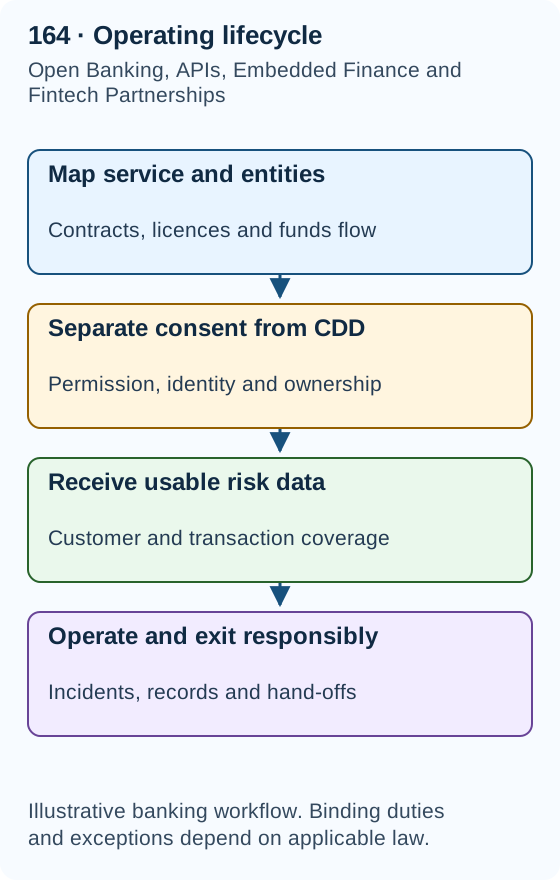
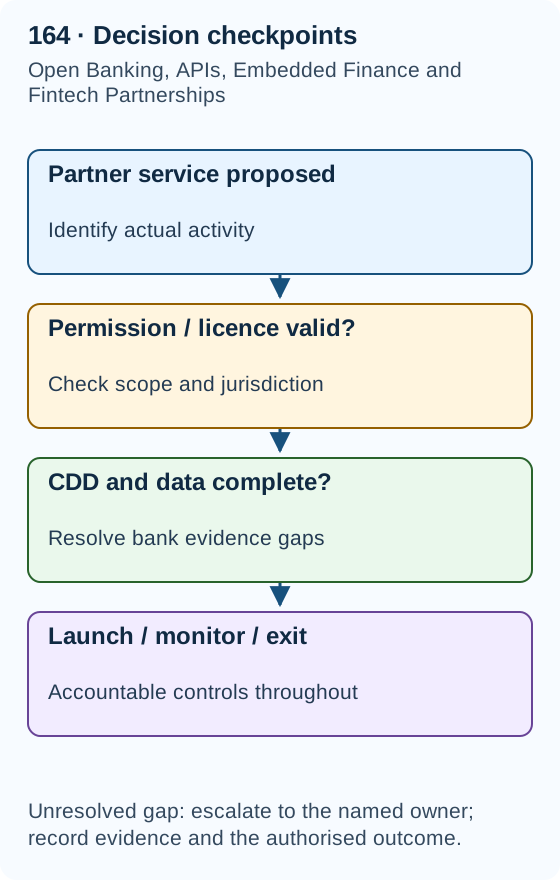
Begin with the service and the legal entities
A technology partnership should be assessed by the financial service actually delivered. An application that displays existing account balances creates different questions from one that initiates payments, opens accounts, holds customer value or provides credit. A partner may offer several services through one interface, while the regulated functions are performed by different legal entities. The bank should identify the customer contracts, regulatory perimeter, jurisdictions, product capabilities and money movement before deciding how controls are allocated.
Open banking is often associated with account-information and payment-initiation services, but the exact framework varies by jurisdiction. An API can also support a bank's own channels, an outsourced service or a private commercial integration unrelated to a statutory open-banking regime. The technical presence of an API does not establish licensing, legal permission, CDD completion or customer authority. A product team should be able to explain which legal and contractual basis permits each function rather than using open banking as an umbrella approval.
Embedded finance describes where the customer encounters the service, not one universal regulatory category. A worker may see a bank account in an employer application, a small business may access payments through accounting software, or a buyer may see finance inside an online checkout. Identify who provides the financial product, who contracts with the customer, who controls the interface and who performs material activities. A clear customer journey can improve usability while concealing complexity from the bank unless those roles are mapped.
The bank's risk assessment should connect that map to available evidence. If the partner controls the interface, can the bank obtain the customer information required for its duties? If the bank executes payments, does it receive the information necessary for the applicable controls? If a partner changes the product or uses a subcontractor, who notices and reassesses the arrangement? Those questions turn a diagram of technical components into an operating model with accountable decisions.
Separate identity, authority, consent and authentication
Identity asks who the person or entity is. Authority asks whether someone may act for that person or entity. Consent concerns permission for a defined use or service under the applicable framework. Authentication concerns confidence that a credential, device or session is controlled by the expected user. These propositions overlap in a customer journey, but they are not interchangeable. Strong authentication can prove control of a session while leaving the identity or corporate-authority question unresolved.
For a business account, an employee may have valid credentials and permission to view balances but no authority to open a new product or change the company's payment beneficiaries. A director may be verified but still need to act within the company's mandate. A consent record should describe the actual permitted scope and relevant state, while a separate authority record supports actions on behalf of the company. Treating both as a single authenticated-user flag can produce unauthorised financial activity.
Consent also has temporal meaning. A customer can withdraw access while the underlying bank relationship continues. An access token can expire even though the customer remains a customer. A service can be terminated while legally required recordkeeping continues. Systems should distinguish those states and apply the consequences required by the actual framework. An expired technical credential should not automatically erase customer evidence or close an investigation.
CDD remains a separate discipline. The applicable law determines identity, beneficial-ownership, purpose and other requirements for the relationship. Information obtained through a legitimate account-information service may help corroborate a fact where permitted and reliable, but it does not automatically satisfy every CDD requirement. The bank should identify what a data item proves, where it came from and whether it is suitable for the specific legal or risk proposition.
Follow the customer through the partner boundary
The journey starts before the API call. A partner may advertise the service, collect initial information, present terms, perform document capture and pass an application to the bank. The bank may make an approval decision, create an account and return status for display. Later, the partner may receive payment instructions, request changes or offer additional functionality. Each handoff can lose information or obscure who made the decision.
Map the required information and decision at each step. Identify which facts are mandatory, which are conditional and which are contextual. Record who collects, verifies, resolves discrepancies and retains the evidence. If the partner supplies a verification result, establish the method, source, coverage and limitations relevant to the bank's reliance on that result. A simple pass response can be insufficient when the bank cannot reconstruct what was tested.
The customer should receive a clear next step when evidence is missing. That does not require exposing internal system architecture. A message can explain that additional ownership information or evidence is needed, what the customer should provide and how to obtain assistance. It should avoid claiming successful onboarding when only a login or consent step is complete. Product status language should reflect the actual financial-service decision.
Changes after activation matter equally. Ownership, customer purpose, product capability, geography and authorised users can change. The bank should understand how the partner captures those changes, when they become effective and which controls consume them. A relationship that was adequately assessed at launch can become poorly understood if the front end expands into new activity without a corresponding bank review.
Decide what can be delegated and what must remain accountable
A partner can perform operational tasks, but responsibility for a bank's own obligations does not disappear. The arrangement may constitute outsourcing, agency, referral, reliance on specified third-party CDD measures where permitted, or another legal model. The classification affects controls and conditions. FATF Recommendation 17 supplies a reliance framework, but applicable national law determines whether and how reliance is available. A contract using the word reliance is not enough.
Specify decision rights. Which party may accept an application, approve an exception, restrict functionality, resolve a screening candidate or decide a reporting referral? Which decisions must return to the bank? How are urgent cases handled outside ordinary operating hours? A partner should not infer approval from the absence of an API rejection when a case is awaiting manual review. The integration should support explicit states and accountable transitions.
Evidence access is essential. The bank may need immediate information for some decisions and retrievable underlying records for later assurance. Contracts should reflect the actual duties and service model, including access after termination and appropriate safeguards. Test retrieval using realistic cases. A promise of records on request is weak if the partner cannot identify the relevant customer, evidence version or transaction history.
Technology risk can become financial-crime risk
Technical defects can reduce control coverage without creating obvious payment failures. A schema change can drop beneficial-owner fields while account creation still works. A retry can duplicate a payment request. A reused partner identifier can connect a new customer to another customer's risk history. A late event can update the wrong effective period. A monitoring feed can omit one product while the bank's totals remain balanced. These failures need controls designed around meaning, not only connectivity.
Stable bank identifiers should link partner records to the actual customer, account and transaction. Preserve the original identifiers and mapping history. Do not allow the partner's change of internal key to erase the bank's evidence or create a second customer with inherited approval. Data validation should distinguish missing required facts, unsupported values and service errors. A vendor timeout should not be recorded as a customer failing identity verification.
API security remains important, but a secure interface does not establish adequate AML controls. Authentication, session integrity, access permissions and request validation protect the technical channel. Customer understanding, transaction visibility, screening, monitoring and reporting address different obligations and risks. Assurance should test both and the interface between them. A penetration-test certificate is evidence about its defined security scope, not proof that every customer has completed CDD.
Monitoring needs the underlying activity
Partner-level volumes can help assess the relationship, but individual customer activity may be necessary for the bank's own controls. Understand the transaction population, relevant customer and counterparty information, product context and available history. A bank should not assume that aggregate settlement fully represents the underlying customer transfers. Equally, it should not collect unlimited personal data without a lawful purpose. Requirements should explain why particular data is needed and how it will be used and protected.
Patterns require interpretation. Sudden payment growth can reflect a partner's successful launch, a new customer segment, an operational retry defect or suspicious activity. Common devices can reflect shared workplaces or coordinated abuse. A new beneficiary can be ordinary commerce or an unauthorised diversion. Analysts need customer and product context, source quality and alternative explanations. Automated scores should support that reasoning rather than become unexplained verdicts.
An investigation referral should carry the evidence available to the partner and bank. Identify the actual customer, trigger, transactions, relevant dates and unresolved facts. Separate a security incident, fraud concern, AML hypothesis and sanctions exposure. The same event may require several routes, but each should apply its own legal or policy test and decision authority. Closing a fraud ticket should not automatically close a suspicious-reporting assessment.
Build for interruption and exit
Partnerships can fail commercially or technically while customers still have active products. An exit plan should identify accounts, pending transactions, restrictions, complaints, protected reports and records that must remain accessible. Decide how customers will be served, informed or migrated under applicable requirements. The bank should not discover during termination that the partner holds the only usable evidence of its customers' identities or instructions.
Outage planning should distinguish loss of the interface from loss of control data. The partner application may be unavailable while the bank continues to process standing instructions. Conversely, the interface may work while event feeds to monitoring fail. Identify which activity remains possible, what visibility is lost and which approved contingency controls apply. Recovery should reconcile late events, duplicates and missed populations, preserving the original incident evidence.
Practitioner decision standard
The partnership is understood when the bank can explain the service, legal entities, customer relationship, authority, consent, CDD basis, funds flow, data coverage and decision ownership. It should also explain what happens when a fact changes, a service fails or the commercial arrangement ends. Technical success is necessary for an API integration, but the banking decision rests on a maintained evidence and control chain throughout the financial relationship.
Partner journey and data coverage
Trace the customer from the partner interface to the bank record and subsequent transactions. Record which party collects each field, verifies evidence, resolves discrepancies and stores the source. A simplified front end can hide missing ownership or purpose data that the bank needs to make its own decision.
Define a data contract covering customer, device, consent, account, transaction, counterparty and decision identifiers as appropriate to the service and lawful purpose. Distinguish required AML data from optional contextual signals. Privacy and purpose limits apply; collecting every available API field without a reason is not a control strategy.
Monitor unusual activity using complete transaction populations and meaningful context. Partner-level totals can conceal individual risk. An expired consent token may stop account-information access but does not necessarily end the financial relationship or remove recordkeeping duties. Track consent state separately from customer, account and investigation status.
Outages and partner termination need an operating plan. Preserve records, route urgent cases, maintain reporting and restrictions, reconcile outstanding transactions and migrate customers lawfully where appropriate. The bank must not lose access to required evidence because a commercial API subscription ended.
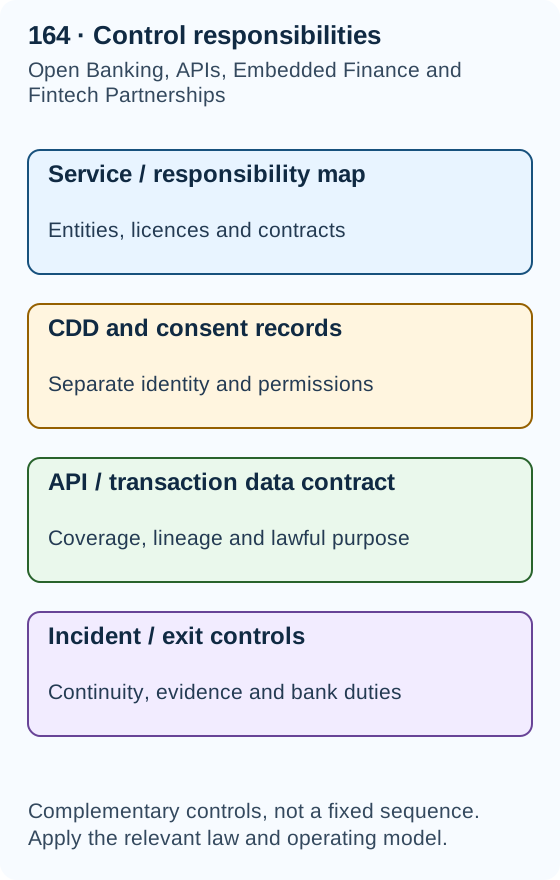
Define the canonical customer and relationship records
The bank should maintain a reliable record of the legal customer and financial relationship, even when the partner supplies the interface. A partner identifier is useful for routing and support, but it should map to a stable bank identifier with controlled history. Separate the person, legal entity, authorised user, account, product and service relationship. One person can use several services; one company can have several authorised users; one partner can support several bank entities. The model should reflect those relationships without conflating them.
Record provenance for significant facts. The source may be customer declaration, document evidence, registry, partner verification service or bank investigation. Preserve the collection and verification dates, method and relevant limitations. A value received through a signed API request is authentic as a transmission from that partner, but it may still be an unverified customer assertion. Technical authenticity and factual reliability are separate dimensions.
Customer matching should have a controlled exception path. If a partner sends a customer name and date of birth matching an existing record, determine what evidence supports linking them. Do not create an automatic identity conclusion from approximate similarity alone. If the same partner identifier appears with incompatible identity information, preserve the contradiction and stop the inappropriate mapping under approved requirements. Merging or splitting records should retain historical transaction links and a reasoned decision.
Keep several state machines separate
Consent state describes the permitted access or service scope under the relevant framework. Credential state describes whether a token or technical key is usable. Customer state describes onboarding, review or relationship status. Account state describes product availability and restrictions. Transaction state describes the progress of a particular instruction. Case state describes investigation and decision status. These states interact, but they should not be represented by one active flag.
For example, a consent withdrawal can stop a specific data-access service while the bank account remains open. A credential expiry can require renewal without implying that the customer failed CDD. An account restriction can affect payment capability while allowing appropriate information access. A case can remain open after a particular transaction is lawfully completed. Requirements should define those consequences explicitly and test them under the applicable service model.
State transitions need evidence. Record the originating event, effective time, bank receipt time, decision authority and resulting action. A late event should not erase the state that applied when a transaction executed. If a partner corrects an earlier event, preserve the original and the correction. Investigators need to reconstruct what the bank knew and what its systems actually did, rather than see only the latest status.
Build a data contract around obligations and decisions
A useful data contract starts with the control question. Which identity information is legally required? Which ownership facts are needed for this customer type? Which transaction attributes support screening or monitoring? Which service and consent information establishes permitted access? Which fields are optional context? Specify the legal or policy basis, source, permitted use, retention and access for each relevant category. Avoid the vague requirement that the partner send all data.
Define completeness by population and stage. A beneficial-owner field may be irrelevant to one personal customer but required for a particular corporate relationship. A counterparty attribute may be available for one payment type and limited for another. The validation should represent those conditions accurately. Default values should not disguise missing required information. A blank field, explicitly unavailable field and verified fact should remain distinguishable where they have different control meanings.
Quality checks should include semantic consistency. Customer type must agree with the required evidence path. Account ownership should agree with the relationship map. Consent scope should match the requested function. Product and jurisdiction should route to the correct decision rules. A transaction date should not be confused with the API receipt date. A successful schema validation proves structural conformity; it does not establish that those business propositions are true.
Trace decisions across synchronous and asynchronous processing
Some API calls return immediately, while others create work completed later. An onboarding request may be accepted technically but remain pending a bank decision. A payment request may enter a queue and receive a later result. A restriction event may require acknowledgement from several systems. The integration should distinguish receipt from approval and approval from execution. Otherwise, the partner can display a success message before the bank has made the relevant financial-service decision.
Asynchronous events need stable correlation. Link request, customer, account, transaction, decision and case identifiers as appropriate. Define deduplication and ordering rules. A repeated delivery should not create a second payment; a delayed event should not reverse a newer approved state without a defined correction process. Keep the original event and processing result so an incident team can identify whether a failure originated at the partner, interface, bank rule engine or execution system.
Retry design should reflect financial meaning. Retrying an evidence request differs from retrying a value-transfer instruction. The system should know whether an earlier request was received, approved or executed before attempting another value movement. Idempotency keys are useful, but their scope and lifetime need to match the product. A reused key attached to different content should generate a defined exception rather than quietly returning an unrelated previous result.
Place controls where the required information is available
Control placement depends on law, product mechanics and data. The partner may see device and journey context that the bank does not receive. The bank may hold account history, sanctions decisions or customer information unavailable to the partner. The operating model should connect relevant evidence lawfully so each control can make an informed decision. A single control point is not automatically sufficient for every risk.
Onboarding controls can prevent a product from becoming active before required evidence and approval are complete. Transaction controls can assess individual instructions where required or appropriate. Ongoing monitoring can identify patterns over time. Event-driven review can update customer understanding. Each needs a defined population, input, expected outcome and execution mechanism. An assurance plan should test whether the handoffs leave a gap between those layers.
Do not prescribe one global instant-payment or sanctions architecture. The applicable jurisdiction, payment rail and legal measure determine the obligation. Partner interfaces should support the bank's approved control model without converting every similar name or technical error into a legal freeze. Where decisions must occur quickly, pre-approved escalation and fallback rules should reflect actual legal and operational constraints.
Make investigation handoffs usable
A partner referral should identify the customer and relevant activity, state the observed concern and provide the evidence supporting it. Include original records or retrievable references, dates, source limitations and any action already taken. A label such as unusual customer is insufficient if the bank cannot determine which transactions or facts triggered it. Equally, the partner should not be required to make a legal reporting decision outside its remit merely to send a useful referral.
The bank should decide how referrals enter its case model and how urgent issues are escalated. A service outage can delay a normal queue; a serious concern may need another approved route. Define who acknowledges the referral, who owns the case and what feedback can lawfully return to the partner. Protected reporting information and personal data should remain subject to appropriate access and disclosure controls.
Case outcomes can update several domains. An investigation may correct customer purpose, identify a security weakness, require a restriction or support a reporting decision. Propagate only the appropriate information to each domain. Do not send a confidential reporting narrative to a customer-facing application merely because it is stored in the same case record. Maintain traceability between the conclusion and the action without widening access unnecessarily.
Assess automation with evidence and limits
Automated partner decisions should be understood according to their actual purpose. A document-validation result, fraud score, device-risk signal and customer-risk rating answer different questions. The bank should know the relevant method, inputs, coverage, version and reason codes, and how uncertain results are handled. A certification or audit report supports only its stated scope. It does not replace the bank's assessment of how the result is used in its own product.
Validation should include legitimate customers who have unusual but explainable circumstances. Shared devices, transliterated names, unsupported document formats and limited digital history can create uncertainty without wrongdoing. An approved alternative path can preserve access while obtaining sufficient assurance. Positive tests should also include known attack and control-defect patterns. The objective is reliable, proportionate decisions rather than the lowest manual-review rate.
Changes to models and vendor services need impact assessment. A threshold adjustment can change who is accepted, referred or rejected. A new document source can improve coverage while introducing a reliability limitation. A product launch can shift the population beyond the original validation set. Record approved changes, test results, limitations and rollback plans. Monitoring should identify drift and unexpected customer effects after deployment.
Control continuity during partner exit
An exit plan should identify evidence ownership, retrieval, customer servicing, pending transactions and restrictions. The bank needs an accessible record of its relationship decisions and the information required under applicable retention obligations. If the partner stores source evidence, the plan should address lawful transfer or continued access, format, integrity and retrieval after contract end. Test a representative retrieval before the relationship is terminated.
Migration should preserve stable bank identifiers, consent and authority history where relevant, account restrictions and open cases. Reconcile customer and transaction populations between old and new channels. Verify that a closed or restricted account does not become active because the new partner uses a different status vocabulary. Verify that customers who remain eligible can access the intended service without unnecessary re-onboarding caused by lost mappings.
Financial positions also need reconciliation. Pending payments, reversals, refunds and charges can survive the interface change. Operations should distinguish a cancelled technical request from a reversed settled movement of value. Customer communication should describe the actual service impact and available next steps. A partner exit is complete when the bank can continue its obligations and reconstruct the relationship without depending on an unavailable commercial interface.
Security and AML boundaries
Test strong authentication with incomplete CDD, valid consent for an unapproved service, reused customer identifiers and a partner sending transactions without required counterparty information. Expected outcomes should distinguish security failures from financial-crime evidence gaps.
Assess models and automation for explainability, source coverage and false confidence. Device or behavioural scores can support fraud and risk analysis but do not replace legal identity or ownership requirements. Partner certifications should be evaluated for their actual scope.
Changes to API schemas, product features, ownership or subcontractors can invalidate the original assessment. Reconcile old and new populations and retest the controls affected rather than accepting a successful connectivity test as full readiness.
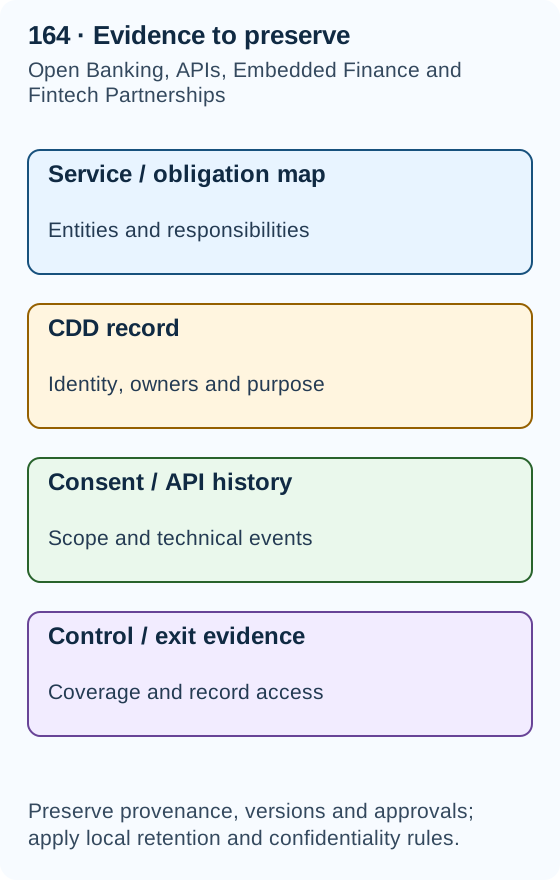
Case method: identify the proposition that failed
These cases are fictional and use illustrative facts. They do not establish one legal outcome across open-banking or embedded-finance regimes. For each case, identify the actual service, bank entity, customer relationship, applicable requirements and evidence. Then separate a technical success or failure from the financial-service decision. A valid token can coexist with missing CDD; a monitoring gap can coexist with balanced accounts; a partner certification can coexist with an untested product.
Case 1: strong login, incomplete company ownership
An accounting platform offers a business account supplied by a bank. The company administrator completes a strong login and grants the requested data access. The partner sends verified company-registry details, the administrator's identity result and a consent token. The ownership section contains only the names of two holding companies. The interface displays account ready, although the bank's corporate CDD decision remains pending.
The initial task is to establish what has and has not been proven. The login supports control of a credential. The consent record supports the specified access or service permission under the relevant framework. Registry evidence can support the company's legal existence and filed information. None of those facts automatically identifies the natural persons required under the applicable ownership or control rules. The administrator's authority to act also needs its own appropriate basis.
The bank should identify missing evidence under its actual jurisdiction and customer type, request it through a usable partner journey and prevent activation where required until the decision is complete. It should not impose a universal ownership percentage or invent a rule from the platform's technical specification. The interface status should be corrected to explain the pending step, while avoiding disclosure of confidential internal reasoning. Existing data-access services may have a different state from the new account application.
Assurance should test whether the bank's pending decision reaches the partner display and product capability. A screen correction alone is insufficient if payments can already execute. Preserve the original request, supplied evidence, rule version and status transitions. The lesson is that identity, authority, consent and CDD must have separate evidential and operational meanings, even when the customer completes them in one journey.
Case 2: consent ends but the bank relationship continues
A customer uses an account-information service to display several bank balances in a financial-planning application. They later withdraw that service's access. The partner sends a consent-revocation event, and the bank correctly stops the relevant access. A poorly designed integration also marks the customer as closed and removes their record from ongoing monitoring for a separate bank account that remains active.
The legal and product teams should identify the actual consequence of the withdrawal in the applicable framework. Ending a specific data-access permission does not automatically end the customer's separate account relationship. The incident team should establish which event caused the customer-status change, which accounts remained active and which controls lost coverage. Preserve event time, bank receipt time and downstream acknowledgements so the exposure window can be reconstructed.
Recovery should restore the correct relationship state and reconcile the monitoring population. Assess whether activity during the gap requires review, without assuming that every transaction was suspicious. Verify that legally required records were not deleted and that customer-facing channels show the correct service availability. Any privacy or customer-protection implications should be assessed within their own applicable framework rather than improvised through AML terminology.
The acceptance test should prove two outcomes simultaneously: revoked access remains revoked, and unrelated active products retain the controls they require. It should include a genuinely closed relationship as a separate negative case so the system does not preserve all services indiscriminately. The lesson is to model consent, service and customer states separately and define their relationships explicitly.
Case 3: secure API, incomplete transaction population
A fintech partner sends payment requests through a well-tested authenticated API. Bank execution and settlement totals agree with partner reports. During an interface release, one payment type is omitted from the event stream consumed by AML monitoring. Security testing reports no issue, and the commercial dashboard remains green because payments still succeed.
The control defect concerns population coverage, not unauthorised access. Identify the omitted payment type, release date, customer population, transaction count and value. Reconcile monitoring inputs against execution records and the partner's original requests. Determine whether the necessary counterparty and purpose data can be retrieved for historical analysis. A successful API security test and balanced settlement are relevant evidence, but they do not answer whether monitoring saw the activity.
Containment should reflect the applicable duties, available alternatives and risk. The bank may restore the feed, apply an approved manual process or limit the affected capability within lawful bounds. The incident review should assess missed screening or monitoring consequences separately. It should also identify whether the omission was visible in schema documentation, reconciliation reports or change acceptance, so remediation addresses the control-design cause rather than only one missing field.
Recovery should include historical replay or another documented review method, with deduplication and provenance. The bank must avoid creating duplicate transactions while replaying analytical events. Retain original and corrected records. The lesson is to reconcile control populations independently of settlement and to test every material product type through the full journey.
Case 4: a reused partner identifier contaminates two customers
A partner changes its customer-management system and reuses an old numeric identifier for a new applicant. The bank maps partner identifiers to customer records without an effective period. The new applicant's onboarding response inherits the old customer's approval and risk rating. Their identity information is different, but the integration accepts the existing mapping as authoritative.
The bank should preserve the inconsistent messages and determine whether any product or transaction became active under the incorrect relationship. The defect is not merely a duplicate record. It is an unsupported identity link and a decision-history error. Establish the original customer, new applicant, identifiers, timestamps and actions. Determine whether personal information was exposed to the wrong party and assess those implications through the appropriate processes.
Correction should restore the right mappings without erasing the original incident evidence. The new applicant requires their own applicable assessment; they should not automatically be treated as fraudulent because the partner made an identifier error. The original customer should retain their history and appropriate service state. Investigators need a reliable link between transactions actually executed and the identity that authorised or benefited from them.
Delivery requirements should prevent identifier reuse from silently establishing identity. Include source-system scope, effective dates, incompatible-attribute checks and an explicit review path. Test migration with both legitimate key changes and erroneous reuse. The lesson is that stable bank identities and controlled relationship history are financial-crime controls, not just database hygiene.
Case 5: the partner expands beyond the approved service
A partner initially provides an interface for existing bank accounts and payment instructions. It later introduces a feature allowing business users to collect funds from their own clients and distribute proceeds. The partner describes the release as a dashboard improvement. The bank learns that the new flow pools money and uses identifiers that do not clearly identify the underlying payers or recipients.
Start with the actual commercial and funds model. Who contracts with the underlying clients? Who holds or controls value? Which entities execute the payments? What permissions and national regulatory requirements apply to the new activity? The original service approval should not be assumed to cover the new function. Conversely, the presence of pooled settlement does not alone establish unlawful activity; the applicable model and evidence determine the assessment.
The bank should assess required customer and transaction visibility, partner authorisation, contractual scope and control capability. If important facts remain unresolved, decide what lawful limits or suspension are appropriate for the new feature rather than automatically closing unrelated services. The commercial team should understand that successful connectivity and familiar branding do not establish approval of a changed financial product.
Change governance should require material service and funds-flow changes to reach the bank before launch. Test the inventory of capabilities against live API functions and transaction populations. The lesson is that financial-service perimeter changes can arrive inside ordinary software releases, and controls need a route to recognise them.
Case 6: partner termination removes the evidence archive
A bank ends an embedded-account arrangement after a commercial disagreement. The partner disables its portal and external evidence archive immediately. The bank retains customer names and account numbers but cannot retrieve the underlying identity-verification records or the mandate evidence for several business customers. Some payments remain pending and several accounts are restricted under ongoing cases.
The bank should identify the records and populations affected, applicable retention and access requirements, contractual rights and available alternative evidence. Legal, compliance, operations and partner-management owners need a coordinated response. The bank should not recreate a clean onboarding decision from incomplete current fields or treat inaccessible evidence as proof that every customer was improperly onboarded. Record the limitation precisely and assess its consequences.
Pending transactions and restrictions require independent continuity. Verify which instructions can execute, which accounts remain restricted and how customers obtain lawful service. A partner's commercial shutdown should not override a bank restriction or cause a completed value transfer to be reported as cancelled. Preserve all accessible records and communications relevant to the incident and determine whether historical reconstruction or remediation is required.
Future contracts and acceptance tests should make evidence retrieval after termination concrete. Test archive access, export integrity, stable identifiers and servicing plans before launch. The lesson is that outsourcing the customer interface must not leave the bank unable to fulfil its own duties when the interface disappears.
Practice challenge: what would change your conclusion?
For each case, identify evidence that could weaken the initial concern. A corporate ownership field may be absent from the interface but available in a verified bank record. A supposedly missing payment type may be monitored through another reconciled path. A changed identifier may have a documented, validated migration mapping. A new dashboard feature may only display information and move no value. Strong investigators test those possibilities. They do not treat the original alert description as an established fact.
Then identify the boundary beyond which additional evidence is necessary. A partner's assurance that everything is compliant does not replace the ownership record, transaction population or legal service assessment. A bank should know which propositions remain unsupported and who can decide whether service may continue. This produces proportionate action: correct the specific defect, preserve lawful service where possible and apply mandatory obligations where required.
Case quality and control learning
A good case record separates the technical incident, customer facts, legal or policy requirements, financial exposure and actual outcome. It names the decision owner and preserves the relevant versions and times. If a data issue is repaired, it shows how affected populations were reconciled. If a service is limited, it shows the scope and execution. If the initial hypothesis is rejected, it records the evidence that changed the conclusion.
Learning should improve the operating model. Repeated status confusion may require separate state machines and clearer interface language. Repeated missing data may require stronger contracts and acceptance criteria. Repeated unapproved product changes may require capability inventory and launch governance. Repeated evidence retrieval failures may require a different archive design or partner decision. The purpose of investigation is both a sound current outcome and fewer avoidable weaknesses in future relationships.
Worked embedded-account case
A fictional partner supplies a verified login and customer consent token but omits the business customer's beneficial owners. The bank should identify the actual service and applicable CDD requirements, obtain missing evidence and prevent the token from being treated as proof of completed onboarding.
Explain who owns the missing data, which controls need it and how the partner journey should communicate the next step without exposing internal implementation detail.
Build a partnership decision brief
A decision brief should describe the proposed financial service in ordinary banking terms. Identify the bank and partner legal entities, customer, product, jurisdiction, contract and funds flow. Describe what the customer can actually do, including opening products, accessing information, initiating payments, changing beneficiaries and receiving value where relevant. A list of endpoints is useful implementation evidence, but it should not replace the service description needed for legal and control assessment.
Then identify the bank's duties and control requirements. Map identity, authority, ownership, purpose, screening, monitoring, reporting and record access to accountable roles as applicable. Distinguish mandatory legal requirements from bank policy and commercial conditions. Explain which partner tasks support those requirements and what evidence demonstrates their adequacy. If lawful reliance is proposed, identify its specific legal basis and conditions rather than treating a technical integration as reliance automatically.
The brief should state limitations and conditions. Which records are held outside the bank? Which populations or functions are excluded from the proposed scope? Which decisions require manual review? What happens during an outage or partner exit? Each material condition should have an owner, completion evidence and a rule preventing unauthorised activity before completion. A pending control capability should not be recorded as already effective.
Write requirements around evidence and outcomes
For onboarding, specify the propositions the bank must establish and the evidence permitted for each. A requirement might state that a corporate application cannot enter the approved product state until required ownership and authority information has been accepted under the applicable rule. Test both a missing-evidence case and a legitimate case where verified information already held by the bank can be reused according to approved policy. Avoid demanding duplicate documents simply because the partner interface has its own form.
For consent and authority, specify what each state permits. A revoked information-access consent should stop the relevant access. It should not automatically erase a separate account relationship. An authorised company user should have only the capabilities supported by their mandate and the service's permissions. Test changes in authority while transactions are pending, with clear expected outcomes defined by the approved model.
For transactions, specify population coverage, required data, correlation, retries and execution evidence. The bank should be able to identify the customer, relevant counterparty facts, instruction, decision and resulting movement of value. Test missing data, duplicate requests, late results and an execution failure after approval. A successful response should mean exactly what the interface documentation and customer communication claim it means.
Use acceptance criteria that expose boundary defects
Acceptance should include the ordinary journey and plausible boundary failures. A technically received application remains pending if the bank has not approved it. A partner's corrected customer identifier does not lose historic links. An expired credential does not become a failed-CDD decision. A security incident does not automatically become a suspicious report. A lawful account restriction reaches every relevant transaction route while preserving intended access to other functions.
Data tests should reconcile the whole relevant population. Choose representative personal and business customers, product types, jurisdictions and partner channels. Compare source requests, bank customer records, execution records and control inputs. Known exclusions need an approved basis and visibility in the report. If a control cannot receive necessary context from a particular payment type, the limitation should be assessed and addressed rather than hidden by aggregate totals.
Evidence-retrieval tests should use live, closed and migrated records. Retrieve the source or accepted evidence, method, relevant dates, decision and approver. Confirm that protected case information stays within authorised access. Test partner non-response and archive failure. Retrieval should be demonstrated under the time and conditions relevant to the actual duty, rather than assumed from a contract clause.
Plan customer treatment alongside control action
When a journey needs additional evidence, give the customer a clear, accurate next step. Distinguish a technical problem from a decision that more information is required. A user should not be told they failed verification because a service timed out. A company administrator should not be told the account is ready when ownership review remains pending. Clear status language reduces repeat applications, support confusion and accidental attempts to bypass controls.
Alternative paths should reflect the legitimate limitations of digital channels. A customer may need assisted submission, another supported evidence method or manual review. Those paths should preserve appropriate assurance without requiring the customer to give credentials to a helper or disclose unrelated personal data. Product, operations, accessibility, privacy, fraud and compliance owners should agree the path relevant to their responsibilities.
Restrictions and exit communications need the correct legal and policy basis. Explain permitted service impact and available support while respecting protected reporting or investigation constraints. A partner should receive enough instruction to implement the action without unnecessary sensitive detail. Test the customer experience after a bank restriction so a technically correct back-end decision does not produce misleading or harmful interface behaviour.
Conduct a release rehearsal
Use a fictional embedded business-account launch. The partner collects identity and registry information, the bank decides CDD, and payments execute through the bank. During rehearsal, inject an incomplete ownership record, a delayed approval event, a reused customer key, a revoked consent, a missing payment type in monitoring and a partner archive outage. Ask the team to show the expected customer, account, transaction and case states for each event.
The rehearsal should involve the people who will operate the service. Product teams explain the customer journey, operations handles exceptions, compliance applies the approved requirements, technology shows event delivery, and assurance tests the outcome. A demonstration by developers alone can miss gaps in decision authority or evidence retrieval. Record the defects and retest the repaired boundary, rather than accepting a narrative that the issue would be handled manually.
The release decision should identify tested scope and limitations. If one product type remains untested or one evidence archive is unavailable, state that precisely and decide the corresponding launch scope. This is more useful than a general declaration that the API works. Readiness means the bank can fulfil the duties attached to the service it actually permits customers to use.
Knowledge checks with explained answers
Does a valid consent token establish completed CDD? No. It supports the defined consent proposition under the applicable framework. Identity, authority, ownership and risk requirements need their own accepted evidence and decision.
Does partner authorisation for account information establish permission to hold customer funds? No. Assess the actual activity and the partner's applicable permission scope. A licence or registration should not be extended by analogy to another service.
Can a penetration-test report prove AML effectiveness? It can support conclusions within its security-testing scope. AML effectiveness also requires customer and transaction coverage, usable evidence, appropriate decisions, execution and reporting controls. Test those directly.
What should happen when required partner evidence cannot be retrieved? Identify affected records, the duty and risk involved, alternative evidence and lawful service options. Preserve the limitation and assign accountable action. Inaccessibility is not automatically proof of wrongdoing, but it cannot be ignored when the bank needs the evidence.
Why preserve event and receipt timestamps separately? They help reconstruct the facts and states at the time of a decision, including late delivery and control latency. Today's corrected record should not erase what the bank actually knew and did yesterday.
Working glossary
Consent scope describes the permitted access or service under the applicable framework. Authority to act concerns the right to act for another person or entity. Credential state concerns technical usability. Canonical customer record is the bank's governed identity and relationship representation. Idempotency prevents an appropriately identified repeated request from executing value movement twice. Data contract defines meaningful information obligations and handling, not just a schema. Control continuity preserves necessary evidence and decisions through outage, migration and exit.
Delivery acceptance and exit evidence
Contracts and system requirements should name control owners, evidence access, reporting hand-offs, incident handling, subcontracting and exit obligations. Preserve decision history and stable bank identifiers when partner records change.
Acceptance tests cover data completeness, consent withdrawal, API failures, late events, duplicate transactions, inaccessible records and partner exit. Verify that appropriate cases reach the bank and that restricted accounts remain protected across all channels.
The partnership is ready when the bank can fulfil its own duties using accessible evidence throughout the relationship, not only at the first successful API call.
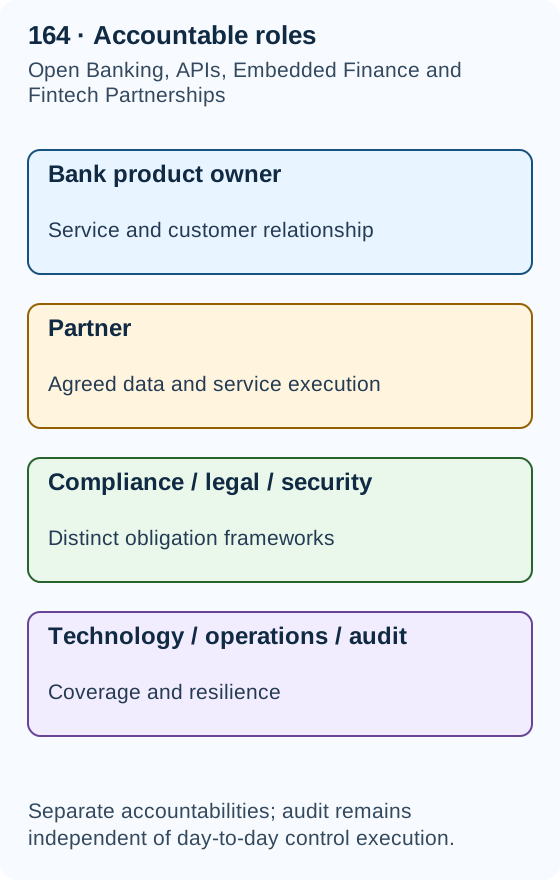
Own the financial service, not only the integration
Senior accountability begins with the service the bank provides. A partner-management team can manage a contract, and a technology team can operate the interface, but neither function alone owns the bank's complete financial-crime responsibilities. The programme should identify an accountable business owner, control owners, decision authorities and independent challenge. Those roles should be connected by evidence and escalation routes, especially where the customer sees only the partner's brand.
The product inventory should describe active functions, legal entities, jurisdictions, customer populations, partner roles and material subcontractors. Compare the inventory with live capabilities. A new endpoint, customer segment or payout function can change the assessed model. Governance should detect those changes before they become ordinary production activity. The bank should not rely solely on the partner's commercial description of a release.
Approval should address practical adequacy. Can required information be obtained and verified? Can the bank make and execute the decisions it must own? Can monitoring see the relevant activity? Can protected records be retrieved without widening access? Can customers obtain support and lawful alternatives? Each answer should be supported by evidence or a clearly identified limitation. An impressive architecture diagram does not answer those operating questions on its own.
Challenge the legal and control classification
The arrangement's classification should be reviewed by competent owners. Referral, outsourcing, agency and third-party reliance create different relationships and conditions. A partner can perform tasks under more than one model, and the classification can differ between activities or bank entities. Keep the analysis specific. A broad statement that the fintech is regulated does not show that its permissions cover the service or that the bank may rely on its CDD work.
Where reliance is permitted and proposed, identify the measures involved, information availability, record access, supervision and other applicable conditions. Where work is outsourced, identify the bank's requirements, oversight and accountability. Keep the distinction visible in contracts, procedures and training. The control should reflect the actual legal model rather than the terminology chosen by a procurement template.
Review conflicts between jurisdictions and entities explicitly. Privacy, payment-service, AML, customer-protection and sanctions requirements can interact. Identify the rule applying to each entity and activity, effective dates and any necessary specialist interpretation. A global policy can support consistency, but it should not invent identical legal requirements everywhere. Material uncertainty should reach the designated decision authority with complete facts and defined options.
Design evidence rights that survive commercial stress
Evidence access should be a tested capability. Specify the records needed, their ownership or custody, retrieval format, integrity, permitted use, retention and access after termination. Include records held by subcontractors where relevant. Test whether the bank can locate a historic customer, retrieve the evidence version used and reconstruct the actual decision. A broad audit right is weak if practical retrieval requires an unavailable employee to manually search an archive.
Commercial stress can expose hidden dependencies. A partner may restrict access during a dispute, lose key staff, change vendors or cease trading. The bank should assess which obligations would become difficult under those conditions. Contingency plans can include bank-held accepted records, lawful archive arrangements, alternative retrieval and servicing routes. The exact design follows the service and applicable requirements, but it should exist before the relationship fails.
Protect sensitive information while preserving usability. Investigation and reporting information may require restricted access. Customer identity and authority evidence should be accessible to authorised reviewers who need it. Operational instructions should give execution teams the necessary action and scope without exposing unnecessary protected detail. Contracts and system access design should support those different needs rather than assume one shared portal is suitable for all information.
Use management information to test the partnership's claims
Management reports should show customer and transaction coverage, required-data quality, evidence retrieval, unresolved decisions, execution failures, incident trends and changes outside approved scope. Define denominators and segment results. A high overall completeness rate can hide poor coverage for corporate customers. A low average referral age can conceal material cases that cannot proceed because evidence is unavailable. A partner-level payment total can hide a product omitted from monitoring.
Technical and financial-crime measures should be connected but distinguished. API uptime measures availability. Authentication failures measure part of security performance. CDD exception quality measures whether decisions are supported. Monitoring reconciliation measures population coverage. Restriction acknowledgements and execution tests measure whether actions reached the relevant paths. None of these measures alone proves overall readiness. A report should explain what each metric supports and what remains uncertain.
Trend interpretation needs context. Rising referrals can indicate a new risky population, improved detection or a deteriorating data feed. Falling manual review can indicate better evidence or an unsafe threshold change. Management should ask what changed and test the explanation. Decisions should name the exposure, owner, proposed action and completion evidence. Otherwise dashboards can remain visually reassuring while the underlying service becomes less understood.
Govern changes by their financial meaning
Change control should involve the owners of affected obligations and decisions. Schema changes, identity-vendor updates, model thresholds, consent logic, new products, new geographies and subcontractor changes can all alter the operating model. Classify the impact and test the relevant chain. A successful connectivity test is necessary for deployment but insufficient when a field's meaning or a service capability changes.
Preserve version evidence. Record the old and new schema or method, approved interpretation, affected populations, test cases, results and release time. Define rollback and data-recovery consequences. A rollback can restore software while leaving customer states or transactions created under the new version. The bank should understand that residual exposure and reconcile it rather than assume reversing a deployment reverses every decision.
Regulatory changes need their own status and dates. Separate current law, adopted future requirements, consultations and guidance. Apply changes to the correct entities and services. Training should explain the actual obligation and operational consequence. A partner's assertion that an upcoming proposal requires immediate customer rejection should be checked against primary material and competent interpretation before the bank implements it.
Rehearse a multi-boundary incident
Assume a partner release reuses some customer identifiers, omits a corporate ownership field and excludes a payment type from monitoring. The customer interface continues to display success, while the bank discovers incompatible records and a missing population. Some customers have active accounts, some applications are pending and some transactions have settled. The partner asks the bank to delete erroneous records and resubmit all applications.
The incident team should resist actions that destroy evidence or duplicate value. Preserve source events, mapping history, decisions and execution records. Identify affected customers and transactions using bank and partner data. Separate identity-link errors, missing evidence, monitoring coverage and customer communication. Decide lawful containment for each exposure, including what service can continue and what needs review. Account for protected information and appropriate customer treatment.
Recovery should reconstruct the correct identities and statuses, retrieve missing evidence and reconcile the omitted transaction population. Assess historical control consequences and reporting duties under the applicable framework. Corrected events should preserve originals and avoid duplicate execution. Customer messages should describe actual service states accurately. Independent assurance should challenge the recovery evidence rather than merely observe that the API is functioning again.
The exercise should produce specific improvements: controlled identifier mapping, required-field conditions, population reconciliation, partner-status alignment and evidence-preserving correction procedures. Assign owners and test completion. The programme learns when the repaired design can withstand the same incident without relying on individuals remembering which spreadsheets were used last time.
Challenge the economics of a control exception
A partnership can create pressure to approve temporary exceptions because the launch date, customer acquisition plan or revenue forecast assumes uninterrupted activation. Decision makers should understand the commercial consequence, but they should also see the actual control exposure. An exception paper should describe the unmet requirement, affected customer population, duration, activity permitted, legal limits, compensating control and exit condition. It should not present a future vendor fix as if it already protects today's customers.
For example, a partner may request activation of business accounts while an ownership-data interface is repaired. Determine whether the missing information can be obtained through another approved route and whether the applicable framework permits the proposed timing or scope. If the required facts cannot be established, commercial urgency does not create legal permission. If an alternative process is lawful and adequate, specify capacity, evidence standards and monitoring so the exception is operationally real. The approving role should know how many applications the process can handle and what happens when that capacity is exceeded.
Exceptions should expire or be reassessed according to their actual conditions. Track whether the population grows beyond approval, whether the promised repair occurs and whether the alternative control remains effective. A temporary arrangement can become permanent through repeated extensions unless management reviews the underlying cause. Record each decision and the information available at the time. Independent challenge should assess both legal adequacy and practical execution.
This discipline helps distinguish a bounded operating choice from an uncontrolled gap. It also supports fair customer treatment: a lawful alternative should be consistently available to eligible customers, while a limitation should be communicated accurately. The bank should not promise immediate activation to customers when its own approved process cannot deliver it. Commercial planning, product language and control capacity should align before the exception is used.
Final governance test
Select a customer who joined through the partner and ask the bank to show the legal relationship, identity and authority evidence, applicable CDD decision, consent or service scope, product state and relevant transaction history. Select a subsequent change and ask how it reached controls. Select a restriction and ask whether it reached every relevant execution route. Select a terminated relationship and ask whether the evidence remains retrievable under applicable requirements.
The partnership is ready when those answers are supported by maintained records and tested operations. The bank can benefit from a simpler customer interface while retaining a precise understanding of the service behind it. Accountability rests on the continuing ability to fulfil its own obligations through the partner arrangement, including change, incident and exit, rather than on the first successful connection or the partner's general assurances.
References and further reading
Reviewed 2 October 2026. FATF provides international standards; applicable national law determines binding duties. The operating examples are fictional teaching cases.
- FATF Recommendations, updated June 2026 — relevant anchors: 10, 15, 17 and 18.