Money or Value Transfer Services, Agents and Remittance Networks
Money or value transfer services (MVTS) accept funds or other value and arrange payment to a beneficiary through a communication, transfer or settlement network. The value may move through a bank payment, agent cash payout or other arrangement. The customer's instruction and the network's later settlement are not necessarily the same movement of funds.
FATF Recommendation 14 addresses licensing or registration and effective oversight of MVTS providers. Agents should be licensed or registered, or the provider should maintain a current agent list accessible to competent authorities, according to the standard's permitted framework. Providers using agents should include them in AML/CFT programmes and monitor compliance. National implementation determines the binding model.
A remittance is not inherently suspicious because it is small, cash-funded or cross-border. Understand sender, beneficiary, purpose, corridor, agent and expected activity with proportionate controls. Financial inclusion matters; blanket exclusion of legitimate remittance customers can push activity into less visible channels.
Payment transparency under FATF Recommendation 16 and its local implementation is also relevant. The June 2025 revised standard has an implementation horizon to end-2030; the June 2026 guidance consultation is not itself an already binding global operating rule. Use the current national requirements while preparing for adopted changes.
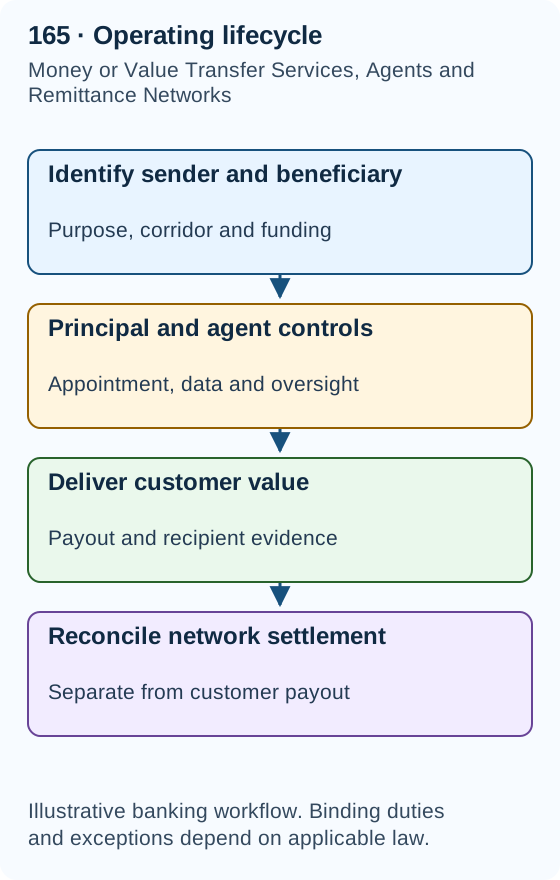
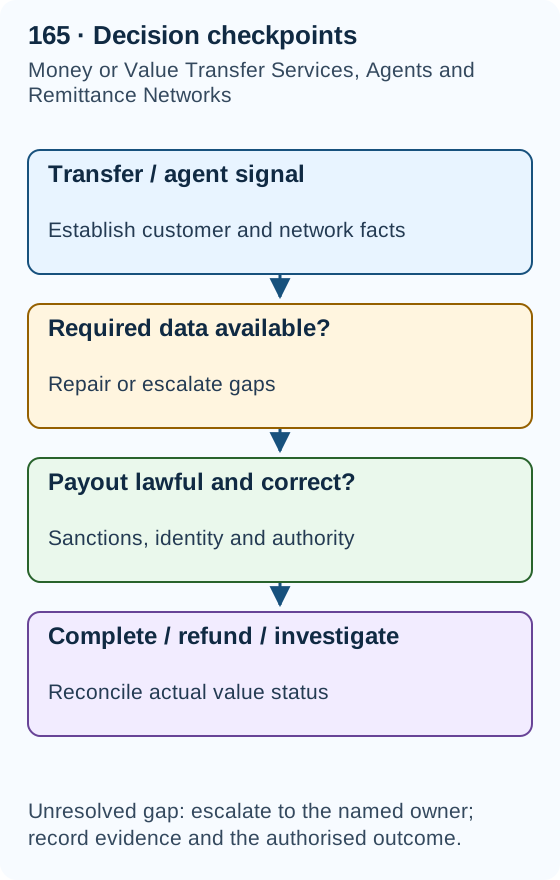
Understand the customer transfer and the network obligation
A remittance customer gives an instruction to make value available to a beneficiary. The service provider and its network then arrange delivery. That customer-facing transfer can be funded in cash, from an account or through another permitted method, and delivered through an account credit, cash payout or other supported channel. The network's later settlement between participants is a separate economic relationship. An investigation needs to see both rather than assume the customer funds travelled through one continuous bank payment.
For example, a sending provider can accept funds and send an instruction to a receiving partner. The receiving partner can pay the beneficiary from its local liquidity. The participants can settle their accumulated obligations later through bank transfers or another lawful arrangement. The sender's instruction, beneficiary payout and network settlement therefore have different timestamps and statuses. A balanced settlement total does not establish that every beneficiary was correctly identified or that every individual transfer carried the required information.
The network map should identify the principal provider, sending agents, receiving agents, relevant subagents, banking relationships, settlement counterparties and customer channels. Record who accepts funds, who records the instruction, who verifies required information, who performs the payout and who reconciles value. Where a participant performs several roles, preserve the distinctions. A head-office contract does not by itself show the locations or subagents actually serving customers.
Identify the applicable perimeter without relying on labels
Money transfer, remittance, money services and value transfer terminology differs across legal frameworks. The binding perimeter depends on the actual activity, jurisdiction and entity. A business can call itself a technology platform while arranging value transfer; another can supply communications or software without undertaking the regulated service. Competent analysis should identify the facts and current national requirements rather than derive legal status from branding.
Verify the provider's authorisation or registration where required and assess its actual scope. A licence for one service or jurisdiction should not be assumed to cover every corridor, customer type or agent arrangement. The bank should understand the provider's supervision, operating footprint and material limitations. Regulatory status is relevant evidence, but it is not proof that the provider's programme works effectively or that all its agents are properly controlled.
The FATF MVTS guidance remains a useful non-binding risk-based reference, but its current publication page warns that it predates later standard revisions, including the 2025 changes to Recommendation 1. Read it alongside current standards and more recent risk-assessment and financial-inclusion material. Training should not convert older guidance examples into current universal obligations, nor ignore current national rules because an international standard has a future implementation horizon.
Build proportionate customer understanding
The sender and beneficiary have different relationships with the service. Identify what information and verification the applicable rules require for each role and transaction. Understand purpose, funding and expected activity proportionately. A migrant worker sending regular support to family presents a different factual pattern from a business using transfers to pay many unrelated recipients. Those distinctions can guide inquiry and monitoring without treating nationality, occupation or corridor alone as guilt indicators.
Evidence should address the proposition being tested. If identification is required, the provider needs an accepted method under the applicable framework; an agent's familiarity alone may be insufficient. If the concern is an unexplained funding pattern, a verified identity document does not answer it. If the issue is recipient authority, a matching telephone number may not establish who may collect the payout. Record what the evidence proves and what remains uncertain.
Customer experience affects control quality. A confusing form can produce inaccurate purpose information. An unsupported document can cause a legitimate customer to be rejected even when an approved alternative exists. Repeated requests for the same evidence can drive customers away without improving understanding. A proportionate journey should explain required information, provide appropriate assistance and preserve a controlled exception path. Financial inclusion and effective controls can support each other when the bank tests actual risks rather than stereotypes.
Understand corridors as operating environments
A corridor describes more than two country names. Consider funding and delivery channels, customer populations, currency conversion, settlement arrangements, agent capability, data quality and applicable legal requirements. A corridor can contain low-risk ordinary family transfers and a smaller population requiring additional inquiry. The assessment should identify those differences rather than treat the whole corridor as one undifferentiated risk.
Local liquidity and banking access can affect delivery. A receiving agent may need cash to make payouts before network settlement. Temporary shortages can create delays or alternative arrangements. Those facts are not automatically suspicious, but they can change the control exposure and customer experience. The principal should understand approved contingency methods and ensure they preserve required identification, records and restrictions.
Changes in volume or recipient patterns need context. A festival, seasonal work cycle, disaster or product promotion can produce genuine changes. A new agent location can introduce a different customer population. Unexplained concentration, inconsistent sender profiles or deliberate concealment can support investigation. Analysts should compare observed activity with the provider's knowledge and test plausible explanations. Neither a country label nor a statistical deviation should replace that analysis.
Agents execute controls; the principal must see whether they work
Agent oversight begins with appointment and continues through the relationship. Establish the agent's identity, authority, location, relevant permissions and intended activities under the actual framework. Define training, systems, evidence standards, transaction visibility, escalation and corrective action. If subagents are allowed, the principal should know how they are approved and monitored. An undisclosed local location can create a gap even when the contracted agent's head-office record is complete.
Oversight should test execution. Retrieve sampled customer and payout evidence, reconcile transaction populations and assess unusual patterns at agent level. Compare locations, products and staff where meaningful. A low referral rate may indicate low risk or poor detection. High volume with consistently weak evidence can indicate capacity, training or incentive problems. The response should identify the cause and proportionate repair rather than assume misconduct from one metric.
Commercial incentives matter. An agent paid for transfer volume may face pressure to minimise questions or split activity across records. That is a risk hypothesis to test, not proof of wrongdoing. Review how exceptions, rejected transfers and customer complaints are handled. Ensure agents know where to escalate uncertainty and that the principal can respond within the product's operating needs. Rules that cannot be supported by available staff and systems are not effective controls merely because they appear in a manual.
Monitoring must join transfers without inventing relationships
Linked-transfer analysis can reveal repeated senders, beneficiaries, devices, addresses or agent locations. Relationships should be established using reliable information and appropriate safeguards. Common names, shared households and community networks are ordinary features of remittance services. A matching attribute can justify a question, but it should not automatically merge different people or classify all related transfers as suspicious.
Define aggregation and scenarios under the applicable rule or approved risk design. There is no universal period or amount that makes every remittance pattern suspicious. Where national law sets a requirement, identify its exact scope. Where bank policy uses a threshold, label it as policy and validate it for the population. Monitor both known risk patterns and the unintended effects on legitimate customers.
An alert should present enough context to investigate. Include relevant sender and beneficiary facts, funding, purpose, agent, delivery method, history and source limitations. Distinguish incomplete data from contradictory data. Investigators should test economic explanations and, where appropriate, connect customer transfers with network settlement or agent behaviour. The case should preserve the original observations even if subsequent evidence changes the conclusion.
Separate reporting, sanctions, fraud and service decisions
A suspicious-reporting decision follows the applicable legal threshold and authorised process. A sanctions decision follows the relevant measure, jurisdictional nexus, person or activity, permission and required disposition. A fraud decision can address unauthorised instructions or deception. A commercial decision can limit service within lawful contractual and policy boundaries. The same transfer may engage several routes, but one label should not stand for all of them.
For cash payouts, execution is especially important. A restriction on an instruction should reach the receiving agent before payout where the control is intended to prevent it. If the beneficiary has already received cash, changing a status to cancelled does not recover the value. Investigators and operations need the actual payout evidence and time. Reporting or remediation should be assessed from those facts rather than an inaccurate technical reversal.
Customer communication should be appropriate to the actual state. A delayed transfer, rejected instruction, completed payout and pending refund require different explanations. Protected reporting or investigation details may restrict disclosure. Provide lawful support and next steps without promising a refund that has not been approved or implying the beneficiary returned cash when they did not. Good status design reduces both financial loss and misleading evidence.
Practitioner decision standard
An effective MVTS model can identify the customer instruction, relevant parties, funding, agent path, payout and network settlement. It can explain the applicable requirements and who performs each control. It can retrieve evidence, investigate uncertainty, execute required actions and maintain those capabilities when an agent changes or fails. The bank should assess the provider's actual risk and control effectiveness while preserving legitimate remittance access where the applicable framework and manageable risk allow it.
Customer transfer and network settlement
Identify the sender, beneficiary, receiving location, delivery method, agent and funding source. Confirm that the recipient and payout instructions are sufficiently clear for the applicable requirements. An agent's local familiarity should not substitute for documented evidence where identification is required.
Trace the instruction through provider and payout agent, then separately reconcile settlement between network participants. Funds can be paid from local liquidity before the participants settle their obligations. Monitoring only the settlement account can therefore miss individual customer transfers; monitoring only instructions can miss mismatches in value settlement.
Principal oversight includes agent appointment, training, transaction visibility, unusual-pattern review, quality checks and corrective action. Review subagents and location changes, not only the contracted head office. Repeated failures at a high-volume agent may indicate weak controls, incentives or undisclosed activity requiring investigation.
Investigate linked transfers, unexplained repeated beneficiaries, inconsistent sender profiles and unusual agent patterns with context. Avoid a universal aggregation period or threshold unless it comes from the applicable rule or governed scenario. Reporting, sanctions and fraud decisions remain distinct.
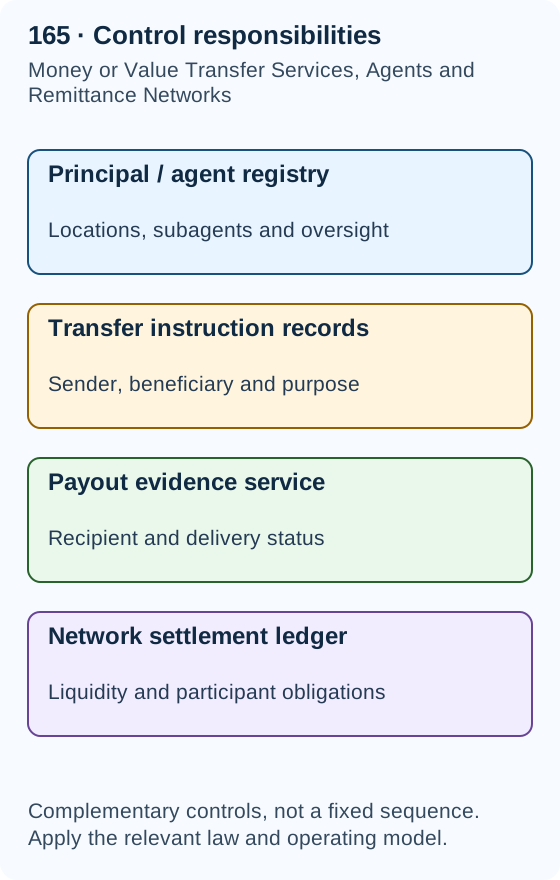
Model the transfer as related events
A reliable transfer record should distinguish instruction creation, funding acceptance, verification, approval, transmission, receiving-agent acceptance, payout, cancellation, refund and network settlement. The exact events depend on the service, but their meanings should be explicit. A transfer can be funded but not yet paid out; paid out but not yet included in network settlement; or cancelled before payout with a refund still pending. One completed flag cannot describe all those positions accurately.
Preserve event time, receipt time and the source of each event. A remote agent may upload records late. The principal may discover an earlier payout after approving a cancellation request. The event history should show that sequence rather than rewriting the record to make the latest status appear true at every prior moment. Historical reconstruction needs the information available at the time and the actual financial event.
Stable identifiers should link sender, beneficiary, instruction, agent, payout and settlement obligation. Preserve original local references and mapping history. If an agent changes software, the principal should reconcile old and new identifiers without losing transactions or creating duplicate instructions. Where evidence cannot establish a link, record the gap and route it for resolution. Do not force unrelated records together merely because amounts and dates are similar.
Keep funding and payout evidence distinct
Funding evidence identifies how value entered the service. Cash acceptance, account debit and another supported channel create different records and risks. Payout evidence identifies how value reached the beneficiary. The sender's payment receipt does not prove that the beneficiary received the funds, and a network settlement debit does not prove payout to the correct person. Investigators should know which proposition each record supports.
For cash delivery, the evidence requirements follow the applicable framework and approved process. The agent should retain the necessary identity, authority, payout reference, amount, time and acknowledgement information, with appropriate safeguards. A person collecting on another's behalf needs the authority required by the actual rules and service conditions. The principal should not assume that local familiarity or possession of a reference number is sufficient in every case.
For account delivery, preserve the beneficiary instruction, account details, relevant validation and actual execution result. A failed credit can lead to repair, cancellation or another outcome depending on the service. A changed beneficiary account should not silently inherit approval from the original instruction. Link the change to the customer request, verification and decision. A bank statement entry can corroborate value movement, but its meaning needs to be connected to the transfer record.
Reconcile three different populations
Reconciliation should compare customer instructions, delivery events and network obligations. Instruction counts and value show what customers asked the provider to do. Delivery records show what beneficiaries actually received or what remains pending. Settlement records show what participants owe or paid one another. The populations need not have identical timing, but differences should be explainable and traceable.
Suppose a fictional agent receives 100 approved instructions, pays 94, leaves four pending and reports two cancelled before payout. The principal should identify all 100 and the evidence for each state. If network settlement includes the value of the 94 payouts plus agreed fees, the arithmetic can be correct. It still does not establish the identity or authority of the people paid. A reconciliation report should retain those separate assurance questions.
Differences should be categorised rather than hidden in one adjustment total. Late upload, failed payout, refund, currency conversion, duplicate transmission and disputed instruction have different meanings. Assign owners and evidence requirements. Unresolved discrepancies can affect customer service, liquidity, financial-crime visibility or several of those domains. Resolution should identify the actual cause and preserve the original discrepancy record.
Understand liquidity without confusing it with customer money
A receiving agent may use local liquidity to pay beneficiaries before being reimbursed by the network. Treasury should understand prefunding, credit exposure, settlement frequency and currency conversion under the actual arrangements. Financial-crime analysts should understand enough of that model to interpret value movement correctly. A settlement payment to an agent can represent many customer transfers and fees, rather than a single customer remittance.
Unusual liquidity behaviour can create a review question. An agent may request new funding, change settlement accounts or use another entity to provide local cash. Those events can have legitimate commercial explanations, but they may also introduce undisclosed participants or opaque value routing. Identify who supplies or receives funds, why, and which permissions or controls apply. Do not assume that treasury balances alone establish the legitimacy of the underlying arrangement.
Alternative settlement methods should be approved on their facts. If the network changes correspondent banks, currencies or intermediaries, assess the resulting visibility, jurisdictional exposure and operational controls. Record effective dates so historic transfers can be reconstructed under the route actually used. A current route diagram should not be applied retrospectively to transactions that followed another path.
Maintain an agent inventory that reflects reality
The inventory should include relevant agents, locations, permitted activities, appointment and termination dates, material subagents and system access. Distinguish a contracted entity from the storefronts or digital channels serving customers. Changes in location, ownership, staff access or product capability can affect risk and oversight. The principal should have a defined route for those changes to be reported, assessed and reflected in controls.
Reconcile the inventory against transaction sources. If transactions arrive from a location not in the approved population, establish whether it is a naming issue, migration defect, authorised new location or unapproved activity. If an agent is terminated, test whether new instructions can still enter through its credentials or another linked route. Residual payouts and records may still require controlled servicing after termination.
Access and permissions should align with activity. An agent approved only for sending transfers should not gain payout capability through a generic software role. Staff who leave should not retain credentials. Shared credentials can make it difficult to attribute decisions and identify misconduct or training failures. The exact security design is service-specific, but accountability requires a usable record of who performed relevant actions.
Measure agent quality using evidence, not familiarity
Training should prepare agents for ordinary and difficult situations: incomplete information, unsupported evidence, uncertain authority, suspicious patterns, sanctions candidates, customer vulnerability and technical outages. Agents need a clear escalation route and a principal that can respond. A training attendance record supports completion; it does not prove competence. Sample practice and observed decisions can test whether the intended reasoning survives commercial pressure.
Quality review should examine both accepted and rejected transfers. Check whether required facts were obtained, evidence was reliable, exceptions were handled appropriately and the actual payout matched the decision. Include legitimate customers who needed alternative evidence, so quality review does not reward unnecessary exclusion. A consistent rejection pattern can reveal an unsupported rule just as a consistent acceptance pattern can reveal weak verification.
Incentive review should connect compensation and control behaviour. If an agent earns more by increasing volume, assess whether splitting, inaccurate purpose descriptions or avoided referrals occur. Test records and customer explanations before concluding misconduct. If poor evidence reflects workload or system limitations, remediation may require capacity or design changes as well as training. Repeating the same instruction to staff will not repair a tool that cannot capture necessary facts.
Design monitoring at customer, agent and network levels
Customer-level monitoring assesses relevant patterns in sender and beneficiary activity. Agent-level monitoring assesses concentration, referral behaviour, evidence quality and unusual local patterns. Network-level monitoring assesses corridors, settlement participants and coverage. These layers can inform one another, but they need separate populations and purposes. A strong aggregate model can still miss one agent's hidden subagents or one customer type omitted from the data feed.
Scenario thresholds should have an approved basis and validation. Use the applicable legal requirement where one exists; label institution-designed parameters as policy or analytical choices. Test whether known risk patterns are detected and legitimate activity is treated proportionately. Changing an aggregation period can alter which relationships appear significant. Preserve version history so an investigator can understand the rule operating at the time of an alert.
Link analysis should preserve uncertainty. Common addresses can represent households, community organisations or agent locations. Common names can represent different people. Repeated beneficiaries can reflect family support or business payments. Combine reliable identifiers, economic context and source quality. The goal is a defensible hypothesis that can be tested, not a visually impressive network that implies guilt from every connection.
Prepare for offline operation and late information
Some service models encounter connectivity limitations. The principal should understand whether offline activity is permitted and what controls and limits apply under the actual framework. If required checks cannot be performed, an agent should follow the approved contingency process rather than improvise approval. The process should define what activity can occur, what evidence must be retained and when the principal receives it.
Recovery should reconcile all instructions and payouts, identify duplicates and assess control consequences. A delayed upload can create apparent bursts of activity that do not reflect actual event timing. Monitoring should retain the original timestamps and distinguish receipt delay from genuine customer concentration where relevant. Late data can also reveal that a restriction did not reach an agent before payout. That exposure should be investigated from actual facts.
Contingency testing should include failed communication, duplicate upload, conflicting status and an agent unable to retrieve evidence. The expected result should specify customer, transaction, payout and settlement states. Test that recovery restores visibility without duplicating value or erasing the gap. A successful connection after an outage is the start of reconciliation, not proof that the incident is closed.
Control effectiveness across the full network
An effective principal can demonstrate the population it supervises, the information it receives, the quality of agent decisions, the execution of restrictions and the reconciliation of value. It can retrieve historical evidence after staff, systems or agents change. It can investigate plausible concerns without turning ordinary remittance behaviour into automatic suspicion. Those capabilities are complementary: a network needs sound accounting, usable customer evidence, proportionate judgement and accountable execution.
Assurance should therefore follow selected transfers end to end. Start with a customer instruction and verify funding, relevant identification, agent path, approval, payout, settlement and any later refund or case. Compare the actual record with the intended process and applicable requirements. The resulting evidence shows whether the network works as a controlled banking service rather than merely a collection of locally balanced agent accounts.
Agent and corridor assurance
Test incomplete sender data, cash payout to the wrong person, duplicate instructions, agent non-response and a transfer cancelled after payout. Check the customer ledger and network settlement so a technical reversal does not falsely imply that the beneficiary returned the money.
Reconcile provider transaction populations with agent reports and settlement records. Missing locations or subagents can create a coverage gap despite balanced aggregate accounts. Use field-level quality measures and sampled evidence retrieval.
Review risk-based restrictions for customer and corridor context and preserve lawful remittances where possible. Higher risk can require stronger controls without automatically justifying a blanket service ban.
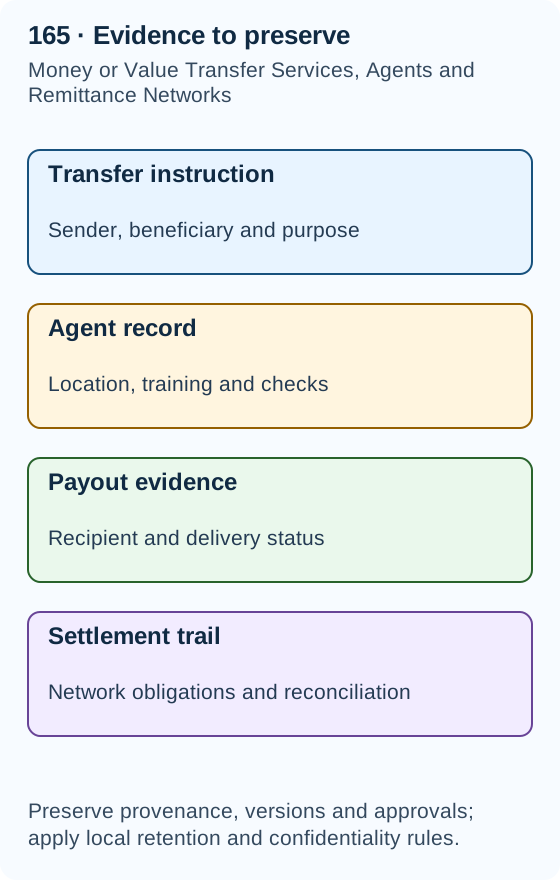
Case method: preserve both the instruction and the value movement
These cases are fictional. Figures, time periods and control choices are illustrative and are not regulatory thresholds. The actual outcome depends on the provider, bank role, national requirements, service conditions and evidence. Work each case by reconstructing sender instruction, funding, agent path, beneficiary delivery and network settlement. Identify what is established, what remains uncertain and which decision belongs to which owner.
Case 1: the settlement balances but beneficiary evidence is missing
A provider's receiving agent pays cash to beneficiaries and submits daily totals. The network settlement account balances with those totals. During quality review, the principal cannot retrieve required beneficiary verification evidence for a set of payouts. The agent says staff know the local customers and that no one has complained. Management initially treats the absence of complaints and balanced settlement as sufficient reassurance.
The principal should identify the affected transfers, dates, staff, locations and evidence requirements. Retrieve original instructions, payout acknowledgements and any alternative accepted records. Determine whether the evidence was collected but cannot be retrieved, never collected, incorrectly linked or lost during a system change. Those explanations have different remediation and historical-review consequences. Local familiarity may provide context, but it does not override an applicable requirement for documented evidence.
The principal should assess current activity and lawful interim controls based on the actual gap. It might require supervised review, corrected retrieval, reduced agent scope or another approved response. It should separately assess whether facts support suspicious reporting, fraud concerns or customer remediation. Missing records alone do not prove every payout went to the wrong person, but the bank cannot claim correct verification without supporting evidence.
Recovery should establish the population and document what can and cannot be reconstructed. Test future retrieval and sample execution rather than accept a new policy statement. The lesson is that financial reconciliation proves agreement of value records, while beneficiary evidence supports a different proposition. Both are necessary where the actual framework and service require them.
Case 2: regular family support looks unusual in a generic model
A customer sends several small transfers each month to relatives in another country. The transfers increase around a festival and include one new family recipient. A generic model flags repeated beneficiaries and cross-border cash funding. The agent knows the customer works seasonally and provides a plausible explanation, but the central analyst receives only amounts and country codes.
The analyst should obtain the customer and service context relevant to the concern. Review known occupation, purpose, expected pattern, funding and beneficiary relationships proportionately. Test whether the festival and seasonal-income explanation fits the timing and history. Do not impose an unnecessary document burden merely because the model lacks context. Equally, do not close the alert solely because the agent says the customer is familiar.
If evidence supports ordinary family support and no separate concern remains, record the explanation and appropriate profile update. If contradictions emerge, such as unrelated recipients or unexplained funding inconsistent with the customer record, investigate those facts. The reporting threshold must be assessed under the applicable framework rather than inferred from the corridor or customer nationality.
The control-learning question is whether the model captures useful context and treats legitimate populations proportionately. Validate the scenario with both ordinary family patterns and known concealment patterns. The lesson is that remittance access and effective monitoring improve when the bank can interpret behaviour, rather than convert common community and family relationships into automatic suspicion.
Case 3: an agent's growth comes from undisclosed subagents
A contracted agent's volume doubles after expansion. Its head-office authorisation and ownership records remain current. Transaction data begins to contain location codes absent from the principal's approved inventory. The agent describes those codes as administrative references, but sampled receipts identify storefronts operated by other businesses. The principal's training records cover only the head-office staff.
Begin with the actual operating footprint. Identify the storefronts, entities, staff, service activities and dates. Determine whether they act as permitted subagents, outsourced locations or another arrangement under the relevant framework and contract. Verify any required registration, approval or listing and the principal's oversight. A head-office licence is relevant but does not establish the status of every location or participant.
Review the affected customer and transfer population. Assess whether required identification, screening, records and referrals were performed. Retrieve examples from each material location and compare them with principal requirements. Determine whether the growth reflects legitimate expansion, weak change control or deliberately concealed activity. Avoid assuming every new location is illicit before the facts are established.
The principal should decide lawful current scope and remediation, including appointment controls, inventory updates, training and evidence retrieval. Historical review should address actual coverage gaps. The lesson is that network growth must be governed at the level where customers are served; an accurate contracted-entity record can coexist with an incomplete live network.
Case 4: cancellation arrives after cash payout
A sender asks to cancel a transfer. The principal's system still shows pending because the receiving agent has not uploaded its latest events. Operations marks the instruction cancelled and begins a refund. An hour later, a payout record arrives showing that the beneficiary received cash before the cancellation request. The agent's settlement report includes the payout, creating a discrepancy.
Reconstruct the event times and available information. Identify when the sender requested cancellation, when the principal sent any stop instruction, when the agent received it, when payout occurred and when the record was uploaded. Determine the service terms and applicable rules for cancellation and refund. A technical cancellation does not establish that cash was recovered or that the beneficiary had not already received it.
Operations should prevent an unsupported duplicate return of value, preserve the records and decide the correct customer and settlement positions under the actual arrangement. If an error caused loss, assess customer remediation and agent responsibility separately. If evidence suggests false payout records or collusion, route that hypothesis for investigation. Do not treat a timing defect as proof of fraud without corroboration.
Testing should cover cancellation before payout, after payout and during delayed communication. The integration should support an uncertain state and evidence-based resolution rather than force a false final status. The lesson is that transfer, payout and settlement states need separate timestamps and decisions, particularly where cash delivery limits reversal.
Case 5: similar names create an incorrect sender network
Monitoring links several senders to one beneficiary and produces a large aggregate amount. Review reveals that common names and an agent's address were used as matching fields. Some records lack stronger identifiers, and several customers used the storefront address because the form did not support their residential format. The network visualisation appears persuasive, but the identity links are uncertain.
The analyst should distinguish reliable relationships from weak similarities. Review available identity evidence, contact details, customer explanations and source quality lawfully and proportionately. Determine why the storefront address appears and whether the same person submitted the transfers. Preserve uncertain links as uncertain. Do not merge people or impose a collective restriction because a graphic displays connected nodes.
The beneficiary concentration may still deserve review even if sender aggregation changes. Identify the beneficiary's relationship to the actual senders, purpose and payout pattern. There may be a legitimate community arrangement, family relationship, business activity or a more serious concern. Test alternatives using evidence rather than discard the entire case because one matching method was weak.
The control repair should address the form, identifier quality and matching logic. Test known distinct people with common names and known linked activity with reliable identifiers. Review the effect of previous incorrect aggregation on customer decisions where relevant. The lesson is that network analysis is only as reliable as its identity and relationship evidence.
Case 6: settlement routing changes without control review
A provider changes how it settles with receiving partners after losing a banking relationship. A new intermediary collects several corridor obligations and distributes value onward. Individual customer transfers still appear normal and beneficiaries receive funds on time. The banking team notices settlement payments to a new company with a broad consulting description and incomplete information about its role.
The bank should map the changed value arrangement. Identify the intermediary, ownership, permissions where required, contractual role, accounts, jurisdictions and onward recipients. Determine whether it is providing a legitimate settlement service, supplying liquidity or undertaking another activity. The description on an invoice is a claim to verify, not a legal classification. Current customer-transfer visibility does not remove the separate settlement-counterparty question.
Assess the bank's own obligations and service exposure under the actual facts. Screening, CDD, purpose understanding and monitoring may need updates. Sanctions or other restrictions require their own applicable legal analysis. A changed route can have legitimate commercial reasons, but unexplained participants and opaque onward settlement can create a material concern. The bank should decide the available lawful service scope and evidence requirements with accountable owners.
The provider's change controls should be repaired if the new arrangement bypassed approval. Preserve effective dates and reconcile obligations across old and new routes. The lesson is that MVTS risk exists both in individual customer transfers and in the network that supplies liquidity and settles value; neither view replaces the other.
Case comparison: choose the right evidence
The first case needs beneficiary evidence and retrieval analysis. The second needs customer and seasonal context. The third needs network-footprint and agent-control evidence. The fourth needs event timing and actual payout status. The fifth needs reliable identity links. The sixth needs settlement-counterparty and route understanding. Asking for the same documents in every case would waste effort and still miss decisive facts. The evidence plan should follow the proposition being tested.
Several decisions can arise from one case. A missing record can create quality remediation, a service condition and a reporting assessment. An incorrect payout can create customer remediation and fraud investigation. A new subagent can create perimeter and oversight questions. Preserve distinct decision grounds and owners. An administrative closure should not erase a live legal or financial position, and a reporting decision should not be mistaken for recovery of funds.
Turn the cases into meaningful assurance
Assurance should seed the known fact pattern and verify the expected evidence and outcome. For the settlement case, prove that balanced accounts do not suppress the missing-evidence exception. For the family-support case, prove that a coherent legitimate explanation can be recorded and acted upon. For the subagent case, prove that an unknown location enters review. For cancellation, prove that late payout evidence prevents a false reversal. For identity links, prove distinct people remain distinct. For routing change, prove the new settlement participant reaches the applicable review.
Test execution and recovery, not only alert generation. Can the principal retrieve records, impose the approved scope, reconcile corrected data and communicate the right service state? Do restrictions reach relevant agents and channels? Are late events retained with their actual times? Can the bank reconstruct the final conclusion without relying on individual memory? Those tests make the cases useful to analysts, BAs, operations teams and assurance functions.
Worked payout-agent case
A fictional provider's settlement account balances, but an agent cannot produce beneficiary verification for a set of cash payouts. The principal should identify the affected transfers, investigate the records and agent process, assess reporting or restriction duties and remediate historical exposure.
Explain why a balanced settlement account proves accounting agreement rather than successful CDD or correct payout identity.
Write a transfer reconstruction brief
Start with one transfer from the affected population. Record the sender instruction, funding method, beneficiary details, sending and receiving agents, relevant checks, approval, payout evidence and settlement link. Preserve the different timestamps and sources. State which facts are verified, which are asserted and which are missing. The brief should allow another practitioner to follow the economic event without assuming that a bank settlement entry proves the entire transfer.
Then extend the scope carefully. Identify why other transfers are included: same location, staff, period, evidence defect or routing arrangement. Use a defensible population definition rather than select only examples supporting the concern. Reconcile the population with principal and agent records. Document exclusions and uncertain links. A lookback should be proportionate to the known defect and risk, while retaining visibility of records that cannot be reconstructed.
The evidence request should be specific. Ask for the records needed to test beneficiary verification, actual payout and the agent process. If the issue is retrieval, identify the archive and reference needed. If the issue is collection, ask for the process and source evidence. If the issue is identity, identify the contradiction requiring resolution. An undirected request for all customer files can delay the decisive answer and impose unnecessary data handling.
Define interim controls without inventing a legal freeze
An interim decision should identify the actual ground, scope, authority and review date. The principal may need additional supervision, a targeted activity limit, delayed activation or another lawful measure. If sanctions law requires a particular disposition, apply that legal basis separately. Do not label an ordinary evidence-review pause as a freeze merely because it stops a transaction temporarily.
Execution should match the scope. If the restriction applies to one agent's cash payout, test whether the receiving location and relevant staff can still pay through another credential or channel. If ordinary account credits are intended to continue, verify they are not unnecessarily stopped. A central status change is not proof that the local agent obeyed it. Preserve acknowledgements and actual transaction results where relevant.
Review the customer consequences. Some beneficiaries may depend on timely lawful remittances. Provide accurate information and appropriate alternatives within the applicable framework and service capability. Protected investigation details may limit what can be disclosed, but that does not justify misleading status messages. A pending review, failed payout, completed payout and approved refund should be communicated according to their actual meaning.
Record a proportionate final conclusion
The conclusion should state what the evidence supports. If records were collected correctly but an archive index was defective, the case may primarily require retrieval and assurance remediation. If required evidence was not collected, the programme needs a different response and a review of historical exposure. If evidence shows payouts to unauthorised recipients, fraud and customer-remediation questions may arise. If facts meet the applicable suspicious-reporting threshold, follow that separate process.
Avoid one label for every outcome. A transfer can be financially reconciled while evidence remediation remains open. An agent can continue a limited service while a historical review proceeds. A reporting assessment can be complete while outstanding customer positions still need resolution. Assign owners and completion evidence to each task so administrative closure does not conceal unfinished obligations.
A corrected process should be tested on fresh samples and the affected historic population. Training alone may be insufficient if the system cannot capture authority or the archive cannot retrieve records. Record which repair addresses which cause. The final file should show how the principal knows the control now works, not merely that the agent has promised to improve.
Requirements that make the network testable
Define transaction states with exact entry and exit conditions. A payout-complete state should require the evidence and event specified by the approved model. A cancelled instruction should not imply recovered value when payout already occurred. A refund should have its own approval and execution state. Specify how contradictory or late events are handled and how the original history is preserved.
Define required data by role and service. Sender, beneficiary, authorised collector, agent and settlement counterparty are different subjects. Mandatory fields should follow applicable requirements and conditional business rules. Do not fill missing identities with the agent's name simply to satisfy validation. A technical service error should enter an exception path rather than become a false customer-risk conclusion.
Define network coverage. Relevant agents and locations should reconcile with transaction sources. An unknown location should enter review and the appropriate control path. Terminated agents should not create new activity through residual credentials, while outstanding lawful obligations remain manageable. Test both the prohibition on unauthorised new activity and the permitted handling of residual transfers.
Positive, negative and recovery tests
Positive tests can include missing required beneficiary evidence, an unapproved agent location, a payout after a valid stop instruction, an unexplained settlement participant and reliably linked transfers needing investigation. Negative tests can include ordinary family support, a legitimate seasonal increase, distinct people with common names, an approved new location and a coherent change in settlement banking. The expected result should come from approved requirements and evidence, not from a desire to maximise alert counts.
Recovery tests should include delayed uploads, duplicate events, conflicting status, archive failure, migration and agent termination. Verify the customer instruction, actual payout, ledger and settlement results together. A replay should restore analytical visibility without moving value twice. A correction should retain original records. A reopened case should explain why it was reopened and preserve the earlier decision.
Agent-assurance tests should retrieve evidence from accepted, rejected, cancelled and completed transfers. Include relevant subagents and closed locations. Confirm that staff can explain the process and escalation route. Compare training claims with actual decisions. Report limitations, failed scenarios, affected populations and accountable repairs rather than summarise the exercise with a generic pass.
Knowledge checks with explained answers
Does a receiving agent's balanced settlement prove correct payout identity? No. It supports accounting agreement. Identity and authority require the relevant evidence and process. Both propositions should be tested where applicable.
Are repeated small family transfers inherently suspicious? No. Assess purpose, customer context, funding and behaviour under the actual reporting framework. A pattern can justify inquiry, but ordinary family and seasonal activity should be considered fairly.
Does a provider's head-office licence establish every subagent's status? No. Determine the permitted national model, actual network footprint and required appointment, registration or oversight arrangements. The principal needs visibility of the locations serving customers.
Can a transfer be cancelled after the beneficiary received cash? A technical instruction can be changed, but that does not itself recover value or establish a lawful refund. Reconstruct payout and cancellation times and apply the actual service and legal rules.
What should an analyst do with uncertain identity links? Preserve the uncertainty, obtain proportionate reliable evidence and avoid treating approximate similarities as established identity. The beneficiary or agent pattern can still be investigated separately.
Is the June 2026 Recommendation 16 consultation current binding operating law? No. It was a consultation on guidance for strengthened standards, with the consultation now closed. Current national obligations govern live services; adopted future standards should be tracked with their implementation status and dates.
Working glossary
Principal is the provider accountable for its programme and agent oversight under the applicable model. Agent footprint identifies the entities and locations actually delivering the service. Customer transfer is the sender's instruction and beneficiary delivery relationship. Network settlement resolves obligations between participating providers or agents. Payout evidence supports actual delivery and relevant identity or authority. Late event is received after its real event time. Unresolved state preserves a material gap while an accountable review and lawful control plan continue.
Data and operational acceptance
Link sender, beneficiary, transfer reference, funding, agent, payout and network settlement while preserving their different timestamps and statuses. Maintain current agent and subagent records and access to evidence after agent termination.
Acceptance tests cover offline agent activity, delayed uploads, failed payouts, refunds, duplicate retries and monitoring coverage. The principal owns its programme; agents execute assigned controls; compliance defines applicable duties; treasury and operations reconcile value movement.
An effective MVTS control model sees both the customer transfer and the network that delivers and settles it.
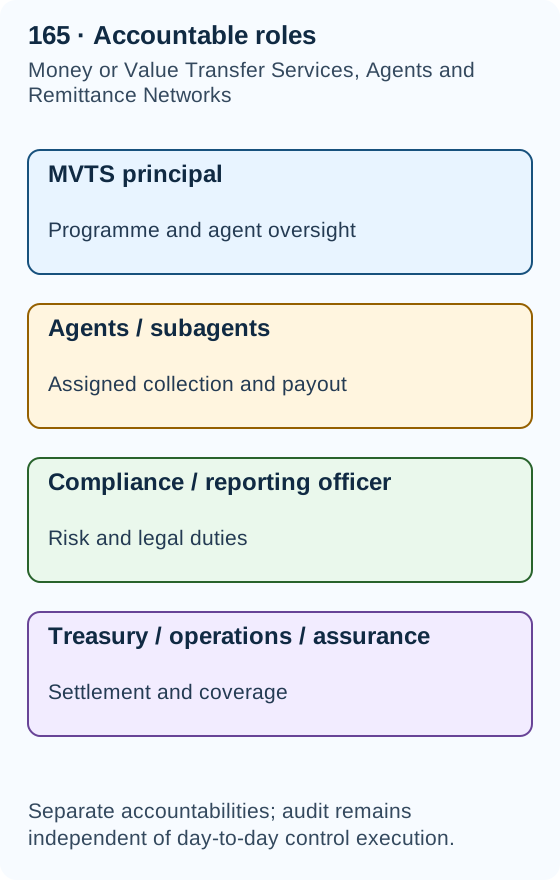
Govern the network at the level where customers are served
A principal's programme should connect central policy with local execution. Senior management owns strategy, resources and risk appetite. Operations manages the transfer and agent processes. Compliance interprets and challenges applicable requirements and supports reporting decisions within its remit. Treasury manages liquidity and settlement. Technology maintains data and execution integrity. Independent assurance tests the full chain. Clear roles matter because a network can have good local accounting and still lack central visibility of customer and beneficiary evidence.
The agent inventory should be treated as a control population, not merely a commercial contact list. Identify relevant entities, locations, activities, subagents, appointment dates, termination dates and system access. Reconcile that population against live transactions. A newly active location should not remain invisible because the contracted head-office name is unchanged. Changes in ownership, service scope or settlement arrangement should have a route to reassessment.
Management should understand the capability and limits of each material segment. Some agents serve digital account credits; others deliver cash in locations with connectivity constraints. Some corridors have strong data availability; others require supported alternatives. The programme should apply appropriate requirements and controls to those facts. Uniform paperwork can look consistent while failing to address the real operating differences.
Assess a provider as a bank customer without blanket assumptions
A bank servicing an MVTS provider should understand the provider's actual business, authorisation where required, customer populations, corridors, agent oversight, funds flow and control effectiveness. The assessment should identify the bank's own role and available information. A provider can present higher risk without being prohibited or automatically unacceptable. A regulatory registration supports a perimeter proposition but does not establish adequate execution of every control.
Due diligence should seek evidence relevant to material risks. Review programme design, sampled execution, incident history, data quality and ability to retrieve records. Identify what the provider can demonstrate and what remains uncertain. Conditions can address manageable weaknesses where lawful and within appetite. Where required evidence or control capability cannot be obtained, the bank should decide service scope or exit on the actual grounds, including any applicable legal constraints.
Avoid requiring the provider to prove that every underlying customer is risk free. The practical question is whether the provider has an effective, appropriate programme and whether the bank can manage its own exposure. Equally, do not accept a general assurance that agents handle everything locally. The bank needs enough understanding and evidence to support its relationship decision and recognise material change. That balance supports legitimate remittance access while preserving accountable controls.
Connect incentives, capacity and control quality
Commercial growth can outpace agent oversight and case capacity. A principal should assess whether onboarding, training, monitoring, retrieval and exception handling can support the live network. A backlog of unresolved evidence requests has a different meaning if agents continue large volumes while review is pending. Management should see affected populations, value, duration and available controls rather than only the number of overdue tasks.
Agent compensation and performance measures should be reviewed for unintended effects. Volume targets can coexist with effective controls, but they can also discourage questions or referrals. Test actual behaviour using samples and trends. A low referral rate is not automatically good performance. An agent producing many sound referrals may be operating responsibly in a more challenging population. Measures should distinguish control quality from commercial throughput.
Remediation should address causes. If staff misunderstand authority requirements, training and supervision may help. If the system cannot record required evidence, redesign is necessary. If retrieval depends on one employee, the archive needs a more resilient process. If commercial incentives reward inappropriate shortcuts, governance should change them. Repeating policy statements without repairing operating constraints creates recurring findings.
Design management information with meaningful denominators
Reports should distinguish instruction coverage, payout evidence, agent quality, monitoring effectiveness and settlement reconciliation. Define the population for each measure. Evidence completeness for completed cash payouts differs from completeness for all instructions, including cancelled transfers. Agent coverage should include relevant locations and subagents, not only contracted entities. Settlement agreement should explain timing and adjustments without being presented as proof of customer due diligence.
Segment the results. A high aggregate evidence-retrieval rate can conceal weak performance in one cash-delivery corridor. A low average case age can hide a few high-value unresolved cases. A stable settlement balance can conceal missing beneficiary records. Management should ask what is absent from the metric and whether that omission is justified. Reports should identify source, owner and limitations so a green result has a clear meaning.
Reporting should lead to decisions. Material gaps need a defined response, owner, review date and evidence of completion. If an agent repeatedly fails to provide records, determine whether current activity can continue lawfully and within appetite. If a monitoring scenario creates unnecessary exclusion of ordinary family support, assess the data and calibration. Effective governance challenges both under-control and disproportionate control.
Keep standards, current law and future change separate
The change inventory should identify current national obligations, applicable supervisory material, international standards, adopted future changes and consultations. Those categories have different status and implementation consequences. The June 2025 revision to FATF Recommendation 16 and the June 2026 guidance consultation should be understood with their implementation context. A closed consultation does not automatically turn its draft guidance into binding domestic rules.
Preparation can still be useful. Assess data models, payment information, interfaces, agent systems and customer journeys against adopted future requirements without misrepresenting them as current obligations. Identify likely changes, dependencies and questions requiring final guidance or national implementation. Keep current operational requirements effective while planning the future state. Version the legal and policy basis so staff know which rule applies to live decisions today.
Other changes can be immediate. A current sanctions measure, national regulatory amendment or permission change may require timely assessment and action. Determine scope, affected participants, transactions and control points. Test agent communication and execution. International consistency is valuable, but it should not flatten different national requirements into one invented global threshold or reporting deadline.
Rehearse a network-control incident
Assume a receiving agent's offline system uploads two days of payouts late. Some records lack required beneficiary evidence. One transfer had a central stop instruction before the payout, and another was refunded after a technical cancellation even though cash had already been delivered. The agent's settlement account balances after an unexplained adjustment. A newly added storefront appears in the upload but not in the approved inventory.
The incident team should first preserve records and identify affected populations. Reconstruct event times, instructions, checks, payouts, refunds and settlement. Separate the missing-evidence problem, restriction execution failure, duplicate-value risk, unexplained adjustment and network-footprint change. Each needs its own facts, authority and owner. A single case label such as agent issue is insufficient to control those positions.
Then decide lawful containment. Identify which activity must stop, which can continue under approved controls and what customer obligations remain. Ensure instructions reach the actual storefronts and staff. Assess suspicious reporting, sanctions, fraud, customer remediation and regulatory or contractual notification under their separate frameworks. Commercial urgency should not override required legal action, while broad suspension should not be imposed without understanding its scope and customer effects.
Recovery should reconcile the original and corrected populations. Retrieve or reconstruct evidence where possible and document limits. Prevent duplicate payouts or refunds during replay. Repair agent inventory and access. Test the restriction path and late-event handling. Independent assurance should challenge the recovery evidence and identify whether other agents use the same defective process. The incident closes when material positions and repairs are supported, not merely when settlement is balanced again.
Preserve service and evidence through agent termination
Terminating an agent creates residual work. Pending transfers, beneficiary complaints, refunds, settlement obligations and records can survive the commercial relationship. The principal should know who will handle them and what access remains lawful and necessary. Remove unauthorised new-activity capability without destroying evidence or preventing required resolution of existing positions.
Test retrieval from terminated locations and former staff records. Contracts, archives and system design should make the necessary evidence available under applicable retention and access rules. If the agent ceases trading unexpectedly, the principal should still be able to identify affected customers and reconstruct relevant transfers. A continuity plan based entirely on calling the former agent manager is fragile.
Migration to another agent or channel should preserve identities, status and restrictions. Customers should understand the actual service change and available next steps. Do not assume that moving the relationship to a new identifier resets unresolved cases or approves previously restricted activity. Reconcile populations and value before and after migration, including residual obligations from the old arrangement.
Reconcile currency and fee explanations
Currency conversion and fees can make the sender amount, beneficiary amount and network settlement differ legitimately. Preserve the original currencies, quoted or applied rates, conversion times, fees and the basis for adjustments. The investigation should distinguish a normal difference supported by the service arrangement from an unexplained value movement. A generic exchange adjustment should not become a convenient category for every discrepancy.
Consider a fictional transfer funded in one currency and paid in another, while the providers settle their obligation in a third. The customer receipt, payout record and settlement entry support different amounts and obligations. Treasury can explain the agreed conversion and settlement method; customer operations can explain the amount promised to the beneficiary; financial-crime analysts can assess whether unexplained participants or adjustments introduce a separate concern. Each explanation should connect to the actual records rather than rely on an aggregate balance.
Changes in exchange arrangements can affect customer treatment, liquidity and risk. A receiving agent may use a new conversion provider or change the account receiving reimbursement. The principal should identify the actual role, counterparty and permitted arrangement, and update relevant controls. Genuine market movements can explain amount variation, but they do not explain an unrelated recipient or missing customer instruction. Preserve the distinctions so staff ask the right question.
Assurance should test sample transfers across supported currencies and conversion paths, including failed payout, refund and late settlement. Verify that the customer position and network obligation are both correct. If a refund follows a different rate or fee rule, identify the applicable service and legal basis and communicate it accurately. The value chain remains reconstructable when differences are explained by evidence rather than erased through convenient netting.
Final assurance standard
An executive or auditor should be able to choose a transfer and follow sender instruction, funding, applicable evidence, agent path, approval, beneficiary delivery, settlement and any later case or refund. They should be able to choose an agent and establish its actual footprint, permitted activities, training, evidence quality, exceptions and corrective action. They should be able to identify a material change and show how it reached the programme.
The network is effective when these answers are supported by records, proportionate decisions and tested execution. Accounting agreement, regulatory status and local familiarity are useful facts, but none replaces the complete chain. A well-governed MVTS service sees both legitimate customer needs and material financial-crime risks, and can act on each without confusing uncertainty, suspicion, prohibition and commercial appetite.
References and further reading
Reviewed 2 October 2026. FATF provides international standards; applicable national law determines binding duties. The operating examples are fictional teaching cases.
- FATF Recommendations, updated June 2026 — relevant anchors: 14, 16 and 1.
- FATF MVTS risk-based guidance
- FATF June 2026 Recommendation16 guidance consultation
The 2016 sector guidance is non-binding and predates later FATF standard revisions, including the 2025 changes to Recommendation 1. FATF expressly advises reading it alongside current Recommendations and more recent risk-assessment and financial-inclusion guidance. It is a source of practical context, not a complete statement of current national obligations.