Layering: Complex Movement and Obscured Ownership
Layering describes the use of transactions, accounts, entities, assets, currencies, jurisdictions and intermediaries to make the origin, ownership, destination or economic purpose of value harder to understand. It is often taught as the middle stage of money laundering, after placement and before integration. That sequence is useful as a learning model, but banks should not expect real cases to follow a tidy three-step path. Digital fraud proceeds can be layered within minutes, professional money-laundering networks may already have established account chains, and a payment can move through several institutions before the first bank even receives a fraud report.
The practical question for a bank is not “Is this transaction definitely layering?” It is: does the movement of value create complexity or distance that lacks a credible economic explanation, and can the bank reconstruct who controls the money and why it is moving?
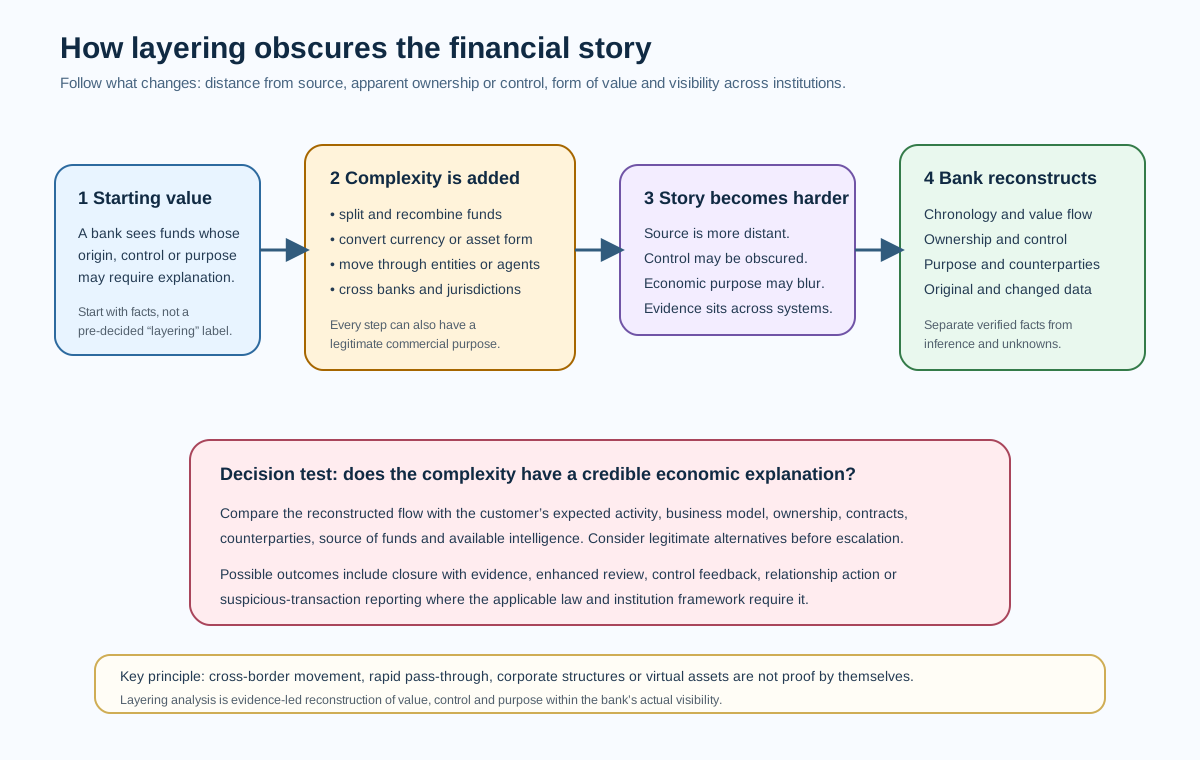
Layering is about obscuring the financial story
A normal business can have complex payments. Multinational companies use treasury centres, intercompany loans, correspondent banks, foreign exchange, securities, trade finance and multiple currencies. Investment funds can have administrators, custodians and special-purpose vehicles. Payment service providers can aggregate thousands of underlying customer transactions. Complexity is therefore not suspicious by itself.
The risk appears when complexity does not make economic sense for the customer, when ownership or control changes without a clear rationale, when transactions create unnecessary detours, or when the pattern appears designed to frustrate traceability. The investigator should ask whether each step serves a plausible business, legal or personal purpose.
Rapid movement of funds
One of the most common layering indicators is rapid onward movement. An account receives funds and transfers most of them out within minutes or hours. This can be consistent with mule activity, fraud proceeds or professional laundering, but it can also be normal for payment companies, marketplaces, correspondent banks and treasury operations.
Velocity therefore needs context. A newly opened personal account receiving multiple unrelated credits and forwarding nearly all value to new beneficiaries presents a different risk from a regulated payment institution settling merchants according to a known business model.
Monitoring should combine speed with customer type, account age, counterparties, beneficiary novelty, transaction purpose, device signals, geographic exposure and known fraud intelligence.
Splitting and recombining value
Criminal networks may split one amount across several accounts, send each portion through different routes and later recombine the value. This can reduce the visibility of the original source and make individual transactions look less significant.
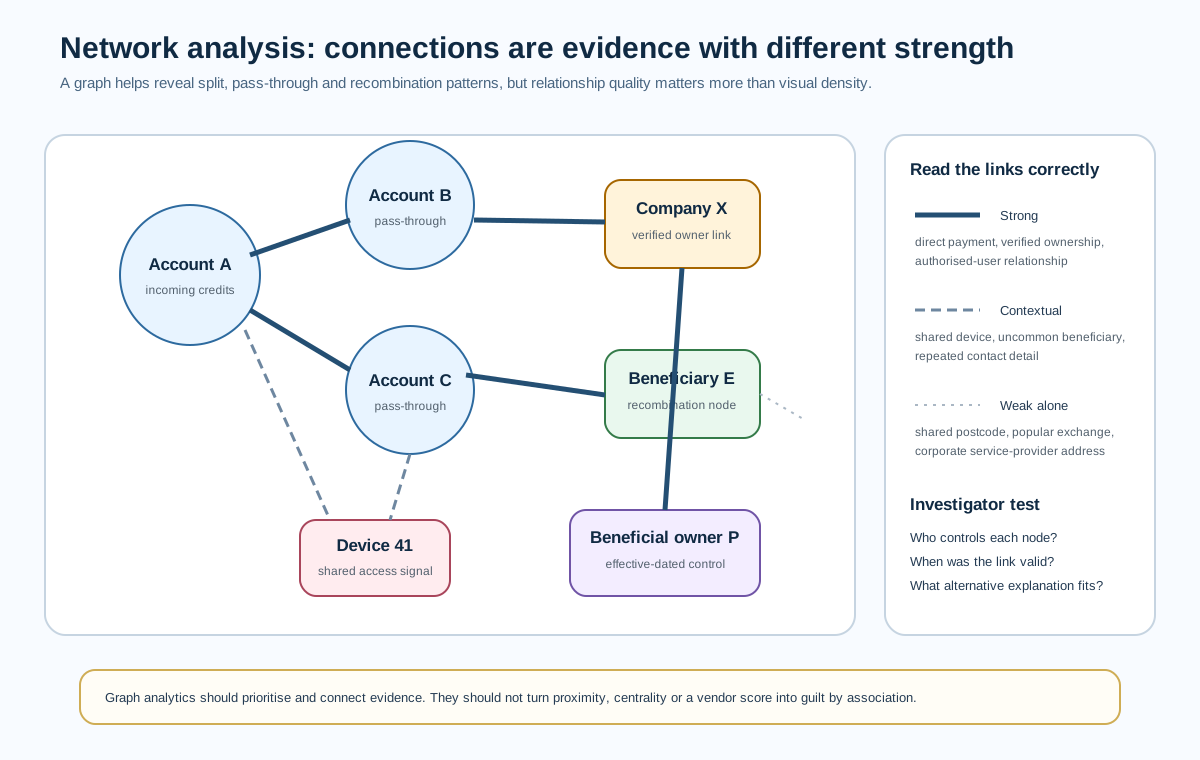
Banks can detect such behaviour more effectively through network analysis than through isolated account rules. Shared beneficiaries, devices, addresses, telephone numbers, IP addresses, corporate directors or transaction references can reveal relationships that individual account histories do not.
Network links are indicators, not proof. Shared addresses may represent apartment buildings, business centres or family households. Shared devices can have legitimate explanations. The analytical value comes from the combination of links and transaction behaviour.
Multiple banks and jurisdictions
Moving value through several banks or countries can create distance between the original source and final asset. Cross-border movement can also introduce differences in legal systems, data availability and reporting timelines.
However, international payments are normal for many customers. A bank should understand why particular jurisdictions and intermediaries appear in the transaction chain. A manufacturer paying suppliers in several countries is different from a domestic retail customer routing funds through unrelated offshore companies.
Correspondent banking makes visibility especially important. One bank may see the originator, another the intermediary route and another the final beneficiary. Payment transparency and preservation of party information therefore matter directly to financial-crime control.
Currency conversion
Changing currency can be part of layering because it changes the form of value and can introduce additional institutions. Yet foreign exchange is also a routine banking service.
The risk depends on whether conversions fit the customer’s needs. A company with international suppliers has a clear reason to convert currencies. A personal account receiving domestic funds, converting repeatedly through several currencies and sending value to unrelated jurisdictions may require greater explanation.
A good investigation keeps the economic value linked across currency changes. The analyst should be able to see the original amount, exchange rate, converted amount, timing and next destination.
Legal entities and ownership chains
Companies, partnerships, foundations, trusts and other arrangements can be used legitimately to organise business, investment, inheritance and asset ownership. They can also be misused to separate the person controlling funds from the legal name appearing on an account.
Layering through entities may involve intercompany transfers, loans, consulting payments, dividends, capital contributions, invoice payments or asset purchases. The labels can all be legitimate. The key question is whether the economic relationship and beneficial ownership are understandable.
FATF’s strengthened Recommendation 24 framework emphasises access to adequate, accurate and up-to-date beneficial ownership information for legal persons. For a bank, that means ownership data should not be collected once and forgotten. Changes in shareholders, directors or controllers can materially alter the risk picture.
Shell companies
A shell company may have little or no active operating business. Shell companies can have legitimate uses, for example holding assets, facilitating transactions or structuring investments. The term should therefore not be used as a synonym for criminal company.
Risk increases when an entity has no credible economic purpose, opaque ownership, nominee arrangements, unexplained cross-border transfers, frequent pass-through activity, mismatched business descriptions or links to known criminal or sanctions concerns.
The next chapters go deeper into shell, front and shelf companies, but the layering principle is simple: legal form can create distance between value and the person who ultimately controls it.
Loans as layering instruments
Loans can move value between entities while creating an apparently legitimate legal explanation. A company may receive a loan from another company, repay it to a third party or convert it into an asset.
Banks should consider the lender’s identity, beneficial ownership, relationship to the borrower, source of the lender’s funds, terms, repayment pattern and commercial rationale. A loan document by itself does not establish legitimacy.
Circular lending can be particularly important. If money leaves a customer, passes through related entities and returns as a “loan,” the economic source may be obscured even though each individual transfer has a plausible label.
Trade-based layering
Trade can create complexity through goods, invoices, shipping routes, agents and financing. Value can be transferred by manipulating price, quantity, quality, shipment or documentation rather than through an obviously unusual payment.
Banks providing trade finance may have access to documentary evidence that ordinary payment processors do not. They can compare invoices, goods descriptions, counterparties, transport documents and payment terms. Banks that see only the payment should be careful not to claim knowledge they do not have.
Trade-based money laundering requires a different evidence model from simple transaction monitoring.
Professional money-laundering networks
Some criminal groups provide laundering as a service to other criminals. They may control networks of mule accounts, companies, virtual-asset wallets, cash collectors, brokers and cross-border intermediaries.
For a bank, professional laundering can appear as unrelated customers using common beneficiaries, devices, addresses or payment descriptions. Individual accounts may show only part of the network.
Cross-customer intelligence becomes important here. Case-management systems should allow investigators to identify related entities without violating legal access restrictions or data-protection requirements.
Virtual assets and layering
Virtual assets can be used legitimately for investment, payment and other purposes. They can also be used to move value across wallets, services and chains. Conversion between fiat and virtual assets can add complexity, especially when several platforms or self-hosted wallets are involved.
Banks should avoid simplistic rules such as “crypto equals layering.” The relevant questions include customer profile, source of funds, counterparties, transaction pattern, exposure to regulated or unregulated providers, and whether the movement has a plausible purpose.
Where blockchain analytics or external intelligence is used, investigators should understand the limitations of labels and risk scores. A vendor classification is an input to judgement, not proof of criminal conduct.
Cards, wallets and payment intermediaries
Layering can also use payment cards, e-money, wallets, merchant accounts and payment institutions. Funds can be loaded, transferred, spent, refunded or withdrawn through different mechanisms.
A bank may see only the funding and withdrawal legs. That makes partner due diligence and information sharing important. If a payment institution is the direct customer, the bank should understand the institution’s business model, customer base, controls and expected transaction flows rather than treating every underlying transaction as though it came from a direct retail customer.
Circular flows
Circular movement occurs when value returns to its originator, related party or connected network after passing through several accounts or entities. Circularity can be legitimate in treasury, investment or supply-chain arrangements, but unexplained circular movement can be a strong indicator that transactions are creating artificial economic activity.
Detection requires entity resolution. Slightly different company names, shared ownership, common directors or related accounts may need to be recognised as part of the same economic group.
A system that sees only account numbers can miss the circle.
Pass-through accounts
A pass-through account receives funds and moves them onward with little retained balance. This pattern can be normal for settlement accounts, payment providers, brokers and treasury centres. In a personal or small-business account it may require more explanation.
The investigator should understand whether the customer is expected to intermediate funds for others. If not, repeated third-party receipts followed by immediate onward transfers can indicate misuse.
The concept of expected purpose is therefore central.
Layering and payment-message data
Payment messages can carry originator, beneficiary, intermediary, remittance, purpose and agent information. ISO 20022 can provide richer structured data than older formats, but only if the data is populated and preserved.
Financial-crime controls should avoid losing party information during transformation. If an original customer instruction contains structured addresses and ultimate-party fields but the screening or investigation system receives only a shortened text string, valuable context disappears.
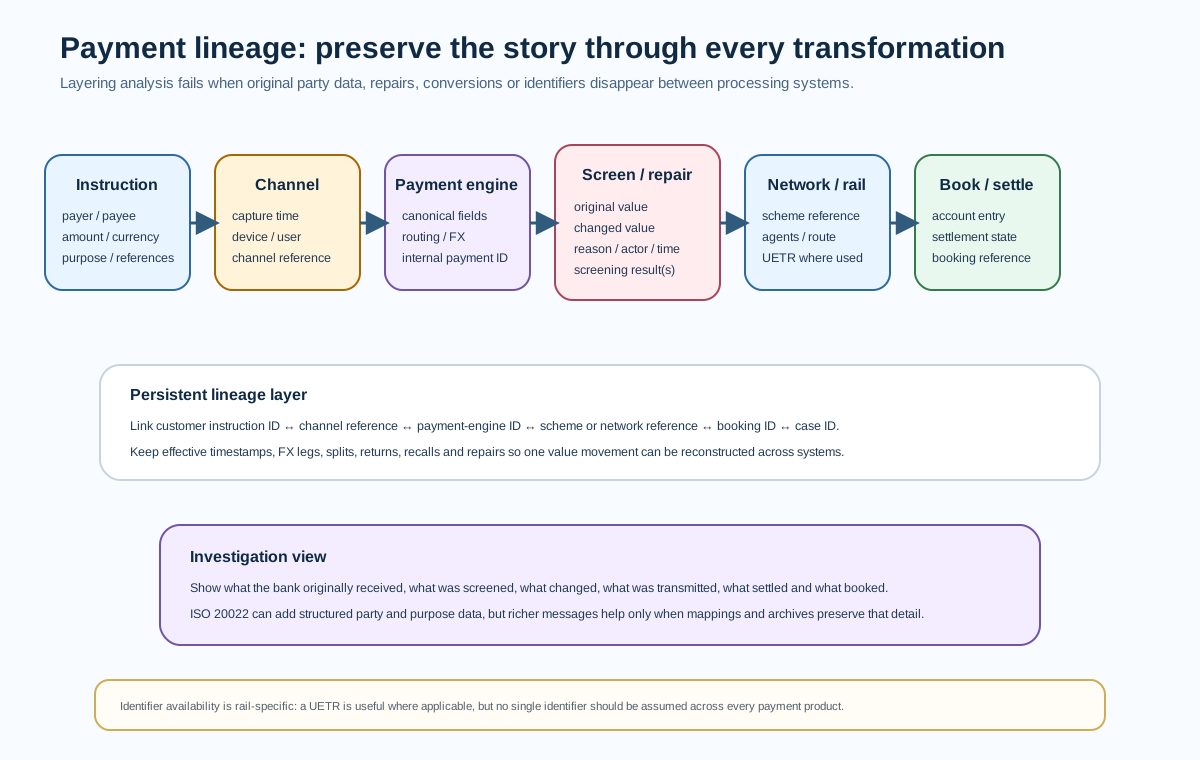
Payment repairs also matter. If a beneficiary name or account is changed after an exception, the bank should preserve the original value, changed value, reason, user and timestamp and perform any required re-screening.
Transaction identifiers
Layering investigations often require following value across systems. A customer instruction may have a channel reference, payment engine ID, scheme reference, UETR, booking reference and case ID.
A strong architecture maintains relationships among those identifiers. Investigators should not need to search manually across screenshots to reconstruct the chain.
For cross-border payments, UETR can be useful for traceability where applicable, but it is not a universal identifier for every payment rail. Requirements should be message- and scheme-specific.
Customer risk and behavioural risk
A high-risk customer is not automatically layering funds. Likewise, a low-risk customer can exhibit suspicious behaviour.
Customer risk determines control intensity. Behaviour determines whether activity requires investigation. A mature monitoring model combines static and dynamic information without confusing them.
This distinction protects both control quality and customer fairness.
Investigation method: reconstruct before interpreting
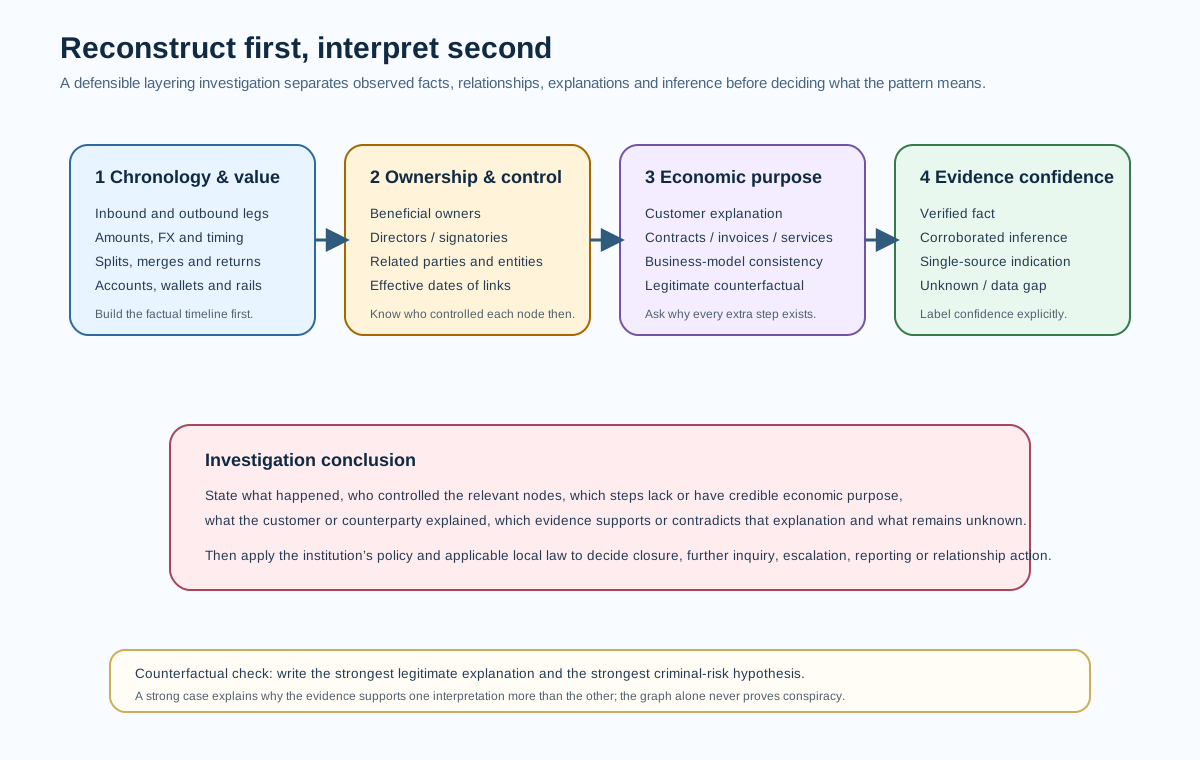
A layering investigation should start by reconstructing the transaction chronology. List inbound funds, outgoing funds, counterparties, currencies, channels and timestamps. Then identify relationships among parties and accounts. Only after the factual map is clear should the analyst interpret why the pattern may be suspicious.
This discipline reduces confirmation bias. If the analyst starts with the conclusion “this is layering,” every transfer can look suspicious. If the analyst starts with the facts, legitimate explanations remain testable.
The case narrative should separate verified facts, customer statements, external allegations and analyst inference.
Scenario: fraud proceeds through several mules
Victims send funds to three retail accounts. Each account forwards smaller amounts to five additional accounts. Those accounts consolidate the money and send it to a virtual-asset service provider.
The first receiving bank may know only about victim complaints. Another bank may see the consolidation accounts. A third institution may see the fiat-to-crypto conversion.
No single institution sees the whole network. Transaction references, FIU reporting, fraud intelligence and lawful information sharing can help connect the fragments.
Scenario: corporate circularity
A corporate customer sends EUR 2 million to an overseas affiliate as an “advance.” Two weeks later a different company in the same beneficial-ownership chain sends approximately the same amount back as a “loan.” The funds are then used to purchase property.
Each transaction has a plausible description. The investigation should examine ownership, contracts, business rationale, exchange-rate differences, source of the returning funds and whether the property purchase is consistent with the company’s purpose.
Circularity is an indicator. It is not proof.
Scenario: treasury centre versus laundering
A multinational treasury centre receives funds from many group companies and redistributes liquidity daily. The pattern resembles pass-through activity and cross-border layering.
The customer’s declared function, ownership structure, documented cash-pooling arrangements, counterparties and historical behaviour explain the activity.
This scenario demonstrates why typology-based rules must incorporate legitimate business models.
Alert design
Layering scenarios can include rapid movement, multiple counterparties, circularity, currency conversion, high-risk corridors, shared beneficiaries, network centrality or sudden changes in behaviour.
The strongest scenarios define the risk hypothesis clearly. “Complex transaction activity” is too vague. “Newly opened personal accounts receiving unrelated third-party credits and forwarding most value within 24 hours to common beneficiaries” is more testable.
Thresholds and segmentation should be reviewed against outcomes and emerging typologies.
Model and AI considerations
Machine-learning and graph models can identify complex patterns that static rules may miss. They can also create false confidence.
A model score should be explainable enough for investigators and governance teams to understand the major drivers. Training data, feature quality, drift, bias and validation all matter.
The bank should not treat an opaque risk score as a substitute for investigation.
Data quality failures
Layering detection is highly sensitive to poor entity resolution. Misspelled names, missing beneficial owners, inconsistent addresses, truncated payment data and duplicated customer records can break network analysis.
Data quality should therefore be treated as a control dependency. A monitoring model can be perfectly designed mathematically and still fail if the input relationships are wrong.
Business analyst view
A BA should map the full information flow: which systems create customer and ownership data, which payment fields survive transformations, which identifiers link transactions, when repairs occur, which systems produce alerts, and how investigators navigate related accounts.
Requirements should state what must be preserved and why. “Store beneficiary data” is weaker than “retain original and amended beneficiary name, account, address and change metadata so screening and investigation decisions can be reconstructed.”
The BA should also define failure handling. What happens if entity-resolution service is unavailable? Does the payment stop, continue, or route to manual review? Which controls are preventive and which are detective?
Measuring effectiveness
Layering-control effectiveness cannot be reduced to alert counts. Useful measures include network cases identified, material typologies detected, quality of investigation narratives, case ageing, data defects, repeated false-positive patterns, law-enforcement feedback and whether known incidents reveal gaps.
The bank should also test whether controls detect activity across multiple accounts rather than only single-account patterns.
Common mistakes
One mistake is treating every cross-border transaction as inherently suspicious. Another is assuming complexity means criminality. A third is relying on the three-stage model so rigidly that investigators force activity into “placement,” “layering” or “integration” labels instead of following the value.
Banks also make mistakes when they lose payment lineage during migration or maintain customer ownership data separately from transaction monitoring.
The solution is disciplined reconstruction, contextual analysis and evidence-based decisioning.
Learning checkpoint
A reader should be able to explain layering as an obscuring objective rather than a mandatory stage, distinguish legitimate complexity from unexplained complexity, reconstruct value across accounts and systems, explain why entity relationships and payment lineage matter, and describe how network analytics can support—but not replace—human judgement.
Reference links
- FATF — The FATF Recommendations, amended June 2026: https://www.fatf-gafi.org/en/publications/Fatfrecommendations/Fatf-recommendations.html
- FATF — Beneficial Ownership: https://www.fatf-gafi.org/en/topics/beneficial-ownership.html
- FATF — Guidance on Beneficial Ownership of Legal Persons: https://www.fatf-gafi.org/en/publications/Fatfrecommendations/Guidance-Beneficial-Ownership-Legal-Persons.html
- FATF — Money Laundering National Risk Assessment Toolkit: https://www.fatf-gafi.org/en/publications/Methodsandtrends/Money-Laundering-National-Risk-Assessment-Toolkit-Annexes.html
- INTERPOL — Financial crime: https://www.interpol.int/Crimes/Financial-crime
Educational note: the legal definition of money laundering, treatment of beneficial ownership, reporting thresholds and information-sharing rules depend on jurisdiction. The chapter describes bank-practical control logic, not jurisdiction-specific legal advice.
Advanced practice: reconstructing complex layering without losing the economic story
Layering becomes difficult when analysts stare at transactions rather than obligations, ownership and control. Ten transfers can be one simple business settlement, while two transfers can hide a complex value exchange if a third party settles the other side through cash, trade or virtual assets. Advanced investigation therefore asks what economic obligation each payment satisfies and whether the movement has a credible purpose.
Case 1: rapid domestic splitting after fraud proceeds
Account A receives four incoming payments from unrelated individuals over 45 minutes. Within ten minutes of each receipt, values are split between Accounts B, C and D. B and C later consolidate funds into Account E, while D purchases virtual assets. All accounts are at the same bank except E.
A transaction-by-transaction review can produce four separate alerts. A network review sees one pattern. The first task is to establish whether the incoming payers are victim-linked or otherwise suspicious. The second is to understand the receiving customers: account age, occupation, expected activity, devices, beneficiaries and explanations. The third is to identify the common downstream nodes.
If B, C and D share devices, addresses or contact information with A, the network connection becomes stronger. If the only link is that they all send funds to a popular exchange, that link is weak. Graph analytics should display this evidential difference.
The investigator should avoid writing "layering through five mule accounts" until the role of each account is supported. A factual narrative can still describe rapid splitting, consolidation and inconsistent customer purpose.
Case 2: corporate layering through management fees
A holding company receives proceeds from the sale of an asset. It transfers funds to three subsidiaries as management fees and intercompany loans. Two subsidiaries then pay a consultancy owned by a director's relative. The consultancy returns part of the value to the original shareholder as repayment of an old loan.
Every leg has a document: asset-sale agreement, management-fee invoices, loan contracts and repayment records. Documentation alone does not establish commercial substance. The investigator maps beneficial ownership, related parties, timing, amount and actual services.
If management services are genuine and the loan history is supported, the structure may be legitimate group finance. If the entities have no staff, invoices are generic and the shareholder loan did not exist before the asset sale, the pattern raises a different concern.
This is why corporate layering analysis needs both KYB and transaction evidence. Payments cannot be interpreted properly without ownership and control.
Case 3: correspondent chain and partial visibility
A bank receives an international payment through two intermediary institutions. The ordering institution is a respondent of another bank, and the underlying payer is not the correspondent bank's direct customer. The message contains originator and beneficiary data, but remittance text is generic.
The correspondent should not write as though it performed CDD on the underlying payer. Its evidence is the payment message, its respondent-bank due diligence, screening results, routing and any additional information obtained through inquiry.
Repeated payments with missing or implausible party data, unexplained nesting, or activity inconsistent with the respondent's business can justify escalation. One incomplete field can also result from operational mapping or legacy formats, so data-quality analysis matters.
A good correspondent-banking investigation distinguishes customer due diligence on the respondent from transaction-level information about underlying parties.
Case 4: payable-through access
A respondent bank offers certain customers direct transactional access through an account maintained with the correspondent. Depending on the structure, this can provide more immediate access than ordinary correspondent processing. The correspondent should understand which customers can use the service, how the respondent identifies and monitors them and what information is available in payments.
The risk is not the product name. The issue is whether underlying access is transparent and controlled. Requirements should capture the specific arrangement rather than treat all correspondent banking as payable-through activity.
Case 5: underground settlement hidden in trade
Trader X in Country 1 receives cash from local criminal clients. Rather than sending that cash abroad, an associated broker instructs Trader Y in Country 2 to pay beneficiaries there. X and Y later settle their positions by manipulating genuine trade flows or paying companies on one another's behalf.
A bank may see ordinary-looking payments between businesses without seeing the original cash clients. This is why professional laundering and underground banking can defeat a simple sender-to-beneficiary view.
The investigator should ask whose obligation is being settled, why the payer and beneficiary are not the commercial buyer and seller, whether trade goods and values make sense, and whether the customer is effectively providing financial services. FATF's 2026 work on underground banking and HOSSPs makes this economic-obligation lens especially important.
Case 6: virtual assets, bridge activity and chain hopping
A customer receives third-party bank transfers and sends the money to a virtual-asset exchange. On-chain analysis indicates movement to another asset, use of a bridge, interaction with a mixer and later deposit at another exchange.
The bank's direct evidence may stop at the fiat payment. Any on-chain conclusion depends on analytics methodology, wallet attribution and confidence. The analyst should document those sources and avoid treating a risk score as legal proof.
Legitimate users can bridge assets, trade actively and use multiple exchanges. The stronger concern is the combination of third-party funding, rapid conversion, inconsistent customer profile, anonymity-enhancing services and downstream links to credible illicit activity.
Case 7: circular payments that are actually treasury activity
Three subsidiaries of a multinational move funds among one another daily through a central treasury entity. Payments are round-value, high-frequency and cross-border. A generic circular-flow model generates repeated alerts.
The investigation establishes cash pooling, documented intercompany balances, common ownership and consistent treasury policy. This is a legitimate explanation and should be reflected in customer segmentation and expected activity.
A mature monitoring framework does not celebrate alerts; it reduces known false positives while preserving controls for unexplained circular flows in customers that do not operate treasury models.
Effective-dated ownership and transaction interpretation
Layering investigations frequently cover months or years. If Company A owned Company B during the suspicious period but sold it later, today's ownership graph can mislead. Ownership relationships, directors, authorised signatories and relevant trust roles should therefore be effective-dated.
The same principle applies to customer risk and expected activity. What the customer declared at onboarding may differ from a later legitimate business expansion. Investigators need both historical and current states.
Payment repair and evidence integrity
Cross-border payments can be repaired when names, addresses, account numbers or other data are incomplete. Repair is operationally necessary but can create evidential risk if original data disappears.
The case should preserve: original message or instruction, validation errors, fields changed, who or what changed them, reason, screening results before and after repair where applicable, final transmitted message, settlement and any return or recall.
This requirement is particularly important in ISO 20022 migrations where data may be transformed across channel formats, internal canonical models and network messages.
Scenario-engineering workshop
When designing a layering scenario, write the hypothesis before the rule. Example hypothesis: "A personal account may be used as a pass-through node when it receives funds from unrelated parties and rapidly redistributes most value to new beneficiaries without an expected intermediary purpose."
Then identify features: payer diversity, pass-through ratio, time-to-outflow, beneficiary novelty, customer occupation, account age, device or network links, fraud reports and historic behaviour. Define exclusions or peer groups for payment institutions, marketplaces or legitimate intermediaries.
Finally define what evidence an investigator needs to close or escalate the alert. If the rule produces an alert that cannot be investigated with available data, the control design is incomplete.
Network confidence model
A useful graph can classify links as direct transaction, verified ownership, authorised-user relationship, shared device, shared contact detail, shared address, common beneficiary, public-information association or intelligence link. Each has a different confidence level.
A common address at a corporate-service provider is weak. A verified beneficial owner is strong. A common beneficiary may be meaningful if uncommon, but weak if it is a utility, tax authority or major exchange. Context prevents graph visualisation from becoming guilt by association.
Counterfactual investigation
Ask what the transaction chain would look like if it were legitimate. If a customer says transfers are supplier payments, would one expect recurring suppliers, invoices, goods or service descriptions, predictable margins and business-related counterparties? If a customer says the account is used for family remittances, would the number and relationship of payers and beneficiaries be plausible?
Counterfactual reasoning helps analysts test an explanation rather than merely decide whether they believe it.
SAR/STR narrative for layering
A strong suspicious report should be chronological. State the customer profile, triggering activity, movement of value, related parties, relevant ownership, customer explanations, evidence that supports or contradicts those explanations and why the pattern remains suspicious.
Avoid unsupported jargon such as "complex layering" if the report does not explain the complexity. Authorities benefit more from a clear transaction chain than from typology labels.
Final reconstruction test
An analyst should be able to draw the value flow on one page and answer: where did value enter the bank's view; who controlled each node at the relevant time; what changed in form, ownership or jurisdiction; what economic purpose was claimed; which parts of the chain are directly evidenced; and what remains inferred or unknown.
If that reconstruction is possible, the analyst has moved beyond stage labels and into professional layering analysis.
Practitioner close: layering as a problem of purpose, path and control
Layering is often described as moving money through many transactions to obscure origin. That description is useful, but it can make legitimate banking activity look suspicious because treasury teams, payment processors, investment firms and multinational groups also move funds rapidly across accounts and jurisdictions. The investigator therefore needs to ask not simply how many movements occurred, but why this path exists, who controls the nodes, what economic purpose explains the sequence and what evidence supports the explanation.
Case lab: instant-payment splitting
An account receives a large credit and sends the value within minutes across twenty beneficiaries using instant payments. Several beneficiaries then send funds to a smaller set of accounts. This can indicate layering, but the first account could also be a marketplace, payroll intermediary or payment-service customer.
The analyst should examine customer type, expected payment model, relationship among beneficiaries, transaction references, historical pattern, common devices or contact details where lawfully available, and whether downstream accounts behave like genuine end users or pass-through nodes. Velocity becomes meaningful when combined with control and economic context.
Corporate intercompany movement
A multinational customer moves liquidity through several group entities each day. Funds can cross borders, use multiple currencies and return to a central treasury account. A simplistic layering rule will create persistent false positives.
The bank should understand the documented treasury model, group ownership, cash-pooling structure, authorised entities and expected corridors. Monitoring can then look for deviations: new unrelated counterparties, routing outside the group, unusual round amounts, unexplained changes in entity roles or movements inconsistent with the known pooling arrangement.
The objective is to distinguish complex legitimate structure from complexity used to conceal control or origin.
Loan and service descriptions can disguise circular movement
Payments described as “loan,” “consultancy,” “management fee” or “investment” can be legitimate. Repeated use of such labels among related or opaque companies can also be used to explain movements that lack economic substance.
Investigators should not decide from the payment text alone. They can compare contracts, company roles, ownership, timing, amounts, previous transactions and whether services or financing make commercial sense. A document records the purported agreement; its authenticity and underlying economic purpose still need assessment.
Correspondent and nested pathways
Cross-border payments may pass through several banks for ordinary routing reasons. The presence of multiple financial institutions is not layering by itself. More relevant questions include whether the customer intentionally uses unusual or changing routes, whether respondent institutions serve undisclosed downstream financial institutions, and whether transaction patterns conflict with the expected correspondent relationship.
The correspondent bank’s visibility is partial. It should be precise about what it can infer from payment messages, respondent due diligence and transactional patterns rather than claim knowledge of every underlying customer.
Virtual assets and chain hopping
Movement among virtual assets, exchanges, bridges or blockchains can complicate tracing. Blockchain analytics can identify wallet relationships, exposure and transaction paths, but confidence varies. A wallet linked indirectly to a service does not automatically prove that the customer controlled every intermediate address.
Investigators should combine blockchain evidence with bank-side facts such as customer identity, fiat on/off-ramp, transaction timing, device or account behavior, counterparties and customer explanation. The laundering hypothesis should remain evidence-based.
Payment repair and data lineage
Layering investigations often depend on names, accounts and payment narratives that were transformed between systems. If a payment was repaired, converted from one message format to another or enriched by a payment hub, investigators should be able to see original and final values.
A counterparty that appears different in two systems may be the same party after truncation or transliteration. Without lineage, graph analytics can create false separate nodes and exaggerate network complexity.
Graph analysis: confidence on every edge
A useful network graph distinguishes confirmed ownership, confirmed payments, shared identifiers, common addresses and inferred associations. A shared corporate-service-provider address is weaker evidence of common control than a verified beneficial-owner relationship.
Analysts should be able to inspect the evidence behind each edge. Network centrality or risk scores can help prioritise review but should not replace explanation of why the network is suspicious.
Counterfactual thinking
A disciplined investigator asks: what would this pattern look like if the activity were legitimate? If a customer claims centralized treasury, would the same group entities appear consistently? If it claims supplier settlement, do beneficiaries resemble real suppliers? If it claims investment, is there evidence of asset purchase and later return?
Testing the legitimate hypothesis reduces confirmation bias. The goal is not to prove the alert right; it is to determine which explanation best fits the evidence.
Final practitioner checkpoint
A strong layering investigation explains the purpose and control behind complex movement, not merely the number of hops. It distinguishes ordinary payment routing and treasury structures from concealment, preserves data lineage, treats graph relationships according to evidential strength, considers virtual-asset evidence carefully and documents why the observed path either fits or contradicts a credible economic story.
Practitioner masterclass: reconstructing complex movement
Layering is easiest to misunderstand when analysts focus on individual transactions. The professional skill is to reconstruct the movement of value across accounts, legal entities, currencies, channels and time, and then test whether the complexity has an understandable economic purpose.
Start with a chronology
Before drawing conclusions, place transactions in time order. Record inbound value, outgoing value, counterparty, account, currency, channel and timestamp. Then map ownership and relationships. This often reveals that what looked like a random set of transfers is either a normal treasury pattern or a coherent suspicious network.
Chronology protects against confirmation bias. If an analyst starts with the conclusion that a customer is layering money, every transfer can appear incriminating. If the analyst starts with the facts, legitimate explanations can be tested fairly.
Reconstructing a cross-border chain
Imagine a corporate account receives USD 600,000 from a customer in Country A, converts the funds to EUR, sends EUR 300,000 to an affiliate in Country B, sends the remainder to a consultancy in Country C, and two weeks later receives a EUR loan from a company in Country D.
The transaction chain is complex, but complexity alone is not suspicious. The investigator should establish whether the companies are related, what contracts exist, whether the consultancy has a real role, how the loan is funded and whether the company’s business model explains the countries and currencies.
If the same beneficial owner controls all four counterparties, the apparent third-party chain may actually be an internal structure. That can be legitimate, but it changes the analysis.
Graph thinking
A graph represents parties as nodes and relationships as links. In financial-crime work, nodes can be customers, accounts, companies, devices, addresses, merchants, wallets or beneficiaries. Links can represent ownership, transactions, shared devices, common addresses or other relationships.
Graph analytics can identify clusters and central nodes that ordinary rules miss. But a graph is only as reliable as the underlying entity resolution. If two different people are incorrectly merged because they share a common name, the network can create a false narrative.
Analysts should understand whether a relationship is verified, strongly inferred or weakly inferred.
Split-and-recombine exercise
A payment of EUR 100,000 enters Account A. Within an hour, four transfers of roughly EUR 25,000 move to Accounts B, C, D and E. The following day, B, C and D send to Account F while E sends to a crypto exchange.
An account-level rule may generate four separate alerts. A network view shows a single economic movement.
The investigator should examine common ownership, device links, transaction descriptions, account age, funding history and whether F receives similar flows from other networks.
The exercise shows why case grouping matters.
Circular-flow exercise
Company X pays Company Y for “consulting.” Y pays Company Z as “investment.” Z lends the money back to X. If all three are independently owned and the contracts are real, there may be a legitimate explanation. If they share beneficial owners and little genuine activity, the circle may indicate artificial transactions.
A circular pattern is not a conclusion. The bank needs economic substance.
Payment-message lineage
Layering investigations can fail because the transaction is represented differently in each system. The channel may hold the original customer instruction. The payment engine may generate another ID. The correspondent network may use a UETR. Core banking may create several ledger entries. The investigation platform may store a shortened description.
A mature architecture links these records. Investigators should be able to move from case to payment, payment to original instruction, and payment to booking and return events.
This is especially important when payments are repaired. Original data may contain the clue that later disappears from the corrected message.
ISO 20022 data
ISO 20022 can carry structured debtor, creditor, ultimate-party, address and remittance information. The value to financial-crime controls depends on implementation. If structured fields are dropped during transformation, richness is lost.
A BA should therefore trace fields through every interface: channel, orchestration, screening, clearing gateway, booking, archive and case management.
Currency conversion exercise
A customer receives GBP, converts to USD, transfers to another bank, receives EUR back and later converts to GBP. Analysts should follow economic value rather than treating each currency leg as unrelated.
Exchange rates, fees and timing explain why amounts will not match exactly. Matching algorithms should tolerate expected conversion differences without assuming any discrepancy means concealment.
Legitimate treasury case
A multinational treasury centre receives cash from subsidiaries, converts currencies and redistributes liquidity daily. Its activity can resemble layering because value passes through quickly and crosses borders.
The bank should understand cash-pooling agreements, group ownership, expected currencies and counterparties. Once the business model is verified, monitoring can focus on deviations from that model rather than repeatedly alerting normal treasury flows.
Professional laundering case
Several unrelated retail customers receive funds from fraud victims and forward them to two small businesses. The businesses then transfer consolidated amounts to an overseas company and a virtual-asset platform.
The common receiving businesses may act as laundering nodes. Network analysis, fraud intelligence and customer due diligence can connect the accounts before every customer has a direct victim complaint.
Trade case
A trading company pays a supplier through an intermediary in a third country. This may be normal in some markets. Risk increases if goods, route, intermediary and pricing are inconsistent or if the intermediary shares ownership with the buyer.
A payment bank should not claim certainty about goods it cannot observe. Trade-finance controls can use documentary evidence where available.
Data-quality stress test
Take a network model and remove beneficial-owner data. Then remove address standardisation. Then truncate payment names. The network rapidly becomes weaker.
This exercise demonstrates that model sophistication cannot compensate for poor data. Data lineage and entity resolution are part of the AML control environment.
Investigation writing
A strong layering narrative should describe chronology, relationship map, amounts, currencies, counterparties, economic explanations and unresolved inconsistencies. Terms such as “layering” should be used only after the facts are described.
For example, “Funds passed through four accounts controlled by related parties within 48 hours before returning to the original beneficial owner as a loan” is more useful than “customer layered funds.”
BA acceptance criteria
For a network-alert feature, acceptance criteria should cover grouping logic, relationship confidence, duplicate entities, effective-dated ownership, transaction reversals, currency conversions, repaired payments, missing identifiers and investigator navigation.
A visual network that cannot explain why nodes are linked is not sufficient for regulated decisioning.
Final practitioner test
The reader should be able to distinguish legitimate complexity from unexplained complexity, reconstruct an economic chain across systems, identify where entity resolution changes the interpretation and explain why network analytics produces hypotheses rather than proof.
60-minute mastery extension: layering, complex movement and obscured ownership
This extension deepens the chapter from the perspective of people who must turn a difficult transaction pattern into a defensible banking decision. Layering is often taught as the middle stage of money laundering, but operationally the bank rarely receives a transaction labelled “layering.” It sees customers, accounts, payment messages, counterparties, corporate relationships, devices, trade documents, virtual-asset touchpoints and ledger entries. The analytical task is to reconstruct how value moved, who controlled the relevant nodes, what economic purpose is claimed for the movement and whether the available evidence supports that explanation.
The most important discipline is therefore reconstruction before interpretation. Complexity is not proof. Cross-border movement is not proof. A sequence of conversions is not proof. A corporate group with several jurisdictions is not proof. Each can be entirely legitimate. The concern becomes stronger when complexity appears to create distance from the source of funds, obscure ownership or control, transform value without a credible commercial reason, or make the final beneficiary harder to identify, especially when the pattern conflicts with the customer's known business and cannot be explained by reliable evidence.
A modern mental model of layering
A useful way to analyse layering is to ask what changed between the point at which value entered the observed chain and the point at which it left the bank's visibility. Four dimensions are especially useful.
The first is distance from source. Value may pass through several accounts, entities, currencies or asset forms before reaching its destination. The second is apparent ownership or control. Funds may move from an account controlled by one person into companies, nominees, wallets or intermediaries that appear unrelated until beneficial ownership, authorised-user, device or transactional relationships are reconstructed. The third is form of value. Cash can become account money; account money can become securities, commodities, prepaid value or virtual assets; one virtual asset can be exchanged for another. The fourth is visibility. Movement across institutions, jurisdictions, payment rails, correspondent relationships or technological platforms can divide the evidence so that no single participant initially sees the whole chain.
None of these dimensions is inherently suspicious. Their value lies in helping an investigator describe exactly why a pattern is difficult to explain and what additional evidence would reduce uncertainty.
Worked case: split, convert and recombine
Consider a corporate customer that receives USD 900,000 from a new overseas counterparty. Within several hours, the customer sends the funds to four related companies. Two entities convert their share into EUR, one purchases liquid securities and one sends value to a regulated virtual-asset service provider. Three weeks later, roughly EUR 780,000 arrives at another company under common beneficial ownership and is described as an intercompany loan.
A weak investigation starts with the conclusion that multiple entities, currencies and asset types “prove layering.” A stronger investigation starts with chronology. It identifies the original receipt, each split, each conversion, each intermediary, each ownership relationship and the eventual recombination. It then reconciles differences caused by foreign-exchange rates, fees, market movement and partial withdrawals. Without that reconciliation, the analyst may mistake ordinary value leakage for deliberate concealment.
Next comes control. Which companies were actually related at the time of the transactions? Were the beneficial owners verified? Were directors or authorised signatories common across the entities? Did the virtual-asset account belong to the customer, a related company or an external party? Historical ownership matters because a company that is related today may not have been related when the transaction occurred.
The third step is economic purpose. A multinational group may legitimately centralise liquidity, hedge currency risk, invest temporarily in liquid securities and lend funds to another group company. The documentation should therefore be tested rather than presumed false: treasury policy, board approvals, loan agreements, interest terms, cash-pool rules, business forecasts and accounting entries can all help determine whether the sequence is consistent with a real financing purpose.
The final step is the counterfactual. What evidence would be expected if the activity were legitimate? What evidence would be expected if the purpose were to obscure source or control? A defensible decision explains why one interpretation fits the observed facts better than the other.
Circular flows and round trips
Circularity can be a useful indicator because money can appear to arise from a new transaction even when it ultimately returns to the same controller. Yet circular structures also occur legitimately in treasury, collateral management, securities settlement, cash pooling, refunds, intercompany finance and market-making activity.
Suppose Company X pays Company Y for consulting, Y invests in Company Z and Z lends money back to X. The fact that value returns to X is not enough to conclude laundering. The investigator should establish whether X, Y and Z are related, whether the consulting service existed, whether Z conducts a real investment business, whether the loan terms are commercially credible and whether the accounting and tax treatment is consistent with the claimed transactions.
The strongest case note does not say “circularity detected.” It describes the cycle, identifies the controlling parties, states what commercial documents were reviewed, explains the legitimate alternatives considered and records what evidence remains inconsistent with those alternatives.
Trade-value layering: genuine goods, questionable economics
Trade can obscure value because the financial flow and the physical flow are different evidence streams. A corporate customer may genuinely import goods while manipulating prices, quantities, counterparties or settlement arrangements. For that reason, investigators should avoid the simplistic assumption that real goods automatically validate the payment or that an unusual price automatically proves trade-based money laundering.
Imagine an established electronics importer whose payments to a long-standing supplier increase sharply while shipment volumes remain broadly unchanged. A second supplier then appears in another jurisdiction with lower prices for apparently similar goods. This pattern warrants investigation because value, volume and commercial explanation no longer align neatly.
The review should compare like with like. Product specifications, quality, Incoterms, insurance, freight, discounts, warranty, delivery timing and currency terms can all explain price differences. Independent market benchmarks may help, but they are rarely exact. The investigator should examine invoices, purchase orders, shipping records, customs data where legitimately available, warehouse evidence and the business rationale for using multiple suppliers.
The second supplier's corporate substance is relevant but must be interpreted carefully. A newly formed intermediary with limited visible operating infrastructure and unexplained below-market pricing can increase concern, particularly when combined with opaque ownership or unusual settlement, but these features are indicators to investigate rather than proof of layering. Many legitimate trading companies are asset-light and use outsourced logistics.
If the evidence ultimately suggests manipulated trade pricing, the case should explain how excess or displaced value moved, who benefited and why the commercial explanation does not fit. Controls can then be improved around value-versus-volume divergence, counterparty changes, pricing anomalies and documentation quality without turning every new supplier into a criminal-risk conclusion.
Payment-data lineage is part of the control
Layering investigations frequently fail for a less dramatic reason: the bank cannot reliably reconstruct its own data. A customer instruction may be transformed by the channel, payment hub, sanctions-screening service, repair queue, clearing interface, correspondent bank, settlement system and booking engine. If identifiers are lost or original values are overwritten, the investigation starts with an incomplete history.
A strong lineage model preserves the original instruction and records every material transformation. If a name or address is repaired, the system should retain the original value, revised value, reason, actor and timestamp. If a payment is split or batched, the relationship between parent and child transactions should remain queryable. If foreign exchange creates multiple ledger legs, the investigator should be able to tie them back to the originating payment. Returns, recalls and reversals should be connected to the same event family rather than appearing as unrelated transactions.
No single identifier works across every payment product. A UETR is useful where applicable, but domestic rails, card flows, internal transfers and other products may use different identifiers. The architecture therefore needs a persistent lineage model that can connect customer instruction IDs, channel references, internal payment IDs, network references, settlement references, account-booking entries and case IDs.
ISO 20022 can improve the richness of party, purpose and remittance data, but the message standard itself does not guarantee investigative quality. Field mappings, truncation, normalisation, repair and archival design determine whether the richer information survives. Migration testing should therefore include reconstruction scenarios, not only syntax validation and straight-through-processing tests.
Retention also needs jurisdictional discipline. Records should be retained according to the legal, regulatory, contractual and policy obligations that actually apply to the relevant entity and record, with legal hold where investigations or proceedings require it. Cross-border activity can create overlapping requirements, but there is no universal rule that the longest retention period of every jurisdiction touched automatically governs every record. The bank should maintain a documented retention matrix and be able to retrieve historical evidence within operationally useful timeframes.
Corporate structures and historical control
Layering analysis often depends on knowing who controlled an entity when the transaction occurred. Current ownership data is not enough. A beneficial owner may have sold an interest, a director may have resigned, a trustee may have changed or voting rights may have been transferred.
A useful data model stores ownership and control as effective-dated relationships. It should distinguish direct ownership, indirect ownership, voting rights, other forms of control, directors, trustees, protectors, authorised signatories and other relevant relationships according to the entity type and applicable legal framework. Percentage ownership alone should not be treated as a universal control test because legal rules differ.
The investigator should also separate verified relationships from inferred ones. A registry filing, certified corporate document or verified customer record has a different evidential status from a shared address, common telephone number or graph-model inference. Both can be useful, but the case should show the difference.
Correspondent banking, payable-through access and nesting
Cross-border banking can create partial visibility because one bank may see the respondent institution while another holds the underlying customer relationship. Correspondent banking itself is a fundamental part of the global financial system and should not be treated as a layering mechanism. Risk depends on the respondent, products, downstream access, jurisdictions, payment transparency and control environment.
The correspondent should understand the nature of the respondent's business, customer base, products and downstream relationships to the extent required by its risk-based framework. Payable-through arrangements and nested relationships deserve particular attention because they can extend access to customers or financial institutions that the correspondent does not directly onboard.
Monitoring should therefore look at changes in corridors, originator or beneficiary populations, message quality, nested-bank indicators, respondent volumes and requests for information. Persistent inability of a respondent to explain material underlying flows can itself affect the relationship risk assessment, but it does not automatically prove that the underlying transaction is criminal.
Operationally, requests for information need service levels, escalation paths and decision ownership. Payment operations, sanctions teams, AML investigators and relationship managers should not issue conflicting requests or make incompatible decisions on the same flow. For BAs and architects, the case record should preserve what information was requested, from whom, when it arrived and how it affected the final decision.
Virtual assets, bridges and chain hopping
Virtual assets can move rapidly across addresses, assets, networks and services. An investigator may observe exchange deposits, withdrawals to unhosted wallets, token swaps, cross-chain bridges, interaction with privacy-enhancing services or eventual off-ramping back into the banking system. These features can be relevant to laundering analysis, but none is automatically proof of criminality.
Blockchain analytics should be treated as evidence with methodology and confidence. Direct attribution supplied by a regulated exchange may be stronger than a clustering heuristic. Timing and amount correlation can support a hypothesis but can also produce false associations in high-volume environments. Exposure to a service labelled by a vendor should be understood in terms of directness, distance, methodology and date.
The investigation should look for corroboration at points where on-chain activity meets verified real-world identity: a bank account, exchange account, merchant, broker or customer-controlled wallet. A trace that does not reach verified identity can still be useful case evidence, but the limits of attribution should be explicit. Similarly, a corroborated off-ramp can materially strengthen a wider hypothesis, yet any action should remain proportionate to the evidence, attribution confidence, applicable law and the bank's policy.
The goal is not to trace indefinitely. It is to obtain enough reliable evidence to make the decision the bank is responsible for making.
Hawala and other similar service providers
Hawala and other similar service providers can be exploited by professional money launderers because value may be settled through offsetting obligations, cash, trade or net transfers rather than a single visible cross-border principal movement. At the same time, these systems also provide legitimate remittance and value-transfer services in many communities. They should not be described as criminal systems or as arrangements that “layer by design.”
For a bank, the control question is whether the customer is providing financial intermediation, whether the activity is authorised or registered where required, whether the observed volumes and corridors fit the stated business and whether there are indicators of criminal misuse. Unexplained third-party credits and debits, cash intensity, trade settlement, common counterparties and netting patterns can all be relevant, but they require contextual interpretation.
Where trade is used to settle balances, the bank may see only fragments of the wider arrangement. Collaboration between payments, trade finance, relationship management and financial-crime teams can therefore be more effective than a single-account review. The objective should be evidence-led differentiation between legitimate community remittance activity and criminal exploitation, not indiscriminate de-risking.
Back-to-back loans and collateral structures
Back-to-back loans can serve legitimate purposes such as liquidity management, currency exposure management, financing restrictions or group funding. They can also be misused to make funds appear to arise from a clean lending transaction when the economic source is elsewhere.
The investigation should examine the commercial purpose of the structure, collateral source, lender and borrower relationships, pricing, maturity, guarantees, accounting treatment and whether a simpler financing route would have achieved the same legitimate objective. Unusual complexity is a reason to ask why, not a conclusion in itself.
A particularly important question is whether the collateral and loan proceeds are controlled by the same person or related network and whether the structure changes the apparent provenance of funds without changing the underlying economic control. If so, the case should describe that mechanism clearly rather than rely on the label “round tripping.”
Network analysis without guilt by association
Graph analytics can reveal relationships that are difficult to see in transaction lists. Nodes may represent customers, accounts, companies, beneficial owners, devices, addresses, wallets or beneficiaries. Edges may represent payments, ownership, control, shared devices, common contact details or other relationships.
The strength of an edge matters. A direct payment between two accounts is different from a common postcode. Verified beneficial ownership is different from a shared company-services address. A shared device may be significant in retail banking, yet family members, delegated users or corporate operating models can create legitimate sharing. Every graph should therefore preserve the source, date and confidence of each relationship.
Model validation should include legitimate high-connectivity populations such as payment service providers, utilities, exchanges, marketplaces, corporate service providers and treasury centres. Otherwise a model can learn that centrality itself is suspicious and flood investigators with structurally predictable false positives.
Investigators also need explainability. If a graph score prioritises a case, the user should be able to see which relationships drove the score and how current they are. A score without interpretable evidence should prioritise review at most; it should not become an unexplained adverse decision.
Monitoring scenarios for layering behaviour
Traditional transaction monitoring often looks for individual patterns such as rapid movement, high-risk geography or unusual value. Layering detection is stronger when several dimensions are combined over time.
A pass-through scenario may compare incoming value with outgoing value over a defined window, but it should segment by customer type because payment firms, treasury centres and marketplaces naturally redistribute funds. A fan-in/fan-out scenario can identify many originators converging on one account and rapid onward distribution, but payroll, collections and platform businesses can show similar shapes. Circular-flow logic can look for value returning to the same customer or related entity, but should account for refunds, cash pools and securities flows.
Network scenarios can identify common beneficiaries, devices or controllers across accounts. Trade scenarios can compare payment value with shipment or invoice characteristics where appropriate data exists. Virtual-asset scenarios can combine customer profile, exchange counterparties, rapid bank-to-VASP-to-bank movement and other contextual features.
For every scenario, the design record should state the risk hypothesis, data sources, segmentation, thresholds or model features, known legitimate patterns, required evidence, expected false-positive drivers and feedback mechanism. Thresholds are internal detection tools, not legal definitions of laundering.
Alert, case and investigation workflow
A layering alert is the beginning of analysis, not a finding. Triage should confirm data quality, identify the customer and relevant entities, review the triggering pattern and determine whether the alert should be merged with related activity. Case assembly should gather the relevant transaction history, KYC/KYB profile, ownership data, prior alerts, fraud intelligence, payment messages, trade documents or virtual-asset evidence as appropriate.
The investigator should then build a timeline and value-flow view. Large cases benefit from separating the analysis into chronology, ownership/control, economic purpose and evidence confidence. This structure prevents a graph or typology label from overwhelming the underlying facts.
Customer or relationship-manager outreach may be appropriate where policy and local law permit it and where doing so would not create a prohibited tipping-off or investigation risk. Questions should be specific enough to test the hypothesis: purpose of a payment, relationship with a counterparty, reason for routing, source of funds, ownership of a destination account or commercial basis for an intercompany transaction.
The conclusion should state what is known, what is inferred, what remains unknown and why the evidence is sufficient for the chosen outcome. Depending on the facts, applicable law and institution framework, outcomes can include closure with documented rationale, enhanced monitoring, KYC refresh, escalation, account or product restrictions, relationship review, suspicious-transaction reporting or law-enforcement response. These are not globally identical duties, so the chapter should not prescribe one universal outcome.
Practical governance and role boundaries
Layering cases often cross organisational boundaries. The first line owns customer relationships, product processes and many operational controls. Financial-crime compliance sets or oversees policy, provides challenge and may own certain investigations depending on the operating model. Fraud teams can contribute intelligence about predicate scams and mule networks. Sanctions teams may need to assess separate legal restrictions. Trade specialists interpret documentary and goods context. Technology and data teams preserve the signals and lineage on which all of these teams depend.
Clear decision rights are essential. Who can hold a payment? Who can ask the customer for information? Who decides whether an alert becomes a case? Who approves a suspicious-transaction report? Who owns relationship exit? Who signs off a model change? The answers depend on the bank and jurisdiction, but they should be explicit and auditable.
Management information should therefore measure more than alert volume. Useful measures can include ageing, case concentration, repeat customers, data-quality defects, request-for-information response, reporting outcomes, confirmed predicate intelligence, model precision and control feedback. Metrics should be interpreted cautiously because high reporting volume does not automatically mean better control and low volume does not automatically mean poor control.
BA, architecture and testing considerations
For a business analyst, layering requirements are fundamentally traceability requirements. The system should preserve original and repaired payment data, effective-dated customer and ownership records, transaction relationships, relevant identifiers, model outputs, analyst actions and final decisions. Requirements should specify the source system and quality expectation for every material field rather than assume that a “customer 360” view is complete.
Architecture should make related events queryable without forcing analysts to manually reconcile several operational systems. It should support parent-child payment relationships, multi-currency value comparison, ownership graphs, case-to-transaction linkage and evidence provenance. If external intelligence or analytics is used, the system should record source, timestamp, confidence and version so later reviewers can understand what the investigator actually saw.
Testing should include more than happy-path alerts. Positive tests should seed known suspicious patterns and verify that relevant relationships and transactions appear in the case. Negative tests should cover legitimate treasury, marketplace, correspondent and corporate structures to measure unnecessary alerting. Boundary tests should exercise time zones, day changes, FX conversions, returns, reversals, duplicate messages, repaired party data, ownership changes and partial data. Failure-mode testing should prove what happens when a source feed is late, a graph service is unavailable or archived evidence cannot be retrieved.
A particularly valuable regression test reconstructs one synthetic value chain end to end after any major payment, data-platform or ISO 20022 change. If the investigator can no longer connect the customer instruction to the transmitted payment, settlement, booking and case evidence, the change has weakened the financial-crime control even if payment processing itself still works.
Mini case study: complexity that survives the counterfactual test
A medium-sized trading company with a stable domestic business receives several large credits from new foreign counterparties. The funds move within a day to three entities in other jurisdictions. Two entities share a beneficial owner with the customer; the third initially appears unrelated. Part of the value returns ten days later as repayment of a loan from a fourth company.
The first review finds nothing illegal in the routing itself. The relationship manager explains that the customer has begun an international expansion and uses group treasury entities. The investigator therefore tests that explanation. Corporate records confirm two related entities, but the customer cannot provide an agreement for the third. Payment messages show that the third entity sends most of the received funds to the fourth company, and historical registry data identifies a director of the customer's parent as the fourth company's controlling shareholder during the relevant period.
The bank requests supporting contracts and loan documentation in line with its procedures. The documents supplied for the loan are dated after the original transfers and do not explain why the third entity was used. Accounting records provided by the customer classify the returned funds differently from the payment narrative. None of these facts is conclusive alone, but together they weaken the international-expansion explanation.
The investigator writes both hypotheses. The legitimate hypothesis is group treasury and new supplier settlement. The suspicious hypothesis is a related-party chain designed to distance value from the original foreign credits before returning it as apparently legitimate financing. The case conclusion identifies the verified relationships, the effective dates, the document inconsistencies, the unexplained intermediary and the areas still unknown. The final reporting or relationship decision is then made under the bank's applicable legal and policy framework.
The value of the case is not that it contains many countries or companies. It is that the investigation demonstrates how the evidence was reconstructed, how an innocent explanation was genuinely tested and why the remaining inconsistencies matter.
Final mastery test
A learner who understands layering should be able to take an unfamiliar transaction chain and answer six questions without relying on typology labels. What value moved and in what sequence? Who owned or controlled the relevant nodes at the time? What changed in currency, asset form, institution or jurisdiction? What economic purpose is claimed for each extra step? Which relationships are verified, inferred or unknown? What legitimate explanation could produce the same pattern, and what evidence distinguishes it from the criminal-risk hypothesis?
If those questions can be answered clearly, the investigation is moving from pattern recognition to professional judgement. That is the real purpose of layering analysis in a bank.
Boundary case: complexity created by bank infrastructure
Not every complex transaction path is customer-created. Correspondent routing, FX settlement, internal suspense accounts, payment repair, liquidity management and message transformation can add technical hops that look like layering in raw data. Investigators and graph models should distinguish the customer’s economic movement from the bank’s processing movement. Otherwise an internal settlement leg can be mistaken for a separate beneficiary or jurisdictional hop.
A strong lineage model links technical events back to one economic instruction and preserves the reason each additional leg exists. Complexity becomes meaningful for AML when it changes control, ownership, destination or apparent purpose without a credible explanation—not merely because the bank’s architecture generated several records.
Final practitioner note: preserve the innocent explanation
A layering investigation should record the strongest credible legitimate explanation considered, not only the suspicious hypothesis. Treasury pooling, marketplace settlement, intercompany funding, foreign-exchange management, correspondent activity, trade and investment can all create rapid, circular or multi-jurisdiction flows. The analyst should explain which evidence supports or weakens those alternatives. This makes the final conclusion more defensible and reduces the risk that complexity itself becomes a substitute for suspicion.
A few important boundaries should govern the whole chapter. Hawala and other similar service providers are not inherently criminal and should not be described as systems that “layer by design”; FATF's September 2026 report expressly recognises legitimate remittance and value-transfer uses while examining how professional money launderers can exploit such networks. Likewise, an offshore VASP, bridge, DeFi interaction, mixer exposure or chain hop is a risk signal only in context. Blockchain analytics labels and tracing heuristics carry different confidence levels and should be corroborated where possible rather than treated as proof.
Retention, reporting, information-sharing and beneficial-ownership requirements must be scoped to the law and policy that actually apply to the relevant entity, product and jurisdiction. A bank should design its architecture so historical evidence remains reconstructable for the required period, but there is no single global rule that the “longest period across every jurisdiction touched” automatically applies to each record.
Finally, a strong investigation can exist even when parts of the chain remain unattributed. The professional standard is to distinguish verified facts, corroborated inference, single-source indication and unknowns, then explain why the evidence is sufficient or insufficient for the decision the bank is making. The graph should generate and test hypotheses; it should never turn proximity into guilt.
2026 practitioner enhancement: layering as a network and lineage problem
Layering is often explained as adding transactions to make criminal value harder to trace. In a modern bank, the more useful operational view is that layering changes one or more of four things: distance from the original source, apparent ownership or control, form of value, or jurisdictional and institutional visibility. A transfer does not become suspicious merely because it is cross-border, fast or complex. The bank needs a risk hypothesis grounded in the customer, counterparties, ownership, economic purpose, available intelligence and the transaction chain it can actually observe.
The classic placement, layering and integration model remains useful for learning, but it is not a mandatory sequence that every laundering case follows. Digital fraud proceeds may move through several accounts, payment providers and virtual-asset services before any institution recognises the predicate offence. Professional laundering networks may already control infrastructure before proceeds arrive. Investigators should therefore reconstruct the value first and use stage labels only when they help explain what happened.
Rapid movement and instant payments
Faster payment rails can compress movement that once took days into minutes. Fraud proceeds can arrive at an account, split to several beneficiaries, consolidate elsewhere and move into cash, goods or virtual assets before a manual investigation begins. Velocity, beneficiary novelty, account age, inbound-payer diversity, pass-through ratio and network links can therefore be useful signals.
None is conclusive alone. Treasury centres, marketplaces, payment institutions, correspondent banks and high-volume merchants can legitimately receive and redistribute funds quickly. Monitoring should segment customers and combine speed with purpose, business model, historical behaviour, counterparties, device or channel information and reliable fraud intelligence.
Professional money laundering and underground settlement
FATF's September 2026 report on professional money laundering, underground banking, hawala and other similar service providers is especially relevant to layering because it describes networks that may use formal bank accounts, fintech platforms, payment service providers, virtual accounts, prepaid instruments, trade and virtual assets alongside informal settlement. The report also makes clear that hawala and similar systems can serve legitimate remittance and value-transfer needs. They are not inherently criminal or inherently 'layering systems'.
For a bank, the practical question is whether the customer is providing financial intermediation that should be understood and, where applicable, authorised or registered, and whether transaction behaviour is consistent with the stated business. Common beneficiaries, corporate controllers, devices, wallets, trade counterparties or cash patterns can reveal a network, but each link should carry its own confidence and legitimate alternative explanation.
Correspondent banking, nesting and payable-through arrangements
Correspondent banking creates legitimate cross-border connectivity and can also create partial visibility. A correspondent typically performs due diligence on its respondent, not direct customer due diligence on every underlying customer. Nested relationships and payable-through arrangements can change the nature of downstream access, so controls should understand the actual product design, respondent customer base, expected corridors, downstream relationships and message transparency rather than treating every correspondent flow as equivalent.
The Basel Committee's consolidated AML/CFT guidelines, published in January 2026, emphasise risk-based customer acceptance, ongoing monitoring, group-wide information sharing and correspondent-banking risk management. Wolfsberg's correspondent-banking materials provide non-binding industry practice that can help banks structure respondent due diligence and risk assessment. Neither source removes the need to apply local law and the bank's own risk framework.
Repeatedly incomplete or repaired payment data can be an operational data-quality problem, a legacy-format issue or a risk signal depending on context. Investigation systems should preserve original and amended values, timestamps, repair reasons and screening outcomes so analysts can tell what the bank received and what changed.
Corporate layering and beneficial ownership
Companies, partnerships, trusts and other legal arrangements can create legitimate separation of ownership, liability, investment and operating functions. They can also make control harder to understand. FATF Recommendations 24 and 25, together with the 2023 legal-person and 2024 legal-arrangement guidance, strengthen the global framework for adequate, accurate and up-to-date beneficial-ownership information while recognising that implementation mechanisms differ by jurisdiction.
For an investigation, current ownership is not enough. A transaction from an earlier period should be assessed against the ownership, directors, trustees, protectors, signatories and other control relationships that applied at that time. Percentage ownership is only one possible route to control; the relevant legal and factual tests depend on the entity or arrangement and jurisdiction.
Virtual assets, DeFi and chain hopping
FATF's virtual-asset red-flag work identifies transaction patterns, anonymity-enhancing features, geography, sender or recipient profiles and source-of-funds inconsistencies as indicators that may warrant further review. FATF's March 2026 offshore-VASP report and July 2026 DeFi report add current context on regulatory-perimeter and supervisory weaknesses. They do not make every offshore VASP, DeFi interaction, bridge, mixer exposure or chain hop a finding of money laundering.
Blockchain analytics should therefore be treated as evidence with methodology and confidence, not as a legal conclusion. Analysts should distinguish directly attributable wallet activity from heuristics, indirect exposure and vendor labels, and should look for corroboration in customer records, fiat flows, verified counterparties, exchange information and other available evidence. Where a bank does not control or observe on-chain activity directly, the case should say so.
Circular flows and apparent economic purpose
Circular or round-trip movement can create an appearance of independent transactions while value returns to the same controller or a related party. It can also arise legitimately in cash pooling, securities activity, intercompany finance, market making, refunds, collateral structures and supply-chain arrangements. A strong investigation tests business purpose, related-party relationships, pricing, contracts, accounting treatment and whether the flow produces genuine economic change.
The central discipline is to reconstruct before interpreting. Build the chronology, map ownership and control, identify the claimed obligation behind each payment, label evidence confidence, then test the strongest legitimate explanation as well as the suspicious hypothesis.
Payment transparency and ISO 20022 lineage
FATF Recommendation 16 is the global payment-transparency standard, but its detailed legal implementation belongs to jurisdictions and payment ecosystems. FATF agreed revisions to Recommendation 16 in June 2025 with implementation expected by the end of 2030, and in June 2026 consulted on supporting guidance. That consultation material should not be treated as final binding guidance.
ISO 20022 can carry structured debtor, creditor, ultimate-party, agent, purpose and remittance information. Richer data improves financial-crime analysis only where channels, payment hubs, screening services, repairs, network interfaces, booking and archives preserve it. A practical BA requirement is end-to-end traceability between the customer instruction, transformed messages, screening events, repair history, settlement or return, account booking and later case evidence.
Monitoring effectiveness and model governance
The Basel Committee's AML/CFT guidelines state that ongoing monitoring is essential and should reflect the bank's risk assessment and customer due diligence. The Wolfsberg Group's 2024 and 2025 Statements on Effective Monitoring for Suspicious Activity are useful non-binding industry frameworks for moving beyond isolated transaction rules toward customer behaviour, attributes, network context and outcome-focused monitoring. Wolfsberg's 2025 statement emphasises transition and validation, balancing model risk with financial-crime risk, and explainability.
For layering controls, that means a graph score, machine-learning score or scenario threshold should be traceable to understandable evidence. Validation should include legitimate high-connectivity entities such as payment providers, utilities, exchanges, corporate-service addresses and treasury centres so the model does not mistake network centrality for criminality.
Investigator test
A layering conclusion should be explainable without relying on the word 'layering'. The case should state what happened, who controlled the relevant nodes at the time, what form or jurisdiction changed, why particular steps appear unnecessary or inconsistent with the customer's purpose, what evidence supports each link, which legitimate explanation was considered, what remains unknown and why the final concern survives those tests.
References and further reading
- FATF — The FATF Recommendations, last updated June 2026: https://www.fatf-gafi.org/en/publications/Fatfrecommendations/Fatf-recommendations.html
- FATF — Guidance on Beneficial Ownership of Legal Persons, 10 March 2023: https://www.fatf-gafi.org/en/publications/Fatfrecommendations/Guidance-Beneficial-Ownership-Legal-Persons.html
- FATF — Guidance on Beneficial Ownership and Transparency of Legal Arrangements, 11 March 2024: https://www.fatf-gafi.org/en/publications/Fatfrecommendations/Guidance-Beneficial-Ownership-Transparency-Legal-Arrangements.html
- FATF — Investigating Professional Money Laundering, Underground Banking, and the Use of Hawala and Other Similar Service Providers, 3 September 2026: https://www.fatf-gafi.org/en/publications/Methodsandtrends/pml-underground-banking-hawala-hossps.html
- FATF — Virtual Assets Red Flag Indicators of Money Laundering and Terrorist Financing, 14 September 2020: https://www.fatf-gafi.org/en/publications/Methodsandtrends/Virtual-assets-red-flag-indicators.html
- FATF — Understanding and Mitigating the Risks of Offshore Virtual Asset Service Providers, 11 March 2026: https://www.fatf-gafi.org/en/publications/Virtualassets/Understanding-Mitigating-Risks-Offshore-VASPs.html
- FATF — Seventh Targeted Update on Implementation of the FATF Standards on Virtual Assets and VASPs, 16 July 2026: https://www.fatf-gafi.org/en/publications/Fatfrecommendations/targeted-updated-virtualassets-vasps-2026.html
- FATF — Targeted Report on Regulatory Challenges from Decentralised Finance, 21 July 2026: https://www.fatf-gafi.org/en/publications/Virtualassets/targeted-report-decentralised-finance-2026.html
- FATF — Public consultation on guidance supporting strengthened Recommendation 16, 24 June 2026; consultation material is not final guidance: https://www.fatf-gafi.org/en/publications/Fatfrecommendations/R16-Public-Consultation-June-2026.html
- Basel Committee on Banking Supervision — Consolidated Guidelines AFS10, Anti-money laundering and counter-terrorist financing, published 1 January 2026: https://www.bis.org/committees/bcbs/basel-consolidated-guidelines/module/afs/10
- Wolfsberg Group — Statement on Effective Monitoring for Suspicious Activity, Part II: Transitioning to Innovation, published 27 August 2025: https://wolfsberg-group.org/resources/195/202
- Wolfsberg Group — Correspondent banking resources: https://wolfsberg-group.org/resources
Jurisdiction note: FATF and Basel materials set global standards or supervisory guidance, while reporting duties, definitions, retention periods, information-sharing permissions, beneficial-ownership tests and payment obligations are implemented through applicable national or regional law. Wolfsberg materials are industry guidance, not binding law.