Integration: Return as Apparently Legitimate Value
Integration describes the point at which criminal value appears to re-enter ordinary economic life as apparently legitimate wealth, income, ownership or investment. In the traditional money-laundering model, integration follows placement and layering. In real banking cases, the sequence is often less tidy. Criminal proceeds can be used to buy property very quickly, fraudulent business revenue can already look integrated when it first reaches the bank, and long-held assets can make the criminal origin difficult to see years later.
The practical bank question is therefore not “Has the customer reached stage three?” It is: does the customer’s apparent wealth, income, asset ownership or business activity have a credible and evidenced economic origin?
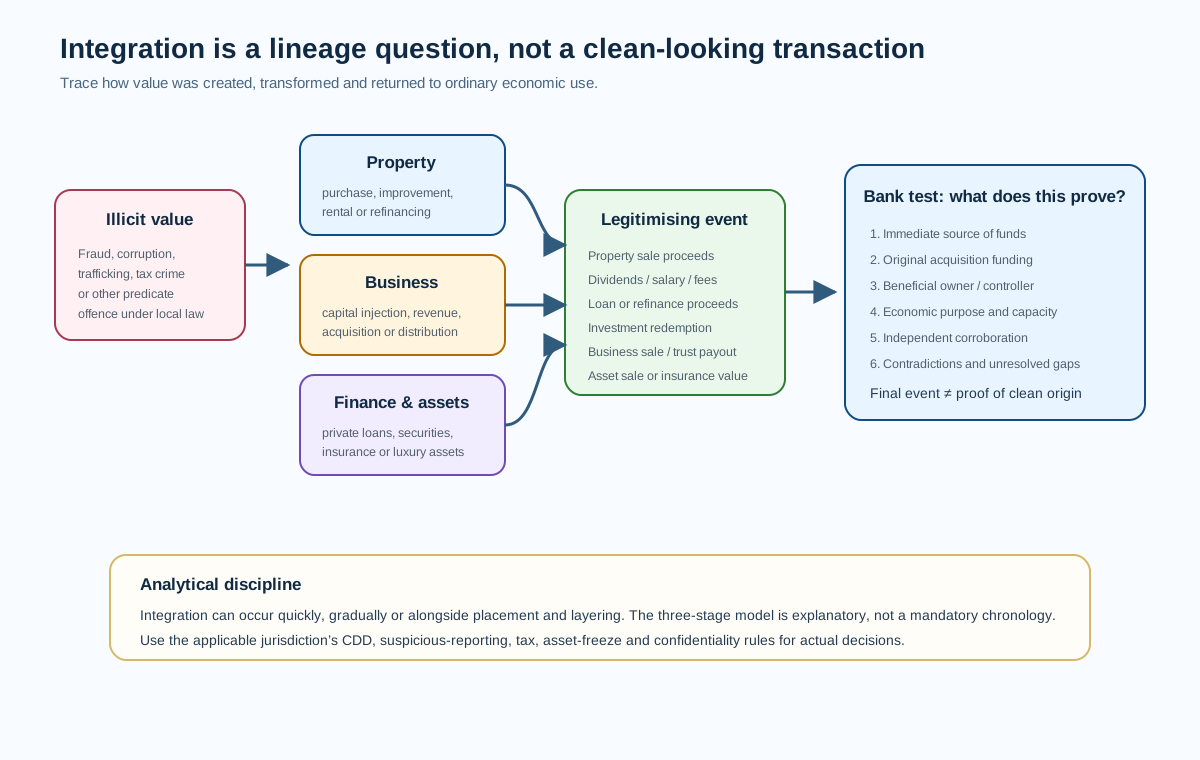
Integration is about legitimacy of economic explanation
Banks routinely handle wealth. Customers buy homes, invest, receive dividends, sell businesses, inherit assets, repay loans and transfer capital across borders. None of these activities is suspicious simply because the values are high or structures are complex.
Integration risk arises when the apparent source of wealth or income does not withstand scrutiny. A customer may present value as business profit even though the business has little credible activity. A company may receive a loan from an entity ultimately controlled by the borrower. Property may be purchased through a chain of companies whose ownership is opaque. Investment gains may be claimed without supporting history. Professional fees may be used to give a commercial label to value that lacks a real service behind it.
The control objective is not to prove a predicate offence. It is to understand whether the economic story is coherent, supported and consistent with what the bank knows.
Source of wealth and source of funds
Integration investigations often depend on the distinction between source of wealth and source of funds.
Source of funds explains where the specific money for a transaction or relationship came from. A house purchase may be funded from savings, a business sale, a loan or an inheritance.
Source of wealth explains how the customer accumulated their broader wealth over time. A wealthy customer may have built a company, inherited assets, earned investment returns or accumulated property.
These questions are related but different. A customer may have a legitimate overall source of wealth but an unclear source for a particular transfer. Conversely, a specific payment may come from an identifiable account while the origin of the customer’s overall wealth remains unexplained.
The level of evidence should be proportionate to risk and local requirements. Banks should avoid collecting documents without understanding what uncertainty they are intended to resolve.
Property and real estate
Real estate is a common integration channel because property can store value, appreciate, generate rental income and later be sold. Property transactions can involve banks, lawyers, escrow accounts, estate agents, companies and mortgage lenders, creating multiple layers of apparent legitimacy.
A property purchase is not suspicious because it involves cash, foreign funds or a company. The bank should understand the customer’s financial capacity, source of deposit, source of wealth, ownership structure and relationship between parties where risk justifies it.
Red flags can include third-party funding without a clear relationship, rapid resales at unusual prices, repeated use of companies with opaque ownership, mortgage repayment inconsistent with income, unexplained overpayments or funds moving through several intermediaries before completion.
The quality of analysis depends on what the bank can legitimately observe. A retail bank may see deposit funding and mortgage payments. A private bank may also hold investment and source-of-wealth information. A correspondent bank may see only a payment to a law firm. Controls should reflect actual visibility.
Business income
Criminal value can be integrated as apparent business revenue. A front business may have real operations but mix illicit proceeds with legitimate sales. A shell company may issue invoices without meaningful activity. A consultancy may receive payments for vague or unverifiable services.
Banks should understand the business model well enough to evaluate whether revenue patterns are plausible. Customer type, industry, turnover, counterparties, tax or accounting information where available, merchant activity and transaction purpose can all provide context.
A business receiving revenue is not suspicious simply because customers are numerous or international. The question is whether the flow makes sense for what the business claims to do.
Loans and debt
Loans can create an apparently legitimate explanation for value. A customer may receive funds under a loan agreement, use them to acquire assets and later repay the lender. The documentation can make the movement look ordinary.
Risk increases when the lender is connected to the borrower, lacks visible financial capacity, has opaque beneficial ownership or receives repayment from unexplained sources. Circular loans can be particularly important where the borrower’s own value is routed through related entities and returns as supposedly external finance.
Banks should consider lender identity, ownership, commercial terms, repayment schedule, security, source of the lender’s funds and whether the agreement is consistent with market practice. A signed contract is evidence, not automatic proof of legitimate origin.
Dividends, distributions and shareholder payments
Companies legitimately distribute profits to shareholders. Criminal proceeds can also be presented as dividends when underlying revenue is false or inflated.
A bank may need to understand whether the company generated sufficient profits, whether the recipient is genuinely a shareholder, whether ownership changed shortly before distribution and whether funds entering the company came from credible business activity.
In group structures, intercompany payments can include dividends, management fees, loans and capital distributions. These should not be treated as suspicious simply because they are cross-border. The economic substance and governance matter.
Investments and securities
Investments can integrate value by converting cash or bank balances into securities, funds, bonds or other assets. Later sales can create statements showing apparently legitimate investment proceeds.
The bank should consider how the investment was originally funded. A brokerage statement proving that securities were sold does not necessarily explain the source of the capital used to acquire them.
For higher-risk customers, source-of-wealth analysis may need to go further back than the latest asset sale.
Luxury goods and portable assets
High-value goods such as jewellery, art, vehicles, watches and other portable assets can store or transfer value. They can be bought, sold, gifted or moved across borders.
Banks normally see only the payments. A payment to a luxury dealer is not suspicious by itself. Risk depends on customer profile, value, frequency, counterparties, source of funds and whether activity is consistent with known wealth.
Where a customer repeatedly buys and sells high-value goods without a clear business purpose, the pattern may justify additional review.
Professional intermediaries
Lawyers, accountants, trust and company service providers, estate agents and other professionals can be involved in completely legitimate transactions. Their accounts can also sit between the bank and the underlying economic parties.
A transfer to a law firm’s client account does not prove legitimacy, and it is not automatically suspicious. The bank may need to understand the nature of the underlying transaction when risk warrants it, while respecting legal privilege and local rules.
Professional intermediaries can make the transaction chain harder to interpret because the account name does not necessarily reveal the ultimate payer or beneficiary.
Trusts and legal arrangements
Trusts and similar legal arrangements have legitimate uses in succession, family wealth, charity and asset management. They can also be misused to obscure control or economic benefit.
FATF Recommendation 25 and associated guidance emphasise transparency of beneficial ownership for legal arrangements. For banks, the practical task is to understand relevant parties such as settlors, trustees, protectors and beneficiaries according to applicable law and risk.
The presence of a trust is not itself a red flag. Complexity should be assessed against purpose, jurisdiction, ownership and source of wealth.
Private banking
Private banking often deals with complex wealth, cross-border structures and high-value transactions. This does not mean private-banking customers are inherently suspicious. It means the bank may need stronger customer understanding because transaction values and structures can create higher exposure.
Source-of-wealth evidence, family structures, companies, trusts, investment portfolios, tax residency and cross-border assets may all be relevant. Relationship-manager knowledge can be useful but should not replace documentary or independent evidence where required.
One control weakness is over-reliance on familiarity. A customer who has been known to the bank for years can still experience changes in ownership, wealth source or risk.
Integration through corporate acquisition
Criminal value can be used to buy a legitimate business. Once acquired, the business can generate real revenue and provide a credible-looking source of future wealth.
Banks may see acquisition finance, seller payments, capital injections and changes in ownership. The key question is the source of acquisition funds and identity of the ultimate controllers.
After acquisition, distinguishing historic illicit capital from legitimate future business income can be difficult. This is one reason long-term source-of-wealth analysis matters.
Asset-backed lending
A customer may pledge an asset as collateral for a loan, converting the economic value of the asset into apparently legitimate bank lending. If the original asset was purchased with criminal proceeds, the bank loan can provide clean-looking liquidity.
The loan itself is legitimate banking activity. The risk lies in the origin and ownership of the collateral.
This illustrates why integration analysis often requires looking beyond the immediate transaction.
Virtual assets and integration
Virtual assets can be converted into fiat and used for ordinary purchases, investments or business funding. The presence of crypto proceeds is not inherently suspicious.
Where risk is higher, a bank may need to understand acquisition history, exchange counterparties, wallet provenance and source of wealth. External blockchain analytics can support investigation but should be interpreted carefully. Risk scores and wallet labels are probabilistic intelligence, not legal conclusions.
Gambling and gaming proceeds
Gambling winnings can represent legitimate income, but they can also be used to explain the source of funds. Banks should avoid assuming either conclusion.
A customer claiming substantial gambling winnings may need to provide evidence proportionate to risk, such as operator statements or transaction history. The bank should consider whether betting behaviour and net results are plausible.
Similarly, gaming platforms and digital economies can create complex value flows that require product-specific understanding.
Integration and tax
Tax evasion, tax fraud and lawful tax planning must be distinguished carefully. Offshore structures, trusts and companies can be legal. Complexity alone does not establish criminality.
Where activity suggests deliberate concealment, false documentation or undeclared income that may constitute a crime under applicable law, AML concerns can arise. Banks should avoid giving tax advice unless that is part of their role and should rely on relevant legal and compliance frameworks.
The role of beneficial ownership
Integration often hides behind legal ownership. The registered owner of an asset or company may not be the natural person who ultimately owns or controls it.
Banks should maintain clear relationships between customers, legal entities, beneficial owners, authorised persons and accounts. Ownership changes should trigger appropriate review where material.
FATF’s strengthened beneficial-ownership standards are especially relevant because anonymous or opaque corporate structures have historically been used to hide illicit wealth.
Payment data and integration
A bank may see integration through outgoing payments for property, investments or luxury assets, or through incoming payments labelled as dividends, loans or sale proceeds.
Payment descriptions should be treated as claims, not verified facts. “Property sale” in a remittance field does not prove that a property existed. “Dividend” does not prove underlying profit.
The bank should use customer context and available evidence to determine whether further review is justified.
Long time horizons
Integration can occur years after the original offence. Current account behaviour may look normal while the underlying wealth was created from criminal proceeds much earlier.
This makes historical records important. Banks need retention policies that meet legal requirements and support reconstruction. System migrations should preserve enough history and lineage for investigations.
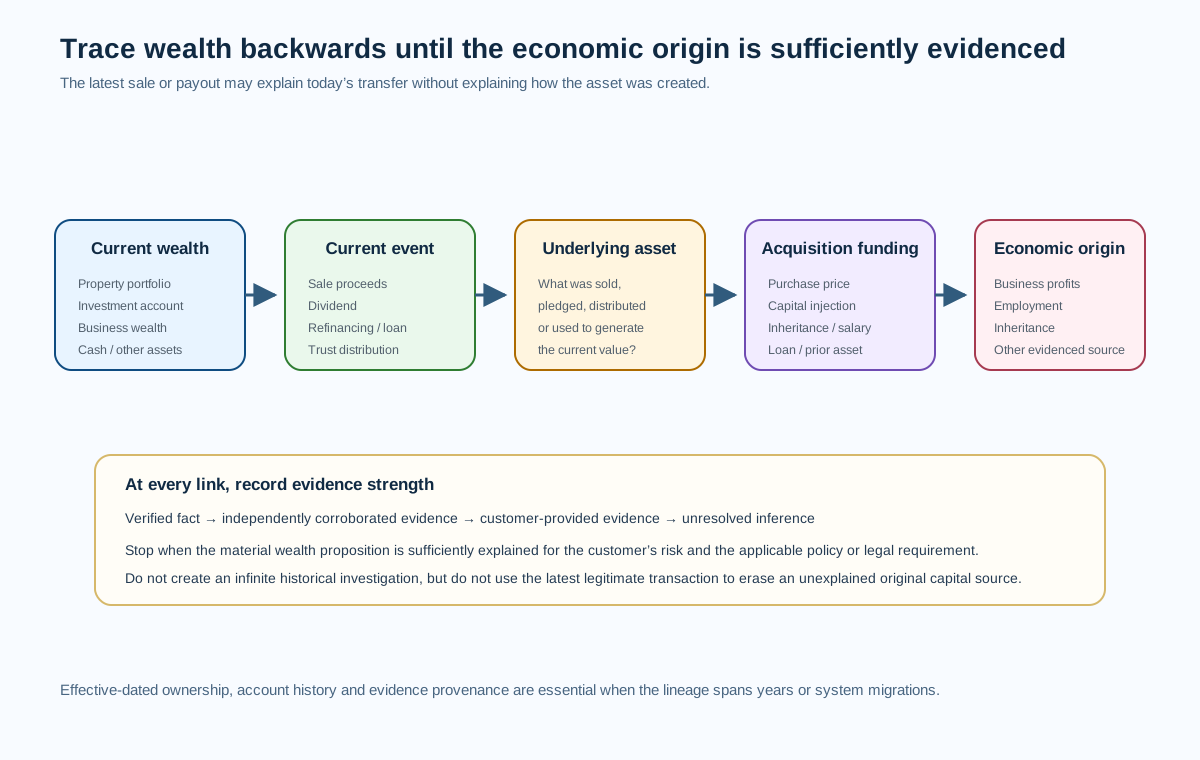
A source-of-wealth review may need to connect present assets to older events such as business sales, inheritance, property acquisition or investment capital.
Scenario: property portfolio
A customer owns several properties and receives regular rental income. Current cash flows appear legitimate. During a source-of-wealth review, the bank finds that the first properties were purchased years earlier using funds from companies with opaque ownership and no clear operating activity.
The rental income itself may be genuine. The question becomes whether the original capital used to build the portfolio had a legitimate source.
This scenario shows why integration can make illicit value look increasingly normal over time.
Scenario: business sale
A customer receives EUR 8 million from the sale of a company. The sale agreement and bank transfer are genuine. The bank should still understand how the customer originally acquired or built the company if the relationship is high risk and source-of-wealth obligations require it.
The sale creates a legitimate transaction, but it may not answer every source-of-wealth question.
Scenario: family loan
A customer receives a large loan from a family member abroad to purchase property. Family loans are common and can be legitimate.
The bank may consider the lender’s relationship, financial capacity, source of funds and loan terms. If the lender is funded immediately beforehand by the borrower through another company, the apparent external loan may be circular.
Scenario: consulting income
A small company receives unusually large “consulting fees” from several overseas entities. The company has few employees and little evidence of relevant activity.
The investigation should examine contracts, services, counterparties, beneficial ownership, transaction history and whether the payments fit the company’s capabilities.
The bank should not call the fees criminal without evidence. It should test whether the economic explanation is credible.
Customer explanation and independent evidence
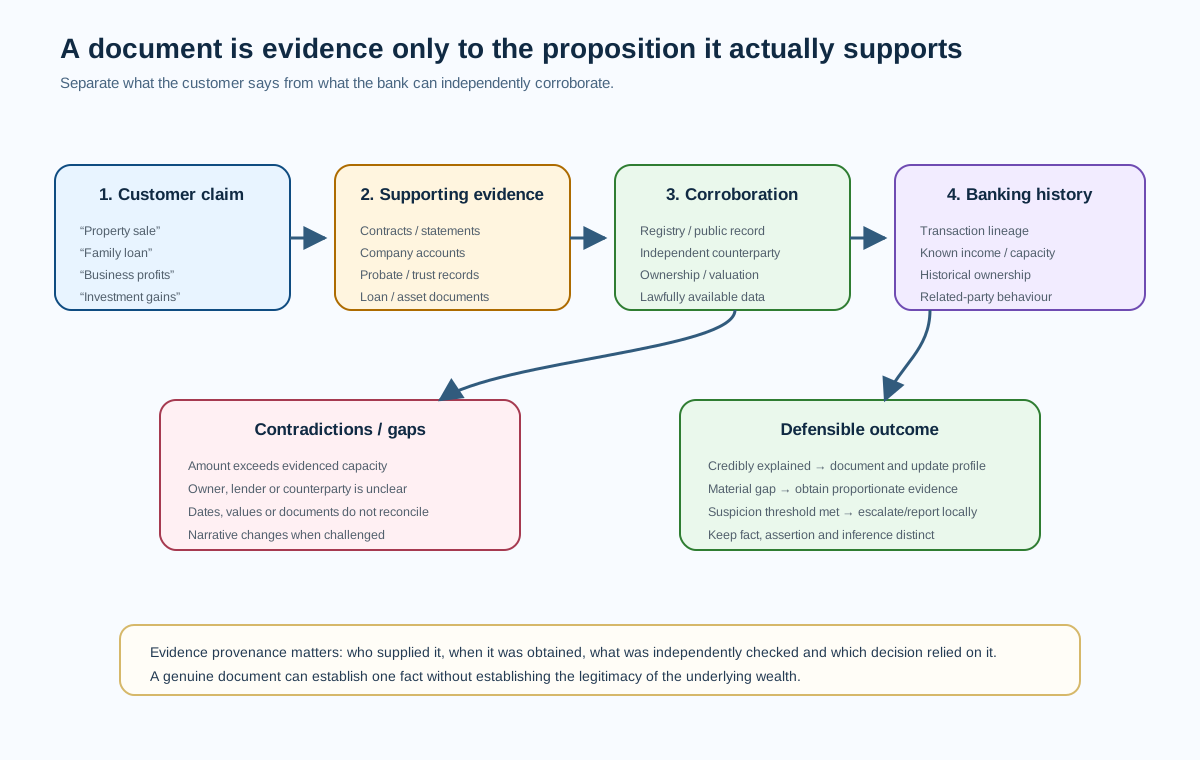
A customer explanation is important but should be distinguished from verified facts. Strong investigations record what the customer said, what documents were provided and which elements were independently corroborated.
Documents can also be falsified. Banks do not need to become forensic document laboratories for every case, but higher-risk inconsistencies should be challenged appropriately.
The investigation should be proportionate and fair.
Integration and sanctions
A customer can hold apparently legitimate assets that are subject to sanctions restrictions because of ownership, control or designated-party involvement. Sanctions analysis is legally distinct from AML.
A source-of-wealth explanation does not override an asset-freeze obligation. Conversely, a sanctioned connection does not automatically prove money laundering.
Systems should preserve separate decision types while sharing relevant ownership data.
Business analyst view
A BA should ensure systems can represent source of funds, source of wealth, evidence type, verification status, ownership relationships and historical changes. Free-text notes alone are difficult to reuse in monitoring and risk assessment.
Requirements should distinguish a customer claim from a verified source. They should also define evidence provenance: who provided it, when it was obtained, how it was validated and which decision used it.
For property or investment flows, transaction lineage should connect funding, asset purchase, sale proceeds and subsequent transfers where the bank has the data.
Monitoring for integration risk
Transaction monitoring can identify patterns such as large asset purchases inconsistent with profile, repeated third-party investment inflows, sudden wealth changes, unusual loan flows, rapid purchase-and-sale activity or unexplained professional-fee income.
Monitoring should not attempt to infer wealth solely from transaction values. Customer profile and product context matter.
For private banking, event-driven reviews may be more useful than generic transaction thresholds. For retail customers, a sudden high-value property transaction may prompt source-of-funds review rather than an automatic suspicious-activity conclusion.
Investigation quality
A strong integration investigation explains the economic story over time. It should identify how wealth was accumulated, how a specific transaction is funded, who controls relevant entities, which evidence supports the explanation and what remains unresolved.
The analyst should avoid circular reasoning. “Customer is wealthy because customer owns property; property is legitimate because customer is wealthy” does not establish source.
The evidence chain should have a credible starting point.
Common mistakes
One mistake is assuming that a bank statement showing incoming sale proceeds proves legitimate source of wealth. Another is treating offshore structures as inherently suspicious. A third is collecting excessive documentation without linking it to a risk question.
Banks also make mistakes when source-of-wealth information is stored only in scanned documents and cannot be used by risk systems.
Finally, investigators can over-focus on the latest transaction and fail to trace how the asset being sold was originally acquired.
Learning checkpoint
A reader should be able to explain integration as the appearance of legitimate wealth rather than a mandatory final stage, distinguish source of funds from source of wealth, analyse property, business, loan and investment examples, understand beneficial-ownership implications and describe how evidence and transaction history support a defensible bank decision.
Reference links
- FATF — The FATF Recommendations, amended June 2026: https://www.fatf-gafi.org/en/publications/Fatfrecommendations/Fatf-recommendations.html
- FATF — Beneficial Ownership: https://www.fatf-gafi.org/en/topics/beneficial-ownership.html
- FATF — Guidance on Beneficial Ownership of Legal Persons: https://www.fatf-gafi.org/en/publications/Fatfrecommendations/Guidance-Beneficial-Ownership-Legal-Persons.html
- FATF — Guidance on Beneficial Ownership and Transparency of Legal Arrangements: https://www.fatf-gafi.org/en/publications/Fatfrecommendations/Guidance-Beneficial-Ownership-Transparency-Legal-Arrangements.html
Educational note: source-of-funds and source-of-wealth requirements, beneficial-ownership rules, property reporting and suspicious-reporting obligations vary by jurisdiction and customer type.
Advanced practice: reconstructing integration and source-of-wealth history
Integration cases often look ordinary at the moment the bank sees them. A property sale produces a clean-looking incoming credit. A company pays a dividend. An investment portfolio generates proceeds. A private loan arrives under a signed agreement. The difficulty is that these transactions can be perfectly legitimate while also sitting at the end of a much older laundering chain. Good investigation therefore requires historical reconstruction, not suspicion based on the asset class.
Case 1: property purchase funded by an overseas loan
A customer with declared employment income of EUR 70,000 purchases a property for EUR 900,000 through a company. The deposit comes from savings in the customer's account, while the remaining purchase price is funded by a loan from an overseas company. The loan agreement is signed, interest-bearing and has a five-year term.
A weak investigation might close because a loan contract exists. A stronger review asks who owns and controls the lender, whether it has financial capacity to lend, what relationship exists with the borrower, where the lender obtained the funds, whether the terms are commercially credible and whether repayments occur as agreed.
Suppose the lender is ultimately controlled by a long-standing business associate of the customer and received almost the same amount from another company connected to the customer shortly before making the loan. The signed agreement remains real, but it does not resolve whether the loan is independent funding or part of a circular structure.
The investigator should map the funding chain and describe the relationships rather than use the label "loan-back" as a substitute for evidence.
Case 2: legitimate business with unexplained historical capital
A manufacturing business has operated successfully for twelve years. Current turnover, payroll, suppliers and tax-related payments appear coherent. The owner has accumulated significant wealth through dividends and a later sale of part of the company. A current source-of-wealth review appears straightforward: the customer is a successful entrepreneur.
Historical account records, however, show that during the first two years the company received several large capital injections from entities that had no obvious commercial relationship with the business. Those entities were later dissolved. Current beneficial-ownership records do not show who controlled them at the time.
This is an integration problem because today's wealth can be supported by genuine business activity even if the origin of the initial capital remains unexplained. The investigation should not assume the entire business or later wealth is criminal. It should identify the historical funding gap and determine whether proportionate evidence can clarify it.
Effective-dated company and ownership data becomes crucial. If the bank has overwritten old KYC records, it may be unable to reconstruct who controlled the funding entities when the capital was introduced.
Case 3: securities portfolio with third-party funding
A private-banking customer has a substantial securities portfolio and regularly trades equities and bonds. Over several months, the investment account receives transfers from two companies not previously associated with the customer. The customer explains that the transfers are repayment of personal investments made years earlier.
High trading volume and foreign-currency conversion are normal for this customer and should not drive the case. The central questions are the relationship to the companies, original investment evidence, ownership, source of the companies' funds and whether payments are proportionate to the claimed investments.
If the evidence supports genuine historical investments, the unusual third-party funding can be resolved. If the companies are controlled by nominees, have minimal operating activity and receive funds from other parties immediately before paying the customer, concern remains even though the money is invested in mainstream securities afterward.
Case 4: luxury asset sale and provenance of funds
A customer receives a large credit from the sale of a high-value vehicle. The sale contract and bank transfer are genuine, and the buyer is identifiable. Source of funds for the current credit is therefore clear: vehicle sale proceeds.
That fact does not necessarily establish source of wealth. If the customer originally acquired the vehicle for cash or through third-party funding inconsistent with their known means, the current sale can convert earlier unexplained value into an ordinary-looking bank credit.
The correct review depends on risk and proportionality. Banks should not attempt to reconstruct every historic consumer purchase. For a high-risk customer, unusually valuable asset or material wealth discrepancy, however, understanding acquisition history can be relevant.
Case 5: trust distribution
A customer receives a distribution from a family trust. Trust documents identify trustees, beneficiaries and the distribution. The customer explains that the trust was created by a relative decades earlier.
The bank should understand the legal arrangement and relevant parties according to applicable CDD rules. Where source of wealth is material, the question may extend to how the trust assets were accumulated and whether the settlor or other controller is consistent with the customer's explanation.
Trusts are legitimate estate-planning and asset-management tools. The existence of a trust is not a red flag. Risk arises where ownership/control is obscured, documents conflict, funding is unexplained or the arrangement is inconsistent with the stated family or commercial purpose.
Sale proceeds can be both legitimate and misleading
One of the most important integration concepts is that a transaction can have a legitimate immediate source while still requiring historical context. Property sale, business sale, securities redemption, insurance payout or loan proceeds can all provide clear source-of-funds evidence. They do not automatically answer the deeper question of how the asset or entitlement was created.
Investigators should use the right question for the risk at hand. If the bank only needs to establish funding for a routine low-risk transaction, the immediate source may be enough. If there is a material discrepancy in wealth or a serious financial-crime concern, source-of-wealth analysis can go further.
Tax issues and money laundering should not be conflated
Unusual wealth, offshore structures or tax-efficient arrangements do not automatically imply tax crime or laundering. Tax rules differ by jurisdiction and legitimate planning can be complex. Where tax evasion is a predicate offence under applicable law and credible evidence exists, it can be relevant, but bank investigators should avoid providing tax-law conclusions outside their competence.
The case should focus on financial facts, customer explanation, ownership and the applicable suspicion threshold.
Professional gatekeepers and evidential limits
Integration often involves lawyers, accountants, investment advisers, notaries, real-estate professionals and trust or company-service providers. Their presence can add documentation and legitimate professional purpose, but it does not transfer the bank's responsibility to understand its own customer.
A lawyer's confirmation that funds relate to a property transaction establishes context; it does not necessarily establish the original source of wealth. An audited company statement can provide strong evidence of revenue; it may not resolve the origin of an earlier shareholder loan.
Evidence should be matched to the question being asked.
Historical data should not be overwritten
A bank-grade financial-crime platform should preserve changes to customer occupation, declared income, business ownership, risk rating, beneficial owners and source-of-wealth explanations. Investigators need to know what the bank knew at the time of a historical transaction.
The same applies to payment data. If a beneficiary name or remittance field was repaired, the case should retain the original and corrected values. If an account was migrated from another core system, reference mapping should remain available.
This creates a practical BA requirement: history is data, not clutter. Overwriting a current-value field can destroy evidence needed for retrospective review.
Wealth-lineage reconstruction exercise
Choose one high-risk customer's current net worth and build a simple lineage backwards:
current property / portfolio / business value → acquisition event → funding source → earlier asset or income → underlying business, salary, inheritance, sale or other origin.
At each step classify the evidence as verified, customer-provided, externally corroborated or unresolved. Stop when the level of assurance is proportionate to the risk and policy requirement. The goal is not infinite historical research; it is a reasoned, documented basis for understanding material wealth.
Monitoring for integration patterns
Transaction-monitoring scenarios can look for large property-related transfers, rapid movement of sale proceeds to unrelated parties, unexplained private loans, third-party investment funding, large capital injections, repeated transactions with professional-client accounts, sudden debt repayment inconsistent with income, or circular movement between related companies.
These signals are contextual. Property investors, private-equity structures, family offices and treasury entities can exhibit many of them legitimately. Segmentation and customer understanding are therefore essential.
Scenario design: property refinancing
A customer buys property with a large unexplained private loan, repays the loan unusually quickly using transfers from related companies, then refinances with a regulated bank. The refinancing proceeds are invested in mainstream funds.
A superficial review of the final investment sees ordinary bank-loan proceeds. A historical view shows that the equity being refinanced may have been created through unexplained related-party funding. The investigation should reconstruct the chain and identify what remains unresolved.
Scenario design: business exit
A customer sells a company to an independent buyer and receives EUR 8 million. The sale is genuine, buyer funding is credible and the customer's ownership is documented. The current credit can be legitimate even if the amount is far above historical account turnover.
The alert should not remain permanently suspicious simply because it is large. Once the economic event and ownership are verified, expected activity and customer wealth records should be updated. Good AML controls learn from legitimate changes rather than forcing the same customer through repeated alerts.
SAR/STR narrative for integration cases
A strong report should explain the wealth or funding discrepancy chronologically: customer profile, relevant asset or company, acquisition or funding event, counterparties, ownership relationships, documents reviewed, customer explanation, contradictions and reason suspicion remains. It should not state that property or investments are "laundered" unless the institution has evidence supporting that conclusion.
Where the bank cannot identify the precise predicate offence, it can still report suspicious activity if the legal threshold is met. The report should be precise about what the bank knows and what it does not.
Final practitioner standard
Integration analysis is the discipline of resisting the comfort of a clean-looking final transaction. A regulated lender, property sale, dividend, portfolio redemption or trust distribution can all be genuine. The investigator asks whether the broader lineage of value and ownership is coherent. When it is coherent, the case should close confidently. When it is not, the unresolved inconsistency—not the asset class—should drive escalation.
Practitioner close: integration and the problem of apparently legitimate wealth
Integration is often taught as the final stage of a neat three-stage laundering model, but real bank investigations are rarely that linear. Proceeds can enter the financial system digitally, move through several accounts, remain dormant, be invested, sold and later reappear as apparently ordinary wealth. The investigator therefore needs to distinguish the immediate source of funds for a transaction from the historical source of wealth that explains how the customer accumulated the asset or capital in the first place.
Case lab: property sale as the immediate source
A customer receives a large credit from a solicitor following the sale of a property. The immediate source of funds is clear: property-sale proceeds. That fact does not automatically establish the historical legitimacy of the wealth used to acquire the property.
Where risk and policy require deeper review, the analyst can examine purchase history, financing, ownership changes, previous income or business activity, related parties and any unexplained third-party contributions. The objective is not to demand decades of documentation from every customer. It is to apply proportionate review when the current transaction is inconsistent with the known customer profile or linked to credible risk indicators.
Case lab: shareholder loan returned years later
A corporate customer receives repayment of a shareholder loan from an overseas company. Documents show that the loan existed. The relevant question becomes how the original loan was funded, whether the overseas company is genuinely independent, whether repayment terms are commercially plausible and whether funds moved through related entities before returning.
A circular movement can be legitimate treasury activity, especially in a corporate group. The bank should compare the transaction with group structure, accounting evidence and commercial purpose rather than assume that a return of capital is laundering.
Securities and investment products
Investment portfolios can make illicit funds appear detached from their origin after legitimate market gains, dividends or sales. Securities transactions themselves are not suspicious merely because they transform cash into investments. Concern arises when funding sources, third-party subscriptions, rapid transfers among related accounts, unexplained beneficial ownership or transaction patterns do not fit the customer’s economic profile.
Investigators should preserve the distinction between the legitimacy of the investment activity and the legitimacy of the capital entering it.
Tax and AML are not the same conclusion
Unexplained wealth can create tax questions, AML questions or both, but analysts should avoid diagnosing tax offences without sufficient evidence. A discrepancy between declared income and assets is a reason to investigate and understand the economic story; it is not by itself proof of tax evasion or money laundering.
Where credible suspicion exists, the case narrative should describe the financial facts and inconsistency rather than make unsupported legal conclusions about the predicate offence.
Gatekeepers and professional accounts
Solicitors, accountants, trust and company service providers and other professionals can handle legitimate client money. Their involvement can also be exploited to add apparent legitimacy to transactions. A payment from a professional-client account is therefore neither automatically clean nor automatically suspicious.
The bank should understand the professional’s role, client relationship where visibility and law permit, purpose of the transaction, ownership and whether the movement is consistent with the expected use of the account.
Historical data and effective dating
Integration investigations often depend on history. Customer ownership, employment, company roles, addresses and wealth sources can change over years. Systems should retain effective-dated KYC and relationship data so investigators can reconstruct what was known when an asset was acquired or a transaction occurred.
Current KYC alone can create a false narrative. A customer who is wealthy today may have had a very different profile ten years ago, while a customer whose current business is small may have legitimately accumulated wealth earlier.
Final practitioner checkpoint
A strong integration investigation does not stop when it finds a respectable-looking immediate source such as a property sale, investment redemption or loan repayment. It asks proportionately whether the historical economic story is coherent, distinguishes source of funds from source of wealth, considers legitimate alternatives, and documents why apparently ordinary value is or is not consistent with the customer’s known history.
Practitioner masterclass: testing apparently legitimate wealth
Integration analysis requires patience because the current transaction may be entirely lawful while the underlying capital has a problematic origin. The investigator therefore has to look beyond labels such as sale proceeds, dividend, investment gain, loan or property income and ask what economic history supports them.
Source-of-wealth reconstruction
A useful source-of-wealth review begins with the present asset and works backwards. If a customer receives money from selling property, the bank may ask how the property was acquired. If it was bought with proceeds from a business sale, the analysis may continue to how the business was built or acquired, depending on risk and policy.
The objective is not infinite historical investigation. It is to establish a sufficiently credible origin for the wealth proportionate to the risk.
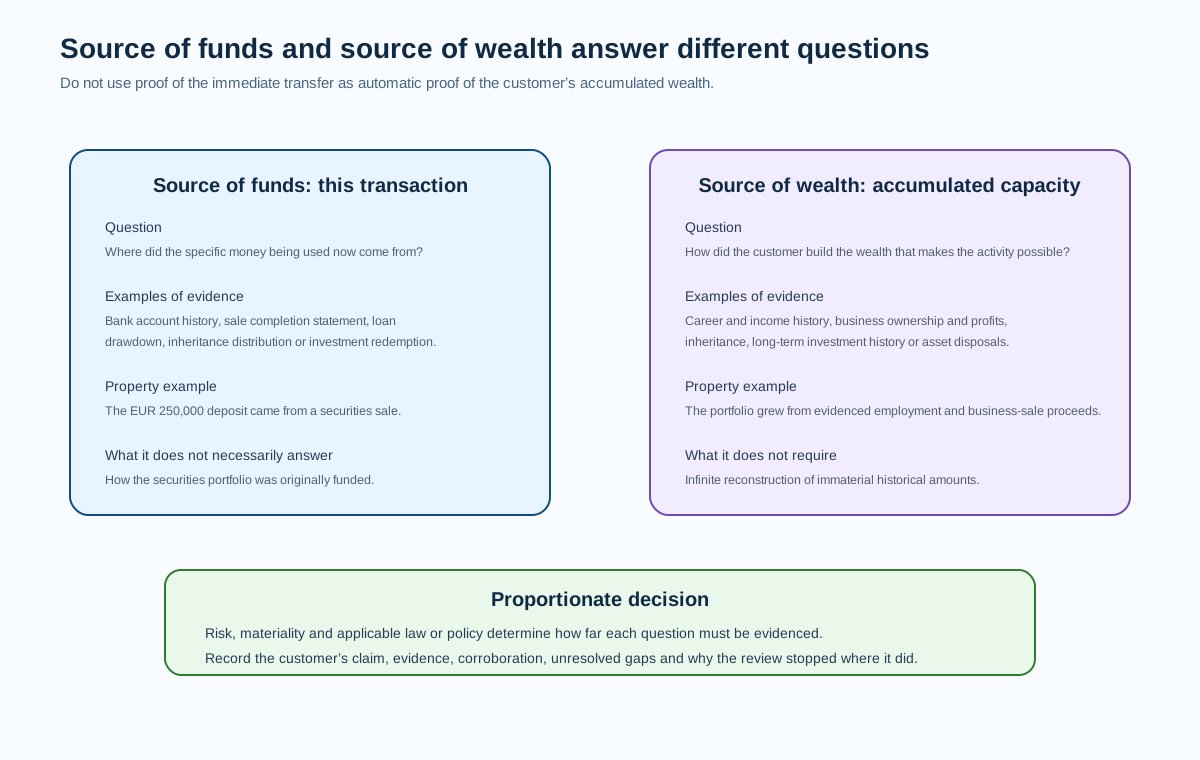
A source-of-funds document should not automatically be treated as a complete source-of-wealth explanation. A current bank statement may identify the account from which money arrived, while the broader question remains how the asset, business or wealth behind that account was originally accumulated. Conversely, a credible long-term source of wealth does not answer every question about a particular transaction. The evidence depth should match the identified risk, the customer type and the applicable legal or policy requirement.
Property case
A customer purchases a EUR 2 million property with EUR 800,000 in own funds and a mortgage. The deposit comes from an investment account. The investment account was funded three years earlier by a transfer from an overseas company controlled by the customer.
The immediate source of funds is the investment account, but the broader source of wealth question concerns the overseas company and how it generated the capital.
A bank should avoid stopping at the nearest account statement when the risk requires a deeper explanation.
Business-sale case
A founder sells a company for EUR 12 million. The sale contract, buyer and payment are genuine. The bank’s source-of-wealth assessment may still consider whether the founder genuinely owned the company, how it was funded and whether the sale value is commercially plausible.
This is particularly relevant if the company was acquired shortly before the sale, had opaque ownership or received unexplained capital.
Loan case
A customer receives a large loan from an offshore company. Documentation shows interest, maturity and repayment terms. The bank should still consider who owns the lender, whether it has financial capacity and whether the funds originate from the borrower or a related party.
Circular funding can make the loan legally documented while obscuring the economic source.
Dividend case
A company pays a large dividend to its owner. The payment may be legitimate if supported by real profits and lawful corporate action. If the company’s revenue was generated by unexplained third-party transfers or fabricated invoices, the dividend can integrate those proceeds into the owner’s personal wealth.
The analysis therefore connects personal wealth to corporate activity.
Investment-gain case
A customer presents brokerage statements showing substantial gains. The statements can demonstrate how current wealth increased, but they do not automatically explain the original capital invested.
Where source of wealth is material, analysts should distinguish performance from initial funding.
Evidence hierarchy
Evidence can include audited accounts, sale agreements, tax documents, probate records, investment statements, property documents, loan agreements and reliable public records. Each source has limitations.
A customer-provided document proves that a document exists; it does not always prove the underlying transaction. Independent corroboration may be appropriate for higher-risk cases.
Plausibility testing
Plausibility asks whether the explanation is economically possible and consistent. A customer claiming decades of professional income should have a profile broadly compatible with that claim. A company claiming large consulting revenue should have some capability to provide the service.
Plausibility is not certainty. It is one part of a risk-based assessment.
Counterfactual thinking
Ask what evidence would normally exist if the explanation were legitimate. A business sale might generate contracts, corporate records and incoming payment from an identifiable buyer. An inheritance might produce probate or estate documentation. A loan might have lender identity and repayment terms.
This approach helps analysts identify meaningful gaps rather than requesting documents randomly.
Long-term wealth and legacy systems
Older wealth can be difficult to evidence, especially when records predate digital systems or legal retention periods. Banks should apply reasonable, risk-based judgement rather than assume absence of old documents proves illicit origin.
Case narratives should explain evidential limitations and what alternative corroboration was considered.
Customer fairness
Source-of-wealth processes can become burdensome if the bank repeatedly asks for information without explaining what is needed. Requests should be proportionate, specific and connected to the identified risk.
The bank should distinguish inability to produce a particular document from inability to explain the source at all.
Sanctions overlay
Even fully legitimate wealth can be subject to sanctions restrictions. Ownership and control analysis should therefore remain separate from source-of-wealth assessment. A bank may be satisfied that money is legitimately earned but still prohibited from dealing with it under applicable sanctions law.
Case-writing exercise
Write a narrative for a property purchase funded through three prior asset sales. Separate verified facts, customer explanations and analyst conclusions. Identify where the evidence chain begins and why that point is sufficient for the risk level.
The exercise forces discipline: avoid phrases such as “funds appear clean.” Instead describe why the source is credible or what uncertainty remains.
BA data-model exercise
Design fields for source type, source description, amount, currency, evidence type, evidence date, verification status, related party, reviewer and effective period. Then decide which data should be reusable across future reviews and which sensitive evidence should remain access-controlled.
Structured source-of-wealth data can reduce repeated customer requests and improve consistency, but privacy and retention rules must be respected.
Final practitioner test
A strong learner should be able to distinguish source of funds from source of wealth, trace present assets back to credible origin, test loans and business income for economic substance, and document uncertainty without overclaiming criminality.
60-minute mastery extension: integration and apparently legitimate value
This extension is designed to make the chapter a minimum 60-minute guided learning experience. Spend about 25 minutes on the core chapter and diagrams, 15 minutes on the source-of-wealth case, 10 minutes on the asset-lineage exercise and 10 minutes on the final evidence test.
Integration is about economic credibility over time
Integration describes the point at which criminal value can appear as ordinary wealth, income, investment, property, loan proceeds, dividends or business revenue. In practice, the analyst should not ask whether a customer has reached "stage three." The stronger question is whether the apparent wealth or income has a credible, evidenced economic origin and whether the ownership and transaction history are consistent with that story.
This distinction matters because a current transaction can be entirely genuine while the capital behind it is problematic. A legitimate property sale proves that property was sold; it does not automatically explain how the property was originally acquired. A genuine dividend can come from a company whose revenue itself is unexplained. A bank loan can create clean-looking liquidity against an asset originally bought with illicit funds.
Worked case: property portfolio
A customer sells a property for EUR 1.8 million and transfers the proceeds to an investment account. The sale contract, buyer and incoming payment are genuine. Source-of-funds evidence is therefore strong for the immediate transfer. During a higher-risk source-of-wealth review, however, the bank learns that the property was purchased five years earlier using funds from an offshore company controlled by the customer. The company had little documented operating activity.
The investigation should work backwards. How was the property acquired? What was the source of the offshore company's funds? Was the company a legitimate holding or investment vehicle? Were there business sales, inheritance, salary, investment returns or other credible wealth sources? The objective is not infinite historical investigation. It is to reach a sufficiently credible origin proportionate to risk.
Source of funds versus source of wealth
Source of funds explains the specific money used in a transaction. Source of wealth explains how the customer accumulated their broader economic capacity. The same case can require both. A bank statement can establish that a house deposit came from an investment account. It may not establish how the investment account was funded.
Systems should store these concepts separately. A field called source is too vague. Useful attributes include source type, description, amount/currency where relevant, evidence type, verification status, related person/entity, date, reviewer and effective period.
Loans and circular funding
A signed loan agreement can make a transfer look legitimate, but the economic source can still be circular. Suppose Customer A sends money to Company B, which sends value through Company C, which later lends similar value back to A. The legal loan document may be genuine. The question is whether the lender has independent financial capacity and whether the funds ultimately originated from the borrower or a related party.
Analysts should review lender ownership, relationship, commercial terms, repayment pattern and funding source. A circular pattern is an indicator; it is not automatic proof of laundering.
Business income and front activity
A company can have real customers and legitimate revenue while also mixing illicit value into its receipts. This is why "economic substance" is not a binary test. A restaurant, consultancy, trading company or property business can be genuine and still be misused.
The investigation should compare declared activity, actual turnover, counterparties, payment descriptions, employees or operational capacity where relevant, tax or accounting information when available, and historical behaviour. The aim is to test whether the scale and nature of income make sense.
Asset-lineage exercise
Choose an asset—property, securities portfolio, business ownership, art, luxury vehicle or virtual assets. Start with the current sale or financing event and work backward through prior acquisition, funding and ownership. At each step classify evidence as verified fact, customer-provided evidence, independent corroboration or unresolved inference.
Then decide where a reasonable investigation can stop. The stopping point should be based on risk and evidential sufficiency, not on an arbitrary number of documents.
Professional intermediaries
Lawyers, accountants, trustees, estate agents and company-service providers can sit between the bank and the underlying economic parties. A transfer from a lawyer's client account can be legitimate and well documented. It should not be treated as automatic proof of legitimacy, nor should the intermediary be treated as suspicious simply because client money is pooled.
The bank should understand the underlying transaction when risk warrants it, while respecting legal privilege, confidentiality and applicable law. The case note should state what the bank was entitled to see and what remained outside its visibility.
Long time horizons and migrated data
Integration risk can involve wealth created years earlier. Legacy-system migrations can therefore matter. If ownership history, transaction records or source-of-wealth evidence are lost during migration, later investigations become weaker. Data-retention design should meet legal requirements while supporting defensible reconstruction.
A BA should ask whether historical ownership is effective-dated, whether closed accounts remain searchable under permitted retention rules and whether evidence links survive system replacement.
Final evidence test
Evaluate these explanations: "property sale," "business profits," "family loan," "investment gains," "inheritance," "dividend," and "crypto profits." For each, state what the phrase proves, what it does not prove and what proportionate evidence could make the origin credible.
A strong learner should finish able to distinguish immediate funding from accumulated wealth, trace assets backward without over-investigating, and document uncertainty without using vague conclusions such as "funds are clean."
Worked case: the inheritance that arrived too conveniently
A new private client arrives with an inheritance explanation for an illustrative 5 million: a deceased relative's estate, probated in an illustrative offshore jurisdiction, distributed through a trust company to the client's account as seed funding for portfolio investment. Documentation includes a grant of probate, the will, trust distribution resolutions and a letter from the offshore trust company confirming the distribution. The client is polite, patient and apparently transparent, answering every question promptly.
The investigation tests the inheritance the way it would test any large unilateral wealth event: by verifying each link independently rather than admiring the completeness of the bundle. Probate records are checked against the issuing court's public records, revealing that the grant exists but relates to an estate valued at a fraction of the distributed amount. The will names the client as a beneficiary but of a specific bequest far smaller than the received funds, with the residue directed elsewhere. The trust company's confirmation, examined closely, confirms only that it processed a transfer on a client's instructions, not that the funds derived from the estate. The deceased's own wealth profile, reconstructed through property records and business history, cannot support an estate of the claimed magnitude.
The pattern is a fabricated-provenance package: genuine document types, some genuine underlying facts, assembled to support a false wealth proposition. Each document is individually defensible, which defeats verification approaches that check documents rather than testing propositions. The correct method verifies the proposition, that this estate generated this wealth for this beneficiary, through independent sources at every link, and treats internal consistency of the customer's bundle as neutral rather than corroborative.
Inheritance claims deserve particular methodological care because genuine inheritances are common, emotionally sensitive and often poorly documented across generations. The proportionate standard distinguishes verification from intrusion: probate and estate records where they exist, deceased's wealth plausibility, tax and legal treatment consistency, and the absence of contradictory indicators, applied with sensitivity but without waiving the requirement. Red flags that escalate the standard include offshore probate for onshore wealth, trust-company involvement that obscures rather than administers, amounts inconsistent with the deceased's means, and urgency or structure suggesting the inheritance narrative was constructed for the account opening rather than preceding it.
Crypto-profits explanations: testing the untestable claim
Claims of substantial cryptocurrency profits present integration analysis with its hardest verification problem: genuinely enormous returns are historically real, documentation is often thin, and the technical complexity deters challenge. A structured testing standard prevents both naive acceptance and reflexive disbelief. The standard examines acquisition evidence first: when, how and with what funds the crypto was obtained, tested against the customer's means and banking history at the claimed time. A student with no income in 2016 claiming large early holdings needs explanation; a technology professional with documented exchange activity does not.
Holding-period consistency is tested next: the claimed assets, acquisition dates and disposal dates must align with market prices and blockchain history where obtainable. Claims of buying at troughs and selling at peaks with perfect timing warrant scepticism proportionate to their convenience. Exchange and wallet records are requested and examined for consistency with the narrative, with gaps treated as unknowns rather than filled by assumption. Tax treatment provides independent corroboration in jurisdictions taxing crypto gains: declared gains supporting the claimed profits strengthen the explanation, while the absence of any tax footprint for life-changing profits weakens it.
The assessment distinguishes three outcomes explicitly. Corroborated crypto wealth, where acquisition, holding and disposal evidence coheres, is accepted with the evidence preserved. Plausible-but-unverifiable claims, where the narrative is consistent but key evidence is unavailable, are treated as unknowns affecting the relationship's risk rating, monitoring intensity and the customer's ability to use the funds for higher-scrutiny purposes such as property purchase without further evidence. Contradicted claims, where evidence undermines the narrative, are treated as failed wealth explanation with the standard reporting and relationship consequences. What the bank must never do is accept crypto-profits language as self-validating: the phrase explains nothing until evidenced, and the evidential standard should reflect the amounts and the purpose, not the technology's mystique.
Worked case: dividends from a company that earns nothing
A relationship review examines a long-standing client, the owner of a holding company that has paid him illustrative dividends of 400,000 to 600,000 annually for six years. The dividends fund a comfortable lifestyle: property, school fees, portfolio investment. The client's file describes the company as a trading business, and each year's dividend is supported by board minutes and audited financial statements from a small local firm.
A new analyst, reviewing the file with fresh eyes, asks the question nobody asked for six years: what does the company actually sell, and to whom? The financial statements show revenue, but the revenue lines trace to three customers, all entities sharing directors with the client's other interests, with contracts that describe advisory services in vague terms. The audit firm has no other clients of comparable size and its work papers, requested through the client, arrive incomplete. The company's bank statements, held at another institution, are not on file and have never been requested.
The investigation reframes the dividends from proof of legitimacy into the object of inquiry. Dividends are credible integration only where the underlying profit is credible, and profit is credible where genuine economic activity supports it, including properly evidenced intra-group trade. Circular or related-party revenue can manufacture distributable profit from injected funds: value enters the company as a loan or capital from an opaque source, circulates as related-party revenue, and exits as a taxed, audited, apparently legitimate dividend. Each step looks respectable in isolation; the whole is a laundering cycle.
Testing follows the money into the company rather than admiring the money coming out. The team obtains the company's bank statements through the client's cooperation, analyses the revenue counterparties for independence and substance, verifies that purported customers exist and trade at the claimed scale, and examines the original capitalisation and any subsequent injections for identifiable legitimate origin. The related-party nature of the revenue does not prove criminality, genuine groups trade internally, but it shifts the evidential burden: related-party revenue requires stronger corroboration, not weaker, because it is the easiest revenue to fabricate.
In this fictional case the corroboration fails comprehensively. The three customers have no employees, no premises and no activity beyond their contracts with the client's company; the audit firm declines to stand behind its opinions when questioned; and the company's initial capital traces to an entity dissolved three years ago in a jurisdiction that discloses no ownership. The dividends, the lifestyle and the portfolio are recharacterised as suspected criminal proceeds, and the case proceeds to reporting, relationship exit and consideration of the property and portfolio assets within the legal framework. The enduring lesson is that integration controls must look through distributions to the economics beneath them, and that professional trimmings, audits, minutes, tax filings, raise the standard of the fabrication without changing the investigative method.
Asset-backed lending: borrowing against criminal value
Lending against assets creates a distinctive integration pathway that analysts frequently misread. A client pledges property, securities or cash collateral and borrows apparently clean bank funds, which are then spent freely. The loan is genuine, the bank's credit process is genuine, and the spent funds are genuinely the bank's, yet the arrangement integrates criminal value if the collateral itself represents criminal proceeds: the borrower enjoys the economic benefit of criminal wealth while the bank holds the risk, and default may expose the bank to enforcement against suspected criminal property, subject to its security rights and applicable law.
Controls must therefore apply source-of-wealth discipline to collateral, not only to deposits and transfers. Collateral valuation should test price plausibility against independent benchmarks, with particular scepticism for assets valued by interested parties, purchased recently at prices inconsistent with the valuation, or held through opaque structures. Collateral provenance should trace acquisition funding with the same rigour as any large inflow. Margin and covenant structures should ensure that collateral opacity affects credit terms rather than being waived for relationship convenience. And workout and enforcement planning should consider the scenario in which the collateral is suspected proceeds, including the legal constraints on realisation and the reporting obligations that crystallise.
A common variant uses cash-collateralised lending: criminal funds placed as a deposit secure a loan of slightly smaller amount, and the loan proceeds enter the economy with a pristine banking pedigree. Back-to-back loan structures across institutions serve the same purpose internationally. Monitoring should therefore treat cash-collateralised borrowing, especially where the collateral arrived recently from third parties or abroad, as a pattern requiring wealth explanation rather than as a low-risk secured exposure.
Gambling, gaming and the leisure alibi
Gambling winnings provide one of the oldest integration explanations, and one of the weakest when examined. Genuine gambling produces verifiable records: operator identity, account history, stake patterns, win probabilities and payout documentation. Fabricated gambling explanations collapse under the same scrutiny: claimed winnings inconsistent with staking capacity, undocumented cash-outs from venues the client demonstrably did not frequent, or online accounts showing deposits rather than play. The control principle is that a leisure explanation must be evidenced like any other source of wealth, with operator records rather than client assertion carrying the weight.
Junket and VIP-room arrangements, premium-player programmes and cross-border gambling tourism add layering dimensions, mixing legitimate high-rollers with funds of obscure origin in environments designed for discretion. Banks serving gambling operators need sector-specific understanding of the operator's own controls, while banks serving individuals claiming gambling wealth need the operator evidence. Neither should accept the industry's opacity as a reason to lower standards; the correct response to a genuinely private leisure activity is proportionate evidence, not abandonment of inquiry.
Wealth reviews across long horizons and migrated systems
Integration analysis routinely spans decades, crossing core-banking migrations, regime changes and evolving documentation standards. A methodology for long-horizon reviews prevents both over-investigation and convenient amnesia. The review defines its scope explicitly: the wealth proposition being tested, the time period material to that proposition, and the evidence standard applied to each era. It inventories available records honestly, noting what migrations destroyed or archived beyond retrieval, and refuses to treat record absence as either inculpatory or exculpatory without era-appropriate reasoning. A 1990s cash business without digital records is not suspicious for lacking them; a 2020s consultancy without contracts is.
Effective-dated reconstruction is the technical core. Ownership, directorships, account mandates and relationship structures must be recoverable as they stood at each material date, not merely as they stand today. Banks should verify that their systems preserve this history and that migrations carried it forward; the discovery during an investigation that five years of mandate history was lost in a platform migration is a control finding about records management, not merely bad luck. Where records are genuinely gone, the review documents the gap, assesses its materiality to the conclusion, and seeks alternative corroboration, registries, tax records, contemporaneous press, counterparty records, rather than filling the gap with assumption.
Proportionality governs depth. A fully corroborated professional career funding observable wealth needs limited review; an inheritance claim needs probate and estate records; a business-sale claim needs the full disposal analysis. The review effort follows the explanatory weight each element carries: the larger the share of wealth an explanation supports, the stronger its required corroboration. Documented proportionality protects both the bank, which cannot investigate every historical detail, and the customer, who should not face archaeological demands for trivial balances.
Insurance and pension products as integration vehicles
Life-insurance policies, annuity contracts and pension arrangements integrate value through legitimate long-term savings mechanics exploited at the margins: single-premium policies funded with criminal proceeds then surrendered after the free-look period, overfunded policies with early surrenders accepting penalties as laundering costs, pension transfers consolidating illicit value into respectable retirement holdings, and policy loans borrowing clean funds against tainted premium value. The integration appeal lies in institutional respectability: insurer-issued documentation, regulated-product status and tax treatment can give subsequent observers an appearance of legitimate provenance without establishing the original source of value.
Controls apply source-of-funds and source-of-wealth discipline at premium payment and top-up points with particular attention to early-surrender economics: customers accepting significant surrender penalties may warrant review when the timing and explanation conflict with the stated savings purpose. Legitimate customers may also exit early because their financial needs have changed. Premium-funding analysis examines third-party premium payments, premium amounts inconsistent with the policyholder's profile, and policies whose funding bears no relation to the stated protection or savings need. Intermediary analysis addresses broker-introduced business where commission incentives favour volume over diligence, with broker-level pattern analysis detecting advisers specialising in high-risk placements. Surrender and claim monitoring watches for the realisation stage: early surrenders, loans against policy value shortly after inception, and beneficiary structures directing proceeds to unrelated parties can be contextual indicators of value transformation. They require assessment against legitimate liquidity needs, policy terms and the relationship between the parties.
Pension-liberation fraud deserves specific attention where pension freedoms permit early access: members induced to transfer pensions to suspect schemes, liberation fees extracting large shares, and investments in illiquid or fraudulent assets within self-invested vehicles. The bank's visibility comes through transfer payments to suspect schemes, adviser-fee patterns and member-borrowing against pension value. Scheme analysis examines authorisation status, investment plausibility, fee structures and adviser independence, with transfers to unauthorised or opaque schemes triggering enhanced inquiry and potential reporting regardless of the member's apparent consent, since consent obtained through deception does not legitimise the destination. Member communication should explain transfer risks plainly before consent, since informed members rarely choose suspect schemes when the warning comes from their own pension provider rather than from investigators after the loss.
Art-secured lending and freeport collateral
Lending against art, collectibles and valuables stored in freeports combines valuation subjectivity with custody opacity, creating integration risk through the collateral channel. The borrowing mechanics appear conventional: appraised collateral, advance-rate haircuts, margin arrangements. The risk concentrates in valuation integrity and title certainty. Valuations commissioned from appraisers with interests in the transaction, appraisals unsupported by comparable sales, and valuations that ratchet upward with each successive financing without market basis each indicate manufactured collateral value supporting genuine loan proceeds, the integration mechanism operating through the bank's own credit function.
Title and provenance verification for art collateral must match the standards for art-market activity: ownership history without gaps inconsistent with the object's claimed trajectory, absence of theft, looting and illicit-export indicators checked against relevant databases and expertise, and seller and intermediary legitimacy in the acquisition chain. Freeport storage adds the complication that the collateral sits outside normal customs and inspection visibility; the bank should verify storage arrangements, access and audit rights, insurance adequacy, and the legal enforceability of its security interest in the storage jurisdiction. An unperfected security interest may provide weaker priority or enforcement rights; Legal must assess its validity, enforceability and treatment in insolvency under the applicable law. Appraised value does not resolve those legal weaknesses.
Monitoring of art-secured facilities tracks valuation currency, with re-appraisal triggers tied to market movements and facility events rather than calendar alone; collateral-substitution requests, which may replace verified objects with unverified ones; and borrower behaviour suggesting the facility's purpose is value transformation rather than liquidity, such as immediate full drawdown with no genuine use of proceeds. Workout planning for art collateral requires specialist disposal capability and legal handling where suspected-proceeds issues arise, since realising art collateral through opaque private sales can compound the original problem.
Family offices, gifts and intra-family loans
Wealthy families move value between members through gifts, interest-free loans, trust distributions and family-office structures that combine legitimate succession planning with integration opportunity. Each mechanism needs evidence standards reflecting its abuse potential. Gifts require donor capacity and relationship evidence proportionate to amount: modest family support needs little, while multi-million gifts from distant relatives or family friends need donor source-of-wealth analysis approaching that applied to the recipient. The direction of scrutiny matters: investigators verify the donor's ability to give, not merely the recipient's gratitude in receiving.
Intra-family loans require loan-substance testing: written terms, realistic interest and repayment provisions, actual repayment behaviour, and security where appropriate. Perpetual interest-free loans with no repayment, rolled over indefinitely between related parties, function economically as gifts or as parking arrangements rather than genuine credit, and should be analysed on substance rather than form. Circular family lending, where funds lent from one member return through another route, can warrant review of economic purpose and funding origin; legitimate family financing can also create circular flows. Documentation created retrospectively when the bank inquires carries little weight; contemporaneous records, fund transfers matching loan dates, and consistent tax treatment corroborate genuine arrangements.
Family offices managing multi-generational wealth present the full integration-analysis challenge in miniature: diverse asset classes, multiple jurisdictions, trust and corporate layers, professional staff whose competence lends respectability. Due diligence must look through the office's professionalism to the origin of the managed wealth, applying the same disposal, inheritance and business-sale testing as for individuals. Offices serving multiple unrelated families, or with client-acceptance standards that emphasise confidentiality over source verification, warrant enhanced scrutiny. The office's own compliance function, where one exists, should be assessed for independence and resourcing rather than accepted as assurance: a compliance officer reporting to the family principals without independent authority cannot constrain the principals' decisions.
Boundary cases: where apparently legitimate value needs careful judgement
Integration investigations are especially vulnerable to overstatement because many of the same structures used to hold or transfer criminal value are routine parts of legitimate economic life. The purpose of these boundary cases is to sharpen judgement rather than create additional red-flag lists.
A genuine sale does not answer every historical question
A customer receives proceeds from the independently verified sale of a property. The buyer is unrelated, the title transfer is genuine and the settlement amount matches the contract. For source of funds, the current credit is well explained. A higher-risk source-of-wealth review may still ask how the property was acquired, but that additional question should have a reason. It may be relevant because the property represents most of the customer’s net worth, because the original purchase was inconsistent with known means, or because the earlier funding involved opaque third parties. It should not become an automatic demand to reconstruct every property acquisition for every customer.
Related-party funding is not automatically circular laundering
Family groups, holding companies and owner-managed businesses routinely use shareholder loans, intercompany funding and private lending. A loan from a related party therefore requires understanding, not condemnation. Independence, capacity, commercial rationale, funding origin and repayment behaviour help distinguish an ordinary group-finance arrangement from a structure designed to return the customer’s own unexplained value as apparently external finance.
A pattern becomes more concerning where the borrower or a controlled entity appears to fund the lender shortly before the loan, where multiple entities add no clear economic function, or where documentation conflicts with observed flows. Even then, the case conclusion should describe the evidence rather than treat the phrase “loan-back” as proof.
Offshore does not mean illicit
Cross-border companies, trusts and investment vehicles have legitimate tax, succession, investment and commercial purposes. The relevant questions are whether the structure is lawful for the parties involved, whether beneficial ownership and control are understood to the extent required, whether the economic purpose is credible, and whether the funding can be explained. Investigators should not use jurisdictional complexity as a substitute for evidence.
Where a jurisdiction is subject to FATF increased monitoring or a call for action, the bank should apply the current FATF statement and its own local implementation. FATF itself makes clear that increased monitoring does not automatically call for enhanced due diligence against every customer or transaction from a listed jurisdiction. Country risk is one factor in a wider assessment.
A tax filing can corroborate without proving criminal-law legitimacy
Tax returns, audited accounts or regulatory filings can strengthen a wealth explanation because they show that an amount was declared within another formal process. They do not necessarily establish the original economic source of every item reported. Conversely, the absence of a tax document should not automatically be treated as evidence of evasion because filing obligations differ by jurisdiction, residence, product and time period.
A bank investigator should avoid giving definitive tax-law conclusions outside the institution’s competence. Where potential tax crime is relevant under applicable law, the case should be escalated through the appropriate legal or compliance framework.
Professional involvement is neither a safe harbour nor a red flag
A solicitor, accountant, notary, trustee, estate agent or investment adviser may be central to a legitimate transaction. Their participation can provide independent context and useful evidence. It does not remove the bank’s duty to understand its own customer, and it does not make the professional suspicious.
The right question is what the professional actually verified. A property lawyer may confirm completion of a sale. A trustee may confirm a distribution. An auditor may confirm financial statements. Each confirmation has an evidential boundary. A strong investigation records that boundary rather than treating a professional letter as a universal certificate of legitimacy.
Investment gains can be real even when they are unusually large
A customer who bought an asset early and sold after substantial appreciation may legitimately accumulate wealth far beyond historical salary or account turnover. Unusual success is not itself suspicious. The review should test the acquisition, holding and disposal history using records proportionate to the amount and risk. If the evidence coheres, the customer profile should be updated to reflect the newly verified wealth rather than repeatedly generating alerts because the old profile was never changed.
The same principle applies to virtual assets. A large gain can be genuine, but the bank should distinguish evidence of acquisition and disposal from vendor-generated wallet labels or risk scores. Blockchain analytics can assist corroboration; it should not be described as a definitive legal finding.
A customer may be unable to produce perfect historical evidence
Long-standing wealth can predate digital banking, modern beneficial-ownership registers or current document-retention periods. Genuine records may no longer exist. A proportionate review should consider the age of the event, the documentation norms of the period, alternative independent sources and the materiality of the unresolved gap.
Absence of old records is neither proof of criminality nor automatic grounds to accept the explanation. The investigator should state what was unavailable, what alternative evidence was obtained and how the remaining uncertainty affected the risk decision.
A current transaction can be innocent even if historic wealth remains unresolved
Integration analysis should not collapse every decision into one binary conclusion. A customer may have a fully verified current transaction but an older, material source-of-wealth gap. Depending on applicable law and policy, the bank may need to separate the payment decision, relationship-risk decision, enhanced due-diligence action and suspicious-reporting decision. Different questions can legitimately produce different outcomes.
This separation matters operationally. A system that stores only approved or rejected cannot represent a case where the payment is released, the customer risk rating is increased, further evidence is requested and an AML reporting decision is escalated independently. Bank-grade design preserves these distinct decision types and the evidence behind each one.
Practitioner note: test the economic origin behind the final transaction
Integration analysis should keep the current source of funds separate from the historical source of wealth. A genuine property sale, dividend, investment redemption or loan can explain an immediate credit without resolving how the underlying asset or capital was accumulated.
Use the diagrams to trace the value backwards, distinguish customer claims from corroborated evidence and identify material gaps. Related-party funding, trusts, offshore structures, professional intermediaries and unusually large gains can all be legitimate. Test the strongest credible explanation before drawing conclusions, and apply proportionate evidence requirements to the customer, product and risk.
An internal investigation does not itself create authority to freeze, seize or confiscate assets. Suspicious reporting, relationship decisions, sanctions restrictions and lawful asset-recovery measures have their own thresholds and decision owners under the applicable jurisdiction. A useful case preserves historical ownership, transaction lineage, evidence provenance and the reasons for each separate outcome.
2026 practitioner enhancement: testing apparently legitimate value without confusing appearance with proof
Integration is useful as an explanatory money-laundering concept, but it should not be treated as a compulsory third step that every laundering case follows in order. Criminal value can be spent, invested, lent, pledged, distributed or converted into assets at different points in a scheme. A bank may first encounter the value years later when it arrives as a property sale, dividend, business-sale payment, loan, trust distribution, securities redemption or other transaction that is entirely genuine in its immediate form.
The practical question is therefore not whether an investigator can label a transaction as “integration”. The stronger question is whether the economic origin, ownership and lineage of material wealth are sufficiently credible for the customer’s risk, the product being used and the legal or policy requirement that applies. That framing is consistent with the FATF risk-based approach and with Basel Committee expectations that banks understand customers, monitor relationships and manage money-laundering and terrorist-financing risk within the broader risk-management framework.
The current global-standard baseline
The FATF Recommendations were last amended in June 2026. They remain global standards that countries implement through their own legal and regulatory frameworks; they are not a single directly applicable world law. For this chapter, the most important principles are the risk-based approach, customer due diligence, beneficial-ownership transparency, ongoing monitoring, record keeping and suspicious-transaction reporting. The exact threshold for reporting suspicion, the information a bank may request, retention periods, tipping-off restrictions, tax-crime treatment and asset-freeze consequences remain jurisdiction-specific.
This matters because source-of-funds and source-of-wealth practices are sometimes described too broadly in training material. A bank should not assume that every customer and every transaction requires the same documentary package. Evidence depth should reflect applicable law, the institution’s policy, the customer’s risk, the materiality of the wealth proposition and the reason the question is being asked. A low-risk salary-funded payment and a high-risk private-banking relationship with opaque cross-border wealth do not require identical treatment.
The Basel Committee’s consolidated guidelines on abuse of financial services, published in their consolidated format in 2026, reinforce a bank-wide risk-management approach to AML/CFT. They support the chapter’s emphasis on customer understanding, ongoing monitoring, governance, information quality and escalation rather than a narrow reliance on isolated transaction rules. Basel Committee guidance is supervisory guidance rather than a supranational criminal-law rule, so local implementation still matters.
Source of funds and source of wealth must remain separate concepts
Source of funds explains the origin of the specific money being used for a transaction or relationship. Source of wealth explains how the customer accumulated the broader economic capacity that supports their net worth or activity. One can be clear while the other remains unresolved.
A genuine property sale, for example, can prove where today’s incoming credit came from. It does not automatically prove how the seller acquired the property. A securities redemption can prove where a house deposit came from without explaining how the portfolio was built. A dividend can be validly declared and paid while leaving open whether the company’s underlying profits arose from genuine commercial activity. The evidence question should always be tied to the proposition being tested.
For system design, these concepts should not be collapsed into one free-text source field. A reusable model can separately capture the source type, amount and currency where relevant, related person or entity, effective period, customer explanation, evidence type, evidence provenance, verification status, independent corroboration, reviewer, decision and unresolved gaps. Historical versions matter because later investigations may need to know what the bank understood at the time of an older transaction.
Real estate: a legitimate asset class with recognised laundering exposure
FATF’s 2022 risk-based guidance for the real-estate sector describes the sector’s exposure to laundering and emphasises risk-based customer due diligence and beneficial-ownership understanding. The FATF page now explicitly notes that the 2022 guidance predates later changes to the FATF Standards, including the 2025 revisions to Recommendation 1, so it should be read alongside the current Recommendations rather than treated as a complete 2026 rulebook.
For a bank, the useful lesson is not that property transactions are inherently suspicious. Property can store value, generate rent, appreciate, be refinanced and later produce legitimate sale proceeds. The control question is whether purchaser, beneficial owner, funding parties, lender, professional intermediaries, valuation and transaction history are coherent with the customer’s economic profile.
A lawyer, notary or escrow account can provide legitimate transactional context without automatically establishing the original source of the customer’s wealth. A mortgage from a regulated lender can create a clear immediate source of funds without necessarily resolving the provenance of the equity or collateral. Rapid resale, third-party funding, opaque legal ownership, unexplained private lending or values inconsistent with the customer’s capacity can justify further review, but each remains an indicator to investigate rather than proof of laundering.
Beneficial ownership is central to integration analysis
FATF strengthened Recommendation 24 for legal persons and Recommendation 25 for legal arrangements, supported by guidance published in March 2023 and March 2024 respectively. Those materials are directly relevant to integration because apparently legitimate assets and distributions may sit behind companies, partnerships, trusts or similar arrangements whose legal owner is not the person who ultimately owns, controls or benefits from the value.
The correct banking approach is not to regard a company or trust as suspicious merely because it adds complexity. Legitimate family wealth, investment, succession, charitable and commercial structures can be complex. The bank needs to understand the structure well enough to determine who owns or controls relevant entities, why the arrangement exists, how it was funded and whether the explanation is consistent with observed activity.
Ownership data should be effective-dated. Overwriting yesterday’s owner with today’s owner destroys evidence. An investigator reviewing a property purchase from five years ago may need the ownership and control chain that existed at the purchase date, not the current corporate chart. The same principle applies to account mandates, directors, trustees, protectors, beneficiaries, authorised persons and material customer-risk changes.
Business revenue and distributions: look through the label to the economics
Revenue, salary, dividends, shareholder distributions and business-sale proceeds can all be legitimate sources of wealth. They can also be used to give an apparently ordinary commercial label to value whose underlying origin is unresolved. The right analysis tests whether the business activity, scale, counterparties, ownership and financial capacity support the claimed income.
A company with genuine premises, employees and customers can still contain unexplained capital. A related-party group can conduct legitimate intra-group transactions. Audited financial statements can be strong evidence without being infallible. None of those facts should be converted into a binary shortcut.
Where risk warrants it, the investigator can compare declared business activity with turnover, customer and supplier patterns, ownership, capital injections, shareholder loans, payroll, tax or accounting information lawfully available to the bank, and the customer’s historical profile. The aim is to test economic coherence, not to perform a full external audit of every business customer.
Loans, refinancing and asset-backed liquidity
A signed loan agreement proves that parties documented a loan. It does not by itself prove that the lender is independent, financially capable or funded from a legitimate source. Related-party lending is common and often entirely legitimate, so the relationship itself is not the conclusion. The relevant questions include who owns and controls the lender, whether the lender has capacity to advance the amount, whether terms and repayment behaviour are credible, where the lender obtained the funds and whether value circulates back to the original controller.
Refinancing and asset-backed lending deserve similar care. A bank loan can be a genuine new liability and still provide liquidity against an asset whose original acquisition funding is unexplained. This does not make secured lending suspicious as a class. It means that where customer risk, collateral provenance or materiality creates a financial-crime question, the bank should not use the regulated status of the new lender as a substitute for understanding the underlying value.
Investment and virtual-asset proceeds
Securities, funds and other mainstream investment products can transform the form of value and later generate sale proceeds that look entirely ordinary. The key analytical distinction is between proof of a disposal and proof of the original investment capital. Portfolio complexity or active trading is not suspicious on its own. Review should be driven by the customer’s risk, third-party funding, unexplained transfers, ownership links and material inconsistencies.
Virtual assets create the same conceptual issue with additional technical evidence. FATF’s July 2026 targeted update on virtual assets and VASPs highlights continuing implementation gaps and illicit-finance risks in the sector. For a bank assessing a customer’s claimed crypto-derived wealth, exchange records, acquisition history, wallet evidence and lawfully obtained blockchain analytics may support the review. Vendor labels and risk scores remain investigative signals rather than legal conclusions. The bank should record the evidential confidence behind them.
Professional intermediaries do not remove the bank’s evidential question
Lawyers, accountants, trustees, company-service providers, investment advisers, real-estate professionals and other gatekeepers perform essential legitimate functions. Their involvement can provide valuable documents and context. It does not automatically validate the economic origin of the funds, and their presence is not itself a red flag.
A useful case record distinguishes what the intermediary actually confirmed. A lawyer may confirm that a payment relates to a completed property transaction; that does not necessarily verify how the seller acquired the property years earlier. An accountant may confirm that a dividend was declared from reported profits; that does not automatically establish the provenance of an earlier shareholder loan. An escrow provider may confirm settlement mechanics without knowing the beneficial owner behind an upstream funding company.
Legal privilege, confidentiality and professional-secrecy rules differ by jurisdiction. The bank should not assume it is entitled to every underlying document. Where information is lawfully unavailable, the investigator should record the limitation and decide whether the remaining evidence is sufficient for the risk rather than filling the gap with assumption.
Monitoring should combine customer context with transactions
The Wolfsberg Group’s 27 August 2025 Statement on Effective Monitoring for Suspicious Activity, Part II, builds on the view that suspicious-activity monitoring is broader than traditional transaction monitoring alone. Customer attributes and behaviour, combined with transaction information, can provide richer insight. For integration risk this is especially important because the final transaction may look ordinary in isolation.
Potentially useful signals include a material unexplained increase in wealth, large private loans inconsistent with the parties’ capacity, repeated third-party funding of investment accounts, rapid movement of asset-sale proceeds to unrelated parties, property or luxury-asset activity inconsistent with profile, circular related-party flows, sudden debt repayment unsupported by known income, or substantial professional-fee income outside a customer’s stated business model. These are contextual indicators. Family offices, property businesses, investment vehicles, private-equity structures and treasury centres can legitimately display several of them.
Good monitoring therefore connects the alert to customer risk, expected activity, ownership, counterparties, product, geography and historical behaviour. A legitimate material life event should update the customer profile after verification so that the customer is not repeatedly treated as anomalous for the same explained change.
Investigation and suspicious-reporting discipline
The FATF Standards require countries to establish suspicious-transaction reporting frameworks, but the precise reporting threshold and process are determined by local law. A bank investigation generally does not need to prove the exact predicate offence before escalating where the applicable suspicion threshold is met. Equally, a weak explanation should not be described as criminal fact.
For integration cases, a strong case narrative is chronological. It describes the customer profile, wealth proposition, relevant asset or business, acquisition or funding history, counterparties and ownership links, documents reviewed, independently corroborated facts, customer explanations, contradictions and unresolved gaps. Facts, customer assertions and analyst inferences should remain clearly separated.
The conclusion should avoid phrases such as “funds are clean” or “property is laundered” unless the evidence and legal context genuinely support them. Better conclusions explain what has been established, what has not been established, and why the remaining uncertainty either is or is not material enough to trigger escalation under the bank’s local framework.
Asset recovery is related but legally separate from bank investigation
FATF published updated Asset Recovery Guidance and Best Practices on 4 November 2025. That work reinforces the importance of tracing and recovering criminal assets, but an internal bank source-of-wealth investigation is not itself a confiscation proceeding. Freezing, seizure, restraint and confiscation require the relevant legal authority and jurisdictional framework.
A bank should therefore keep its internal AML conclusion separate from law-enforcement or court determinations about criminal ownership. Where a legal order, sanctions restriction or other mandatory asset-control obligation applies, that process has its own decision rights and deadlines. The shared value is accurate ownership, transaction and asset-lineage data that can support lawful cooperation when required.
Current professional-money-laundering context
FATF’s 3 September 2026 report on professional money laundering, underground banking, hawala and other similar service providers describes the continuing use of professional and informal value-transfer networks by criminal actors while recognising that such systems can also serve legitimate purposes. The relevance to integration is methodological: value can move through networks and reappear in forms that are disconnected from the original offence in the data visible to one bank.
The report should not be used to stigmatise hawala, remittance activity or particular communities. Its value is in understanding networked facilitation, professionalisation and the need for evidence-led investigation across counterparties, businesses and jurisdictions.
References and further reading
- FATF — The FATF Recommendations, as amended June 2026: https://www.fatf-gafi.org/en/publications/Fatfrecommendations/Fatf-recommendations.html
- FATF — Risk-Based Approach Guidance for the Real Estate Sector, 26 July 2022. The FATF page notes that the guidance predates later Standards revisions and should be read with current material: https://www.fatf-gafi.org/en/publications/Fatfrecommendations/Guidance-rba-real-estate-sector.html
- FATF — Guidance on Beneficial Ownership of Legal Persons, 10 March 2023: https://www.fatf-gafi.org/en/publications/Fatfrecommendations/Guidance-Beneficial-Ownership-Legal-Persons.html
- FATF — Guidance on Beneficial Ownership and Transparency of Legal Arrangements, 11 March 2024: https://www.fatf-gafi.org/en/publications/Fatfrecommendations/Guidance-Beneficial-Ownership-Transparency-Legal-Arrangements.html
- FATF — Asset Recovery Guidance and Best Practices, 4 November 2025: https://www.fatf-gafi.org/en/publications/Methodsandtrends/asset-recovery-guidance-best-practices-2025.html
- FATF — Seventh Targeted Update on Implementation of the FATF Standards on Virtual Assets/VASPs, 16 July 2026: https://www.fatf-gafi.org/en/publications/Fatfrecommendations/targeted-updated-virtualassets-vasps-2026.html
- FATF — Investigating Professional Money Laundering, Underground Banking, and the Use of Hawala and Other Similar Service Providers, 3 September 2026: https://www.fatf-gafi.org/en/publications/Methodsandtrends/pml-underground-banking-hawala-hossps.html
- Basel Committee on Banking Supervision — Consolidated Guidelines, AFS10 Anti-money laundering and counter-terrorist financing, published in consolidated format 1 January 2026: https://www.bis.org/committees/bcbs/basel-consolidated-guidelines/module/afs/10
- Wolfsberg Group — Statement on Effective Monitoring for Suspicious Activity, Part II: Transitioning to Innovation, 27 August 2025: https://wolfsberg-group.org/resources/195/202
Source-scoping note
These sources support global standards, supervisory principles and typology understanding. They do not create one universal evidential checklist for source of funds or source of wealth. Before turning any example in this chapter into a production control, the bank must map the relevant jurisdiction, legal entity, customer type, product, applicable CDD and reporting rules, data-protection constraints, retention requirements and internal risk policy.