AML/CFT Programme Design and the MLRO
An anti-money laundering and countering the financing of terrorism (AML/CFT) programme turns a bank's risk assessment into daily controls. The money laundering reporting officer (MLRO) coordinates responsibilities defined by the relevant jurisdiction, including internal suspicious-activity escalation and external reporting where assigned. The title is not universal: a US bank usually appoints a Bank Secrecy Act (BSA) compliance officer. Neither appointment transfers the board's oversight duties or the business's responsibility for executing controls.
FATF Recommendation 18 and its Interpretive Note describe an international baseline: management-level compliance arrangements, internal policies and controls, employee screening, ongoing training and independent audit. They are standards implemented through national law, not a single global statute. A bank must map local requirements to legal entities, products and customer populations before adopting group policies.
The programme begins with inherent risk: customer types, products, delivery channels, geography and transaction patterns. Control effectiveness then informs residual risk and investment priorities. A wealthy customer, a high-risk corridor and a missing ownership record are different risk dimensions; adding scores mechanically does not establish whether a control actually works.
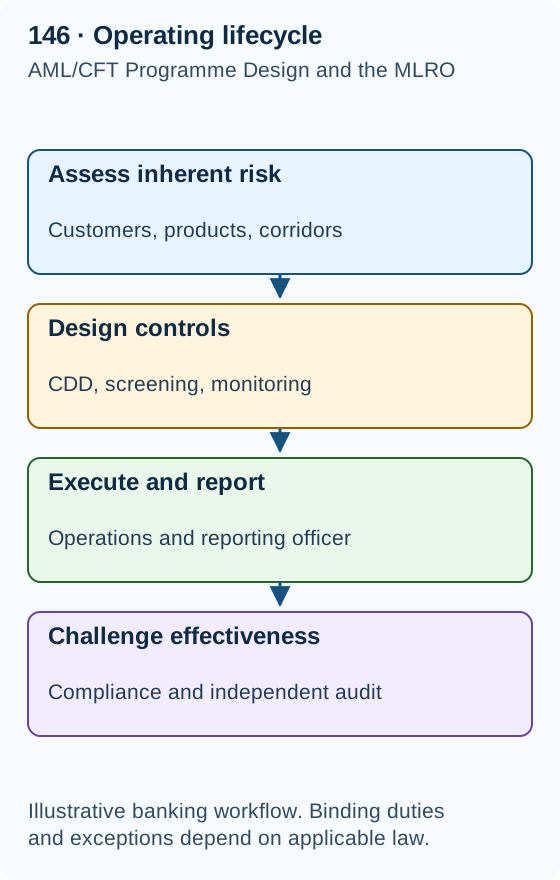
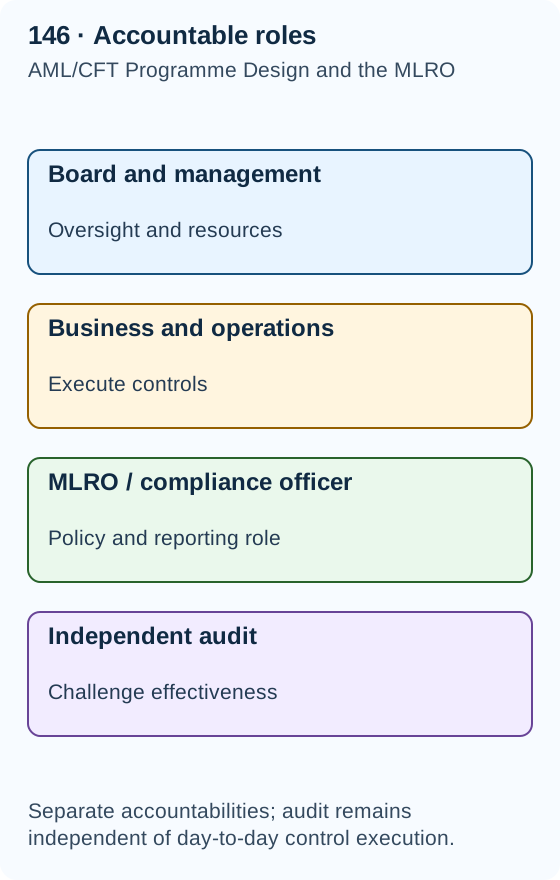
Allocate responsibilities explicitly. Relationship teams collect and challenge customer information; operations execute onboarding, screening and monitoring; compliance sets policy and challenges outcomes; legal interprets powers, restrictions and disclosure gateways; technology and data owners maintain coverage; independent audit tests the system. Give the MLRO timely access to information, appropriate resources and a route to senior management that survives commercial disagreement.
A programme is a connected operating system
The programme joins customer understanding, transaction information, decisions and organisational learning. Customer due diligence establishes who receives a service, who controls the customer and what activity is expected. Screening and monitoring examine relevant events under their own purposes and rules. Investigation tests explanations and material uncertainty. Reporting communicates qualifying suspicion under applicable law. Governance decides how the bank will maintain suitable controls and address weaknesses. Each component depends on information from others, but its outcome remains distinct. A monitoring alert is not a criminal finding, and a filed report is not evidence that customer due diligence was adequate.
The design should make those dependencies visible. A customer profile may support both risk assessment and monitoring, while a payment message supports sanctions decisions and investigation. If ownership information becomes stale, the problem can affect several controls. If payment identifiers are removed during migration, investigations can lose the ability to connect activity to customers. Programme design therefore requires participation from business, operations, technology, data and legal teams. Compliance cannot establish effective coverage through policy wording alone when the relevant information is absent from the operating environment.
Consider a retail bank expanding into services for payment institutions. Its individual-customer controls may be mature, but institutional customers introduce settlement activity, underlying-user visibility, agent networks and correspondent dependencies. The bank must understand the service and risks rather than copy an existing consumer onboarding checklist. The institution's own licence and programme provide useful information but do not answer every question about how the bank's accounts will be used. The programme assessment should identify the bank's responsibilities, information access and escalation conditions before volumes grow beyond the original design.
The MLRO and senior management have different decisions
The title MLRO has a particular meaning in some jurisdictions and should not be treated as a universal job description. For relevant FCA firms, SYSC 6.3 addresses AML systems and controls, senior responsibility and an MLRO with sufficient authority, independence, information and resources. It also describes governance information, including an annual MLRO report in its guidance. A US BSA compliance officer operates under the applicable US framework. Map each appointment to the actual legal entity and requirements rather than assuming that one group title automatically satisfies every local role. FCA SYSC 6.3, FFIEC BSA compliance officer.
The reporting officer may decide whether local suspicion-reporting conditions are met, oversee escalation and challenge the adequacy of the programme. The board and senior management establish oversight, strategic priorities and resources within their responsibilities. Business owners decide how services are offered and ensure their processes operate properly. Those responsibilities should support one another without becoming interchangeable. A board cannot make a reporting duty disappear by accepting commercial risk. Equally, the MLRO should not be expected to personally repair every operational defect or approve every ordinary customer decision.
Authority needs practical expression. The reporting officer should obtain material customer and transaction information, raise concerns directly with appropriate senior management and challenge a proposal despite revenue pressure. That access must coexist with legitimate confidentiality and privilege constraints, which require controlled routes rather than unqualified access to every document. The governance arrangement should record how information limitations are resolved and how unresolved disputes reach a decision maker. An impressive title without effective access, deputies or escalation is weak programme design.
The programme lifecycle
Start by defining the bank's services and exposures. Evaluate customers, beneficial owners, products, delivery channels, geography and transaction patterns. Identify relevant laws, regulatory expectations and internal policy choices. Translate them into controls with owners, scope and evidence. Implement the controls in procedures and systems; train the people whose actions matter. Measure operation, investigate failures and independently test the important conclusions. Feed outcomes back into the assessment when the business or threat environment changes. The cycle should reflect actual events, including acquisitions and new channels, rather than wait automatically for an annual policy review.
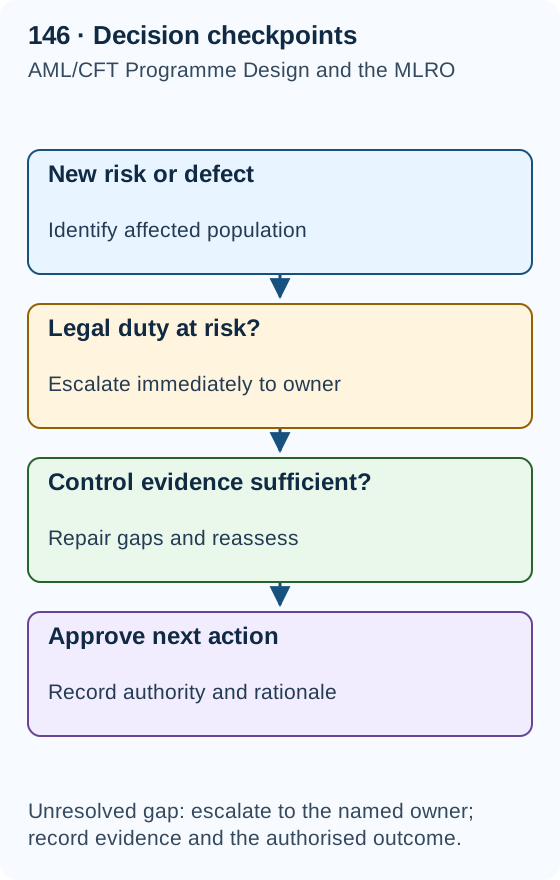
A programme change should have a reasoned impact assessment. Opening a new branch, introducing instant payments or moving customer identification to a partner changes dependencies even if the policy principles remain the same. The business sponsor explains the proposed activity; legal and compliance identify applicable constraints; data and technology explain coverage; operations demonstrates the workflow; the authorised governance body decides readiness. Record material conditions and what happens if they are not satisfied. An approval that depends on a feed arriving later is not equivalent to approval of a fully operational control.
Periodically challenge the programme's assumptions. Customer behaviour can differ from launch forecasts. A product designed for occasional low-value use may become a channel for high-volume transfers. An acquisition can add customer types the bank has not previously understood. New evidence can reveal that a monitoring rule misses a known pattern or that source data cannot support its intended logic. The programme should have routes for recognising these changes and revising controls. Continuing to operate a design because it was approved last year does not establish that it remains suitable today.
Customer treatment is part of effective control
Good controls distinguish unresolved risk from missing paperwork that can be resolved through proportionate alternatives. A customer unable to produce a standard document may have reliable alternative evidence. A complex company may have a legitimate structure with adequate ownership transparency. A customer questioned about a payment may provide an explanation that should be tested rather than dismissed. The bank still meets its applicable obligations, but its procedures should help staff obtain useful information and make appropriate decisions instead of applying indiscriminate barriers. Programme design should consider complaints, vulnerable customers and avoidable friction alongside detection outcomes.
Restrictions require their own authority and implementation. A fraud-protection limit, sanctions freeze, legal restraint and discretionary relationship exit have different purposes and release conditions. A case platform should preserve those distinctions. Multiple restrictions can coexist, so lifting one does not necessarily restore every channel. Customer-facing staff need approved information about operational effects and routes for assistance, while protected reporting details remain restricted. The programme should ensure that legitimate communications about underlying activity are not blocked solely through an overbroad confidentiality label, subject to the actual jurisdictional rules.
An exit is also an operational process. Determine notice, remaining funds, linked products, pending payments, complaints and record retention under the relevant framework. Continue required monitoring and reporting while the relationship remains active. Do not assume that closing an account resolves earlier control weaknesses or replaces a necessary report. A bank should preserve the rationale and evidence for separate decisions so a later reviewer can distinguish commercial risk management from statutory action. That separation protects customers and makes the bank's own conduct easier to assess.
Evidence of a working programme
The strongest evidence connects real populations to real decisions. An onboarding sample can show identity and ownership checks, risk assessment, approvals and unresolved conditions. A monitoring trace can show source activity, rule evaluation, alert handling and case outcome. A reporting trace can show the legal entity, relevant trigger, authorised decision, submission and acknowledgement. An issue record can show containment, affected population, historical review, root-cause repair and independent challenge. Together they establish a working chain rather than a collection of approved documents.
Programme evidence should also show failure handling. A bank that cannot explain rejected records, unavailable feeds, overdue high-risk cases or unsupported overrides has an incomplete picture of effectiveness. Reviewers should see exceptions and the decisions made about them, including limitations that remain open. Assurance should have access to appropriate source populations and challenge selected samples rather than receiving only files prepared to demonstrate success. Senior management should receive the resulting uncertainty in a form that supports decisions about resources, product restrictions and remediation priorities.
The practical objective is an organisation able to explain how its own business is controlled. The programme is credible when a product owner can describe exposure, a control owner can demonstrate coverage, an investigator can reconstruct the facts, a reporting officer can defend the applicable decision and senior management can account for unresolved weaknesses. Documents, dashboards and committees support that objective. Their presence alone does not establish it. The following sections develop the operating, technical and assurance details through concrete banking situations.
From policy to an executable programme
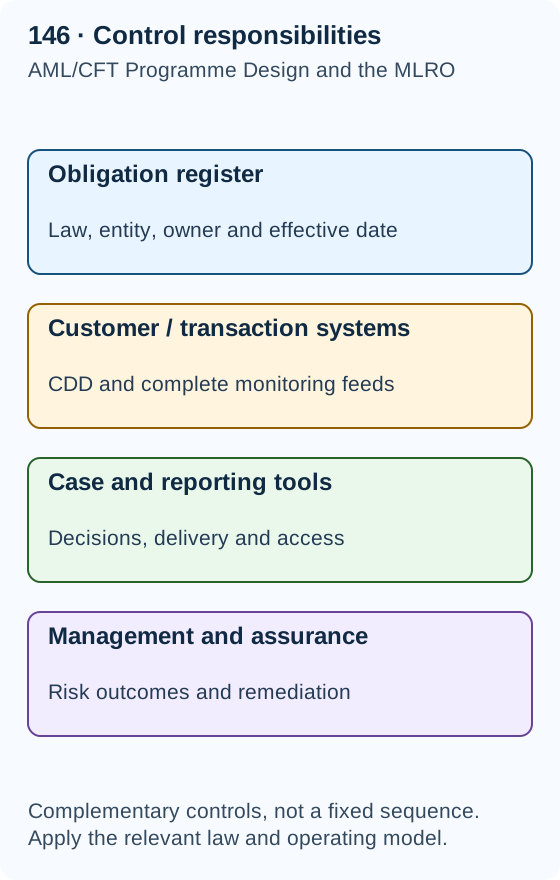
Create an obligation-to-control register. For each applicable requirement identify the legal entity, source and effective date, control owner, system or manual procedure, evidence produced, testing method and escalation route. A policy saying that all payments are monitored is insufficient if an acquired payment platform never reaches the monitoring engine. Reconcile source-system populations against accepted records and investigate exclusions.
Separate reporting decisions from relationship decisions. A suspicious activity report (SAR) or suspicious transaction report (STR) is an intelligence disclosure under local law; it does not automatically direct closure, prove guilt or authorise freezing. The MLRO or designated reporting officer assesses the reporting threshold while the authorised business and control functions decide continuation, restrictions and customer communication within legal limits. Document each rationale separately.
Capacity is a control variable. Measure the age and severity of unreviewed cases, missed data feeds, overdue high-risk reviews and reporting deadlines. A declining alert count after a failed feed is a defect, not improved effectiveness. During outages preserve affected populations, establish temporary controls and approve a recovery plan; restarting the application alone does not recover missed transactions.
Management information should connect risk to outcomes. Pair volumes with sample quality, recurring defects, control coverage and overdue remediation. The board should see what remains unmitigated, who owns it and whether the proposed deadline is credible. Independent testing needs access to failed and closed cases, not only files selected by the control owner.
Design around the bank's actual perimeter
A programme inventory begins with legal entities, licences, establishments and activities, rather than the products appearing on the public website. A deposit-taking entity may serve retail customers directly, maintain settlement accounts for a payment subsidiary and provide treasury services to an overseas branch. Each relationship produces different customer, counterparty and transaction populations. If the assessment considers only named retail customers, the bank can overlook institutions using its infrastructure and the people behind aggregated payment flows. The programme designer asks who receives the service, which entity performs it, where responsibility sits and which data the entity can actually obtain.
Product inventories must also include discontinued products with continuing exposure. A closed mortgage product can still receive repayments; an acquired card portfolio can retain dormant accounts; a legacy trade-finance facility can remain contingent after new issuance stops. Calling a platform legacy does not remove the relevant customer, recordkeeping or reporting duties. The product owner should identify the remaining population, expected run-off, transaction routes and arrangements for monitoring and enquiries. Decommissioning requires a control decision supported by population evidence, not merely a technology cost-saving ticket.
Map delivery channels separately from product names. An account opened through a branch, a remote identification service and an embedded-finance partner can have the same contractual product but very different evidence and control dependencies. Remote onboarding may depend on document authenticity, device signals and identity matching; a branch may depend on staff recognising impersonation and recording identification accurately. An intermediary channel may introduce uncertainty about who collected the information and whether the bank can retrieve it. The risk assessment should describe those differences before the control team decides whether a common workflow is sufficient.
Turn the risk assessment into decisions
An inherent-risk assessment is useful when its conclusions change control design. Suppose a bank identifies rapid growth in small-business accounts receiving third-party marketplace settlements. An annual report that merely adds a higher product score has not addressed the exposure. The programme should identify expected settlement patterns, beneficial-ownership information, onboarding evidence, payment attributes, monitoring coverage, investigator skills and escalation triggers. Some changes may be proportionate and inexpensive, such as preserving marketplace identifiers in the transaction feed. Others may require a business decision about accepting customers whose commercial purpose cannot be explained.
Control effectiveness should be supported by evidence specific to the exposure. A payment-screening system operating successfully on domestic transfers does not establish that correspondent-originated transfers are covered. A high completion rate for annual customer reviews does not establish that ownership changes were recognised. The assessment should distinguish control existence, coverage, correct implementation and effective operation. Where evidence is unavailable, record the limitation and its consequence. Treating an untested control as fully effective can produce an artificially reassuring residual-risk score and suppress the investment that would make the control testable.
Residual risk is not a permission to ignore law. Management may choose a product strategy, additional investigation resources or an interim compensating control within its discretion. It cannot use a risk committee decision to waive a reporting duty, a sanctions prohibition or required customer due diligence. The decision paper should therefore separate legal minimums from discretionary appetite. A proposal may be commercially attractive but unworkable because the required information cannot be obtained. That is a product-design problem to resolve before launch, rather than a score to reduce through optimistic assumptions.
Give control ownership operational meaning
The control owner is accountable for an outcome, not necessarily the person who presses the button. For example, payment operations may execute a reconciliation, technology may maintain the job and a data team may maintain reference mappings. The accountable owner should still know what population is expected, what constitutes failure, who receives exceptions and how completion is demonstrated. A responsibility matrix naming three teams without assigning a decision maker leaves room for each team to believe another accepted the gap. A useful ownership record identifies the accountable person, deputy, execution team, dependencies and escalation authority.
Separate a control from its supporting tasks. Obtaining a report, reviewing totals and sending an email can all be tasks within a completeness control. The control's outcome is confidence that the expected in-scope population reached the relevant decision process, with exclusions explained. A task can complete while that outcome fails. A reconciliation that balances after an entire product feed is accidentally omitted from both sides is a particularly dangerous example. The owner needs an independent source of expected populations rather than two reports generated from the same incomplete staging table.
The MLRO should be able to challenge ownership gaps without becoming the default operator for every failed process. If every data defect is assigned to financial-crime compliance, the organisation can obscure the business and technology decisions that created it. Compliance explains the required outcome, assesses risk and challenges the remediation. The source owner corrects the feed; the product owner explains the population; operations validates handling; assurance checks the result. Escalation should make missing ownership visible to senior management and require a decision, rather than quietly expanding the MLRO's workload.
Resource the reporting function as a critical service
Suspicious-reporting capacity includes investigation, decision, narrative preparation, quality checks, submission and acknowledgement. Counting analysts alone ignores bottlenecks in authorised approval, specialist review or filing-channel access. A bank with thirty investigators and one reporting officer may be vulnerable when that officer is absent. The operating model needs authorised deputies, controlled access, clear handover and coverage for urgent cases. The deputy should understand the applicable decision threshold and reporting process; a generic operations substitute cannot safely exercise powers simply because a deadline is approaching.
Distinguish operational service targets from legal filing clocks. An internal target to begin reviewing an alert does not determine when local law requires a report. A case can meet a legal threshold before every investigation question is resolved. The workflow should preserve the relevant trigger and allow submission using the facts available, followed by further action where appropriate. Reassignment, merging, reopening or waiting for a commercial stakeholder should not silently reset the legal clock. The MLRO needs reports showing threshold-met cases awaiting submission, failed filings and urgent decisions, not only average case age.
Review confidentiality as part of staffing and technology design. Reporting staff may require protected access beyond ordinary customer-service permissions. Deputies need that access before an emergency, but general managers do not automatically need copies of reports to supervise capacity. A dashboard can show workload, deadlines and unresolved issues without exposing report existence broadly. The September 2026 US clarification permits communication about underlying facts within applicable boundaries; it does not remove protection of SARs or their existence. A global bank should avoid translating that jurisdiction-specific clarification into unrestricted visibility across its group.
Training that changes behaviour
Training should connect to the decisions a role actually makes. A relationship manager needs to recognise inconsistent business explanations, capture useful facts and route concerns without making unsupported accusations. A payment-repair analyst needs to understand which missing identifiers may be corrected from reliable sources and which require escalation. An investigator needs to distinguish an alert from suspicion and preserve contradictory evidence. A senior product sponsor needs to understand why launching a product before data coverage is established can undermine the entire programme. Giving each role the same slide deck produces attendance evidence with uncertain operational value.
Assess effectiveness through realistic tasks and subsequent quality evidence. A staff member may answer a definition correctly but still fail to attach the relevant source document to a referral. A useful learning assessment presents a realistic payment or customer change and asks what information is needed, who decides and which action follows. Later quality reviews can identify whether the trained population applies the procedure. Results should feed back into process design: repeated errors may reflect a confusing interface or contradictory procedure rather than a lack of effort. Training alone is an inadequate repair for a broken workflow.
Maintain training populations as carefully as customer populations. Staff join, change roles, move between entities, become contractors and leave. The learning system needs reliable role and entity mapping so material training reaches the right people. A completion metric based on last year's staff list can conceal untrained new teams. Exceptions such as prolonged leave or temporary assignment should have an owner and appropriate return-to-work handling. Preserve the relevant content version so later reviewers can establish what staff were taught when an incident occurred, rather than projecting today's procedure into the past.
Incident response and continuing operation
A programme incident can occur without an identified suspicious customer. Missing transaction data, compromised case access, incorrect deadline calculation or unauthorised changes to screening configuration can impair controls across an entire population. The response starts by defining the affected control and exposure window. Technology restores service, but the programme owner determines whether missed transactions require replay, open cases require reassessment or reports require correction. Keep recovery of the application separate from recovery of the control outcome. A green system-health indicator is insufficient evidence that historical gaps have been addressed.
Containment should be proportionate and authorised. During a failed monitoring feed, the bank might reconcile and manually review a defined high-risk population while preparing replay. That arrangement needs volume estimates, staffing, decision rights and a clear limit on duration. An undocumented instruction to be extra vigilant gives no assurance that the affected population will be covered. Where an incident creates potential legal breaches, the local responsible functions assess notification obligations and escalation. Commercial teams should receive enough operational information to manage customer impact without receiving protected reporting or investigation details unnecessarily.
The senior escalation paper should state what is known, what remains uncertain, what customer population is exposed and what decision is required. It should distinguish an interim control already operating from one merely proposed. Include the risk of delaying remediation and the consequences of stopping an affected service. Management needs a practical choice, such as funding reconciliation capacity, pausing a migration or restricting an unsupported product route. A paper that reports a serious incident but asks for no decision can become a record of awareness without evidence of responsible action.
The MLRO report as an argument supported by evidence
An effective report explains whether the programme is suitable for the bank that currently exists. It should connect changes in customers, products, geography and delivery channels to control capability. A bank entering new payment corridors needs evidence that customer understanding, data, monitoring, investigation and reporting arrangements support that exposure. Present limits explicitly: unresolved feed gaps, uncertain coverage, overdue high-risk reviews, repeated quality errors and resource constraints. The report should make clear which conclusions are supported by testing and which depend on assumptions still awaiting validation.
Balance aggregate measures with segments and examples. Average case ageing can look acceptable while a small high-severity queue deteriorates. Overall customer-review completion can conceal weak coverage in an acquired business. A useful report includes relevant distribution, severity and trend, together with a short explanation of material changes. The board should be able to distinguish genuine risk reduction from a change in rule thresholds, source populations or reporting definitions. Include decisions from previous meetings and evidence of their completion so accountability survives the reporting cycle.
Keep the report itself governed. Store the approved version, source extracts, relevant dates, assumptions and challenge received. If a metric is corrected later, preserve the earlier statement and explain the correction. The objective is reliable oversight, not a permanently polished historical record. A candid report that identifies a limitation and obtains an appropriate decision is stronger than an apparently flawless report contradicted by operational evidence. The MLRO's independence becomes meaningful when uncomfortable findings reach the people who can change priorities and resources.
Programme assurance and defensible exceptions
Test a customer from source record to decision: identity and ownership data, risk assessment, screening result, monitoring coverage, investigation, reporting decision and retained evidence. Then reverse the test by selecting an alert and tracing it back to the complete source population. This detects both missing customers and unreliable decisions.
An exception needs a defined population, reason, approving authority, compensating control, expiry and review trigger. A business sponsor's approval cannot waive a legal duty. If staff lack evidence required to complete due diligence, follow the applicable restrictions and consider reporting; an exception register is not a licence to onboard indefinitely.
Keep independent audit distinct from daily quality assurance. Quality assurance improves operational decisions; audit challenges the design and effectiveness of the programme. Closing a remediation issue requires evidence that the defect was fixed and that affected historical cases were considered. A new procedure signed by management is only one part of that evidence.
Programme architecture: connect obligations to executable controls
A programme register should distinguish an obligation, a policy decision, a control and an implementation. An obligation identifies a requirement applicable to an entity and activity. A policy expresses how the bank will meet that requirement and what additional standards it chooses. A control states the intended preventative or detective outcome. An implementation names the process, rule, system or manual action that delivers it. Keeping these concepts separate prevents a common mistake: declaring a requirement satisfied because an approved policy exists, even though the relevant transaction population never enters the system implementing it.
Use stable identifiers across those layers. A local suspicious-reporting obligation can link to a policy section, several case-workflow controls and the filing integration used by that entity. A change in the authority's submission format should identify the integration and validation rules requiring revision without forcing unrelated policy changes. A change in reporting scope may affect customer classification, source feeds, decision rules and staff procedures. The register should support both directions: from a requirement to its evidence and from a production defect to the requirements potentially affected.
Keep scope explicit enough to test. Descriptions such as monitor all customers are difficult to reconcile with systems. A more operational statement defines legal entities, account populations, product events, source platforms, exclusions and effective dates. The control can then compare expected input with accepted records and identify exceptions. Where a control intentionally excludes a product because another control covers it, record the alternate control and evidence. Exclusions inherited from old architecture should be challenged rather than accepted as permanent facts. The register is a model of actual coverage, not a catalogue of aspirations.
Build a programme data model
The core objects include legal entity, establishment, product, customer population, obligation, control, implementation, owner, evidence object, finding, action and decision. Relationships matter as much as attributes. A product can be operated by several entities; one source feed can support screening and monitoring; one issue can affect several controls. A flat spreadsheet with one row per policy paragraph may be sufficient for a small initial inventory but becomes fragile when dependencies multiply. Whatever technology is chosen, the model should preserve those relationships without requiring users to duplicate facts across disconnected records.
Dates need distinct meanings. An obligation's publication date, application date and local implementation date are not interchangeable. A control's approval, deployment, first successful operation and retirement can also differ. An action marked complete on the day software was released may still await replay and effectiveness testing. Store event dates and knowledge dates where historical reconstruction matters. Later reviewers should be able to establish what the bank knew at a decision, what law or policy applied then and what evidence appeared afterward. Overwriting a current row cannot support that reconstruction.
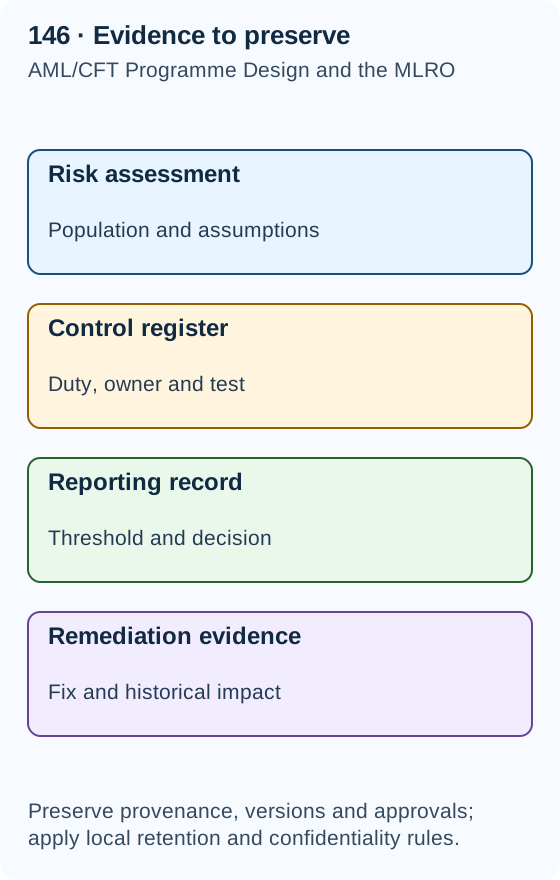
Evidence objects need provenance and controlled access. Identify the producing system, extraction parameters, population, time range, version and accountable owner. A graph showing a control as effective should link to the test or operational evidence supporting that state. Do not treat a screenshot as a substitute for population data when completeness is the issue. Conversely, a technical log does not establish that the business decision was sound. The evidence model should accommodate different forms while retaining enough context to assess their meaning and reliability.
Design management information that resists misleading success
Every metric should state its numerator, denominator, period, population and treatment of exclusions. Consider overdue high-risk reviews. A denominator containing only reviews created by the workflow may omit customers whose reviews were never scheduled. A stronger measure reconciles the customer population requiring review to the review tasks and reports missing tasks separately. The same principle applies to monitoring alerts, payment screening and reporting. Metrics should expose absent work, rather than describe only the work the system managed to create.
Use paired measures to interpret performance. Case throughput needs quality and severity context; alert reduction needs population and parameter-change context; filing timeliness needs rejection and acknowledgement context. A queue can improve because analysts close cases faster, because fewer events enter it or because the bank changes what counts as open. Those explanations have different risk implications. Management information should retain definition changes and show when a trend spans different calculation methods. A visually smooth chart can conceal a discontinuity that senior management needs to understand.
Automated dashboards should have data-quality controls. Check expected arrival, freshness, entity mapping and totals before publishing. A dashboard last refreshed three days ago should not present current status without a warning. Missing entity data should remain visible as missing; replacing it with zero implies no exposure. Preserve approved snapshots used by committees so later investigations can assess decisions against the information presented. The dashboard owner should have an escalation route when a source cannot be trusted, rather than feeling obliged to publish a reassuring number on schedule.
Acceptance criteria for responsibility and independence
When a material control is created, the system should require an accountable owner, execution responsibility, relevant scope and evidence expectation before it can be marked operational. When an owner leaves or changes role, the affected controls should enter a reassignment process with a named interim owner. An email address remaining in a database after its holder leaves is not continuity of accountability. Test owner transitions using real dependencies, including committee reporting and incident escalation, rather than merely checking that a new name appears on the register.
A design should prevent control operators from approving their own independent assurance conclusion. This does not mean designers cannot supply evidence or participate in testing. It means the conclusion and closure authority have appropriate independence for the question being answered. Record conflicts, scope limitations and the challenge process. For a small bank, independence may be achieved through an appropriate external or separate internal arrangement rather than a large dedicated department. The required arrangement follows the applicable framework and risk; a particular organisational chart is not a universal rule.
Commercial escalation should preserve the control recommendation. If a business sponsor disagrees with a proposed restriction, the record should show the facts, recommendation, disagreement, authority of the final decision maker and permitted outcome. Mandatory legal requirements remain outside discretionary acceptance. Access controls should prevent ordinary business users from rewriting an investigator's reasoning or deleting adverse evidence. A well-governed override is visible and reviewable; an informal instruction delivered through a private message is difficult to challenge or reconstruct.
Test completeness using independent expected populations
A meaningful test starts with a source the control cannot silently omit. For monitoring, compare a independently established transaction population with accepted input, not two tables populated by the same interface. Seed missing product codes, duplicate identifiers, invalid dates and unrecognised legal entities. Verify that failures create actionable exceptions with a defined owner. A job reporting success after rejecting thousands of records is a control failure unless the rejects are reconciled and appropriately resolved. The objective is coverage, not merely absence of application errors.
Follow a sample event through each dependency. Start with a genuine source transaction, identify the normalisation and enrichment steps, confirm rule evaluation, inspect the resulting alert or justified non-alert outcome and trace any investigation or report. Preserve identifiers through corrections and retries. A system that assigns a new identifier at every stage without a relationship table makes reconstruction unnecessarily difficult. Test both scheduled and event-driven processing, because a population may be covered in overnight batches while urgent real-time paths bypass the intended controls.
Test historical replay separately from current operation. Replaying a missed month with today's customer profile or scenario version may answer a current risk question but cannot automatically reconstruct what should have happened at the time. Specify the purpose of replay, available historical data and treatment of missing versions. Where current knowledge is deliberately used to identify continuing concern, label it accordingly. Assurance should challenge whether the chosen method is fit for that purpose rather than requiring an impossible reconstruction without examining the available evidence.
Capacity, resilience and access tests
Simulate a reporting-officer absence during a high-volume period. Confirm that authorised deputies can obtain evidence, make the relevant decisions and use submission channels within applicable deadlines. The test should include failed credentials, unavailable supporting staff and an urgent case requiring specialist input. Merely proving that another person can log in is insufficient. The bank needs an operational handover, escalation contacts and preserved decision authority. Capacity forecasts should include complexity and rework, because equal case counts can represent very different investigation effort.
Simulate a case-platform outage with open threshold-met cases. The temporary process should preserve deadlines, access boundaries, decisions, submission attempts and later reconciliation into the main system. Avoid spreading protected information through unrestricted spreadsheets or shared drives. Determine how duplicates, rejected submissions and incomplete acknowledgements will be identified during recovery. The resilience test should end only after operational records reconcile and material exceptions have owners; restarting servers is an intermediate milestone. Customer communications need a truthful approved route even while the normal workflow is unavailable.
Test information access across surrounding systems. Search, exports, notifications, analytics, support tools and backups can expose sensitive information even when the main case screen is protected. Role changes should revoke obsolete access promptly according to the bank's control design. Emergency access needs an approved purpose, limited duration and retrospective review. Audit records should establish who accessed or exported protected material without unnecessarily reproducing its content. The programme should distinguish legitimate authorised sharing from leakage; simply preventing all access can make investigation and oversight ineffective.
Assurance findings that lead to a defensible closure
A finding should describe the failed outcome, affected population and evidence, rather than only a control label. Monitoring incomplete is less useful than identifying which feed, entity, period and transaction types were absent. The action plan should address immediate containment, historical impact, root cause and continuing effectiveness. Link actions to owners with authority over the relevant systems or processes. An assurance finding assigned entirely to the MLRO can remain unresolved if the underlying product or data owner has no committed work. Senior management should see that dependency explicitly.
Closure requires evidence appropriate to each component. Deployment evidence establishes that a change occurred. Reconciliation establishes coverage of a population. Case review establishes whether previously missed activity was assessed appropriately. A sustained operational sample helps establish that the repaired control works over time. These are different questions, and one successful test cannot automatically answer them all. If a component remains incomplete, preserve it as an open action or an explicitly governed residual issue rather than using an overall green status to hide it.
The independent reviewer should retain scope limitations. A vendor may refuse access to source logic, a historical archive may be incomplete or a local privacy restriction may limit customer-level review. Those facts affect the strength of the conclusion. Seek controlled alternatives such as on-site review, appropriately redacted evidence or independently produced aggregate reconciliations. If no adequate alternative exists, the programme owner and senior management need to understand the remaining uncertainty. Assurance adds value by defining what is demonstrated and what remains unresolved, rather than transforming incomplete access into unwarranted confidence.
Worked programme case
A fictional bank launches a cross-border wallet through a partner. The partner's onboarding dashboard shows all customers approved, but the bank receives only monthly totals and no individual ownership or transaction records. The MLRO should establish what the bank legally needs, identify the missing populations, escalate the launch condition and require accessible evidence before relying on the dashboard.
Explain which controls need customer-level information, who can approve residual commercial risk, and which statutory duties cannot be waived. A sound answer separates the partner's service assurance from the bank's own due diligence, screening, monitoring and reporting responsibilities.
Programme review: challenge the decision, not just the document
A reviewer should distinguish an incomplete assessment from an assessment containing an uncomfortable conclusion. If the bank's business model depends on information a partner cannot lawfully provide, the problem may be the proposed service rather than missing wording. Ask what decision the assessment supports and which evidence could change it. A policy update is appropriate when the intended standard is unclear. A source-data repair is appropriate when the standard is sound but the information does not reach the control. Additional staff are appropriate when a credible process cannot handle the population. Those repairs are not substitutes for one another.
Consider a new high-volume merchant segment. The product team proposes increasing monitoring thresholds to keep alerts within current staffing. A reviewer should ask whether the original threshold has a sound risk basis, whether data quality causes avoidable noise and whether investigator capacity matches the forecast. Capacity is relevant to service design, but it should not silently become the detection objective. Possible decisions include segment-specific logic, better enrichment, staged onboarding or additional resources. The approval should explain why the selected approach addresses the exposure rather than presenting reduced alert counts as proof of improved effectiveness.
An ownership problem disguised as an overdue action
An action register shows a transaction-reconciliation repair as six weeks overdue. The listed owner is the MLRO, while the actual mapping change belongs to a platform team funded by another business. The team has no allocated capacity and the product sponsor regards reconciliation as a compliance enhancement. The reviewer should trace why the action lacks a committed delivery owner and what operational risk exists meanwhile. Reassigning the due date without changing authority, resources or containment does not resolve the problem. Senior escalation should make the dependency and required decision explicit.
A defensible action plan assigns the mapping repair to the accountable source or platform owner, the population validation to the relevant operations or data owner and risk assessment to financial-crime compliance. It states the interim control and its limitations. Management decides resources or service restrictions within its authority. The MLRO remains involved in challenge and oversight but is not represented as personally implementing the interface. Review the resulting evidence at each milestone. A successful code release, reconciled historical population and effective ongoing exception handling are different deliverables with different reviewers.
A reporting deputy who exists only on paper
The programme identifies a deputy reporting officer but has never tested the arrangement. When the primary officer is unexpectedly unavailable, the deputy cannot submit through the filing channel and does not know which urgent cases have reached the relevant threshold. An effective review treats this as a continuity weakness, not a clerical access request. Examine credential readiness, decision authority, case handover, supporting staff and escalation contacts. Confirm which filing obligations could be affected and preserve the real trigger dates while resolving the operational problem.
The repair should include a controlled rehearsal using fictional records and the approved submission-testing environment where available. Test primary-person absence, rejected submission, missing acknowledgement and an urgent specialist question. Ensure temporary access is appropriate and does not expose protected information to an unrestricted helpdesk. Record whether the deputy can complete the process, not merely open the application. Periodically reconsider coverage when personnel, systems or local reporting requirements change. A deputy named years earlier may no longer have the role, training or access the arrangement assumes.
A committee whose minutes conceal disagreement
A committee approves expansion into a new corridor after compliance recommends postponement pending counterparty-data testing. The minutes record unanimous approval because the chair wants a concise record. The problem is not the absence of lengthy minutes; it is loss of the material recommendation, uncertainty and conditions. The governance record should explain the facts considered, the authority of the final decision maker and the reasons for the chosen lawful outcome. If the decision relies on an interim control, identify its owner, duration, capacity and evidence requirement. Dissent and challenge can be preserved concisely.
The reviewer should also determine whether committee approval has operational effect. A condition requiring a working feed before launch should link to the deployment or release gate. If the product can launch while the condition remains open, the minutes alone do not prevent exposure. Test how the system records conditional readiness, who confirms satisfaction and what happens when evidence is disputed. An executive sponsor should not be able to reinterpret an unmet mandatory requirement as an acceptable delay merely because the committee discussed commercial urgency.
A training success that fails in customer contact
All relevant staff complete an awareness module, yet referrals repeatedly omit transaction identifiers and attach unrelated account statements. The training metric is accurate but insufficient. Review whether the module teaches the task, whether the referral form asks understandable questions and whether staff can access the needed information. A short practical example can demonstrate how to describe observed facts without asserting guilt. Feedback should reach the originating teams in a form that improves future referrals without exposing protected reporting decisions unnecessarily.
Customer-contact quality also matters. Staff should use truthful approved explanations for legitimate information requests and operational reviews, while respecting local confidentiality boundaries. A procedure that tells staff never to discuss anything connected to suspicious activity can obstruct useful enquiry and create misleading customer messages. A procedure allowing staff to reveal report existence can breach protections. The programme needs an appropriately scoped communication model with escalation for uncertainty. Assess actual messages, scripts and complaints; policy language may be correct while frontline behaviour differs.
A control that works today but cannot be reconstructed tomorrow
A bank proves current monitoring coverage but retains neither historical configuration nor source-to-rule lineage. Six months later, an examination asks why a defined event did not create an alert. The current rule cannot answer what happened under the previous version. A programme review should identify which changes need effective-dated records and what evidence supports retrospective analysis. Retain the relevant configuration, approval, deployment and testing records under the applicable retention arrangements. Preserve material source identifiers and mapping history so conclusions can be related to the population that actually existed.
Reconstruction does not require retaining every possible data element indefinitely. Classify records, determine applicable periods and triggers, apply holds and use controlled disposal. The programme owner should understand the dependencies before platforms or contracts are retired. A vendor migration may preserve case narratives while losing the attachments supporting them. Acceptance should reconcile both content and lineage. Where historical evidence is irretrievably limited, record that limitation and assess its effect rather than manufacturing certainty from current-state information.
The final approval question
Before programme sign-off, identify the material exposures the bank cannot yet demonstrate it controls. State which obligations are met, which conclusions depend on tested evidence and which assumptions remain open. Confirm that accountable owners and deputies can perform the required decisions, that exceptions reach appropriate senior management and that customer impacts have an authorised route. A credible conclusion can contain limitations and a concrete remediation plan. The conclusion becomes unreliable when unresolved legal requirements, missing populations or unsupported control-effectiveness claims are disguised by completion percentages and reassuring labels.
Delivery hand-offs and acceptance evidence
Before a product change, business analysts map new customer and transaction populations; data engineers prove feed completeness; developers preserve decision history; operations demonstrate usable exception queues; compliance checks obligation coverage; legal confirms disclosure and restriction powers. The product owner coordinates readiness but does not substitute for each control owner's sign-off.
Acceptance evidence includes population reconciliation, negative tests for missing identifiers, access-control tests for reporting records, case ageing under peak load and a recovery rehearsal after a feed failure. Use fictional records with expected results agreed before execution. When an expected escalation fails, record the population at risk and the corrective action rather than changing the test expectation to match the software.
The programme is effective when its owners can explain how actual risk is controlled and show the evidence. An organisation chart, an annual training completion percentage and a long policy manual cannot establish that by themselves.
Meridian's wallet launch: a programme decision under pressure
This fictional case illustrates programme design and escalation. Meridian Bank provides deposit accounts and domestic payment services. Its UK subsidiary plans to offer settlement accounts supporting a cross-border wallet distributed by Horizon, an external partner. Horizon supplies the customer-facing app and performs several onboarding tasks. Meridian holds settlement funds and executes agreed payments. The arrangement is initially described as a technology partnership. That description does not determine which entity has customer relationships, what services are regulated or which party is responsible for particular controls. The programme team needs the actual operating model before assessing readiness.
The business forecast expects twenty thousand users in the first quarter, mostly individuals sending funds to family. The proposed settlement account belongs to Horizon, while the app maintains user balances internally. Some users are small sole-trader businesses. The payment gateway sends Meridian a batch containing account number, payment amount, currency and a partner reference. Recipient names appear in a separate report available to Horizon. Meridian's existing monitoring expects a bank customer identifier and structured counterparty data. The proposed interface does not yet supply a stable user identifier linked to those attributes.
The product paper says that Horizon conducts identity checks and that Meridian will rely on the partner's monthly assurance report. The MLRO asks which functions are outsourced, whether any legally permitted reliance is proposed, which due-diligence elements Meridian must perform and what information Meridian can retrieve. Legal reviews the contractual service and entity perimeter. Compliance reviews the customer-risk model. Operations maps actual payment paths. The first lesson is that a vendor's assurance statement cannot replace defining the bank's own obligations and risk exposure. The contract's commercial label is insufficient evidence.
The readiness review finds a population gap
Data engineers run a controlled pilot with 1,200 fictional wallet payments. The partner's file contains 1,200 rows and the gateway accepts 1,200, so the initial technical reconciliation balances. Monitoring, however, evaluates only 940 rows. The remaining 260 use a partner transaction code absent from the mapping table. The interface records them as successfully delivered because transport succeeded; the monitoring process classifies them as non-eligible. The technical test therefore answers a different question from the programme's coverage test. A green interface does not demonstrate that all in-scope payments received risk evaluation.
An independent expected-population extract reveals the exclusions. The control owner traces the unmapped code to expedited refunds and wallet-to-wallet settlement adjustments. Some are operational corrections, but others can move value between users. The programme does not assume that every excluded event requires the same monitoring treatment. The product team explains the event semantics, compliance identifies the risk question and monitoring specialists determine appropriate coverage. Deliberate exclusions need a recorded reason and an alternate control where necessary. Simply renaming the code so that the job accepts it would not establish that the rule logic fits the event.
The pilot also identifies weak user linkage. Horizon recycles a short reference after a user closes an account. Two different users can therefore appear to be one person in a historical analysis. The bank asks for an immutable partner-user identifier, its relationship to legal identity and controls around changes. The data team proposes retaining source references while assigning a bank-side relationship identifier. The customer-facing reference can still change, but the evidence chain must preserve who performed each event. An identifier designed for display is not automatically suitable for investigation.
The MLRO's escalation separates three decisions
The commercial sponsor wants launch to proceed because marketing has already announced a date. The MLRO submits a decision paper identifying the legal-perimeter work, population gap and evidence-access limitations. The paper does not claim that every wallet user is suspicious. It explains why Meridian cannot yet demonstrate appropriate controls over the proposed activity. It requests a launch decision, specific data changes and resources for operational testing. The MLRO's reporting responsibility remains separate from the commercial readiness decision; there is no reportable customer case merely because the programme design is weak.
Legal identifies information the bank needs under its applicable arrangements and the conditions for lawful disclosure from Horizon. The product owner defines a limited initial service with lower operational complexity. Monitoring specialists assess whether temporary review can cover that limited population credibly. Senior management can decide to postpone or restrict the launch within its authority, but cannot waive a mandatory requirement. The committee minutes preserve compliance's recommendation and the basis for the final decision. They also distinguish requirements that must be satisfied before launch from improvements that can follow under an approved, time-limited plan.
The committee postpones general launch and authorises another controlled pilot. It requires stable identity linkage, defined transaction semantics, accessible supporting evidence, reconciliation of all relevant routes and demonstrated investigation handling. Marketing receives an approved customer communication explaining the delay without asserting misconduct by users or the partner. Horizon receives a precise requirement list rather than an instruction to provide more assurance. Each condition names an owner and an acceptance measure. The decision is concrete enough that a later readiness meeting can determine whether the conditions have been met.
A case tests whether the programme can work
During the second pilot, investigators receive a scenario containing multiple users sending funds to the same recipient shortly after wallet funding. The amounts are not individually remarkable. The synthetic pattern is designed to test whether Meridian can connect activity across partner-user identifiers and obtain information supporting a plausible explanation. Horizon initially provides a summary stating that all users passed onboarding. The investigator asks for relevant identity information, funding context and the original data underlying the linked activity. Passing onboarding does not answer the transaction question, and the bank should not treat a general certification as case evidence.
Horizon supplies records through the controlled route. One apparent user cluster is explained by a shared household using a common recipient. Another reflects a duplicate identifier caused by a partner migration. A third remains unexplained because several user files lack expected funding context. The investigators preserve these different findings rather than closing or escalating the whole cluster uniformly. The MLRO's team reviews any applicable suspicion-reporting question using available facts and local law. The product team addresses the migration defect. The programme owner records a data-quality issue. The same test can reveal several distinct outcomes.
The exercise exposes a practical access problem. Only one Meridian investigator can open the partner evidence portal, and that person is on leave during the test. The deputy has case access but no partner credentials. The team resolves the immediate access through an authorised process and adds a continuity requirement. The case should not wait indefinitely for a named individual if a legal reporting clock has started. Capacity and resilience are therefore part of programme design, not administrative details to address after launch. The follow-up test includes absence of the primary investigator and failure of the evidence portal.
Early production reveals a misleading improvement
After controlled readiness approval, the service launches in a limited form. Six weeks later, dashboard alert volumes fall by forty percent. The commercial sponsor regards this as evidence of a low-risk customer population. The monitoring owner checks volume denominators and discovers that a weekend feed failed. The alert reduction is a coverage problem. Source payments continued, but a subset did not reach monitoring. The bank identifies the affected period, preserves source records and establishes an authorised temporary review for the defined exposure while engineers restore the interface. The incident is escalated through the programme route.
The recovery plan separates service restoration from historical coverage. Restored daily processing begins operating correctly, but the missed weekend remains unresolved. Engineers build a replay population with original identifiers and source dates. Monitoring specialists state which rule version and customer information the replay will use. Investigators review relevant results, and reporting officers assess any resulting reporting decisions under local rules. The case team records the limitations of reconstructing historical partner data. The issue cannot close simply because the current dashboard is green. The historical population and decisions need reconciliation.
Customer impact is reviewed separately. The bank considers whether temporary restrictions are authorised and proportionate for individual cases, rather than blocking every wallet user because a feed failed. Customer-service staff receive approved instructions about operational delays and assistance routes. They do not receive unrestricted reporting indicators. Any continuing legal restriction retains its own release authority. The incident review includes complaints and cases where duplicate identifiers caused unnecessary enquiry. Repairing a control should improve both coverage and the accuracy of customer treatment, not create a blanket response unsupported by the facts.
Independent review tests the closure claim
The independent reviewer does not begin with the issue owner's selected successful records. It obtains the agreed expected population, accepted current feed, replay population, exception inventory and relevant case outcomes. It checks that the expedited transaction codes now receive the intended treatment and that the stable user identifier survives corrections and account closure. It samples explained as well as escalated activity. It tests whether a new code creates an actionable exception instead of silently becoming non-eligible. The closure conclusion concerns specified outcomes, not a general declaration that the partner arrangement is safe.
The review finds one remaining gap: the partner's evidence portal retains attachments for less time than Meridian's required case-evidence arrangement. The contract promises access, but the technical retention setting does not support it. Legal, records management and the partner owner agree a controlled evidence-retention process with appropriate access and purpose limits. The relevant records are verified before the old access path is retired. The issue remains partially open until that population is reconciled. A contractual promise without operational evidence would leave the investigation chain dependent on future cooperation that may not be possible.
The MLRO's next governance report presents the original readiness findings, the production incident, the historical review and the remaining retention issue. It explains how the programme assessment changed and which assumptions were tested. Senior management approves continuing resources and revised expansion conditions. The committee does not infer readiness for every new corridor from success in the limited pilot. Each material change still needs an impact assessment. The programme has improved because evidence altered decisions and responsibilities, not because Meridian produced a longer policy or declared the launch successful.
References and further reading
Reviewed 2 October 2026. FATF provides international standards; applicable national law determines binding duties. The operating examples are fictional teaching cases.
-
FATF Recommendations, updated June 2026 — relevant anchors: 18; also 1, 10, 20 and 21.
-
FCA SYSC 6.3 Financial crime — UK MLRO systems-and-controls responsibilities, authority and resources.
-
FinCEN September 2026 SAR-confidentiality customer-communication clarification — US communication boundary; SAR existence remains protected.