Unit Economics
Acquisition cost, lifetime value, loss rate, servicing and contribution
Choose the unit before calculating
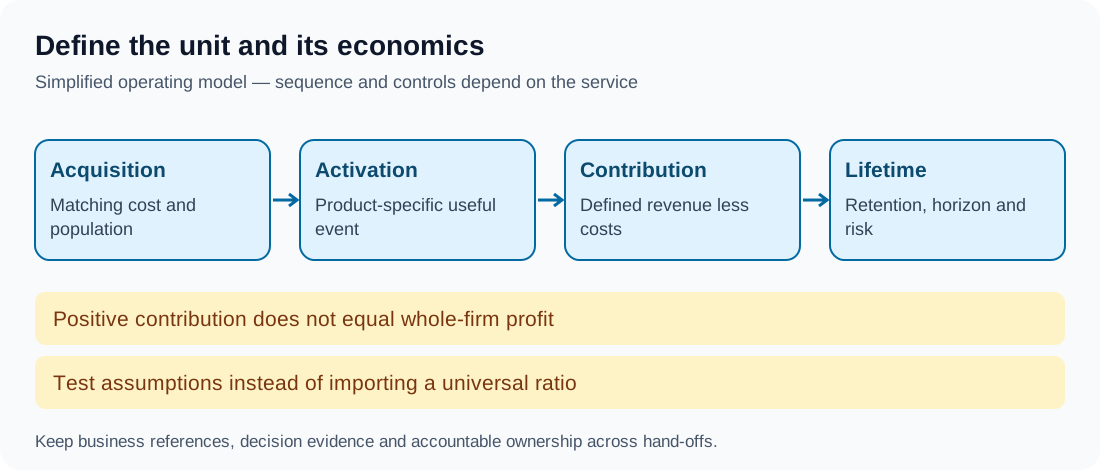
Unit economics evaluates the economic result of a defined customer, account, loan, payment or service cohort. The unit should match the question. A per-payment margin does not establish customer profitability if the customer also generates acquisition and support costs.
Define the time period, revenue, included costs, customer state and allocation method. Keep definitions stable or explain changes. Marketing leads, opened accounts, funded accounts and active customers are different denominators.
Acquisition and activation
Customer acquisition cost (CAC) is the acquisition cost included under the stated method divided by the matching acquired population. Include relevant campaigns, incentives, partner commissions and onboarding effort when assessing the full cost. Distinguish acquisition expenditure from its statutory accounting treatment.
In a fictional campaign, 20,000 currency units produces 1,000 opened accounts and 400 customers meeting the defined funded-account activation event. Cost per opening is 20; cost per activated customer is 50 using the same cost pool. Both can be valid metrics if labelled, but neither may silently substitute for the other.
Activation depends on the product. There is no universal third-transaction rule for a platform or first-repayment rule for every loan. Define the meaningful event and track later behaviour rather than choosing the denominator that looks cheapest.
Contribution after relevant costs
Contribution is a management measure, not one universally defined accounting subtotal. Specify the revenue less costs included. Payment processing, rewards, support, fraud losses, funding and expected credit loss may be relevant, depending on the product and purpose.
For a fictional active account, monthly revenue of 8 less processing cost of 1, allocated servicing of 2 and other relevant variable cost of 1 gives a contribution of 4 under that definition. It does not establish whole-firm profit: technology, compliance, resilience and other fixed or step costs still need funding.
Avoid double counting realised losses and provisions, or combining annual risk estimates with monthly revenue without conversion. Forecast expected risk cost and reconcile actual emergence. The applicable accounting framework, such as IFRS 9, determines statutory impairment where in scope; a managerial risk estimate does not replace it.
Lifetime value and payback
Lifetime value (LTV) estimates future economic contribution over an explicit horizon using retention, behaviour, margin and relevant discounting assumptions. It is uncertain. A simple contribution-divided-by-churn shortcut can be misleading when margins, customer behaviour or churn vary, particularly in lending and new products.
Payback occurs when cumulative contribution under the selected definition recovers the acquisition cost. The timing of cash, losses and refunds matters. A cohort can show positive current contribution while taking years to recover CAC, or run out of cash before accounting payback.
Do not prescribe a universal LTV-to-CAC ratio. Product life, capital intensity, funding conditions and estimate uncertainty differ. Show downside scenarios rather than importing a benchmark from an unrelated software business.
Cohorts and cost allocation
Compare customers by acquisition period, channel and relevant product use. Early adopters may differ from later campaigns; that is a hypothesis to test, not a universal deterioration rule. Track retention, loss emergence, contact reasons and contribution through comparable ages.
Allocate shared costs with documented drivers where useful, while distinguishing marginal economics from fully allocated economics. Average support cost can conceal a small group requiring complex case work. Improving automation may reduce some costs while creating new exception or assurance work.
Review and takeaway
Reconcile counts and money to authoritative source records. Explain forecast-to-actual differences, excluded costs and sensitivity to retention, rates, losses and workload. Keep profitable cohorts from concealing a harmful or unsustainable segment.
Unit economics is reliable only when its unit, horizon and included costs are clear. A profitable unit under one definition is not automatic proof of sustainable scale or fair customer treatment.
Continue to Pricing & Proposition Design.