Traditional Bank vs Digital Bank
Comparing distribution, operating capabilities, cost and control
Compare capabilities rather than labels
Traditional bank often refers to an established institution with branches and legacy systems. Digital bank often refers to a firm emphasising electronic distribution and modern operating processes. These categories overlap: incumbents can operate real-time services, and newer digital firms can depend on batch systems or partner banks.
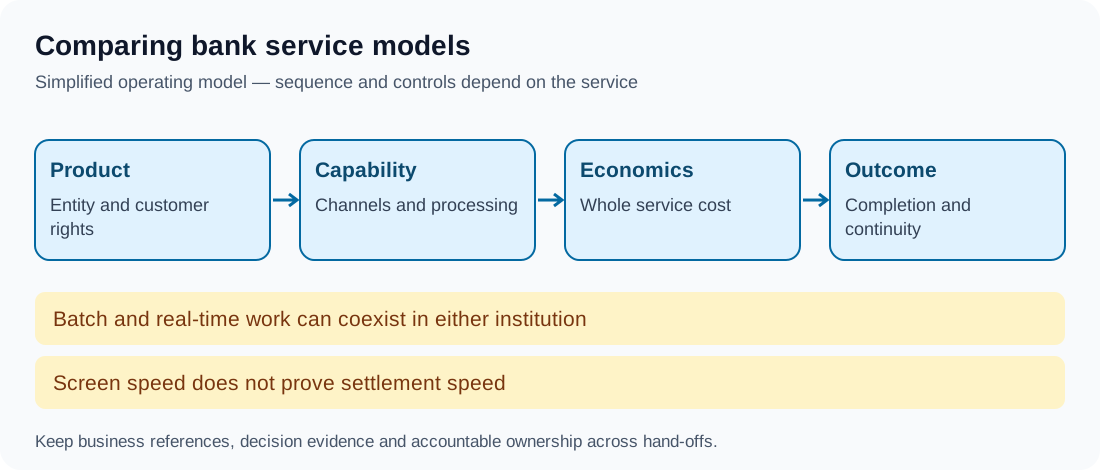
First establish the legal entity and products being compared. A licensed bank and a nonbank app distributed through a bank are not equivalent simply because both display an account balance. Assess rights and protection separately from channel design.
Distribution and service
| Dimension | Questions for either model |
|---|---|
| Access | Which customers, devices and channels can use the service? |
| Processing | Which tasks are real-time, queued or manually reviewed? |
| Support | Can routine and complex exceptions reach an effective owner? |
| Evidence | Can instructions, decisions and financial effects be reconstructed? |
| Continuity | What remains usable during channel or provider failure? |
Branch service can support complex mandates, cash and assistance; it can also involve delay and manual error. Digital service can offer convenient access and automation; it can also exclude customers or amplify a faulty process quickly. Neither channel guarantees sound control or customer understanding.
Processing and architecture
Batch and event-driven work can coexist in both institutions. A card authorisation may be immediate while clearing and settlement occur later. An account application may need manual review even when submitted through an app. Explain the actual service rather than treating every digital instruction as instantly final.
Sanctions controls, fraud decisions and transaction monitoring have different purposes and timings. Do not imply all incumbent controls run overnight or that every digital AML control must decide in milliseconds. Determine applicable duties and design the relevant pre-execution and continuing controls.
Cost, revenue and financial resources
Compare total cost for relevant completed service. Premises, cash handling, software, cloud, providers, acquisition, fraud and support can contribute differently. Fixed and variable costs also change with scale. Operating both old and new systems during migration can add cost before savings emerge.
Digital fees and customer growth do not remove funding, liquidity or applicable capital needs. A new bank may have a narrower book or different acquisition costs; an incumbent may benefit from existing relationships while carrying transition costs. Explain the basis for any claim that one is cheaper or more profitable.
Governance and transition
Controls depend on ownership, evidence and effective authority rather than team labels. A committee can make timely informed decisions; a product squad can also defer essential controls. Assess actual decision and incident outcomes.
For migration, preserve balances, agreements, permissions and required histories. Test mapping, cutover, reconciliation and recovery. A channel launch is not proof that the old platform can be decommissioned safely. Records may remain legally necessary after active processing moves.
Fictional example: payment-service comparison
An incumbent and a new digital bank both provide immediate card authorisation. One offers broader assisted dispute handling, while the other has lower routine service cost under the stated comparison. Both still depend on later clearing and external scheme processes.
The relevant choice depends on customer needs, actual terms, resilience and service quality. Declaring one modern and the other slow would conceal those differences.
Public reference and application
The Basel principles for operational resilience provide a common supervisory reference for banks managing disruption. A digital channel does not remove the need to identify dependencies and deliver critical operations.
Takeaway
Compare legal products, useful tasks, operating evidence and sustainable cost. The strongest model is the one that serves its customers reliably within its obligations and constraints.
Continue to Neobanks & Challenger Banks.