Regulatory Sandboxes
Controlled experimentation with regulator engagement
A bounded test with defined protections
A regulatory sandbox enables testing under a regulator's programme and agreed conditions. It can help firms examine an innovation, customer effects and regulatory questions before wider deployment. Programmes differ in eligibility, support, legal tools and whether tests involve real customers or other environments.
A regulatory sandbox is different from a developer sandbox with synthetic data. Connecting successfully to test APIs does not establish permission for live regulated activity. Neither does acceptance into a regulator's programme automatically prove a product is safe or commercially viable.
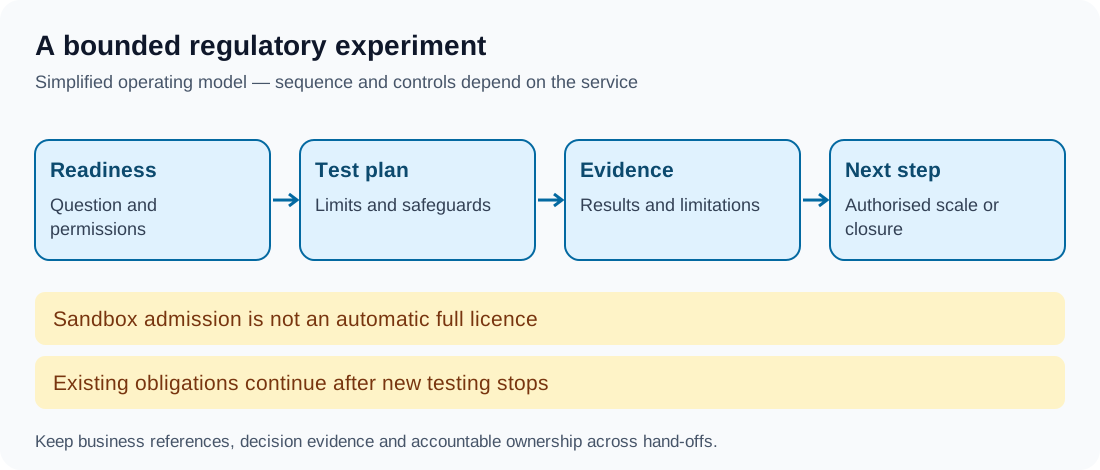
Establish readiness and the question
Describe the innovation, intended benefit, uncertainty and why the proposed test is necessary. Identify entities, permissions, participants, data and financial effects. A useful test has a question that can be answered, rather than a general request to launch without normal preparation.
The FCA Regulatory Sandbox is a scoped UK example. It is not regulatory exempt. Firms conducting regulated activities need the relevant authorisation or registration unless an exemption applies; tailored restricted permissions can support agreed testing. Other sandbox programmes may operate under different statutory arrangements.
Define limits, safeguards and stop conditions
Set the applicable scope, duration, participant eligibility and financial limits. Do not invent a universal customer cap or mandatory daily-reporting schedule. Protect participants with the disclosures, consent or other lawful arrangements, support and compensation processes relevant to the actual test.
Define what happens when a limit is reached, a safeguard fails or a serious incident occurs. Staff need authority and technical means to contain the test. Stop new activity where required while handling existing obligations safely; shutting the interface cannot erase balances, credit or claims.
Learn from outcomes, including failures
Collect evidence for the stated question and relevant customer effects. Monitor successful tasks, errors, complaints, security and financial reconciliation. Participants may not represent the full target population, and a small short test may not reveal long-term credit outcomes or rare failures.
Share evidence under the programme's actual reporting arrangements. Record limitations and changes rather than selecting only favourable metrics. A regulator's engagement is not an endorsement the firm can automatically advertise to customers.
Fictional example: biometric payment pilot
A firm proposes a limited biometric payment test with an approved alternative payment path. Under some lighting conditions, legitimate participants cannot complete authentication reliably. The team follows the agreed stopping and support process, measures the failure and revises the design.
The result demonstrates a specific usability and assurance issue. It does not prove that biometric payment is universally unsafe or that the amended system is ready for unrestricted scale. Wider rollout requires the relevant permissions, controls and evidence for the broader setting.
Transition or closure
Confirm conditions for continued service, expanded permissions or closure with the relevant authorities and arrangements. Explain participant options and preserve servicing and records. Successful completion does not automatically confer a full licence, passport or permission for every related product.
Takeaway
A sandbox is useful when the test answers a clear question within meaningful protections. Its value lies in usable evidence and an authorised next step, not merely admission or a launch announcement.
Continue to Competition & Big Tech.