Competition & Big Tech
Platform power, data advantages and changing financial distribution
Understand the sources of platform power
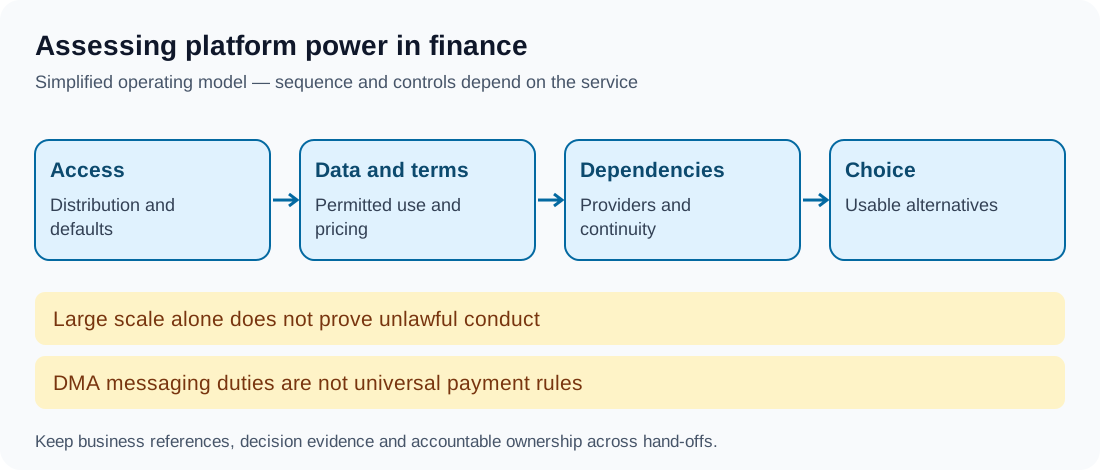
Large technology platforms can influence finance through customer access, devices, commerce, identity, cloud infrastructure and data. Network effects can make a service more useful as participation grows, while scale, default placement and switching costs can reinforce its position. These features can also deliver convenience and efficiency; size alone does not prove unlawful conduct.
Distinguish customer distribution from financial provision and infrastructure. A wallet operator may control the checkout experience while another firm issues the card. A cloud supplier may support several banks without directly providing their regulated products. Each relationship has different competitive and operational implications.
Data advantages have limits and obligations
Transaction and behavioural data can improve service or selection, but coverage, quality, lawful use and conflicts matter. More records do not automatically produce better credit assessment or customer outcomes. Information from commerce, devices and financial services cannot simply be combined for any desired purpose.
Examine who can use data, what users understand and how permissions or lawful restrictions are applied. Portability may help competition, but a data export alone does not transfer financial accounts, credit agreements or every service relationship. Confidentiality, privacy and legitimate security controls remain relevant.
Choice and switching need actual completion
Assess defaults, ranking, fees, eligibility and practical alternatives. A customer can theoretically choose another service yet face costly funding, withdrawal or credential replacement. Measure completed switching and continuing access to financial rights rather than interpreting every retained login as customer preference.
Avoid treating every commercial advantage or boundary fee as illegal. Applicable competition analysis examines the relevant market, conduct and legal tests. Remedies and platform-specific obligations are not universally interchangeable with general financial regulation.
Scope digital-market rules accurately
The European Commission's Digital Markets Act overview describes obligations for designated gatekeepers and relevant core platform services. These are not blanket duties on every bank, wallet or large company.
For example, the Commission's Article 7 interoperability explanation concerns specified messaging services. It should not be presented as a universal command that all bank accounts or payment systems interoperate without conditions. Other obligations and sector frameworks need their own applicability analysis.
Partnership and infrastructure dependence
Assess access terms, pricing power, concentration and continuity. Several business units can depend on one provider, region or identity service despite separate contracts. Provider diversity does not guarantee independence, and no arrangement should promise effortless substitution without evidence.
The Basel third-party-risk principles provide a banking-risk reference for relevant dependencies. Competition and resilience are connected but distinct: a competitive market can still contain common technical failure points.
Fictional example: checkout access changes
A bank distributes payment credentials through a platform. A change in placement reduces customer use and increases acquisition cost. The bank examines actual terms, customer alternatives and economics, then compares improved service, additional channels and negotiation options.
It does not infer that the platform legally owns every customer relationship or that all lost volume is anti-competitive. Evidence about outcomes and dependence informs both commercial decisions and any legal assessment.
Takeaway
Evaluate platform relationships through usable choice, lawful data use, economics and operational dependence. Regulatory labels need the correct scope, and strategy should account for how access and terms can change.
Continue to Interoperability.