Future Bank Operating Models
Composable, ecosystem based and specialised banking models
An operating model defines how service is delivered
A bank operating model describes capabilities, people, decisions, systems, legal entities and financial resources that deliver its products. Future-model discussions often consider modular capabilities, partner ecosystems, specialisation and shared infrastructure. These are options with trade-offs, not predictions that every institution must adopt one design.
Separate distribution, product provision, risk taking and infrastructure. Different firms can perform them, but customer rights and financial records need a coherent operating arrangement. A modular technology estate is not by itself a new legal or financial business model.
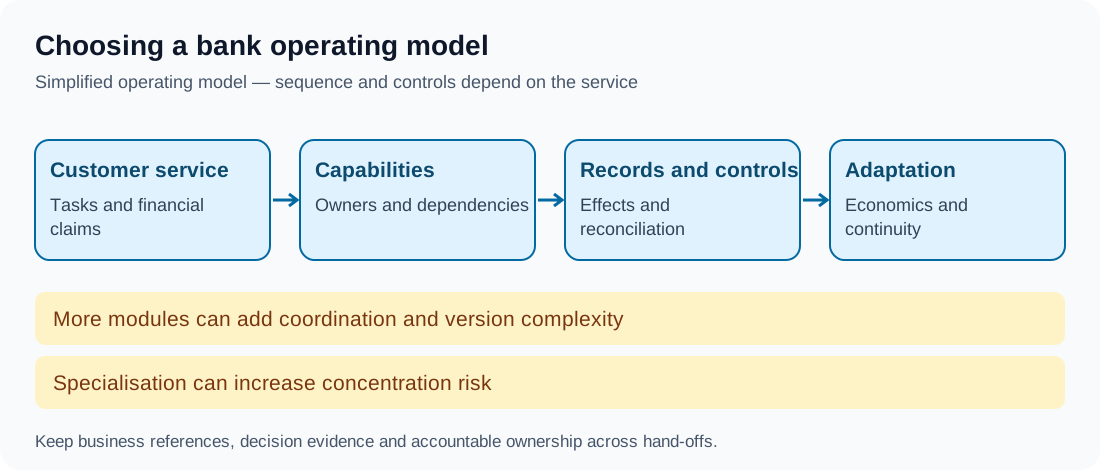
Modular and composable capabilities
Modules can support reuse and independent change when contracts, data meaning and ownership are clear. They also introduce integration, version and coordination work. More microservices do not automatically reduce complexity or improve resilience.
Identify which systems own important states and how financial effects are authorised and reconciled. Avoid assuming all modules share one transaction, clock or exactly-once processing guarantee. Test duplicates, delayed events and partial change. A new channel can reuse a capability while still requiring its own permissions, controls and servicing.
Ecosystem and specialised models
An ecosystem can combine bank infrastructure with partner access or products. The arrangement needs activity-specific responsibility and continuity across firms. The Basel third-party-risk principles offer a bank-risk reference; national requirements and relationship facts remain relevant.
Specialisation can deepen service for a segment or financial task. It can also increase concentration in customers, sectors, funding or partners. A narrowly focused product business is not automatically a narrow bank in the technical policy sense, and a narrow-bank concept does not eliminate every operational, liquidity or business risk.
Shared utilities can lower duplicated cost and improve expertise, while creating common dependencies. Several institutions using one utility may face correlated disruption. Service substitution, records and financial continuity should be tested under realistic constraints.
People, economics and governance
Capability owners need authority over outcomes, changes and exceptions, with risk, operations and finance involved. Reorganising teams does not itself transfer legal obligations or make weak data joins reliable. Fund the skills and support the model requires after launch.
Evaluate recurring income, total operating cost, funding, liquidity and applicable capital separately. A service fee and a financial balance-sheet return have different drivers. Stress loss of a distribution partner, cost escalation, service failure and customer run-off rather than relying on permanent growth.
Fictional example: modular lending
A bank uses separate application, assessment, agreement and servicing components. The channel receives an approval but contract execution fails. The systems preserve the provisional status and references, and funding waits for the required conditions under this design.
The model succeeds when staff can explain and resolve the unfinished relationship. It fails if each component reports healthy while nobody owns the customer's unresolved loan. Modularity needs accountable coordination.
Takeaway
Choose an operating model for the actual customers, capabilities and constraints. Its quality is demonstrated through controlled service and sustainable economics, including failure and change, rather than through architectural labels.
Continue to Digital Banking Strategy.