Fintech Funding Lifecycle
Capital, financing and liquidity through development and growth
Different money serves different purposes
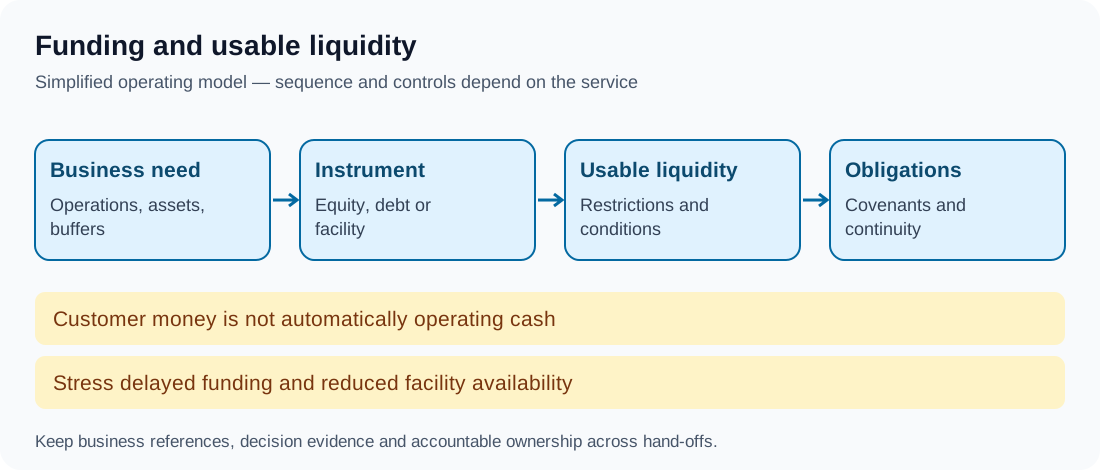
A fintech may need funding for product development, operating losses, regulated capital, lending assets and working capital. These needs are related but not interchangeable. Investor cash can pay operating expenses; customer money held under safeguarding arrangements is not automatically available for that purpose.
Equity supplies ownership capital with dilution and investor rights. Debt creates repayment and contractual obligations. A lending facility may finance eligible receivables under borrowing-base and covenant conditions. Bank deposits are liabilities within a bank's prudential framework. Do not treat all cash sources as unrestricted corporate funding.
Plan the lifecycle without assuming a standard ladder
Early development may rely on founder funds, grants, investors or strategic partners. Later rounds can support expansion, acquisitions or required buffers. There is no mandatory seed-to-Series-C sequence or guaranteed next round. Firms can grow through retained earnings, partnerships or other structures appropriate to their business.
Strategic investment can bring distribution or technical support, but it is not always a distribution agreement. Assess the actual shareholder rights, exclusivity, information access, conflicts and exit terms. Investment does not remove regulatory responsibilities or give an investor unrestricted customer information.
Cash runway is only one measure
Cash runway estimates how long available cash supports forecast net outflows. State which balances are unrestricted, how burn is calculated and what commitments are assumed. An undrawn facility is not equivalent to cash if drawing depends on eligibility, covenants or lender discretion.
Consider capital, liquidity and contractual limits separately. A regulated firm can have cash and still fail a capital requirement. A lending platform can report positive equity yet face cash stress when warehouse funding stops or borrowers repay more slowly. The Basel Core Principles address bank supervision; their application does not make every fintech a bank subject to identical capital rules.
Worked example: restricted financing
In this fictional lender, unrestricted cash is 6 million currency units and forecast monthly net operating outflow is 0.5 million. A simple constant-burn calculation gives twelve months. That estimate excludes changing losses, growth expenditure, debt repayments and uncertain fundraising, so scenario analysis is needed.
An additional 20 million committed lending facility can fund only eligible receivables, subject to its terms. It cannot simply be added to operating cash and advertised as another forty months of runway. A fall in eligible assets can reduce available draws precisely when the firm needs liquidity.
Diligence, governance and continuity
Maintain reliable financial statements, ownership records, permission maps, customer-money records, asset performance and contractual obligations. Present cohort economics with definitions and reconcile them to finance reports. Distinguish signed funding, conditional commitments and discussions; a favourable conversation is not available liquidity.
Stress delayed fundraising, lower revenue, rising losses, partner exit and facility restrictions. Set triggers for spending changes and customer-continuity action. Document how servicing, complaints, withdrawals or asset administration continue if growth stops. Diversification can reduce concentration, but its cost and feasibility require assessment rather than a universal minimum-provider rule.
Takeaway
Funding readiness means having the right instrument for each need, understanding its restrictions and maintaining liquidity and customer continuity under adverse conditions. A high valuation alone proves none of those things.
Continue to Profitability & Scale.