Profitability & Scale
Turning customer value and growth into sustainable financial performance
State which profit is being measured
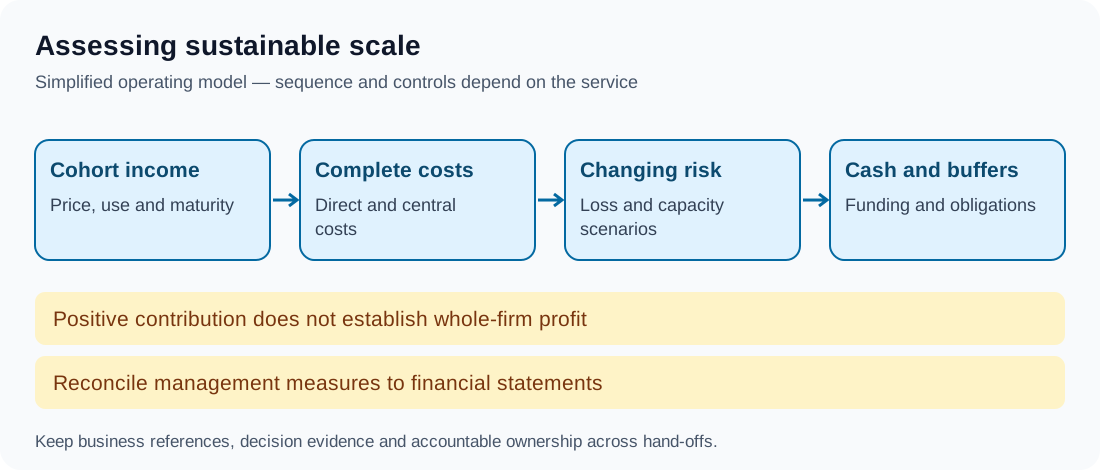
Contribution, operating profit, accounting profit, cash generation and risk-adjusted return answer different questions. A positive contribution after direct costs does not establish whole-firm profitability. Central expenses, financing, depreciation, tax and other relevant items still need their applicable treatment.
Define each management measure and reconcile it to the financial statements. Adjusted measures can help explain performance when transparent and consistent; they are not automatically deceptive. Equally, repeatedly excluding material losses or ordinary operating work can obscure the actual business economics.
Understand what scale changes
Some costs are largely fixed within a capacity range, some vary with activity, and others rise in steps when new capability or capacity is needed. Infrastructure, operations and compliance do not all follow the same curve. Automation can reduce workload, while complexity, new markets or poor data can increase it.
Separate product economics from total operating capacity. Model routine delivery, exceptions, complaints, financial-crime work, resilience and change. Capital or safeguarding obligations depend on the entity and product; their economic impact should be assessed without treating every buffer as an ordinary expense in the statutory profit statement.
Cohorts, losses and promotional effects
Compare customers acquired under different prices, channels and risk conditions. Later cohorts may perform better or worse; deterioration is not a universal law. Immature lending cohorts have not yet revealed their full credit outcomes. A short profitable period may depend on favourable rates, delayed losses or temporary partner support.
Show the effect of promotions and one-time payments separately without assuming every subsidy is illegitimate. Explain which incentives are temporary and which are part of the ongoing contract. Forecast loss and servicing assumptions using relevant evidence, with uncertainty visible.
Worked example: contribution is not profit
In this fictional payments firm, annual recognised revenue is 12 million currency units. Direct processing, servicing and relevant losses total 7 million, leaving 5 million contribution under the stated management definition. Central operating expenses total another 6 million, so the simplified operating result is a 1 million loss before any additional applicable items.
Growth could spread existing fixed costs, but a forecast must price added capacity and changing customer outcomes. If doubling volume requires a new support team and higher partner charges, simply doubling the existing contribution and freezing every other line overstates the benefit.
Stress the operating model
Test lower activity, price changes, funding costs, credit deterioration, fraud and provider disruption. Check cash timing as well as accrual profit: receivables can delay cash, while repayment and required liquidity needs may arrive before income. Recognition of losses, provisions or remediation expenses follows the applicable accounting framework and facts, not an arbitrary rule to amortise every incident.
Changes to underwriting, limits or authentication should be evaluated as risk changes, not booked as effortless productivity. Independent review and outcome monitoring should challenge apparent gains. Staffing reductions that leave harmful cases unresolved can move costs into complaints, remediation and customer loss.
Decide when to expand
Use explicit capacity, control, financial and customer-outcome evidence. Review the marginal segment or market rather than assuming the original proposition works everywhere. Expansion may be worthwhile before current profitability if its funding and path to sustainability are credible; it still needs honest assumptions and customer continuity.
Finance, product, operations and risk should reconcile their reports to the same business population. Track mature cohort contribution, full-firm results, cash forecasts and significant adverse outcomes together. No single growth ratio or cost-income target supplies a universal release decision.
Public reference and application
The FCA Consumer Duty includes price and value requirements for in-scope UK retail business. Increasing revenue is therefore not sufficient evidence that a proposition provides fair value.
Takeaway
Sustainable scale joins customer value, complete costs, changing risk and usable cash. Clear definitions and adverse scenarios help distinguish improving economics from a result that depends on omitted costs or temporary conditions.
Return to Fintech Business Models.