Digital Wealth
Robo advice, fractional investing and digital portfolios
Why this chapter matters
Sravanthi can now buy a slice of a fund between two bus stops. That is the point of digital wealth. It is also how a savings intention becomes a market risk she did not sit with.
Ramesh hears "the app lost my money" after a week the market was open and honest. Gunaditya hears a custody chain where the brand, the adviser, the platform and the custodian are four firms and one logo.
This card is digital investment journeys. Embedded investment in Section 4 named the partner shape. Stay here on advice versus execution, the portfolio she thinks she holds, and who can give it back.
The plain meaning
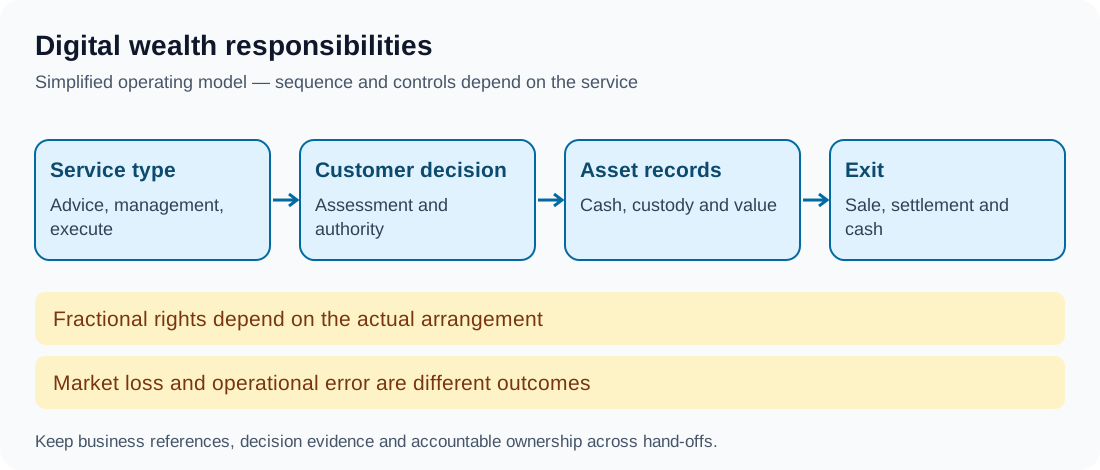
Digital wealth is the origination, arrangement or management of investments through a digital path: goal in, portfolio out, money in, report out, money out.
Three models keep getting mixed on one screen.
Execution only — she chooses, you transmit.
Guided or robo — a process recommends a mix from her answers.
Discretionary — a firm manages in her name under a mandate.
If the screen talks like a guide and the terms talk like execution only, you have a conduct file, not a proposition.
Robo is a process, not a personality
A questionnaire, a risk score, a model portfolio, a rebalance rule. That can be good advice at industrial scale if the questions are honest and the mapping is stable.
It fails when the questions are a marketing funnel ("when do you want to be rich"), when the model portfolio is the one that pays the platform more, or when rebalance is a tax event she was not told about.
Assess the actual advice, portfolio-management or execution service and its applicable permissions. In the EU, MiFID II Article 25 distinguishes suitability and appropriateness, with specific conditions for execution-only treatment. Automation does not remove the relevant assessment.
Fractional does not make the asset smaller in law
A fractional position may provide beneficial rights in an underlying asset or a contractual exposure under the arrangement. Explain which claim the customer receives and its voting, transfer and corporate-action treatment. Some programmes give beneficial ownership. Some give a contractual claim on a pool. She will assume she owns the name on the tile.
Custody and safeguarding for investments are not the same as deposit protection. Write the exit: how long to sell, who holds the cash after the sale, what happens if the custodian fails. Pretty charts do not replace that paragraph.
Cash that waits is still a product
Uninvested cash can be held under different deposit or client-money arrangements. Identify the actual holder, customer claim and permitted use. The accounts card already said name the liability. Wealth teams hide this in "uninvested cash". Name it. Assess interest, protection, segregation and use under the actual arrangement and jurisdiction. A label such as uninvested cash does not itself establish deposit protection.
Worked example: the goal that was a fund
In this fictional example, she taps "house in five years". The app puts her in an equity mix because the questionnaire scored her as "comfortable". A two-year drop eats the deposit she needed for a booking.
The firm should assess the goal, time horizon, financial situation, loss capacity and risk tolerance under the relevant service obligations. A comfortable-risk answer alone does not justify ignoring the stated need or presenting a guaranteed goal outcome.
Worked example: micro-invest the spare change
In this fictional example, round-ups buy fractions every day. Fees are tiny per trade and large as a percent of a two-pound ticket. She thinks she is saving. She is paying a turnstile.
Show the fee in the same units as the round-up. If the economics only work on heavy spenders, do not sell the product as a piggy bank for thin balances.
What usually goes wrong
Advice voice, execution contract.
Model portfolios chosen by commercial share.
Uninvested cash with no name.
Custody that cannot be explained in one sentence.
Exit that takes longer than the sale story.
A risk score she can game to see a higher return tile.
Measuring what matters
Measure assessment quality, customer understanding, charges relative to invested amounts, cash and holdings reconciliation, valuation errors, sale-to-cash completion and complaints. Portfolio performance should be interpreted against the actual mandate, benchmark, costs and risk; it is not a guarantee of suitability. Distinguish market loss from operational or advice defects.
What this card will not do
It will not pick your custodian. It will not design an ETF list. It will not write a suitability engine.
When a digital flow becomes advice, how client assets must be held, and what you must show before she taps buy, are local. Check them against current primary sources.
Takeaway
Digital wealth is a market risk delivered through a small screen. Say whether you advised, who holds the asset, and how she leaves. A slice is not a toy.
Regulatory posture on wealth
Apply the actual service, customer and instrument rules. EU MiFID II suitability, appropriateness and execution-only conditions are distinct; other jurisdictions use their own frameworks. Client assets, fractional rights, waiting cash and compensation eligibility require separate assessment. Do not imply protection against all market loss.
See also: Enterprise Risk Taxonomy · Mule Accounts and Account Networks
References and further reading
- ESMA: MiFID II Article 25 — suitability, appropriateness and execution-only conditions.
- ESMA investor information — understanding authorised services, products and costs.
Continue to Insurtech.