Insurtech
Digital distribution, underwriting, pricing and claims
Why this chapter matters
Insurance sold in an app still has to pay a claim on a wet Tuesday. Sravanthi ticks a box next to a flight. She thinks she is covered. The policy wording lives at a firm she never opened. Ramesh meets her when the claim is declined for a exclusion that sat behind a chevron.
Gunaditya meets the book when the price was set by a model that liked last year's quiet weather.
This card is digital insurance. Embedded insurance in Section 4 named the partner tile. Stay here on distribution, the underwrite, the price, and the claim — the only moment she finds out whether the product existed.
The plain meaning
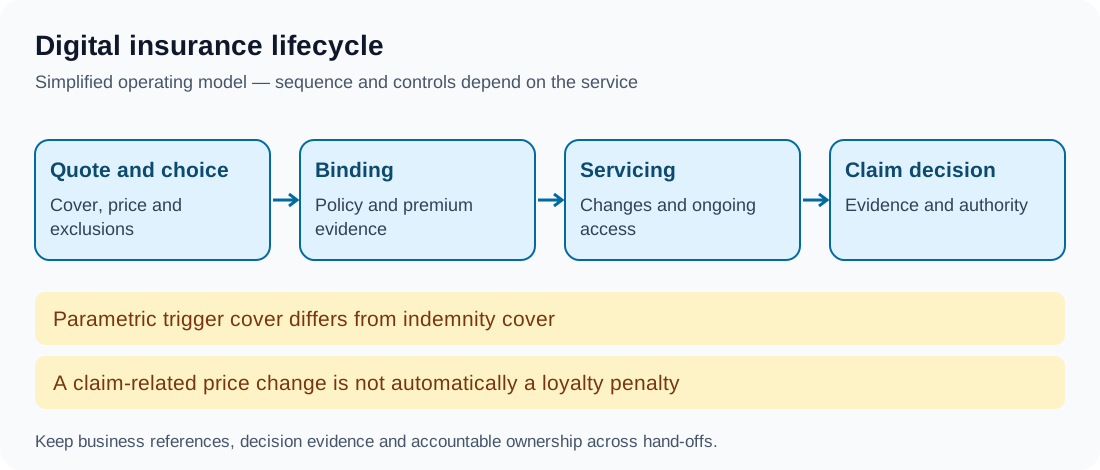
Insurtech, in this academy, is insurance manufactured or distributed through digital journeys: quote, bind, pay, change, claim, complain.
Four roles must be named.
Distributor — the app or partner that sold the policy.
Insurer — the firm that carries the risk.
Intermediary or MGA, when present — binds or prices under authority.
Claims handler — often a fourth logo.
If she cannot find the insurer after bind, the design is doing what the embedded-finance card already called lying.
Distribution is not underwriting
A beautiful quote flow can still sell a policy the customer does not need. Pre-ticked travel cover, gadget cover bundled into a checkout, life cover offered after a loan yes — those are distribution acts. Some are lawful if disclosed. None are underwriting.
Default off unless the contract truly requires the cover. The journeys card said this. Insurance is where the tick prints premium.
Assess permissions for the actual distribution activity. EU Insurance Distribution Directive Article 20 addresses demands and needs and comprehensible product information within its scope; national implementation and exemptions also matter.
Pricing models still owe a reason
Usage-based, behavioural, parametric, instant bind from a few answers. Fine, if the price can be explained when she asks why her neighbour pays less, and if the data used had a purpose she can recognise.
A renewal price can change because risk or other permitted factors change; a claim-related increase is not automatically a loyalty penalty. UK home and motor rules constrain renewal prices against equivalent new-business prices and do not prohibit all risk repricing. Explain applicable factors and review unfair or prohibited pricing separately.
Parametric products pay on a trigger (flight delay, rainfall). They are not a replacement for indemnity just because the payout is fast. Say what they do not cover.
Claims are the product
A digital claims process can support notification, evidence, automated decisions within validated authority and specialist review. The appropriate process depends on cover, complexity and risk; neither claim size nor a model label alone establishes honesty or entitlement.
A chatbot that cannot register a claim is a brochure. A decline that cannot show the clause is a fight. A repair network that takes six weeks makes the "digital" prefix a joke.
Fraud controls belong here. They do not justify a default suspicion voice on every first notice.
Worked example: the add-on at checkout
In this fictional example, she buys a phone. Screen insurance is pre-ticked. The policy excludes cracks from drops unless she bought the extra extra. She drops it. Decline.
That file is a distribution defect first. Take the tick off. Put the exclusion next to the price. Name the insurer before bind.
Worked example: parametric flight
In this fictional parametric policy, cover pays when a specified vendor records at least six hours of delay. The accepted data shows five hours fifty, so the stated trigger is not met. Explain the trigger, source, correction or dispute process and the difference between trigger cover and indemnifying the actual loss.
If the trigger is the vendor, say the vendor. Do not sell "your delay, our pay" if the delay you recognise is a third-party clock.
What usually goes wrong
Insurer unnamed at bind.
Exclusions behind a second tap.
Claims handled by a firm that cannot see the sale file.
Pricing that punishes the honest claim.
Add-ons that attach to the wrong person in a household.
A wind-down with no run-off owner.
Measuring what matters
Measure comprehension, binding accuracy, premium reconciliation, claim and complaint outcomes, decision delays, cancellations and access to ongoing service. Attach rate and loss ratio alone do not establish customer value. Monitor model and source changes, including weather or usage-data drift, against actual cover and pricing obligations.
What this card will not do
It will not pick a class of business. It will not write a wording. It will not set a loss ratio.
Licensing, product-oversight duties and claims timescales are local. Check them against current primary sources.
Takeaway
Insurtech is a policy that can be bought on a phone and proved at a claim. If the claim cannot find the sale, you did not digitise insurance. You digitised the premium.
Regulatory posture on insurtech
Scope licensing, distribution, pricing, data use, claims and run-off to the actual regime and product. A UK home/motor renewal-pricing rule is not a ban on all claim-related risk pricing worldwide. Automation does not change who bears the policy obligation; retain an authorised decision and challenge route appropriate to the service.
See also: Enterprise Risk Taxonomy · Mule Accounts and Account Networks
References and further reading
- EU Insurance Distribution Directive — distribution and product-information framework.
- FCA ICOBS 6B — scoped home and motor renewal-pricing rules.
Continue to Regtech.