Digital Product Management
Discovery, proposition design, prioritisation, lifecycle ownership and outcome measurement
Own the proposition through its lifecycle
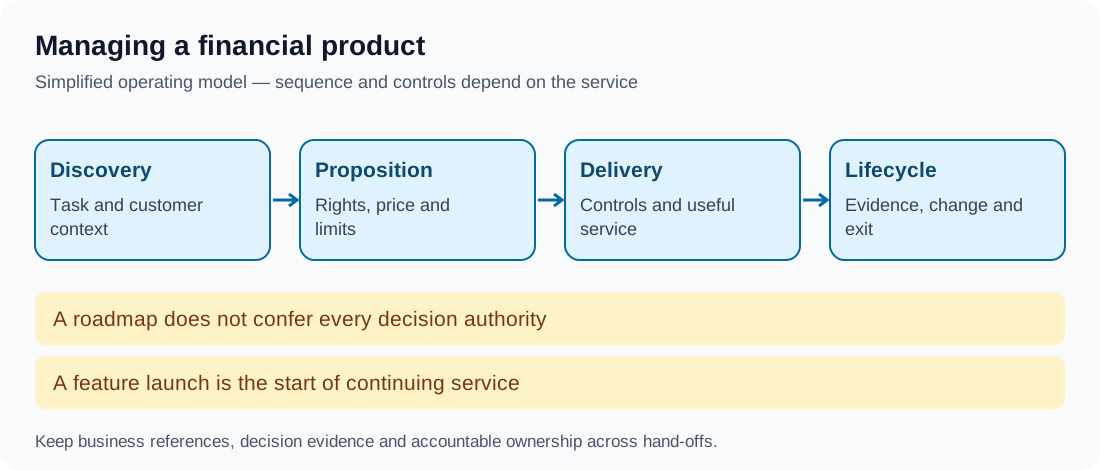
Digital product management connects customer needs, service design, financial mechanics and delivery decisions. The work continues after launch through monitoring, corrections, changes and retirement. Product ownership does not mean one manager personally holds every legal or operational authority.
Identify the useful task and the actual product: provider, financial claim, price, limits, risks and support. Discovery should examine real circumstances and exceptions, including customers who cannot complete the standard journey. A popular feature request is evidence to assess, not an automatic instruction to build.
Design the financial and service meaning
Join the visible journey to agreements, authority, decisions and financial records. Explain pending, declined, approved and usable states accurately. A savings pot might be a presentation over one account or a separate financial product; the actual arrangement determines rights, interest and protection.
Work with operations, risk, engineering, finance, legal and compliance as relevant. Establish who can approve, change, pause and remediate the service. A roadmap cannot transfer powers that belong to other accountable functions or legal entities.
Prioritise delivery and assurance
Compare expected benefit, evidence, cost, dependencies and risk. Include support, observability, reconciliation, security and migration rather than treating them as permanent phase-two work. Release slices should be usable within their disclosed limits, not simply visually complete.
Define acceptance criteria for actual outcomes and representative failures. A payment timeout needs enquiry and duplicate protection; a cancellation needs the intended billing and partner effects. Passing the interface test alone does not establish that the financial service works.
Experiments should use appropriate lawful arrangements, guardrails and analysis. Randomisation does not exempt a product from fairness, disclosure or other applicable obligations. Monitor uncertain and adverse effects and distinguish short-term conversion from mature outcomes.
Pricing and communication
Use actual qualifying events, charges and benefits in customer statements. Fee changes depend on contract, applicable notices and relevant rights; grandfathering and a fixed notice period are not universal requirements for every change. Assess customer effects and provide accurate practical options.
The FCA Consumer Duty is a scoped UK example of product, value, understanding and support outcomes. Other markets have different frameworks. Predictable attrition among low-balance customers does not alone prove that a repricing decision is fair or suitable.
Operate, learn and retire
Monitor useful activity, financial performance, complaints, legitimate declines and unresolved effects. Investigate themes and put material corrections into funded work. An upheld complaint can provide important evidence, but its rate is affected by case mix and access; it is not an ungameable universal customer-satisfaction score.
Rollback or restriction should follow appropriate authority and account for already executed obligations. Retirement requires communications, agreements, residual balances, access and retained records to be handled under the actual framework. Stopping an interface does not automatically close the product.
Fictional example: savings-pot release
A bank offers named pots within one account. It explains that the pots do not create separate deposit protection and specifies how available funds and transfers work. Testing covers round-up failures, concurrent spending and changed rules.
After launch, the team measures funded useful pots, customer understanding and reconciliation differences. Corrections address the actual effects rather than adding features to conceal confusion.
Takeaway
Product management needs a clear proposition, controlled delivery and continuing evidence. The lifecycle should protect customer rights and financial records through growth, incidents, changes and exit.
Continue to Remote Onboarding Operating Model.