Digital Onboarding
Application, identity, verification, decisioning and account activation
From applicant to usable product
Digital onboarding establishes a customer relationship through electronic channels. It combines an understandable application with the checks, decisions and records needed for the actual product. A completed form, issued account number and usable account are different states.
Define the journey for the customer and legal entity concerned. Opening an individual payment account differs from onboarding a company with beneficial owners and authorised signers, or applying for credit. Collect necessary information without assuming every applicant needs the same evidence or enhanced checks.
A controlled lifecycle
Explain eligibility, provider identity, material terms and information use. Capture application facts; perform appropriate identity verification and customer due diligence; assess product and risk conditions; then accept, decline or refer. Create and activate the product only through the authorised process.
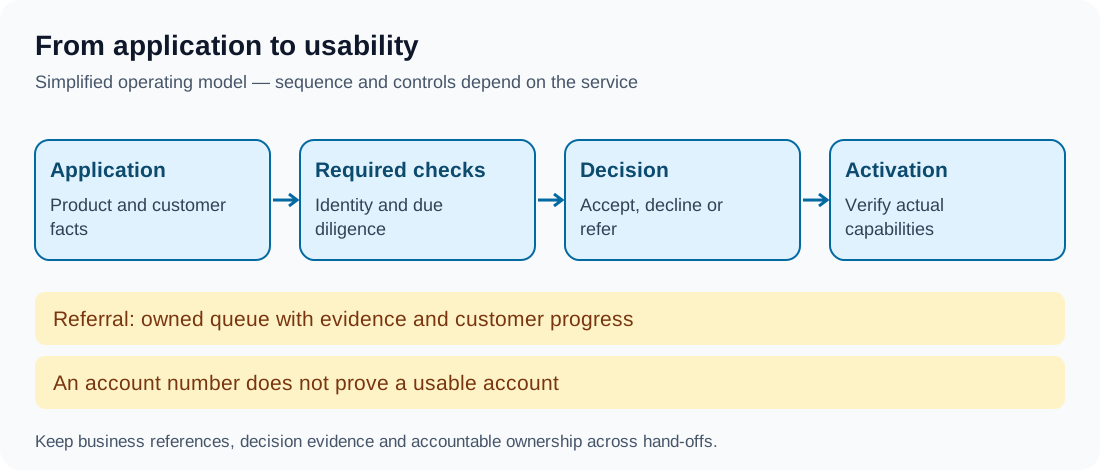
Sequencing can differ. Some arrangements permit restricted activity or later verification under defined conditions; others require checks before opening or use. Do not treat partial activation as universally permitted. State restrictions clearly and enforce them in the account and payment systems, not only the app.
Identity and due diligence are related, distinct work
Identity proofing assesses the claimed person and their evidence. Customer due diligence also addresses the relationship and relevant financial-crime obligations. A successful selfie match does not establish beneficial ownership, source of funds or suitability for a credit product.
The FATF digital-identity guidance explains assessing digital identity reliability and assurance within a risk-based customer-due-diligence approach. Remote contact alone does not make every relationship high risk. Applicable national rules and the actual system's assurance still govern use.
Referrals and assisted completion
Refer unclear evidence, mismatches or product decisions to a queue with an owner, relevant information and urgency. A referral is a designed outcome, not proof of fraud. Give truthful progress and an appropriate way to provide missing information or seek assistance.
Protect assistance from impersonation. A translator or family helper does not automatically become the account holder or authorised operator. Offer suitable capture alternatives and accommodation without bypassing necessary assurance. Do not impose an invented universal number of retries before assistance.
Worked example: activation after approval
In this fictional onboarding service, an application passes required checks and receives approval. Account creation then times out. The app shows that activation is pending rather than displaying a fabricated usable balance or prompting the customer to send money.
Operations enquires using the original application reference. If the account already exists, the process completes its linkage and confirms its actual capabilities. If it does not, a controlled retry avoids duplicate accounts. The approved-to-usable queue is monitored separately from application conversion.
Records, security and ongoing operation
Join application, evidence, decision, agreement and product references. Preserve the required review history and data under appropriate retention and access controls. Minimise document images and biometric information in logs, analytics and support tools.
Test duplicate submissions, expired or changed evidence, capture failures, manual review, partial account creation and customer exit. Ongoing due diligence and monitoring do not end when the welcome screen appears. Review the customer relationship when relevant facts change under the applicable obligations.
Takeaway
Onboarding is complete at the defined, evidenced product state. Clear status, risk-based checks and controlled exceptions protect both the customer experience and the financial relationship.
Continue to Electronic Identity.