Digital Banking Explained
Channels, financial records, controls and continuing service
Banking delivered through digital channels
Digital banking uses electronic channels and systems to provide financial products and service. It can include mobile and web journeys, APIs, partner distribution and automated operations. Digital describes delivery and capability; it does not by itself establish the provider's licence, a deposit guarantee or a particular architecture.
A bank with branches can deliver strong digital services. A new app can depend on a licensed bank or another financial provider. Identify the actual product and entity rather than assuming every digital brand is itself a bank.
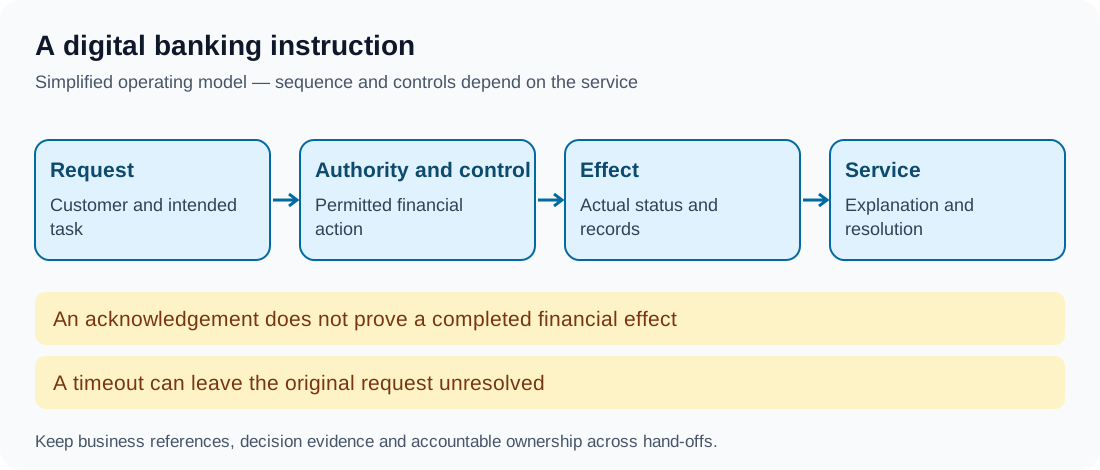
Follow the financial instruction
A payment, account application or limit change begins with a request. Establish the actor, account, action and appropriate authority. Run the controls relevant to the activity, then execute, decline or refer through the actual process. An acknowledgement, approval and completed financial effect are different states.
The architecture might use channels, gateways, orchestration, core systems and external processors in different combinations. Not every service follows one sequence or runs every check in milliseconds. Some controls act before execution, while monitoring and investigation can continue later. The design must satisfy the specific product and applicable obligations.
Records and financial meaning
Use durable references to join requests, decisions, agreements, postings and external statuses. Several systems may retain different identifiers; reliable mapping can preserve traceability without one universal identifier shared everywhere.
Posted balance, pending items, holds and available funds have different meanings. Availability can include an authorised credit line. Differences are not automatically errors, but must be defined and reconciled. Customer messages should reflect the actual state instead of inferring settlement from a green icon.
Uncertainty, retries and recovery
A timeout can occur after another system acted. Treat the result as uncertain until relevant evidence resolves it. Enquire using the original reference and use controlled idempotent processing to avoid duplicate effects. Messaging guarantees alone cannot establish end-to-end exactly-once financial processing.
Fallbacks depend on the service and permissions. Queueing, reduced functionality or alternative routes need defined limits and customer communication. A second payment route should not be used while an original instruction may already have executed without resolving that risk.
Card locks and account restrictions also need a defined scope. A lock does not universally reverse earlier authorisations or stop every offline or recurring event. Confirm the actual effect and explain exceptions under the product arrangement.
Rights, support and economics
Taking deposits, providing payments, granting credit and holding assets can have different permissions and protection. A bank may outsource technology while retaining its own duties. Nonbank brands and bank partners can have distinct responsibilities. The FDIC's third-party-app guidance illustrates scoped US deposit-protection conditions and nonbank-failure limitations.
Provide support, accessible alternatives, complaints, recovery and exit. Automation can reduce routine cost while adding software, infrastructure, assurance and exception costs. Digital service is not automatically cheaper or universally available without interruption.
Fictional example: a payment timeout
A customer submits a payment and loses the connection. The bank finds the original instruction with a debit and an unresolved external status. It displays a pending investigation, checks authoritative evidence and avoids an unverified second transfer.
Resolution includes the correct financial outcome and an understandable update. Restoring the app alone would not resolve the original payment uncertainty.
Takeaway
Digital banking joins usable channels with accurate financial effects, appropriate controls and continuing service. Evaluate the whole task, including exceptions, rather than just screen speed.
Continue to Traditional Bank vs Digital Bank.