Developer Portals & Sandboxes
Documentation, testing, onboarding and support
A usable route from discovery to operation
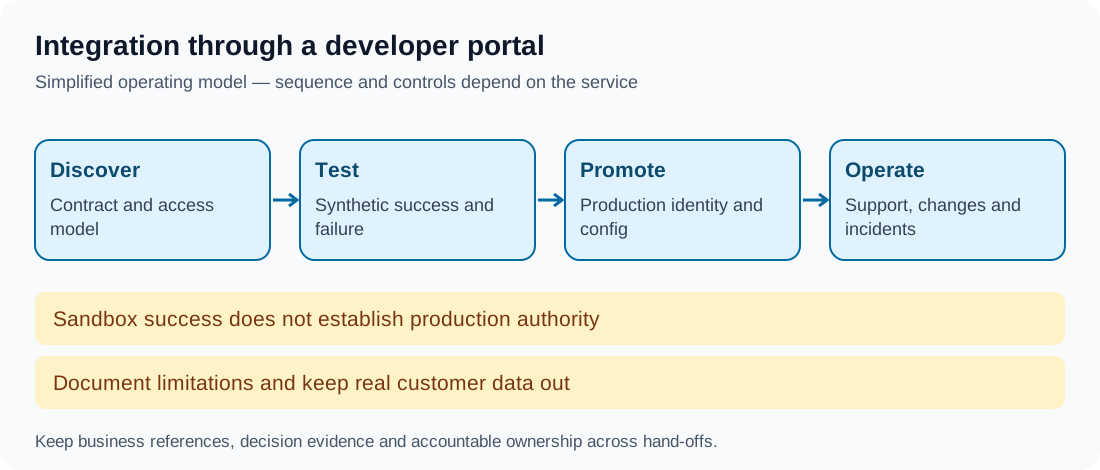
A developer portal explains the API products available, their business meaning, access requirements and support process. A sandbox lets developers exercise representative behaviour without using real customer money or confidential data. Together they support integration; neither establishes production authority by itself.
The portal needs a product owner and a release process linked to the interfaces it describes. Public discovery information can be separated from restricted credentials and operational tools. Do not require a commercial onboarding ceremony where the applicable mandated-access framework does not allow that barrier.
Documentation that matches the contract
Explain eligible consumers, authentication and authorisation, fields, states, pagination, idempotency, errors, version changes and support. Define optional and unavailable values. Show examples of pending payments, refused scope and rate limits as well as success.
Publish the implemented security profile and its version. The OpenID Foundation FAPI 2.0 profile illustrates why a product must identify actual requirements rather than simply advertise secure APIs. A portal description should match the selected ecosystem and implementation.
Documentation examples should use fictional identifiers and synthetic data. Keep credentials out of example code, support tickets and screenshots. A sample response should not include staff-only risk fields merely because they exist in a source system.
A sandbox with useful limits
Provide deterministic scenarios for expired permission, denied role, insufficient authority, unavailable data, pending outcome, duplicate request, changed payload and pagination. A developer should know how to trigger each scenario and what the expected response means.
Describe differences from production: simplified risk decisions, simulated finality, traffic limits and unavailable integrations. A sandbox need not reproduce every production dependency. It should accurately represent the contract behaviours that consumers rely on and avoid implying that a test payment moved real funds.
Keep test and production data, keys and accounts separated. Protect the sandbox against abuse and uncontrolled cost. A public test environment is not a reason to remove access controls from administrative functions.
Production cutover and support
Check the production identity, applicable role, credentials, registration, redirect configuration and supported contract version. Test operational contacts and correlation references. A passed sandbox test with one entity does not authorise a different production entity.
Support should identify the environment, product version, business reference, time and error without demanding secrets. Provide a usable incident path and clear status information. Coordinate API changes, documentation and consumer migration under applicable obligations; no single deprecation window applies globally.
Worked example: the sandbox never shows an overdraft
In this fictional integration, a budgeting app handles only positive available balances because its fixtures never include a negative value. Production customers with overdrafts see an incorrect spendable amount. The contract permits negative values, but examples and tests did not exercise them.
The teams correct the app behaviour, add representative fixtures and investigate affected customer outputs. The portal owner checks similar edge cases, including missing balances and pending transactions. A cosmetic warning that production may differ would not adequately explain a defined field.
Measures and review
Track documentation drift, unresolved integration defects, time to diagnose failures, compatibility incidents and conformance results. Developer registrations and endpoint counts are weak measures without successful, controlled business journeys.
The UK Open Banking standards are an example of an ecosystem with defined specifications and customer experience guidance. Apply the actual market framework instead of claiming that one portal template satisfies every regime.
Takeaway
A useful portal and sandbox make the contract understandable and testable, including failure. Production readiness also requires verified authority, configuration and operational support.
Continue to Premium APIs.