Customer Acquisition & Growth
Distribution, referrals, partnerships and activation
Growth ends in a supported customer
Customer acquisition brings an intended customer into a service; growth includes activation, useful ongoing activity and retention. A signup is not the same as an account that can transact, and a funded account is not proof of good customer outcomes.
Define the target population, distribution channel and actual product promise. Organic discovery, advertising, referrals, partnerships and sales create different costs and expectations. An attractive partner message that the bank cannot deliver becomes an operational and customer-protection problem.
Instrument the funnel
Track discovery, application, verification, acceptance, funding or drawdown, first useful activity and retention as appropriate. Record definitions and distinguish drop-off from refusal, technical failure and manual referral. Apply authority, verification and eligibility rules consistently with the actual product and market.
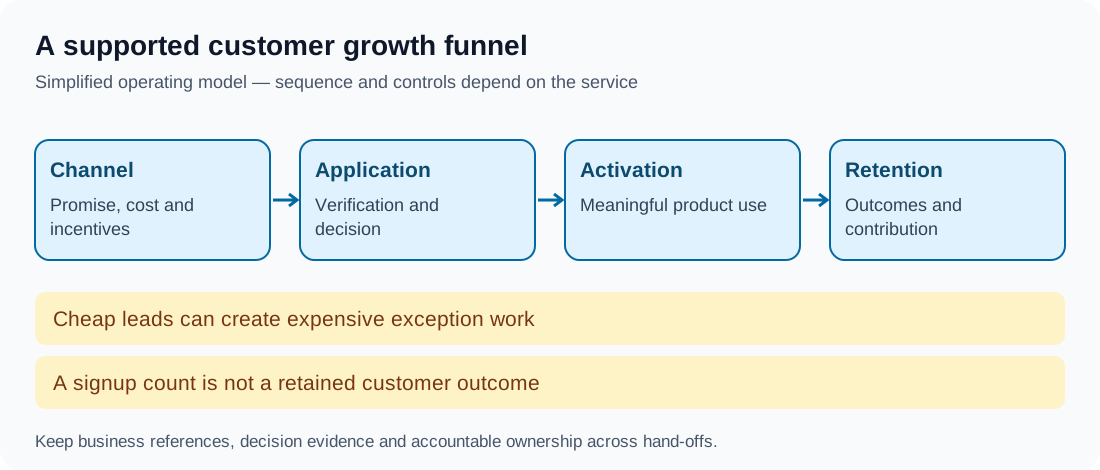
Evaluate cost per lead, application, accepted customer and activated unit with matching cost pools and periods. A low lead price can produce expensive review work or poor retention. Attribution estimates are uncertain: the last click may not explain the decision, and a campaign may claim customers who would have joined anyway.
Distribution and incentives
Control material messages across the bank and partners. Identify the actual provider, conditions and service limits. Apply the relevant financial-promotion and distribution rules. A referral agreement does not automatically permit the referrer to provide regulated advice or collect every customer's data.
Bonuses and bounties can encourage legitimate trial but also duplicate signups, incentive abuse or inappropriate distribution. Define eligible events, funding, terms and anti-abuse controls. Use proportionate investigation rather than treating every promotional customer as fraudulent.
Align commercial incentives with intended outcomes. Paying solely for accepted applications can reward volume without useful activation. Paying for activity can also create harmful behaviour if it encourages unsuitable borrowing or unnecessary transactions. Review the specific incentive mechanism, not only its conversion rate.
Capacity and experiments
Forecast onboarding attempts, referral rates, support and fraud-review work before a campaign. More successful acquisition can increase both automated load and manual cases. Staff or limit the rollout to the service's safe capacity, with clear escalation and customer expectations.
Experiments should preserve required disclosures, authority checks and customer protections. Define outcomes and stopping conditions before launch. A higher conversion rate is weak evidence if losses, complaints or unresolved applications rise. Avoid using sensitive attributes unlawfully for targeting or exclusion.
Worked example: cheap partner accounts
In this fictional channel, a partner produces many accepted accounts at a low bounty. Most accounts remain unfunded, while enquiries about the advertised bonus rise. The initial cost-per-account report looks strong but excludes support and reviews.
The team checks promise comprehension, eligibility and meaningful activation by cohort. It corrects any misleading promotion, reviews the bounty definition and assesses total cost and retention. It does not bypass verification merely to improve the funnel or silently change bonus terms after customers have applied.
Retention and review
Track recurring useful activity, cohort retention, reason-coded contacts, loss where relevant, complaints and contribution. Compare cohorts at equivalent ages. Neither repeated logins nor difficulty cancelling proves loyalty.
The UK FCA Consumer Duty illustrates a framework connecting product distribution, customer understanding and support within scope. Identify the actual promotion, privacy and distribution duties for each channel and jurisdiction.
Takeaway
Good growth brings suitable customers into a service that can keep its promise. Measure activation and later outcomes alongside acquisition price and volume.
Continue to Product Led Growth.