Banking as a Service
Licensed infrastructure, embedded products and sponsor bank models
Financial capabilities provided through another brand
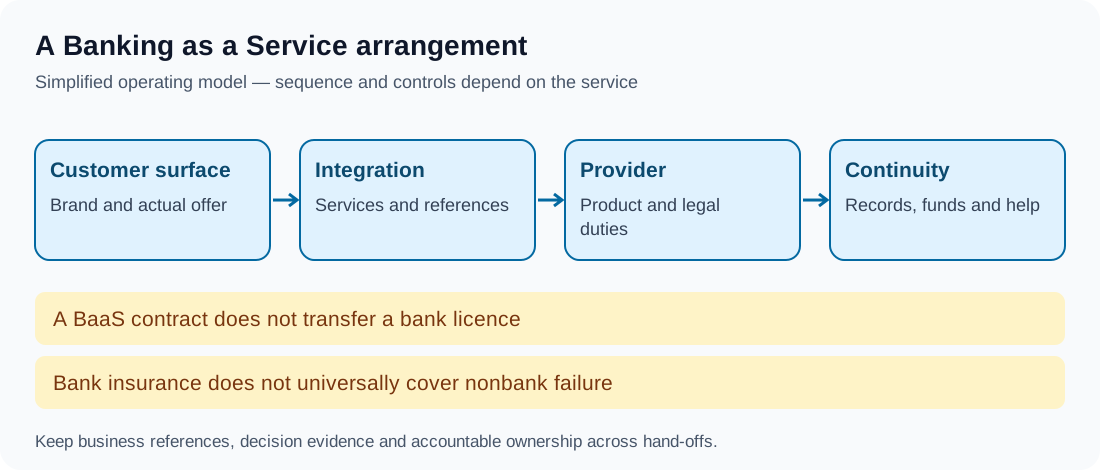
Banking as a Service commonly describes arrangements in which a bank provides capabilities used by another firm's proposition. A brand might distribute accounts or cards, while the bank provides the underlying product and a technology provider supports integration. Configurations vary, and some services marketed under this label involve other regulated providers.
The arrangement is not a rental that transfers a banking licence to the brand. Identify each entity's actual activities, permissions, customer agreements and responsibilities. A software contract cannot establish a right to take deposits or provide every financial service.
Follow the financial claim
Customers may hold individual accounts, beneficial interests through a pooled structure or another type of claim. Determine the legal product and records needed to establish each entitlement. The screen's balance alone does not prove deposit protection or the ability to withdraw after platform failure.
The FDIC third-party-app guidance gives a scoped US example: pass-through insurance has conditions and does not insure the nonbank's failure. Other jurisdictions have distinct deposit, e-money and safeguarding frameworks.
Financial records and reconciliation
Join provider balances, beneficiary records, holds, fees and pending financial events. A pooled-account reconciliation must reflect the actual structure and defined adjustments. Do not force available balances, posted positions and external bank balances into one identical number without explaining their different meanings.
Important records may reside in bank and provider systems. What matters is their accuracy, accessibility, integrity and continuity under the applicable arrangement. It is inaccurate to assume a middleware subledger can never be an authoritative operational record or that a bank can rely on an inaccessible partner-only file for essential obligations.
Controls and service responsibilities
Onboarding, sanctions, fraud, monitoring and reporting responsibilities need specific allocation with required information flows. Not every control has the same timing or applies identically to every participant. Verify the relevant framework rather than asserting every programme name is screened at every hop or that all suspicious-activity duties belong to only one firm.
The US interagency third-party guidance and Basel third-party-risk principles provide scoped bank-risk references. Outsourcing does not remove a bank's own applicable duties.
Restrictions and financial authority should work at their enforcement points. Confirm scope and propagation without promising simultaneous state changes in all systems. Support needs linked evidence, clear ownership and an authorised route to resolve actual financial effects.
Economics, concentration and exit
Income and costs depend on contracts, product and financial treatment. Programme growth can concentrate deposits, credit or operational dependencies. Customer funds are not ordinary service revenue, and restricted balances should not be treated as free operating cash.
Plan continuity, authorised migration or run-off. Provider termination does not automatically extinguish customer balances, credit, disputes or retention duties. Test records and service under realistic partner failure rather than assuming an exit clause guarantees immediate replacement.
Fictional example: paused seller payout
A marketplace shows seller proceeds through a bank-supported arrangement. A payout times out. The parties join the seller position, original instruction and bank/external status, preventing an unverified second payout. The customer receives an accurate pending status and effective support.
Takeaway
BaaS requires precise financial claims, accessible records and executable responsibilities across the firms. The operating arrangement must continue to serve customers when the brand, platform or provider changes.
Continue to Platform & Marketplace Banking.