Chapter 100: The Complete Bank Finance Case Study
Section 20: Finance Data, Change Delivery and Practical Capstones · Chapter 100 of 100
One fictional quarter connects lending, funding, impairment, profit, capital, liquidity and reporting. This capstone derives the journals and every ratio from explicit assumptions instead of unexplained percentage-point bridges.
1. Chapter opening
This fictional quarter integrates banking events, accounting measurement, prudential calculations, close controls and reporting. Amounts below are millions unless stated. Separate customer principal, IFRS carrying amount, accounting equity, CET1, RWA, HQLA and weighted funding measures. Every numerical result has explicit inputs; none is a universal prudential requirement or a real bank outcome.
2. Learning objectives
- Post lending, funding, accrual and impairment events from the bank perspective.
- Reconcile quarterly profit and accounting balances.
- Derive CET1 from numerator/denominator movements, not additive unexplained basis points.
- Calculate LCR/NSFR from their defined weighted inputs.
- Preserve reporting scope, version and evidence through concurrent changes.
3. Business context
Example Bank starts the quarter with CET1 of 6,100 and RWA50,000, ratio 12.2%. It originates 2,000 loans, raises 500 labelled green deposits and refinances 3,000 wholesale maturities. A100bp rate move changes the specified income assumptions; an 800 credit portfolio has evidenced SICR, a taxonomy upgrade changes presentation and an SSI fraud attempt is stopped. These events need separate accounting and operational decisions. No prescribed annual control budget, guaranteed funding premium or claim that all shocks resolve without error is assumed.
4. Finance and accounting view
4.1 Origination, deposits and refinancing journals
Assume new 2,000 loans pass the IFRS 9 amortised-cost tests, fair value equals contractual principal before integral fees/costs, received integral fees 10 and paid qualifying incremental costs 4. To isolate settlement, assume external disbursement with fees withheld: Dr Loan principal 2,000 / Cr Settlement cash 1,990 / Cr Integral-fee contra-asset 10. Costs: Dr Loan transaction-cost adjustment 4 / Cr Cash 4. Initial gross carrying amount is 1,994; cash net outflow is 1,994. Legal principal remains 2,000. Initial ECL and later changes belong in the independently calculated impairment bridge.
External green-deposit inflow: Dr Cash 500 / Cr Deposit liability 500. A green label does not create accounting income or change principal safety. Allocation is separately reconciled to the disclosed eligible asset pool; do not assert that each fungible depositor’s cash is physically traceable to one loan.
Assume wholesale refinancing is at par with no issuance fees: Dr Cash 3,000 / Cr New debt 3,000; repay old matured debt Dr Old debt 3,000 / Cr Cash 3,000. The paired principal events have no direct P&L and no net cash change. Pre-funding changes the timing and funding profile; it does not mechanically prove a quarter-end LCR. Accrue interest and costs separately under the instruments’ terms.
4.2 Reproducible profit bridge
Assume baseline quarterly PBT before the specified event effects is 265. Rate repricing benefit 55 less deposit repricing 15 gives NII increment 40. Other fee income adds 5; incremental impairment expense 120 comprises evidenced lifetime-ECL top-ups 100 and a documented non-duplicative overlay 20; incremental operating cost 10. PBT=265+40+5−120−10=180. Assume tax expense 45, giving PAT135. The tax is an explicit scenario assumption, not a universal bank tax rate. Integral fees 10 from origination are not added as immediate fee income; they enter EIR. The 5 fee income is separate service revenue earned in the quarter.
SICR on the 800 portfolio supports lifetime ECL under the stated assessment; an amount migration alone does not establish the 100 top-up. Journal for the total incremental impairment 120: Dr Impairment expense 120 / Cr Loss allowance/undrawn provision 120, split to the independently evidenced exposure components. Do not call Stage 2 automatically NPEor switch its interest to a Stage 3 net basis. The overlay must address risk not already in the model, with approval and eventual review.
4.3 CET1 numerator and RWA denominator
Assume quarterly profit135 meets the required verification conditions before the distributions shown in this bridge. Ordinary distributions100 and distributions25 on qualifying equity-classified AT1 reduce retained earnings; the AT1 amount is not already deducted as interest expense in PAT. Apply foreseeable-distribution treatment once, using the same numerator basis, rather than deducting these amounts twice. A separate additional prudential deduction 150 is assumed for an asset/balance already recognised in accounting but subject to the specified eligibility treatment. It is a prudential adjustment, not an extra 150P&Lexpense. Closing CET1=6,100+135−100−25−150=5,960.
Assume growth adds 1,200 RWA and credit migration adds 200, with no other RWA movements. Closing RWA=50,000+1,200+200=51,400. CET1 ratio=5,960/51,400=11.5953307%, displayed 11.60%. Decline from 12.2%is 0.6046693 percentage points, or 60.4669 basis points. The accounting equity and capital-perimeter bridge must separately explain the assumed deduction and eligibility. A growth allocation of 8%×1,200=96 is a hypothetical capital requirement calculation; it does not subtract 96 from actual CET1. Do not add approximate ratio effects as if they prove the final numerator and denominator.
4.4 Liquidity and hedge distinctions
Assume eligible HQLA after applicable rules is 16,500 and 30-day net cash outflows 10,000: LCR=165%. Assume weighted available stable funding 62,000 and required stable funding 50,000: NSFR=124%. These are separately calculated reporting measures, not derived by adding raw 500 deposits or 3,000 new debt to cash. Outflow/inflow caps, eligibility, maturity and scope need the actual local rules.
A rate shock can affect realised NII, EVErisk estimates, fair value, credit risk and FTP differently. Economic hedging does not automatically qualify for hedge accounting. Document qualifying hedge relationships at their inception; no rule requires every risk-management swap to be designated. For a qualifying cash-flow hedge, assess effective OCIand ineffectiveness under the applicable standard; for a fair-value hedge, the relevant hedged-item and instrument adjustments differ. Trade, hedge inception, settlement and reporting dates are not interchangeable.
5. Product and customer impact
Customers need accurate principal, interest, fees, lawful repricing/renewal and fraud protection. Internal FTP or capital targets do not authorise changes to signed terms. Green allocation evidence is separate from deposit protection and principal obligations. A stopped fraud attempt can still require customer communication, legal restriction decisions and separate SAR/STRassessment; no universal day-one filing deadline is assumed.
6. Regulatory and supervisory view
Use entity-specific current accounting and prudential rules and return instructions. The displayed 11.60%CET1 ratio alone does not prove distribution permission or compliance with all buffers, leverage, resolution and stress constraints. Distribution approval needs actual eligible resources, requirements, foreseeable charges, legal restrictions and authorised decisions. Consistent COREP/FINREP/Pillar 3 packs need explained differences in scope and measurement, not identical numbers forced across different regimes.
7. Systems and data view
Preserve transaction IDs, contractual and accounting schedules, fee/cost adjustments, approved ECL/model inputs, hedge designation evidence, capital deductions, weighted liquidity measures, reporting maps and final submissions. Use common dated facts with explicit scope/measure bridges; different required reporting dates/perimeters can legitimately produce different totals. A data correction after freeze requires an approved version/change process, not automatically a published financial-statement restatement. Taxonomy parallel differences may be intended semantic changes.
8. End to end process
- Capture authorised lending/funding events and settlement states.
- Reconcile principal, fee/cost, accrual and allowance components.
- Reassess risk and qualifying hedges on evidence.
- Close and derive profit from the stated bridge.
- Reconcile eligible capital and RWA separately.
- Calculate weighted liquidity measures.
- Attribute mapping/period/perimeter differences.
- Review, file, disclose and archive actual acceptance and open items.
9. Controls and risks
| Risk | Control | Evidence |
|---|---|---|
| Cash/principal confusion | Same-bank/external event distinction | Settlement and account records |
| Integral fee booked immediately | Principal/adjustment/EIRbridge | Contract and schedule |
| ECL overlay double counts | Model/overlay attribution | Approved risk evidence |
| Ratio bridged by unsupported bps | Numerator/denominator roll-forwards | CET1/RWA pack |
| Funding inflow treated as LCR proof | Weighted eligible measures | Liquidity calculation |
| Economic hedge auto-designated | Qualifying inception documentation | Hedge memo |
| Filing upload mistaken for acceptance | Final gateway status | Submitted instance/receipt |
10. Practical examples
Independently reproduce the lending journal 1,994 net carrying amount, PBT180/PAT135, CET15,960/RWA51,400 and liquidity ratios 165%/124%. Then vary one fact: a loan fee is a separate service, new lending credits a same-bank deposit, a borrower becomes credit-impaired, profit is not yet eligible for capital, HQLA is encumbered, a late event is adjusting, or a gateway rejects the submission. State which measures and journals change; avoid a generic “all engines rerun” answer.
Readiness scorecard: report actual reconciliation completeness, owned open items, statutory deadlines, final acceptance, critical defects and approved reporting versions. A6/6 green policy score is not regulatory approval, proof of no unknown errors or permission to distribute. A SARtimer must come from applicable law and facts, not a training colour code.
11. Diagrams
Figure 1. Complete finance close case.
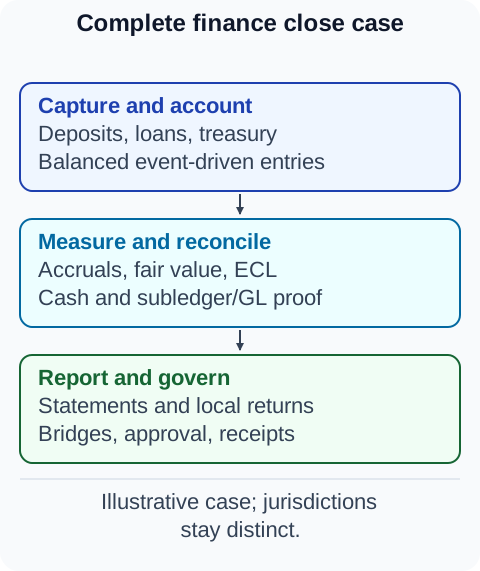 Figure 2. Different final measures.
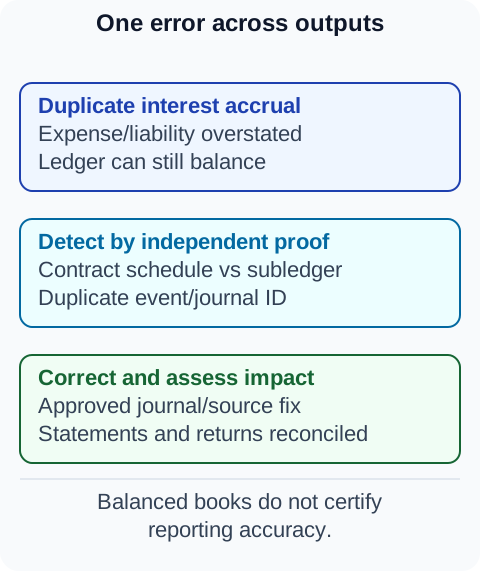
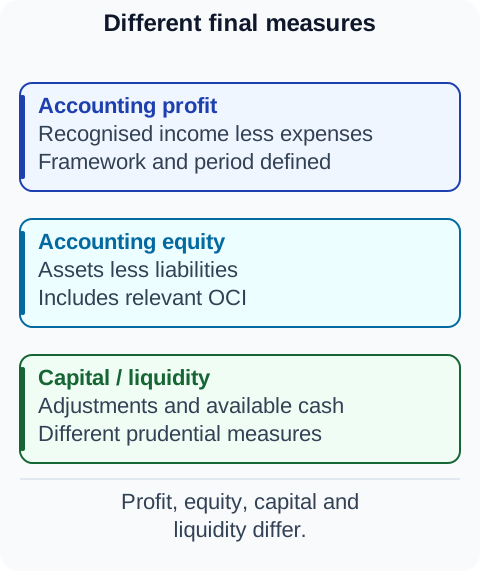 Figure 3. One error across outputs.
12. Tables
| Measure | Explicit calculation |
|---|---|
| Initial loan carrying amount | 2,000−10+4=1,994 |
| Incremental PBT impact | 40+5−120−10=−85 |
| PBT and PAT | 265−85=180;180−45=135 |
| Closing CET1 | 6,100+135−100−25−150=5,960 |
| Closing RWA | 50,000+1,200+200=51,400 |
| CET1 ratio | 5,960/51,400=11.5953307% |
| LCR | 16,500/10,000=165% |
| NSFR | 62,000/50,000=124% |
13. Illustrative bank case study
The quarter is evidenced. Example Bank’s fictional reviewers can reproduce the event journals and all ratios above, identify the legal/accounting assumptions and list unresolved items. The result illustrates integration rather than a real supervisor endorsement, investor reliability premium or claim that every future quarter will be quiet.
14. BA, developer, tester and operations guidance
- BA: link events to journals, measures, perimeters and outputs.
- Developer: preserve stable event effects, versions and adjustment history.
- Tester: reproduce arithmetic independently and test changed facts.
- Operations: attest actual evidence, open items and acceptance status.
15. Common mistakes
- Counting integral fees as immediate income.
- Treating refinance principal as profit.
- Subtracting hypothetical capital allocation from actual CET1.
- Deriving liquidity ratios from raw cash movements alone.
- Treating all economic hedges as designated accounting hedges.
- Calling every data correction a restatement.
- Treating a green scorecard as compliance certification.
16. Key takeaways
An integrated Finance model preserves the distinctions between contractual events, accounting measurement, capital eligibility, regulatory exposure, liquidity weighting and reporting scope. Reproducible journals and explicit bridges make the whole quarter reviewable.
17. References and verification notes
- IFRS 9: accounting classification/impairment and prudential risk measures are separate; use endorsed period version.
- Basel capital framework: Capital eligibility and deductions differ from accounting equity. Fictional CET 1 bridge assumptions are not local requirements.
- Basel LCR: Eligible HQLA divided by stressed net outflows differs from cash profit and structural funding. Domestic implementation governs actual requirements.
- Basel NSFR: Weighted available stable funding divided by required stable funding, not a raw funding sum. Check current local implementation.
- BCBS 239: 14 principles:11 bank-focused plus 3 supervisory; scope and domestic application need assessment. No prescribed universal database, staffing or response deadline.
All amounts, events, ratios and capital eligibility/deduction assumptions are fictional. Tax and capital distribution conditions are stated scenario assumptions, not current local calibrations. Primary IFRS and Basel references describe separate frameworks; binding jurisdictional implementation and actual bank facts govern operational decisions. Course complete—use the worked examples to practise those distinctions.