Chapter 099: Automation and AI in Finance Operations
Section 20: Finance Data, Change Delivery and Practical Capstones · Chapter 099 of 100
Automation can match records, suggest decisions or post authorised accounting events. This chapter separates those actions and tests the evidence, authority, economics and recovery controls for each.
1. Chapter opening
Deterministic rules can automate standard Finance events; machine-learning tools can rank anomalies or suggest matches; generative tools can draft explanations from controlled evidence. Match status, accounting adjustment and external settlement are different actions. Human management remains accountable for authorisation, controls and reporting even when an approved deterministic process posts without per-item manual approval. AI autonomy and oversight follow the actual task risk, not an assertion that all automated postings are prohibited.
2. Learning objectives
- Separate auto-matching, suggested disposition and accounting posting.
- Define validation, sampling and escalation for each risk.
- Preserve decision evidence without promising exact stochastic replay.
- Verify generated numbers and causal explanations against sources.
- Calculate evidenced cost/benefit and test recovery.
3. Business context
Automation can reduce repeated work but may scale a bad rule or concentrate operational dependency. Measure actual avoidable costs, false-match consequences, exception workload, maintenance and monitoring. No universal 30–50%saving,90%STP,0.5%error or staffing benchmark is established here. Redeploying salaried staff creates capacity; it is not automatically cash saved. A high match rate can be harmful if the model pairs unrelated items to shrink the queue.
4. Finance and accounting view
4.1 Matching without fictitious journals
Assume a reconciliation compares a bank statement with a GL cash account. An exact reference/amount/date match can mark two records reconciled under approved rules; it normally creates no new journal because both events were already recorded. An unmatched statement item may need investigation, and only an authorised accounting disposition can produce a correction/accrual journal. An amount difference below 1,000 is not permission to plug the account. Any bank-policy tolerance must specify whether it concerns investigation priority, permissible rounding or authorised write-off, with legal/accounting controls.
Fuzzy candidate matches need features, confidence, conflict checks and evidence. Avoid matching one item twice, netting unrelated breaks or hiding partial amounts. Model approval must test item-level false matches and economic loss, not only aggregate accuracy. For example,997 correct among 1,000 reviewed gives 99.7%sample accuracy, but the sample design and confidence interval determine what can be inferred about the whole population. Three false matches could still include the most material items. Stratify sampling by amount, model confidence and risk; validate labelled outcomes rather than treating historical manual actions as inherently correct.
4.2 Generated narratives and evidence
Generate drafts from dated, access-controlled figures and approved analysis. A5m decline in income is a numerical observation; “caused by a market disruption” needs separate causal evidence for the correct period. A retrieval citation can be wrong, stale or irrelevant; check the underlying source and date. Low temperature, banned phrases, retrieval and guardrails reduce some risk but cannot make hallucinations impossible. Accounting/regulatory interpretation needs competent review, not only a source-link check.
4.3 Auditability, permissions and recovery
For deterministic rules, preserve inputs, rule/configuration version and outputs for reproducibility. For ML/GenAI, archive the actual historical output, model/provider version, prompts, retrieved documents, settings, decision features and reviewer edits. Exact rerun reproduction may be unavailable because of randomness, unavailable model versions or vendor changes; preserving the issued result and its evidence is essential. Do not promise that every AI text will regenerate verbatim years later.
Use least-privilege service identities and segregation of duties; a bot cannot approve its own exceptional accounting adjustment. Govern prompts, models, rules, training data and deployment changes. Retention periods follow actual legal/regulatory and business obligations; seven years and model-life-plus-three are not universal rules. Input sanitisation alone does not defeat prompt injection: isolate untrusted documents/instructions, restrict tool/data authority and validate outputs. Test kill switches, queue preservation, idempotent retry and forward corrections for already committed/settled work.
4.4 Drift and fallback
Track false-match severity, duplicate/omitted items, exceptions, overrides, data shifts and reviewed narrative errors against an approved validation baseline. Set explicit warning/action thresholds and risk-based response timing. A statistical input shift calls for investigation; it is not always confirmed performance failure, and an unmonitored date does not automatically prove every subsequent result invalid. Fallback can use a controlled alternative process, reduced essential scope or manual procedures if capacity is demonstrated; pretending a small remaining team can instantly handle full volume is not resilience.
5. Product and customer impact
Customer-facing automation needs lawful and accurate decisions, complaint handling, fairness and communications under the actual product/jurisdiction requirements. Automation is not universally forbidden from making a refund; determine authority and required review for the decision. An automated outcome must remain challengeable and correctable where required. Do not train or retrieve personal/confidential data merely because it exists in a Finance archive.
6. Regulatory and supervisory view
Apply the current relevant model-risk, operational-resilience, outsourcing, privacy, conduct and AI requirements. NIST’s AI Risk Management Framework is a voluntary tool, not banking law. Assess specific AI-use risk categories and applicable local obligations and dates; do not treat every Finance drafting tool as a high-risk credit decision, or copy a proposal into current law. Preserve validation and vendor/access evidence appropriate to actual risk.
7. Systems and data view
The control stack can include an orchestrator, rule/workflow engine, model validation and monitoring, restricted generation gateway, evidence archive and incident/recovery tooling. Service permissions and review cadence follow risk rather than a universal quarterly schedule. Bind source snapshots and recognition periods to runs; scheduling success does not prove accounting completeness. A generated narrative must not bypass approved disclosure ownership.
8. End to end process
- Define the decision/action and its authority.
- Assess task risk and data legality.
- Build deterministic checks and appropriate model validation.
- Validate labelled outcomes independently.
- Deploy with controlled permissions and monitoring.
- Review exceptions and factual/causal output evidence.
- Preserve issued decisions and changes.
- Test fallback and committed-event recovery.
9. Controls and risks
| Risk | Control | Evidence |
|---|---|---|
| False matches hidden by high STP | Item/risk-stratified validation | Labelled review outcomes |
| Small breaks plugged automatically | Separate authorised adjustment rule | Journal approval |
| Fabricated causal explanation | Dated source and competent verification | Draft/edit record |
| Excess tool/data authority | Least privilege and untrusted-input isolation | Access/security tests |
| Historical output unreproducible | Preserve issued result and source/version evidence | Audit archive |
| Failure overwhelms manual team | Demonstrated fallback capacity | Timed recovery drill |
10. Practical examples
Fictional cost case: build 800,000; verified avoidable manual cost 600,000/year; incremental maintenance 150,000/year; net annual cash saving 450,000. Simple steady-state payback=800,000/450,000=1.7778 years, or 21.33 months, before ramp-up, discounting, tax and other costs—not 18 months. If the 600,000 is merely redeployed salaries, report capacity benefit and reassess cash payback.
Narrative error: the draft attributes a 15m movement to an event from another quarter. The reviewer checks dates and approved causal analysis, corrects the draft and logs the model error. One added gate reduces a known failure mode; it does not establish future invented events are impossible.
Period mismatch: scheduling drift creates 12 incorrect matches. Correct reconciliation status; only reverse journals that were actually and incorrectly posted. Reconcile any committed cash/settlement effects. A corrected trial balance alone does not prove zero customer or financial impact.
11. Diagrams
Figure 1. Choose automation safely.
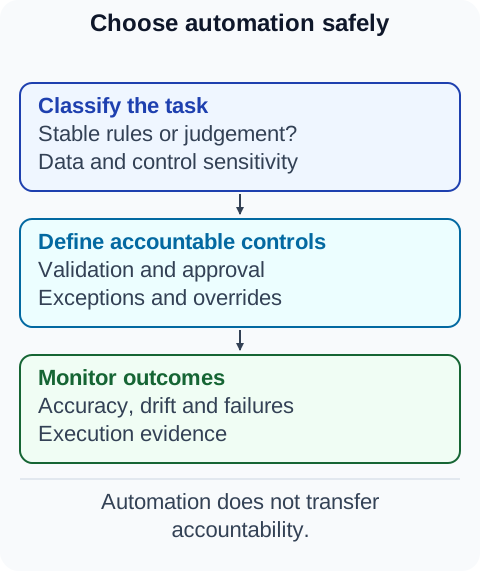 Figure 2. Automation and AI roles.
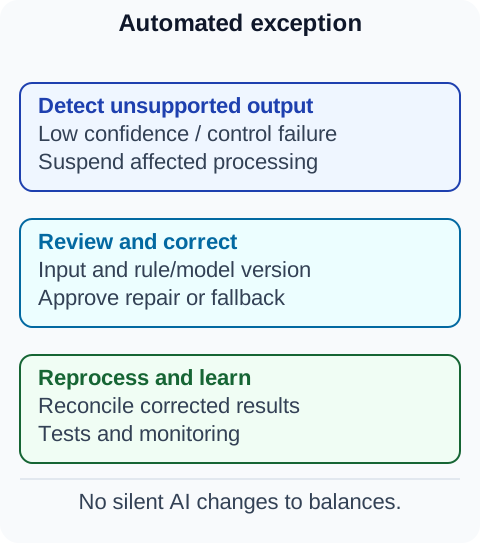
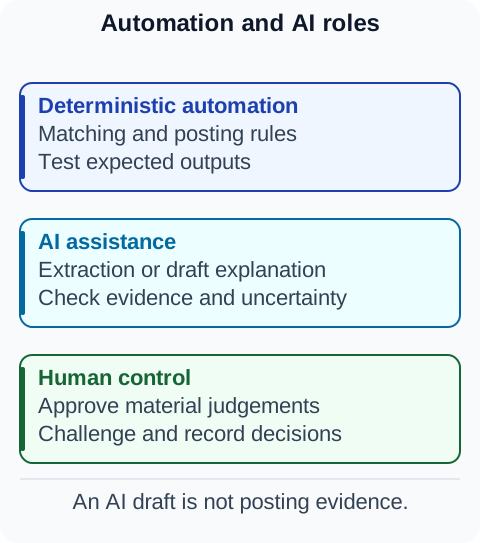 Figure 3. Automated exception.
12. Tables
| Task | Controlled treatment |
|---|---|
| Exact reconciliation match | Approved rule marks existing items matched; normally no journal |
| Fuzzy candidate | Conflict/amount/risk checks and appropriate review |
| Accounting adjustment | Explicit authorised journal, not a matching tolerance plug |
| Anomaly detection | Validated ranking with accountable disposition |
| Disclosure narrative | Source-grounded draft, competent review and preserved issued output |
| Customer decision | Actual authority, fairness/legal obligations and correction path |
13. Illustrative bank case study
Historical shortcuts became training labels. In this fictional bank, a model trained on manual matches repeated impermissible netting. Independent item-level review found unrelated items paired despite a high auto-match rate. The remediation corrected labels/rules, reprocessed affected populations and reconciled required journals without claiming a real bank loss or universal savings ratio.
14. BA, developer, tester and operations guidance
- BA: distinguish status changes, authorised journals and external actions.
- Developer: restrict authority and preserve actual decisions/source versions.
- Tester: validate false matches, source dates, prompt injection and recovery.
- Operations: challenge exceptions and demonstrate fallback capacity.
15. Common mistakes
- Treating a match as permission to post a plug.
- Validating accuracy without loss severity or sample design.
- Treating historic human outcomes as correct labels.
- Assuming citations/temperature eliminate hallucinations.
- Promising exact replay of every stochastic output.
- Counting redeployment as verified cash saving.
16. Key takeaways
Automate authorised repeatable work and preserve accountable judgement. Validate economic outcomes, restrict authority, verify generated claims and retain the actual issued evidence and recovery path.
17. References and verification notes
- NIST AI Risk Management Framework: A voluntary risk-management framework, distinct from banking law. It does not guarantee elimination of hallucinations.
- ICO lawful-basis guide: current UK guidance updated 2 April 2026 lists seven lawful bases, including recognised legitimate interest; select the applicable basis and additional conditions rather than assuming consent is universal.
- BCBS 239: 14 principles:11 bank-focused plus 3 supervisory; scope and domestic application need assessment. No prescribed universal database, staffing or response deadline.
Fictional metrics and thresholds are control examples, not universal requirements. Cash-payback arithmetic states its assumptions. NIST is voluntary; privacy guidance and bank-specific legal/model-risk obligations need separate applicability assessment.