Chapter 082: Reporting Scope and Obligations
Section 17: Regulatory Reporting Foundations and Delivery · Chapter 082 of 100
Which entities consolidate? Does the small subsidiary report COREP solo? Is the branch a separate return? Scope errors invalidate entire submissions — right numbers, wrong perimeter. This chapter defines reporting scope (solo, consolidated, sub-consolidated), proportionality relief, thresholds and frequencies, with the calendar discipline that keeps obligations met.
1. Chapter opening
Scope answers: which legal entities, branches and activities sit inside each return (accounting vs regulatory consolidation differ — insurance, commercial holdings and some SPVs treated differently); proportionality tiers obligations by size/complexity (small-bank simplifications, reduced templates); thresholds trigger returns (trading-book size, cross-border activity, systemic designation); frequencies follow risk velocity (daily liquidity, quarterly capital). This chapter maps scope to obligation with worked perimeters.
Determine the reporting perimeter before extraction, mapping and validation. A material omission can require broad correction, while another scope error may affect only specified cells or periods. Assess the amount, affected requirements, governance and authority’s correction process; findings, remediation and costs depend on the facts rather than an automatic classification of every scope error as a material governance failure.
2. Learning objectives
- Distinguish accounting vs regulatory consolidation with three difference examples.
- Apply proportionality: which reliefs exist for small/non-complex banks (verify locally).
- Read threshold triggers (size, activity, designation) into the obligation register.
- Build a scope-frequency matrix per entity in a group.
- Explain branch vs subsidiary reporting consequences.
3. Business context
Scope decisions shape structure: subsidiary vs branch choices carry different solo-reporting loads; acquisitions import scope obligations (and data gaps) on day one; proportionality relief is strategic (staying simple has reporting value); threshold breaches (trading-book growth crossing simplified-treatment limits) trigger step-changes in cost. New activities need scope assessment before launch — "we'll report it somehow" fails at first deadline.
The business case for scope governance is clear. A bank that acquires a subsidiary in a foreign jurisdiction must incorporate that entity into its reporting perimeter from day one — not from the first regulatory filing after acquisition. The scope assessment must occur during due diligence, before deal close, because the reporting obligations, data requirements, and system implications must be understood and budgeted. The practical challenge is that scope obligations are determined by the regulatory framework in each jurisdiction, which may differ from the accounting consolidation treatment. An entity that is equity-method accounted (not consolidated under IFRS 10) may nonetheless be required to be included in the regulatory consolidated group. This divergence between accounting and regulatory scope creates reporting complexity that must be managed systematically.
Proportionality relief is a strategic asset. Banks that qualify for simplified reporting (reduced templates, lower frequency, fewer granular disclosures) save directly on reporting costs — but they also save on the governance infrastructure required to support full reporting (additional systems, staff, controls, and audit procedures). The decision to remain within proportionality thresholds is therefore a business decision, not merely a compliance question. A bank considering whether to grow its trading book above the simplified-treatment threshold must weigh the revenue opportunity against the reporting cost — and the reporting cost is not just the immediate increase in templates and systems, but the permanent increase in governance infrastructure.
| Scope | Covers | Example consequence |
|---|---|---|
| Solo | Single legal entity | Subsidiary files own COREP |
| Sub-consolidated | Intermediate group | Regional holding reports |
| Consolidated | Whole group | Group ratios bind distributions |
| Branch | Extension of parent | Host reporting, home capital |
4. Finance and accounting view
4.1 Consolidation and capital treatment are separate
Determine accounting control under the relevant framework, then determine each regulatory perimeter using its own law. Insurance entities may be consolidated in financial statements but excluded from line-by-line prudential consolidation, with the investment subject to the applicable capital deduction, risk weight or permitted treatment. Deconsolidation is not the same event as an own-funds deduction.
Non-financial holdings require both a perimeter decision and the applicable investment treatment. Do not label every holding above a generic 15% threshold as deducted: EU qualifying holdings rules have their own scope and possible 1,250% treatment or prohibition.
Securitisation significant risk transfer governs recognition of prudential capital relief; it does not by itself determine IFRS control, accounting derecognition or regulatory consolidation. A synthetic securitisation normally transfers specified credit risk without selling the loan asset. Document all three decisions separately, including retained tranches and support obligations.
Eliminate intragroup balances only when both entities are in the relevant perimeter. Maintain an internal entity-by-entity bridge and publish the accounting-to-regulatory reconciliation where the disclosure requirements call for it; not every internal scope record is public.
4.2 Proportionality and thresholds (verify locally)
Small/non-complex criteria (size, trading-book share, cross-border activity, no internal models) unlock simplified templates, reduced frequency or waivers (solo waivers within groups under conditions). Threshold examples: trading-book size for simplified market-risk treatment; systemic scores for buffer/designation; derivative exposure for margin-rule phases. Monitor proximity to thresholds — crossing needs readiness, not surprise.
Proportionality criteria are rule-specific. The EU small and non-complex institution definition includes a 5bn average total-asset criterion alongside multiple other conditions and national discretion. It is not a blanket exemption from all COREP reporting. Market-risk simplifications use their own value and percentage tests, calculation dates and transition conditions. There is no universal 15% trading-book ceiling. Internal-model reporting differs by approach; the Basel final operational-risk standard replaced the Advanced Measurement Approach, so AMA must not be presented as a current generic implementation option.
For each relief, record the rule paragraph, calculation perimeter, look-back period, conditions, threshold value, notice obligation and first reporting date if eligibility is lost. Monitor actual and projected positions using an approved early-warning margin. Do not manufacture a common notification deadline for all regimes.
4.3 Deep dive: booking-model governance and waiver-condition monitoring
Booking location, risk management, legal entity and customer service may differ, with accounting, capital, liquidity and reporting consequences. Assess substance, outsourcing/delegation, transfer pricing and supervision before a material change. Identify the actual approval or notification duties for the home and host jurisdictions; “dual-supervisor comfort” is not a universal legal permission requirement. Keep entity capabilities, contracts, local controls and reporting impacts in the approval pack.
Separate inter-entity legal transactions from internal branch allocations. Intragroup transfer-pricing and tax requirements apply according to the arrangement and jurisdiction; an internal branch allocation is not automatically an external arm’s-length trade or a separate statutory receivable. Reconcile accounting eliminations, risk transfer and prudential recognition independently. Demonstrate that the booking entity meets the applicable governance and local substance requirements.
Remote booking needs a documented assessment of who trades, books, manages and supervises the risk. Legal and regulatory teams resolve applicable approvals, notifications and access rights before launch. Explain any material change to the competent authority when required; preserve actual correspondence and conditions instead of inventing a blanket requirement for two supervisors to consent to every trade.
Maintain the actual waiver decision and continuously assess its conditions, including any guarantees, transfer restrictions and risk-management arrangements. Record the relevant capital, liquidity and reporting waiver separately. If a condition fails, follow the decision and governing rule for notification, restored requirements and remediation. The timeline cannot be inferred as “within days” for every waiver.
Distinguish waivers of individual prudential requirements from waivers or reduced scope of specific reporting obligations. They are not automatically identical. Preserve the actual decision, entities covered, legal conditions and notification requirements. Capital and liquidity waivers can have different criteria; the existence of a parent guarantee does not alone remove a subsidiary's solo filing duty.
5. Product and customer impact
Scope affects booking models: where trades are booked decides solo ratios and host obligations (booking-model governance); branch vs subsidiary shapes customer onboarding (parent vs local KYC reliance); proportionality keeps small-bank products viable (reporting cost passed through otherwise).
Customer-facing implications of scope include: KYC (know your customer) reliance — branches and subsidiaries must meet applicable local AML obligations, group arrangements and permitted reliance/delegation conditions; neither legal label alone proves that parent KYC reliance is allowed or prohibited; product availability — a subsidiary subject to full reporting obligations may face higher compliance costs that affect product pricing; and resolution planning — the scope of the resolution entity affects which customer deposits and contracts fall within its perimeter. These implications should be considered during structural decisions (subsidiary vs branch, acquisition vs organic growth) and documented as part of the scope assessment.
6. Regulatory and supervisory view
Scope/perimeter disputes are examination staples (consolidation tricks to exclude risks draw findings and restatements). Waiver conditions monitored continuously (breach = obligations snap back). Cross-border: home/host allocation of supervision (colleges, joint decisions) follows scope. Verify every threshold, waiver and frequency in the current applicable rulebook.
Supervisory attention to scope is increasing because scope manipulation — structuring to exclude risks from regulatory capital — was a feature of pre-crisis behaviour. Supervisors therefore examine scope decisions with scepticism, looking for evidence that the structure reflects genuine business substance rather than regulatory arbitrage. The practical implication is that scope decisions must be documented with business rationale (why this entity, why this structure), not just regulatory analysis (what reporting does this create). A structure whose substance or compliance is unclear can prompt supervisory challenge; an actual finding depends on the applicable rule and evidence, not appearance alone.
The home authority supervises the group and relevant parent obligations, while host authorities have applicable responsibilities for local subsidiaries and branches. A branch is part of the parent's legal entity and may contribute to consolidated and home reporting while also filing host statistics or other returns. Supervisory colleges coordinate responsibilities; accounting consolidation does not allocate all legal supervision or put every branch outside the group.
7. Systems and data view
Scope engine: entity master with scope flags per return, consolidation hierarchy versioned, threshold monitors with proximity alerts, obligation register (return × entity × frequency × owner × deadline), calendar integration. Controls: scope-change governance (acquisitions, restructurings), threshold-breach escalation, scope-bridge tie-outs each cycle.
The scope engine is the master reference for all reporting obligations. It must: (1) maintain an entity master with scope flags for each return type (is entity X included in COREP? In FINREP? In statistical returns?); (2) version the consolidation hierarchy (structural changes create new versions that must be retained for audit trail); (3) monitor thresholds with proximity alerts (the system alerts at the approved, threshold-specific early-warning margin, giving time for readiness planning); (4) maintain the obligation register (every return × entity × frequency × owner × deadline, with automated calendar generation); and (5) integrate with the calendar system (deadlines are generated automatically from the obligation register). The scope engine must handle structural changes: when an entity is acquired, the system must update scope flags, generate new obligations, and create the scope bridge for the new entity.
8. End to end process
- Maintain entity/scope master. 2. Monitor thresholds continuously. 3. Derive obligations per entity per return. 4. Calendar with owners/deputies. 5. Execute, validate, submit per scope. 6. Reconcile scope internally and publish the required accounting↔regulatory bridge. 7. Reassess on structural change.
The process is continuous, not cyclical. The entity/scope master is maintained in real-time as structural changes occur. Threshold monitoring is continuous (automated alerts when proximity thresholds are approached). Obligation derivation follows from the scope master and threshold status. Calendar generation is automated. Execution follows the calendar. Bridging is maintained at each reporting cycle. Structural change triggers a full scope reassessment — the scope of every return must be re-evaluated when an entity is acquired, disposed, or restructured.
9. Controls and risks
| Risk | Control | Evidence |
|---|---|---|
| Wrong perimeter | Scope master + change governance | Scope approvals |
| Missed threshold breach | Proximity monitoring | Alert logs |
| Waiver-condition drift | Continuous condition testing | Condition packs |
| Unbridged scope gaps | Scope-bridge tie-out | Bridge reports |
| Scope change not reflected | Structural-change trigger with scope reassessment | Change log |
| Threshold trajectory unmonitored | Quarterly trajectory review with growth scenarios | Trajectory reports |
10. Practical examples
A — Acquisition surprise (fictional): a purchased loan vehicle was wrongly omitted from the specified perimeter, excluding assumed2bnRWA. Assess the actual affected returns and correction process. B — Threshold trip (fictional): a bank crosses a simplified-treatment threshold. Its rule register determines whether and when fuller reporting applies, including any transition/review conditions; the next quarter is not a universal consequence of every threshold crossing.
10.3 Worked example: monitoring a hypothetical threshold
This example uses an invented 15% limit solely to illustrate implementation; it is not an EU market-risk threshold. At 11% of assets, the trading book grows 8% annually relative to a constant denominator: after two years the share is 11% × 1.08² = 12.83%, not above 15%. It approaches 15% after four years and first exceeds it in year five (11% × 1.08⁴ = 14.97%, marginally below; year five =16.16%). A readiness trigger at 12% leads to shadow calculations, approvals and preparation under the actual applicable transition rules. The cost, notification deadline and next filing date require institution-specific evidence rather than a claimed universal 1:8 cost advantage.
11. Diagrams
Figure 1. Determine reporting scope.
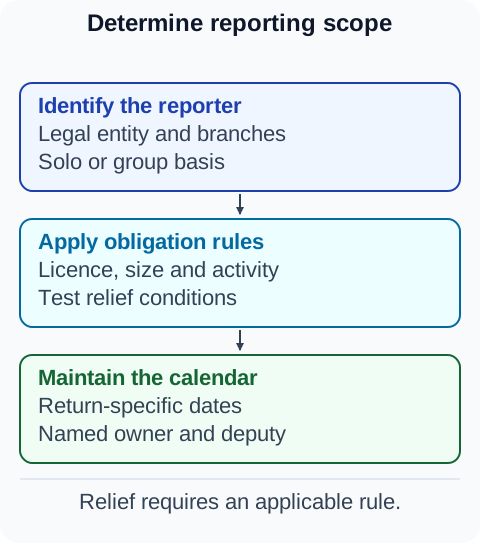 Figure 2. Reporting boundaries.
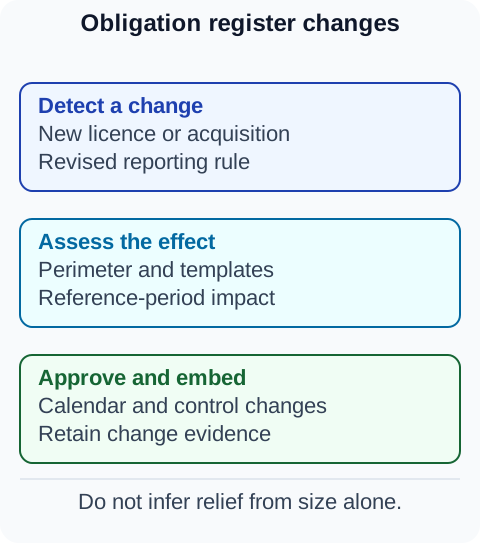
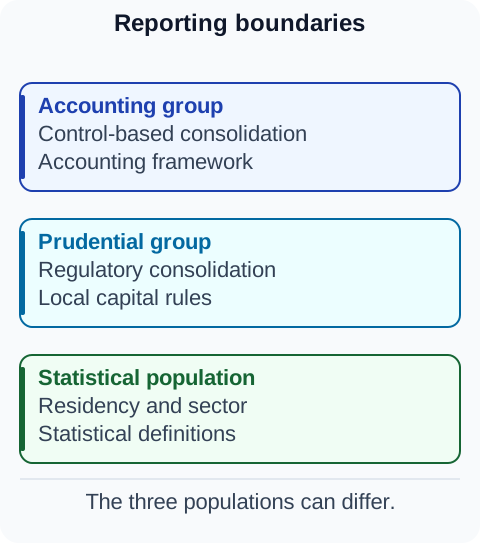 Figure 3. Obligation register changes.
12. Tables
Table 1 — Scope matrix extract (illustrative)
| Entity | COREP | FINREP | Stats |
|---|---|---|---|
| Parent solo | Yes | Yes | Yes |
| Subsidiary A | Waived (conditions) | Yes | Yes |
| Branch B | Parent return plus applicable host obligations | Via parent | Host |
| Sub-group C | Sub-consolidated | Sub-consolidated | Yes |
Table 2 — Threshold watchlist (verify locally)
| Threshold | Triggers |
|---|---|
| Size (assets) | Disclosure/buffer tiers |
| Trading-book share | Simplified vs full market risk |
| Cross-border activity | Additional templates |
| Systemic score | Buffers, TLAC, planning |
13. Illustrative banking case study
The vehicle outside the perimeter (fictional). A bank securitises a loan portfolio and assumes this removes the vehicle and assets from every reporting view. Finance separately assesses accounting control and derecognition; risk assesses capital relief and retained exposures; regulatory reporting applies the legal consolidation rules. The conclusion may differ across the three views. A retained first-loss position is evidence to assess, not proof that every securitisation fails significant risk transfer.
14. BA, developer, tester and operations guidance
- BA: Maintain the obligation register (return × entity × frequency × owner) as a living requirement artefact.
- Developer: Flag scope per entity per return; monitor thresholds; version hierarchies.
- Tester: Scope-change scenarios (acquisition, waiver loss, threshold trip); bridge tie-outs.
- Operations: Calendar by scope; escalate threshold proximity quarterly.
The BA should maintain the obligation register as a living document — not a one-time exercise. Every structural change (acquisition, disposal, restructuring, new product, new jurisdiction) must trigger a register update. The register should include: the entity, the return type, the scope status (in-scope, out-of-scope, waived), the frequency (daily, monthly, quarterly, annually), the owner (named individual, not a role), the deputy (named individual), the deadline (specific date or "T+X business days after period end"), and the submission channel (electronic portal, paper, etc.). The developer should build scope-flagging into the system: each entity has a scope flag for each return type, and the flag determines whether the entity appears in the obligation register for that return. Threshold monitoring should be automated: the system calculates threshold ratios quarterly and generates alerts when proximity is breached. The tester should simulate scope-change scenarios: acquisition of a new entity (does the register update correctly?), loss of a waiver (does the entity reappear in the solo obligation register?), threshold trip (does the obligation change from simplified to full?). Operations should calendar by scope and escalate threshold proximity quarterly to the Board risk committee.
15. Common mistakes
- Assuming accounting and regulatory scopes match.
- Discovering thresholds by breaching them.
- Waiver conditions unmonitored until revoked.
- Branch/host obligations forgotten in booking-model changes.
- Required public scope reconciliations missing, or internal scope bridges untied.
- Scope assessment not performed during acquisition due diligence.
- Threshold trajectory not monitored — only the current position.
16. Key takeaways
- Scope (solo/sub/group/branch) decides every return's perimeter — master it centrally.
- Reconcile accounting and regulatory views; publish the required scope disclosures.
- Proportionality is strategic; thresholds need readiness plans.
- Structural change triggers scope reassessment before close.
- Waivers are conditional privileges, monitored continuously.
- Scope decisions require business rationale, not just regulatory analysis — supervisors examine intent, not structure.
17. References and verification notes
- Consolidation scope, proportionality criteria, thresholds, waiver conditions and frequencies per applicable rulebook (CRR/PRA/US/RBI) — verify current texts locally; accounting scope per IFRS 10/IAS 28 as endorsed.
- EU CRR, as amended: prudential consolidation, waivers, qualifying holdings and small/non-complex definition. The consolidated text and relevant reporting ITS determine specific obligations.
- IFRS 10: accounting control; securitisation capital relief requires a separate prudential assessment.
- Matrices are illustrative training designs; adopt approved registers.