Wire Controls, Beneficiary Validation, Sanctions and Recalls. A practitioner deep dive into wire authority, Article 4A security procedures, beneficiary validation, fraud and OFAC sanctions controls, release governance, Fedwire return requests, recovery, reconciliation and audit evidence.
A wire payment can travel from a customer instruction to final interbank settlement in seconds or minutes, but the controls around that payment are rarely simple. The operational challenge is not only to move money quickly. It is to prove that the bank had authority to act, that the payment data was fit for purpose, that the intended beneficiary and destination were handled correctly, that sanctions and fraud controls were applied, that release occurred under the right authority, and that any later request to stop or recover the payment was handled according to the payment's actual legal and settlement state.
That is the focus of Chapter 20.
Chapter 16 explained the Fedwire Funds Service itself. Chapter 17 explained CHIPS and liquidity-efficient settlement. Chapter 18 explained the domestic wire product from initiation through posting and reconciliation. Chapter 19 explains cross-border USD correspondent banking and SWIFT. Chapter 20 is different. It is the control layer that sits around high-value wire processing before, during and after external execution.
A useful operating model is:
customer authority → beneficiary/payee control → data and routing validation → fraud and sanctions controls → release governance → external execution → settlement-state awareness → recall/return request if needed → investigation and recovery → reconciliation, reporting and evidence.
The most important lesson is that control words must not be used loosely. Authorization is not authentication. Beneficiary validation is not guaranteed beneficiary ownership. A sanctions alert is not automatically a sanctions match. A recall request is not a reversal. A return request is not a returned payment. Settlement finality is not the same as impossibility of later recovery.
For a roughly 60-minute core session, spend about 35 minutes on Sections 3–6, Sections 7–10 and Sections 11–15. For the next 10 minutes, use the chapter’s three diagrams to separate validation assurance, sanctions decisions and return-of-funds messages. Use 10 minutes to work through one case in Section 16, then spend the final 5 minutes explaining: Why does a positive response to a recall request still need to be reconciled to actual returned value? Treat these timings as a study guide. The remaining sections, additional cases and extended reference material are follow-up study; completing the whole chapter takes longer.
Chapter navigator
- Why wire controls are a separate banking capability
- Control ownership across customer, bank and network
- Customer authority, entitlements and UCC Article 4A security procedures
- Beneficiary and payee setup, maintenance and change controls
- Beneficiary data validation: routing, account and name boundaries
- Misdescription, identifying numbers and the legal payment-order boundary
- Fraud controls before a wire is released
- OFAC sanctions screening and risk-based sanctions compliance
- Sanctions alerts, holds, blocks, rejects and false positives
- Release governance, cutoffs and final pre-send control
- Post-release states and the shrinking intervention window
- Cancellation, recall and Fedwire return-request messages
- Receiving-bank response and the actual return of funds
- Investigations, customer communication and evidence
- Reconciliation, reporting, audit and control governance
- End-to-end cases, BA checklist and testing
1. Why wire controls are a separate banking capability
A wire system can be technically healthy while a payment is unsafe to release. That is why banks need to think of wire controls as a separate business capability rather than assuming the rail itself provides all protection.
Fedwire or CHIPS can validate network-level requirements, message structure and participant reachability. Those systems cannot know whether a corporate user's approval was legitimate, whether a beneficiary was changed after an email-account compromise, whether a payment is inconsistent with the customer's normal behavior, whether the account number was copied incorrectly, or whether the bank has a sanctions concern requiring intervention.
Those questions belong primarily to the sending and receiving banks and to the customer's own control environment.
A practical wire control framework therefore sits across several layers:
customer layer — identity, authority, entitlements, approval and beneficiary ownership processes;
bank channel layer — authentication, session security, API/file controls, maker-checker and instruction integrity;
payment-control layer — data validation, routing, sanctions, fraud, limits and duplicate controls;
release layer — final release authority, cutoff and settlement-route decision;
network layer — network message validation, acceptance, settlement and nonvalue investigation/return-request messaging;
post-settlement layer — investigation, return request, beneficiary-bank response, returned value, accounting and reconciliation.
The bank needs evidence across all six layers.
A common implementation mistake is to merge them into one generic status called APPROVED. A payment may be customer-approved but still waiting for sanctions screening. It may be compliance-cleared but waiting for treasury release. It may be released by the bank but not yet accepted by the network. It may be network-settled but not yet posted to the beneficiary customer. Each state has a different control meaning.
Controls should follow financial state
The strongest wire platforms change their permitted actions as financial state changes.
Before bank release, a payment can usually be edited, rejected or cancelled according to the bank's product rules. After external transmission, editing should become tightly restricted. Once external settlement is final, the original value movement should be treated as history. Recovery becomes a new process rather than rewriting the original payment.
This sounds obvious, but many operational errors happen because a user interface presents the same buttons at every stage.
A safe system asks: what has already happened financially? before allowing the next action.
2. Control ownership across customer, bank and network
Wire controls work only when ownership is clear. A bank cannot outsource responsibility merely because a processor performs a technical step, and a customer cannot assume the bank will detect every internal fraud scenario inside the customer's organization.
At the customer, payment authority normally starts with a legal and contractual relationship. Corporate customers define who may create payees, who may create payments, who may approve, what value limits apply, and which accounts and payment types users may access. The bank maps those instructions into entitlements and security procedures.
At the bank, different teams own different controls. Channel security may own authentication. Payments product may own eligible payment types and cutoff rules. Financial-crime teams may own sanctions policy. Fraud teams may own behavioral controls. Operations may own manual review and release queues. Treasury may own liquidity controls. Technology teams implement the rules, but they do not replace business ownership.
At the network, Fedwire or CHIPS owns its own admission, message and settlement rules. A network acceptance is evidence that the payment passed the network's relevant controls. It is not evidence that every customer-level or bank-level control was correct.
The RACI matters during incidents
Consider a payment that is delayed because the beneficiary's routing number was changed in the customer's master data, passed bank validation, but later triggered a fraud alert because the new beneficiary was unusual.
Who owns the decision?
The channel may confirm the change was submitted by an authenticated user. The fraud engine may say the behavior is abnormal. Operations may be able to contact the customer. The relationship team may know the customer is executing an acquisition. Compliance may have no sanctions concern.
No single technical component has enough context.
A bank-grade operating model therefore defines:
- who can place a hold;
- who can release from hold;
- which decisions require dual approval;
- what customer confirmation is sufficient;
- what evidence must be captured;
- which actions are prohibited after external release;
- who owns a recovery request after settlement.
Third parties do not remove accountability
Banks may use processors, fraud vendors, sanctions-screening platforms, payee-validation providers or managed connectivity. Contracts should define data ownership, availability, decision latency, audit evidence and outage behavior.
If a screening vendor is unavailable, the payment platform should not silently bypass screening. It should enter a controlled state according to policy.
The correct principle is fail safely, not fail invisibly.
3. Customer authority, entitlements and UCC Article 4A security procedures
U.S. commercial wire controls cannot be understood properly without UCC Article 4A. Article 4A provides a legal framework for funds transfers and gives particular importance to agreed security procedures between a customer and receiving bank.
Under section 4A-201, a security procedure is a procedure established by agreement for verifying that a payment order or amendment/cancellation is that of the customer, or for detecting error in transmission or content. Examples can include codes, identifying words or numbers, encryption, callback procedures or similar security devices. A signature comparison by itself is not enough to constitute a security procedure under that definition.
Section 4A-202 then addresses authorized and verified payment orders. In simplified operational language, if the bank and customer have agreed on a security procedure, the effectiveness of a payment order can depend heavily on whether the procedure was commercially reasonable and whether the bank accepted the order in good faith and in compliance with the agreed procedure and relevant written restrictions.
This is why payment security is not merely an IT login issue.
Authentication, authorization and security procedure are different
Authentication asks whether the system has established the user's identity to the required level.
Entitlement asks what that user is permitted to do.
Authorization asks whether the customer has approved the payment under the agreed authority model.
Security procedure is the agreed mechanism used to verify the order or detect error for Article 4A purposes.
A bank may implement these concepts through one digital experience, but requirements should keep them distinct.
Commercial reasonableness is contextual
Article 4A-202 expressly frames commercial reasonableness by considering factors such as the customer's wishes, circumstances known to the bank, the size/type/frequency of payment orders, alternatives offered, and procedures generally used by similarly situated customers and banks.
That means a bank should not treat security as a single static control for every customer.
A small business initiating occasional $20,000 wires and a large treasury operation initiating hundreds of multimillion-dollar wires may require different security arrangements. The exact controls are institution-specific, but the assessment should be deliberate and evidenced.
Payment amendments and cancellations need security too
Article 4A applies security-procedure concepts to amendments and cancellations as well. This is important operationally because fraudsters may target the recall or amendment process just as they target original initiation.
A telephone request saying “stop that $5 million payment” should not automatically bypass the customer's agreed security model simply because the caller claims urgency.
4. Beneficiary and payee setup, maintenance and change controls
Many wire fraud events begin before the payment itself. The high-risk event may be the creation or modification of the beneficiary.
A corporate user receives a convincing email that appears to come from a supplier. The message says the supplier has changed banks and provides new wire instructions. If the customer's payee master is changed and the bank later receives a properly authenticated payment to that new account, the bank may face a difficult authorized-push-fraud scenario.
This is why beneficiary maintenance should be treated as a controlled lifecycle.
A useful lifecycle is:
PAYEE_CREATED → VALIDATION_PENDING → APPROVED → ACTIVE → MODIFIED_PENDING_REVIEW → ACTIVE_NEW_VERSION → SUSPENDED/RETIRED.
The exact state names vary by bank. The important point is versioning and control.
Creation and payment approval should not collapse into one act
For higher-risk customers or payment types, banks may support controls such as separate payee creation and payment approval, cooling-off periods, callback verification, independent confirmation, device-risk checks, or enhanced review after material payee changes.
These are bank risk choices, not universal statutory rules for every wire.
A mature BA requirement should therefore say what risk is being controlled and who owns the policy, rather than inventing a universal requirement such as “all new beneficiaries must wait 24 hours.”
Material changes need version history
Changes to account number, beneficiary bank, routing number, beneficiary name, country, address or correspondent route should be versioned where they matter to the payment decision.
Do not overwrite the old record and lose the history.
For every material change, preserve:
- previous values;
- new values;
- user or channel that requested the change;
- timestamp;
- authentication context;
- approval evidence;
- any out-of-band confirmation;
- effective date;
- payments that used each version.
This lineage becomes essential during fraud investigations.
Templates and standing instructions are high-value assets
Corporate customers often reuse wire templates. Templates reduce data-entry error but can magnify compromise. A fraudulent change to one high-volume supplier template can affect many future payments.
Template governance should therefore include entitlement, change audit, version history, monitoring and possibly step-up controls for sensitive changes.
5. Beneficiary data validation: routing, account and name boundaries
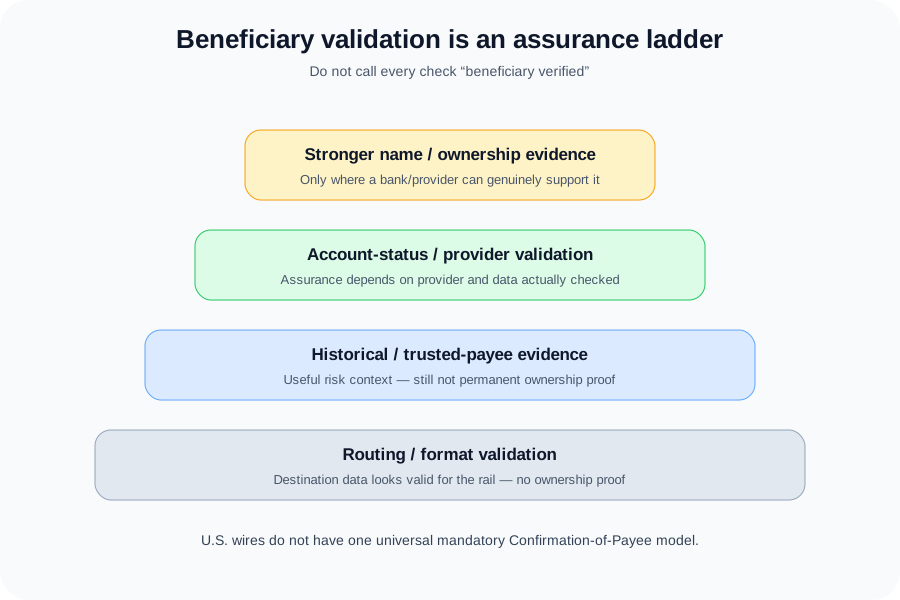
“Beneficiary validation” sounds like one control, but in practice it is a family of checks.
A bank can validate whether a routing number has the right format and belongs to a known financial institution. It can validate whether the payment rail supports the destination. It may validate whether an account number meets internal format expectations. It may use account-validation or name-matching services where available. It can compare the beneficiary against customer history. It can assess whether the destination is new or unusual.
None of those checks should be described as automatically proving that the account belongs to the intended beneficiary.
Routing number validation proves routing data, not beneficiary ownership
The Federal Reserve's E-Payments Routing Directory and other governed routing data can help determine whether a routing number is valid for relevant payment services.
A valid routing number tells the bank about the receiving institution or endpoint. It does not prove that the beneficiary account exists, is open, belongs to the named person, or is safe from fraud.
Account validation has different strengths
Possible account controls include:
- syntax and length checks;
- customer-maintained trusted-payee data;
- prior successful-payment history;
- account-status or validation services where contractually available;
- ownership/name checks where a provider can support them;
- customer confirmation of changed instructions.
Requirements should specify the actual assurance achieved.
“Validated beneficiary” is too vague.
The United States does not have one universal wire Confirmation-of-Payee rule
Some markets have scheme-level payee-name verification services. U.S. wire processing should not be described as if every Fedwire or CHIPS payment receives a mandatory beneficiary-name match before execution.
Banks can and do implement beneficiary-risk controls, but the legal and operational model remains more nuanced.
This matters because customer messaging must be truthful. A green check saying “beneficiary verified” can create false confidence if the bank has only verified the routing number.
6. Misdescription, identifying numbers and the legal payment-order boundary
One of the most important and often misunderstood Article 4A rules is section 4A-207 on misdescription of the beneficiary.
Where a payment order identifies the beneficiary both by name and by an identifying or bank account number, and the name and number identify different persons, Article 4A does not simply say “the name always wins.” In defined circumstances, if the beneficiary's bank does not know the name and number refer to different persons, it may rely on the number as the proper identification and need not determine whether the name and number refer to the same person.
This is a crucial learning point.
It does not mean banks should ignore beneficiary names. It does not prohibit banks from offering name-based controls. It does not eliminate fraud-management obligations. It means the legal payment-order framework recognizes account-number reliance in a way that makes accurate customer instructions critically important.
What a BA should take from section 4A-207
The payment system should preserve exactly what the customer instructed:
beneficiary_name
beneficiary_account_number
beneficiary_bank/routing identifier
customer beneficiary ID/template version
validation results
warnings shown
customer confirmation.
If the customer later claims the bank “paid the wrong person,” investigation needs to reconstruct whether the account number was supplied by the customer, changed by malware, transformed by an internal system, or modified manually.
Do not silently normalize high-risk fields
Formatting cleanup can be useful, but high-value payment systems should be extremely careful about transformations that change account or routing meaning.
A system may remove harmless spaces or permitted punctuation according to a documented rule. It should not silently substitute a different routing number because a beneficiary name “looks similar” to a known bank.
Every material transformation should be deterministic and auditable.
Warnings should be actionable
A warning such as “beneficiary name not verified against account” can be appropriate where the bank truly cannot verify ownership. A vague “please check details” warning placed on every payment quickly becomes meaningless.
Good control UX tells the user what was checked, what was not checked, and what action the user should take.
7. Fraud controls before a wire is released
Wire fraud prevention is strongest before external release because the bank still controls the payment.
Fraud controls can combine customer behavior, user/device behavior, beneficiary behavior, payment attributes and relationship context. The exact rule set is bank-specific and should evolve with threats.
Useful signals can include:
- newly created or recently changed beneficiary;
- new device or unusual login context;
- unusual payment amount;
- payment outside normal customer operating hours;
- unusual geographic or network behavior;
- rapid sequence of payee change and high-value payment;
- deviation from historical beneficiary pattern;
- change in approver behavior;
- high-risk communication patterns known to the bank;
- multiple failed authentication or approval attempts;
- abnormal file/API source behavior;
- mismatch between customer profile and payment purpose.
No single signal proves fraud.
Fraud decisioning should be explainable operationally
An alert should tell operations why the payment is held.
HIGH_VALUE + NEW_BENEFICIARY + DEVICE_CHANGE
is more useful than RISK_SCORE_782 with no reason codes.
The score can still exist, but human operations needs interpretable evidence.
Confirmation should be independent enough to add value
If a payment is held because the user's email may be compromised, sending a confirmation link to the same email account may add little assurance.
Banks may use callbacks to established contact details, relationship-manager confirmation, step-up authentication, trusted-device confirmation or other risk-based methods. The appropriate method depends on the customer and risk.
Fraud hold is not a sanctions hold
Keep them distinct.
A fraud hold may be resolved by customer confirmation. A sanctions alert may require sanctions expertise and legal analysis. One queue should not use the other's disposition codes.
Duplicate controls belong here too
High-value wires require strong duplicate detection and idempotency.
A duplicate can arise from customer resubmission, channel retry, operator uncertainty, manual intervention or recovery tooling. The platform should detect duplicate risk using stable payment identity and external execution evidence, not merely identical amount and beneficiary.
8. OFAC sanctions screening and risk-based sanctions compliance
OFAC sanctions controls are central to U.S. wire processing because U.S. persons and U.S. financial institutions must comply with applicable OFAC sanctions programs.
OFAC's Framework for Compliance Commitments strongly encourages a risk-based sanctions compliance program built around five essential components: management commitment, risk assessment, internal controls, testing/auditing and training.
The framework matters because sanctions screening is not simply a list-matching engine.
A mature sanctions program asks:
- which customers and counterparties create sanctions exposure;
- which countries and corridors are relevant;
- which products and payment types are exposed;
- which party fields and transaction attributes must be screened;
- which lists and program rules apply;
- how fuzzy matching is tuned;
- how ownership/control rules are assessed;
- who investigates alerts;
- how blocks and rejects are handled;
- how list changes are distributed;
- how the controls are tested.
Screening should use current, governed list data
OFAC's Sanctions List Service provides current SDN and non-SDN list data. Banks should govern ingestion, versioning, effective timing and monitoring of sanctions-list updates.
A sanctions engine with yesterday's list is not equivalent to one using current data.
Name screening is only part of sanctions compliance
Wire controls may need to consider:
- originator/debtor;
- beneficiary/creditor;
- ordering and beneficiary institutions;
- intermediaries;
- addresses;
- countries;
- free-text/remittance fields where relevant;
- vessels or other referenced parties in specialized payments;
- ownership or control information when applicable;
- program-specific prohibitions.
The exact field set and logic are risk- and program-dependent.
Do not invent a universal screening sequence
Some banks screen at initiation, again after enrichment, and again immediately before release. Others use different architectures. What matters is that the final externally released instruction has passed the required controls using the data actually being sent.
If routing enrichment changes the beneficiary bank or adds an intermediary, the screening architecture should understand whether those new parties require screening before release.
9. Sanctions alerts, holds, blocks, rejects and false positives
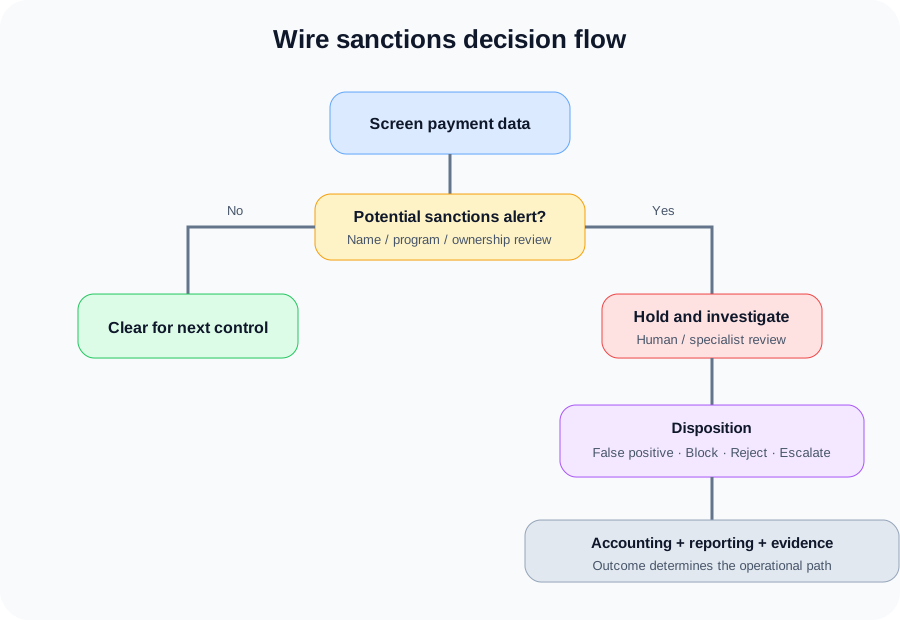
A sanctions screening alert is a signal for review. It is not automatically a legal match.
OFAC itself recognizes that screening software can produce alerts that are not actual sanctions targets and that human analysis may be required. Banks therefore need a controlled alert-disposition process.
A useful state model can include:
SCREENING_CLEAR
POTENTIAL_MATCH_HELD
FALSE_POSITIVE_CLEARED
ESCALATED_FOR_SANCTIONS_REVIEW
BLOCK_REQUIRED
REJECT_REQUIRED
LICENSE/EXCEPTION_REVIEW
RELEASED_AFTER_CLEARANCE.
These are conceptual states, not mandatory OFAC labels.
Blocking and rejecting are not the same
OFAC distinguishes blocked transactions from rejected transactions. A transaction involving blockable property may need to be blocked. In other cases, a transaction may be prohibited but not involve a blockable interest, in which case it may need to be rejected rather than blocked.
Operations must not use “sanctions reject” as a generic label for every sanctions outcome.
The accounting consequences differ too. Blocked funds may need to be placed in an appropriate blocked account and handled according to OFAC requirements. A rejected payment is not processed in the same manner.
Reporting obligations need evidence
The applicable OFAC Part 501 provisions generally require reports of blocked property and rejected transactions within 10 business days of the blocking or rejection event, subject to the specific provision and current reporting instructions. The original transfer instructions are part of the reporting evidence.
A bank therefore needs to preserve the full instruction and the sanctions decision that caused the action.
False positives need controlled reuse
Banks may maintain false-positive or good-guy logic to reduce repeat noise, but those controls should be governed. A false-positive disposition should not become a permanent global bypass simply because one analyst cleared one historical alert.
Context matters: party identity, aliases, address, country, list version and program can change.
10. Release governance, cutoffs and final pre-send control
Release is the point where an internally approved payment becomes an external financial instruction. That boundary deserves explicit control.
A strong release process verifies that all required conditions are satisfied immediately before transmission:
- customer authority complete;
- beneficiary/payee state valid;
- payment data valid;
- fraud decision clear or approved exception;
- sanctions decision clear or approved action;
- product and account limits satisfied;
- funding/liquidity conditions satisfied where relevant;
- route available;
- cutoff not missed;
- no duplicate execution evidence exists;
- required approvals are current;
- no intervening data change invalidated an earlier control.
Control decisions can become stale
Suppose sanctions screening was completed at 09:00, but at 09:05 the routing engine adds an intermediary bank. The payment should not assume the 09:00 result covers data that did not exist at 09:00.
Similarly, if the beneficiary account is changed after customer approval, the payment may need reapproval.
A bank-grade platform should define which field changes invalidate which prior decisions.
Maker-checker must be meaningful
Dual approval is useful only if the second user can see the material information and is genuinely independent under the customer's or bank's authority model.
A checker who clicks “approve all” without seeing changed beneficiary details is not providing the intended control value.
Cutoff handling must be truthful
A payment can be fully approved and still miss the bank's same-day release cutoff. The system should distinguish:
CONTROL_FAILED
from
CONTROL_PASSED_BUT_CUTOFF_MISSED.
Customer communication, rescheduling and routing decisions depend on the difference.
11. Post-release states and the shrinking intervention window
The ability to stop a wire shrinks rapidly as the payment moves forward.
Before external release, the bank usually controls the instruction internally. After release but before external acceptance, there may still be some intervention possibilities depending on architecture and timing. After acceptance and settlement, the original payment cannot simply be edited out of existence.
Article 4A-211 reflects this distinction. A cancellation or amendment can be effective when the receiving bank gets it in time and has a reasonable opportunity to act before acceptance. After acceptance, cancellation or amendment generally requires agreement of the receiving bank or an applicable funds-transfer-system rule, subject to the Article 4A framework.
Status precision is essential
A useful state progression is:
CREATED
CUSTOMER_AUTHORIZED
BANK_CONTROLS_COMPLETE
RELEASED_EXTERNALLY
NETWORK_ACCEPTED
SETTLED
BENEFICIARY_BANK_PROCESSING
BENEFICIARY_POSTED
RECALL_REQUESTED — if later applicable
RETURNED — only if value actually returns.
Do not label RECALL_REQUESTED as REVERSED.
Unknown outcome is a high-risk state
If the bank loses connectivity immediately after sending a wire, the correct state may be OUTCOME_UNCERTAIN.
The bank must establish whether the network accepted and settled the payment before sending another one or attempting a different route. A blind retry can create a duplicate high-value transfer.
External identifiers such as Fedwire IMAD/OMAD and ISO message references become critical evidence.
12. Cancellation, recall and Fedwire return-request messages
In everyday banking language, customers often say “recall my wire.” Operationally, the bank must translate that request into the correct action for the payment's state.
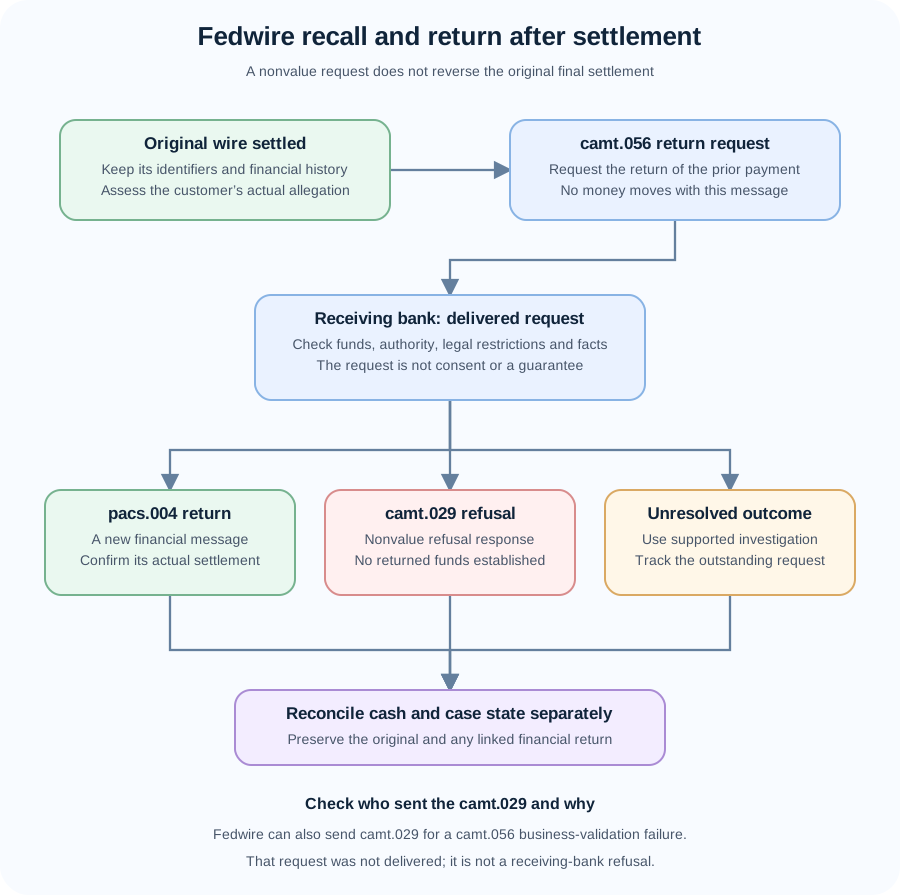
For Fedwire in the ISO 20022 environment, Federal Reserve Financial Services distinguishes the request to return funds from the actual return of value.
A camt.056 is the nonvalue return-request message used to request the return of the amount of a previously settled payment order.
A camt.029 is used for return-request response/refusal scenarios and can also serve specific negative-acknowledgement functions for a camt.056 with business errors, as described in Fedwire's ISO 20022 guidance.
A pacs.004 is the payment-return message used to return funds from a previously settled value message.
This distinction should be visible in both systems and training.
A return request has no settlement value by itself
The camt.056 asks another participant to return funds. It does not move money back merely because it was sent successfully.
The sending bank should therefore maintain separate evidence:
original_payment_settled = true
return_request_sent = true
return_request_delivered = true/false
response_received = pending/refused/other
returned_value_received = true/false.
This prevents a dangerous customer-service statement such as “your recall was successful” when only the request was delivered.
Positive acknowledgement is not recovery
Fedwire guidance describes an admi.007 positive acknowledgement for successful delivery of certain nonvalue messages. That evidence tells the sender the request was delivered through the service. It does not mean the receiving bank has agreed to return the funds.
Investigation messages have a different purpose
Fedwire provides camt.110/camt.111 for investigation requests and responses. The Fedwire guidance specifically directs participants to use camt.056 rather than camt.110 to request return of funds.
A payment platform should enforce this difference rather than allowing operators to send whichever nonvalue message they remember.
13. Receiving-bank response and the actual return of funds
Once the receiving bank gets a return request, the case becomes a bank-to-bank operational and legal process.
The receiving bank may need to determine whether funds remain available, whether the beneficiary has already withdrawn or transferred them, whether fraud or legal restrictions exist, whether a block or hold applies, whether customer consent is needed under the applicable facts, and what its obligations are under law, agreement and network rules.
The original sending bank should not promise recovery before that process finishes.
Refusal and silence are different outcomes
A camt.029 response can communicate refusal in relevant Fedwire return-request scenarios. A lack of response may require follow-up and investigation, but should not be converted automatically into REFUSED unless the bank's operating model explicitly defines an internal timeout state.
Use states such as:
REQUEST_SENT
DELIVERED
RECEIVER_REVIEWING
REFUSED
RETURN_EXPECTED
PARTIAL_RECOVERY_EXPECTED
RETURN_VALUE_RECEIVED
CLOSED_NO_RECOVERY.
The actual return is a new value movement
When funds are returned, that return must be reconciled as a separate financial event linked to the original wire.
For Fedwire, pacs.004 is the correct ISO 20022 payment-return message for returning funds from a previously settled value message.
The accounting model should therefore preserve:
original wire debit/settlement
plus
return credit/settlement.
Do not delete or negate the historical original settlement record.
Partial recovery needs explicit handling
Fraud cases can involve partial recovery. The beneficiary may have moved part of the funds before action was taken.
A system that only supports RETURNED_FULL or NOT_RETURNED cannot represent reality.
Store requested amount, returned amount, outstanding amount, fees if applicable, dates and case ownership separately.
14. Investigations, customer communication and evidence
Wire recovery is often a race against time, but urgency cannot replace evidence.
A good investigation reconstructs the complete story:
- What did the customer originally instruct?
- Who created or changed the beneficiary?
- Which users approved the payment?
- Which security procedure and authentication evidence applied?
- Which beneficiary data was displayed to approvers?
- What fraud and sanctions decisions occurred?
- When did the bank release the payment?
- What did the external network accept and settle?
- What did the receiving bank receive?
- When was the recall/return request created and delivered?
- What response was received?
- Was any value actually returned?
Customer communication must use settlement truth
Before release, it can be correct to say “we stopped the payment.”
After settlement, the accurate wording may be “we have sent a request to the receiving bank to return the funds; recovery is not guaranteed.”
Those are very different statements.
Keep legal conclusions out of automated status labels
A system can record facts such as SECURITY_PROCEDURE_PASSED, BENEFICIARY_CHANGED_2_HOURS_BEFORE_PAYMENT, or RETURN_REQUEST_REFUSED.
It should be cautious about automatically labeling a customer legally liable or not liable. Legal responsibility under Article 4A and related agreements can depend on detailed facts.
Evidence should be immutable enough for dispute handling
For high-value payments, preserve original message payloads, transformed payloads, control decisions, user actions, timestamps, network identifiers, nonvalue messages, responses, accounting entries and customer communications.
Analysts may add notes, but they should not overwrite historical evidence.
15. Reconciliation, reporting, audit and control governance
Wire-control work does not end when the payment settles or the case closes. Controls need reconciliation and governance.
Daily operational reconciliation should prove that every wire population is accounted for across meaningful states:
received
held
rejected before release
released
externally accepted
settled
return requested
return received
sanctions blocked
sanctions rejected
investigation open
closed.
A payment should not disappear because it moved from the payments platform into a sanctions or fraud case-management system.
Control reconciliation is different from cash reconciliation
Cash reconciliation proves financial amounts and settlement postings.
Control reconciliation proves that required decisions happened and that exceptions were owned.
A bank can have perfectly balanced cash and still have a control failure if a payment bypassed required screening.
Management information should show control health
Useful MI can include:
- wire volume and value;
- new-beneficiary payment volume;
- beneficiary-change-to-payment intervals;
- fraud-alert rates and outcomes;
- sanctions-alert rates and false-positive rates;
- blocked and rejected transaction counts;
- manual-release volumes;
- override use;
- recall/return-request volumes;
- recovery rate and recovery time;
- uncertain-outcome incidents;
- duplicate-prevention events;
- ageing of open investigations;
- control-system outages;
- list-update timeliness.
The bank should avoid simplistic targets that encourage bad behavior, such as rewarding teams only for reducing alert counts.
Audit needs end-to-end lineage
An auditor should be able to sample a payment and trace:
customer instruction → authority/security procedure → beneficiary version → fraud decision → sanctions decision → release → external message → settlement → customer posting/report → recall/return activity → reconciliation → case closure.
If one stage cannot be reconstructed, the evidence design is incomplete.
16. End-to-end cases, BA checklist and testing
Chapter 20 becomes useful when the controls are tested as complete journeys rather than isolated screens.
Case 1 — legitimate new beneficiary, high-value domestic wire
A corporate customer creates a new beneficiary and enters a $4 million wire. The payee change is independently approved according to the customer's arrangement. The payment requires two customer approvals. Fraud scoring flags NEW_BENEFICIARY + HIGH_VALUE and routes the payment for review. Operations confirms the instruction through the bank's approved process. Sanctions screening is clear. The payment is released and settles.
Testing must prove that the legitimate alert can be resolved without bypassing the control and that every decision remains in the audit trail.
Case 2 — account number changed after approval
The customer approves a payment. Before release, an authorized user changes the beneficiary account number.
The system should not blindly retain the earlier approval and screening decisions. Requirements should define which controls are invalidated by the material data change. In most bank-grade designs, the changed beneficiary information should force appropriate revalidation and reapproval according to policy.
Case 3 — name/account mismatch warning
A user enters beneficiary name “Alpha Supplies LLC” with an account number received in an email. The bank can validate the routing number but cannot independently prove account ownership.
The UI should not say “beneficiary verified.” It should clearly state the assurance actually obtained and prompt the customer to confirm sensitive details. Investigation evidence must preserve what was displayed.
Case 4 — sanctions false positive
A beneficiary name is similar to an OFAC-listed party. The screening engine creates a potential match and holds the wire. An analyst reviews identifying details and determines it is a false positive according to policy. The payment is released.
Test list version, alert evidence, analyst identity, disposition reason and release authorization.
Case 5 — sanctions block
A wire contains a blockable interest under an applicable sanctions program. The bank determines blocking is required.
The payment should not proceed to external release. The blocked funds/accounting process, reporting process and audit evidence must follow the bank's sanctions procedures and applicable OFAC requirements. The customer-facing message should be controlled by legal/compliance policy.
Case 6 — sanctions reject rather than block
A transaction is prohibited but the relevant rule requires rejection rather than blocking. The operational and accounting path must differ from a block. Test that the case-management reason is not mapped to the wrong accounting treatment.
Case 7 — customer requests cancellation before external acceptance
A properly authenticated customer requests cancellation while the payment is still internal or otherwise before the relevant acceptance boundary. The bank acts within the available window according to Article 4A, agreement and rail rules.
Test security procedure for the cancellation itself, state transition and customer confirmation.
Case 8 — customer requests recall after Fedwire settlement
The original Fedwire payment is already settled. The bank creates a camt.056 return request linked to the original payment. The network acknowledges delivery. The customer is told a return has been requested, not that the payment has been reversed.
Test the separate states for request delivery and financial recovery.
Case 9 — receiving bank refuses the return request
A camt.029 refusal is received. The original payment remains settled. No cash return should be booked. The investigation case is updated and the customer receives accurate communication.
Case 10 — full return received
The receiving bank returns the full amount using the appropriate value-return mechanism. The bank receives the returned payment, posts it to the correct account according to its product/accounting rules, reconciles it to the original wire and closes the recovery case with both original and return settlement records intact.
Case 11 — partial recovery
Only part of the amount returns. The case remains open or closes with residual loss depending on the business decision. The system must support partial amounts without corrupting the original payment amount.
Case 12 — outcome uncertain after transmission
Connectivity fails after local send. The customer submits the payment again because the portal appears stuck.
The bank should not blindly send the second instruction. It must establish network outcome using available identifiers and status evidence. Test idempotency, duplicate detection and manual escalation.
Case 13 — sanctions service outage near cutoff
The sanctions platform becomes unavailable 15 minutes before a major customer cutoff. The payment engine must follow documented contingency behavior. It must not silently mark payments clear merely because the screening service is unavailable.
Test queueing, monitoring, customer communication, recovery and controlled release after service restoration.
Case 14 — stale sanctions list feed
The sanctions engine is online but the latest list update failed. This is a different incident from total service outage. Monitoring should detect list age/version and prevent the system from presenting false confidence.
Case 15 — beneficiary template compromised
A supplier template used by 150 scheduled wires is changed. Controls should detect the material template change and ensure future payments do not inherit a compromised beneficiary silently. Test impact analysis and mass hold/repair procedures.
Case 16 — audit reconstruction six months later
Select a settled wire and reconstruct the full control chain without relying on tribal knowledge. Retrieve the customer instruction, payee version, approval/security evidence, screening results, release decision, external settlement IDs, customer report and any recall activity.
If the team cannot reconstruct it, the control architecture is incomplete.
BA requirement checklist
For every wire-control requirement, a BA should be able to answer:
- What risk or legal/control obligation is being addressed?
- Which payment states does the control apply to?
- What data does the control use?
- Who owns the rule?
- What happens on clear, alert, error and timeout?
- Which prior approvals become stale after data change?
- Can the action still be taken after network acceptance or settlement?
- What customer wording is permitted?
- What evidence is stored?
- How is the result reconciled?
- How is the control tested during outage and recovery?
- How are rule/list versions governed?
Tester checklist
Testing should include normal and adverse cases across:
- user authentication and entitlements;
- maker-checker independence;
- security-procedure enforcement;
- beneficiary creation and change;
- routing-number validation;
- unsupported or invalid beneficiary data;
- new-payee risk;
- fraud-alert decisioning;
- sanctions exact and fuzzy matches;
- list update/version changes;
- false-positive handling;
- blocking versus rejection;
- manual override governance;
- cutoff handling;
- external transmission uncertainty;
- duplicate prevention;
- pre-acceptance cancellation;
- post-settlement camt.056 request;
- camt.029 refusal/business-error handling;
- pacs.004 returned value;
- partial recovery;
- customer communication;
- accounting and reconciliation;
- audit reconstruction.
Final learning model
A safe wire platform should be able to answer five questions at any time:
Who had authority?
Who and what did the bank believe the beneficiary to be?
Which fraud and sanctions controls were completed?
What has happened financially on the external rail?
If recovery is being attempted, has money actually returned or has only a request been sent?
If those five answers are clear, the bank has a strong foundation for controlling high-value wire risk without confusing prevention, settlement and recovery.
Authoritative references
-
Federal Reserve Regulatory Service — Uniform Commercial Code Article 4A, Funds Transfers
https://www.federalreserve.gov/frrs/regulations/uniform-commercial-code-article-4a-funds-transfers.htm
-
Federal Reserve Regulatory Service — Regulation J
https://www.federalreserve.gov/frrs/regulations/regulation-j-collection-of-checks-and-other-items-by-federal-reserve-banks-and-funds-transfers-through-fedwire.htm
-
Federal Reserve Regulatory Service — Commentary on Regulation J
https://www.federalreserve.gov/frrs/regulations/commentary-on-regulation-j.htm
-
Federal Reserve Financial Services — Fedwire Funds Service
https://www.frbservices.org/financial-services/wires
-
Federal Reserve Financial Services — Fedwire ISO 20022 Format FAQs
https://www.frbservices.org/resources/financial-services/wires/faq/iso-20022/format
-
Federal Reserve Financial Services — Fedwire ISO 20022 FAQ
https://www.frbservices.org/resources/financial-services/wires/faq/iso-20022
-
Federal Reserve Financial Services — Fedwire ISO 20022 Implementation Center
https://www.frbservices.org/resources/financial-services/wires/iso-20022-implementation-center
-
Federal Reserve Financial Services — Fedwire Operating Hours
https://www.frbservices.org/resources/financial-services/wires/operating-hours.html
-
Federal Reserve Financial Services — E-Payments Routing Directory
https://www.frbservices.org/resources/routing-number-directory
-
Office of Foreign Assets Control — A Framework for OFAC Compliance Commitments
https://ofac.treasury.gov/recent-actions/20190502_33
-
Office of Foreign Assets Control — Sanctions List Service
https://ofac.treasury.gov/sanctions-list-service
-
Office of Foreign Assets Control — Blocking and Rejecting Transactions FAQs
https://ofac.treasury.gov/faqs/topic/1601
This application uses JavaScript for the full interactive experience. This text summary is served for accessibility and search indexing.