Wallets and Payment Overlays: Zelle, PayPal, Venmo and Cash App. Distinguish bank-account overlays, provider balances, funding and withdrawals, settlement evidence, consumer protections and wallet reconciliation.
Maya sends $180 to her brother through her bank's Zelle service. Later, she receives $180 in a payment-app balance and selects an option to transfer it to her checking account. Both screens use reassuring language about receiving money. Yet the first experience pays directly into a bank account, while the second can involve a provider balance followed by a separate withdrawal. When Maya calls the bank, the support team needs to identify which event she means before looking for a missing credit.
Chapter 45 separated account linking from payment authority and execution. This chapter follows what sits above those connections: the customer experience, recipient directory, provider ledger and bank interfaces behind wallets and payment overlays. It covers US dollar payment services, rather than cryptocurrency trading or international remittance products offered under some of the same brands.
A brand identifies a service. It does not, by itself, identify the funding rail, the account holding the recipient's money, or the evidence of interbank settlement.
Allow roughly 60 minutes for the chapter, diagram walkthroughs and worked cases. People, amounts, internal states and accounting examples are fictional. The implementation recommendations are training designs, not descriptions of providers' private systems. Provider terms and public sources were checked on October 5, 2026; product eligibility and contracted interfaces still require implementation-specific confirmation.
Chapter navigator
- Identify the financial product behind the screen
- Participants, accounts and responsibility
- Zelle as a bank-account payment experience
- PayPal funding, balances and merchant payments
- Venmo and Cash App balance journeys
- Funding, internal value transfer and withdrawal
- Where clearing and settlement occur
- APIs, events and a reliable transaction record
- Availability, operating windows and liquidity
- Fraud, sanctions and account restrictions
- Consumer protections and complaint classification
- Cancellation, refunds and uncertain outcomes
- Reconciliation and accounting across balances
- Implementing the service inside a bank
- Worked cases and implementation decisions
- Role checklist and learning closure
1. Identify the financial product behind the screen
A payment overlay simplifies an interaction that would otherwise require the customer to understand banking details. It can resolve a recipient from an email address, authenticate a user, request a payment or present a familiar checkout button. A wallet may hold payment credentials, maintain a monetary balance, or combine several functions. These capabilities should be identified individually rather than inferred from the word wallet.
Zelle's public service description says money goes directly into a bank account. PayPal, Venmo and Cash App also offer services involving provider balances, subject to their respective account terms. Those are materially different operating models. A recipient with money in a supported app balance may still need a separate transfer to obtain a credit at an external bank. The bank cannot find that external credit merely by locating the earlier app-to-app payment.
For an implementation, start with three questions. Which account or balance funds the payment? Which account or balance is credited? Which institution or provider owes the recipient after the displayed completion event? The answers reveal whether the transaction is a bank-account transfer, an internal provider-ledger transfer, an externally funded payment or a withdrawal.
Keep the product distinction visible in reporting. A wallet top-up is not necessarily payment to another person. A merchant checkout is not automatically a personal transfer. A withdrawal to a debit card is not a reversal of the original receipt. Combining them in one undifferentiated transaction count makes reconciliation and complaint handling much harder.
Maya's bank should ask for the payment or withdrawal reference, destination and date. It should not demand that she learn the platform's architecture. Good internal classification allows a simple external conversation: did the money reach the app, or did the app confirm a transfer to this bank account?
2. Participants, accounts and responsibility
The customer supplies the instruction and chooses a recipient or merchant. A provider may supply the app, directory, customer balance and payment processing. An account-holding bank maintains an external deposit account. A card issuer or ACH participant may support a funding or withdrawal leg. A settlement bank may support a provider's aggregate financial obligations. One corporate group can perform several functions through different legal entities and contracts.
Map these roles at transaction level. A customer's external bank might see an ACH debit funding a wallet transaction but not the underlying conversation between payer and recipient. The wallet provider might hold that conversation and the recipient ledger event but need its bank's report to establish external settlement. Neither record should be discarded just because another organization holds different evidence.
The service contract should identify who operates the account ledger, who holds bank deposits, who can suspend a payment and who supplies investigation records. A bank processing aggregate provider activity also needs the agreed access to underlying customer records appropriate to its role. An aggregate account balance alone cannot explain the distribution of obligations among customers.
Use precise language for funds held through a third party. FDIC insurance addresses eligible deposits when an insured bank fails; it does not insure a nonbank's bankruptcy. Pass-through coverage depends on applicable conditions and records. A provider's relationship with an insured bank is therefore not a blanket guarantee covering every app balance or every interruption in access. The FDIC's third-party-app guidance is the relevant starting point, followed by the particular product terms.
A useful operational ownership map includes the funding leg, recipient credit, withdrawal, consumer complaint and provider insolvency or outage scenario. These are different problems even when the same brand appears on every screen.
3. Zelle as a bank-account payment experience
Zelle connects eligible bank accounts through participating financial institutions. Its public information describes use of an email address or US mobile number and says payments to enrolled users typically occur within minutes. That customer timing is not a statement that every underlying interbank settlement leg uses an identical mechanism. The standalone-app payment model should not be taught as the current enrollment route: participating-bank guidance confirms the March 31, 2025 transition to bank and credit-union enrollment.
For a bank integration, separate recipient enrollment and directory resolution from the financial instruction. The alias helps find a destination; it is not itself a deposit account number or a Federal Reserve settlement account. The customer should review the resolved recipient information before authorizing the transfer. Changes in alias ownership, enrollment and destination require controls defined by the actual network and bank arrangement.
The bank needs to connect its instruction reference to its customer posting and the contracted network records. Public customer FAQs do not establish the complete participant message specification, settlement timetable or exception file layout. I cannot confirm a single universal Zelle settlement path from those public sources. A production design must obtain the current participant documentation and establish the bank's actual funding and settlement relationship.
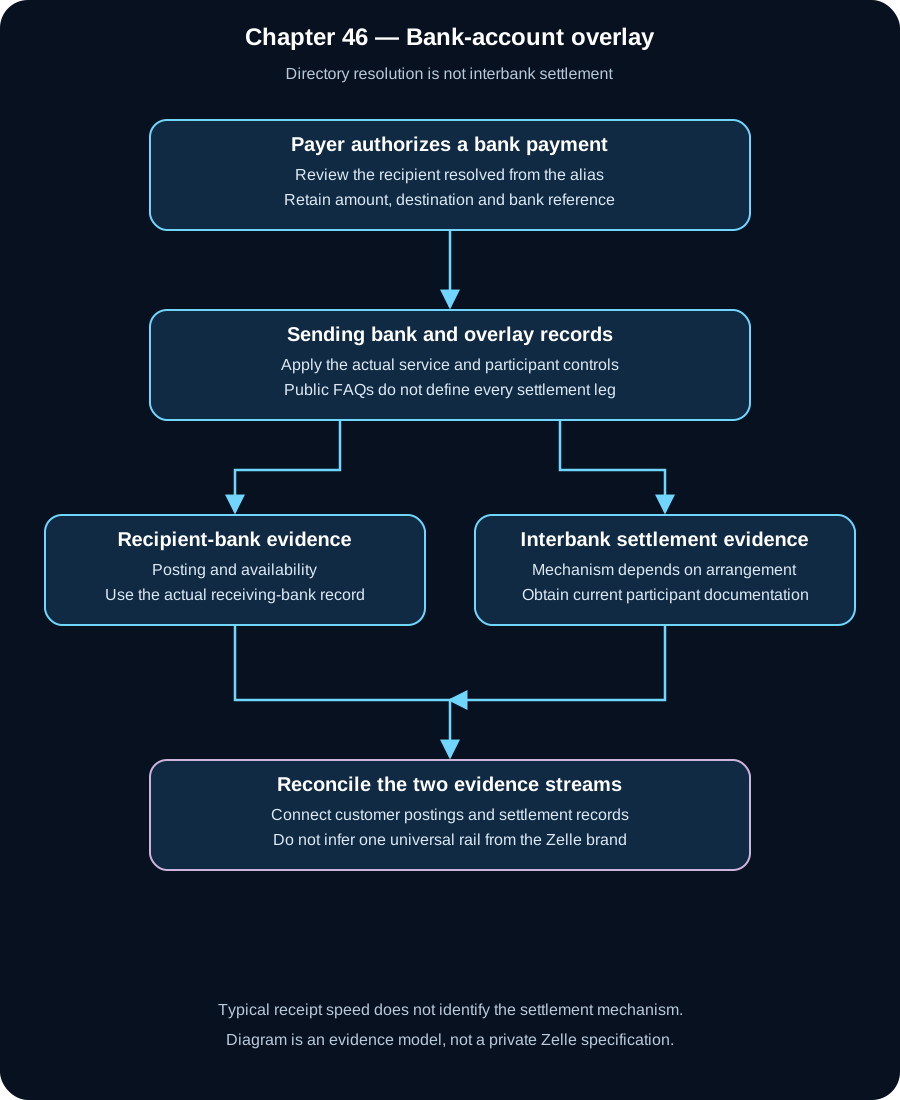
The diagram deliberately leaves the interbank mechanism conditional on the contracted arrangement. It shows where the bank must obtain evidence, rather than inventing an ACH, RTP or FedNow leg for every Zelle payment. The recipient's available bank balance and the institution's settlement evidence belong in connected but distinct records.
Recipient mistakes have a financial consequence
If Maya selects the wrong enrolled recipient, support should establish whether payment completed and what recovery options exist. A request for repayment is not a guaranteed cancellation. The bank should preserve the original destination and authorization evidence, assess the case under applicable protections and network policies, and avoid sending a second payment merely because the intended recipient has not received the first.
Zelle's current FAQ permits cancellation when the recipient has not yet enrolled; an already enrolled recipient's payment cannot be canceled through that mechanism. The bank should distinguish this enrollment-dependent cancellation from a later request to recover a completed payment. Sending limits also come from the participating institution, rather than one universal consumer limit.
Zelle itself does not provide purchase protection for goods that are missing or misdescribed. Its FAQ separately says qualifying impostor scams may be eligible for reimbursement through the customer's institution. Neither statement replaces the Regulation E assessment discussed in Section 11. A bank should classify the complaint before promising or denying a remedy.
4. PayPal funding, balances and merchant payments
PayPal's US user agreement distinguishes personal and business accounts and identifies supported funding sources including cards, bank accounts and eligible balances. Personal customers may use a linked PayPal Balance account, governed by separate terms. The agreement also addresses holds, restrictions, disputes and withdrawals. These features mean that payment acceptance, balance availability and transfer to an external bank should not be collapsed into one status.
Consider a fictional retailer accepting a $180 PayPal checkout. The order system should retain its order ID and the provider's payment reference. If the provider reports the payment completed for the merchant, the retailer uses the applicable fulfillment and protection terms. Its treasury team separately reconciles provider activity, deductions and withdrawals to the bank account. It should not expect one bank credit for each individual checkout.
An internal implementation can represent funding, merchant receipt and withdrawal as linked objects. That does not assert PayPal's private ledger design. It gives the retailer or bank a way to preserve evidence from different interfaces. A charge against a linked bank account might have a different reference and financial lifecycle from the merchant receipt it supports.
The distinction matters when a funding source fails after a provider has made value available. Contractual recovery, restrictions or other adjustments must be interpreted from the applicable agreement. The bank should not assume the merchant receipt automatically disappears, nor assume that the provider bears every possible loss. The actual allocation of risk is a contractual question.
Refund handling should begin from the original commercial payment through the supported refund process. A fresh personal payment to an email address may lose the original transaction linkage and create a second fraud opportunity. The refund record needs to show amount, original payment, approval, provider outcome and subsequent bank or balance evidence.
5. Venmo and Cash App balance journeys
Venmo's US agreement governs personal and supported commercial activity, balance use, transfers and applicable purchase protections. An eligible merchant transaction is not interchangeable with an informal personal payment. The same visual app can therefore support transactions with different contractual treatment. A merchant should use the supported business arrangement instead of asking customers to disguise purchases as payments to friends.
Cash App's US terms likewise distinguish services, balance activity, bank transfers, account restrictions and product-specific eligibility. Cash App is a financial-services platform rather than itself a bank. Its current terms and relevant bank agreements should determine the exact product, including any deposit-insurance eligibility. Avoid transferring a statement about one Cash App feature to all balances or services under the brand.
For either provider, a bank implementation should classify a receipt into an app balance separately from a cash-out instruction. It should record the selected destination, method, gross amount, any disclosed fee and the provider's expected delivery information. These are operational data requirements, not invented provider API fields.
A fictional recipient receives $180 and requests a withdrawal. If the chosen option charges an illustrative $2 fee, the expected bank receipt is $178 only if the actual product deducts that fee from proceeds. Another product could charge separately. Reconciliation must use the transaction's real fee treatment; it should not apply one assumed percentage to every transfer.
Social messages are not financial evidence. A payment note, a screenshot or a message claiming a business account must be upgraded should never trigger release of goods or an additional transfer. The receiving user or merchant should establish receipt through the authenticated service and apply its own policy to the supported transaction type.
6. Funding, internal value transfer and withdrawal
A provider can support more than one financial leg around a single customer interaction. External funding brings value into the arrangement. An internal ledger entry reallocates a supported balance between users. A withdrawal sends value out through a bank or card arrangement. The order and timing depend on the product; the internal model below is illustrative rather than universal.
Suppose two eligible customers already hold funded dollar balances at the same provider. A $180 transfer can reduce the provider's obligation to the sender and increase its obligation to the recipient. That accounting movement does not inherently require $180 to move between two external bank accounts at that moment. The provider must still maintain the backing, records and settlement processes required for its arrangement.
If the sender instead funds from an external bank, an additional financial leg exists. The recipient may receive available value before that funding leg has completed all relevant exception exposure, depending on the product. This is a credit or risk decision within the arrangement, not evidence that ACH became irrevocable because the app displayed an immediate receipt.
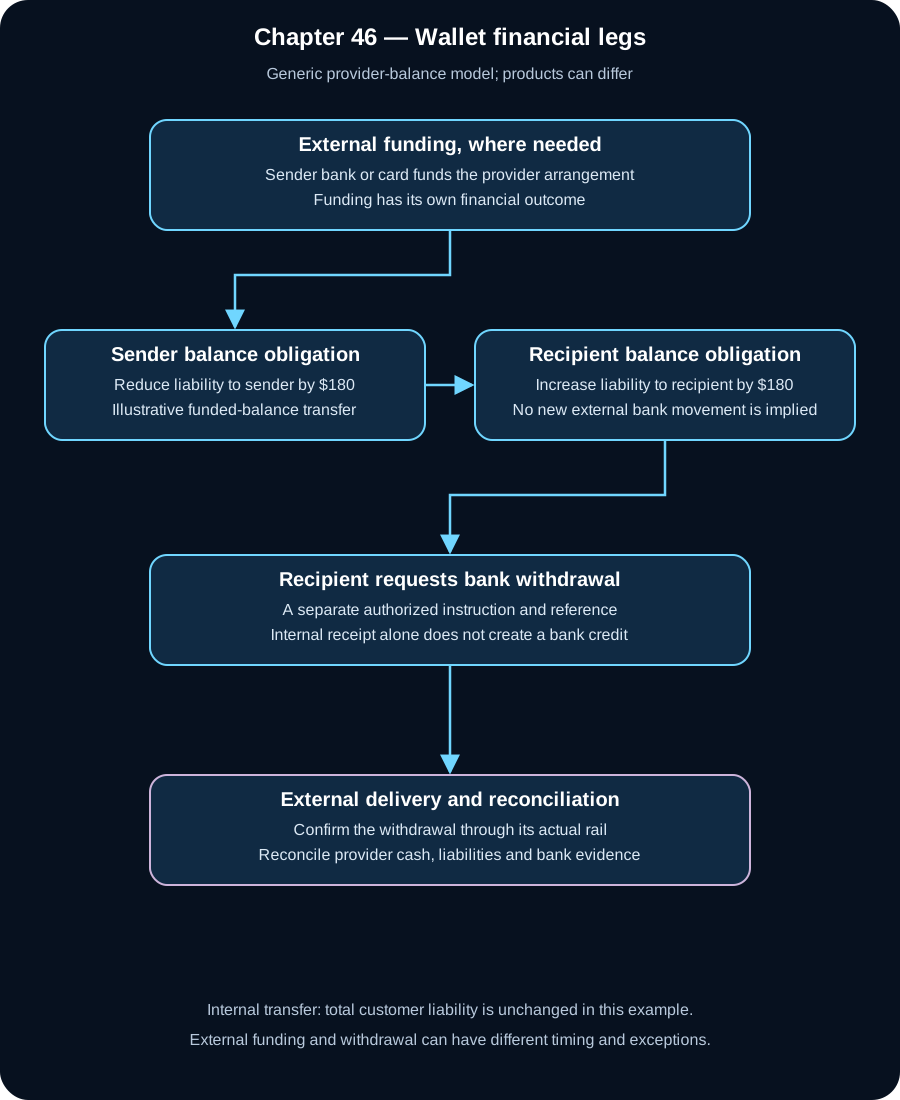
The diagram uses a generic balance provider so it does not assert that every named brand follows the same sequence. It distinguishes a provider's liability ledger from its bank cash and shows withdrawal as another instruction. A learner should be able to point to the record answering each of Maya's questions: who received value, where it is available, and whether an external bank transfer occurred.
For the bank, this distinction prevents false matching. A debit of $180 and a later credit of $180 may relate to different users, products or days. Matching by amount alone can conceal an unresolved funding failure or a duplicate withdrawal. Preserve the provider's financial-leg references and their parent relationship.
7. Where clearing and settlement occur
External legs use their actual payment mechanisms. An ACH funding debit is processed under the applicable ACH arrangement, with interbank settlement and subsequent customer-account effects. A card-funded payment involves card processing and the relevant network settlement, while provider availability can precede final reconciliation. A bank-account withdrawal or supported card payout has its own acceptance and settlement evidence. Earlier ACH and card chapters explain those mechanisms in depth.
A provider API response is a message about an event. A private product agreement determines contractual rights and commitments. Network rules govern participating activity on a particular rail. Regulation can impose duties independently of those agreements. None of these should be presented as the settlement account itself.
Inside a bank, settlement may use its own account or an agreed correspondent relationship. The implementation needs to identify the account actually debited or credited for the relevant leg. Provider cash, bank control accounts and customer subledger entries must reconcile, with timing differences supported by identifiable transactions rather than a generic overnight suspense balance.
For a generic bank withdrawal, distinguish provider acceptance, release to its bank, interbank processing, recipient-bank posting and customer availability. A system may not receive every event directly. Where evidence is limited, the report should say what is known and identify the agreed investigation source. It should not manufacture recipient credit merely because a file was sent successfully.
8. APIs, events and a reliable transaction record
Use the current contracted specification for authentication, request fields, responses, webhooks and inquiry functions. There is no common public API payload shared by Zelle, PayPal, Venmo and Cash App. A JSON payment response is not automatically an ISO 20022 message. Any translation into bank or rail formats belongs to a specific interface and implementation guide.
A bank's canonical record should preserve the business intent, provider transaction, financial leg and accounting event separately. One customer payment can have several events and multiple external legs. Record their identifiers, amounts, currencies, destinations, creation times, effective dates, current outcomes and source evidence. Sensitive account details should remain protected, with masked references in ordinary support views.
Callbacks can arrive late, twice or out of order. Process each authenticated event according to its identity and meaning. A repeated notification of completion should not produce a repeated ledger credit. An older pending event should not erase a later confirmed outcome. A subsequent financial adjustment, however, may legitimately change the net position while leaving the original completion event historically true.
For timeouts, preserve an uncertain state and query or reconcile the original request through supported methods. A new request ID should not be used to bypass duplicate controls. If the provider offers idempotent submission, establish its scope and retention behavior from documentation rather than assume the protection lasts indefinitely.
The practical acceptance test is whether support can reconstruct the payment without searching unconnected logs. The transaction view should show the original instruction, provider events, bank financial evidence and any recovery case in a coherent sequence.
9. Availability, operating windows and liquidity
An app can accept instructions all day while an external funding or withdrawal method observes a banking calendar. An available provider balance can also reflect an advance or risk decision before external collection is fully resolved. Neither fact makes the provider's commercial promise meaningless; it makes the promise product-specific.
Display the expected delivery information applicable to the chosen transaction. Avoid one global instant label covering internal transfers, standard bank withdrawals, card payouts and restricted accounts. A failed identity check or account limitation can prevent release even when the underlying rail is operating normally.
Treasury should forecast external funding receipts, withdrawals, refunds and unsettled obligations separately. If withdrawals accelerate while collections are delayed, the provider may face a cash requirement even though its customer-ledger totals balance. A bank supporting that provider needs agreed funding controls and visibility into the settlement account relevant to its role.
An illustrative end-of-day report might show $500,000 of provider withdrawals accepted, $460,000 confirmed at the bank-processing stage, $25,000 definitively rejected and $15,000 awaiting evidence. Calling the entire $500,000 paid overstates the known result. Releasing the $15,000 again without resolving the originals creates a duplicate risk. The report should reconcile both amounts and counts and retain the unresolved population into the next operating period.
10. Fraud, sanctions and account restrictions
The overlay adds fraud signals beyond the underlying rail: new devices, alias changes, unusual recipients, rapid movement through newly established balances and changes to withdrawal destinations. These signals should complement the bank's existing controls rather than replace payment-level review with a successful app login.
Protect the point at which a recipient or withdrawal destination changes. A legitimate user can be deceived into selecting a fraudulent destination, while an attacker can take control of an existing account. Those scenarios require different evidence. Record what was shown to the user, who initiated the payment and whether the destination had recently changed.
Sanctions obligations apply according to the parties, activity and applicable programs. A domestic dollar payment is not automatically free of sanctions concerns. OFAC's compliance framework supports risk assessment, internal controls, testing, training and management commitment; it does not prescribe one identical screening sequence for every wallet. The bank and provider should agree responsibility and evidence access for their actual roles.
An account restriction is not necessarily a payment return. The restriction may prevent new withdrawals while an earlier transfer remains completed. Customer communication should identify the affected capability and supported next steps without promising an unverified release time. Operations must reconcile restricted balances and pending activity rather than move them out of financial reporting.
11. Consumer protections and complaint classification
The CFPB's EFT FAQs explain that qualifying P2P and mobile transfers can be covered by Regulation E, and that nonbank providers can also be financial institutions under that regulation. Private-network finality does not erase applicable consumer protections. A bank must assess its own obligations rather than automatically send every complainant back to the app.
Distinguish a transfer initiated by a fraudster using fraudulently obtained credentials from a payment personally initiated by a customer deceived about the underlying purpose. The facts and applicable law matter; neither the word scam nor successful authentication alone decides every case. Provider protections and network reimbursement policies can add further treatment but should not be confused with statutory duties.
For operations, capture the allegation in the customer's words, the relevant account and financial leg, the initiation evidence and the applicable investigation clock. A merchant non-delivery complaint, an unauthorized funding debit and a missing withdrawal may concern related activity but require different records and remedies.
Keep bank remediation separate from recovery. If an applicable consumer obligation requires action, uncertainty about recovering funds from another participant is not permission to ignore that obligation. Conversely, a recovery request should not be described as completed reimbursement until the financial and customer-account evidence supports it.
12. Cancellation, refunds and uncertain outcomes
Cancellation depends on the actual state and service. An instruction that has not been released may be stoppable. A completed transfer may require a separate recovery or repayment process. An app button's disappearance is not legal evidence of finality, and a customer-service promise cannot undo an interbank entry without the supported mechanism.
A refund corrects a commercial payment through its supported process. A funding return concerns the external leg used to finance an activity. A withdrawal failure concerns delivery from the provider to an external account. These events can happen independently. The bank should retain their relationships without letting one silently reverse every related ledger entry.
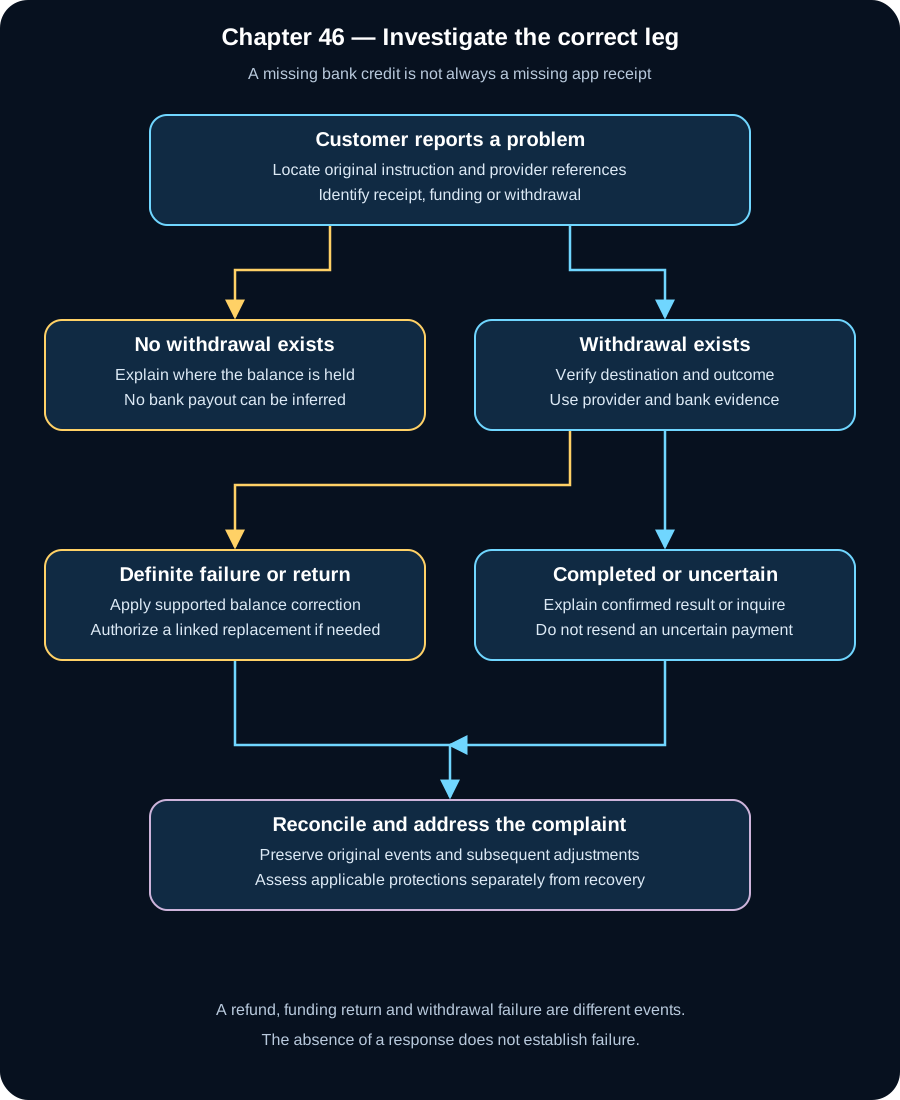
Suppose Maya's app reports a completed receipt but her bank has no credit. First determine whether she requested a withdrawal. If none exists, the bank credit is not missing. If a withdrawal exists, locate its destination and provider reference and investigate that leg. If it was definitively rejected, restore or retain the provider balance according to the product's rules and establish a corrected instruction. If uncertain, resolve it before replacement.
Support should also protect against refund scams. Someone claiming to have sent money accidentally may ask for a separate payment to another account. The recipient should use the provider's supported investigation or refund process instead of creating an unrelated transfer based on a message. The original receipt could itself be disputed or unsupported.
13. Reconciliation and accounting across balances
Reconcile the provider activity statement to the relevant bank accounts and to the bank's own ledger responsibilities. Separate opening balance, funding, received transfers, sent transfers, fees, refunds, restrictions, withdrawals and adjustments. A net movement can reconcile numerically while hiding an incorrectly attributed customer transaction.
For a generic provider with two funded users, moving $180 from user A to user B reduces the liability to A and increases the liability to B. The total customer liability is unchanged. A later external withdrawal reduces the liability to B and, when financially completed, the provider's bank cash. Intermediate clearing entries depend on the actual accounting policy. These are illustrative provider entries, not the customer's bank's postings.
If the provider advances value before an external funding receipt, finance must separately recognize and control the relevant exposure under its accounting policy. It should not book an unconfirmed collection as settled cash. A failed funding leg can create a receivable, restriction or loss treatment depending on the contract and circumstances; the implementation must not choose silently.
Reconciliation reports need both gross activity and net bank movement. A $10,000 withdrawal batch containing a $100 failed item should show the failure and corrected payable treatment. Matching the eventual $9,900 bank movement to a manually edited batch total destroys evidence of the original instruction and obscures whether the $100 remains owed.
14. Implementing the service inside a bank
Start with a supported product and a representative transaction rather than integrating every branded feature at once. Establish the account model, permissible funding methods, receipt evidence, withdrawal options and complaint responsibilities. Obtain the current participant or provider specifications for the functions the bank actually performs.
The release review should include operations and finance. Can the bank distinguish a provider balance from a bank deposit? Can it identify an external withdrawal in the customer-facing description? Can it retrieve original evidence after a provider reference changes? Does it prevent duplicate posting during callback replay? Does it retain unresolved transactions through an outage and recovery?
Third-party oversight should address data access, subcontractors, incident handling, financial controls and exit arrangements proportionate to the relationship. The interagency guidance describes a risk-management lifecycle; it is supervisory guidance, not a new payment rail or an exemption from existing duties. The bank remains responsible for understanding the activity it supports.
A controlled exit requires more than switching off the API. Pending funding, withdrawals, refunds and complaints may outlive new transaction acceptance. The bank should retain the records and operational access necessary to complete or investigate them. Historical ledger evidence must remain usable even if customers can no longer initiate new transactions through the old arrangement.
15. Worked cases and implementation decisions
A receipt exists but no withdrawal was requested
Maya receives $180 in a supported provider balance and assumes it reached her bank. The app's receipt is genuine, but there is no withdrawal reference. Identify the location of available value and explain the supported transfer choices. Do not create a missing-bank-payment incident or promise a bank credit date for an instruction that does not exist.
For the exercise, write the two statements the bank can safely make: it has no evidence of an incoming transfer to the specified bank account, and the provider receipt does not itself establish such a transfer. Then identify the provider evidence Maya should review. Avoid telling her the money is lost or guaranteed safe without assessing the actual balance arrangement.
External funding fails after recipient availability
A fictional provider makes $180 available to a recipient while collecting from the sender's bank. The funding debit later returns. The provider's customer receipt record, funding failure and recovery rights must be considered separately. The bank processing the return should report the actual returned leg rather than assert that the recipient never received value.
Draw the remaining obligations from the contract: who owes whom, which cash was advanced and which customer restrictions are permitted? The correct training answer cannot specify a universal loss owner because the provider arrangement determines it. It can require linked records, accurate cash treatment and a controlled recovery decision.
A withdrawal times out and is resubmitted
A $600 withdrawal request receives no response. A support agent wants to submit it again with another reference. Keep the original uncertain, use the supported inquiry and examine provider and bank evidence. If the first completed, a replacement would pay $1,200 against a $600 instruction. A customer pressing refresh should not create the second financial intent.
Test this with a duplicated completion callback arriving after the inquiry response. The ledger should reflect one withdrawal, while the event log retains both deliveries. If a later legitimate return arrives, it should create the appropriate adjustment linked to that withdrawal, not be discarded as another duplicate notification.
A fraudster obtains a login code
A customer is deceived into sharing a code, and a fraudster initiates a transfer. Preserve evidence identifying the initiator and assess the unauthorized-EFT allegation under applicable Regulation E requirements. Do not reject the case automatically because a correct code was used. Recovery from the recipient and the customer's protection are separate workstreams.
Compare that record with a customer who personally enters a payment instruction after being deceived about a purchase. The bank must investigate the facts and applicable rules in both cases, but should not assume the legal classification is identical. This exercise tests whether the complaint system stores facts rather than only a fraud label.
Reconcile a provider withdrawal report
A fictional report shows $12,000 requested, $11,700 financially completed, $200 rejected and $100 unresolved. The components add to $12,000. The bank evidence should support the completed portion; the rejected portion needs the appropriate balance or payable treatment; the $100 remains an open case. There is no basis to report all requested funds as delivered.
Now add a duplicate notification for a $300 completed item. Requested and completed economic amounts remain unchanged. If the totals increase, the event-consumption design has confused message volume with financial activity. Explain this distinction to both the developer and the operations analyst before accepting the integration.
16. Role checklist and learning closure
Product should state where the customer receives value and what a displayed status proves. Business analysis should map each financial leg and its owner. Technology should preserve identifiers and process repeat events safely. Operations should distinguish missing receipts, missing withdrawals, funding failures and disputes. Finance should reconcile customer obligations to actual cash and supported timing differences.
Risk and customer teams should keep contractual protections, consumer law and recovery options distinct. The practical standard is whether the bank can explain Maya's payment from her action to the actual destination of value without guessing which rail a familiar logo represents.
Chapter 47 moves from individual wallet experiences to payment facilitators, marketplaces and app stores, where one customer purchase can create proceeds owed to a separate seller or developer.
Authoritative references
Sources checked on October 5, 2026. Provider pages describe their own products; internal ledgers and unspecified settlement paths above are explicitly illustrative.
This application uses JavaScript for the full interactive experience. This text summary is served for accessibility and search indexing.