USA Payments & Collections Overview. A practitioner foundation map of the US payments and collections ecosystem across ACH, wires, instant payments, cards, checks, cash, settlement, controls, reporting and reconciliation.
The United States does not have one payment system. It has a layered ecosystem of bank-account rails, card networks, check infrastructure, cash services, private clearing systems, Federal Reserve services, digital overlays and specialist collection channels. The practical skill is not memorising their names. It is learning to answer one question consistently: for this business event, which instrument, network, settlement model, control set and reporting trail actually moves the money and proves that it moved correctly?
This chapter is the foundation for the entire USA programme. It intentionally stays at overview level while still giving enough functional and technical depth to understand how a real bank sees payments and collections. Later chapters take each rail, participant, message family, control and operating process apart in detail. Here the objective is to build the map first.
A useful working rule for the whole academy is simple: customer experience, payment instruction, clearing, settlement, account posting, funds availability and finality are related events, but they are not the same event.
What you should be able to do after this chapter
After working through the chapter, you should be able to:
- distinguish a payment from a collection without assuming that each needs a different rail;
- identify whether a movement is push, pull, request-led, on-us or interbank;
- explain the practical roles of ACH, Same Day ACH, Fedwire, CHIPS, RTP, FedNow, cards, checks, lockbox and cash collection services;
- separate initiation, validation, routing, network exchange, settlement, posting, availability, reporting and reconciliation;
- explain why speed, finality, reach, cost, liquidity and exception rights are different decision dimensions;
- describe what a bank must control before releasing a payment and what evidence must exist after it completes;
- understand the high-level US legal and rulebook layers without confusing regulation with network operating rules;
- understand how routing identifiers and participant access models affect execution;
- distinguish rejects, returns, reversals, recalls or return requests, refunds, chargebacks and ACH Notifications of Change;
- explain how a cross-border USD payment can involve SWIFT messaging, correspondent accounts and a US settlement rail without treating SWIFT itself as the settlement system;
- read a business requirement and ask the right questions before anybody starts designing a solution;
- understand where customer channels, payment hubs, core banking, network gateways, fraud, sanctions, accounting and reporting services fit;
- recognise why reconciliation and investigations are part of the payment product rather than back-office afterthoughts.
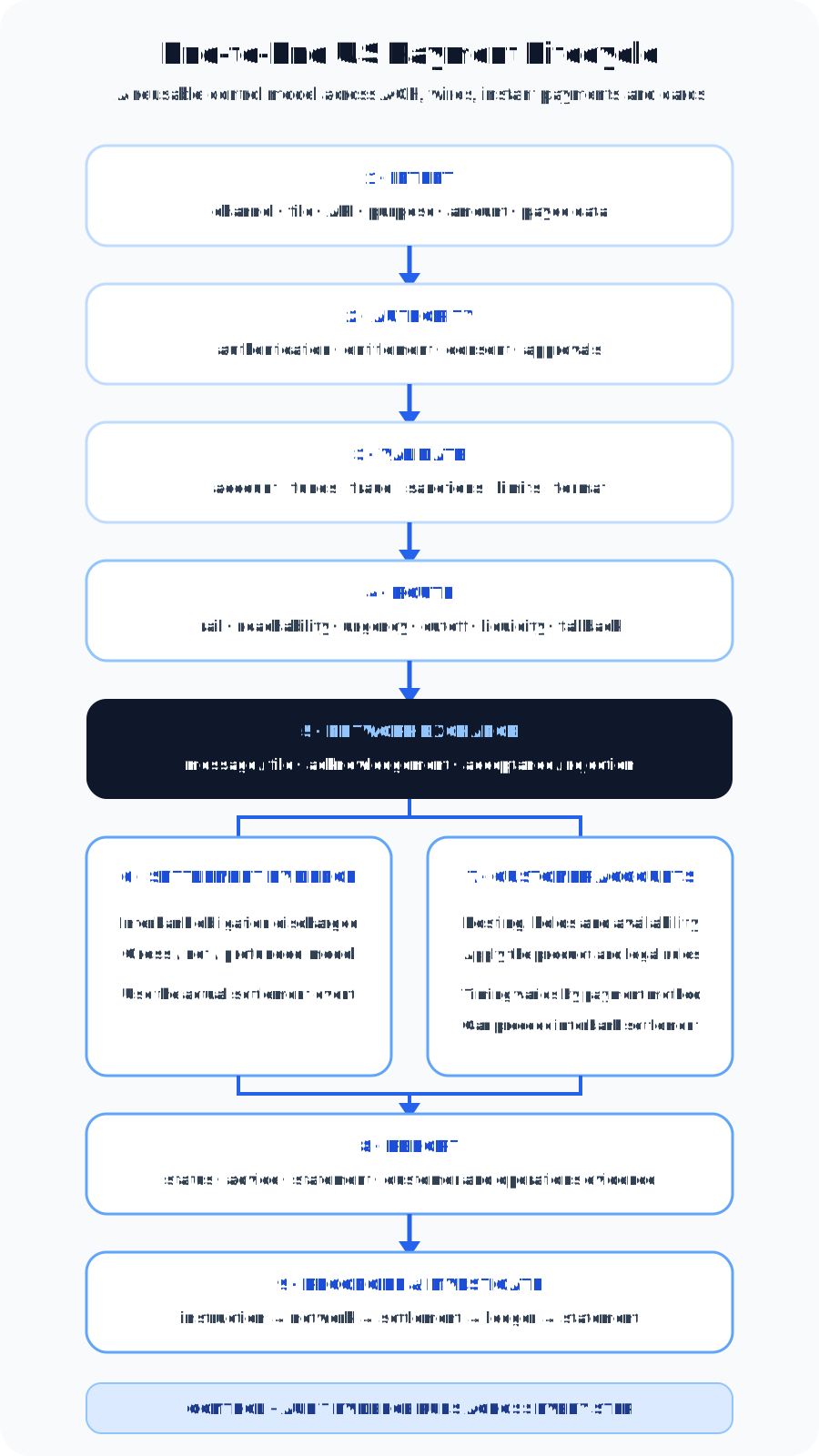
For a roughly 60-minute core session, spend about 35 minutes on Sections 1–3, Sections 13–20, Sections 29–31, Section 36 and Section 41. For the next 10 minutes, use the chapter’s three diagrams to follow the chosen rail from customer intent to bank evidence. Use 10 minutes to work through the customer-collection story in Section 23, then spend the final 5 minutes explaining: What evidence would let you tell a customer that a payment has settled? Treat these timings as a study guide. The remaining sections, additional cases and extended reference material are follow-up study; completing the whole chapter takes longer.
Chapter navigator
- Start with a real business day, not a list of rails
- Seven questions that identify almost every US money movement
- The US ecosystem in six layers
- ACH: the volume backbone
- Fedwire Funds Service: RTGS and high-value certainty
- CHIPS: high-value USD with liquidity efficiency
- RTP: private-sector instant credit transfers
- FedNow: instant settlement in central-bank money
- Cards: instant decision, later clearing and settlement
- Checks: paper instruction, digital clearing
- Cash: physical collection still needs a digital control trail
- Digital overlays are not always new rails
- Clearing, settlement, posting, availability and finality
- How a bank actually chooses a route
- The bank control stack before release
- What happens after network acceptance
- Reporting: the customer needs to understand what happened
- Reconciliation: proving the story end to end
- Liquidity: the invisible requirement behind payment execution
- Operating clocks: 24/7 changes the bank, not only the rail
- Collections architecture: invoice to cash
- Payment architecture: obligation to beneficiary
- Story: a $420,000 customer collection from start to finish
- Story: a $3.2 million supplier payment
- Cards collection story: why gross sales do not equal bank credit
- ACH debit collection story: authority matters
- Fraud: faster money movement shortens the decision window
- Sanctions, AML and payment data
- Exceptions: design them before production finds them
- Investigations: follow the identifiers
- Accounting: every payment has a ledger consequence
- Service-level thinking: define the actual promise
- Functional requirement checklist for any US payment product
- Testing a US payment product end to end
- Common misconceptions to remove now
- The US legal and rulebook map: one payment can sit under several layers
- Routing and identifiers: how the bank knows where the money must go
- Direct participation, indirect access and correspondent banking
- Exception vocabulary: reject, return, reversal, recall, refund and chargeback are not synonyms
- Cross-border USD: SWIFT messaging is not the settlement rail
- Compact rail comparison
- Three practitioner cases
- Final end-to-end mental model
- Practitioner checkpoint
- Official and primary references
1. Start with a real business day, not a list of rails
At 8:05 a.m. a manufacturer releases payroll. At 8:20 a.m. its treasury team receives a $6.4 million customer payment. At 9:10 a.m. its ecommerce channel starts receiving card sales. At 10:00 a.m. a corporate customer approves an invoice after receiving a Request for Payment. At noon, mailed checks arrive at a lockbox. At 2:30 p.m. a property closing needs final funds. At 5:45 p.m. an insurance claim must reach a consumer immediately. At 11:30 p.m. another customer still expects an instant refund.
Every one of those events can be called a payment. Operationally they are very different.
Payroll may travel as ACH credit. The large customer payment may arrive through Fedwire, CHIPS or a correspondent arrangement. Card sales may be authorised in seconds while merchant funding happens later. A Request for Payment is a structured request that may lead to an instant credit transfer; it is not itself the movement of funds. Lockbox turns paper checks and remittance documents into deposits and usable receivables data. A property closing frequently values wire finality. An instant insurance payout may use RTP or FedNow when the receiving institution is reachable and the sending bank supports the relevant capability.
That is the US landscape in one day: multiple rails coexist because speed, economics, reach, authority model, data, risk, liquidity, exception rights and finality needs are different.
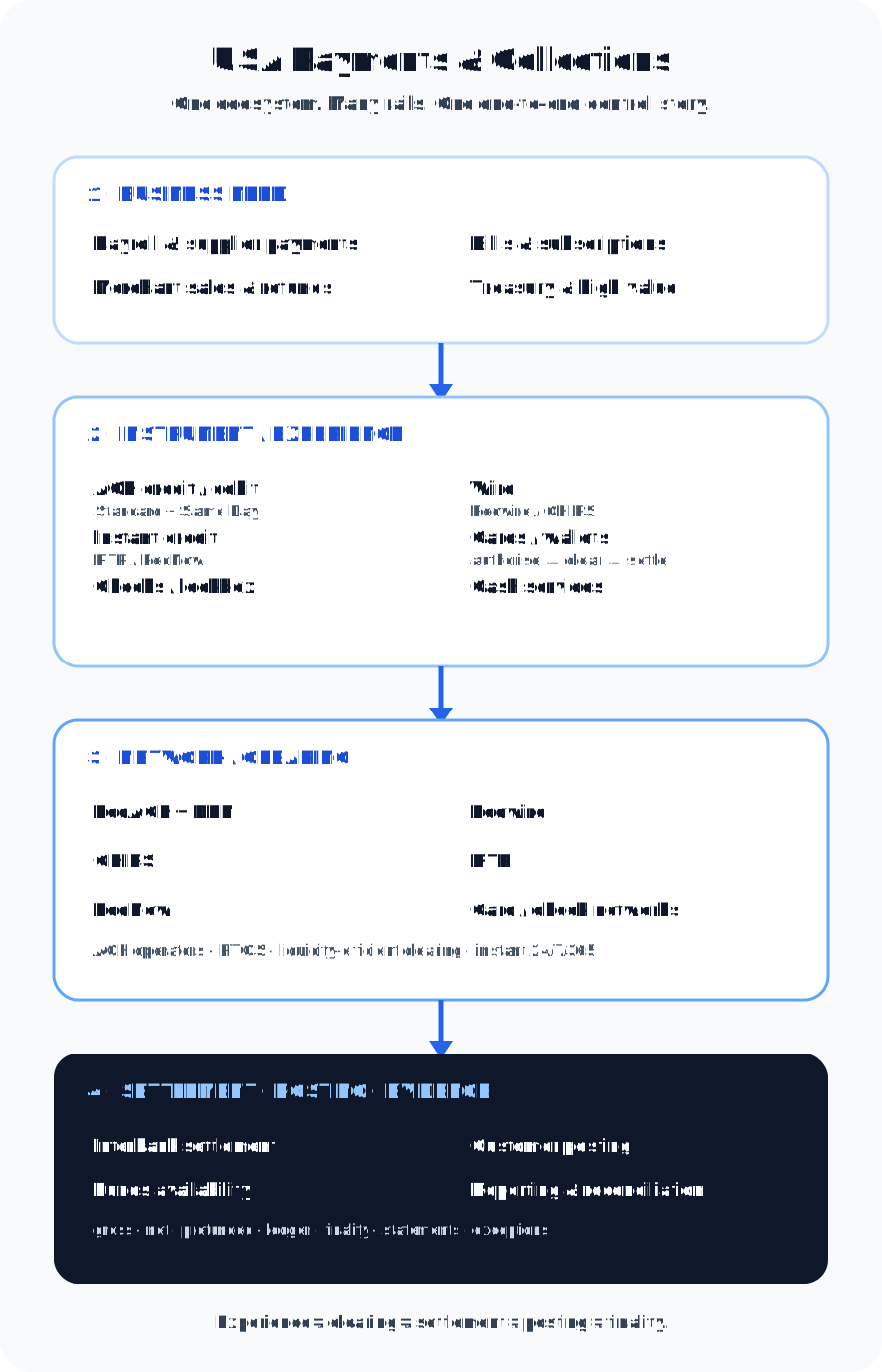
A good business analyst therefore does not begin a requirement workshop by asking, “Do you want ACH or RTP?” The better opening question is, “What business event are we trying to complete, by when, for whom, with what authority, and what evidence must exist when it is done?”
2. Seven questions that identify almost every US money movement
Before naming a rail, ask seven questions.
2.1 Who is causing the movement?
A payer can push money. A biller can originate an authorised ACH debit. A merchant can submit a card transaction the customer authorised at purchase. A bank can move money between accounts on its own books. A corporate can send a wire. A government agency can originate disbursements. A platform may orchestrate a payment while another regulated institution actually holds and moves the funds.
The initiating party matters because the control model follows authority. A customer-authenticated credit push is not controlled like a biller-originated debit. A card authorisation is not controlled like an ACH mandate. A bank book transfer does not have the same interbank clearing dependency as a payment to another institution.
2.2 Is the economic purpose a payment, a collection or both?
A payment is normally discussed from the sender or disburser side: payroll, supplier payment, tax payment, refund, claim payment, treasury transfer or consumer payout.
A collection is normally discussed from the receiver or biller side: invoice collection, subscription debit, card sale, rent collection, lockbox receipt, cash deposit, ecommerce settlement or receivable payment.
The same movement can be both. An ACH credit is a payment for the originator and a collection for the receiver. RTP or FedNow can support collections through Request for Payment even though the underlying transfer remains a payer-authorised credit push.
This distinction is important in product design. The corporate collector usually cares about invoice identification, remittance information, automated cash application and receivables status. The payer cares about authority, account balance, timing and proof of payment. The rail has to serve both ends of the same economic event.
2.3 Is the instruction push, pull or request-led?
A push means the payer or payer-side institution releases a credit transfer. Fedwire, CHIPS customer transfers, RTP, FedNow and ACH credits are examples.
A pull means the receiver side initiates a debit based on valid authority. ACH debit is the most important bank-account pull mechanism. Card transactions can feel merchant-pulled, but they operate through card authorisation and network rules rather than Nacha debit mechanics.
A request-led model sends a structured request that the payer can approve or decline. RTP and FedNow Request for Payment capabilities fit this model. The request carries context; the approved movement remains a credit push.
Why does this matter? Because fraud and liability controls change dramatically depending on who initiates and who authorises. An instant final push cannot rely on the same after-the-fact return rights that exist for some debit scenarios.
2.4 Is it on-us or interbank?
If both accounts are held at the same bank, the institution can perform an on-us book transfer. No external clearing system is required to move value between the two bank liabilities. The customer experience may be immediate, but authentication, fraud checks, account posting, audit evidence and reporting are still required.
If different financial institutions are involved, an interbank mechanism is needed. That may be FedACH/EPN, Fedwire, CHIPS, RTP, FedNow, card network settlement, check image exchange or another correspondent or specialist arrangement.
This is one of the first routing questions a bank payment hub may evaluate. A product advertised as “instant” might use an internal book transfer when both parties are customers of the same bank and use an external instant rail when they are not.
2.5 When does the receiver see money, and when is settlement final?
Funds availability and settlement finality must never be treated as synonyms.
A cardholder sees an authorisation before merchant settlement. A deposited check can become available to the customer while return risk still exists. An ACH entry can post according to bank and network timelines even though the broader exception model is not the same as an instant final credit transfer. Fedwire and instant-payment systems are designed around immediate or near-immediate final settlement once the transaction completes under their rules.
A requirement that says “the beneficiary must receive the money in ten seconds” is incomplete. Does “receive” mean the receiving institution accepted the message? Interbank settlement completed? The account was posted? The balance is available to spend? A customer notification was sent? Those timestamps need separate definitions.
2.6 What data travels with the money?
Reference quality determines downstream automation. A payment can arrive successfully and still become an operations problem if the receiver cannot identify the invoice, customer, policy, claim, tax period or contract it belongs to.
US banks operate across several data traditions: Nacha records and addenda for ACH; ISO 20022 on major modern high-value and instant infrastructures; card message standards and proprietary processor files; X9 image-cash-letter formats for checks; BAI2 and increasingly ISO 20022 cash-management reporting for corporates; and many API/provider event formats around digital channels.
The business value of richer data is not simply “more fields.” The objective is better automation: screening, matching, routing, investigations, customer reporting, reconciliation and analytics.
2.7 What happens when it goes wrong?
Every method has a different exception model.
ACH has returns, reversals, Notifications of Change and rule-defined processes. Wires provide strong settlement certainty, so post-payment recovery is not a routine consumer-style reversal process. Instant payments are credit push and final once accepted under the relevant network rules, while separate messaging or return-of-funds mechanisms may exist. Cards have reversals, refunds, disputes and chargebacks. Checks may be returned unpaid and are exposed to counterfeit, alteration and duplicate presentment.
A production-grade requirement never specifies only the happy path. If you cannot explain rejection, repair, return, reversal, recovery, investigation, duplicate handling and customer communication, the requirement is not complete.
3. The US ecosystem in six layers
Layer 1 — customer and business initiation
Intent enters through mobile banking, online banking, corporate treasury portals, host-to-host files, APIs, ERP/AP systems, payroll platforms, merchant checkout, POS, billing portals, lockbox mail, branch deposits, remote deposit capture, ATMs, smart safes and third-party platforms.
The channel answers how the instruction was captured. It does not determine the settlement rail by itself.
Layer 2 — bank or provider orchestration
Banks and processors validate the instruction, authenticate the user or channel, verify entitlements, apply product rules, enrich routing data, perform fraud and sanctions controls where applicable, check limits, decide the route and create the network-specific message or file.
In a modern bank this capability may be distributed across a payment hub, ACH engine, wire platform, instant gateway, card processor, fraud engine, sanctions engine, core ledger, customer information systems and reporting services.
Layer 3 — clearing or network exchange
This is where payment information and obligations are exchanged according to network rules. FedACH and EPN process ACH. CHIPS handles major high-value USD payment activity. RTP and FedNow exchange instant-payment messages. Fedwire provides its own real-time gross settlement service. Card networks handle authorisation and clearing messages. Check images are exchanged through Federal Reserve and private-sector arrangements.
Layer 4 — settlement
Settlement is the discharge of the interbank obligation.
Fedwire settles transfers individually in central bank money. FedNow settles through Federal Reserve accounts. RTP uses a prefunded model. ACH uses deferred settlement cycles. CHIPS is designed for high-value USD clearing and settlement with liquidity efficiency. Card and check systems settle according to their own network arrangements.
Layer 5 — customer posting and availability
The receiving bank posts the result to the customer account according to the rail, product, regulation and operating rules. Posting is a ledger event. Availability is whether the customer can use the funds. Those events may align or differ.
Layer 6 — reporting, reconciliation and evidence
A payment is not operationally complete when a balance changes. Banks and corporates need acknowledgements, advices, statements, settlement reports, return information, network reports, accounting entries, fee data, audit logs and exception evidence.
For collections, this layer can be the difference between straight-through cash application and thousands of dollars sitting in suspense because the corporate cannot identify what a receipt relates to.
4. ACH: the volume backbone
The ACH Network is a central volume rail for US bank-account payments and collections. It supports credits such as payroll, supplier payments, benefits, reimbursements and account-to-account transfers, and debits such as utility bills, insurance premiums, subscriptions, loan payments and many business collections.
ACH is governed through Nacha operating rules and processed through the Federal Reserve’s FedACH service and The Clearing House’s Electronic Payments Network. For most customers, the important question is not which ACH operator processed an entry but whether the bank can deliver the required service, timing, controls and reporting across the network.
Standard ACH is batch-oriented. Same Day ACH introduces faster settlement windows while remaining ACH. It should not be described as an instant rail. As of October 5, 2026, the Same Day ACH per-payment limit is $1 million. Nacha has approved an increase to $10 million effective September 17, 2027. That future date matters: a product or requirement written in 2026 must not behave as though the future limit is already available.
ACH also has a mature exception environment. Return reasons, return timeframes, reversals, Notifications of Change, prenotes or account-validation strategies, originator controls and debit authorisation models matter heavily in bank implementation.
For a corporate-originated ACH file, a real bank may need to perform file-level and transaction-level checks: file integrity, customer identity, originator status, approval workflow, duplicate detection, exposure limits, account and routing validation, effective-entry-date handling, SEC-code eligibility, fraud monitoring and release cutoff control. Then the ACH engine creates or validates network-formatted entries and submits them to the operator.
For ACH debit collections, the customer experience looks simple—“pull the invoice amount from the customer”—but the bank must know that valid authority exists, the correct debit class is used, the amount and timing align with what the customer was authorised for, and downstream return handling is operationally ready.
A key practitioner insight: ACH is inexpensive and broadly reachable because it is mature and efficient, not because controls can be relaxed.
5. Fedwire Funds Service: RTGS and high-value certainty
Fedwire Funds Service is operated by the Federal Reserve Banks. It is a real-time gross settlement service: qualifying transfers settle individually across Federal Reserve accounts rather than waiting for a later batch net settlement.
Fedwire migrated to ISO 20022 on July 14, 2025. For banks, this is more than a syntax change. Richer structured data can improve screening, routing, investigations and corporate reconciliation when institutions preserve it end-to-end rather than flattening it into legacy fields.
Current Fedwire operating hours remain 22 hours per business day, from 9:00 p.m. Eastern Time on the preceding calendar day to 7:00 p.m. Eastern Time. The Federal Reserve has announced expanded operating days for a future 2028 or 2029 implementation, but that future model must not be presented as the 2026 operating state.
Fedwire is important when certainty, value and timing matter. Treasury movements, financial-market funding, real-estate closings, correspondent transfers and other high-value or time-critical transactions may use wires.
The customer says, “send a wire.” The bank hears a much larger workflow: authenticate the customer, validate entitlements, verify the debit account, control the beneficiary, ensure available funds or credit, apply fraud and sanctions controls, check amount and product limits, enrich routing data, decide whether repair or dual approval is needed, generate the correct network message, release it within service hours, receive status, post accounting entries, generate advice and preserve traceability.
That is why “wire” is not just a message format or a front-end button. It is an end-to-end service.
6. CHIPS: high-value USD with liquidity efficiency
CHIPS is operated by The Clearing House and is a major infrastructure for large-value and cross-border USD payments. It migrated to ISO 20022 in April 2024.
The practical difference from Fedwire is not simply “international versus domestic.” That shortcut creates bad requirements. Both are USD high-value infrastructures. The actual route depends on participation, correspondent relationships, payment purpose, timing, liquidity, beneficiary reach, internal routing policy and customer service configuration.
CHIPS is designed to reduce the amount of liquidity required to settle very large payment values through its clearing and settlement design. That matters to banks because liquidity is a real operating resource. Two routes may both reach the beneficiary, yet one may be preferable because of available liquidity, deadline, pricing or correspondent arrangement.
For a corporate customer receiving USD from abroad, the customer may only see one incoming credit. Behind that receipt, several institutions and accounts may have participated before the final credit reached the corporate account. Investigation teams therefore need to distinguish the customer-facing receipt from the interbank messaging and settlement chain.
7. RTP: private-sector instant credit transfers
The RTP network from The Clearing House operates 24/7/365, uses ISO 20022 messaging and supports real-time credit transfers. Its current transaction limit is $10 million, effective since February 9, 2025.
RTP is a credit-push network. Request for Payment adds a structured request and response experience but does not convert the underlying payment into a debit pull. This distinction affects consent, customer communication, fraud control and liability analysis.
The RTP model also creates a different liquidity discipline from weekday batch processing. Sending institutions need sufficient settlement capacity under the network’s prefunded model. A customer channel can be healthy, the network can be reachable and the payment can still be non-executable if the bank’s liquidity position or internal control framework does not support release.
Because an instant payment moves fast and is final under the network rules once accepted, prevention controls must move earlier. Authentication, entitlement, beneficiary confidence, account state, fraud decisioning, limits and customer confirmation need to be strong before the transaction is released.
The bank must also treat 24/7/365 as an operational promise. It means fraud engines, network gateways, ledger posting, customer notifications, monitoring, liquidity management, reconciliation and incident response all need a round-the-clock design. “The API is available 24/7” is not enough.
8. FedNow: instant settlement in central-bank money
FedNow Service, operated by the Federal Reserve Banks, also runs 24/7/365 and uses ISO 20022. Effective November 12, 2025, the network transaction limit for customer credit transfers and payment returns increased to $10 million. A participating institution can still apply lower internal or customer limits.
FedNow and RTP are separate networks. A bank can participate in one, both or neither, and capabilities may differ between receive and send. Therefore “the customer selected instant payment” does not automatically tell you which rail will carry the instruction.
A bank routing engine may need to consider receiving-institution reachability, customer entitlement, amount, bank-set limits, urgency, fraud result, account status, network status, liquidity, pricing and fallback rules before choosing a route.
Instant rails make routing intelligence more important, not less. A simple UI label can hide a sophisticated execution decision.
9. Cards: instant decision, later clearing and settlement
Cards are one of the easiest places to confuse response speed with settlement speed.
At checkout, the merchant sends an authorisation request through its acquiring and network chain to the issuer. The issuer decides whether to approve based on account status, available credit or funds, fraud controls and network rules. That can happen in seconds.
But merchant funding is not normally the same event as authorisation. Clearing follows with financial transaction detail, interchange and fee calculation. Settlement transfers the resulting obligations between participants, and the acquirer or provider funds the merchant under the merchant agreement.
The ecosystem includes cardholder, merchant, gateway, acquirer, processor, network and issuer. Wallets may tokenise card credentials and improve authentication or customer experience while the underlying transaction still settles as a card payment.
For the merchant, the real collection requirement is much bigger than “payment approved.” The merchant must reconcile sales, capture, refunds, reversals, fees, chargebacks, adjustments, reserves and settlement batches to the actual net credit received.
A good requirements document therefore separates at least these timestamps: authorisation, capture, clearing, settlement and merchant funding.
10. Checks: paper instruction, digital clearing
A check may begin on paper, but modern interbank check clearing is largely image-based. Check 21 helped enable substitute-check and image-exchange models that removed the routine need to physically transport the original paper between banks.
A check collection lifecycle can include deposit capture, image-quality checks, duplicate detection, account and endorsement controls, image exchange, paying-bank decision, settlement, customer availability and possible return.
Remote Deposit Capture and mobile deposit are capture channels. They do not create a separate settlement rail; they digitise the item for the check-clearing process.
Lockbox services industrialise business check collection. The bank or provider receives mail, opens envelopes, scans checks and remittance documents, deposits items and produces data feeds for the corporate. The true value of lockbox is often not only faster deposit but also better receivables data and automated cash application.
Checks demonstrate again why availability is not finality. A bank may make funds available according to policy and regulation even though the item can still be returned.
11. Cash: physical collection still needs a digital control trail
Cash is often excluded from digital-payment discussions, but for retailers, restaurants, transport businesses and other cash-intensive customers it remains a real collection mechanism.
The payment technology is physical currency; the banking problem is controlled intake. Branch deposits, ATMs, smart safes, armored transport, vault services, deposit tickets, cash counting, counterfeit detection, provisional credit, final verification and account posting can all form part of the service.
A strong bank product needs chain-of-custody evidence: who deposited, where it was deposited, what was counted, what was provisionally credited, what was later verified, whether a difference was found and how it was resolved.
Cash therefore reinforces the chapter’s core idea: money movement is not complete until value, ledger and evidence agree.
12. Digital overlays are not always new rails
Payment products frequently place modern customer experiences over existing infrastructure.
A digital wallet may use tokenised card credentials. A billing portal may send an ACH debit or initiate a card payment. A P2P product may use an internal bank transfer, ACH, debit card, RTP, FedNow or a provider-managed combination. A Request for Payment may ride on instant-payment messaging but the funds movement is still a credit push after payer approval.
The business analyst must always ask: what actually settles underneath?
If the answer is unclear, important requirements around timing, returns, finality, reporting and dispute rights will also be unclear.
13. Clearing, settlement, posting, availability and finality
These terms deserve deliberate separation.
Clearing is the exchange, validation and calculation process that determines payment obligations between institutions.
Settlement is the discharge of those interbank obligations.
Posting is the update of the bank’s customer or internal ledger.
Funds availability is when the customer can use the money.
Finality is the point at which settlement is treated as final under the applicable system or legal framework.
Consider four examples.
A card purchase may be authorised immediately, cleared later and settled later still.
A check deposit may become available before the paying bank’s return opportunity has disappeared.
An ACH entry can settle through an ACH cycle and still be subject to rule-defined return processes.
A Fedwire transfer settles with immediate finality when processed by the service, but the receiving bank still needs to perform customer posting and reporting correctly.
These differences are not academic. They drive customer promises, balance treatment, liquidity calculations, accounting, exception management and operational risk.
14. How a bank actually chooses a route
A customer may say “send quickly” or “pay today.” The bank still needs to choose an executable route.
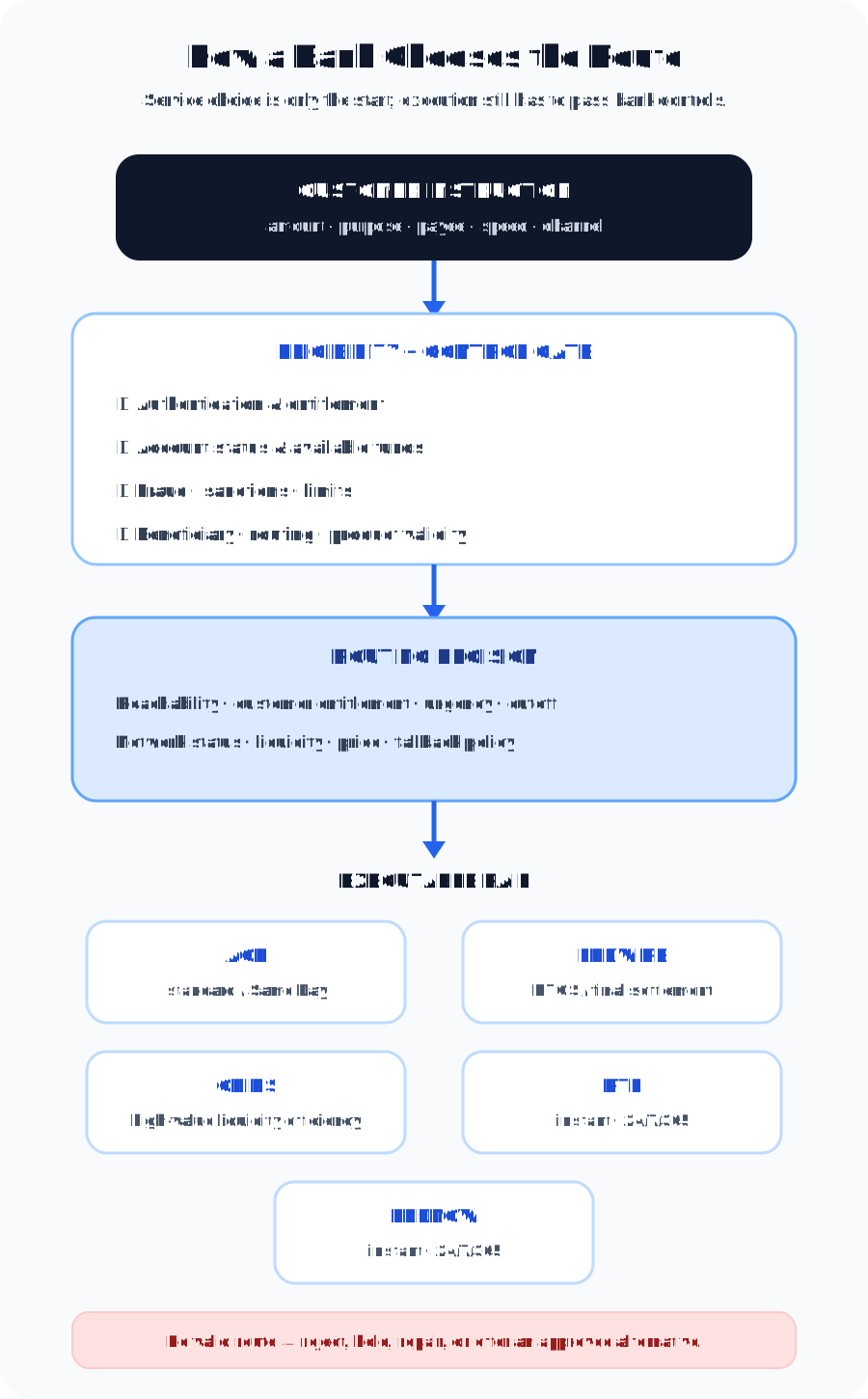
The routing decision can consider:
- whether the payment is on-us or interbank;
- receiver reachability on the candidate network;
- customer product entitlement;
- transaction amount and internal limits;
- required speed and service commitment;
- current time and network operating window;
- fraud and sanctions decision;
- beneficiary and routing-data validity;
- available balance or credit;
- network status;
- liquidity position;
- pricing and customer agreement;
- permitted fallback behaviour.
The important functional principle is that fallback must be explicit. If an instant route is unavailable, the bank should not silently send a transaction through a slower rail when that would violate customer expectation or contractual timing. The product must define whether to reject, hold, ask the customer, repair or offer an alternative.
15. The bank control stack before release
A real bank payment does not go directly from customer click to network gateway.
Identity and channel control
Who is sending the instruction? Is the digital session authenticated? Is the host-to-host certificate valid? Is the API client authorised? Has the file channel been correctly identified?
Entitlement and approval
Is this user allowed to use the product? Is the account enabled for this payment type? Does the corporate require one approver or multiple approvers? Has maker-checker segregation been satisfied?
Data validation
Are required fields present? Is the routing information valid? Is the amount syntactically and commercially valid? Are dates and currencies permitted? Is the requested rail compatible with the instruction?
Account and funds control
Is the debit account open and eligible? Is sufficient available balance or credit present? Is a hold needed before release? Are overdraft or intraday-credit rules involved?
Fraud control
Does the transaction differ from expected customer behaviour? Is the beneficiary new? Is the device or session suspicious? Has there been a rapid sequence of payments? Does the amount or destination require stronger authentication or review?
Sanctions and compliance control
Banks apply screening and compliance controls according to legal obligations, payment type, participant data and institutional policy. A system design must preserve the data needed for these controls and create auditable outcomes.
Product and limit control
A network may support a $10 million transaction while a bank product supports only $100,000 for a particular customer segment. Network limit and customer limit are not the same thing.
Duplicate control
Duplicate detection is critical for files, APIs and retry-heavy real-time channels. A customer timeout must not automatically become a second payment. Idempotency, message identifiers, file controls and network status checks matter.
Release control
Only after the required controls pass should the bank create and transmit the executable network instruction.
This is especially important for instant and high-finality payments, where the cost of a bad release can be much harder to recover after settlement.
16. What happens after network acceptance
Network acceptance is not the end of the bank’s work.
The bank must correctly interpret the response or status. It must update internal payment state. It may need to release or finalise a debit hold. It must book fees and accounting entries. The receiving side must post the beneficiary account. The customer may need confirmation. Treasury and liquidity systems need settlement information. Reporting services need the status. Reconciliation needs identifiers that connect the instruction to the network event and ledger movement.
A robust state model therefore distinguishes values such as captured, authorised, validated, released, network-accepted, settled, posted, reported, returned or rejected rather than collapsing everything into “success” and “failed.”
17. Reporting: the customer needs to understand what happened
Corporate customers may receive reports through portals, APIs, files, BAI2, ISO 20022 cash-management messages or provider-specific formats.
The report may need to show payment reference, network reference, amount, value date, debit or credit account, counterparty, fees, status and remittance information.
Good reporting separates status from cash position. A payment can be operationally accepted while customer posting is pending. A collection can settle while cash application is still unresolved because remittance data is missing.
The customer should never need to guess whether “processed” means submitted, accepted, settled or credited.
18. Reconciliation: proving the story end to end
Reconciliation is the systematic proof that corresponding records across systems agree.
A bank may need to reconcile:
- the customer instruction;
- the payment-orchestration record;
- the outbound network message or file;
- the network acknowledgement or settlement record;
- settlement-account movement;
- customer-ledger posting;
- general-ledger entries;
- fees and charges;
- customer reporting.
For collections, the corporate may need to reconcile the incoming payment to open receivables. That requires usable references and sometimes supplemental remittance data.
The cleanest design uses stable identifiers that survive the entire lifecycle. If each system invents its own unrelated reference, investigation becomes manual and expensive.
Three practical reconciliation questions are powerful:
- Did we send or receive everything we expected?
- Did every network movement produce the expected ledger and accounting result?
- Can we explain every difference without manual guesswork?
19. Liquidity: the invisible requirement behind payment execution
Liquidity is often missing from front-end requirements even though it can determine whether a bank can execute a payment.
Fedwire gross settlement consumes central-bank balances or available intraday liquidity payment by payment. CHIPS is designed for liquidity efficiency across high-value flows. RTP uses a prefunded model. FedNow settlement also affects Federal Reserve account positions. ACH settles in cycles, so banks need to forecast and manage net positions.
For treasury and operations, the important concepts are opening balances, expected inflows, expected outflows, prefunding, settlement deadlines, intraday positions, network-specific capacity and contingency arrangements.
For a business analyst, the lesson is not to design treasury algorithms. It is to remember that “customer has sufficient funds” and “bank has sufficient settlement liquidity” are separate checks.
20. Operating clocks: 24/7 changes the bank, not only the rail
Traditional payment operations often revolve around business-day cutoffs. Instant payments force a different mindset.
If a rail runs 24/7/365, the supporting bank capabilities need suitable availability as well: customer authentication, fraud controls, account checks, core posting, settlement capacity, monitoring, alerting, customer notifications, incident management and reconciliation.
A weekend payment that settles instantly cannot wait until Monday for a mandatory downstream ledger or fraud process that determines customer availability.
Meanwhile other rails retain operating windows and batch cycles. The bank therefore runs multiple clocks at once. Product requirements must explicitly state which clock governs each service.
21. Collections architecture: invoice to cash
Consider a corporate that issues 100,000 invoices each month. Its problem is not “how can customers pay?” Its real problem is how can the business convert outstanding receivables into identified, usable cash with minimal manual work?
A complete collection capability can include:
- invoice generation;
- customer presentment or billing portal;
- payment choice;
- payer authentication or debit authority;
- collection initiation;
- network processing;
- settlement;
- bank credit;
- remittance capture;
- receivables matching;
- exception repair;
- customer service;
- reporting and reconciliation.
The corporate may offer ACH debit, ACH credit instructions, cards, Request for Payment, checks and lockbox. The best mechanism depends on customer type, transaction value, required certainty, recurring-versus-one-time relationship, fees, dispute rights and data quality.
A collection product should therefore optimise cash conversion and identification, not just transaction initiation.
22. Payment architecture: obligation to beneficiary
Now consider the outgoing side. A corporation needs to pay employees, suppliers, tax authorities, consumers and treasury counterparties.
A payment factory or bank service may ingest ERP files or APIs, validate them, apply customer approvals, classify the payment, choose ACH/wire/instant routing, execute, receive status, post the customer account and return reporting.
The disbursement problem is often one-to-many: a single approved file can contain thousands of payments with different beneficiaries and exception outcomes. File-level success does not mean every underlying payment succeeded.
A good implementation therefore models both file state and transaction state independently.
23. Story: a $420,000 customer collection from start to finish
Malla Manufacturing has issued invoice MM-20418 for $420,000 to a US customer. The receivables team wants same-day certainty and enough remittance information to apply the cash automatically.
The customer receives the invoice in a billing portal. The portal offers several payment methods. Because the customer wants to control release, the corporate sends a structured payment request rather than initiating a debit.
The customer reviews the amount, invoice reference and creditor identity, authenticates with its bank and approves the payment.
The sending bank now owns the execution decision. It confirms the customer is entitled to the payment service, checks the account, available funds, amount limit, beneficiary information and fraud signals, and verifies the receiving institution can be reached on the selected instant rail.
The payment instruction is transformed into the network message. The network validates and accepts it. Interbank settlement completes according to that network’s model. The receiving bank receives confirmation and posts $420,000 to Malla Manufacturing’s account.
The receiving bank also preserves the invoice reference MM-20418 and makes it available through reporting. The corporate receivables platform matches that reference to the open invoice and closes the receivable automatically.
Notice how many separate outcomes were required for a “simple” collection:
- the request reached the payer;
- the payer authorised it;
- the payment passed bank controls;
- a valid route existed;
- the network accepted the instruction;
- settlement completed;
- the beneficiary account was posted;
- the customer was informed;
- the invoice reference survived;
- cash application succeeded;
- bank and corporate reconciliation agreed.
If the money arrives but MM-20418 is lost, the payment succeeded but the collection process did not fully succeed.
24. Story: a $3.2 million supplier payment
A corporate treasury department needs to pay a critical supplier $3.2 million before a contractual deadline.
The instruction enters through the corporate treasury channel. Two authorised users approve it because the customer’s policy requires dual approval above a threshold.
The bank validates the debit account and funds, screens the parties and transaction according to its compliance framework, applies fraud controls and confirms the beneficiary routing data.
The routing engine evaluates the service request. ACH may be inappropriate because of the amount, timing or contractual finality need. An instant rail may technically support the value, but customer entitlement, receiver reachability, internal bank limits, liquidity and product policy still matter. Fedwire or CHIPS may be selected based on the bank’s routing policy and the payment context.
After release, the bank receives the relevant network outcome, updates its payment state, books accounting entries, sends customer advice and preserves network references for investigation.
The BA question is not “which rail is fastest?” It is “which permitted route satisfies timing, finality, reach, control, liquidity and customer agreement for this payment?”
25. Cards collection story: why gross sales do not equal bank credit
A merchant reports $1,000,000 in card sales for the day. Its bank account receives only $972,000 from its acquiring arrangement.
There is no immediate reason to assume $28,000 is missing.
The difference may include refunds, interchange, processor fees, network fees, chargebacks, reserves, timing differences or adjustments. The reconciliation process needs detailed settlement reporting from the acquirer or provider.
This is why collection requirements must distinguish gross sales, cleared sales, settled position and net merchant funding.
26. ACH debit collection story: authority matters
A utility company wants to debit a customer automatically each month.
The business requirement cannot stop at “run ACH debit on due date.” It needs to define how authority is captured and stored, what amount rules apply, what happens when the customer changes accounts, how failed debits are handled, when retry is permitted, how returns are processed, how the customer is notified and how the receivable is reopened if collection fails.
Collections are therefore part payment rail, part customer-consent model and part exception workflow.
27. Fraud: faster money movement shortens the decision window
Fraud control differs by rail, but one principle is universal: the faster and more final the transfer, the more important pre-release decisioning becomes.
Signals can include unusual device or login behaviour, new beneficiaries, sudden amount changes, rapid payment sequences, anomalous customer behaviour, suspicious account relationships or known fraud indicators.
Instant-payment fraud controls need very low latency because the payment cannot wait minutes for a batch decision. The fraud engine therefore becomes part of the real-time payment path.
At the same time, false positives matter. If every high-value legitimate payment is stopped, the product is unusable. Banks balance security, customer friction, decision quality and regulatory expectations.
28. Sanctions, AML and payment data
Payment processing needs enough participant and transaction information to support the institution’s sanctions and financial-crime controls.
The specific screening approach differs by rail, message type, customer and bank policy. The functional requirement is to preserve the necessary data, invoke the required controls at the right stage, prevent unauthorised release when a control has not completed, and retain auditable evidence of the outcome.
ISO 20022 migrations matter partly because structured party and remittance information can improve downstream processing when banks map and preserve it correctly.
A poor migration that compresses rich structured data into one legacy free-text field wastes much of that value.
29. Exceptions: design them before production finds them
Common exception categories include:
- invalid account or routing data;
- insufficient funds;
- customer not entitled;
- duplicate instruction;
- suspected fraud;
- sanctions or compliance hold;
- receiver not reachable on requested rail;
- network unavailable;
- file partially accepted;
- payment rejected by network;
- beneficiary account posting failure;
- ACH return;
- check return;
- card dispute or chargeback;
- missing or unmatched remittance;
- reconciliation break.
Each exception needs an owner, status, repair or recovery path, customer communication approach and evidence trail.
The worst design is a generic “failed” status with no reason, no retry safety and no operational ownership.
30. Investigations: follow the identifiers
When a customer asks “where is my payment?”, operations should not have to search five systems manually using amount and date.
A mature platform preserves identifiers across the full lifecycle: customer reference, bank payment ID, file ID where relevant, network reference, settlement reference, ledger booking ID and investigation case ID.
The investigation process then reconstructs the timeline:
captured → approved → validated → released → network status → settlement → beneficiary posting → reporting.
Good observability is a product feature. It reduces operations cost and customer frustration.
31. Accounting: every payment has a ledger consequence
Payments move money but also create accounting events.
A sending bank may debit the customer account and credit an internal settlement or clearing account. Settlement-account positions move. Fees may post separately. Receiving-side entries credit the customer and offset the appropriate internal account. Suspense or repair accounts may be used when something cannot be completed automatically.
The exact accounting design is bank-specific, but the requirement must identify when accounting is created, reversed or adjusted and how it reconciles to the network event.
A payment engine that says “network success” while accounting is broken is not operationally successful.
32. Service-level thinking: define the actual promise
A service-level promise should identify the event being measured.
Examples:
- “customer receives acknowledgement within two seconds”;
- “payment reaches network within five seconds after approval”;
- “beneficiary account is credited immediately after accepted instant settlement”;
- “ACH file submitted before the bank cutoff is released in the eligible processing window”;
- “wire submitted before customer cutoff is processed subject to validation and network availability.”
Avoid vague language such as “fast”, “real time” or “same day” without defining start and end events.
33. Functional requirement checklist for any US payment product
Before considering a requirement complete, answer these questions.
Customer and product
Who can use the service? Which accounts? Which channels? What customer segments? What currencies? What maximum and minimum amounts? What service hours?
Instruction
What fields are mandatory? How is the beneficiary identified? What remittance information is supported? Is the instruction one-time, recurring, file-based or API-based?
Authority
Who may initiate? Who approves? Is dual approval required? How is debit authority or consent evidenced?
Validation
What account, routing, amount, date, format and duplicate checks are required?
Risk and compliance
What fraud, sanctions, AML or policy controls must complete before release? What happens on hold or review?
Routing
What candidate rails exist? What determines route choice? What if the preferred rail is unavailable? Is fallback allowed?
Network
What message or file is created? What acknowledgement and rejection information comes back?
Settlement and posting
When is the bank’s interbank obligation settled? When is the customer account posted? When are funds available?
Fees and pricing
What customer charges or network costs are relevant? When are fees calculated and posted?
Reporting
What status does the customer receive? Through which channel? What references and remittance information are preserved?
Exceptions
What can reject, return, reverse or fail? Who owns repair? Is retry safe?
Reconciliation
What records must match? What tolerance is permitted? What happens when they do not match?
Audit and retention
What evidence is required to prove who did what, when, and what the bank decided?
If any of these areas is missing, developers and testers will be forced to invent behaviour.
34. Testing a US payment product end to end
Testing should mirror the lifecycle rather than testing only individual screens or APIs.
A useful test pack includes:
- happy-path transaction for every supported rail;
- on-us and interbank variants;
- minimum, normal and maximum values;
- customer limit exceeded;
- insufficient funds;
- invalid routing data;
- beneficiary not reachable for instant payment;
- network unavailable;
- duplicate submission and retry;
- fraud block or step-up decision;
- compliance hold;
- cutoff boundary cases;
- weekend and holiday behaviour;
- file partial acceptance;
- network rejection;
- receiving-bank posting failure;
- ACH return and reversal scenarios where applicable;
- check return;
- card refund and dispute scenarios where applicable;
- reporting correctness;
- fee correctness;
- settlement-account reconciliation;
- customer-ledger reconciliation;
- audit-trail completeness;
- production-support searchability by reference.
The critical testing principle is do not stop at the network response. Verify ledger posting, customer reporting and reconciliation too.
35. Common misconceptions to remove now
“ACH and instant payments are the same because both are electronic.”
No. ACH has its own batch-oriented operating and exception model. RTP and FedNow are distinct instant-payment networks.
“Same Day ACH is instant.”
No. It is accelerated ACH with same-day processing windows.
“RTP and FedNow are interchangeable.”
No. They are separate networks with separate participation and operational models.
“Wire means Fedwire.”
Not necessarily. US high-value payment routing can involve Fedwire, CHIPS or correspondent arrangements depending on the bank and payment.
“If the app shows success, settlement is complete.”
Only if the product defines success that way. UI status must map to a precise backend event.
“Card approval means the merchant has the money.”
No. Authorisation, clearing, settlement and merchant funding are different events.
“A mobile check deposit is a new payment rail.”
No. It is a capture method feeding the check-clearing process.
“The network supports $10 million, so every customer can send $10 million.”
No. A bank can apply lower product and customer limits.
“Reconciliation is an operations concern after launch.”
No. It is part of the functional design.
36. The US legal and rulebook map: one payment can sit under several layers
A payment rail is not a law, and a regulation is not a network operating manual. A real US payment can be affected by several layers at the same time: federal law, federal regulation, state commercial law, network operating rules, bank contracts and internal policy.
At foundation level, five frameworks are especially useful to recognise.
Regulation E — consumer electronic fund transfers
Regulation E implements the Electronic Fund Transfer Act and establishes important rights, liabilities and responsibilities for consumer electronic fund transfers. It includes areas such as disclosures, unauthorised transfers, preauthorised transfers and error-resolution procedures. The key word is consumer. A commercial treasury payment is not automatically governed in the same way merely because it is electronic.
UCC Article 4A — commercial funds transfers
Uniform Commercial Code Article 4A is a core legal framework for many commercial funds transfers. It deals with payment orders, acceptance, authorised and unauthorised orders, security procedures and the rights and obligations of parties in a funds transfer. Exact application can depend on the payment type and applicable law, so a BA should recognise the framework without turning a product requirement into legal advice.
Regulation J — Federal Reserve payment services
Regulation J establishes rules around Federal Reserve Banks’ collection of checks and other items and funds transfers through Federal Reserve services. Subpart B addresses Fedwire Funds Service funds transfers, and Regulation J also contains provisions for FedNow. This is one reason a Fedwire or FedNow payment cannot be understood only from a message specification.
Regulation CC — checks and funds availability
Regulation CC is central to check collection and funds-availability concepts. It helps explain why “the customer can use the funds” and “the check can no longer be returned” are not identical ideas.
Nacha Operating Rules — ACH network obligations
The Nacha Operating Rules define roles, responsibilities and requirements for ACH Network participants. They sit alongside applicable law and regulation. ACH product behaviour therefore cannot be designed from a file format alone.
The practical BA rule is:
law/regulation defines legal rights and obligations; network rules define how participants operate within a scheme; bank product terms and policy define what the institution offers its customer.
These layers must align, but they are not interchangeable.
37. Routing and identifiers: how the bank knows where the money must go
A payment can be perfectly authorised and fully funded yet still be impossible to execute if the destination cannot be identified correctly.
For US account payments, the ABA routing transit number is a foundational identifier used to identify financial institutions in relevant payment contexts. The customer account number identifies the account at that institution. However, a bank should never assume that one identifier works identically across every rail or that the presence of a routing number proves a specific network capability.
For ACH, routing and account information is carried in ACH records and the receiving institution must be reachable through the ACH Network.
For Fedwire, routing information must identify a Fedwire-reachable receiving institution or correspondent path, and the bank’s wire platform must construct the appropriate payment order.
For RTP and FedNow, the bank needs to determine whether the receiving institution or endpoint is reachable on the selected instant network. A valid bank routing identifier does not by itself guarantee that the institution can receive the requested instant payment on that rail.
Cards use a different identification model built around account credentials, issuer identification and increasingly tokens. A digital wallet may substitute a token for the underlying card credential while still routing the transaction through the card ecosystem.
Checks contain routing and account information that supports collection, while modern image clearing also relies on check-specific data and image standards.
A strong bank architecture therefore separates three questions:
- Who is the beneficiary or payee?
- Which institution or endpoint holds the destination account?
- Which executable rail can reach that destination for this transaction?
Do not combine them into one vague field called “beneficiary details.”
Identifier validation is also a control. The bank may validate format, checksum where applicable, account eligibility, beneficiary data, network reachability and customer-maintained payee information before release. A syntactically valid identifier is not necessarily an operationally reachable destination.
38. Direct participation, indirect access and correspondent banking
The customer sees its bank or payment provider. The underlying network may see a different set of institutions.
Not every financial institution connects directly to every US payment rail. Depending on the network and institution, access can involve a direct participant, correspondent bank, sponsor bank, processor, service provider or other permitted arrangement.
A smaller institution may offer wire services to its customers while using a correspondent relationship for part of the execution chain. A fintech may provide the customer interface while a partner bank actually holds accounts and participates in the relevant payment infrastructure. A corporate may connect to one bank, while that bank uses another institution in the settlement chain for a particular cross-border USD payment.
This distinction creates several requirements that are easy to miss:
- which institution is legally and operationally responsible for the payment order;
- which party performs customer authentication and fraud controls;
- which party performs network connectivity and message validation;
- whose settlement account or prefunded position is used;
- which identifiers must be preserved across the indirect chain;
- who receives network acknowledgements and returns them to the customer-facing institution;
- who owns reconciliation when one party’s records disagree with another’s;
- who supports investigations and customer enquiries;
- what happens if the intermediary or service provider is unavailable.
The architecture lesson is simple: customer-facing provider, account-holding institution, network participant and settlement institution can be the same organisation, but they do not have to be.
Chapter 2 will examine participants in much more detail. For Chapter 1, recognising this separation is enough to prevent the false assumption that every bank connects directly to every rail.
39. Exception vocabulary: reject, return, reversal, recall, refund and chargeback are not synonyms
Payment teams often create confusion by using “reversal” for every movement that undoes or fails a payment. The words have different operational meanings.
Reject
A reject generally means an instruction is not accepted for processing at a particular stage. It may fail bank validation before network release or be rejected by a network or receiving participant. In many cases the original intended transfer never reaches successful settlement.
Return
A return is a subsequent payment or network process that sends value or an entry back after the original item entered the clearing or payment flow. ACH has formal return processes and return reason codes. Instant-payment networks can support return-of-funds processes, but that does not make the original accepted payment non-final.
Reversal
A reversal is a specific corrective process used in circumstances permitted by the relevant rail or rulebook. It should never be implemented as a generic “undo button.” ACH reversals, for example, are governed by network rules and must meet defined conditions.
Recall or request for return
For a final credit transfer, the sending side may request that funds be returned. That request does not mean the bank can unilaterally erase a completed final settlement. Recovery can depend on receiving-bank action, beneficiary circumstances, network procedures, law and bank policy.
Refund
A refund is normally a new business transaction returning money to a customer, commonly seen in cards and merchant payments. It is economically related to the original purchase but operationally may be a separate credit transaction.
Chargeback
A chargeback belongs to the card dispute framework. It is not simply another name for a refund. It follows card-network rules, reason codes, evidence and dispute processes between issuer, acquirer and merchant.
ACH Notification of Change
A Notification of Change, or NOC, is not a return of value. It informs an originator through the ACH process that certain payment information should be corrected for future entries.
A useful requirements rule is: never create one generic status called “reversed” for every post-initiation exception. Model the actual event, reason, ownership, financial consequence and next action.
40. Cross-border USD: SWIFT messaging is not the settlement rail
Cross-border payments are one of the most common places where learners mix messaging, correspondent banking and settlement.
Imagine a company in Europe paying a US supplier in dollars. The originating bank may use SWIFT to exchange payment instructions with another bank. SWIFT provides secure financial messaging; it does not itself hold the payer’s deposit account and does not by itself settle the USD obligation between the banks.
The banks may rely on correspondent accounts—often described using nostro and vostro perspectives—to hold and transfer balances for one another. One or more intermediary banks may be involved when the originating institution does not have the required direct relationship with the beneficiary bank.
The USD leg may ultimately settle through a US high-value infrastructure such as CHIPS or Fedwire, or through movements across correspondent accounts depending on the path and participating institutions.
If the original payment begins in another currency, an FX conversion may also occur. The foreign-exchange trade and the payment settlement are related but conceptually separate. The exchange rate determines how one currency amount converts into another; the payment rails and accounts determine how the resulting monetary obligations are transferred.
A cross-border investigation therefore needs to ask separate questions:
- what customer instruction was created;
- what currency conversion occurred, if any;
- which bank messages were exchanged;
- which correspondent institutions handled the payment;
- where the USD obligation settled;
- what deductions or charges occurred;
- what reference reached the beneficiary bank;
- when the beneficiary account was actually credited.
The foundation rule is:
SWIFT can carry the message, correspondent banking can provide the account relationship, FX can convert the currency, and Fedwire or CHIPS can settle a USD leg. Those are different functions in the same end-to-end payment story.
41. Compact rail comparison
| Method | Typical direction | Speed model | Settlement concept | Strong fit | Important caution |
|---|
| Standard ACH | Credit or debit | Batch | Deferred settlement | Payroll, AP, recurring collections, broad reach | Returns, timing and debit authority matter |
| Same Day ACH | Credit or debit | Same-day windows | ACH settlement | Faster payroll, AP, collections | Still not instant; 2026 limit is $1m |
| Fedwire | Credit push | Real-time during service hours | Gross settlement in central-bank money | High-value, time-critical, final payments | High-finality release controls matter |
| CHIPS | Credit payment | High-value same-day processing | Liquidity-efficient high-value settlement | Large-value and cross-border USD | Route depends on participation and bank policy |
| RTP | Credit push | 24/7/365 real time | Prefunded instant settlement model | Instant account-to-account use cases | Network reachability, liquidity and pre-release fraud controls |
| FedNow | Credit push | 24/7/365 real time | Settlement through Federal Reserve accounts | Instant account-to-account use cases | Separate participation from RTP; bank may impose lower limits |
| Cards | Merchant transaction | Real-time authorisation; later clearing/settlement | Network settlement | Retail and ecommerce collections | Approval is not merchant funding |
| Checks | Debit instrument | Image clearing cycle | Check settlement arrangements | Consumer/business deposits, lockbox | Return risk and funds-availability treatment |
| Cash | Physical | Depends on collection service | Physical verification + bank posting | Cash-intensive business collections | Chain of custody and discrepancies |
Use this table as orientation only. Real implementation depends on customer product, bank policy, network rules and transaction context.
42. Three practitioner cases
Case A — consumer refund at 11:45 p.m.
A retailer promises an immediate bank-account refund. ACH may not meet the experience. RTP or FedNow might, but first check customer product design, beneficiary-bank reachability, amount, fraud controls, sending capability, network state and liquidity. If no instant route is executable, the product needs an explicit fallback promise.
Case B — monthly insurance premium
The insurer wants predictable recurring collection from authorised customers. ACH debit is a natural candidate because it supports pull-based recurring collection, but requirements must cover authorisation, account validation strategy, returns, retries, customer cancellation and receivables reopening.
Case C — commercial real-estate closing
The requirement values timing certainty and settlement finality. A wire service is likely to be considered. The key work is beneficiary validation, fraud prevention, authority, funds, cutoff, routing and clear confirmation rather than simply choosing the fastest user interface.
43. Final end-to-end mental model
When you see any US payment or collection, walk through this sequence:
Intent → authority → validation → route → network exchange → settlement → posting → availability → reporting → reconciliation → exception handling.
At every step ask:
- who owns the step;
- what data enters;
- what control is performed;
- what state is created;
- what reference proves it;
- what happens if it fails;
- what downstream system needs the result.
Then add three cross-cutting questions:
- which legal, regulatory and network-rule layers govern the event;
- which participant actually executes or settles it;
- which identifiers let every system prove that it is still talking about the same payment.
That discipline prevents most requirement gaps.
44. Practitioner checkpoint
Before moving to Chapter 2, answer these without looking back.
- Why can the same ACH credit be described as both a payment and a collection?
- What is the difference between a push, pull and request-led experience?
- Why is Same Day ACH not an instant-payment rail?
- What is the practical distinction between Fedwire and CHIPS?
- Why can a bank support “instant payments” without every payment using the same network?
- Why is card authorisation not merchant settlement?
- Why can check funds availability occur before full economic certainty?
- What is the difference between customer funds and bank settlement liquidity?
- Why must fallback routing be explicitly defined?
- What records should a bank reconcile after a payment completes?
- Why does remittance data matter so much to collections?
- Why are exception and investigation flows part of product design?
- What is the difference between a regulation, a network operating rule and a bank product policy?
- Why does a valid routing number not automatically prove instant-payment reachability?
- Why can a bank offer a rail without being a direct participant in every part of the execution chain?
- Why are reject, return, reversal, refund and chargeback different events?
- In a cross-border USD payment, what is the difference between SWIFT messaging, correspondent banking, FX and USD settlement?
If you can explain those answers in your own words, you now have the foundation needed for the next 59 USA topics.
One sentence to carry forward
A bank-grade payment or collection is not complete because money moved; it is complete when the authorised instruction, governing rules, selected rail, participant chain, settlement event, customer posting, reporting, accounting and reconciliation all tell the same story.
Practitioner closure: how to use the overview in a real bank
The overview becomes useful when it is treated as a decision framework rather than a catalogue of rails. For every payment or collection requirement, the bank should be able to trace the business event from customer intent through authority, validation, routing, network exchange, settlement, customer posting, reporting and reconciliation. That trace should identify which team owns each decision, which system records the authoritative state, which identifier links one stage to the next and which evidence is retained for investigation. A requirement that specifies only the outward payment method but not the control, status and evidence model is still incomplete.
For product design, the same business need should be tested against urgency, value, reachability, operating hours, customer authority, return or recovery model, settlement finality, liquidity impact, data richness, pricing, fraud exposure and downstream reconciliation. These dimensions explain why several rails can legitimately coexist for similar customer journeys. The objective is not to force every instruction onto the newest rail, but to select a path whose service characteristics match the customer promise and the bank's risk and operating model.
For architecture, channels capture intent; authentication and entitlement services prove who may act; payment orchestration validates and routes; fraud and compliance services make control decisions; network gateways exchange rail-specific messages; treasury and settlement functions manage interbank value; ledgers record customer and internal accounting; reporting communicates outcomes; reconciliation proves financial completeness; and investigations handle uncertainty. A bank may implement these responsibilities in fewer or more systems, but the responsibilities do not disappear.
For testing, every major rail should be exercised through duplicate submission, invalid destination data, insufficient funds, control holds, cut-off misses, network rejection, uncertain outcomes, delayed posting, returns or recovery, reconciliation breaks and corrected customer status. The expected result must be defined at each layer. A technically successful network message is not enough if customer posting fails, and a customer-visible credit is not enough if settlement or accounting cannot be reconciled.
The first twenty chapters should therefore be read as one connected operating model. The foundation chapters establish terminology and lifecycle boundaries; the ACH chapters show high-volume debit and credit processing with mature exception handling; the connectivity chapter explains how instructions enter and leave bank platforms; and the high-value chapters show how Fedwire, CHIPS, domestic wires, correspondent banking, SWIFT and wire controls fit together. The recurring discipline is the same throughout: preserve payment identity, separate status from assumption, distinguish clearing from settlement and posting, make controls explicit and retain enough evidence to reconstruct what happened later.
A final implementation review should also ask whether customer communication is aligned to the actual payment state. Terms such as submitted, processing, sent, settled, posted, available and completed must not be used interchangeably across channels and operations dashboards. When customer-facing wording is simpler than the internal state model, the mapping between them should be deliberate, documented and testable. This avoids the common situation where a customer sees success while operations still has an unresolved settlement, posting or reconciliation exception.
45. Official and primary references
The chapter uses the supplied USA Collections, Payments & Clearing workbook as its curriculum baseline and validates time-sensitive operating facts against primary operator or regulator material current to October 5, 2026.
Federal Reserve Financial Services — Fedwire Funds Service operating hours
https://www.frbservices.org/resources/financial-services/wires/operating-hours.html
Federal Reserve Financial Services — Fedwire ISO 20022 migration, July 14, 2025
https://www.frbservices.org/news/press-releases/071525-iso20022-migration-announcement
Federal Reserve Financial Services — planned expanded Fedwire operating days
https://www.frbservices.org/news/fed360/issues/101525/wires-fedwire-funds-service-nss-expanded-hours
Federal Reserve Financial Services — FedNow transaction limit increase effective November 12, 2025
https://www.frbservices.org/news/communications/111225-fednow-transaction-limit-increase
The Clearing House — RTP network
https://www.theclearinghouse.org/payment-systems/rtp
The Clearing House — RTP document library and operating rules
https://www.theclearinghouse.org/payment-systems/rtp/document-library
The Clearing House — RTP $10 million transaction capability
https://www.theclearinghouse.org/payment-systems/Articles/2025/02/BNY_%2410M_Payment_RTP-Network_02-10-2025
The Clearing House — CHIPS ISO 20022 migration
https://www.theclearinghouse.org/payment-systems/Articles/2024/04/CHIPS_Network_Migrates_ISO_20022_04-10-2024
Nacha — Same Day ACH limit increase approved for September 17, 2027
https://www.nacha.org/news/same-day-ach-payment-limit-increase-10-million
Nacha — upcoming rule changes
https://www.nacha.org/content/summary-upcoming-rule-changes
Nacha — how the ACH Operating Rules are made and what they govern
https://www.nacha.org/content/how-ach-rules-are-made
Federal Reserve — Regulation J: checks, Fedwire and FedNow
https://www.federalreserve.gov/frrs/regulations/reg-j-collection-of-checks-and-other-items-by-federal-reserve-banks-and-funds-transfers-through-fedwire.htm
Consumer Financial Protection Bureau Regulation E — electronic fund transfers
https://www.federalreserve.gov/frrs/regulations/consumer-financial-protection-bureaus-regulation-e-electronic-fund-transfers.htm
Federal Reserve — Regulation CC / funds availability
https://www.federalreserve.gov/paymentsystems/regcc-about.htm
Uniform Commercial Code Article 4A — funds transfers
https://www.law.cornell.edu/ucc/4a/article4a
Federal Reserve — payment systems and services
https://www.federalreserve.gov/paymentsystems.htm
This application uses JavaScript for the full interactive experience. This text summary is served for accessibility and search indexing.