US Payment Rules and Regulatory Map. Map transaction facts to US law, regulation, service terms, network rules and customer agreements, then turn obligations into controlled bank implementation.
A product team at Malla Bank wants to offer one screen for supplier payments, consumer transfers and overseas family remittances. The design looks consistent: enter a recipient, approve an amount and receive a confirmation. During review, someone asks which rulebook governs the product. There is no useful one-word answer. The same screen can create different legal relationships, use different settlement services and trigger different customer protections.
Chapter 55 examined the funding needed to meet payment obligations. This chapter establishes how the bank identifies the sources that create those obligations. It is a working map for product design, requirements, operations and change management. It does not repeat the individual rail chapters or replace an institution's legal interpretation of its own arrangements.
Start with the transaction, parties and account relationships. Then identify the applicable law, regulation, service terms, scheme rules and customer agreement. A familiar payment brand or message name cannot do that classification for the bank.
Allow roughly 60 minutes for the chapter, diagram walkthroughs and worked cases. Malla Bank, product designs and implementation records are fictional. Sources were checked on October 5, 2026. Legal conclusions for a production product require its actual facts, jurisdiction, agreements and currently effective requirements.
Chapter navigator
- Why the map begins with a business relationship
- Separate the sources without inventing a universal hierarchy
- Map public authorities to their actual functions
- Consumer electronic transfers and credit-card obligations
- Commercial funds transfers and state-law variation
- Federal Reserve services have service-specific frameworks
- ACH rules, operators and federal government entries
- Private networks, card arrangements and messaging standards
- Financial crime and data obligations cross the rail map
- Turn obligations into testable requirements
- Resolve apparent conflicts through the right owners
- Outsourcing changes execution, not the need for accountability
- Manage effective dates and rule changes deliberately
- Evidence that the map works inside the bank
- Worked cases and implementation decisions
- Role checklist and learning closure
1. Why the map begins with a business relationship
Consider two customers sending the same dollar amount from the same app. One is paying a household bill from a consumer account. The other is a company paying an invoice from its business account. Even if their instructions pass through the same technical gateway, the bank cannot assign identical statutory rights simply because the payloads look alike.
The first useful record describes who is acting, in what capacity, for which purpose and against which account. It should identify the bank's role: account holder, originating institution, receiving institution, intermediary, settlement bank, card issuer or another agreed function. A bank can occupy more than one role in one commercial arrangement, but the associated duties still need to be identified separately.
The delivery promise is another fact. A domestic account transfer, an international remittance promising local-currency receipt and an instruction to fund a provider balance have different endpoints. Requirements should identify what the bank promises and what another provider promises. Otherwise the bank can produce accurate network confirmations while making an inaccurate statement about the customer's outcome.
Build this factual description before searching for a convenient rule. It prevents the team from choosing a legal category merely because it fits an existing software component. The classification should survive a change of user interface or processor while being revisited when the underlying product or financial relationships change.
2. Separate the sources without inventing a universal hierarchy
A statute is enacted law. A regulation implements authority granted by law. A Federal Reserve operating circular supplies terms for a Reserve Bank service within its legal framework. A payment network's rules govern the relevant participation and transactions. A customer agreement establishes the bank's contractual commitments within the limits of applicable law. Internal policy determines how the bank controls its own activity.
An industry standard is another category. ISO 20022 describes financial message models and definitions; its use does not itself determine customer liability or the point of final settlement. PCI DSS is a card-data security standard whose applicability and validation obligations arise through the relevant arrangements. Neither should be labeled a federal payment statute.
These sources are not a simple stack in which the last document read always wins. Mandatory provisions, permissible contractual variation, incorporation of another rulebook and explicit conflict clauses matter. Legal review should establish the relationship between sources for the actual product. A scheme rule may be contractually binding without becoming a regulation; an internal control may be sensible without being a legal mandate.
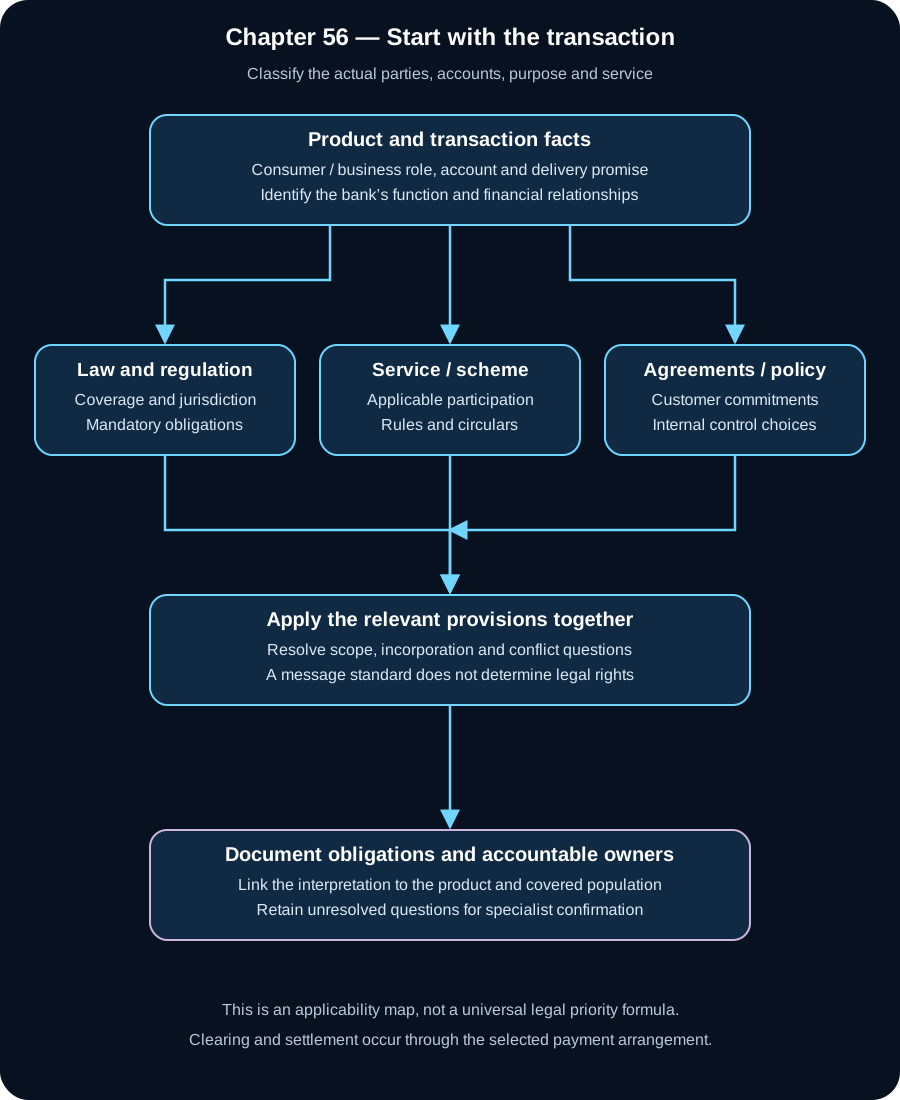
The diagram shows a classification process, not a legal priority formula. In a requirements workshop, ask participants to identify the source of each proposed obligation. A statement such as compliance requires two approvals is incomplete until the team establishes whether it comes from law, a contract, risk policy or a particular control design.
3. Map public authorities to their actual functions
The Federal Reserve has central-bank, supervisory and regulatory responsibilities, while the Reserve Banks also provide payment services. Those functions should not be collapsed into the claim that every US payment is operated or regulated by the Federal Reserve in the same way. A Reserve Bank service agreement and a Board regulation are different sources even when both are relevant.
The OCC, FDIC, Federal Reserve, NCUA and state authorities have responsibilities that depend on institutional charter, membership and other jurisdictional facts. The CFPB has consumer-financial-law responsibilities, with supervision and enforcement allocated under the applicable statutes. A bank should maintain its own current supervisory map rather than infer its regulator from the payment method a customer selected.
FinCEN administers Bank Secrecy Act requirements within Treasury's framework. OFAC administers economic and trade sanctions. A suspicious-activity reporting question and a sanctions prohibition question therefore belong to different legal analyses. State money-transmission and other state-law questions can also matter for a nonbank partner, even when the bank itself has a different regulatory position.
The operating benefit of this map is clear ownership. When a requirement changes, the bank needs the responsible legal or compliance specialist, the affected business and the relevant implementation owner. A generic regulator column containing Federal Reserve for every payment product hides those responsibilities and encourages inaccurate customer explanations.
4. Consumer electronic transfers and credit-card obligations
For consumer electronic fund transfers, begin with the Electronic Fund Transfer Act and Regulation E's coverage provisions. Account purpose, transfer characteristics and exclusions matter. The framework includes consumer disclosures, authorization, liability and error-resolution requirements. Chapter 57 examines those customer-facing duties in detail; this chapter identifies when that review belongs in the product assessment.
Consumer credit-card activity requires a different analysis under the Truth in Lending Act and Regulation Z, alongside applicable card-network rules. A merchant chargeback process is not the whole of the issuer's legal responsibility. Calling a credit-card dispute an ACH return, or applying one debit-card complaint template to every credit product, obscures both the legal duty and the operational route.
A consumer's international remittance can bring Regulation E Subpart B into the assessment even where the underlying funding or delivery method has other treatment. Do not infer that every consumer wire is either wholly inside or wholly outside every part of Regulation E. The bank must identify the specific provision and transaction, including any relevant exclusion and remittance coverage.
In the requirements record, distinguish a customer right from the mechanism the bank uses to obtain reimbursement from another party. A network deadline can affect recovery while the bank still has an independent duty to investigate or correct an error. This is why legal classification must remain visible after the payment has settled.
Regulation CC belongs in the map for relevant deposit availability, check collection and substitute-check rights, alongside applicable check law. Consumer review must also consider prohibitions on unfair, deceptive or abusive acts or practices where applicable. Meeting a network specification does not by itself establish that the bank’s disclosures, fees or complaint handling comply with those obligations.
5. Commercial funds transfers and state-law variation
Article 4A of the Uniform Commercial Code provides an important funds-transfer framework, but its application depends on enacted law, scope, agreements and any governing federal provisions. It is not one federal operating manual for every movement of money. Checks, consumer EFTs and commercial credit transfers cannot be treated as interchangeable merely because each moves a balance.
New York's Section 4-A-202 illustrates the analysis of authorized and verified payment orders, including agreed security procedures, commercial reasonableness and the bank's good-faith compliance. It should not be reduced to a valid-password rule. Chapter 52 discussed the corresponding evidence: what was agreed, which instruction was received and what procedure the bank actually followed.
For a commercial product, legal and product teams should document governing law, payment-order acceptance, security procedures, cancellation terms, notice obligations and permitted variation. The record should identify any limitations imposed by applicable law. A generic template copied from a different state or service may omit a material relationship even if its terminology looks familiar.
An operational analyst need not decide a disputed legal question alone. The analyst should make the question answerable by preserving the facts and identifying the relevant provisions. When public sources cannot establish the bank's contractual position, record it as requiring confirmation from the executed agreement rather than filling the gap with an assumed market practice.
6. Federal Reserve services have service-specific frameworks
Regulation J separates the Federal Reserve check-collection framework in Subpart A, Fedwire Funds transfers in Subpart B and FedNow transfers in Subpart C. The relevant operating circular adds service terms. The correct subpart matters: adopting one Reserve Bank service does not make another service's cutoffs, messages or acceptance conditions applicable.
Fedwire's framework incorporates specified Article 4A provisions with federal rules and service terms governing their application. FedNow's framework also addresses its relationship with consumer law. A requirements document should identify the actual provision instead of saying federal finality overrides all customer rights. The finality of an interbank posting and liability to a consumer remain distinct questions.
Other Reserve Bank services have their own documentation. FedACH, check services, electronic access and NSS cannot be specified solely from a Fedwire document. NSS's individual account postings and file-resolution mechanics were explained in Chapter 54; their source is the applicable multilateral settlement framework, not a general assumption about all net settlement.
Maintain a service profile linking the current circular, procedures, operating schedule, access agreement and technical specification. Review updates to each separately. A format amendment can require software changes without changing a legal deadline, while an operating-day change can affect scheduling and staffing without changing the message schema.
7. ACH rules, operators and federal government entries
Nacha administers the ACH Operating Rules. ACH operators exchange and process entries within their service arrangements; they are not the same role as the rule administrator. Banks participate as ODFIs or RDFIs, and their responsibilities depend on direction and activity. A third-party processor does not become the originating bank simply because it constructs the file.
Federal government ACH activity also requires Treasury's framework, including 31 CFR Part 210 and current Green Book guidance. The incorporation of ACH rules and Treasury-specific provisions must be read as written. Do not assume that every private-sector rule amendment automatically changes federal government processing in exactly the same way on the same date.
The implementation record should identify which population is government activity and which is ordinary commercial activity. Returns, reclamations, enrollment and account information can require different treatment. An operations team receiving a Treasury-related claim needs its actual basis rather than a generic ACH dispute label.
For ordinary ACH change management, distinguish the effective amendment from explanatory guidance and from the licensed current rulebook. Public Nacha pages are useful for verified changes, but they are not a complete production specification. Where a precise rule condition is unavailable publicly, the bank must consult its authorized current rules access rather than infer it from an old training slide.
8. Private networks, card arrangements and messaging standards
RTP, CHIPS and card networks have their own participation rules, procedures and technical documentation. Their operators, membership models and settlement arrangements differ. Network availability or membership does not itself establish a bank's legal authority to offer every product built on that network.
Card activity can involve issuer, acquirer, processor, merchant and facilitator agreements. The bank should identify which relationship creates the requirement under review. An issuer's obligation to its consumer, an acquirer's obligation to a merchant and a network's interchange settlement calculation are different matters even when one purchase connects them.
Debit-card programmes also require a Regulation II assessment for applicable interchange-fee and network-routing provisions, including their scope and exemptions. These regulatory requirements are distinct from the card network’s commercial rules. The bank should verify currently operative provisions and relevant legal developments rather than copy a fee cap from a historical presentation.
Message standards tell systems how to express information within a supported implementation. A pacs or camt family name is not proof that two networks support the same use case, version, field population or response. The network's implementation specification supplies those details. Similarly, a swift message carries information; the corresponding account relationships explain the movement of funds.
This map prevents accidental rule migration. A developer reusing a message parser should not also inherit another rail's return deadline or finality assumption. Shared components can normalize identifiers and evidence while preserving the service-specific rules that determine valid financial actions.
9. Financial crime and data obligations cross the rail map
Fraud prevention, BSA/AML requirements, sanctions restrictions and information security can all affect a payment, but they answer different questions. Whether a transaction is authorized, suspicious, legally prohibited or exposing protected data cannot be decided by one generic risk flag. Chapter 58 develops the operational control model.
The regulatory map should record the bank's role in each obligation. A participant may possess customer-identification information that an intermediary does not, while the intermediary has its own responsibilities for the data it receives and the activity it processes. Do not assume that an upstream screening result discharges every downstream duty.
Data protection also needs a defined perimeter. Customer information, authentication secrets, cardholder data and confidential investigation records can have different access and retention treatment. PCI DSS should not be described as the sole data rule for an ACH or wire platform, and an encrypted database is not evidence that every retention or disclosure requirement has been met.
At design time, map the control's input, owner, decision, permitted action and retained evidence. A requirement that simply says perform compliance screening is too incomplete to test. The team must know what happens when screening is unavailable, information is incomplete or a reviewer identifies a legally restricted transaction.
10. Turn obligations into testable requirements
A useful requirement connects a source provision to an observable bank behavior. It identifies the covered population, trigger, required decision, clock, responsible party and evidence. The bank can then test the behavior without treating the source document as a collection of vague design suggestions.
For an illustrative consumer-error requirement, the trigger is the qualifying notice received by the institution, not the later date on which a back-office investigator opens a work item. The implementation should preserve both timestamps. The precise deadline belongs to the applicable legal workflow, which Chapter 57 explains; the mapping discipline belongs here.
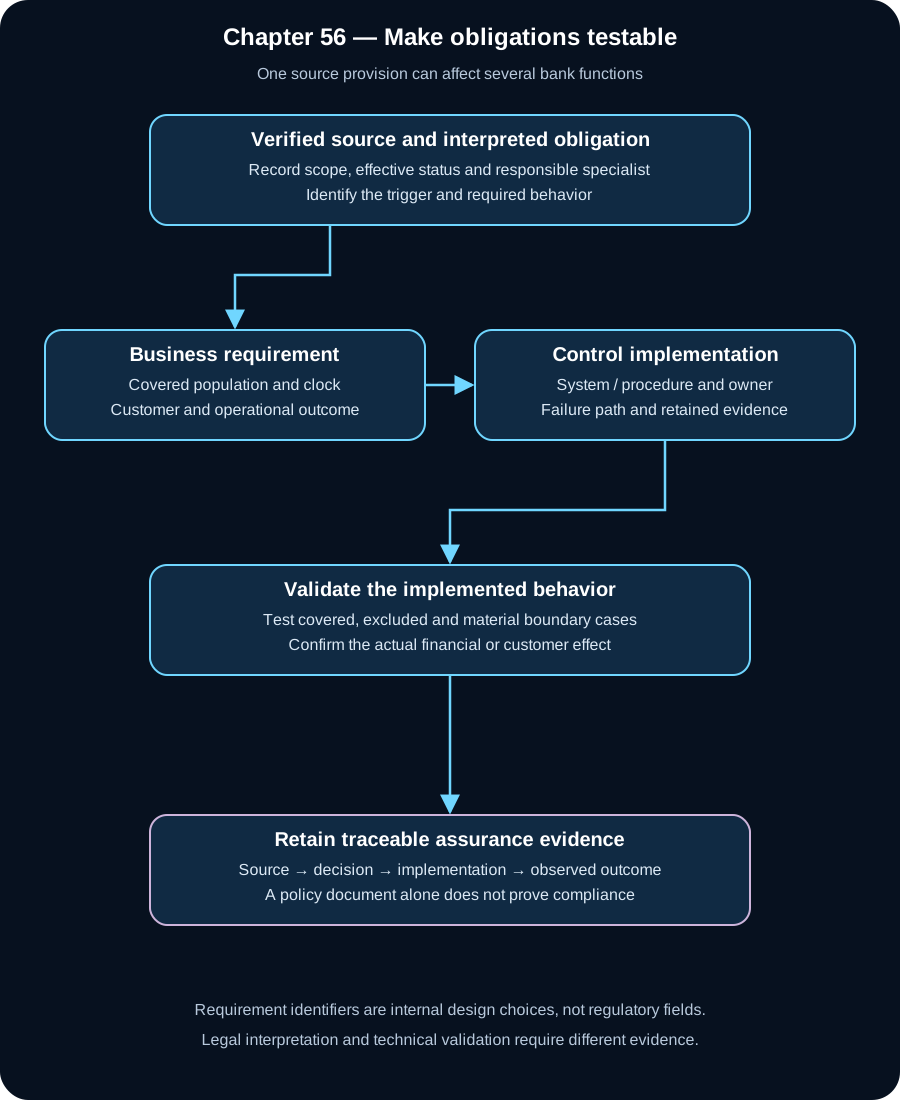
The diagram follows one requirement into implementation and verification. An internal requirement identifier is useful for traceability, but it is a bank design choice, not an invented regulatory field. Test evidence should show the covered case, excluded case, boundary condition and failure route where those distinctions are material.
A legal interpretation should have an owner and review record. If the source permits alternatives, identify the selected approach and its conditions. Otherwise a later engineer may simplify an apparently optional control without realizing that the bank relied on it to meet a mandatory obligation.
11. Resolve apparent conflicts through the right owners
Suppose a network recovery window has ended but a customer has made a qualifying legal error claim. The bank should not let a recovery adapter decide that the customer has no rights. Legal and compliance determine the customer obligation; operations determines available interbank recovery; finance records any resulting bank exposure.
Another apparent conflict can arise between an internal release deadline and an operator's later cutoff. The later service window does not automatically extend the bank's customer commitment or eliminate its controls. Product and operations should explain the difference and identify any supported exception. A published service time is not permission to bypass sanctions or funding checks.
Where sources appear inconsistent, capture the exact versions, facts and affected behavior. Refer the interpretation to the appropriate owner rather than allowing individual teams to adopt different answers. The resulting decision should be reflected in customer terms, processing logic, procedures and tests where applicable.
Do not manufacture certainty when a contract, private specification or jurisdiction-specific rule is unavailable. An explicit unresolved requirement with an accountable decision owner is safer and more useful than a polished paragraph that incorrectly claims every bank follows the same rule. Production release should address material unresolved obligations through the institution's governance.
12. Outsourcing changes execution, not the need for accountability
A provider may operate the user interface, format messages, conduct selected controls or supply investigation evidence. The bank still needs to understand its own obligations and the risks of the arrangement. Interagency third-party guidance supports risk management across the relationship lifecycle; the contract should make responsibilities and access to evidence operationally usable.
Describe responsibility at the level of a task. Who receives a customer notice? Who calculates a legal deadline? Who can stop a pending release? Who holds the original message? Who posts a correction? A contract stating that the vendor handles compliance is not enough to resolve these questions during an incident.
The bank also needs continuity if the provider fails or the relationship ends. It should be able to retrieve customer records, reconcile outstanding transactions and respond to unresolved cases. A successful vendor dashboard does not substitute for access to the financial evidence needed to discharge the bank's responsibilities.
This chapter does not prescribe one outsourcing model. It asks the institution to make the actual model explicit and test its handoffs. Chapter 59 will examine the resulting monitoring and reconciliation responsibilities, including how to recognize when a provider's reported success is not yet a confirmed financial outcome.
13. Manage effective dates and rule changes deliberately
Keep publication date, effective date, compliance date and implementation date distinct. A proposal announces a possible requirement; a final rule can still have a later effective date; an operator notice can alter a service schedule without amending a statute. Those differences should be visible in the change register.
As of 5 October 2026, Nacha's 2026 phased fraud-monitoring changes are effective, including the revised IAT definition and the non-Same-Day ACH funds-availability amendments effective 18 September 2026. Keep the rule's RDFI-local-time requirement and geographic exceptions separate from settlement and customer posting. FinCEN's April 2026 AML/CFT program reform announcement remains a proposal. These examples demonstrate why a current-year search result is not enough to classify legal status.
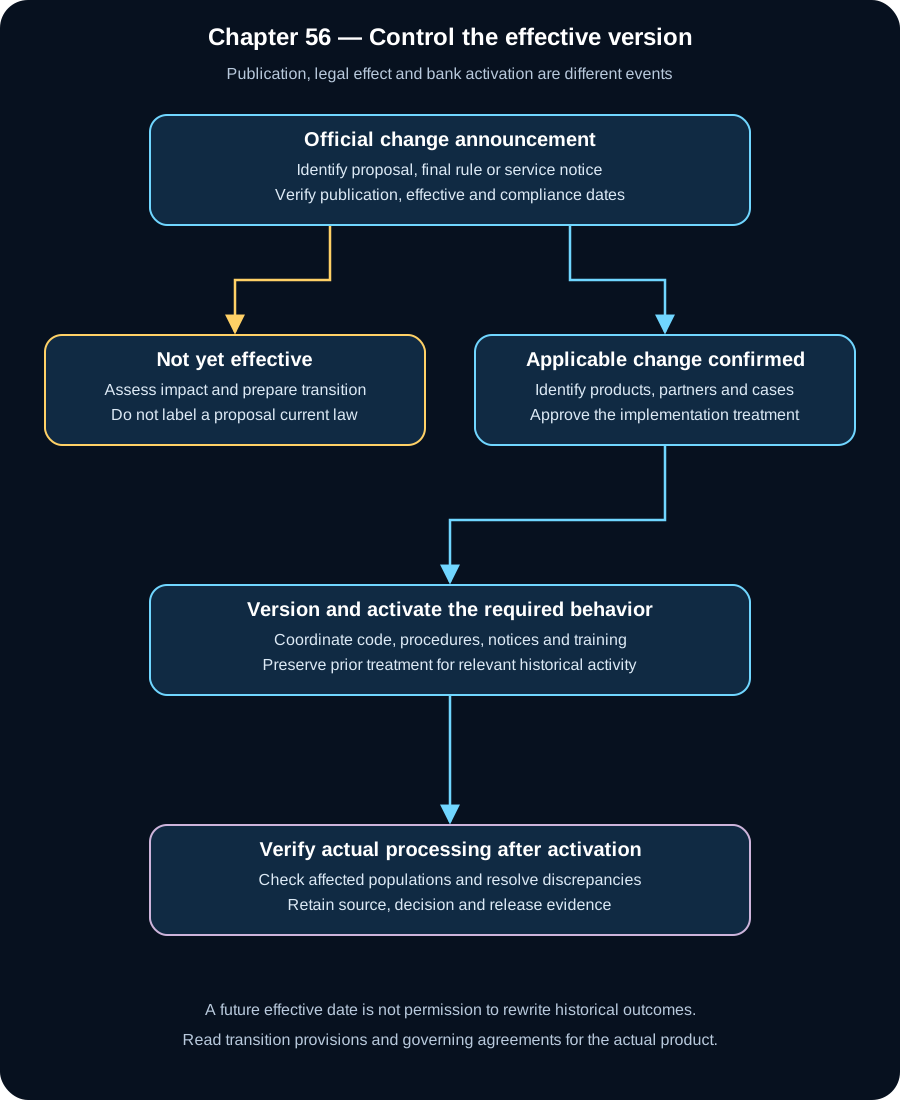
The diagram separates analysis from activation. The bank should preserve the prior rule version for historical cases, schedule the new behavior against the correct population and verify actual processing after release. Updating the procedure while leaving a scheduler or customer notice unchanged can create contradictory behavior.
Change assurance should consider training, partner readiness, financial reporting and open investigations as well as code. A case opened before a change may require facts or rules from an earlier period. The institution should determine the transition treatment explicitly rather than applying today's configuration retrospectively to every historical transaction.
14. Evidence that the map works inside the bank
The map is useful when an operator, tester or product owner can follow it to an answer. It should connect the product profile, relevant source, interpreted obligation, implemented control and evidence. A folder of regulations without those relationships leaves the practical work unfinished.
For a new payment product, walk one instruction through initiation, release, settlement and complaint handling. At each point, identify the source of the relevant requirement and the party responsible. Money moves through the selected settlement arrangement; the regulatory map explains obligations around that movement and does not become an additional clearing or settlement layer.
Periodic review should sample both successful and exceptional activity. A product can meet its normal processing specification while mishandling a late notice, a provider outage or a change in customer authority. Findings should identify the failed obligation and affected population, with a corrective owner and evidence of remediation.
Management reporting should distinguish unresolved interpretation, implementation defect and operational breach. Those categories need different action. Counting them all as policy exceptions can hide a material legal issue or misrepresent a minor documentation gap as a payment failure. The report should help the bank choose the next concrete action.
15. Worked cases and implementation decisions
One screen, two account purposes
A company treasury payment and a household transfer use the same API. The project proposes assigning the same consumer-dispute workflow to both. Identify the customer capacity, account purpose and transaction facts before selecting the governing workflow.
For the exercise, write two product profiles and show which technical components can remain shared. Explain why identical JSON fields do not establish identical legal rights. Record any governing-law or contractual facts still requiring confirmation.
The network deadline has expired
Operations cannot use its usual network recovery route, but the customer notice may still trigger a legal obligation. The screen currently closes the claim automatically when recovery is unavailable.
Separate the customer determination from interbank recovery. Identify the required evidence and the potential financial exposure. A correct answer can involve a customer correction even when the bank has not recovered from another institution.
A public FAQ is treated as the whole rulebook
A team uses a short network FAQ to configure all return reasons and deadlines. The FAQ explains the concept but does not contain the full production conditions.
Identify which statements are verified and which require current participant documentation. Keep the readable explanation, but prevent unconfirmed field values or deadlines from becoming production requirements.
A proposed rule is activated early
A compliance analyst adds a proposed regulatory change to the current operating checklist. Technology enables new behavior immediately because the announcement is dated this year.
Distinguish proposal, final adoption and effective status. Define the monitoring owner and the evidence needed before activation. Future readiness work can proceed without claiming that a proposal is already binding.
The processor holds all the evidence
A provider can display a payment result but cannot promptly supply the original instruction or complaint-receipt record. The bank has an approaching customer deadline.
Map the missing evidence to the bank's obligations and the provider's contract. Propose a recoverable handoff and retention design. Do not assume that a vendor assurance shifts the customer's deadline to a more convenient date.
Federal government ACH is treated as ordinary commercial activity
An operations procedure applies every private-sector ACH rule change to Treasury activity without checking Part 210 or the Green Book. A special government claim then reaches the wrong team.
Identify the affected population and the source that governs the specific issue. Explain how to maintain common ACH processing while preserving Treasury-specific requirements and ownership.
16. Role checklist and learning closure
Product should describe the customer promise and actual financial relationships. Legal and compliance should establish applicability and interpretation. Business analysis should connect each obligation to a testable behavior. Technology should preserve rule versions and service-specific behavior. Operations should recognize when an apparent exception requires another legal or contractual analysis. Assurance should test implementation against the stated obligation rather than merely checking that a policy exists.
The learner should be able to take one payment and explain which source governs which question, without turning ISO 20022 into law or a network recovery result into a consumer-rights decision. Chapter 57 follows that map into the customer's experience of disclosures, authorization, errors, provisional credit and complaint resolution.
Authoritative references
Sources checked on October 5, 2026. Public source summaries support orientation; production interpretation also requires the bank's current agreements and applicable jurisdiction.
This application uses JavaScript for the full interactive experience. This text summary is served for accessibility and search indexing.