US Bank Payment Connectivity and File/API Channels. A practitioner deep dive into US bank payment connectivity across portals, host-to-host files, SFTP, APIs, FedLine/FedACH links, acknowledgements, security, idempotency, monitoring, resilience and reconciliation evidence.
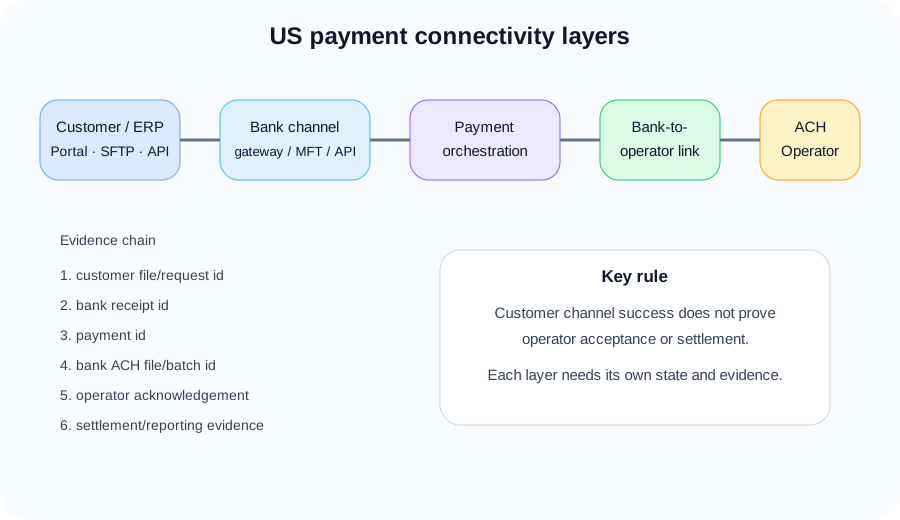
Payments do not reach a bank simply because a customer has created an instruction. They need a connectivity path. A payroll file has to move from a corporate treasury system into the bank. A payment created through an API has to be authenticated, validated, accepted and made traceable. A bank-originated ACH file then has to move from the bank or its processor to an ACH Operator. A receiving bank has to obtain output files, acknowledgements and settlement information. If one of those connectivity layers fails, the underlying payment rail may be completely healthy while the customer still experiences a payment failure.
That is the purpose of Chapter 15.
Chapter 6 explained ACH infrastructure. Chapters 7–10 explained ACH credit, debit, authorisation and Same Day processing. Chapters 11–14 covered returns, fraud, investigation and reconciliation. Chapter 15 explains how payment instructions and payment evidence move between customers, banks, processors and payment infrastructures.
The chapter uses this connectivity model throughout:
customer or source system → customer-to-bank channel → bank channel gateway → authentication and entitlement → syntax/business validation → payment orchestration → bank-to-operator channel → operator acknowledgement/output → settlement and posting → reporting/reconciliation → operational monitoring and recovery.
A crucial distinction is:
payment rail ≠ customer channel ≠ bank gateway ≠ operator connection.
A corporate customer can use SFTP to send an ACH file to its bank even though the bank itself uses FedLine Direct File to communicate with FedACH. Another customer can call a bank API, while the bank still converts the accepted instructions into ACH batches and sends them to an ACH Operator through a file-based operator connection. The customer experience can therefore be API-driven while the underlying ACH exchange remains file-oriented.
This is a genuine practitioner chapter: the focus is not merely on protocol names, but on ownership, controls, status, duplicate prevention, cutoffs, security, resilience, audit evidence and how connectivity behaves inside a real bank.
For a roughly 60-minute core session, spend about 35 minutes on Sections 1–5, Sections 6–10 and Sections 11–15. For the next 10 minutes, use the chapter’s three diagrams to separate channel receipts, payment outcomes and safe retry decisions. Use 10 minutes to work through one case in Section 16, then spend the final 5 minutes explaining: What should a client do after a timeout when the bank may already have accepted the instruction? Treat these timings as a study guide. The remaining sections, additional cases and extended reference material are follow-up study; completing the whole chapter takes longer.
Chapter navigator
- Connectivity architecture: channel, gateway, rail and settlement are different layers
- Customer-to-bank channels: portal, host-to-host, SFTP and APIs
- File-based payment connectivity and the bank file-ingestion lifecycle
- API payment connectivity and synchronous versus asynchronous truth
- Authentication, certificates, keys, entitlements and non-repudiation
- Bank-to-operator connectivity: FedLine, FedACH and processor models
- Acknowledgements, receipts and the connectivity status model
- Cutoffs, scheduling and time semantics across channels
- Idempotency, duplicate prevention, retries and replay safety
- Inbound operator files, routing, distribution and receiving points
- Exceptions, rejected files, partial failure and operational recovery
- Monitoring, observability, SLAs and production support
- Security controls, segregation of duties and channel governance
- Resilience, contingency, failover and business resumption
- Reconciliation, reporting and evidence across the connectivity chain
- End-to-end cases, BA checklist and testing
1. Connectivity architecture: channel, gateway, rail and settlement are different layers
The first mistake in payment connectivity design is to call every interface a payment rail.
A customer portal is a channel. SFTP is a transport mechanism. An API is an application interface. A payment gateway is an internal control and routing layer. ACH is a payment network. FedACH and EPN are ACH Operators. Federal Reserve settlement is a settlement mechanism. These layers work together, but they are not interchangeable.
Imagine a corporate customer sends a payroll file to a bank through SFTP. The bank decrypts the file, authenticates the sender, validates the file format, performs customer and payment controls, creates ACH batches and transmits an ACH file to its ACH Operator. The ACH Operator processes and distributes entries, and settlement occurs through the applicable settlement arrangement. The employee only sees the final account credit.
If the SFTP server is unavailable, the ACH Network is not down. If the bank accepts the file but its ACH gateway fails before operator transmission, the customer channel succeeded but the payment did not reach the network. If the operator accepts the file but the bank's customer reporting service fails, the payment can settle while the customer portal still says Processing.
For this reason a bank-grade design should preserve separate layers and statuses:
CHANNEL_RECEIVED
AUTHENTICATED
FILE_OR_REQUEST_VALIDATED
PAYMENTS_CREATED
BANK_RELEASED
OPERATOR_TRANSMITTED
OPERATOR_ACCEPTED
SETTLED
POSTED/REPORTED
RECONCILED.
The names are implementation choices. The separation is the important part.
Connectivity has two major sides
Customer-to-bank connectivity connects customer systems and users to the bank. Typical examples include portals, APIs, host-to-host file channels and managed file transfer.
Bank-to-infrastructure connectivity connects the bank, its processor or service provider to ACH Operators and other payment infrastructures.
The protocols can be completely different on the two sides.
A well-designed payment platform therefore does not force channel semantics into rail semantics. It maps a customer instruction into a stable internal payment object, then sends that payment through the appropriate infrastructure connection.
2. Customer-to-bank channels: portal, host-to-host, SFTP and APIs
Banks usually support more than one customer connectivity model because customers have different operating needs.
A small business may create payments manually in an online banking portal. A large corporate may generate thousands of payments in an ERP or treasury management system and send files automatically. A fintech or embedded-banking client may prefer APIs. A global corporation may use both files and APIs: files for large payroll or supplier batches and APIs for urgent or event-driven payments.
Portal channels
A portal is attended. A human user signs in, creates or uploads instructions, reviews them and releases them according to entitlement. Portal connectivity is valuable because it combines user interaction, validation and payment status in one experience.
However, a portal upload is still a file-ingestion process when the user uploads a payment file. The bank should distinguish uploaded from accepted and released.
Host-to-host and managed file transfer
Host-to-host connectivity is designed for system-to-system exchange. In practice banks commonly use managed file transfer patterns such as SFTP or other secure transfer technologies.
The channel usually has:
- an agreed endpoint;
- customer or partner identity;
- encryption/authentication controls;
- inbound and outbound directories or logical mailboxes;
- file naming conventions;
- duplicate-file controls;
- acknowledgement files or status feeds;
- retention and archive rules;
- operational support procedures.
The business advantage is automation. The operational risk is that automation can move a large volume before a human notices a configuration error.
APIs
APIs support event-driven and request-driven interaction. They can provide faster validation feedback, structured errors and richer status retrieval than traditional batch files.
But API does not mean instant settlement. An API can accept an instruction for standard ACH, Same Day ACH, wire or instant payment. The underlying rail still determines processing and settlement behavior.
The bank should therefore keep channel = API separate from rail = ACH.
3. File-based payment connectivity and the bank file-ingestion lifecycle
File channels remain fundamental in corporate payments because they are efficient for bulk instructions and integrate well with ERP/TMS batch processes.
A mature bank does not simply watch a folder and send whatever appears.
A controlled lifecycle is:
receive → authenticate channel → verify transport integrity → decrypt if applicable → virus/malware/content checks where relevant → validate file envelope → identify customer and service → duplicate-file check → parse records → validate totals and structure → validate business rules → create payment instructions → apply entitlement/release controls → schedule → route → transmit → archive evidence.
File arrival is not payment acceptance
The transfer layer may confirm that bytes were successfully delivered. That does not mean the payment content is valid.
A useful status model can distinguish:
TRANSFER_RECEIVED
FILE_AUTHENTICATED
FILE_DECRYPTED
FILE_FORMAT_VALID
FILE_BUSINESS_VALID
PAYMENTS_ACCEPTED
PAYMENTS_RELEASED.
If the bank returns one generic ACCEPTED status too early, customers can reasonably assume their payments are already in processing when only the transfer completed.
File-level and payment-level acceptance are different
One file can contain thousands of payment entries. The bank must define whether validation is all-or-nothing or whether some entries can be accepted while others are rejected.
That is a product and implementation decision, not something to improvise during production support.
If partial acceptance is supported, customer reporting must identify exactly which payments were accepted and which were rejected. File totals alone are no longer sufficient.
Control totals
File-level counts and amounts are powerful controls.
The bank should preserve source totals and compare them with parsed/accepted populations. For example:
source file 25,000 payments / $82.4m
parsed 25,000 / $82.4m
accepted 24,998 / $82.35m
rejected 2 / $50k.
Those totals become critical reconciliation evidence later.
4. API payment connectivity and synchronous versus asynchronous truth
APIs create an expectation of immediate answers. Payments often cannot provide a final answer immediately.
The API can usually answer whether the request was received and whether initial validations passed. It may not yet know whether a later fraud control will hold the payment, whether the customer will release it, whether the ACH Operator will accept the eventual file, or whether settlement will complete.
The safest model separates synchronous acknowledgement from asynchronous payment state.
For example:
HTTP 202 / request accepted for processing
with
payment_id = P12345
is different from
payment_status = SETTLED.
API response design
A useful API response can provide:
- stable request/payment identifier;
- accepted/rejected validation result;
- validation errors;
- current payment state;
- links/endpoints for status retrieval;
- correlation identifier;
- timestamp and processing context.
Webhooks and polling
Banks may provide status through polling APIs, event streams, webhooks or files. Whatever the pattern, event delivery must be idempotent and replay-safe.
A webhook can be delivered twice. A customer must not interpret duplicate notification delivery as duplicate payment execution.
API errors should be classifiable
Transport errors, authentication failures, validation failures, business rejects and downstream-processing failures are different.
Returning 500 for everything forces customers to retry blindly and can create duplicate risk.
The client should know whether the request definitely failed before creation, was created but processing is uncertain, or was accepted and can be queried safely.
5. Authentication, certificates, keys, entitlements and non-repudiation
Connectivity security has several layers.
Transport security protects the channel.
System/client authentication identifies the connecting application or host.
User authentication identifies a human where humans are involved.
Entitlement determines what that authenticated party may do.
Payment authorisation/release determines whether the payment instruction is permitted to proceed.
These should not be collapsed into one authenticated = true flag.
Certificates and keys
System-to-system connections commonly rely on certificates, key pairs, managed secrets or equivalent machine credentials. Their lifecycle matters as much as initial setup.
A bank should control:
- issuance;
- secure storage;
- expiry;
- rotation;
- revocation;
- emergency replacement;
- ownership;
- environment separation;
- audit evidence.
An expired certificate can stop a payment channel even when every payment system behind it is healthy.
File signing and encryption
Some bank/customer file arrangements use signing and/or encryption in addition to secure transport. The important design question is what the control proves.
Encryption protects confidentiality. A digital signature can support integrity and signer authenticity. SFTP transport authentication proves the connecting endpoint identity. These are related but not identical controls.
Entitlements
A corporate API credential may be allowed to create payments but not release them. Another credential may access only selected accounts. A portal user may create files but require another user to approve them.
The connectivity layer must carry sufficient identity/context to the entitlement and payment-control layer.
6. Bank-to-operator connectivity: FedLine, FedACH and processor models
The Federal Reserve offers multiple FedLine connectivity solutions. The choice depends on the institution's services, volume and operating model.
FedLine Direct is designed for unattended, high-volume computer-to-computer access. Federal Reserve Financial Services describes FedLine Direct File as the file transfer component used for FedACH and other file-based services, using IBM Connect:Direct with Secure+ in its service architecture. FedLine Command is another unattended batch file solution for certain services. FedLine Advantage and FedLine Web provide attended/web-based capabilities at different service levels.
The important practitioner lesson is not to memorize product names in isolation. It is to understand that operator connectivity is a bank/processor infrastructure decision, not a customer-channel decision.
A corporate client can upload through SFTP while the bank sends to FedACH using FedLine Direct. A bank can outsource ACH processing to a processor, in which case the bank's connectivity may terminate at the processor and the processor may maintain the operator connection.
FedACH Origination and Receipt
Federal Reserve Financial Services describes FedACH Origination and Receipt as providing scheduled file delivery, multiple sort options, routing of files to receiving points, and file status/count/value information through FedLine capabilities.
This means bank architecture must model both sending point and receiving point behavior.
The component that originates a file may not be the same system or location that receives all output files and reports.
Processor model
If a third-party processor is used, responsibilities must be explicit:
customer → bank channel → bank/processor handoff → processor ACH gateway → ACH Operator.
The bank still needs end-to-end evidence even when a processor owns part of the transport.
Outsourcing transport does not outsource accountability for customer status, reconciliation and control.
7. Acknowledgements, receipts and the connectivity status model
Connectivity without acknowledgements creates ambiguity.
A sender needs evidence that the receiver obtained the transmission. But one acknowledgement rarely proves the whole payment outcome.
For FedACH, Federal Reserve service descriptions note that customers may receive file acknowledgements, advices and balance reports in addition to payment files. Those artifacts serve different purposes.
A bank should preserve a hierarchy such as:
TRANSFER_SENT
TRANSFER_DELIVERED
FILE_ACKNOWLEDGED
FILE_ACCEPTED/REJECTED
BATCH/ENTRY_PROCESSED
SETTLEMENT_REPORTED.
Acknowledgement is not settlement
A successful file acknowledgement proves something about receipt/processing at a specific layer. It does not prove that customer accounts at receiving banks were posted.
Negative acknowledgements
Negative acknowledgements or rejected-file statuses need actionable reasons.
The bank should preserve:
- file identifier;
- sending point;
- received timestamp;
- rejection reason;
- affected population;
- retry/recovery decision;
- operator correlation/reference where available.
Customer status mapping
Internal operator statuses often should not be exposed literally to customers. The bank can map them into understandable states while retaining detailed evidence internally.
The mapping must be deterministic and versioned. Otherwise the same network event may appear differently across portal, API and file reporting.
8. Cutoffs, scheduling and time semantics across channels
Connectivity cutoffs exist at multiple layers.
A customer may have a 2:00 p.m. bank cutoff for a service. The bank may have an internal release cutoff at 2:20 p.m. The operator may have a later processing deadline. The bank intentionally creates buffers so validation, fraud checks, release, file construction and transmission can complete safely.
Do not publish an operator deadline as the customer deadline unless the product truly operates that way.
Time fields should be explicit
A payment platform may need to distinguish:
customer_requested_execution_date
bank_cutoff_time
scheduled_release_time
file_creation_time
operator_transmission_time
operator_processing_date
settlement_date.
Late files
A file arriving after a customer cutoff should follow a defined policy: reject, reschedule, downgrade from Same Day to standard ACH where permitted and agreed, or place into manual review.
Silent rescheduling is dangerous because the customer may believe the original execution date still applies.
Time zones
Corporate channels can serve customers across time zones. Customer-facing cutoff communication should identify the applicable time zone. Internal timestamps should be stored consistently with enough context to reconstruct local business time.
9. Idempotency, duplicate prevention, retries and replay safety
Connectivity failures often create the most dangerous payment question:
Did the bank receive it or not?
A customer sends a file, the connection drops before confirmation, and the customer considers resending. An API client times out after submitting a payment and automatically retries. If the bank cannot identify replay, the same economic instruction may be created twice.
File duplicate controls
Duplicate detection can use a combination of:
- customer ID;
- file name/reference;
- content hash;
- creation timestamp;
- control totals;
- business batch identifiers;
- bank-assigned receipt ID.
No single attribute is universally sufficient.
API idempotency
An API can require an idempotency key or stable client request identifier.
The rule should be:
same customer + same idempotency key + same logical request → return same outcome, do not create new payment.
If the client reuses the same key with different content, the bank should reject or require explicit handling rather than silently treating it as a new payment.
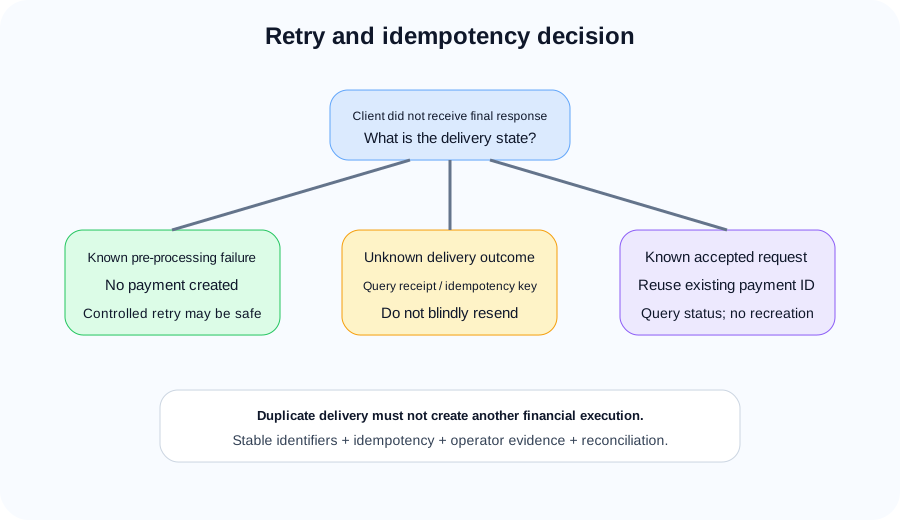
Retry classification
Retry is safe only when the failure mode is understood.
Known pre-processing failure may be safe to retry.
Unknown delivery outcome requires query/reconciliation before resend.
Known accepted request should not be re-created; the client should query status.
Internal retries
The same principle applies between bank services. A gateway retry after timeout must not create a second payment object in the orchestration layer.
10. Inbound operator files, routing, distribution and receiving points
Connectivity is bidirectional.
Banks send origination files and also receive output files containing incoming ACH entries, returns, NOCs, acknowledgements and reports.
Federal Reserve Financial Services notes that FedACH Origination and Receipt supports scheduled delivery, sort options and routing to different receiving points. That matters operationally because one institution may distribute files to multiple processors, business units or systems.
Receiving-point architecture
A bank should maintain controlled routing metadata such as:
service
routing/transit context
file type
receiving point
processor/system destination
delivery schedule
fallback route.
Information copy versus processing copy
Some operating models distribute an information-only copy to another system for reporting or exception creation. Such copies must be clearly marked as non-booking/non-processing inputs.
Otherwise a reporting copy can accidentally trigger duplicate posting.
Inbound file lifecycle
A controlled inbound lifecycle can be:
operator file available → secure receive → transport validation → file identity/control check → dedupe → classify → route → ingest → reconcile → archive.
The receiving bank should know which expected files have not arrived. Monitoring only files that did arrive cannot detect missing delivery.
11. Exceptions, rejected files, partial failure and operational recovery
Connectivity failures do not all have the same financial meaning.
Transport failure before receipt
If the sender can prove the file never left its environment, the recovery may be straightforward.
Delivery uncertain
If the sender transmitted but did not receive confirmation, the bank must determine whether the receiving system obtained the file before resending.
File rejected before payment creation
If parsing or file-level validation fails before payment objects are created, the bank can reject the file and provide clear errors.
Partial processing
If some payments are created and others fail, recovery must operate at payment level, not by blindly resending the whole file.
Downstream failure after bank acceptance
A file can pass customer-channel validation but fail later during ACH file construction or operator transmission.
The customer should not be told the file was rejected by channel if the real issue is downstream processing.
A robust case model records:
channel_result
payment_result
operator_result
separately.
Recovery controls
Manual retransmission should require evidence that duplicate execution will not occur. Operations should not solve an uncertain-delivery incident by repeatedly clicking send.
12. Monitoring, observability, SLAs and production support
A payment channel is an operational service, not merely an integration endpoint.
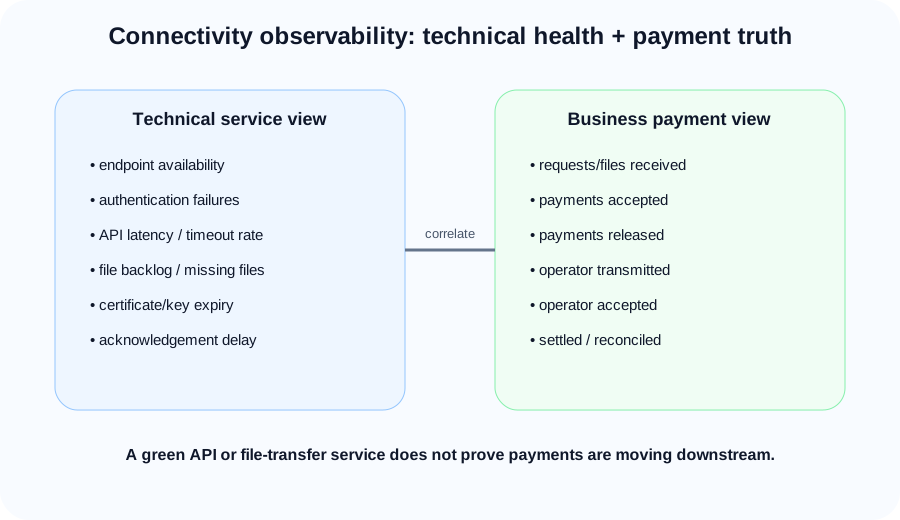
Monitoring should cover availability, throughput, latency, backlog, error rates, missing expected files, certificate/key expiry, acknowledgement delays and downstream processing.
File-channel monitoring
Useful metrics include:
- files expected/received;
- files rejected;
- bytes/records processed;
- parse/validation failures;
- duplicate files;
- files awaiting release;
- transmissions awaiting acknowledgement;
- inbound operator files missing past expected time;
- archive failures.
API monitoring
Useful metrics include:
- request rate;
- authentication failures;
- validation rejection rate;
- latency percentiles;
- timeout rate;
- idempotency replays;
- downstream queue depth;
- status-event delivery failures;
- webhook retries.
Business observability
Technical health alone is insufficient.
An API can return HTTP 200 while no payment reaches the operator because an internal queue is stuck.
A stronger dashboard connects:
requests/files received → payments accepted → payments released → operator transmitted → operator accepted → settled.
13. Security controls, segregation of duties and channel governance
Payment connectivity is a high-risk control surface because it can originate large-value or high-volume instructions automatically.
Environment separation
Production credentials, endpoints and keys should be separated from test environments. Test credentials should not be able to reach production payment services.
Least privilege
A channel credential should receive only the permissions it needs. A reporting API credential should not automatically gain payment-creation rights.
Maker-checker and system release
Automated channels still need governance. Some customers use bank-side auto-release after successful validation; others require separate approval. The release model should be explicit in contracts/product configuration and reflected in system state.
Configuration changes
Changes to endpoints, certificates, SSH keys, API scopes, receiving points, routing rules or customer service mappings can redirect or stop payments.
They should therefore follow controlled change processes with approval, testing and rollback planning.
Logging
Security and operational logs should record enough to reconstruct activity without exposing secrets or sensitive payment data unnecessarily.
Never log private keys, passwords, bearer tokens or full confidential payloads simply because debugging is easier.
14. Resilience, contingency, failover and business resumption
Federal Reserve Financial Services explicitly provides connectivity/application testing and contingency testing options, and describes redundancy/failover options for FedLine solutions. That reflects a fundamental bank principle: connectivity failure must be planned before production failure occurs.
Primary and secondary paths
A bank can design primary and alternate connectivity paths depending on service and product options. The alternate path must be genuinely usable, not only documented.
Failover decision
Failover should consider:
- current processing window;
- in-flight transmissions;
- acknowledgement state;
- duplicate risk;
- operator availability;
- backlog size;
- customer impact.
A failover that retransmits already accepted files can be worse than the original outage.
Business resumption testing
Testing should demonstrate that the bank can:
- activate alternate connectivity;
- authenticate successfully;
- send/receive agreed test files or messages;
- preserve identifiers and control totals;
- prevent duplicates;
- restore normal processing;
- reconcile activity across the switch.
Customer-channel contingency
Banks also need contingencies for customer-facing channels. If an API is unavailable, an agreed file channel may serve as fallback for some customers. But not every product should automatically offer cross-channel fallback because entitlement, formatting and operational controls may differ.
15. Reconciliation, reporting and evidence across the connectivity chain
Chapter 14 covered ACH reconciliation deeply. Chapter 15 focuses on connectivity evidence that feeds reconciliation.
A payment should have a traceable path such as:
customer request/file ID
→ bank receipt ID
→ payment ID
→ bank batch/file ID
→ operator transmission reference
→ operator acknowledgement
→ settlement/reporting evidence.
Connectivity reconciliation
A practical control can compare:
files/requests received
payments created
payments released
operator files generated
operator files transmitted
operator files acknowledged.
If 100 API payment requests created 100 payments but only 99 appear in the ACH output population, the issue is between orchestration and operator file construction, not customer connectivity.
Channel acknowledgements should be customer-reconcilable
Customers need identifiers they can store and later reference. A generic message upload successful without a bank receipt ID makes investigation harder.
Archive and retention
The bank should retain enough transmission and acknowledgement evidence to investigate disputes and operational incidents according to its legal, rule and record-management obligations.
The archive should preserve the original payload or controlled representation where appropriate, hashes/control totals, timestamps, identity, acknowledgements and status history.
16. End-to-end cases, BA checklist and testing
Case 1 — corporate payroll through SFTP
A corporate treasury system produces a payroll file at 01:30. It encrypts the file and sends it through the agreed SFTP channel.
The bank receives the transfer, authenticates the customer connection, decrypts and validates the file, checks duplicate indicators and control totals, creates 18,400 ACH credit instructions, applies the customer's release model, creates ACH batches and later transmits the operator file.
The customer should receive separate evidence for file receipt, payment acceptance and later payment processing. If the bank only sends one success acknowledgement at transfer time, the customer cannot distinguish connectivity from payment acceptance.
Test expired keys, malformed file, duplicate resend, partial validation, cutoff miss, operator rejection and delayed acknowledgement.
Case 2 — API timeout after payment creation
A corporate API submits a $250,000 ACH credit. The bank creates the payment but the API gateway times out before returning the response.
The client retries with the same idempotency key.
The bank should return the existing payment outcome rather than create a second payment.
Test identical replay, changed payload with same key, timeout before creation, timeout after creation and status query.
Case 3 — file sent but operator acknowledgement missing
The bank transmits an ACH file. The transmission component reports completion, but the expected operator acknowledgement is not available.
Operations must not blindly retransmit. They first determine whether the operator received/accepted the file using available status/research capabilities and only then follow the controlled recovery path.
Case 4 — inbound operator file routed to wrong internal processor
A configuration change sends an inbound ACH file to a reporting system instead of the posting processor.
The transfer succeeded, but customer posting does not occur.
Monitoring should detect that the expected processing destination did not ingest the file even though the connectivity platform marked delivery successful.
Case 5 — certificate expiry
A machine certificate expires overnight. The next automated corporate API/file connection fails authentication before any payment payload reaches the bank.
The incident should be classified as channel authentication failure, not payment rejection.
Certificate-expiry monitoring should alert well before expiration.
Case 6 — failover during uncertain delivery
The primary bank-to-operator path fails after a file is sent but before local confirmation is stored. The bank activates its contingency route.
Before resending, it must establish whether the original file was accepted. Stable file identifiers, operator status evidence and duplicate controls are critical.
BA checklist
Before approving a payment-connectivity solution, ask:
- Are customer channel, bank gateway, payment rail and operator connection modeled separately?
- Are file/API receipt statuses separated from payment acceptance and settlement?
- Is there a stable customer request/file identifier and bank receipt identifier?
- Are file-level and payment-level validation outcomes distinct?
- Is partial acceptance supported or prohibited explicitly?
- Are counts and value control totals preserved?
- Are API requests idempotent?
- Are timeout/retry behaviors defined for known and unknown delivery outcomes?
- Can duplicate files be detected without relying only on filename?
- Are certificate/key lifecycle, rotation and expiry monitored?
- Are authentication, entitlement and payment release separate controls?
- Are customer cutoffs distinct from operator deadlines?
- Are time zones explicit?
- Are operator acknowledgements and advices mapped to internal statuses accurately?
- Can inbound output files be routed to multiple controlled receiving points?
- Is information-only output prevented from triggering financial posting?
- Are missing expected files detected?
- Is bank-to-operator contingency tested?
- Does failover prevent duplicate retransmission?
- Is connectivity evidence available to Chapter 14 reconciliation?
- Can operations reconstruct the exact path from customer instruction to operator acknowledgement?
Testing minimum
A serious Chapter 15 test pack should include portal upload, SFTP success/failure, bad credentials, expired certificate/key, encryption/signature failure, malformed file, duplicate file, same filename/different content, API authentication error, entitlement failure, idempotent retry, timeout after creation, webhook duplicate, cutoff miss, partial validation, file-level rejection, downstream operator rejection, acknowledgement delay, missing inbound file, wrong receiving-point routing, processor outage, failover, failback, replay after recovery, archive failure and end-to-end reconciliation.
The final practitioner principle is:
Connectivity is successful only when the bank can prove what arrived, who sent it, what the bank accepted, what it released, what reached the operator, what acknowledgement came back, and how that evidence maps to the payment's financial outcome. A green network connection alone does not prove a payment moved.
Authoritative references
This application uses JavaScript for the full interactive experience. This text summary is served for accessibility and search indexing.