Stored Credentials, Recurring Payments and Subscription Collections. Agreement-driven card collections across CIT/MIT classification, billing events, consumer debit obligations, credential maintenance, controlled retries, cancellation and receivables reconciliation.
A customer cancels a $35 monthly membership on Friday. The merchant's support system records the cancellation immediately. Its billing service already queued Monday's collection, however, and the retry service still considers the customer active. On Monday the issuer approves the charge. Every individual system appears to have done its own job, but the customer has been charged after asking the merchant to stop.
Chapter 33 follows the authority and operational state behind later card collections. Chapter 32 explained remote checkout, authentication and tokenization. This chapter explains what changes when credentials are retained and used again: consent, customer-initiated and merchant-initiated transactions, billing schedules, credential maintenance, retry control, cancellation and reconciliation. Chapter 34 covers the resulting dispute process when something goes wrong.
A stored credential tells the system how it might submit a payment. The customer's agreement determines whether this particular collection is permitted.
For a roughly 60-minute core session, spend about 35 minutes on Sections 1–2, Section 5, Section 7 and Sections 11–12. For the next 10 minutes, use the chapter’s three diagrams to follow collection authority through retries and cancellation. Use 10 minutes to work through one case in Section 15, then spend the final 5 minutes explaining: How should cancellation stop future attempts while preserving the history of an in-flight collection? Treat these timings as a study guide. The remaining sections, additional cases and extended reference material are follow-up study; completing the whole chapter takes longer.
Examples are fictional. Suggested state names, controls and data fields are implementation patterns, not prescribed network fields. Network rules, consumer law and the merchant's contract are discussed as separate sources of obligation.
Chapter navigator
- The agreement behind later collections
- Stored credentials CIT and MIT
- Recurring instalment and unscheduled arrangements
- Establishing the initial relationship
- From agreement to each collection
- Billing events amounts and notices
- Consumer debit and preauthorized transfers
- Subscription law and network obligations
- Credential security and lifecycle services
- Declines retries and customer re-engagement
- Cancellation revocation and stop payment
- Capture settlement and receivables
- Reconciliation reporting and evidence
- Bank architecture and migration controls
- Worked cases and implementation testing
- Role checklist and learning closure
1. The agreement behind later collections
Recurring card collection begins with a commercial agreement, not with a scheduler. The customer agrees to a defined product or service and a method of charging for it. The merchant needs evidence of the relevant terms and the customer's acceptance. The payment system then implements that agreement rather than creating authority of its own.
Useful agreement information includes the merchant identity, service, amount or calculation method, collection frequency or trigger, start date, duration where relevant, cancellation process and customer contact details. The precise disclosures and evidence requirements depend on applicable law and network rules. A bank should not assume that one generic checkbox meets every use case.
The agreement and credential should be separate records. A customer can replace a card without changing the subscription terms. A customer can end a subscription while retaining an account with the merchant. A card can remain technically usable after the collection authority has ended. If these states are collapsed, credential maintenance can accidentally reactivate cancelled billing.
The agreement also needs a version history. If a membership price changes from $35 to $42, the merchant should know which terms applied to each collection and what notice or consent supported the change. Overwriting the original price makes later investigations difficult because the system can no longer reconstruct what the customer actually accepted.
The bank's role depends on its position. The acquirer assesses the merchant's collection model and controls. The issuer handles the card-account decision and relevant customer requests. Neither should confuse an authorization approval with proof that the merchant complied with its subscription agreement. The issuer may not possess the merchant's complete contract at authorization time.
Making the agreement an operational record
A recurring-payment agreement should be usable by the systems that collect money, not confined to a document that only customer service can retrieve. The merchant needs to identify the customer relationship, the service, the permitted charging basis and the evidence of acceptance. The payment service needs enough supported context to process later transactions correctly. The bank needs the relevant evidence if a collection is challenged. These are different uses of the same commercial authority.
Take a fictional home-maintenance membership charging $35 each month. The customer agrees to the service and provides a card through the merchant's supported checkout. The merchant should be able to establish which version of the offer the customer accepted, when acceptance occurred and what the customer was told about later charges. A current terms page cannot by itself prove what that customer saw months earlier if the offer has since changed.
The agreement should also be linked to the correct person and service account. A household can have several members and several payment methods. A customer may pay for a relative's service without transferring ownership of the service account. The merchant should not assume that the name on a billing profile, the service user and the cardholder are always identical. The relationship should be supported by the actual authority collected, without inventing unnecessary personal-data requirements.
An agreement lifecycle can include active, paused, cancelled and completed states, but the business meaning must be defined. Pausing service may or may not pause every contractual charge. Cancelling at period end differs from cancelling immediately. Completing an instalment plan differs from a failed payment. These are illustrative internal states, and the merchant should map them to its actual terms and legal obligations before automating billing.
Evidence should survive the end of the relationship for the period legitimately required. Deleting a cancelled subscription from the active customer interface should not destroy the history needed to investigate a later complaint or reconcile a prior refund. Conversely, preserving evidence does not justify retaining prohibited card authentication data. The agreement record and the protected payment reference serve different purposes.
For the bank analyst, the key requirement is reproducibility: given a historical collection, can the merchant show the agreement and billing facts that supported it at release time? If the answer depends on today's mutable customer record, the design is weak. A versioned relationship makes it possible to explain both legitimate collections and mistakes without reconstructing authority from payment success alone.
2. Stored credentials CIT and MIT
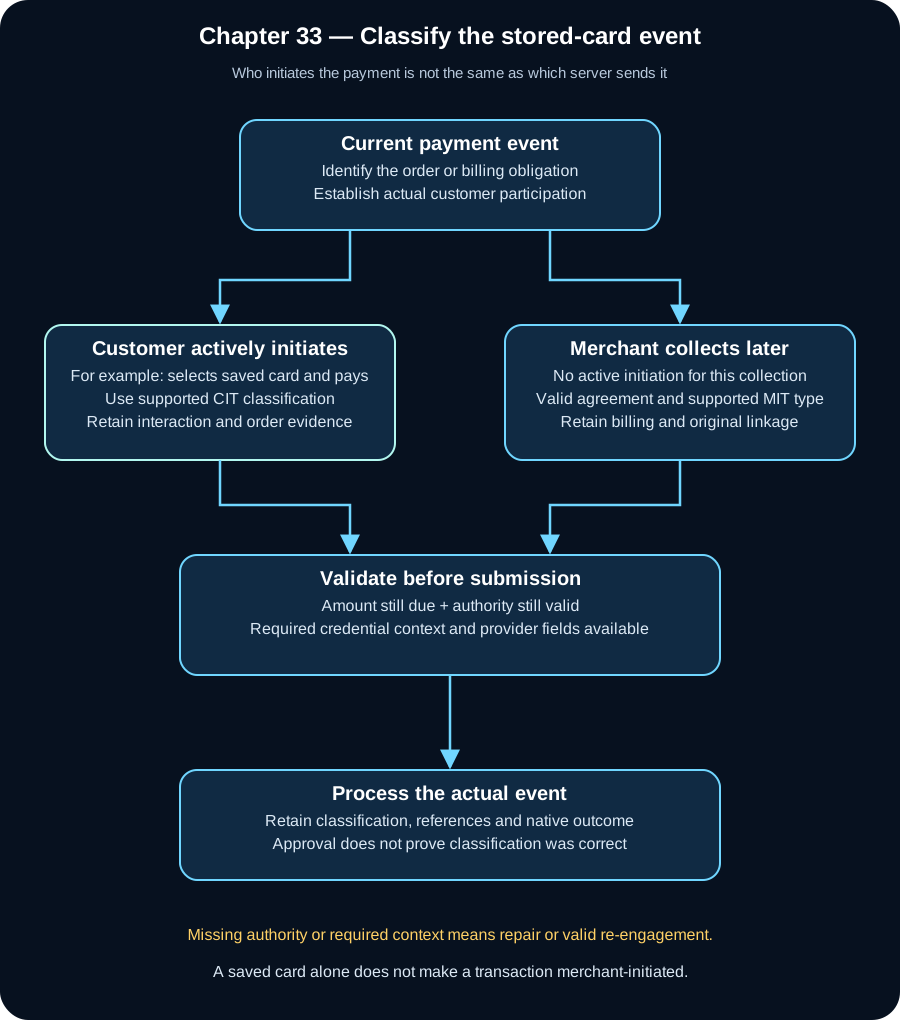
A stored credential is retained for later use under an applicable arrangement. The later transaction can still be customer-initiated. A customer who signs in, selects a saved card and presses “Pay $80” is actively initiating that purchase. The fact that the merchant retrieved a saved credential does not turn the purchase into a merchant-initiated transaction.
A merchant-initiated transaction is submitted without the customer's active participation at that moment, under a previously established relationship. Visa's public guidance ties MITs to the earlier customer interaction and agreement. The processor's supported indicators and original-transaction references communicate the relevant context; an internal label alone is insufficient.
For example, a customer actively pays an annual invoice using a stored card. That is different from the merchant automatically collecting an agreed monthly subscription while the customer is asleep. Both can use the same credential. Their initiation context differs, and the integration should reflect that difference accurately.
An MIT is not a mechanism for bypassing a decline or avoiding authentication on a new customer-driven purchase. If a customer is present and initiating a transaction, the merchant should use the appropriate customer-initiated flow. A transaction cannot legitimately become recurring merely because changing an indicator improves the apparent approval rate.
The bank's reporting should preserve initiation type, stored-credential use and agreement relationship separately. That enables investigation of merchants who submit unusual volumes of MITs without corresponding setup evidence. It also helps distinguish a genuine recurring-payment issue from a customer who simply does not recognize a one-time purchase made with a saved card.
Distinguishing customer action from merchant execution
The initiator classification concerns who initiates the transaction in the relevant payment context, not merely whose server sends the API request. Almost every online merchant sends processing requests from a server. That fact does not make every purchase merchant-initiated. The merchant must identify the actual customer interaction and the supported stored-credential relationship under the applicable network and processor rules.
Consider three uses of the same saved card. A customer signs in and presses pay for a new service visit. The merchant bills the monthly membership automatically under an existing agreement. Later, the customer changes a failed payment method and actively completes a new checkout. These events can require different classification and linkage even though the same merchant account and customer profile appear in all three.
The application should preserve the evidence that supports the classification. For an actively initiated payment, that may include the order and customer interaction associated with the attempt. For an unattended later collection, it includes the agreement, billing event and supported relationship to earlier credential establishment. These are business records around the required processing fields, not replacements for the provider's technical specification.
Incorrect classification can become an operational defect before it becomes a dispute. A merchant may omit required linkage, use an unsupported transaction category or send a later collection as though the customer were present. The provider may reject the request, the issuer may make a different decision, or the transaction may be processed with incomplete evidence. An approval response should not be treated as proof that the classification was correct.
The design should therefore make transaction category a controlled decision. A billing worker should not accept an arbitrary value supplied by a support screen merely to improve approval rates. The decision should follow the agreement type, current event and actual customer participation. If the system cannot establish the required context, it should seek a valid next interaction or route the case for repair rather than fabricate the missing relationship.
Reporting should retain the classification used at the time. If a later investigation discovers that a population was misclassified, operations needs to identify those transactions and assess the appropriate response with the acquirer. Overwriting historical categories with a corrected default would hide the original processing behavior and weaken the evidence needed to determine customer, merchant and bank impact.
3. Recurring instalment and unscheduled arrangements
Recurring collections typically follow an agreed schedule for continuing goods or services. Instalment collections divide an agreed obligation into a defined series. Unscheduled credential-on-file arrangements can collect when an agreed event occurs rather than on a fixed calendar. These models need different billing controls even when the underlying payment credential is the same.
A $35 monthly membership has an ongoing service period and cancellation behavior. A $600 purchase payable in three $200 instalments has a finite collection plan. An agreed automatic top-up when a stored balance falls below a threshold has an event trigger. Treating all three as “charge card every month” loses essential business meaning.
For instalments, the system should know the intended number, amount and completion state of the series. An extra collection after the final instalment is not a harmless scheduler error. For event-triggered collections, it should retain the triggering event and prevent the same event from creating multiple charges. A balance update replay should not cause repeated top-ups.
Some industry-specific later transactions, such as certain delayed charges or no-show arrangements, have their own network conditions. They should not be forced into a subscription category. The merchant must establish that the transaction type is supported and that its agreement and evidence meet the applicable requirements.
The business analyst should therefore define the collection model before mapping network indicators. The mapping follows the business facts. It should not start with whichever API field happens to be easiest for the development team to populate. A processor's generic recurring endpoint may not represent every form of MIT correctly.
Modelling the obligation before choosing the schedule
Recurring, instalment and unscheduled arrangements differ in the business event that makes money collectible. A monthly membership has an ongoing service period. An instalment plan has an agreed total or sequence of payments. An unscheduled arrangement can depend on a later event described in the agreement. The billing design should start from that obligation rather than fitting every product into a generic monthly-job table.
For an instalment purchase of $600 paid in three agreed $200 collections, the merchant should know how much has been successfully collected and how much remains legitimately due. A failed second attempt does not create a fourth instalment or increase the original total. A refund or adjustment can change the remaining obligation, and the billing engine must apply that change before releasing later work.
For a recurring service, the number of future periods may not be fixed at onboarding. The customer can cancel under the agreement and applicable law, and the merchant must determine the effective service and collection consequences. The payment system should not continue indefinitely merely because the credential remains valid. Credential eligibility is a technical condition; the continuing commercial authority is a separate condition.
For an unscheduled collection, the triggering event should be recorded. A merchant might charge an agreed amount after a service event or an agreed usage calculation, subject to the actual arrangement. The system should retain the event and the calculation supporting the charge. A generic description such as miscellaneous fee is weak evidence when the customer asks why money was taken.
Mixed products require particular care. A membership can have a fixed periodic fee and separately ordered services. The merchant should identify whether an additional payment is customer-initiated, part of an agreed later collection or outside the existing authority. It should not use the membership's stored credential as permission to charge every new item automatically. The product and legal design must establish the relationship first.
The bank's implementation review can test the model by asking what stops the next collection. Completion of an instalment schedule, effective cancellation, a resolved invoice, a service pause or a loss of valid authority should each have a defined effect. If the only stopping condition is an issuer decline, the merchant has confused technical payment capability with the right to collect.
4. Establishing the initial relationship
The initial customer interaction establishes the terms and the credential relationship. Depending on the use case and processor, setup may involve a purchase or a supported account-verification operation. A free trial does not necessarily require an arbitrary charge, but it still requires appropriate disclosure and collection authority before later billing.
The integration should retain the processor and network references returned by the supported setup flow. Later transactions may need linkage to that original interaction. An internal subscription identifier cannot replace a required network reference. Both belong in the record because they connect different parts of the lifecycle.
The merchant should give the customer a usable record of the arrangement through the required or agreed channel. Operationally, the record should make the merchant recognizable, explain what will be charged and identify how to stop future collections. A vague receipt saying only “payment method saved” is weak evidence of agreement to an ongoing paid service.
Setup itself can fail halfway. The customer may accept the terms but credential verification fails. The credential may be stored while the subscription activation event is lost. The subscription should not become billable merely because one component succeeded. The system needs a defined condition for activating the arrangement and a recoverable record of incomplete setup.
Risk controls should cover account takeover at setup and later credential replacement. A criminal who gains access to a merchant account may change the card or contact details. The resulting collection might be technically well-formed but commercially unauthorized. Keep evidence of who initiated the change and what verification or confirmation was used.
Establishing a relationship that later transactions can reference
Initial credential establishment should join the customer's agreement to the provider's supported stored-credential process. The merchant needs to know whether the first interaction includes a purchase, a supported account verification or another permitted setup operation. It should not assume that any successful credential check establishes every relationship needed for later collections. The actual network and processor requirements determine the necessary indicators and references.
The merchant should preserve the returned linkage information in a protected, durable record. A later billing worker may need that information long after the original browser session has disappeared. If it is stored only in a front-end session or temporary checkout log, the recurring service can appear successfully enrolled while the first unattended collection fails because the required relationship was lost.
Initial failures should leave a clear enrollment state. A customer may accept the service terms but fail to establish a usable payment method. The merchant can then follow its product policy for incomplete enrollment, but it should not record the entire relationship as active and collectible without the required payment setup. Agreement acceptance and credential establishment are related milestones that can succeed or fail independently.
Duplicate enrollment is another practical case. A customer presses submit twice or returns after a timeout. The merchant should determine whether it is seeing another attempt to establish the same membership or a genuinely separate service agreement. Creating two subscriptions because two setup requests exist can lead to duplicate monthly charges that every downstream payment system processes correctly. The defect originates in the commercial relationship, not in card-network duplicate detection.
The enrollment confirmation should reflect what actually completed. It can identify the service, the relevant billing arrangement and how the customer can manage it. It should not imply that a future collection is guaranteed to succeed. The issuer will still apply the relevant account and transaction decisions when later requests arrive, and the merchant remains responsible for the authority and accuracy of those requests.
Migration and support teams should be able to retrieve the initial relationship without exposing sensitive credentials. A protected reference, agreement version, establishment outcome and native provider identifiers can support the trace. The bank should distinguish a missing historical reference that can be legitimately recovered from one that the merchant is proposing to manufacture. Recreating evidence after the fact is not a valid substitute for having established the relationship correctly.
5. From agreement to each collection
The diagram separates agreement authority, billing, individual payment attempts and financial processing. Cancellation and credential updates affect different parts of the model.
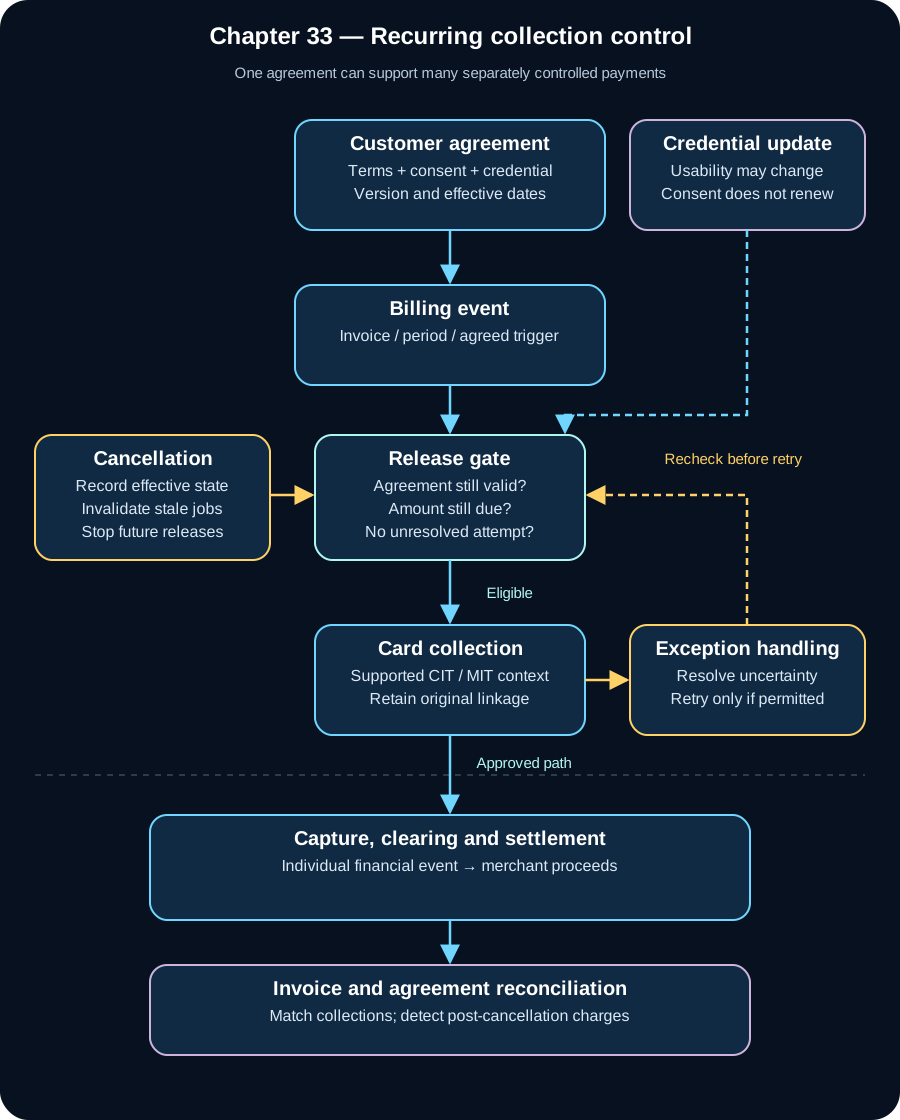
When a billing event becomes due, the system should confirm that the agreement is active for the proposed amount and period or trigger. It creates an invoice or equivalent obligation and an identifiable collection instruction. The payment service retrieves an eligible credential and submits the correctly classified transaction using the supported linkage.
The release check should occur close enough to submission to detect cancellation or other relevant changes. A list prepared on Friday is not proof that every item remains collectible on Monday. Where a queue is used, the collection record should retain the agreement version or cancellation sequence needed to detect stale work.
An approval then enters the merchant's capture and financial processing model. A decline or uncertain response enters a controlled exception process. The billing engine should not independently schedule a new charge while the payment engine is still resolving the first attempt.
Cancellation stops future collection authority according to the agreement and applicable requirements. It does not erase historical invoices, payment records or evidence. Credential replacement changes the means of payment, not the underlying terms. Keeping those operations separate is what prevents the cancelled membership in the opening example from being charged again.
The lifecycle should also distinguish service entitlement. A merchant may allow a grace period after a failed collection, suspend service immediately where permitted or contact the customer. That commercial choice should not be hidden inside the card adapter as an automatic side effect of every decline.
Releasing a collection from a controlled business event
Each collection should originate from a specific billing event. For the $35 membership, that event might identify the service account and period being billed. The event should be separate from the payment attempt so that a retry does not create another obligation. This separation allows the merchant to see one amount due with several controlled attempts, rather than several apparent invoices for the same service period.
Before release, the billing service should evaluate the current agreement and invoice state. Is the period still collectible? Has the customer cancelled with an effective date that covers it? Has another payment or credit already satisfied the amount? Is the credential relationship usable for the intended transaction? These checks should use authoritative current records, with a traceable decision about which version was applied.
The release boundary is especially important for queued work. A job created on Monday may execute on Wednesday after the customer changed the agreement on Tuesday. The worker should not assume that the conditions remain valid because they were valid when the job was scheduled. The business requirement is to prevent stale instructions from overriding later legitimate changes. The exact locking, versioning or messaging mechanism is an implementation choice.
Once released, the attempt needs its own lifecycle. A provider acknowledgement may establish receipt, while an authorization or financial result establishes another stage. An uncertain response should remain linked to the billing event and block unsafe duplication until resolved through the supported process. The invoice should not be marked paid solely because the request left the merchant's system.
Capture and financial processing should follow the actual arrangement. Some merchant integrations combine steps operationally, while others retain separate actions. The recurring engine must know which outcome makes its receivable eligible for the merchant's chosen accounting treatment. A bank analyst should document that point explicitly instead of allowing each downstream system to choose its own interpretation of success.
At the end of the cycle, the merchant should be able to reconcile the intended billing population to released attempts and final outcomes. Missing attempts may represent a scheduling defect; extra attempts may represent duplicate work; unresolved outcomes may represent financial uncertainty. This population-level control catches errors that individual customer support cases cannot reliably reveal.
6. Billing events amounts and notices
The billing engine should determine the commercial amount before the payment service submits it. Taxes, discounts, proration, credits and changes of plan should produce an explainable invoice calculation. A payment approval proves only that the submitted amount was approved; it does not validate the merchant's billing arithmetic.
Time handling matters. A monthly service can be defined by calendar date, anniversary date or another contractual convention. A customer who joins on the thirty-first creates an edge case for shorter months. Time zones can cause cancellation and billing events to cross different local dates. The merchant should define these conventions explicitly rather than letting a server's default timezone decide them.
Notifications should be linked to the event they describe. If an amount-change notice was generated but delivery failed, the system should not automatically treat the communication obligation as fulfilled. The applicable requirement determines what must happen next. Operational evidence should distinguish generated, sent, delivered where known and returned or failed messages.
Free trials and promotional periods require clear transition handling. The system needs the trial end, paid-service start and applicable charge amount. Extending a trial should update the collection schedule coherently. A marketing system changing the promotion while a payment queue retains the old date can create premature charges.
Proration is a useful implementation exercise. Suppose a customer upgrades mid-period and the merchant calculates an additional $8 charge. The system should establish whether the agreement permits that collection, whether additional consent or notice is required, and how it relates to the next scheduled bill. It should not simply increase the next charge and overwrite the original invoice.
Calculating the amount the customer can understand
A recurring invoice can be more complex than a fixed subscription price. A merchant may apply a plan change, tax adjustment, credit, usage amount or agreed proration. The calculation should be reproducible from the relevant service and pricing records. The payment request should carry the resulting amount, but the merchant must retain the explanation of how it was derived.
Suppose a customer moves from a $35 plan to a $50 plan during a service period. The merchant's terms and applicable requirements determine whether the change applies immediately, at renewal or through another agreed calculation. The billing engine should implement that decision consistently. It should not choose a proration method because a developer found it convenient or because another product uses it.
Credits deserve explicit allocation. A $10 service credit can reduce a future invoice, be refunded or be applied in another permitted way under the actual arrangement. The customer should be able to understand which occurred. If the merchant reduces the next collection to $25, the reconciliation should link the $35 charge basis and $10 credit to the $25 payment event rather than treating the difference as an unexplained shortfall.
Notice generation should use the same authoritative amount and timing data as release. If a notice states one amount and the collection uses another, the bank may face a complaint even when the payment request is technically well formed. The merchant should preserve what was sent, when and through which supported channel, and distinguish successful generation from actual delivery evidence where available.
Changes after notice need a controlled path. The merchant should establish whether the new amount requires another notice or customer action under the applicable obligations. It should not assume that an old notice automatically covers every later adjustment. Legal applicability belongs with the responsible compliance or legal function, while the technical design must be able to carry out the resulting requirement.
Customer support should be able to explain the calculation without exposing internal jargon. A useful explanation identifies the service period, agreed plan, relevant adjustment and final amount. It should not merely say that the system calculated it. The same evidence should support a dispute investigation, making billing transparency an operational control as well as a customer-experience feature.
7. Consumer debit and preauthorized transfers
Recurring use of a consumer debit card can fall within Regulation E's preauthorized-transfer provisions. It is not outside those provisions merely because collection travels through a card network rather than ACH. Product and transaction scope must be assessed before the system assigns its legal treatment.
Under §1005.10, covered preauthorized debits require written or similarly authenticated authorization and a copy for the consumer. A consumer can give the institution a stop-payment instruction at least three business days before the scheduled transfer. Written confirmation may be required within fourteen days under the rule's conditions. Varying amounts generally require ten days' advance written notice, with specified range or difference options. The official interpretation also addresses using a third party where the institution cannot itself block a card-network debit.
The implementation consequence is an issuer-side control that can identify the relevant recurring relationship and give effect to valid customer instructions. A bank should not respond that recurring debit-card payments cannot be stopped simply because the card platform lacks an easy screen for the operation. The legal obligation and the technology gap need separate treatment.
Classification should be documented carefully. Not every later card transaction is necessarily a preauthorized EFT at substantially regular intervals. An actively initiated saved-card purchase differs from a recurring debit. Commercial accounts and credit products also require their own legal analysis. Avoid applying one consumer-debit checklist indiscriminately to every card-on-file transaction.
For a bank implementation, compliance should own the applicability logic and legally required notices. Product and operations should own customer handling, while technology implements the required outcomes. A technical inability to match a merchant consistently is a control defect to resolve, not a reason to redefine the customer's request.
Implementing consumer-debit obligations across systems
The Regulation E provisions summarized earlier create operational requirements that can span the card platform, customer-service system and merchant relationship. The bank should first determine whether the transfer and account fall within the relevant scope. It should then ensure that the customer's valid instruction reaches the system capable of giving effect to it. A legal obligation does not disappear because a card platform was originally designed around replacement cards rather than recurring-transfer controls.
For a stop-payment request, the intake record should identify the customer's intended scope as clearly as the available information permits. The customer may want to stop one upcoming collection or an ongoing series. A descriptor can vary, and the bank should use the relevant account and transaction evidence rather than demand that the customer know every processor identifier. The matching approach should be reviewed for both missed collections and unintended blocking of unrelated purchases.
Operations needs a way to verify the outcome. Recording a service ticket is not the same as implementing the control. The system should show whether the instruction was accepted, applied, requires lawful follow-up or encountered a technical exception. The customer should receive the appropriate explanation and any required communication. Where the bank cannot implement the instruction through its normal screen, an owned exception path is necessary.
The bank should also distinguish the customer's instruction from merchant cancellation. A customer may ask the bank to stop a transfer while the merchant still believes a service agreement exists. The bank should handle its own applicable obligations without claiming to adjudicate every aspect of the commercial contract. The merchant separately needs to address cancellation, authority and any legitimate remaining amount under the relevant agreement and law.
Testing should include descriptor changes, card replacement, different amounts within the same relationship and an incoming transaction after the instruction becomes effective. These are recommended coverage cases, not a universal matching specification. The aim is to demonstrate that the bank's implementation works for the actual recurring relationships it supports and does not rely on one fragile text match.
Audit evidence should connect intake, applicability assessment, implementation and subsequent results. A reviewer should be able to establish what the customer asked, what the bank decided, what control was applied and whether it worked. That chain is more meaningful than a report showing that all stop-payment tickets were closed within an internal service target.
8. Subscription law and network obligations
US subscription obligations are not one rulebook. Federal consumer-protection law, relevant state laws, card-network requirements and the merchant's agreement can all matter. They regulate different relationships and should not be presented as interchangeable sources of authority.
For online negative-option transactions, ROSCA addresses disclosure of material terms before billing information is obtained, express informed consent before charging and simple mechanisms to stop recurring charges. The merchant's legal review should also consider applicable state automatic-renewal requirements and other relevant law. This chapter does not assert that one nationwide cancellation design satisfies every jurisdiction.
The FTC's current Negative Option Rule page, accessed 5 October 2026, links the operative 16 CFR Part 425 text and the March 2026 advance notice of proposed rulemaking. The 2024 click-to-cancel amendment should not be presented as an operative nationwide requirement for this release. ROSCA, the operative rule text, applicable state automatic-renewal law, and network/contract requirements remain separate obligations; confirm legal status and jurisdictional applicability before implementing a cancellation control.
Network requirements concern matters such as transaction identification, stored-credential processing and specific subscription practices. They are contractual scheme obligations, not federal statutes. A merchant can satisfy the technical transaction format while failing its consumer disclosure obligations, or provide good disclosure while submitting incorrectly classified payment messages.
A practical control register should identify the source, jurisdiction, effective date, owner and affected system for each obligation. Proposed changes belong in change planning. Effective requirements belong in production controls. Marketing announcements and old implementation guides should not be treated as current law without checking their status.
Maintaining an obligation register without confusing sources
A subscription product can be affected by consumer law, network rules, processor requirements and its own contractual promises. The merchant should record these separately because they have different sources, applicability and change processes. A network processing indicator does not satisfy a disclosure obligation by itself, and a well-written customer agreement does not guarantee that later transactions are submitted correctly.
An operational obligation register can identify the requirement, affected product, jurisdiction, effective date, owner and implementing control. For example, a disclosure requirement may be implemented in enrollment, a cancellation requirement in account management, and a processing requirement in the payment adapter. The register should link to the authoritative source or approved internal interpretation rather than a remembered summary from a product presentation.
Proposed rules need a separate status from effective requirements. A merchant can plan for a possible change without telling staff it already applies. The FTC history described earlier illustrates why this distinction matters: a widely discussed amendment can have a different legal status by the time a training document or release is used. The bank should verify the current source and preserve the reasoning for its implementation decision.
State-specific obligations require an applicability process rather than a generic nationwide assertion. The merchant's legal review should determine which customer and transaction facts matter for its products. Technology should receive a concrete, testable rule from that review. It should not infer legal geography solely from an IP address or assume that the location of the processing server determines the consumer's rights.
Customer promises can exceed a minimum requirement. If the merchant advertises immediate cancellation or a particular refund policy, its operational design should support the promise it actually made, subject to applicable law. The bank should not describe a breach of that promise as harmless merely because a narrower technical network requirement was met. Commercial conduct and processing correctness remain separate dimensions.
Change management should include evidence and customer communication. When terms, prices or cancellation arrangements change, the merchant needs to establish which customers are affected, what action or notice is required and when the new logic takes effect. Updating a webpage and a billing table independently can produce inconsistent outcomes. A joined release plan connects legal interpretation to the actual enrollment, billing, payment and support systems.
9. Credential security and lifecycle services
The merchant should retain only the payment information it is permitted and needs to retain. A vault reference or supported payment token can reduce direct exposure to card data. It does not remove the need to protect the account, consent record and access to the payment service.
PCI SSC expressly prohibits merchants from storing card verification codes after authorization for card-on-file or recurring use. Customer permission does not make that storage acceptable. The recurring design should use the processor's supported credential and transaction context, not a stored verification code replayed every month.
Account-updater and token-lifecycle services can help maintain eligible credentials after expiry or replacement. Their availability and behavior depend on the program. An update says something about the credential relationship; it does not create a new subscription agreement or reverse a cancellation.
For the $35 membership, suppose a new expiry date arrives after the customer cancelled. The credential service may update its record, but the billing agreement must remain cancelled. The release check should continue to block collection. A test that only confirms the updater increased approval rates misses this important negative case.
Credential maintenance needs an audit trail. Record what changed, the source of the update and the relationships affected, using protected references. Do not expose full credentials in routine support views. If a token is suspended for risk reasons, an automated fallback should not silently defeat that restriction by selecting another stored credential without a valid basis.
Wallet-based recurring arrangements deserve particular care. The merchant should confirm that the selected wallet and processor support the intended later transactions and appropriate credential type. A captured one-time wallet payload is not a reusable subscription instrument merely because it can be saved as a string.
Applying credential updates without renewing authority
A credential maintenance service can improve continuity, but it should update the payment relationship only within its supported purpose. A new expiry date, replacement credential or token-state event does not say that the customer still owes the next invoice. The billing release check must continue to evaluate the agreement and obligation independently of the credential update.
Suppose the $35 membership is cancelled on the final day of the month, and a credential update arrives that evening. The credential service may legitimately record the update for historical or other permitted relationships. The cancelled membership should remain blocked from future collection according to its effective cancellation. A system that treats any successful credential update as reactivation has converted technical maintenance into invented commercial authority.
The merchant should preserve the source and timing of changes. A customer actively replacing a payment method differs from an automated provider update. The former can involve a new customer interaction and supported setup process; the latter follows the maintenance service's contract. Both should be linked to the relevant agreement where appropriate, but the evidence should not be flattened into a generic card changed event.
Security controls should protect the ability to use a stored reference. Even when the merchant cannot see the underlying PAN, an attacker with access to its payment API or billing administration may still initiate charges. Tokenization therefore does not remove the need for authorization controls, protected service credentials, monitoring and separation of duties. The relevant risk is access to payment capability, not only access to readable card data.
Credential deletion should be handled carefully. The merchant can remove a method from future use while retaining the protected historical references needed for refunds, disputes and reconciliation, subject to applicable retention requirements. Deleting every reference immediately can make legitimate financial servicing impossible. Retaining a reference should not leave it selectable for new billing after the customer has removed its authority.
The bank should test these boundaries explicitly: update after cancellation, replacement during a retry queue, token suspension before release and refund after removal from the customer's active wallet. Each case verifies a different relationship between eligibility, authority and history. The expected outcome should come from the actual agreement and provider behavior, not from an assumption that the latest credential event always overrides every other system state.
10. Declines retries and customer re-engagement
A collection failure needs classification before retry. A malformed request belongs in technical repair. A definitive account restriction may require stopping further attempts. A condition that may change could support a later permitted retry. An uncertain response needs status resolution. Treating every non-success as “try again tomorrow” creates unnecessary customer friction and duplicate risk.
Network retry restrictions and processor guidance can depend on the response category and transaction context. There is no single safe retry count or interval for all US recurring card collections. Use effective-dated policy based on the actual program, and preserve the response and decision supporting each retry.
The invoice and payment attempt should be distinct. One $35 invoice can have several permitted attempts, but it should not become several $35 invoices because a worker restarted. An attempt ledger should show submission, response, uncertainty resolution and whether another attempt was allowed. The maximum collectible amount should remain linked to the obligation.
Customer re-engagement can be better than another unattended attempt. A customer may need to provide a new payment method or actively complete a supported authentication flow. That new customer interaction must be classified accurately. The merchant should not simply relabel the previous failed MIT as a successful CIT without the customer's participation.
Retry systems should also recheck agreement state. Cancellation, refund, service closure or another successful payment may have occurred since the retry was queued. A retry that was valid when scheduled can become invalid before release. This is why cancellation must reach scheduled jobs, event queues and recovery workers, not just the customer-service screen.
Retrying the payment without recreating the debt
A retry is another attempt to collect an existing legitimate obligation. It should not create a new invoice, move the billing period or increase the collectible amount unless a separate lawful business event supports that change. The attempt ledger should therefore sit beneath the receivable rather than define it. This makes it possible to distinguish collection effort from the customer's actual debt.
For a failed $35 collection, the merchant should first establish whether the outcome is definitive. A provider validation reject, an issuer decline and a communication timeout require different handling. A timeout may conceal a successful transaction and should enter the supported inquiry process. Retrying it as though it were a confirmed decline can collect the same invoice twice even if each attempt has a unique identifier.
For a definitive decline, the permitted next action depends on the actual response category and program rules. The merchant should use the provider's documented guidance and effective policy. It should not publish or implement one universal retry count for every card product and reason. Internal collection strategy can operate only within the applicable processing restrictions and the customer's continuing authority.
Retry timing should also respect business events. A customer may pay the invoice through another method, receive a service credit or cancel before a scheduled retry executes. The worker should reload the current obligation and agreement state. A retry that was valid when queued can become invalid later. This is why a queue cannot be treated as a permanent authorization to collect.
Customer re-engagement should create evidence of the new interaction. If the customer returns to complete a payment or establish a replacement credential, the merchant should classify and process that event correctly. It should not simply relabel an unattended failed transaction as customer-initiated to obtain a different result. The processing category must describe what actually happened.
Operations should measure whether retries resolve legitimate receivables without producing duplicates, complaints or unsupported attempts. A higher approval rate is not sufficient if it was achieved by ignoring cancellation or misclassifying transactions. A useful report links every retry to the original billing event, the reason another attempt was allowed, the outcome and the remaining amount due. That evidence supports both merchant collections management and bank oversight.
11. Cancellation revocation and stop payment
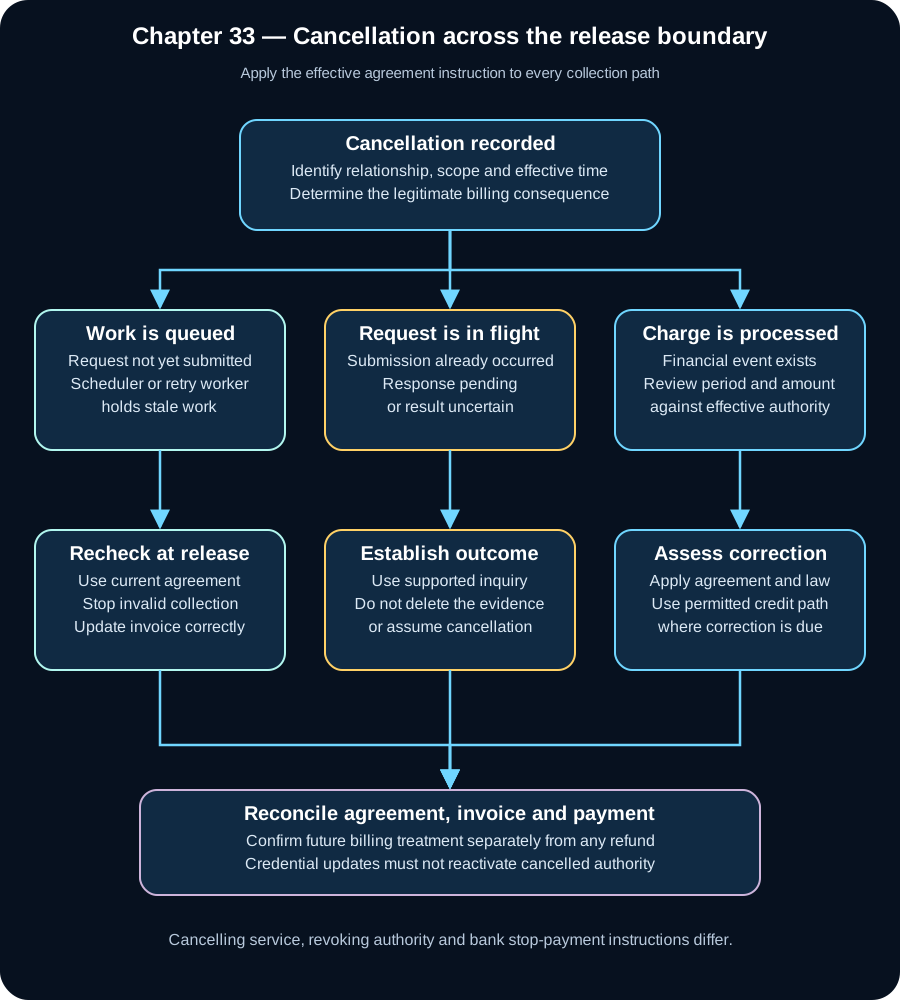
Three actions need separate treatment. Cancelling a service changes the commercial relationship. Revoking collection authority ends permission for specified future charges. Giving the bank a stop-payment instruction engages the bank's applicable obligations for the transfer. These actions can be related, but one system should not assume that another action automatically occurred elsewhere.
The merchant should record the effective cancellation time and what it means for the current service period. If a final amount is legitimately due, the agreement and law determine how it may be collected. Cancellation should not be used as a reason to invent a new fee or submit a charge under an unrelated transaction category.
Technical cancellation must reach all release paths. A useful design checks an agreement version immediately before submission. If a queued job carries an earlier version, it must reload the current state before proceeding. The exact concurrency mechanism is an implementation choice, but the business invariant is clear: stale work must not override a later cancellation.
An in-flight transaction requires lifecycle handling. A cancellation can arrive after a request left the merchant but before the response returned. The system should determine what was submitted and what financial correction, if any, is required. Deleting the queued record at that point does not stop the already transmitted payment.
Replacing a card is not a universal cancellation mechanism. Credential continuity services may preserve some relationships, and historical financial events remain. The issuer should handle the customer's actual stop or revocation request under the applicable process, rather than promising that a new card number will necessarily prevent every future collection.
Customer communication should distinguish confirmation that future billing stopped from confirmation of a refund. A cancellation receipt should not imply that a prior charge has already been credited unless that financial action has actually occurred.
Closing every path through which a cancelled charge can escape
Cancellation is a distributed-systems problem as well as a customer-service process. The active agreement may be stored in one service, scheduled work in another, and failed attempts in a retry queue. A customer can receive a correct cancellation confirmation while an old job remains capable of submitting a charge. The merchant must identify every release path and ensure that it checks the effective instruction.
Consider a cancellation received at 09:02 after the daily billing job selected the membership at 09:00 but before the payment worker submits it at 09:05. The business rule should determine whether the upcoming charge remains legitimate under the agreement and applicable requirements. The worker must use that current determination, not the fact that the job selected the account earlier. The timestamps are illustrative and are not a legal cutoff.
An in-flight request creates a different problem. If submission occurred before the effective cancellation and the response arrives afterward, the system should establish the transaction outcome and the required financial disposition. It cannot stop a request already transmitted by deleting its local queue entry. A supported reversal, refund or other action may be needed depending on the actual lifecycle and obligation.
Cancellation also needs scope. A customer with two services may cancel one and retain the other. A household may remove one payment method while retaining the service. The merchant should identify the intended relationship and avoid both underblocking and overblocking. A broad customer-level cancelled flag can accidentally stop legitimate unrelated collections or leave the wrong service active.
The confirmation should distinguish future billing from prior financial corrections. If a refund is due but has not yet been processed, the merchant should say so accurately and track it separately. A cancellation receipt should not be treated as proof that the issuer credited the card account. Customer support needs both the agreement outcome and the financial outcome to answer follow-up questions correctly.
The strongest test follows a cancelled relationship through all remaining automation: the normal billing scheduler, retry workers, credential updates, migration jobs and manual support tools. None should resurrect collection authority through stale data. If a later legitimate agreement is established, it should be recorded as a new or properly amended relationship with its own evidence, rather than silently reversing the historical cancellation.
12. Capture settlement and receivables
Each recurring charge is an individual payment event within a continuing relationship. Authorization, capture, clearing and settlement still apply according to the processing model. The fact that the merchant has collected successfully for twelve months does not make the thirteenth payment pre-settled or guaranteed.
The billing ledger records what the customer owes. The payment ledger records collection attempts and accepted financial events. The acquiring ledger records merchant financial activity and funding. These records should reconcile, but their statuses need not change at the same moment. A merchant may mark an invoice provisionally paid after approval while separately tracking capture and settlement exposure.
Actual participant money movement follows the card settlement arrangement. Merchant funding follows the acquiring contract. A recurring label does not create an ACH mandate or change the card payment into an ACH debit. If the merchant later receives an ACH credit for its proceeds, that remains a separate funding leg.
Assume a merchant has 1,000 illustrative $35 invoices, giving $35,000 billed. At the reporting point, 940 are financially accepted, 40 declined and 20 remain uncertain. Accepted collections total $32,900. The remaining $2,100 is not all the same problem: $1,400 is associated with declines and $700 with unresolved outcomes. Retrying the entire $2,100 without first resolving uncertainty could overcollect.
Fees, refunds and disputes further affect net proceeds. Revenue recognition and service entitlement follow the merchant's accounting policy and business obligations; they should not be derived automatically from a bank's funding date. Chapter 29 supplies the detailed settlement foundation, while this chapter supplies the agreement-to-invoice relationship needed to interpret the money.
Connecting the recurring invoice to cash without skipping stages
The merchant's receivable and the card transaction are related records with different meanings. The invoice states what the merchant believes is due. The payment attempt seeks collection. The financial record shows what was processed. The acquiring report and bank-account credit show how proceeds reached the merchant under its arrangement. A recurring service should reconcile these relationships rather than mark every submitted request as cash received.
Suppose one thousand memberships are billed at $35, creating an illustrative $35,000 gross billing population. Some accounts may be excluded before release because of effective cancellation or credits. Some released attempts may decline. Some may remain uncertain. Some may be processed and later refunded. The merchant should preserve each population so it can explain the difference between billed value, processed value and eventual net proceeds.
Accounting treatment should follow the merchant's applicable policy and facts. Recognition of service revenue is not determined solely by the timing of a card authorization. A card receivable or clearing balance may bridge processing and cash receipt, while fees and refunds are separately identified. This chapter does not prescribe a universal journal for every subscription business; it establishes the evidence that finance needs to apply its own accounting correctly.
If an invoice is paid through another channel while a card attempt is uncertain, the receivable should be protected from duplicate collection. Operations needs to resolve the card outcome and, if necessary, correct the extra payment through the supported path. The fact that the invoice balance is now zero does not prove that the uncertain card request failed. Receivable closure and payment uncertainty must both remain visible.
Refund allocation can also affect later billing. A refund of one service period should not automatically cancel every future period unless the agreement or customer instruction requires that outcome. Conversely, a cancellation can stop future billing without requiring a refund of every historical charge. The merchant's system should record the intended commercial treatment and the resulting financial events separately.
Treasury forecasting should use realistic processing and funding expectations under the actual acquiring contract. A monthly billing run is not a guarantee that all projected value becomes available cash on the same day. Declines, uncertainty, refunds and contractual deductions can change the result. Finance needs a forecast that distinguishes expected collections from confirmed financial outcomes and actual funding, rather than relying on the gross invoice total alone.
13. Reconciliation reporting and evidence
Reconciliation should connect agreement, billing event, invoice, payment attempt, accepted financial event and merchant funding. A break should identify which connection failed. An invoice with no attempt differs from an approved attempt with no capture, and both differ from captured funds not allocated to the correct customer account.
The opening membership incident illustrates a different control: agreement-state reconciliation. The merchant should identify collections released after the effective cancellation state. A system can reconcile every dollar perfectly and still have charged customers without valid authority. Financial completeness and commercial correctness are separate controls.
Useful reports include due invoices without collection instructions, unresolved attempts, permitted retries pending, cancelled agreements with future jobs, credential-update failures and charges requiring customer contact. Counts should distinguish invoices from attempts. A rising attempt count may indicate a retry loop rather than business growth.
Evidence for a later complaint should be retrievable by the original transaction reference and agreement. It may include accepted terms, notices, invoice calculation, cancellation history and relevant payment results. Retention must follow applicable requirements and policy, with access restrictions. Retaining everything indefinitely is not a substitute for a defensible evidence design.
Customer statements and merchant descriptors should make the collector recognizable. An unfamiliar descriptor can create avoidable inquiries, but improving it does not resolve a genuinely unauthorized charge. Operations should investigate the actual complaint rather than dismissing every unrecognized transaction as a descriptor problem.
The issuer and acquirer should be able to exchange the appropriate network evidence without assuming they share the same internal subscription identifier. Preserve both business references and network references so the investigation can cross the bank boundary.
Reconstructing one disputed month from the evidence
A recurring-payment investigation should be able to reconstruct the exact period in question. The merchant should locate the agreement version, billing event, calculation, notice where relevant, release decision, credential relationship, attempt history and financial outcome. It should also identify cancellation, credits or other payments that could affect the amount. This is a joined evidence record, not a bundle of unrelated screenshots.
Suppose the customer disputes a $35 charge after cancelling. The decisive questions include the effective cancellation, the period billed and the timing and authority of release. A generic copy of the current terms does not answer those questions. Nor does an issuer approval prove that the customer agreed to that month's collection. The merchant needs evidence addressing the actual allegation, which Chapter 34 develops through the dispute process.
Reconciliation should identify duplicate obligations as well as duplicate attempts. If an enrollment defect created two memberships, each may have a distinct invoice and a distinct successful payment reference. Network duplicate controls may see two separate transactions. The merchant must still establish whether there was one legitimate service relationship or two. Commercial duplication can therefore survive technically correct payment processing.
Reporting should distinguish active agreements, billable events, released attempts, successful financial records and cash received. A rise in active subscriptions does not automatically mean higher collectible revenue. A rise in attempts may reflect retries rather than more customers. A rise in approvals can conceal a cancellation defect. These measures become useful when the relationships and denominators are explicit.
Evidence access should be role appropriate. Support may need agreement and billing explanations. Payment operations may need native processor references. Finance may need allocation and funding details. Compliance may need the basis for applicability and customer handling. A protected shared case reference can connect those views without giving every user unrestricted access to all customer and payment data.
The merchant should also preserve corrections. If an amount was calculated incorrectly and later fixed, the original calculation and approved correction should remain traceable. Replacing the old invoice silently can make the final account appear correct while removing the evidence of what the customer actually experienced. A bank-grade operating model explains the full sequence, including mistakes and remediation, rather than presenting only a cleaned-up final balance.
14. Bank architecture and migration controls
A coherent collection platform separates agreement management, billing, credential storage, payment orchestration, retry policy, cancellation control, financial posting and case management. These functions may be supplied by different vendors. Their state transitions need a shared business contract even if their technical protocols differ.
The most important design decision is release authority. Which service establishes that a particular amount may be collected now? The answer should incorporate current agreement status, invoice state, prior attempts and any relevant restriction. A scheduler should not have independent authority to submit charges merely because a date has arrived.
Migration creates special risks. A new processor may need different linkage fields or supported transaction classifications. Existing vault references may not be portable. The merchant must maintain consent and cancellation history while transferring only permitted credential information through secure arrangements. Creating every existing customer as a fresh unlinked recurring agreement is not a harmless technical shortcut.
Cutover should prevent both old and new schedulers from collecting the same period. A migration control can assign each billing event to one processing platform and reconcile the boundary interval. Old refunds and disputes may still need access to the prior processor. The migration is not complete until those historical servicing paths work.
Monitoring should join billing and payment systems. A payment provider can show normal availability while the merchant's scheduler has stopped creating invoices. A billing platform can show all invoices created while an adapter has misclassified the transactions. Operational dashboards should identify the affected agreements and financial exposure, not merely report infrastructure uptime.
Migrating recurring relationships without losing control
A recurring-payment migration moves more than stored payment references. It can involve agreement records, billing schedules, outstanding invoices, retry states, cancellation instructions and historical financial traces. The migration team should identify which system owns each element and which must remain available through the transition. A successful new authorization is only one part of readiness.
Before moving a population, the merchant should establish which credential relationships can be migrated through the providers' approved arrangements. It should not export or reconstruct prohibited data to avoid customer re-engagement. Where a supported transfer is unavailable, the product may need a legitimate new setup interaction. The customer communication should explain the required action without implying that every old credential is automatically portable.
The cutover population should be reconciled by agreement and obligation. Active, paused, cancelled and completed relationships should retain their meaning. Open invoices should not be recreated as additional debt. Pending or uncertain attempts should remain linked to the original provider so their outcomes can be resolved. A cancellation received during the transition must reach whichever system can still release a collection.
Dual running requires a clear release boundary. The old system and new system should not both consider themselves responsible for the same billing event. A controlled ownership marker or another appropriate mechanism can prevent double release. The design should also handle rollback: if the new system stops, the old system must not blindly rebill obligations already processed by the new one.
Historical refunds and disputes often remain with the original processing relationship. Support and finance should retain access to the relevant references and reports for the required period. The new customer portal can present a joined history, but it should not fabricate new provider references for old transactions. Migration should preserve traceability across systems rather than pretend all history occurred on the replacement platform.
Acceptance testing should include cancelled agreements, partially paid instalments, open retries, credential updates and uncertain attempts. These edge populations are where financial defects often hide. The migration should be signed off through reconciled counts and values, sample evidence and owned exceptions. A report that only says all customer rows were copied successfully does not establish that the right future collections will occur.
15. Worked cases and implementation testing
The following cases reconstruct recurring-collection problems. For each, identify whether the defect concerns authority, classification, amount, credential state, payment state or reconciliation.
Case A — cancellation after queue creation. Friday's job creates a $35 collection for Monday. The customer cancels on Saturday. Monday's worker submits the old record and receives approval. Which control would have prevented the charge?
A current agreement check before release would have detected the later cancellation. The queued job should not be treated as immutable permission. For remediation, establish the payment's lifecycle and perform the appropriate correction, stop all related future jobs and explain the outcome to the customer. Reconciliation should identify every agreement affected by the same queue defect, not just the customer who complained.
Case B — saved-card purchase mislabelled. A customer actively buys a $120 course with a previously saved card. The gateway marks all saved-card use as MIT. Why is the mapping wrong?
Stored-credential use and transaction initiation are separate dimensions. The customer actively initiated this purchase. Correct the mapping to the provider's supported customer-initiated stored-credential flow and preserve the appropriate evidence. Do not change the commercial record to suggest that the merchant initiated an unattended collection. Test both active reuse and genuinely unattended recurring use of the same credential.
Case C — unknown result and nightly retry. A $200 instalment times out. The retry worker sends another $200 request overnight before the original result is resolved. Both eventually clear. How should the instalment ledger behave?
It should show one intended $200 obligation and two linked financial events requiring duplicate correction. It should not silently mark two instalments paid unless the customer actually authorized that arrangement and the business facts support it. The preventive design resolves uncertainty before permitting another financial attempt and keeps the instalment sequence separate from the number of submissions.
Case D — updater reactivates billing. A token update arrives for a cancelled $35 membership. The credential handler sets the subscription to active because the payment method is usable again. What state boundary was crossed?
Credential usability was incorrectly treated as collection authority. The update should affect the credential record only. The cancelled agreement remains cancelled unless a valid new customer agreement changes it. Add a test that processes updates after cancellation, after a stop instruction and during an in-flight refund.
Case E — invoice paid through another channel. After a recurring decline, the customer pays the invoice manually. An already queued card retry succeeds the next day. What should release control have checked?
It should have checked the invoice's current outstanding amount and the status of other collection attempts. Payment channels can be separate, but they collect the same commercial obligation. The resulting overcollection needs a controlled correction linked to both payments. The customer should receive an explanation that identifies the duplicate collection rather than a generic message that the subscription renewed successfully.
For implementation testing, add free-trial activation failure, plan changes, varying-amount notice handling, short months, time-zone boundaries, final instalment completion, valid stop instructions and processor cutover. Each test should specify the expected agreement state, permitted payment action and financial result. A recurring-payment test suite that checks only whether a scheduler fires on time is incomplete.
Following a cancellation race from complaint to repair
A membership merchant receives complaints that customers were charged after receiving cancellation confirmations. The billing team points to a cancelled flag in the customer database and concludes that the payment processor must have retried old transactions. The payment operations team instead finds new merchant-originated attempts, each linked to a retry job created before cancellation. The processor executed the requests it received; the merchant's release control was incomplete.
The investigation separates the affected relationships from all cancelled customers. It identifies retry jobs that remained eligible after an effective cancellation and determines which were never submitted, which definitively failed and which produced financial records. The merchant stops invalid future releases and resolves uncertain outcomes before creating corrections. It does not refund every historical payment on each account, because the legitimate prior service periods remain a separate question.
For one customer, the cancelled $35 period was charged once and no other payment exists. The merchant processes the appropriate linked correction and communicates its confirmed status. For another, the retry timed out but the processor shows a successful collection; that outcome must be resolved before another action. For a third, the queued job was never released, so there is no financial credit to issue. The customer records can all show the same cancellation state while requiring different payment actions.
Technology changes the release worker to evaluate the current agreement and invoice state immediately before submission. The cancellation workflow also marks relevant queued work for review, but that alone is not relied upon as the only safeguard. Credential updates and manual retry screens are included in regression testing so another release path cannot recreate the defect.
The merchant reconciles the affected billing events, corrective credits and customer communications. Management receives the cause, population, residual exposure and evidence that the release invariant now holds. The practical conclusion is specific: a cancellation confirmation is trustworthy only when every system capable of collecting money respects the effective instruction. Storing the right status in one database is insufficient if stale work can still reach the card network.
16. Role checklist and learning closure
The acceptance decision for a billing release
Before accepting a recurring-billing implementation, ask the team to demonstrate one collection that must proceed and one that must stop. The proceeding case should show a valid agreement, an unpaid billable event, the correct supported credential relationship and a traceable processing outcome. The stopping case should show an effective cancellation or satisfied obligation reaching every relevant worker, including a retry created earlier.
The evidence should include the resulting receivable and payment records. It is not enough for the screen to display a cancellation message if a queued request can still collect money. It is also not enough to prevent the payment while leaving the customer incorrectly marked overdue. A complete implementation gives the agreement, billing, payment and customer-service systems a consistent account of the same obligation.
The Business Analyst defines the agreement, billing model, initiation context and cancellation effects. Compliance and legal teams establish the applicable consumer obligations and distinguish current requirements from proposals. The Architect makes current authority part of release control and separates credential maintenance from billing state.
The Developer preserves original references, prevents duplicate collection and implements cancellation across queues and retries. The Tester uses race conditions and migration cases, not only monthly success. Operations tracks uncertain outcomes and stale jobs. Finance reconciles invoices, accepted financial events and net proceeds. Customer support can show when cancellation took effect and whether any earlier charge was corrected.
Before moving to disputes, explain why an issuer approval does not settle a disagreement about consent, and why an account update cannot renew a cancelled membership. Those are the facts a dispute investigation will later need to reconstruct.
Recurring collection is reliable when every charge remains traceable to a valid agreement, a specific obligation and one controlled financial outcome.
Authoritative references
Public sources checked on 6 September 2026. Retry parameters, linkage fields, subscription notices and wallet-recurring capabilities must be verified for the applicable network, processor and jurisdiction. The architecture and cases are original illustrative designs.
This application uses JavaScript for the full interactive experience. This text summary is served for accessibility and search indexing.