Same Day ACH. A practitioner deep dive into Same Day ACH eligibility, three intraday processing windows, limits, ODFI release controls, settlement, RDFI funds availability, exceptions, reconciliation, liquidity and real-bank operations.
Same Day ACH is best understood as an accelerated processing and settlement option inside the existing U.S. ACH Network. It does not replace ACH. It does not create a separate instant-payment rail. It takes eligible ACH entries that would otherwise settle later and gives ODFIs additional same-banking-day windows to submit them for same-day clearing and settlement.
That distinction matters. A Same Day ACH payment still uses the ACH participant model, ACH files or equivalent operator-facing records, SEC Codes, ACH Operators, settlement accounts, RDFI posting, returns and reconciliation. What changes is the time compression. The Originator, ODFI, ACH Operator and RDFI have less time to validate, release, process, settle, post and investigate an item that is expected to complete within the current banking day.
Chapter 6 explained the ACH Network, FedACH and EPN. Chapter 7 covered ACH credits. Chapter 8 covered ACH debit collections. Chapter 9 covered authorization, SEC Codes and authority evidence. Chapter 10 now asks what changes when eligible ACH credits and debits are deliberately accelerated into Same Day ACH.
The governing mental model is:
eligible ACH instruction → Same Day intent → ODFI eligibility and risk decision → same-day submission window → ACH Operator processing and delivery to the RDFI. Track the scheduled same-day interbank settlement separately from RDFI posting and required credit availability. Operator delivery can precede settlement; those events are not one status. Reporting and reconciliation must also preserve any later return, reversal or other exception.
Same Day ACH should never be reduced to the sentence “ACH but faster.” A bank-grade implementation has to understand which transactions are eligible, which are merely submitted late or with stale dates, how operator windows work, what the current per-payment limit is, how to distinguish customer deadlines from operator deadlines, how funds availability differs by window, how liquidity and settlement-funding decisions change, how duplicate or late-file risk is controlled, and how customer-facing status language avoids pretending that Same Day ACH is real-time or irrevocable.
For a roughly 60-minute core session, spend about 35 minutes on Sections 1–3, Section 5 and Sections 8–14. For the next 10 minutes, use the chapter’s three diagrams to keep submission deadlines, settlement times and credit availability distinct. Use 10 minutes to work through one case in Section 16, then spend the final 5 minutes explaining: What should the bank decide when a payment misses its intended same-day window? Treat these timings as a study guide. The remaining sections, additional cases and extended reference material are follow-up study; completing the whole chapter takes longer.
Chapter navigator
- What Same Day ACH really is
- Eligibility: which ACH entries can settle same day
- The three Same Day ACH processing windows
- How Same Day intent is identified
- Originator and ODFI release logic before a same-day window
- Same Day ACH credits: payroll, supplier payments, payouts and A2A transfers
- Same Day ACH debits: collections, bill payments and receivables
- Operator processing, inter-operator exchange and settlement
- RDFI receipt, posting and Same Day credit funds availability
- Dollar limits, future limit changes and product controls
- Statuses, acknowledgements and customer communication
- Exceptions: missed windows, ineligible entries, duplicate risk and operational recovery
- Returns, reversals and the boundary of same-day finality
- Liquidity, accounting, reconciliation and reporting
- Controls, fraud monitoring, resilience and real-bank operating design
- End-to-end cases, BA checklist and testing
1. What Same Day ACH really is
Same Day ACH is a timing capability within the ACH Network. The payment remains an ACH entry. The participants remain Originator, ODFI, ACH Operator, RDFI and Receiver. The entry still has ACH data, a SEC Code where applicable, an Effective Entry Date, a Settlement Date, trace information and normal ACH exception possibilities.
The important difference is that the ACH Network offers multiple intraday opportunities for eligible entries to be processed and settled on the same banking day they are submitted.
That means Same Day ACH sits between traditional next-day ACH and true instant-payment rails.
Traditional ACH is designed for efficient batch-oriented processing and can be future-dated. Instant rails such as RTP and FedNow are designed around immediate message exchange and settlement within seconds, around the clock, subject to their own rules. Same Day ACH is different from both: it is still banking-day ACH, using scheduled processing windows and batch-oriented operating disciplines, but it is materially faster than waiting for the next banking day.
A useful practitioner comparison is:
Same Day ACH = accelerated ACH settlement during defined banking-day windows.
It is not:
real-time customer-to-customer finality.
That matters for customer promises. A bank should not market a Same Day ACH submission at 11:15 a.m. as “instant” simply because the payment is expected to settle later that day. The ODFI may know that the entry was accepted into a Same Day window. It does not necessarily have direct evidence at that moment that the RDFI has credited the Receiver account.
Same Day changes operational time, not legal identity
If a PPD payroll credit is sent Same Day, it remains PPD. If a WEB debit is sent Same Day and otherwise eligible, it remains WEB. Same Day processing does not replace the SEC Code or authorization model.
This is a critical architecture principle:
payment application and settlement speed are separate dimensions.
A system should therefore store attributes such as:
payment_direction = CREDIT | DEBIT
sec_code = PPD | CCD | CTX | WEB | ...
settlement_speed = STANDARD | SAME_DAY
rather than creating separate payment types that lose the underlying ACH application.
Same Day is optional for origination but mandatory for RDFI receipt
ODFIs and Originators decide whether they will offer and use Same Day origination as a product or service. An Originator might have standard ACH only, Same Day ACH only for approved urgent use cases, or Same Day ACH as a user-selectable option with limits and pricing.
RDFIs, however, must be able to receive Same Day ACH entries. That ubiquitous receiving reach is one of the reasons Same Day ACH is useful: the Originator does not need to check a separate reachability directory to determine whether the beneficiary bank can receive Same Day ACH.
A practical example
An employer misses its normal payroll file deadline because a payroll correction is approved late in the morning. It has 40 employees who still need to be paid today.
The bank can evaluate whether those entries are Same Day eligible, whether the file can reach an applicable window, whether the employer is funded, whether the transaction amounts and SEC/application data are valid, and whether fraud/risk controls are satisfied. If released into a Same Day window, the entries can settle that banking day rather than waiting until the next one.
The employee experience may look like “late payroll fixed today.” The bank experience is more detailed:
late business event → Same Day eligibility → urgent approval → funding check → window selection → operator acceptance → settlement → RDFI posting → availability → reconciliation.
2. Eligibility: which ACH entries can settle same day
Same Day ACH is intentionally broad, but it is not universal.
Nacha describes virtually all common ACH credits and debits as eligible for same-day processing when they meet the applicable rules. The key current exclusions include IAT entries, ENR entries and entries above the current Same Day ACH dollar limit. The entry also has to be presented within an applicable Same Day processing window and must not carry a future Effective Entry Date when being treated as a Same Day item.
For a practitioner, eligibility should be modeled as a decision, not a hard-coded list buried in file-generation logic.
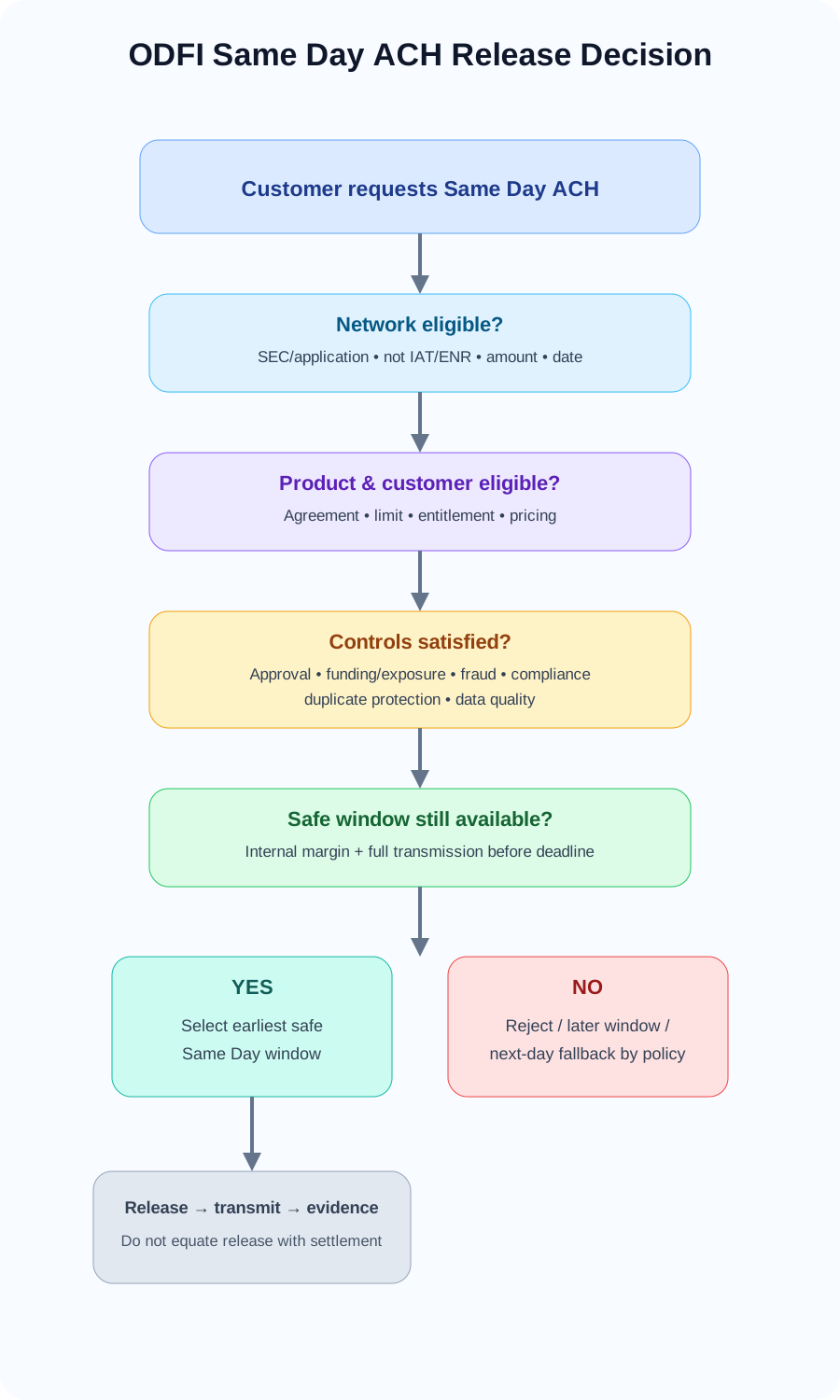
A strong eligibility service asks at least:
- Is the ACH application/SEC Code eligible for Same Day treatment?
- Is the entry an IAT or ENR and therefore excluded?
- Is the amount at or below the current Same Day ACH limit?
- Is the Effective Entry Date compatible with Same Day treatment?
- Can the ODFI complete transmission before a Same Day operator deadline?
- Does the Originator/product agreement permit Same Day origination?
- Does the payment pass funding, entitlement, fraud and release controls?
- Are any lower product, customer, SEC-specific or bank-policy limits applicable?
Eligibility is not the same as product availability
The Nacha Rules can make an entry eligible while the customer’s bank product still does not offer Same Day ACH for that use case.
For example, an ODFI may allow Same Day ACH for emergency payroll and supplier credits but not expose a Same Day option for every low-value consumer transfer. Another bank may make Same Day the default for selected corporate products. Both can operate within the network framework.
A BA should therefore distinguish:
network eligible
from
ODFI product eligible
from
Originator authorized to use Same Day.
Eligibility does not guarantee same-day completion
An entry can be eligible at 1:30 p.m. ET but still fail to settle same day if the bank misses the 2:45 p.m. ET transmission deadline.
The eligibility state should therefore be separate from the execution state.
Useful internal states might include:
SDA_ELIGIBLE
SDA_WINDOW_SELECTED
SDA_RELEASED
SDA_OPERATOR_ACCEPTED
SDA_SETTLED
SDA_MISSED_WINDOW
SDA_DOWNGRADED_TO_NEXT_DAY
The exact names differ by institution. The principle is to preserve why a payment did or did not receive same-day settlement.
Stale or invalid dates require careful handling
Historically, Same Day ACH rules have included treatment for entries with stale or invalid Effective Entry Dates that are submitted within a same-day window and otherwise meet the criteria. This is one reason a bank should not assume that only a literal current-date field can ever result in same-day processing.
The correct control is not “date = today means Same Day.” The correct control is to apply the current Nacha and ACH Operator rules to the entry and submission timing.
For customer-facing products, however, intent should be explicit wherever possible. A payment should not accidentally become Same Day merely because bad date logic produced a stale value.
Lower limits can still apply
Even when the general Same Day ACH limit is $1 million, other limits can apply because of SEC-specific rules, customer agreements, ODFI exposure limits, fraud controls or product design.
A good rule model therefore computes:
effective_same_day_limit = minimum(network_limit, sec_specific_limit, product_limit, customer_limit, risk_limit)
where applicable.
3. The three Same Day ACH processing windows
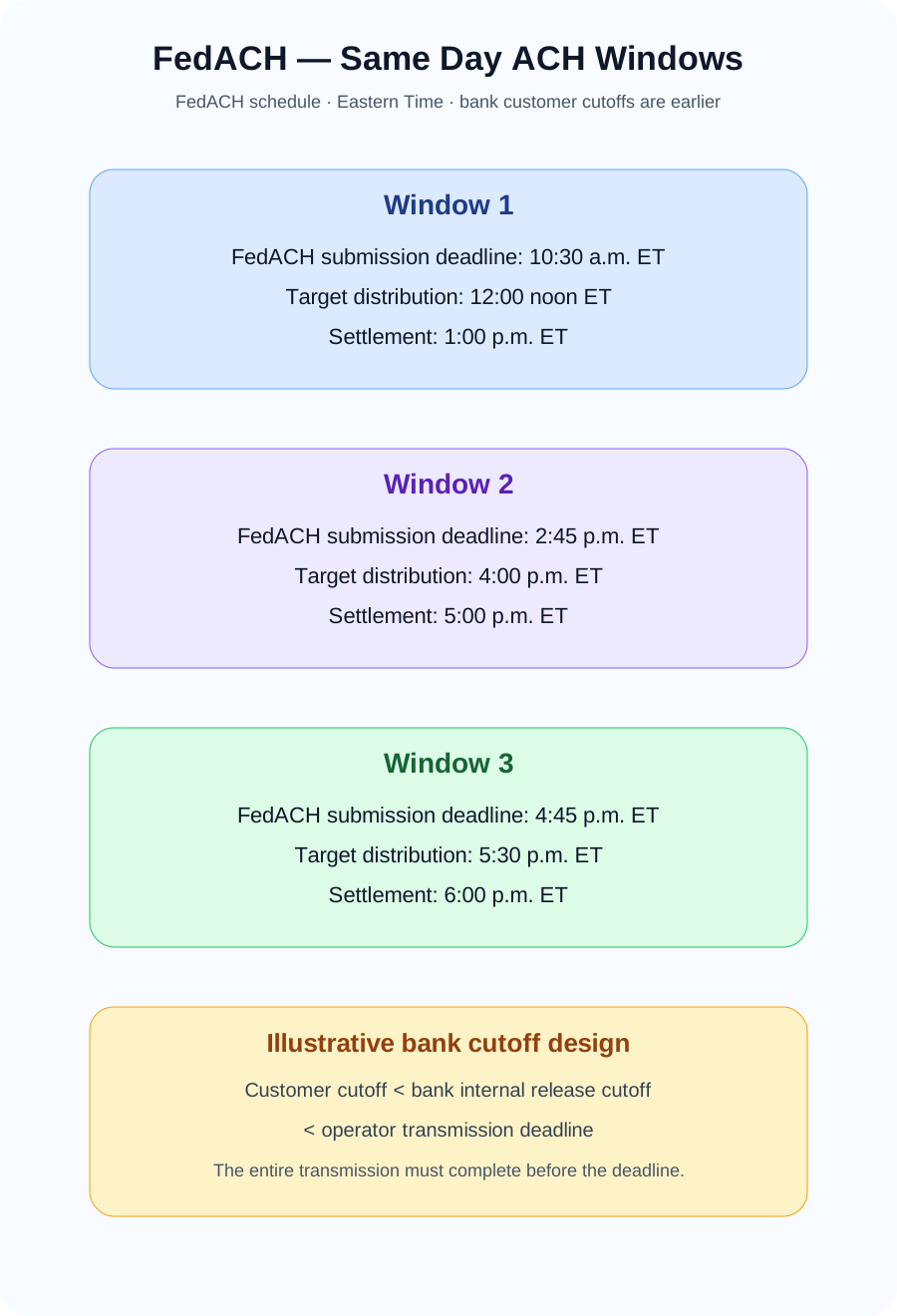
The window values in this section are the current FedACH schedule. EPN has separate published inter-operator and intra-EPN cutoffs; participant/operator status and the actual route determine which schedule applies. Do not use the FedACH times below as universal bank submission cutoffs or as an EPN interface specification.
The window values in this section are the current FedACH schedule. EPN has separate published inter-operator and intra-EPN cutoffs; participant/operator status and the actual route determine which schedule applies. Do not use the FedACH times below as universal bank submission cutoffs or as an EPN interface specification.
The window values in this section are the current FedACH schedule. EPN has separate published inter-operator and intra-EPN cutoffs; participant/operator status and the actual route determine which schedule applies. Do not use the FedACH times below as universal bank submission cutoffs or as an EPN interface specification.
Same Day ACH currently operates through three intraday processing windows.
For FedACH, the published Same Day eligible forward-item schedule is:
First window — transmission deadline 10:30 a.m. ET, target distribution noon ET, settlement 1:00 p.m. ET.
Second window — transmission deadline 2:45 p.m. ET, target distribution 4:00 p.m. ET, settlement 5:00 p.m. ET.
Third window — transmission deadline 4:45 p.m. ET, target distribution 5:30 p.m. ET, settlement 6:00 p.m. ET.
These are operator processing deadlines, not customer upload deadlines.
That distinction is one of the most important things a bank must teach customers and internal teams.
If FedACH requires the complete file to be received by 2:45 p.m. ET, the ODFI cannot promise a customer that “2:45 p.m.” is the upload cutoff. The bank needs time to receive the file, authenticate the channel, parse it, perform validations, run fraud/risk checks, make funding decisions, build the operator-facing output, perform control totals and start transmission early enough for the entire transmission to finish by the operator deadline.
Therefore:
customer cutoff < bank processing cutoff < operator transmission deadline.
The three clocks
A mature Same Day ACH service manages at least three different clocks.
The customer clock controls when the Originator must submit and approve the payment.
The bank clock controls internal processing, risk and release.
The operator clock controls the ACH Operator submission and settlement window.
If those clocks are mixed together, customer promises become unreliable.
Window selection should be deterministic
Suppose a corporate approves a Same Day file at 10:22 a.m. ET.
The payment might technically still fit the first operator window, but the ODFI may have an internal rule that first-window customer submissions must be final by 10:00 because it needs at least 20–25 minutes for processing and transmission margin.
The system should not attempt a “heroic” release that risks an uncertain transmission at 10:29:59. It should select the next feasible window according to bank policy.
A strong window-selection service can calculate:
next_eligible_window
internal_release_deadline
operator_deadline
expected_settlement_time
credit_availability_requirement
and expose those values to operations and customer channels.
Banking days matter
Same Day ACH is not available on weekends and Federal Reserve holidays simply because a payment is urgent. It follows ACH banking-day operating schedules.
That is a major distinction from RTP and FedNow, which operate continuously.
A Friday-evening customer request can therefore be a routing/product decision: wait for the next ACH banking day, use an instant-payment rail if appropriate and reachable, use a wire if the business need and operating hours permit, or choose another arrangement.
4. How Same Day intent is identified
The ODFI needs to know whether the Originator intends the entry to settle Same Day.
This sounds obvious, but ACH file processing historically relied heavily on the Effective Entry Date. Same Day ACH therefore needs disciplined date handling and product intent so that an item is accelerated because the customer and bank intended it—not because a date was malformed.
Effective Entry Date and processing intent
The Effective Entry Date remains important ACH data. For Same Day treatment, the entry cannot simply carry a future date and still be treated as a same-day item under the ordinary eligibility model.
A corporate channel may capture:
requested_execution_date
requested_settlement_speed = SAME_DAY
and then the bank’s ACH formatter derives the appropriate Effective Entry Date and operator treatment.
That is safer than asking a customer to manipulate raw NACHA fields.
API and ISO 20022-originated instructions
Modern corporate channels may not originate native ACH files. A customer might send a pain.001 payment instruction or proprietary API request to the bank. The bank then maps the instruction into ACH.
Same Day intent should survive that transformation explicitly.
For example:
service_level = SAME_DAY_ACH
can be an internal normalized concept even if the customer-facing message uses different terminology.
The bank must then validate that the desired date and speed are actually achievable.
Do not infer urgency from amount
A $200 payment can be urgent. A $900,000 payment can be scheduled days in advance.
Same Day selection should therefore come from explicit product logic, customer instruction or controlled bank routing policy—not a simplistic “large amount means faster” rule.
Defaulting policy should be visible
Some banks price Same Day ACH separately or treat it as a premium service. Others may use it automatically for certain internal products.
If a system auto-upgrades an eligible payment to Same Day, the policy should be documented. If it auto-downgrades a missed Same Day payment to next-day ACH, that policy also needs explicit customer agreement and reporting.
A customer should not believe a payment was Same Day if it silently rolled to the next banking day.
5. Originator and ODFI release logic before a same-day window
The compressed timeline of Same Day ACH makes release discipline more important, not less.
A payment should not bypass ordinary controls simply because the customer says it is urgent.
The Originator still needs valid authority, correct payment data, sufficient approval and a legitimate business purpose. The ODFI still needs to decide whether it is comfortable creating the settlement obligation.
The release sequence
A practical ODFI flow can be:
receive → authenticate → parse → identify Same Day intent → validate ACH/application eligibility → validate amount/limit → validate date/window → confirm approvals/entitlements → run fraud and compliance controls → perform funding/exposure check → build operator file → control-total check → release → transmit → capture operator evidence.
Different banks can order some controls differently, but the state transitions should be explicit.
Funding and exposure are time-sensitive
A corporate may upload a file at 8:00 a.m. and approve it at 2:20 p.m. If the bank checked funding only at 8:01, that evidence may be stale by release time.
Same Day ACH products should define whether funding/exposure is checked:
- at file receipt;
- at approval;
- immediately before release;
- at more than one point.
For large Same Day populations, the ODFI should know exactly when the customer funding obligation becomes locked and when settlement liquidity must be available.
File-level and entry-level decisions
A file can contain a mixture of eligible and ineligible entries depending on the bank’s product model.
The bank must decide whether to:
- reject the entire file;
- separate eligible entries from ineligible entries;
- process eligible Same Day entries while routing the rest as standard ACH;
- require the customer to resubmit separate populations.
There is no value in hiding this decision. It should be a documented product rule because reconciliation becomes much harder when one customer file is silently split into multiple settlement lanes.
Same Day should not weaken dual control
A corporate emergency payroll may require rapid approval, but that does not mean one user should be allowed to create and release the entire payment if the bank/customer policy normally requires maker-checker control.
A strong service supports urgent processing within the control model.
6. Same Day ACH credits: payroll, supplier payments, payouts and A2A transfers
Credits are among the clearest Same Day ACH use cases because the business value is easy to see: the payer needs funds to reach the receiving account sooner than ordinary ACH would provide.
Emergency and late payroll
Payroll is a classic scenario.
An employer discovers at 9:15 a.m. that 120 employees were left out of the regular payroll file. Rebuilding the entire payroll may be unnecessary. The corporate can create a correction population and submit it as Same Day ACH if eligible.
The ODFI should treat this as a separate controlled payment run. It should not simply re-send yesterday’s file.
The key evidence includes:
- which employees were missing;
- why the new payment population is not duplicate;
- approval of the correction run;
- funding for the additional payroll;
- correct PPD treatment and current Company Entry Description requirements where applicable;
- Same Day window selected;
- operator acceptance and settlement evidence;
- individual returns if any.
Supplier and invoice payments
A buyer may need to make a supplier payment today to avoid a late fee or release goods.
Same Day ACH can be attractive where the beneficiary can tolerate ACH timing and the payment is within the current limit. The corporate can preserve remittance information using the appropriate ACH application while accelerating settlement.
The bank should still distinguish:
cash arrived
from
supplier applied the cash to the right invoice.
Same Day speeds the funds movement. It does not solve missing remittance.
Account-to-account transfers
A consumer or corporate treasury customer can use ACH credits to move money between accounts at different institutions. Same Day ACH can reduce the waiting period without requiring an instant-payment product.
But if both accounts are at the same bank, an on-us transfer may be more appropriate. If the use case requires immediate confirmation, an instant rail may be better. Routing is still a product decision.
Payouts and refunds
Insurers, marketplaces and businesses may use Same Day ACH for claims, refunds or approved payouts. The value proposition is faster access at ACH economics.
The bank should consider beneficiary-data quality carefully. Faster settlement reduces the time available to catch a misdirected credit before it leaves the ODFI.
Credit completion is layered
For a Same Day credit, the ODFI can often prove:
accepted by bank
transmitted to operator
operator processed
settled
But beneficiary posted may remain outside the ODFI’s direct evidence unless additional receiving-bank information exists.
Customer status language should reflect that difference.
7. Same Day ACH debits: collections, bill payments and receivables
Same Day ACH also supports eligible debit entries.
The business value is different from credits. A biller or collector may be able to accelerate the collection of funds, improve receivables timing or support due-date payments without waiting an additional banking day.
Chapter 8 owns the full ACH debit lifecycle and Chapter 9 owns authorization. Chapter 10 focuses only on what same-day timing changes.
Authorization must already exist
Same Day processing does not create debit authority.
A recurring PPD debit still needs its valid authorization. A WEB debit still needs the applicable WEB authorization and account-validation/fraud controls. A TEL debit still needs the appropriate oral authorization framework.
The correct sequence is:
authorization → debit instruction → Same Day eligibility → Same Day processing.
Not:
Same Day request → permission assumed.
Due-date collections
A customer pays a utility bill by ACH debit on the due date. If the biller originates the debit early enough and the application is eligible, Same Day ACH can accelerate settlement.
The biller’s receivables system should still distinguish:
payment initiated
ACH accepted
settled
return period still relevant.
A same-day debit settlement does not mean the collector can erase all later return risk.
Receivables and cash forecasting
Same Day debits can improve treasury forecasting because collection settlement happens earlier. However, expected cash and final collected cash remain different concepts.
A treasury dashboard should therefore identify Same Day debit settlement separately from unresolved returns or adjustments.
Customer cutoff promises
A bill-pay service might advertise “pay today” using Same Day ACH debit. The bank or biller must define what “today” means.
Does it mean the debit is originated today?
Does it mean settlement occurs today?
Does it mean the biller applies the payment today?
Those are different events.
8. Operator processing, inter-operator exchange and settlement
Same Day ACH still uses FedACH and EPN as the two national ACH Operators.
The operator receives eligible files or entries, performs edits, sorts items to RDFIs, handles inter-operator exchange where necessary and produces settlement information.
Chapter 6 explained this infrastructure in detail. Here the critical point is that the same machinery is operating under tighter intraday windows.
Operator acceptance is not settlement
When an ODFI receives evidence that a Same Day file was accepted, that is an important milestone. But settlement occurs at the applicable scheduled settlement time.
A bank should not collapse:
OPERATOR_ACCEPTED
and
SETTLED
into one customer-facing state.
Inter-operator payments still work
An ODFI can use EPN while the RDFI uses FedACH, or vice versa. Inter-operator exchange allows the Same Day ACH payment to reach the RDFI. Federal Reserve infrastructure supports settlement of inter-operator positions.
Same Day therefore does not require Originator and Receiver banks to use the same ACH Operator.
Settlement position and entry identity
The settlement account sees aggregated obligations while operations may need individual payment traceability.
A bank-grade data lineage should connect:
customer payment ID → ACH batch → trace number → operator file/submission → settlement window → settlement position → return/reversal link if any.
Without that lineage, reconciliation teams may know the net settlement amount but struggle to explain which customer entries created it.
Settlement time is an operational anchor
The scheduled settlement times—1:00 p.m., 5:00 p.m. and 6:00 p.m. ET—are useful control points.
Operations can monitor:
- expected Same Day population by window;
- operator acceptance before settlement;
- expected net debit/credit position;
- settlement evidence received;
- variance between expected and actual settlement;
- unresolved entries after the window.
9. RDFI receipt, posting and Same Day credit funds availability
Receiving-side processing is where Same Day ACH becomes visible to the Receiver.
The RDFI receives the operator file, validates and parses it, identifies the receiving account, applies posting rules, credits or debits the account where appropriate, makes credit funds available according to the Nacha Rules, reports the transaction and handles exceptions.
Funds availability is not one universal Same Day timestamp
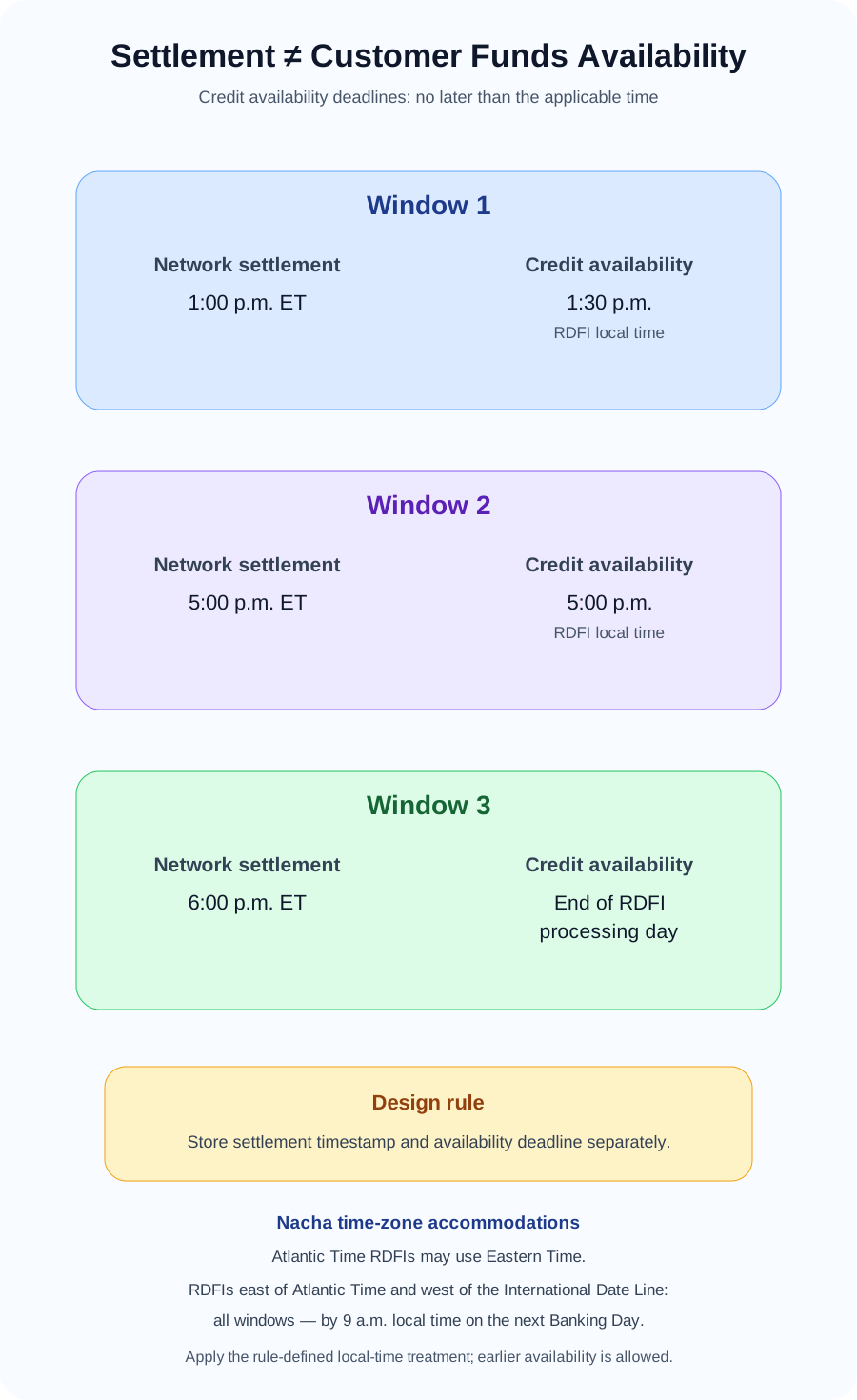
For Same Day credits, the availability requirement depends on the processing window.
For credits from the first Same Day window, funds are required to be available by 1:30 p.m. RDFI local time.
For credits from the second Same Day window, funds are required to be available by 5:00 p.m. RDFI local time.
For credits from the third Same Day window, funds are required by the end of the RDFI’s processing day, subject to the applicable rule provisions and time-zone accommodations.
These are latest-availability deadlines, not instructions to delay an earlier credit. Nacha provides specific time-zone accommodations: an RDFI using Atlantic Time may use Eastern Time; an RDFI east of the Atlantic Time Zone and west of the International Date Line must make Same Day credit funds available by 9:00 a.m. local time on the Banking Day after settlement, regardless of the Same Day window. The deadline engine must apply that treatment before converting a deadline to UTC.
This is why a product should not expose one hard-coded promise such as “Same Day ACH credits are always available at 5 p.m.”
Settlement and availability are different
A first-window credit may settle at 1:00 p.m. ET while the RDFI availability obligation is expressed in the RDFI’s local time.
Those are different clocks and different obligations.
A requirements document should therefore include both:
network settlement timestamp
and
customer funds availability deadline.
RDFI posting architecture matters
Some RDFIs post incoming ACH through near-continuous processing. Others process in scheduled internal batches.
Same Day ACH can require the RDFI to ensure its internal posting cycles are capable of meeting the funds-availability requirement for the relevant window.
If the ACH Operator file arrives but the deposit core does not process it until the next morning, the bank has an internal design problem even if network settlement worked correctly.
Debits have a different customer impact
For Same Day debits, the receiving account is being debited rather than credited. Funds availability rules for credits are therefore not simply mirrored onto debits.
The RDFI must apply the relevant debit-posting and return rules rather than treating every Same Day entry as a credit-availability event.
10. Dollar limits, future limit changes and product controls
The current Same Day ACH per-payment limit in 2026 is $1 million.
That limit applies per eligible Same Day ACH payment, not per file total. A corporate file can therefore contain many eligible entries as long as each entry satisfies the applicable rules and the bank’s product/risk controls.
The approved $10 million limit is future-effective
Nacha has approved an increase from $1 million to $10 million per payment effective September 17, 2027.
That date matters.
A 2026 system should not behave as though the $10 million limit is already in force. A forward-looking implementation can prepare configuration and testing for the 2027 change, but production eligibility remains governed by the current rule until the effective date.
Effective-dated limit configuration
A strong platform should not hard-code 1000000 into twenty services.
It should maintain an effective-dated rule such as:
2026-09-01 through 2027-09-16 → SDA general limit = 1,000,000
from 2027-09-17 → SDA general limit = 10,000,000
subject to future rule changes and SEC-specific constraints.
That allows the bank to test the boundary cleanly.
File total versus entry amount
A file worth $30 million can still contain Same Day entries if each entry is eligible and within the per-entry limit and the bank accepts the overall exposure.
That does not mean the bank should ignore file-level risk. A $30 million Same Day file can create a significant intraday settlement position even when every individual item is only $300,000.
The ODFI should therefore control both:
per-entry limit
and
customer/file/window exposure.
Product limits can be lower
A bank may set a $250,000 Same Day ACH limit for a certain customer segment even though the network allows $1 million. Another corporate may have a higher contracted limit within the network maximum.
Customer-facing channels should display the effective product limit, not only the network maximum.
Fee economics
Same Day ACH includes a Same Day Entry fee paid from ODFIs to RDFIs through ACH Operator billing. The established interbank fee has been 5.2 cents per Same Day entry, and Nacha’s 2026 review resulted in no change for the next review period.
A bank’s customer price can be different from the interbank fee. Customer pricing can reflect service design, value, risk and commercial policy.
The BA should not confuse:
network interbank Same Day fee
with
customer Same Day ACH price.
11. Statuses, acknowledgements and customer communication
Same Day ACH creates pressure for precise status language because customers expect fast updates.
A generic SUCCESS status is especially dangerous.
A strong status model separates:
RECEIVED
VALIDATED
SAME_DAY_ELIGIBLE
APPROVED
WINDOW_SELECTED
RELEASED_TO_OPERATOR
OPERATOR_ACCEPTED
SETTLED
RDFI_POSTING_UNKNOWN | POSTED where evidence exists
RETURNED
REVERSED
MISSED_WINDOW
ROLLED_TO_NEXT_DAY
The exact state names can vary. What matters is that each state has one defined business meaning.
“Sent” is not “settled”
If a customer sees “sent” immediately after bank release, the help text should explain what that means.
For example:
Sent to ACH — your payment has been released by the bank for ACH processing. Same-day settlement is expected in the selected window, subject to ACH processing.
That is more accurate than “payment completed.”
Expected settlement should be visible
A corporate treasury user benefits from seeing:
- selected Same Day window;
- expected settlement time;
- whether the operator has accepted the payment;
- whether settlement evidence has arrived;
- whether any entries were returned or downgraded.
This helps customers manage cash positions rather than guessing from a file-upload status.
Do not promise beneficiary posting without evidence
An ODFI may know the entry settled. It may not know exactly when every RDFI posted it to every Receiver account.
Customer language should therefore be based on evidence the bank actually possesses.
12. Exceptions: missed windows, ineligible entries, duplicate risk and operational recovery
Same Day ACH compresses exception handling into hours rather than days.
Missed window
A file is approved at 2:43 p.m. ET, but transmission does not complete by 2:45.
The bank needs a deterministic outcome.
Possible policy:
- attempt the 4:45 window if still eligible;
- if the third window cannot be met, route as next-day ACH with customer agreement;
- reject and ask the customer to decide;
- route to an alternative rail only if product rules explicitly allow it.
The system should not silently change settlement date without reporting the change.
Ineligible entry inside an eligible file
A customer submits 500 Same Day entries. One is an IAT and two exceed the current per-payment limit.
The bank must define whether the file is rejected or split.
If split processing is supported, the customer report should clearly identify:
497 same-day accepted
3 not eligible for Same Day
and what happened to those three.
Uncertain transmission and duplicate risk
One of the highest-risk operational moments occurs when the ODFI cannot tell whether the ACH Operator received the file.
The wrong response is a blind retransmission.
If the first transmission actually succeeded, resending the file can duplicate a Same Day population and leave very little time to recover before settlement.
Safe recovery should check:
- bank transmission logs;
- file ID/modifier and control totals;
- operator acknowledgements;
- support procedures;
- whether operator processing can confirm receipt;
- whether a controlled retransmission is required.
The principle is safe retransmission after uncertain delivery, not “retry until green.”
File-control errors
A Same Day file can fail because of file structure, batch control totals, routing data or other ACH format problems.
The compressed window means repair may not fit before the deadline.
Operations should know whether a technical repair can preserve Same Day status or whether the entry must move to the next window.
Internal outage
If the bank’s fraud service, ACH formatter or gateway fails near a Same Day deadline, business continuity needs a pre-agreed decision tree.
A contingency that requires ten manual approvals and two hours of data rebuilding is not useful for a 20-minute Same Day recovery window.
13. Returns, reversals and the boundary of same-day finality
Same Day settlement does not eliminate the ACH return framework.
This is a crucial misconception to remove.
An ACH credit or debit can settle Same Day and still have a later return or reversal event when the applicable rules permit it.
Chapter 11 owns the detailed return codes, timing, reversals and Notifications of Change. Chapter 10 only needs the boundary.
Same-day settlement is not irrevocable instant-payment finality
A Same Day ACH credit can settle today and later generate a return because the receiving account was closed or another valid return condition existed.
A Same Day debit can settle today and later be returned under the applicable return framework.
That means a customer-facing statement such as FINAL can be misleading.
Better language is:
Same Day ACH settlement completed
with separate tracking for later returns/reversals.
Same-day reversals
Nacha’s future $10 million rule explicitly preserves the utility of Same Day reversals by applying the increased limit to eligible credits and debits. That is an important design clue: reversals remain part of the ACH framework even when the original payment was Same Day.
A reversal should still be used only for permitted error correction—not as a generic cancellation after settlement.
Return impact on reconciliation
A payment that settled in the first window and returned the next day should not cause yesterday’s settlement record to be rewritten as “never settled.”
The correct lineage is:
original Same Day settlement
plus
later return financial event.
That preserves accounting truth.
14. Liquidity, accounting, reconciliation and reporting
Same Day ACH increases the importance of intraday liquidity because settlement happens multiple times during the banking day.
ODFI settlement liquidity
The ODFI may originate large Same Day credit populations that create debit settlement positions at 1:00, 5:00 or 6:00 p.m. ET.
The bank therefore needs to forecast Same Day exposure by window, not only by end-of-day total.
A treasury dashboard can show:
first-window expected debit position
second-window expected position
third-window expected position
actual settled position
variance
Chapter 55 later goes much deeper into liquidity. Here the key lesson is that Same Day timing creates intraday funding events.
Customer funding and settlement liquidity remain different
A corporate customer may be fully funded while the ODFI still needs settlement liquidity at the operator settlement time.
Conversely, the bank can have ample settlement liquidity but still refuse to originate because the customer lacks funds or approved exposure.
These are separate controls.
Accounting
Banks use different internal ledger models, so Chapter 10 should not invent a universal journal.
The control objective is that customer funding, ACH clearing/settlement and final account/GL positions reconcile across the correct settlement window.
Temporary clearing and suspense balances should be identifiable by window and age.
Reconciliation hierarchy
A strong Same Day reconciliation model connects:
customer file → bank payment population → Same Day eligibility → operator submission → window → settlement totals → individual trace → RDFI/return events → GL/customer reporting.
A mismatch can then be localized.
Examples:
Customer expected 1,000 entries but only 998 entered the Same Day file.
Operator accepted 998 but settlement totals reflect 997.
Settlement is correct but customer reporting still shows processing.
Each is a different break.
Reporting
Operations need Same Day reports by window, not only daily totals.
Useful measures include:
- entries and value submitted per window;
- accepted/rejected population;
- missed-window population;
- downgraded-to-next-day population;
- settlement totals and variances;
- returns/reversals linked to Same Day originals;
- processing latency by stage;
- customer cutoff breaches;
- manual interventions.
15. Controls, fraud monitoring, resilience and real-bank operating design
Speed changes the control problem.
A fraudulent or misdirected Same Day ACH credit can leave the ODFI within hours. A Same Day debit can accelerate collection before a weak authorization problem is discovered. Therefore faster processing should be accompanied by stronger timeliness of controls, not weaker controls.
2026 fraud-monitoring context
Nacha’s 2026 fraud-monitoring changes apply risk-based monitoring expectations across ODFIs, non-consumer Originators/TPSPs/TPSs and RDFIs according to the phased effective dates.
Same Day ACH is not a separate fraud rule, but it is a payment population where detection latency matters.
Useful signals include:
- first-time Same Day use by an Originator;
- unusual jump from standard ACH to Same Day;
- new beneficiary or account immediately before Same Day release;
- amount near the customer or network limit;
- unusual file count/value relative to history;
- manual cutoff override;
- repeated failed approvals followed by urgent release;
- unusual SEC/application mix;
- payment shortly after credential or beneficiary changes.
Sanctions and compliance controls
A Same Day payment still requires the bank’s applicable compliance processing. The existence and order of sanctions/AML controls can vary by institution and payment direction, but the bank should not skip them merely to meet a cutoff.
The practical requirement is to design enough processing margin that required controls complete before operator release.
Resilience
Critical components include:
- customer channel;
- file/API intake;
- authentication/entitlement;
- payment validation;
- fraud/risk services;
- funding/exposure services;
- ACH formatter;
- transmission gateway;
- operator connectivity;
- acknowledgement ingestion;
- settlement/reconciliation systems;
- receiving/posting systems for RDFIs.
A failure in any one can cause a missed Same Day window.
Observability
The bank should alert on missing expected events:
file expected but not received
released but no operator acknowledgement
operator accepted but settlement evidence missing
settlement completed but customer report not updated
RDFI file received but posting population incomplete
These are better controls than waiting for customer complaints.
Manual override governance
Cutoff overrides, limit overrides and forced reprocessing should be rare, authorized and fully auditable.
Operations should record:
- who approved the override;
- why;
- which payment population was affected;
- what risk was accepted;
- what final outcome occurred.
16. End-to-end cases, BA checklist and testing
The best way to confirm Same Day ACH understanding is to follow realistic cases.
Case 1 — emergency payroll in the first window
At 8:45 a.m. ET a corporate discovers that 75 employees were omitted from payroll.
The payroll processor creates a correction file. The corporate approves it by 9:25. The ODFI validates PPD data, checks funding and risk, confirms all entries are below applicable limits, assigns Same Day treatment and releases the file before its internal first-window cutoff.
FedACH receives the complete transmission before 10:30 a.m. ET. The target RDFI distribution is around noon ET and settlement is scheduled for 1:00 p.m. ET. First-window Same Day credit availability requirements then apply at the RDFI.
The customer dashboard should show the progression rather than jumping directly from upload to completed.
Case 2 — supplier file misses the second window
A corporate approves a $4 million supplier file containing 20 entries at 2:40 p.m. ET.
The bank’s internal second-window cutoff is 2:30. The system selects the third Same Day window instead of attempting an unsafe late transmission.
The corporate sees the new expected settlement time before release.
The operational lesson is that operator deadlines are not customer deadlines.
Case 3 — one entry over the limit
A file contains 200 entries. One is $1.2 million while the current Same Day limit is $1 million.
The bank’s product rule rejects that entry from Same Day treatment. Depending on product configuration, the file is either split or rejected for customer repair.
The system must not treat the future 2027 $10 million limit as current.
Case 4 — uncertain operator delivery
An ODFI sends a Same Day file near the third-window cutoff. The network connection drops after transmission begins. The gateway cannot tell whether the full file reached the operator.
Operations do not blindly resend.
They inspect file identity, transmission evidence, operator acknowledgements and support procedures. Only after confirming the correct state do they perform a controlled retransmission if required.
This protects against duplicate same-day origination.
Case 5 — Same Day debit later returned
A biller originates an authorized Same Day debit. It settles at 5:00 p.m. ET.
The next day the debit is returned under an applicable return condition.
Reconciliation retains both truths:
original Same Day settlement occurred
and
later return changed the financial outcome.
The bank does not rewrite history as though settlement never happened.
BA requirement checklist
A Same Day ACH requirement set should answer:
- Which customer products can originate Same Day ACH?
- Which SEC Codes/use cases are supported?
- How is Same Day intent captured?
- What current network exclusions are enforced?
- What is the current per-payment limit and how is it effective-dated?
- What lower product/customer limits apply?
- What are customer cutoffs for each window?
- What internal processing margin is required?
- How is the next feasible window selected?
- What happens if the selected window is missed?
- Can a file be split between Same Day and standard ACH?
- How are funding and exposure checked at release?
- What fraud/compliance controls must complete before release?
- How are operator acknowledgements captured?
- What states distinguish acceptance from settlement?
- How are first-, second- and third-window credit availability obligations supported at the RDFI?
- How are inter-operator items reconciled?
- What is the safe process for uncertain transmission?
- How are Same Day returns and reversals linked to originals?
- What reports are available by window?
- What evidence is retained for audit and investigation?
Testing checklist
Testing should cover more than one happy-path file.
Eligibility tests
Eligible credit below the limit.
Eligible debit below the limit.
IAT exclusion.
ENR exclusion.
Entry exactly at the current limit.
Entry one cent above the current limit.
Future-effective $10 million configuration must not activate before September 17, 2027.
Window tests
First-window success.
Second-window success.
Third-window success.
Customer submission just before internal cutoff.
Submission just after internal cutoff routes to next window.
Submission after third-window cutoff follows product fallback policy.
Weekend/holiday request.
Transmission tests
Complete file before operator deadline.
Transmission starts before deadline but completes after deadline.
Lost acknowledgement.
Uncertain delivery with safe retransmission procedure.
Duplicate-file protection.
RDFI tests
First-window credit funds available by the required time.
Second-window credit availability.
Third-window end-of-processing-day availability.
Receiving account closed.
Posting service outage and controlled recovery.
Reconciliation tests
Customer totals equal operator totals and settlement totals.
One entry rejected before submission.
One entry moved to a later window.
One entry returned later.
Settlement evidence delayed but payment identity preserved.
Operational tests
Fraud service outage near cutoff.
Funding service stale decision.
Manual override with audit trail.
Customer reporting delay.
Processor/gateway failover.
The final practitioner test
A person who understands Same Day ACH should be able to answer this without hesitation:
What changed because the payment was Same Day, and what remained ordinary ACH?
The answer is:
The payment received accelerated same-banking-day processing and settlement through one of the defined Same Day windows, with associated eligibility, limit, funds-availability and operational requirements. But it remained an ACH entry with the same underlying participant roles, SEC/application meaning, authorization framework, operator processing, settlement-account model, return/reversal framework, reporting and reconciliation responsibilities.
That distinction is the heart of Chapter 10.
Authoritative references
This application uses JavaScript for the full interactive experience. This text summary is served for accessibility and search indexing.