RTP Credit Transfers. A practitioner deep dive into RTP credit transfers from customer authority and pacs.008 creation through receiving-bank pacs.002 decisions, final prefunded settlement, immediate availability, timeouts, recovery, reconciliation, reporting, controls and 24x7 bank operations.
The RTP® network is often introduced with one sentence: money moves in seconds, twenty-four hours a day. That is useful for a customer, but it is far too small a description for someone who has to design, build, test, operate, reconcile or investigate an RTP payment inside a bank.
An RTP credit transfer is a tightly controlled chain of customer authority, bank validation, network messaging, receiving-bank response, interbank settlement, beneficiary availability, accounting evidence and operational truth. The payment is a credit push. The sending customer instructs its bank to send USD to a receiver at another participating financial institution. The sending participant creates the RTP payment message, The Clearing House RTP System validates and routes it, the receiving participant decides whether to accept, accept without posting in narrowly defined circumstances, or reject, and the network settles the accepted payment through its prefunded model.
At the 5 October 2026 audit, The Clearing House document library labels the 30 September 2026 RTP Operating and Participation Rules as current and separately lists an October 4 package as upcoming, while the October 4 Operating Rules PDF states that its changes are effective October 4, 2026 (except OBO changes effective March 31, 2028). This operator-library/PDF labeling conflict must be resolved with the operator for production configuration; this chapter does not treat the June 1 baseline as current. The October 4 package states a $10 million per RTP Payment general network limit, with lower sending-participant limits permitted. The network operates continuously rather than around banking cut-off windows.
This chapter focuses only on the RTP credit transfer itself. Chapter 21 already established the wider U.S. instant-payment landscape and common bank architecture. Chapter 23 will deep-dive FedNow credit transfers. Chapter 24 owns Request for Payment. Chapter 25 owns the deeper cross-rail treatment of reachability, liquidity, limits and fallback routing. Chapter 26 owns the broader instant-payment exception, fraud and return-of-funds operating model. Here, the purpose is to understand RTP credit transfers so completely that a Business Analyst can specify them, an architect can place them correctly, a developer can implement the state machine, a tester can challenge failure paths, and operations can reconstruct any payment from evidence.
For a roughly 60-minute core session, spend about 35 minutes on Sections 2–4, Sections 6–10 and Sections 12–14. For the next 10 minutes, use the chapter’s three diagrams to connect receiver responses, final settlement and RTP funding evidence. Use 10 minutes to work through one case in Section 16, then spend the final 5 minutes explaining: How would you explain a settled payment whose customer posting still needs operational attention? Treat these timings as a study guide. The remaining sections, additional cases and extended reference material are follow-up study; completing the whole chapter takes longer.
Chapter navigator
- What an RTP credit transfer is
- Participants, accounts and RTP-specific roles
- Eligibility, payment types, amount limits and prohibited use
- Customer initiation and the sending-bank admission decision
- RTP payment data, identifiers and pacs.008 construction
- Sending participant release and RTP System processing
- Receiving participant validation and response logic
- Accept, reject and accept-without-posting
- Settlement, prefunding and financial finality
- Beneficiary posting, immediate availability and customer display
- Statuses, pacs.002, acknowledgements and payment truth
- Timeouts, duplicate prevention, unknown states and safe retry
- Returns, recovery and post-settlement correction
- Accounting, reconciliation, reports and cash visibility
- Controls, resilience, 24x7 operations and change governance
- End-to-end cases, BA checklist, testing and authoritative references
1. What an RTP credit transfer is
An RTP credit transfer is a transfer of value from a Sender to a Receiver through the RTP System pursuant to an RTP Payment Message. The rules define the payment instruction as an instruction by the sender to the sending participant to cause the receiving participant to pay a fixed amount of money denominated in U.S. dollars to the receiver.
That wording matters. The network is not a pull mechanism where a collector reaches into another customer’s account. It is not a deferred-net batch. It is not simply an API notification saying a payment may happen later. It is a real-time credit push in which the customer’s sending institution submits a payment message to the RTP System and the receiving institution responds in real time.
The current RTP Message Specifications Version 5.0 identify the principal customer credit-transfer message as pacs.008.001.08 FIToFICustomerCreditTransferV08. The immediate message-status response is pacs.002.001.10 FIToFIPaymentStatusReportV10. Other RTP messages can support the payment journey—such as requests for information, payment acknowledgements, stand-alone remittance advice, status requests and requests for return of funds—but the credit transfer is the value-moving event.
A useful bank mental model is:
customer instruction → bank admission → immutable RTP payment → pacs.008 → RTP validation/routing → receiving participant decision → pacs.002 outcome → RTP settlement → beneficiary availability → customer status → reconciliation.
The word immutable is important. The current RTP Operating Rules state that a payment message cannot be cancelled or amended by the sending participant once it has been sent to the RTP System. There is a system timeout mechanism, and there are later return/recovery mechanisms, but there is no traditional “pull it back from the queue and edit it” concept after release.
This is why RTP implementation quality depends on strong controls before submission. In a batch system, a bank may have minutes or hours to repair a malformed instruction. In RTP, the design goal is to make the customer instruction complete, authenticated, validated and safe before the rail adapter releases the payment.
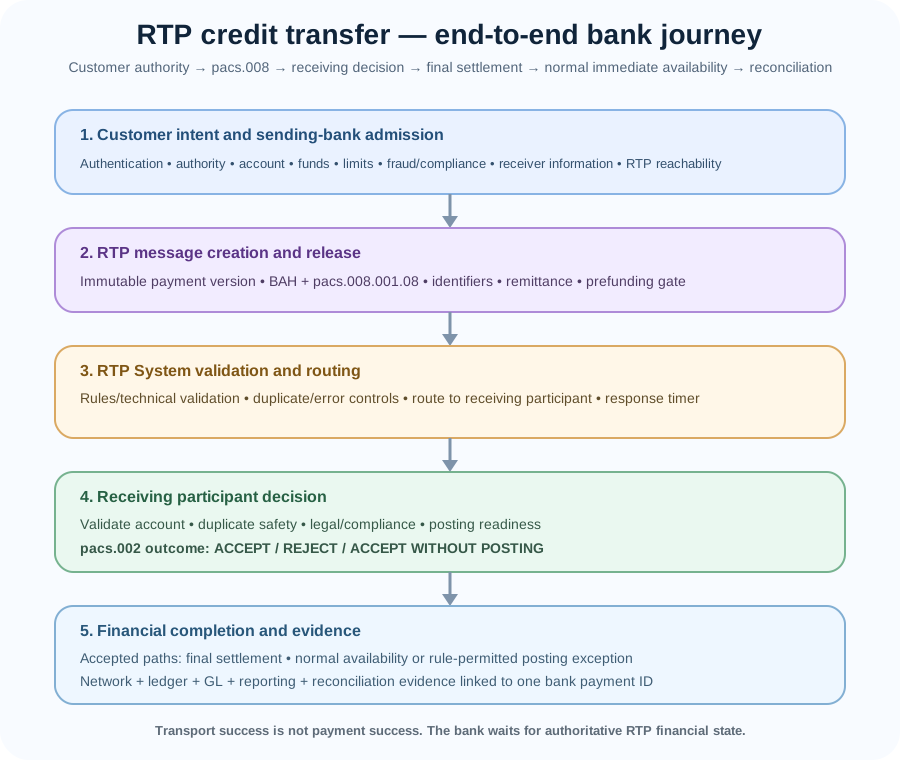
The five truths of one RTP payment
A single payment has at least five truths that should never be collapsed into one generic status.
Customer truth answers what the sender and receiver have been told.
Bank processing truth answers what the sending and receiving banks have admitted, validated and posted.
Network truth answers what the RTP System accepted, rejected, timed out or settled.
Ledger truth answers what happened to the sender and receiver account balances and to internal accounting.
Reconciliation truth answers whether network, settlement and books agree.
A bank can have a network-accepted transaction but still have a delayed customer notification. It can have a network timeout before settlement while its customer channel is still waiting. It can have an accept-without-posting outcome where settlement has occurred but funds are not yet available because the receiving institution is conducting the limited legal/compliance review permitted by the rules. These are different truths, and the system must retain them separately.
2. Participants, accounts and RTP-specific roles
The simplest RTP credit transfer has four economic actors: sender, sending participant, receiving participant and receiver. The operational chain can contain more.
The Sender is the titled owner of the account from which the RTP Payment is instructed, subject to the specialized payment models recognized in the rules. The Sending Participant holds the sender’s account and initiates the RTP Payment. The Receiving Participant holds the receiver’s account and receives the Payment Message. The Receiver is the customer whose account is designated for receipt of the payment.
A participant is a depository institution that has entered the required RTP participant agreement. A bank may connect directly or may use a third-party service provider for technical connectivity. Funding can also be organized differently. A participant may be a Funding Participant, or it may be a Non-funding Participant using an approved Funding Manager or Funding Provider arrangement. These distinctions matter because the customer payment can look identical while treasury and settlement responsibilities differ materially.
A Funding Participant is able to fund the RTP prefunded balance arrangement and manages its own relevant position. A Non-funding Participant participates but relies on a funding arrangement. A Funding Agent can support one or more non-funding participants by managing settlement funding. The current rules also distinguish Funding Managers and Funding Providers, each with specific responsibilities.
The bank should not represent all of this with one field such as rtp_participant=true. A real participant profile needs attributes such as:
participant_role
send_enabled
receive_enabled
funding_model
funding_agent_or_provider
connection_model
service_provider
active_routing_numbers
message_version
effective_from
operational_status.
Receive-only is a real implementation stage
Many institutions enter RTP by becoming receive-capable first and later enable sending. This is a practical implementation strategy because receiving still requires real-time network connectivity, validation, posting, customer availability, reconciliation and operations, but it avoids the full outbound customer-authority and prefunding burden at the initial stage.
That approach is visible in real industry implementations. A bank’s roadmap can therefore include:
Phase 1 — receive RTP payments.
Phase 2 — send controlled internal use cases.
Phase 3 — expose sending to broader retail, small-business or corporate customers.
This is not a network requirement; it is an implementation strategy. The BA must distinguish what the network permits from what the bank chooses to launch.
OBO and payment transparency
Current RTP rules include On Behalf of (OBO) Payment concepts. An OBO Payment is sent by a Sender to make a payment for another Person, the Payer. This introduces additional party transparency requirements. The current payment-transparency rules require appropriate identification of the Sender, Payer and, where applicable, the Initiating Customer using the designated ISO 20022 fields.
This matters to Chapter 22 because the credit-transfer message is not merely “debit account + credit account + amount.” Party semantics drive legal, compliance, screening and operational understanding. A bank that flattens Sender, Payer and Initiating Customer into one generic originator field can lose material information.
The deeper product/service-provider policy belongs to the applicable rules and later chapters, but the credit-transfer implementation must be capable of carrying and preserving the correct party structure.
3. Eligibility, payment types, amount limits and prohibited use
The current RTP Operating Rules establish clear boundaries around an RTP Payment.
An RTP Payment is denominated in U.S. dollars. The current general transaction limit is $10,000,000 per RTP Payment. Sending participants may impose lower limits for their customers. Receiving participants may not impose a lower network transaction limit on receivers as a condition of receipt.
That produces several distinct limit layers inside a bank:
network limit — the RTP maximum;
bank product limit — what the institution allows for a product or customer segment;
customer limit — the specific entitlement or agreement for the sender;
channel limit — what mobile, online, corporate API or other channels permit;
risk limit — dynamic controls based on account, recipient, behavior or fraud risk;
funding/liquidity limit — what the bank can actually release while maintaining its prefunded position.
The effective permitted amount is usually the lowest applicable limit.
No fee netting from principal
The current rules prohibit participants from reducing the principal amount of an RTP Payment as a means of collecting fees. A bank can separately charge customers according to its product terms, but it should not convert a $10,000 payment instruction into a $9,990 interbank principal because it wants to net a $10 fee from the amount.
This is operationally important. Reconciliation should compare the RTP principal amount to the intended payment principal, not to a net-of-fee amount unless the customer instruction itself and applicable product/accounting design create separate ledger entries.
Domestic scope
The RTP System is for U.S. domestic RTP Payments between accounts located in the United States under the rules. A payment may involve richer party structures or service-provider contexts, but the bank should not treat RTP as a generic cross-border rail merely because the ISO 20022 data model can carry international-looking addresses or party information.
No searching for accounts
Current rules prohibit using RTP Payment Messages merely to search for accounts. An account number can be validated in the permitted context, but a bank should not generate speculative payments to discover which accounts exist.
This is an important fraud and privacy boundary. A customer-facing “is this account real?” experience must be designed using permitted validation or directory methods and must not disguise account enumeration as payment traffic.
Typical RTP credit-transfer use cases
RTP supports a broad set of legitimate credit-transfer use cases, including consumer account-to-account movement, P2P-backed bank propositions, supplier payments, treasury payments, insurance disbursements, merchant/network settlement, brokerage-to-bank transfers, wallet funding/cash-out arrangements and other business disbursements.
The credit-transfer mechanics are shared, but the admission rules differ. A corporate cash-concentration transaction might require dual authorization and high-value treasury controls. A consumer A2A payment may need device and new-payee controls. An insurance payout may need claim-reference reconciliation. A merchant settlement may need platform-to-bank correlation IDs. The network payment is the same family; the customer product is not.
4. Customer initiation and the sending-bank admission decision
The RTP payment begins before any RTP message exists.
A customer may initiate through mobile banking, internet banking, corporate online banking, an API, a treasury workstation, an embedded-finance interface or a controlled internal bank process. The bank should normalize those different channels into one internal payment object before constructing the network message.
The admission decision answers a simple but critical question:
Is the bank willing and able to create this RTP Payment now?
The answer requires more than sufficient balance.
Authentication and authority
The current RTP rules require sending participants to use authentication/authorization controls that meet applicable RTP risk requirements, including multi-factor authentication in the circumstances required by the Risk Management and Fraud Control Requirements Schedule. Fraud and risk-screening measures must be available continuously because RTP operates continuously.
For consumer channels, useful evidence includes authenticated customer ID, device ID, session risk, authentication method, payee relationship age and confirmation timestamp.
For corporate channels, useful evidence includes corporate customer ID, operator ID, account entitlement, transaction entitlement, approval policy, maker/checker evidence, API credential or certificate identity, and release timestamp.
The payment hub should not receive a naked instruction that says only “send $50,000.” It should receive the authority context proving why the bank is entitled to act.
Account and funds checks
The sending bank validates that the account exists, is open and eligible, belongs to or is properly controlled by the sender, and has sufficient available funds or permitted credit under the product design.
In a real implementation there is a subtle question: when does the bank reserve or debit the sender?
Some banks reserve funds before RTP submission and finalize the debit after authoritative network success. Others may post a debit at a defined state with compensating logic for a network rejection or timeout. The exact ledger pattern is bank-specific, but the design must prevent both overdrawing and double debiting.
A robust pattern is:
AVAILABLE → FUNDS_RESERVED → RTP_SENT → RTP_SETTLED → DEBIT_FINALIZED.
If the network rejects or times out without settlement, the reservation is released according to the bank’s controlled state machine.
Recipient information and consumer receiver-name display
The current RTP rules include specific requirements for consumer-originated RTP payments relating to receiver-name information associated with the routing information provided by the sender. The RTP Customer Display Requirements effective for credit transfers from July 1, 2026 also define what information is required, optional, restricted or internal for customer display.
This should not be simplified into “the network validates beneficiary name.” The receiving participant may rely on the receiver account number identified in the Payment Message and is generally not obligated under the RTP rules to confirm consistency between receiver name and account number. The sending customer experience, directory/alias logic and customer display requirements are separate control layers.
The BA should therefore specify exactly:
- where receiver information comes from;
- whether it comes from customer input, directory resolution, prior payee data or RfP data;
- what name is displayed to the sender;
- what the customer confirms;
- what gets carried into the RTP message;
- what evidence is retained.
Fraud, sanctions and payment transparency
Before RTP submission, the sending bank performs the fraud, financial-crime and payment-transparency controls required by its policy and applicable law/rules.
The current RTP rules require fraud and risk screening prior to submission. Current 2026 payment-transparency guidance also emphasizes correct use of legal names and party fields. For standard RTP Payments, the legal name of the Sender is expected in the debtor name field. OBO Payments require the additional party transparency described in the applicable rules.
The important design principle is that risk and transparency decisions happen before the irrevocable external payment state.
5. RTP payment data, identifiers and pacs.008 construction
The current RTP Message Specifications Version 5.0 use ISO 20022 message structures. The value-moving customer credit-transfer message is pacs.008.001.08.
The RTP message is not just a set of customer fields. It is a structured network instruction with routing, party, amount, account, identification and remittance data that must satisfy RTP-specific usage rules.
Business Application Header and business payload
RTP messages are constructed from a Business Application Header (BAH) and the business payload. The BAH supports point-to-point routing and message characteristics. The pacs.008 payload carries the credit-transfer business information.
A bank may maintain a canonical internal model that is not identical to pacs.008. That is good architecture if the mapping is controlled. The rail adapter then transforms canonical fields into the RTP-required structure.
The danger is losing semantics during translation. A source channel may call a field payerName, while the RTP message needs to distinguish debtor, ultimate debtor, initiating party, creditor and ultimate creditor depending on the payment model. The mapping must preserve business meaning, not just data type.
Identifiers that matter operationally
The exact RTP message contains multiple identifiers. A bank should retain them rather than overwrite them with one “transaction ID.”
Operationally important identifiers can include:
bank payment ID — created internally at customer admission;
channel/customer reference — what the sender recognizes;
message ID — identifies the point-to-point message;
instruction ID / transaction ID — identifies the transaction in the payment chain;
End-to-End ID — customer/business correlation where applicable;
UETR — a UUID-format payment reference carried in the message model;
network/system references — network evidence returned during processing;
ledger posting IDs — debit/credit accounting evidence;
case or return IDs — later recovery/investigation correlation.
The relationship among these IDs should be modeled as a correlation graph.
Amount and settlement information
For RTP, the instructed interbank payment amount is in USD. The bank should retain both customer instructed amount and RTP settlement amount even if they are normally equal, because doing so makes future reconciliation explicit and prevents accidental reuse of multi-currency assumptions from cross-border architectures.
Remittance information
ISO 20022 allows richer remittance than legacy payment formats. The current RTP message model supports structured and unstructured remittance elements according to its specifications, and a stand-alone remittance advice message is also defined for additional information outside the normal pacs.008 content.
This matters particularly for B2B, invoice and receivables use cases. The receiver should be able to correlate money with the commercial obligation without relying on manual matching by amount and date.
A bank should therefore protect remittance data through the entire path:
customer input → canonical payment → pacs.008 → receiving-bank event → customer reporting → reconciliation/cash application.
6. Sending participant release and RTP System processing
Once the bank has admitted the payment and built a valid pacs.008, the rail adapter prepares to release it.
The current RTP Operating Rules require the sending participant, before submitting a Payment Message, to satisfy its applicable prefunded requirement, ensure the Payment Message complies with the rules and technical specifications, and meet other sending-side prerequisites.
The release decision should therefore combine four final gates:
financial gate — funds/reservation and RTP funding position are sufficient;
control gate — fraud/compliance/limits/authority are complete;
data gate — required RTP message data and identifiers are valid;
connectivity gate — RTP participant, route and service state allow submission.
Only after all four are true should the bank mark the payment RELEASE_READY.
What the RTP System does
After receiving the Payment Message, the RTP System validates the message against applicable rules and technical requirements. TCH may reject messages that do not comply and may refuse to process transactions that appear erroneous, including apparent duplicates.
The system then routes the Payment Message to the receiving participant and waits for the required real-time response.
The payment is not settled simply because the sending bank successfully transmitted an HTTP/API or MQ request to its gateway. The authoritative external state depends on the RTP System processing and receiving participant response.
This is one of the most important implementation rules in the chapter:
transport success is not payment success.
A 200 response from an internal API can mean only that the payment hub accepted the request. A successful network socket write can mean only that bytes left the bank. A bank should tell the customer “completed” only after the defined RTP financial state is achieved.
7. Receiving participant validation and response logic
The receiving participant is not a passive mailbox. It has immediate responsibilities.
The current RTP rules require a receiving participant to respond to a Payment Message within the timeframe established in the technical specifications. It may not create a cut-off that pushes the payment into another day or delays required funds availability.
The receiving bank must determine whether it can accept the payment for the identified receiver account.
The rules provide a general acceptance expectation for conforming Payment Messages, subject to permitted reasons such as the receiver account being closed, invalid, monitored for suspected fraud/illegal activity, not qualifying as the required account type, customer instructions not to accept specified RTP payments, or legal/regulatory compliance constraints.
A receiving-bank decision engine
A practical receiving sequence is:
1. Message authenticity and schema validation. Is the received message valid and from the trusted RTP connection?
2. Participant/routing validation. Is this institution and endpoint the intended receiving participant?
3. Duplicate/idempotency check. Has this network message/payment already been processed?
4. Account lookup. Does the receiver account exist and meet RTP eligibility?
5. Account status. Is it open and allowed to receive?
6. Legal/compliance/fraud checks. Is there a permitted reason to reject or use accept-without-posting?
7. Posting readiness. Can the bank post and make funds available immediately if it accepts?
8. Response creation. Send accept, accept without posting where specifically permitted, or reject with the most appropriate reason.
A receiving bank should complete these steps deterministically and within the network response window. Manual repair is not the normal path for an ordinary RTP credit transfer.
Relying on account number
The current RTP rules state that a receiving participant may rely on the receiver account number in the Payment Message and is not obligated under the RTP rules to confirm consistency between name and account number. This is a critical legal/operational boundary.
It does not mean beneficiary-name quality is irrelevant. It means the bank must understand where receiver-name confirmation belongs. The customer experience, directory, sender confirmation, fraud controls and payment-transparency requirements are separate from the receiving participant’s account-number reliance rule.
8. Accept, reject and accept-without-posting
The receiving participant’s response is one of the most important state transitions in RTP.
Accept
An accept response means the receiving participant accepts the Payment Message and will provide immediate funds availability to the receiver. Upon the system’s acknowledgement of the receiving participant’s accept response, the receiving participant must make the funds available to the receiver identified by the account number in the accepted message.
For a bank system, ACCEPT therefore means more than “message is syntactically valid.” It creates a firm obligation to complete receiving-side availability.
Reject
A reject means the receiving participant has rejected the Payment Message. The RTP System then notifies the sending participant. The receiving participant must use an appropriate reason consistent with the applicable specifications.
A reject is a pre-settlement failure state for the original payment. The sending bank should not treat it as a settled payment that needs a return. Instead, the sender’s reserved funds can be released/adjusted under the internal ledger design and the customer can receive a truthful failure status.
Accept without posting
Accept without posting is intentionally narrow and should never become a generic repair queue.
Under the current rules, it is available when the receiving participant needs additional time to review the RTP Payment for legal or compliance purposes, or in a specified return-to-closed-account situation following a request for return of funds where the receiver has another account or a replacement account is being established and immediate availability cannot yet be provided.
For a new payment to a closed account, the rules indicate that the receiving participant should reject rather than use accept without posting.
The most important technical nuance is this:
A Payment Message accepted without posting is immediately and finally settled under the RTP settlement rules even though funds have not yet been made available to the intended receiver.
That means the receiving bank now holds a financial obligation that cannot be treated as if the original payment never settled.
If the receiving participant later determines it cannot make the funds available, it must promptly refund the payment unless legally prohibited. If it is a sending participant, the refund is made through a new Payment Message that references the original RTP Payment. If it is receive-only, it must use another payment mechanism and preserve the original payment identification in accordance with that mechanism’s specifications. That is a new value event, not a reversal of the original settlement.
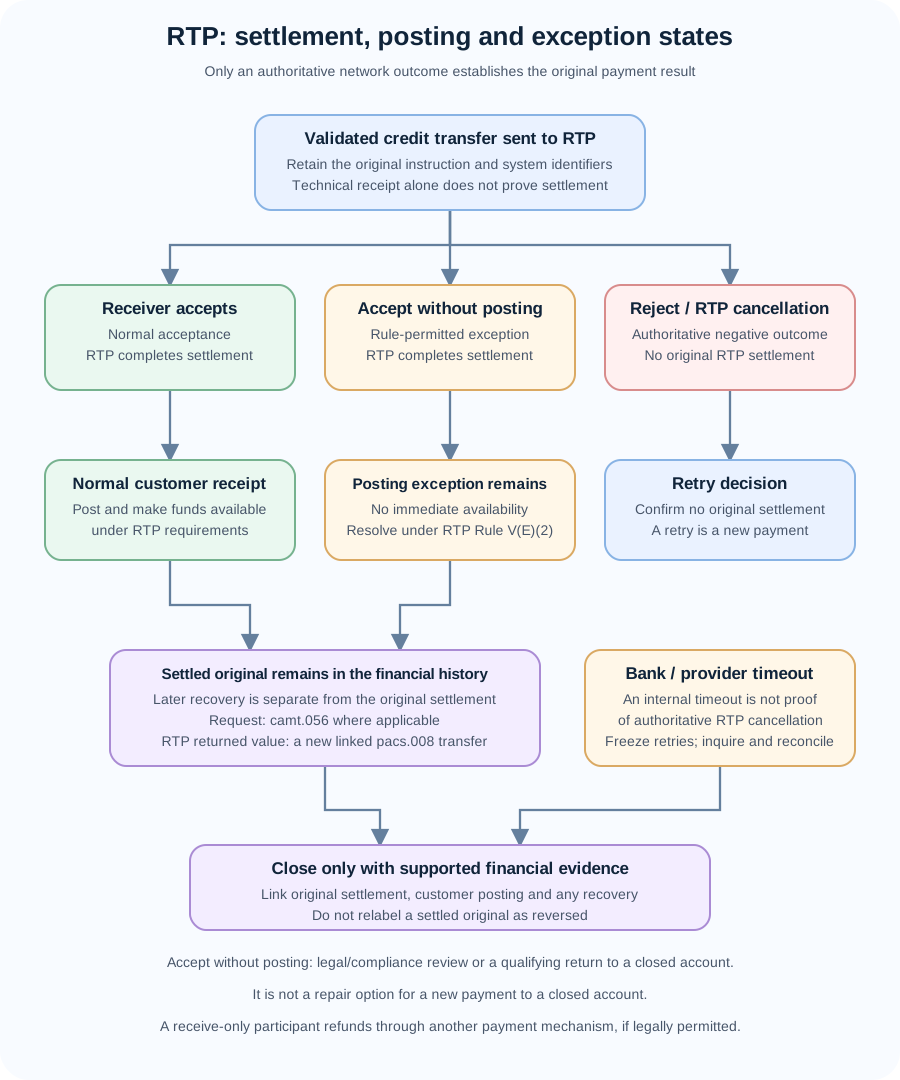
9. Settlement, prefunding and financial finality
RTP settlement is not deferred until an overnight net cycle. The network is built around a prefunded settlement model supporting continuous operation.
The current RTP rules define a Prefunded Balance Account, a special deposit account maintained for the joint benefit of relevant funding participants/funding agents and used to support RTP activity. Sending participants with funding obligations must satisfy their prefunded requirement before they can originate RTP Payments.
The rules allow funding through Fedwire and, for enabled participants/funding agents, through the FedNow Liquidity Management Transfer service subject to the applicable RTP and Federal Reserve procedures.
Current prefunded position
The RTP System continuously records the relevant positions. The bank treasury function therefore needs near-real-time visibility into:
- opening prefunded position;
- current prefunded position;
- payment sends reducing available position;
- receipts increasing position;
- prefunded requirement;
- excess liquidity;
- expected peak outflows;
- funding/disbursement activity;
- reconciliation-window position.
The detailed multi-rail liquidity design belongs to Chapter 25, but Chapter 22 must make one RTP-specific point explicit: outbound credit-transfer capability depends on usable prefunded capacity.
Settlement trigger
The sending participant becomes obligated to pay the amount of the Payment Message when the receiving participant sends an accept or accept without posting payment-status response. The obligation is satisfied when the payment is settled under the RTP settlement rules.
This creates a precise financial boundary for the bank’s state model.
Before the qualifying receiving response, the transaction may still reject or time out without settlement.
After settlement, the bank must treat the original payment as final and irrevocable. Any later movement back is a new payment/recovery event, not a deletion of settlement history.
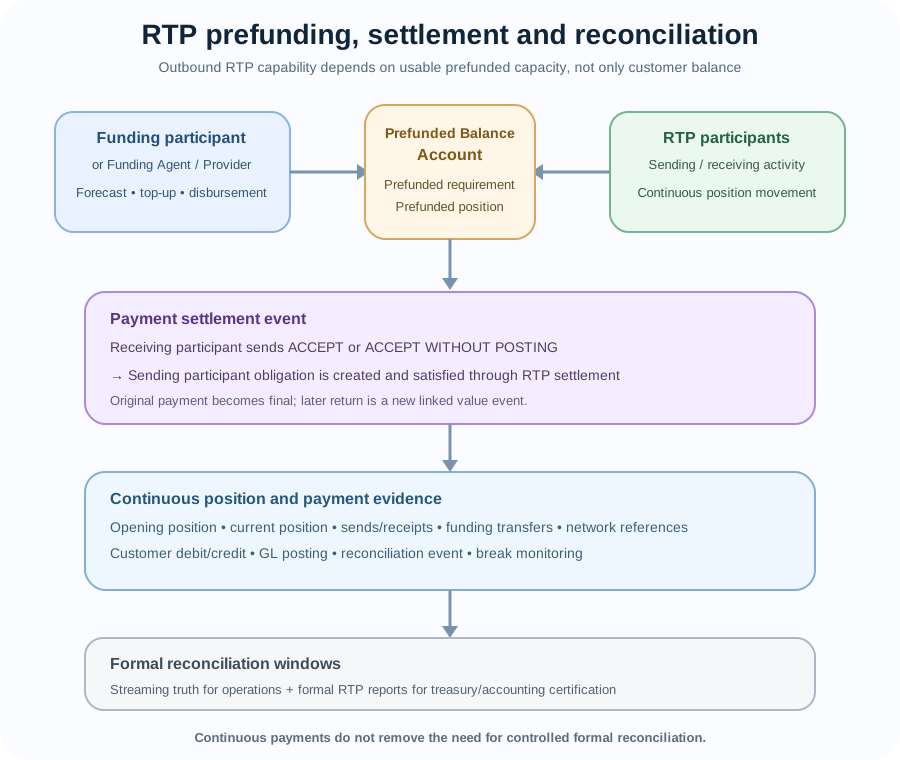
Funding Participant versus Non-funding Participant
A Funding Participant handles its relevant funding obligations under the RTP model. A Non-funding Participant can operate through approved funding arrangements. The customer should not need to understand this, but operations and treasury absolutely must.
A participant using a Funding Agent must have clear ownership for:
funding forecast
position monitoring
top-up trigger
weekend/holiday coverage
funding incident escalation
reconciliation report ownership
contractual SLA with funding agent.
Without that operating model, “24/7 payments” can depend on an undefined manual treasury process.
10. Beneficiary posting, immediate availability and customer display
A receiving participant that sends an accept response must make the funds available to the receiver as required by the RTP rules once the RTP System acknowledges receipt of the accept.
This is stronger than simply posting a pending credit. The customer promise is immediate availability, subject only to the narrow exceptions recognized in the rules.
Duplicate-safe posting
The receiving bank must guarantee that redelivery, internal retry or repeated event consumption cannot credit the beneficiary twice.
A safe inbound posting model uses an idempotency key derived from durable RTP identifiers and stores the result of the first posting attempt.
Conceptually:
IF rtp_payment_id already posted → return existing posting result
ELSE validate → post once → persist ledger reference → respond.
The ledger service and RTP adapter should agree on which identifier is authoritative for idempotency. A generic API request ID generated anew on every retry is not enough.
Customer display
The current RTP Customer Display Requirements Version 5.0 distinguish fields that are required, optional, restricted or internal for display. For example, customer-facing receiver name and related party information have specific display treatments depending on message context.
A bank should therefore avoid simply rendering raw ISO 20022 XML on statements or mobile screens. It should map RTP business data to controlled customer labels such as:
From
To
Amount
Date/time
Payment reference
Message/remittance
Status
while preserving all detailed RTP identifiers internally for servicing.
Notification is not posting
Push notification, SMS, email or app status is downstream of financial truth. If a notification service is unavailable, the beneficiary credit must not be rolled back. If the customer opens mobile banking, the balance and transaction history should reflect ledger truth even if the alert failed.
11. Statuses, pacs.002, acknowledgements and payment truth
The RTP message set uses pacs.002.001.10 as the Message Status Report for credit transfers and other supported message interactions.
For the credit transfer, the bank should distinguish at least three status layers:
message status — was a specific message accepted, rejected or otherwise responded to by the network?
payment status — what is the financial state of the credit transfer?
customer status — what simple wording should the customer see?
These are related but not identical.
Internal state model
A bank-grade internal state model might include:
CAPTURED
AUTHORIZED
VALIDATED
FUNDS_RESERVED
RISK_APPROVED
RTP_RELEASE_READY
RTP_SENT
RTP_NETWORK_VALIDATED
RECEIVER_ACCEPTED
RECEIVER_ACCEPTED_WITHOUT_POSTING
SETTLED
BENEFICIARY_AVAILABLE
REJECTED
TIMED_OUT
UNKNOWN_INTERNAL
RETURN_REQUESTED
RETURN_PAYMENT_RECEIVED
RECONCILED.
Do not expose that entire vocabulary to a customer. The customer might see only:
Processing
Completed
Could not be sent
Under review
with carefully controlled wording for exceptional states.
Payment acknowledgement
RTP also defines a Payment Acknowledgement message (camt.035.001.05) that can communicate acknowledgement by the receiver of a payment. This is not the same as the receiving participant’s initial accept status that drives settlement.
The bank should preserve the distinction between “the receiving bank accepted the payment” and “the receiver/customer acknowledged it.”
Status request
The RTP technical message set includes a pacs.028.001.03 FIToFIPaymentStatusRequest for requesting status about a credit transfer or other supported message. This is an operational tool and should not become a substitute for a reliable event/state architecture. A healthy bank should normally know the payment state from the original message exchange, using status requests when investigation or recovery requires it.
12. Timeouts, duplicate prevention, unknown states and safe retry
Timeout handling is where many payment implementations become dangerous.
The current RTP rules define an RTP System timeout. If the receiving participant fails to respond to a Payment Message within the timeframe established by the technical specifications, TCH cancels the Payment Message and notifies the sending and receiving participants. A cancelled Payment Message may be resubmitted only as a new Payment Message meeting the applicable requirements.
The RTP Message Specifications describe the system timeout and use camt.056 as the system timeout notification to the receiving participant in the applicable flow. The timeout reason code DS24 is reserved for the RTP System timeout message.
The sending bank therefore needs to separate two very different situations.
Case A — authoritative RTP timeout/reject received
The bank has evidence that the original RTP Payment did not settle. It can move the original instruction to a terminal failure/timeout state, release or correct any sender reservation according to ledger design, and allow the customer to initiate a new payment if appropriate.
Case B — internal connectivity timeout before authoritative RTP outcome is known
Suppose the bank sends to its RTP gateway but loses the connection before it receives the external outcome. The bank must not assume that the RTP System timed out the payment.
This is an internal unknown state.
The bank should query/reconcile the network or processor state using the permitted operational mechanisms before resubmitting. Otherwise it can create two distinct RTP Payments for one customer intent.
Duplicate prevention
Duplicate safety belongs at several layers:
channel idempotency — repeated button click or API retry should not create a second customer payment;
payment hub idempotency — repeated inbound command should resolve to the same bank payment ID;
rail adapter idempotency — message generation must not create a new RTP instruction accidentally;
receiving posting idempotency — repeated technical delivery must not create a second customer credit;
return/recovery linkage — a recovery payment must be deliberately new and linked to the original rather than mistaken for a duplicate.
The RTP System can identify apparent duplicate/error transactions under its controls, but the bank cannot outsource its own duplicate prevention to the network.
13. Returns, recovery and post-settlement correction
An RTP credit transfer should be assumed irrevocable after settlement. The sending participant has no right to cancel or amend the Payment Message after it has been sent to the RTP System, apart from the RTP System’s own timeout cancellation mechanism before settlement.
If a sender later says “I sent it to the wrong person,” “I entered the wrong amount,” “my account was taken over,” or “I was tricked by a scammer,” the bank is now in recovery territory.
Request for Return of Funds
The RTP message set uses camt.056.001.08 for Request for Return of Funds and certain system-timeout/RfP-cancellation use cases. The receiving participant’s response to a Request for Return of Funds uses camt.029.001.09 in the current message specification.
Importantly, if the receiving side agrees to return funds, the value comes back through a new credit transfer rather than by reversing the settled original payment. The message specification shows a new pacs.008 as the positive-value return payment linked to the original identifiers.
This protects financial history:
Original RTP Payment = settled and retained
Return request = investigation message
Return payment = new RTP Payment linked to original.
Fraud reporting in 2026
The current RTP Compliance Bulletin 1-2026 requires participants to report certain fraudulent RTP-native payment activity through RTP System Message Reports using Request for Return of Funds (camt.056) with the specified reason codes.
Unauthorized RTP-native payments are reported using FRAD. From March 31, 2026, fraudulently induced RTP-native payments under false pretenses use UAPA, except where the RfP warranty claim prerequisites require the applicable UPAY treatment.
This is exactly why a bank should not use one generic reason FRAUD. Fraud taxonomy affects network reporting, operations, analytics and recovery.
Chapter 26 will go much deeper into fraud, return-of-funds and investigation workflows. Chapter 22’s required lesson is that post-settlement correction is a linked new process, never mutation of the original RTP financial truth.
14. Accounting, reconciliation, reports and cash visibility
A completed RTP credit transfer is not operationally complete until the bank can prove it financially.
The sending bank needs to reconcile:
customer instruction
customer debit/reservation
pacs.008
RTP outcome
settlement position movement
fees if separately charged
GL entries
customer reporting.
The receiving bank needs to reconcile:
received pacs.008
response
settlement position movement
beneficiary credit
funds availability
GL entries
customer reporting.
Reconciliation windows
The RTP rules define Reconciliation Windows and require the RTP System to track participant net positions and current prefunded positions through these windows. Reconciliation reports are therefore part of the formal network operating model even though payments themselves process continuously.
This is a useful distinction:
payment processing is continuous; reconciliation still has controlled reporting windows.
A bank does not need to wait for a reconciliation window to know whether an individual customer payment settled. But finance and treasury use the formal reports to prove aggregate positions and support controlled accounting closure.
Real-time reconciliation plus formal close
The best operating model has two layers.
Continuous reconciliation matches each payment event in near real time. Breaks become visible immediately.
Formal reconciliation uses network reports, settlement positions and ledger totals at defined control points to certify the books.
If a bank reconciles only once per day, a posting break at 02:00 can remain hidden for hours. If it relies only on streaming events and never performs formal totals, cumulative drift can escape detection. Both are necessary.
Break taxonomy
Common RTP reconciliation breaks include:
- customer debit without authoritative RTP settlement;
- RTP settlement without finalized sender debit;
- inbound settlement without beneficiary credit;
- duplicate customer credit;
- amount mismatch;
- incorrect fee accounting;
- missing network reference;
- payment marked customer-complete while network state differs;
- accept-without-posting item not resolved;
- return payment not linked to original;
- funding-position mismatch;
- GL posting missing or duplicated.
Each break should have an owner, severity, SLA and safe remediation path.
15. Controls, resilience, 24x7 operations and change governance
RTP is continuously available, so the surrounding bank platform needs continuously available control services.
A bank cannot advertise 24x7 RTP sending if its fraud engine is unavailable every Sunday from 02:00–03:00. It cannot accept inbound RTP continuously if the core ledger blocks all customer posting during end-of-day. It cannot depend on a manually refreshed routing table that updates only Monday morning.
Core 24x7 dependencies
At minimum, the critical path includes:
- customer authentication/authorization;
- account and balance service;
- limit service;
- fraud/risk decisioning;
- sanctions/compliance controls required for release;
- RTP participant/routing data;
- payment orchestration;
- RTP adapter/connectivity;
- customer ledger/posting;
- audit/event storage;
- settlement/funding monitoring;
- incident alerting.
Notifications, analytics and non-critical reporting can recover asynchronously if designed correctly, but they must not corrupt financial state.
Continuous operations
The RTP document library includes a Continuous Operation Specification, and the current RTP site emphasizes zero scheduled network downtime. A participant must therefore design maintenance without assuming the network will stop for it.
Useful patterns include active-active or active-standby critical services, rolling deployment, blue/green release, backward-compatible message processing, durable queues, idempotent consumers, feature flags and tested failover.
Operational dashboards
A real-time operations dashboard should show:
outbound counts/value by state
inbound counts/value by state
RTP response latency
rejects by reason
timeouts
accept-without-posting inventory and aging
unknown internal states
prefunded position and warning thresholds
beneficiary posting failures
reconciliation breaks
fraud reports / RFRF activity
processor/connectivity health.
Change governance
The Clearing House publishes current and upcoming operating/participation rules, message specifications, display requirements, compliance bulletins and rule interpretations. A bank must manage effective dates rather than treating the RTP rulebook as static.
As of the 5 October 2026 audit, the operator library and October 4, 2026 Operating Rules PDF carry conflicting current/upcoming labels. Rule-dependent configuration must be pinned to the operator-confirmed effective package, with the September 30 and October 4 documents retained in the version register. The June 1 baseline must not be treated as current.
The bank should maintain:
source document
version/effective date
requirement
impacted system/process
owner
implementation status
test evidence
production effective date.
16. End-to-end cases, BA checklist, testing and authoritative references
Case 1 — successful $25,000 corporate supplier payment
A corporate treasury user creates a $25,000 supplier payment through the bank’s API. The API authenticates the corporate credential and verifies that the submitting user/process is entitled to the debit account. The corporate policy requires two approvals; the payment does not enter RTP processing until both are recorded.
The payment hub validates USD, amount, sender account, available funds, receiver routing/account information and customer limits. Fraud/risk screening completes. The RTP routing table confirms the destination is reachable. The bank reserves the funds and constructs a Version 5.0 RTP pacs.008 with the appropriate sender/receiver, party, account, amount, remittance and identifier fields.
The rail adapter releases the message. RTP validates it and sends it to the receiving participant. The receiving participant validates the account, performs the required receiving controls and responds accept. The RTP System completes settlement through its prefunded model. The receiving bank posts $25,000 and makes it immediately available. The sending bank finalizes the sender debit and marks the external payment settled. Both banks write the network and ledger identifiers. The sending customer sees Completed. Reconciliation later confirms the transaction in the network reports and internal books.
The important lesson is that the customer saw one status, but the bank proved multiple states.
Case 2 — receiver account invalid
A consumer sends $500 using a stored payee. The destination routing number remains RTP-reachable, but the receiver account has been closed.
The sending bank passes its own controls and sends the pacs.008. The receiving participant cannot accept the new payment to the closed account, so it rejects with the applicable reason. RTP notifies the sending participant. The payment does not settle. The sending bank releases the reserved funds and displays a controlled failure message.
Operations retains the failed pacs.008, pacs.002 reason, timestamps and customer reference. It does not create a Request for Return of Funds because no settled payment needs to be returned.
Case 3 — legal/compliance review and accept without posting
A receiving bank receives an RTP payment that requires additional legal/compliance review under the circumstances permitted by the rules. It sends accept without posting.
The network settles the payment immediately and finally, but the beneficiary does not yet receive immediate availability. The receiving bank opens/links the compliance case and tracks the item in a dedicated accept-without-posting inventory.
If the bank later clears the payment, it provides the appropriate follow-up acknowledgement and credits the receiver according to the applicable rules. If it determines that funds cannot be made available, it sends the required refund as a new payment unless legally prohibited.
The bank must never model this item as “not settled yet.”
Case 4 — internal gateway uncertainty
The sending bank transmits a $40,000 pacs.008 to its RTP service provider. The internal connection fails before the bank receives an external response.
The payment hub cannot prove whether RTP received the message. The state becomes UNKNOWN_INTERNAL. The bank freezes automatic retry. Operations/automation queries the provider/network evidence and reconciliation data.
Only after proving the original did not become an RTP Payment can the bank create a new submission path. This prevents a duplicate $40,000 payment.
BA requirement checklist
A complete RTP credit-transfer requirement set should answer:
- Which customers and accounts may send and receive?
- Which initiation channels are supported?
- What authentication and authorization evidence is mandatory?
- What are network, product, customer and channel limits?
- How is the RTP routing/participant file sourced and refreshed?
- How are sender, payer, initiating customer, receiver and payee semantics represented?
- What receiver information is shown to consumers before authorization?
- Which pacs.008 version and RTP usage rules apply?
- Which identifiers are created, propagated and retained?
- When are sender funds reserved and finalized?
- What exact state allows the customer to see Completed?
- How are accept, reject and accept-without-posting represented internally?
- What is the behavior on RTP system timeout?
- What is the behavior on internal connectivity uncertainty?
- How is duplicate prevention enforced across channel, hub and ledger?
- How is immediate receiving availability guaranteed?
- How are return requests and returned funds linked to the original?
- What reports are consumed for settlement/reconciliation?
- How are prefunded positions monitored?
- Which services are required 24x7?
- What happens during core EOD, maintenance and failover?
- Which dashboards and alerts are required?
- How are current/upcoming RTP rule changes governed?
Testing catalogue
A world-class RTP test pack should include successful consumer and corporate sends; successful inbound payments; receive-only institution behavior; direct and TPSP connectivity; Funding Participant and Non-funding Participant scenarios; payment exactly at bank product limit; payment above product limit but below network limit; payment at $10 million network limit; payment above network limit; invalid routing number; routing number not RTP-enabled; invalid account; closed account; restricted account; customer opt-out; insufficient funds; duplicate customer click; duplicate API retry; repeated inbound delivery; pacs.008 schema failure; incorrect party transparency; receiver-name display; fraud decline; sanctions/compliance stop; receiving reject; accept; accept-without-posting; follow-up accept; accept-without-posting followed by refund; RTP system timeout; internal network uncertainty; service-provider timeout; prefunded position too low; funding-agent degradation; ledger unavailable; fraud engine unavailable; notification unavailable; reconciliation-report mismatch; customer debit without settlement; settlement without beneficiary posting; return-of-funds request; fraud reason FRAD; fraudulently induced reason UAPA where applicable; linked return payment; disaster recovery; rolling deployment; business-date rollover; weekend and Federal holiday operations.
Authoritative references
The Clearing House — RTP Network:
https://www.theclearinghouse.org/payment-systems/rtp
The Clearing House — RTP Document Library:
https://www.theclearinghouse.org/payment-systems/rtp/document-library
The Clearing House — RTP Operating Rules package effective October 4, 2026 (operator library labels reconciled before production):
https://www.theclearinghouse.org/-/media/New/TCH/Documents/Payment-Systems/RTP/RTP-Operating-Rules--Effective-October-4-2026.pdf?rev=ab1a98b7548846b6bfd3b859c583088e&hash=9CC55375380CFF2B6623AC90F5D3B0AF
The Clearing House — RTP Message Specifications Version 5.0:
https://www.theclearinghouse.org/payment-systems/rtp/document-library
The Clearing House — RTP Reports Specification Version 5.2:
https://www.theclearinghouse.org/payment-systems/rtp/document-library
The Clearing House — RTP Prefunded Settlement Model and Reconciliation for Funding Participants:
https://www.theclearinghouse.org/payment-systems/rtp/document-library
The Clearing House — Funding and Settlement Model for Non-funding Participants and Funding Agents:
https://www.theclearinghouse.org/payment-systems/rtp/document-library
The Clearing House — RTP Network Request for Return of Funds Guidelines and Suggested Practices:
https://www.theclearinghouse.org/payment-systems/rtp/document-library
The Clearing House — RTP Customer Display Requirements for Credit Transfers and Request for Payments v5.0:
https://www.theclearinghouse.org/payment-systems/rtp/document-library
The Clearing House — RTP Compliance Bulletin 1-2026, Fraud Reporting Requirement:
https://www.theclearinghouse.org/payment-systems/rtp/document-library
The Clearing House — RTP Compliance Bulletin 2-2026, Payment Transparency Rules:
https://www.theclearinghouse.org/payment-systems/rtp/document-library
The Clearing House — RTP Participants and Routing/Transit Numbers:
https://www.theclearinghouse.org/payment-systems/rtp/rtn
The Clearing House — RTP Network statistics:
https://www.theclearinghouse.org/payment-systems/rtp/RTP-Annual-Statistics
New York Uniform Commercial Code, Article 4-A — legal applicability should be assessed by the bank’s legal/compliance function for the specific payment/customer context.
This application uses JavaScript for the full interactive experience. This text summary is served for accessibility and search indexing.