Payment Operations: Monitoring, Reconciliation, Accounting and Reporting. Explain payment populations through monitoring, settlement evidence, bank accounting, reconciliation, reporting and controlled operational recovery.
Malla Bank's payment dashboard is green, but a corporate customer says two suppliers are still unpaid. The approved run contained 1,000 instructions totaling $4.8 million. Twenty instructions totaling $80,000 failed validation; 978 totaling $4.7 million have confirmed settlement evidence; two totaling $20,000 remain uncertain. The technical service is healthy, yet the business run is not fully delivered. Operations needs to account for every instruction and every financial movement before it can explain the result.
Chapter 58 examined the controls that influence payment decisions. This chapter brings the resulting activity into the bank's operating model: monitoring, reconciliation, accounting, reporting, shift handover and recovery. It focuses on how the bank proves what happened across services, rather than repeating the individual rails' settlement mechanics or the detailed investigation process in Chapter 60.
Service health, payment completion and balanced accounting are separate forms of evidence. Connect them at instruction and account level so that an operational success message cannot conceal an unpaid obligation or an unexplained balance.
Allow roughly 60 minutes for the chapter, diagram walkthroughs and worked cases. The bank, run totals, journal examples and internal systems are fictional. Sources were checked on October 5, 2026. Illustrative accounting uses one bank's perspective and does not prescribe its chart of accounts, recognition policy or production message specification.
Chapter navigator
- Define the population the bank must explain
- Organize monitoring around business states and service states
- Use an operating view that exposes the next required action
- Design references that survive every handoff
- Reconcile instructions to execution outcomes
- Reconcile execution to settlement and external account records
- Reconcile settlement to customer and business application
- Read accounting from one institution's perspective
- Control suspense, adjustments and small differences
- Manage dates, cutoffs and continuous services
- Report different truths to different audiences
- Recover operations without creating new payment risk
- Make handoffs and ownership explicit
- Implement and assure the operating model
- Worked cases and implementation decisions
- Role checklist and learning closure
1. Define the population the bank must explain
Start with an authoritative population: customer instructions received, an approved payment run, incoming network activity or a settlement cycle. Define its boundary and version. A report called today's payments is ambiguous unless the team knows whether today refers to receipt, requested execution, settlement, posting or another business date.
The opening run reconciles as 1,000 instructions: 20 rejected before execution, 978 confirmed settled and two uncertain. Its values reconcile as $4.8 million: $80,000, $4.7 million and $20,000 respectively. Those equalities explain the current population; they do not claim that the rejected or uncertain obligations have been paid.
A customer run and a bank settlement cycle are not necessarily the same population. One file can be split across execution dates, services or settlement accounts. Conversely, a settlement total can combine many customer runs and include other financial events. Operations needs a bridge between those views rather than one aggregate total labeled complete.
Preserve later changes as events. A corrected instruction, return or manual replacement should link to the original business obligation without overwriting the original outcome. Otherwise the bank can produce a clean current report while losing the explanation of how it reached that result.
2. Organize monitoring around business states and service states
Technical monitoring reports connection health, message processing, queue depth, latency and component availability. Business monitoring reports instructions awaiting approval, validation failures, control holds, releases, settlement outcomes and customer posting. Both are necessary, but neither is a substitute for the other.
A healthy API can receive a file that fails business validation. A network connection can remain up while downstream settlement is unavailable or the bank lacks usable funds. A ledger can be available while a mapping defect sends credits to suspense. The monitor should identify the point at which the expected financial outcome stopped progressing.
Use precise state definitions. Received should mean the institution has the instruction, not that it accepted the obligation to execute. Acknowledged should identify the specific acknowledgment. Settled should require the relevant service or account evidence. Posted should identify whose ledger was updated. Available should identify the customer's usable funds where that is the relevant product outcome.
Monitoring design should also retain uncertainty. When a release response is missing, the item remains unresolved until evidence establishes its outcome. Treating timeouts as failures makes a dashboard look decisive while creating a duplicate-payment risk. The next action should be an inquiry or supported recovery decision, not automatic resubmission.
3. Use an operating view that exposes the next required action
A useful operations screen groups work by owner, urgency, financial exposure and required action. An item approaching a legally or contractually important deadline should be distinguishable from a harmless informational delay. Amount matters, but a small failed payroll credit can still have significant customer impact.
Show the reason for the state and the evidence supporting it. An operator should be able to tell whether a payment is held for missing data, unresolved authority, sanctions review, funding or an unavailable destination. Those conditions require different teams and remedies. A single repair queue encourages inappropriate attempts to fix every issue by editing the message.
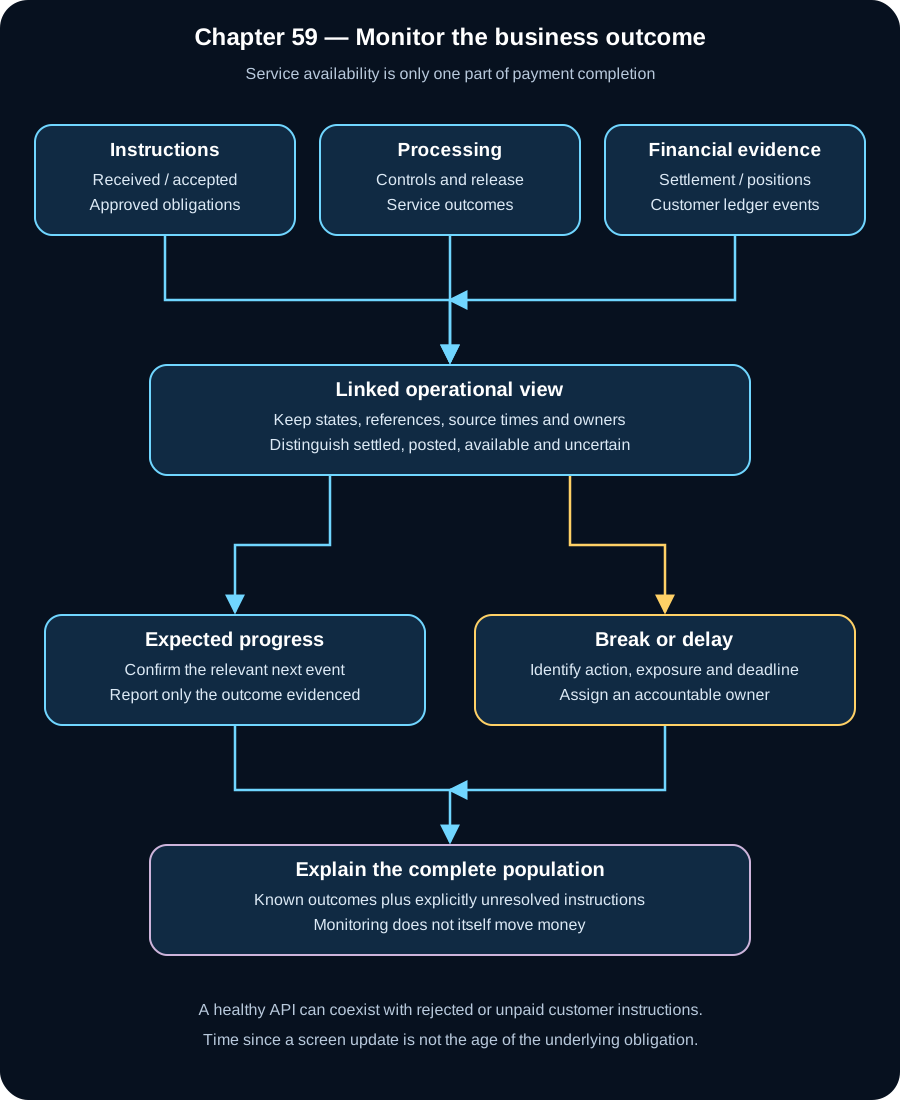
The diagram distinguishes the evidence streams feeding the operating view. It does not imply that monitoring itself moves money. Operators use it to decide the appropriate action, while the execution service, settlement arrangement and ledgers perform their own documented functions.
Age an item from the event relevant to its obligation. Time since last screen update can hide a payment that has been unresolved for hours. Retain original receipt, requested execution, release and latest evidence times so that escalation remains meaningful when ownership changes or the application restarts.
4. Design references that survive every handoff
A bank needs references for the business obligation, submission, file, individual instruction, execution attempt, network transaction, ledger event and later case. These identifiers can be linked without pretending that one value is universally unique across every system and rail.
Keep original references when a service supplies new ones. If a file is split into batches, record the parent-child relationships. If one instruction has a failed attempt and an authorized replacement, retain both attempts against the obligation. Reusing a display reference must not cause two distinct financial events to collapse into one record.
Message families provide useful semantics but not universal implementation guarantees. A pacs.002 concerns payment status in its supported usage; a camt.053 is an account statement family; a camt.054 concerns debit/credit notification. Actual services use particular versions, codes and delivery arrangements. Banks and corporate customers can also use files, portal reports or APIs with different structures.
Do not infer settlement solely from a file's successful transmission or from the presence of an ISO 20022 name. Interpret the actual service event and correlate it to financial records. Production mappings need the current participant or bank interface specification, with unknown fields or statuses treated explicitly rather than guessed.
5. Reconcile instructions to execution outcomes
The first reconciliation asks whether each accepted business instruction has a known outcome or an explained pending state. It should identify omissions, duplicates, partial acceptance and unexpected additions. Counts and values are useful control totals, but instruction-level relationships establish which obligation is affected.
For the opening run, the 20 validation rejects require correction or another authorized business decision. The 978 settled instructions should not be resent. The two uncertain instructions require outcome research. A blanket replay of the accepted file could duplicate hundreds of completed payments while attempting to solve only two unresolved items.
Reports should preserve the difference between a rejected instruction and a later return. A return follows an earlier financial event and has its own amount, date and reference. Replacing settled with failed in the original record destroys the settlement history and can make both reconciliation and customer communication misleading.
Define reconciliation completeness separately from delivery completeness. The bank can reconcile all 1,000 instructions into known categories while some business obligations remain unpaid. The customer report should show those remaining obligations clearly rather than interpret a balanced control equation as proof of successful delivery.
6. Reconcile execution to settlement and external account records
The second reconciliation asks whether service activity agrees with the actual settlement account or position. Sources can include Federal Reserve accounting information, network reports, correspondent statements and provider settlement reports. Each source has a defined scope and timing; none should be assumed to contain every customer detail.
Gross payment activity may reconcile through a net settlement position. The bridge must explain how underlying items, fees, adjustments and other included activity produce the posted amount. A mismatch between gross customer value and net cash is not automatically an error, but the difference needs a documented calculation.
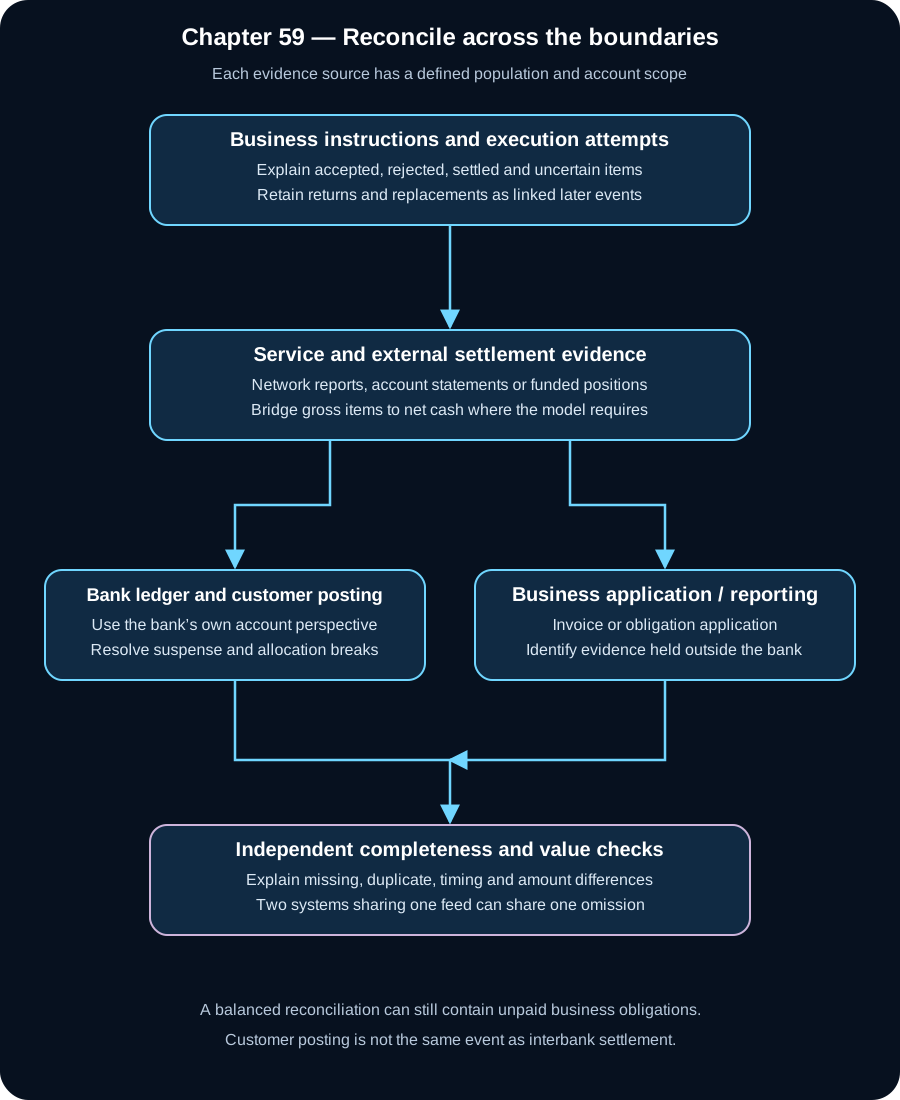
The diagram shows connected reconciliations rather than a magical single match. An internal processing report and an internal ledger generated from the same defective feed can agree while both omit a payment. An independent service or account source helps establish completeness, subject to that source's own coverage.
Federal Reserve Accounting Information Services and the Account Management Guide describe available account information and tools. FedNow and other services have service-specific reports. The bank should select the relevant evidence rather than assume one generic download contains detailed activity for every service or every respondent relationship.
7. Reconcile settlement to customer and business application
The third reconciliation asks whether settled value reached the correct internal customer or business account. A receiving institution can obtain settlement while customer posting remains unresolved. A corporate customer can receive a bank credit while its receivables application has not applied the money to an invoice. These are different breaks with different owners.
For an incoming $12,000 credit, the bank's Federal Reserve or correspondent asset may increase before the beneficiary can be identified for posting. The bank needs a controlled suspense or other approved interim treatment, not an unexplained balance or a fabricated customer credit. The later resolution should retain the original receipt and its allocation.
For an outgoing payment, a customer debit does not itself prove the beneficiary received money. Operations must connect the debit to the actual execution and settlement outcome. If the debit exists but release definitively failed, the supported correction should be based on the real financial state and applicable product terms.
Business application may remain outside the bank's direct control, but the bank can provide usable remittance and references. It should not claim that an invoice is paid merely because an interbank credit settled. Chapter 43 covered cash application; the operational boundary here is to identify who holds the evidence for the next step.
8. Read accounting from one institution's perspective
A customer's deposit is a liability on the bank's books. The bank's balance at a Reserve Bank or correspondent is an asset. An outgoing transfer can reduce both; an incoming transfer can increase both. The customer company's accounting has a different perspective and should not be mixed into the same journal illustration.
In a simplified outgoing $12,000 example, the bank can debit the customer's deposit liability and credit an outgoing settlement control account. When settlement is confirmed, it debits that control account and credits the relevant settlement asset. These two stages illustrate a possible design, not a requirement that every bank books customer debits at exactly that moment.
For the incoming example, the bank can debit its settlement asset and credit an incoming suspense liability when funds arrive without resolved allocation. Once the beneficiary is established, it debits suspense and credits the customer's deposit liability. The second journal allocates an existing receipt; it does not create another external settlement.
Every illustration must reflect the actual recognition event and account classification in the institution's approved policy. A reservation may affect available balance without being the same as a booked debit. A technical status update should not post money unless the associated financial event and authority support it.
9. Control suspense, adjustments and small differences
Suspense is a controlled unresolved position, not a place to hide a mismatch indefinitely. Each item should identify the source event, amount, currency, reason, owner, age and expected resolution. Aggregate balances alone cannot reveal whether old items have been offset by unrelated new ones.
Avoid clearing a suspense difference by posting it to income or expense simply because its amount is small. The institution's approved adjustment and write-off policy may permit particular treatment, but it requires the relevant authority and evidence. A reconciler should not manufacture a balancing journal to make a report look clean.
Separate posting errors from legitimate fees, exchange differences, rounding and timing. Each category requires its own explanation. A cross-currency provider payout may have a valid conversion and fee bridge; applying an arbitrary tolerance to the whole difference can hide an incorrect rate or missing payment.
Manual journals need the same traceability as automated postings. Record the original event, correcting entry, approval and effect on outstanding items. If the source system later replays its original posting, the bank must prevent a duplicate correction or reconcile it explicitly. An operations note outside the financial record is not sufficient protection.
10. Manage dates, cutoffs and continuous services
Payment operations uses several clocks: customer submission, requested execution, network business day, settlement day, ledger posting date, value date and reporting period. These dates can legitimately differ. The bank should preserve their meanings rather than normalize every event to local midnight.
Chapter 55 described current operating windows and funding calendars. Here the requirement is to apply the correct service calendar in reconciliation and reporting. A payment processed during a prior-calendar-day opening window may belong to the next service business day. An instant service can continue processing while its business-date label rolls over.
End-of-day reconciliation therefore remains necessary in a continuously operating service, but it cannot depend on stopping all payments. Define a controlled reporting boundary, identify late-arriving events and carry unresolved items forward with their history. Restating a report should preserve the earlier version and explain the reason.
Customer deadlines and service cutoffs should remain visible to operators without being confused. A payment that missed the customer's requested date may still be technically eligible for a later cycle. The operational decision must address the customer commitment, available execution route and any required notice rather than simply move the date forward silently.
11. Report different truths to different audiences
Customers need a clear account of accepted, rejected, pending and completed instructions, charges and relevant references. Corporate users may need item-level file results and reconciliation data. Consumers need the applicable account information and notices. The report should describe the event the bank can establish, not the most optimistic interpretation of a network message.
Treasury needs actual and expected account movements, usable balances and unresolved exposure. Finance needs reconciled postings and evidence for period-end balances. Operations needs actionable queues. Risk and management need service performance, incidents, losses and control weaknesses. These reports can share a common data foundation while retaining different purposes.
Regulatory reporting has prescribed definitions, scope and controls. A management dashboard is not automatically a regulatory report, and a SAR or sanctions filing should not be folded into a general customer-reporting feed. Chapter 58 explained those reporting boundaries; this chapter emphasizes accurate population and access control.
Publish metric definitions. Straight-through processing, success rate, return rate and average completion time can produce misleading conclusions if their denominators exclude difficult cases or mix incompatible populations. A 99 percent success figure is not informative until the reader knows which instructions, time period and success event it measures.
12. Recover operations without creating new payment risk
An outage can interrupt receipt, execution, reporting or only the user interface. Determine which functions and populations are affected before choosing a contingency. A portal outage does not prove that the underlying scheduled payments stopped, and a reporting gap does not authorize their resubmission.
Recovery should establish the last confirmed state, reconcile activity processed during disruption and resolve uncertain attempts. A backup channel needs access to the same obligation and duplicate controls. Operators should not create a new file identifier and assume the original financial instruction has disappeared.
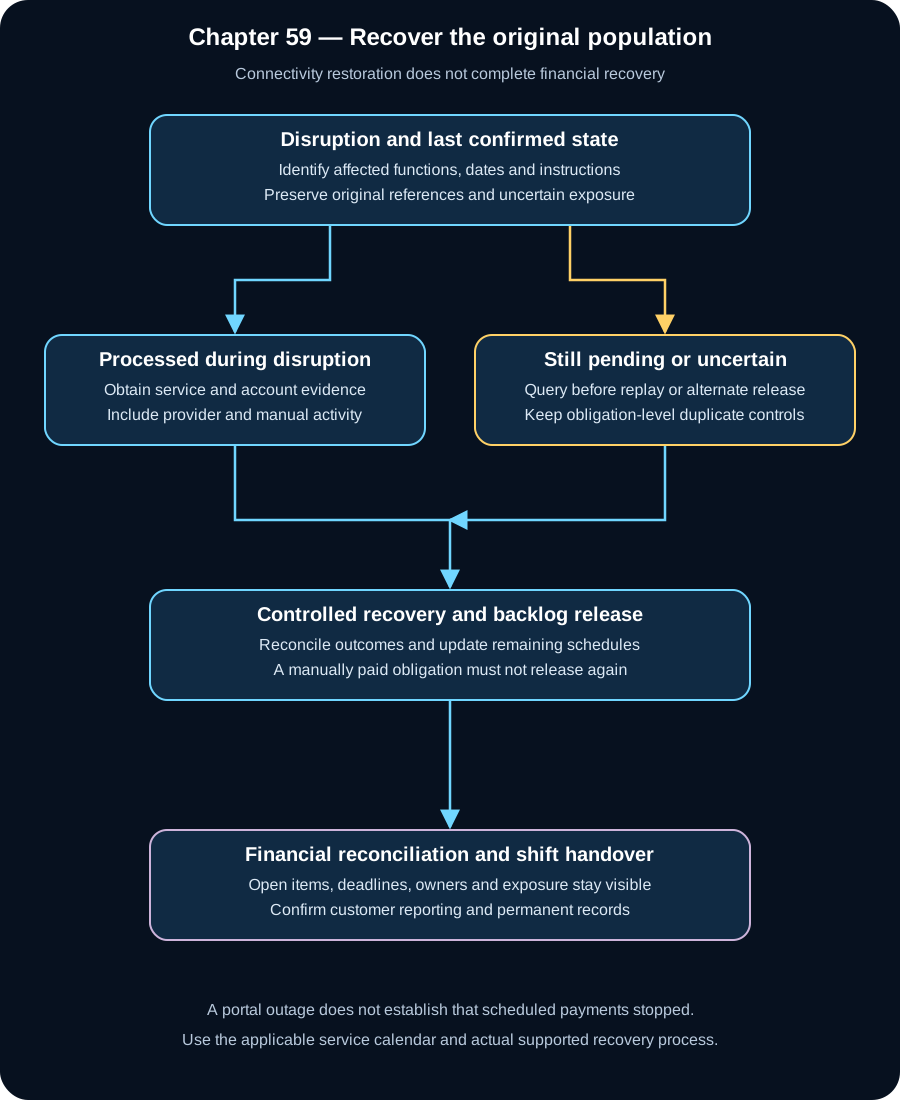
The diagram treats reconciliation as part of recovery. Restoring connectivity is an important milestone, but the bank must also account for backlog, manual actions, missing responses and customer commitments. The FFIEC business-continuity framework supports an end-to-end view of critical services rather than recovery of isolated servers alone.
After restoration, verify that paused schedules, reservations and contingent instructions are in the intended state. A manually paid obligation must not release again overnight. The next shift should receive the financial history, not merely a message that the incident has been closed.
13. Make handoffs and ownership explicit
Operations rarely controls every component needed to resolve a break. Technology may restore a feed, treasury may fund an account, compliance may determine a restriction, and a correspondent may supply missing evidence. The bank needs one accountable owner for the unresolved payment outcome even when several teams contribute.
A shift handover should identify material open populations, deadlines, financial exposure, actions already taken and the next decision. Include uncertain payments and manual contingencies explicitly. A verbal assurance that everything important is covered is not a durable control when the receiving team cannot reconstruct the basis.
Escalation should be tied to the business risk, not only application severity. Two delayed wage payments can warrant urgent attention even when the overall platform is healthy. A low-volume reconciliation break can reveal a systemic mapping defect. Staff should have a route to raise that concern without first waiting for a large outage count.
For provider relationships, agree evidence availability and response responsibilities before an incident. The bank should know how to obtain file results, settlement records and original references if the normal dashboard fails. A provider's support ticket number is useful, but it does not replace the bank's own case and obligation records.
14. Implement and assure the operating model
Business analysis should define states, events, reference relationships, financial recognition points and report populations together. Technology can then implement interfaces that preserve those meanings. Designing the dashboard first and adding reconciliation later often exposes that the required source references were never retained.
Acceptance scenarios should include the opening partial run, incoming suspense, a late return, a missing settlement report and an uncertain manual fallback. Demonstrate the customer view, operational state and financial entries for each. The goal is an explainable outcome across systems, not a test that merely confirms a status field changed.
Independent review should assess reconciliation coverage, aged breaks, manual adjustments and evidence quality. A reconciliation process can exist on paper while staff routinely clear differences without investigating them. Sampling should follow selected items through source records and resolution, including items classified as timing differences.
Continuous improvement should target repeated causes: poor customer data, ambiguous statuses, missing provider references, stale schedules or fragile report delivery. Correct the root cause and verify the affected population. Rewriting a well-working process simply to standardize terminology adds risk without necessarily improving the bank's ability to explain its money.
15. Worked cases and implementation decisions
The run balances but two instructions remain uncertain
The approved 1,000-instruction run totals $4.8 million. Twenty rejects total $80,000; 978 settled instructions total $4.7 million; two uncertain instructions total $20,000. The sums reconcile, but the customer still has unresolved obligations.
Prepare the customer and operations reports with those distinctions intact. Identify the next action for each category and explain why a whole-file replay is inappropriate. Reconciliation completeness should not be labeled delivery completeness.
An incoming receipt cannot be allocated
The bank receives $12,000 into its settlement relationship but cannot identify the intended customer from the available evidence. An operator proposes crediting the most likely account to clear suspense.
Keep the receipt in the approved controlled position and obtain reliable allocation evidence. Show the bank-perspective journals for receipt and later allocation. Explain why the allocation does not create another interbank transfer.
Gross transactions are compared directly with net cash
A provider report lists customer activity, fees and adjustments, while the bank statement shows one net amount. The reconciliation marks the difference between gross value and cash as missing funds.
Build the documented bridge and verify its underlying population. Separate legitimate netting from unexplained differences. Do not use the existence of a net model as permission to accept any settlement total without item support.
Two internal systems agree on the same omission
The payment application and ledger reconcile perfectly because both consume the same feed. A network report contains an additional settled item that the feed omitted.
Identify the independent completeness check and the affected account outcome. Determine whether a posting, customer communication or wider population review is needed. Agreement between dependent systems is not proof that all external activity was captured.
A manual payment remains in tomorrow's schedule
Operations pays an urgent obligation through a contingency channel after establishing the original scheduled instruction was not released. The original schedule remains active for the next morning.
Link the manual attempt to the obligation and apply the supported cancellation or suppression of the old schedule. Reconcile both systems before handover. The emergency payment is not a successful recovery if it creates a predictable duplicate tomorrow.
A small suspense balance is written off repeatedly
A daily difference is below the team's informal tolerance and is posted to expense without investigation. Over several weeks the same pattern continues.
Identify the source population, approved adjustment authority and cumulative exposure. Determine whether the recurring difference indicates a fee mapping, missing event or another defect. A small daily amount does not make a systematic control gap harmless.
16. Role checklist and learning closure
Operations should account for the complete instruction population and own unresolved outcomes. Treasury should reconcile usable settlement positions. Finance should maintain correct account perspectives and controlled adjustments. Technology should preserve events, references and recoverable states. Product and customer service should communicate the outcome actually evidenced. Assurance should challenge both missing activity and unexplained balances, including apparently small recurring breaks.
The learner should be able to reconstruct a payment run from business instruction to service outcome, settlement movement, ledger posting and report. Chapter 60 completes the programme by following the exceptions that cross those boundaries, including investigations, recovery, audit evidence and communication with customers and other institutions.
Authoritative references
Sources checked on October 5, 2026. Internal state models and journals are illustrative; service reports and production formats require their current specifications.
This application uses JavaScript for the full interactive experience. This text summary is served for accessibility and search indexing.