Payment Data, Remittance and ISO 20022 in the USA. A deep practitioner guide to payment business data, remittance, identifiers, ISO 20022 message families, Fedwire/FedNow/RTP usage, ACH translation, mapping quality, lineage, reporting and reconciliation.
A payment is not only money moving from one account to another. It is also a data story: who is paying, who is receiving, which accounts are involved, what amount is being moved, why the payment exists, which invoice or obligation it relates to, what date should apply, which bank or payment service is responsible at each stage, and which references allow every party to prove what happened later.
When the data is weak, even a technically successful payment can become operationally expensive. A supplier can receive the money but fail to identify the invoice. A bank can settle correctly but struggle to reconcile the customer debit with the network transaction. A sanctions or fraud process can receive incomplete party information. An investigation can become a manual search across multiple systems because the original customer reference was not preserved. A payment can even be routed correctly while the remittance information needed by the beneficiary disappears during format conversion.
That is why Chapter 5 is not an XML chapter. It is a chapter about payment meaning, data quality, remittance, identifiers, interoperability and lineage. ISO 20022 is important because it provides a rich business model and structured messaging language, but the standard is only useful when banks preserve and use the information properly.
The US payments landscape makes this topic especially interesting. Fedwire Funds Service completed its migration to ISO 20022 in July 2025. FedNow uses ISO 20022 messaging. The RTP network uses ISO 20022 message specifications. ACH, however, remains the ACH Network with Nacha formats and rules; Nacha provides official mapping guidance that helps financial institutions translate certain ISO 20022 messages into ACH transactions and translate ACH outcomes back into ISO-style reporting and status messages. The result is not “one format everywhere.” It is a coexistence environment where banks must understand business data independently of the transport format.
This chapter stays deliberately focused on that foundation. Later chapters will go deeper into ACH files, Fedwire, RTP, FedNow, cross-border SWIFT, regulatory controls and specific message implementation. Here the objective is to build the mental model that makes those later chapters easier.
For a roughly 60-minute core session, spend about 35 minutes on Sections 2–3, Sections 5–9 and Sections 13–15. For the next 10 minutes, use the chapter’s three diagrams to follow payment identifiers and remittance through translation. Use 10 minutes to work through one case in Section 16, then spend the final 5 minutes explaining: What evidence should survive when a rich customer instruction becomes a more constrained rail message? Treat these timings as a study guide. The remaining sections, additional cases and extended reference material are follow-up study; completing the whole chapter takes longer.
Chapter navigator
- Why payment data is part of the payment
- The business data layers inside a payment
- Parties, accounts, agents and identifiers
- Amounts, currency, dates, charges and purpose
- Remittance information: connecting cash to the obligation
- Structured and unstructured remittance
- End-to-end references and transaction lineage
- ISO 20022: business model first, XML second
- pain, pacs, camt and remt message families
- Fedwire after the US ISO 20022 migration
- FedNow and RTP: rich data in instant payments
- ACH and ISO 20022: translation, not replacement
- Canonical models, mapping, truncation and data loss
- Data quality, fraud, sanctions, privacy and governance
- Reporting, reconciliation and investigations through data lineage
- End-to-end cases, BA checklist and testing
1. Why payment data is part of the payment
A payment instruction has two inseparable parts: value and information. The value is the amount that ultimately moves. The information tells everyone what that movement means and how it should be processed.
A corporate payment of $248,000 without meaningful context is operationally weak. Who is the beneficiary? Which supplier account should receive it? Which invoice or invoices does it settle? Is the amount gross or net of a credit note? Is the payment urgent? Is there an agreed purpose code? Which legal entity is the payer? Which bank account funded it? Which reference should appear in the supplier's bank statement? Which reference should the payer use if it later raises an investigation?
At a bank, the same transaction creates additional data needs. The bank needs customer identification, account eligibility, channel and entitlement evidence, beneficiary information, routing data, fraud and sanctions inputs, payment method, processing timestamps, network references, settlement evidence, ledger booking IDs and customer-reporting data. Treasury may care about currency and settlement timing. Finance needs accounting references. Operations needs exception codes. Reconciliation needs identifiers that link the instruction to clearing, settlement and posting.
This is why data quality is not an administrative afterthought. Poor data creates real costs. A payment may be delayed because the beneficiary bank cannot interpret a party field. A screening system may generate a false positive because a name and address were merged badly. A receivables team may spend twenty minutes matching a payment that could have been matched automatically if the invoice reference had remained structured. A duplicate payment can escape detection when the business identifier changes during transformation.
The strongest payment architecture therefore treats information as part of the product. It asks not merely “can we send the money?” but also:
- can we preserve the customer's business meaning from initiation to reporting;
- can every participant understand the fields it needs;
- can we distinguish customer-supplied data from bank-enriched data;
- can we map between formats without silently corrupting meaning;
- can we reconstruct the transaction months later;
- can the beneficiary apply the cash automatically;
- can fraud, sanctions and compliance controls consume data at the right granularity;
- can we explain exactly which fields were truncated, transformed or defaulted.
The central principle for this chapter is:
A payment is successful only when value and the necessary business information reach the right place with enough integrity for processing, reporting, reconciliation and investigation.
2. The business data layers inside a payment
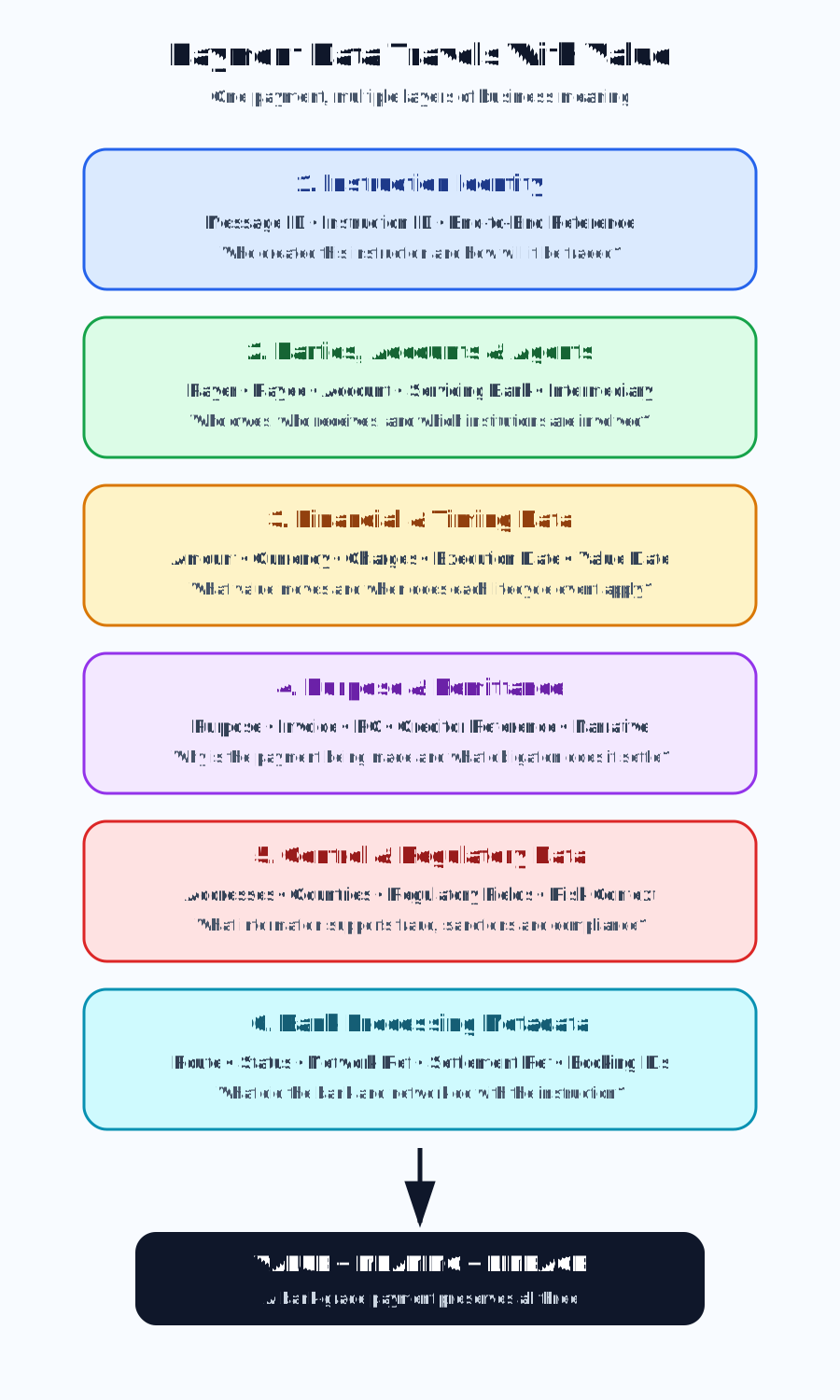
Payment data becomes easier to understand when it is separated into business layers rather than memorised as field names.
The first layer is instruction identity. It answers which instruction this is and which customer or system created it. Typical concepts include file ID, message ID, payment-information ID, instruction ID, end-to-end reference, bank transaction ID and network transaction ID. Not every rail uses the same identifiers, but every mature payment platform needs a controlled identity strategy.
The second layer is party data. This identifies the economic actors: payer, payee, debtor, creditor, ultimate debtor, ultimate creditor, initiating party, biller, merchant or other relevant participants. The exact terminology varies by message model and rail. The important point is that the account holder, the economic payer and the initiating party are not always the same legal entity.
The third layer is account and agent data. It identifies the customer accounts and the financial institutions that service them. In the US, routing information may involve ABA routing numbers or rail-specific participant identifiers. Account identification can be domestic account data, proprietary identifiers or other scheme-specific representations. The same customer can be reachable through different rails, so an identifier should not automatically be treated as proof of rail reachability.
The fourth layer is financial data: amount, currency, exchange-rate information where relevant, charges, settlement amount, instructed amount and related monetary details. A single cross-border or FX payment can legitimately contain more than one amount concept. Even in domestic USD flows, fee treatment can make “amount” ambiguous unless the field is defined.
The fifth layer is timing data: requested execution date, settlement date, value date, posting timestamp, acceptance timestamp, availability timestamp and other lifecycle times. Chapter 4 explained why those events differ. Chapter 5 focuses on preserving the data that proves each event.
The sixth layer is business context: purpose, category purpose, invoice reference, customer reference, purchase order, remittance narrative, tax reference, payroll context or other information explaining the obligation.
The seventh layer is control and regulatory data. This can include party addresses, country information, regulatory reporting fields, intermediary information, sanctions-relevant data, fraud attributes and evidence required by a particular payment use case.
The eighth layer is processing metadata generated inside the bank: route chosen, validation result, screening result, repair action, network response, exception code, settlement reference, booking ID and reconciliation status.
A useful architecture should distinguish business data from processing metadata. The customer's invoice reference should not be overwritten by an internal transaction key. The bank's route code should not be sent to the beneficiary as though it were customer remittance. The network's message ID should not replace the customer's end-to-end reference.
Think of a payment record as a layered object, not a single flat row.
3. Parties, accounts, agents and identifiers
Party modelling is one of the areas where rich standards provide real value, because real payments often involve more parties than the simple phrase “sender and receiver” suggests.
Consider a large corporate group. The parent treasury centre may initiate a payment, but the debtor account belongs to a subsidiary. The economic obligation may be owed by another group company. A shared-service centre may prepare the file. A service provider may transmit it. The beneficiary may be a supplier whose collections are managed by a lockbox or treasury provider. If all of those roles are compressed into two free-text names, important business meaning is lost.
A practical design therefore asks four questions separately.
Who initiated the instruction? This can be a user, corporate platform, processor or agent acting under authority.
Who owns the debited account? This is the account holder at the sending institution.
Who economically owes the money? This can differ from the account holder in group treasury or payment-on-behalf-of models.
Who should receive and economically benefit from the payment? The account credited and the ultimate creditor can also differ.
Account data needs similar precision. A bank should know whether a supplied account identifier is complete, valid for the chosen product, permitted for the transaction type and paired with the correct routing information. Valid syntax is not the same as a valid account, and a valid account is not the same as an account reachable through a particular instant-payment network.
Agent data identifies institutions in the payment chain. Depending on the rail, this can be the debtor agent, creditor agent, intermediary agent, instructing agent, instructed agent or settlement participant. In a simple domestic payment, there may be only two relevant banks. In a more complex cross-border USD chain, intermediary institutions can matter. Chapter 20 will go deeper into correspondent banking; here the point is simply that a payment's party model and bank-agent model are different layers.
Identifiers are valuable only when their semantics are clear. An ABA routing number is not a customer account number. A bank transaction ID is not necessarily the customer's reference. A network transaction ID may be unique inside one network but meaningless to the customer's ERP. An invoice ID identifies a commercial obligation, not the payment message itself.
A strong data dictionary therefore documents for every identifier:
- who creates it;
- where it must be unique;
- whether it can change during transformation;
- whether it is visible to the customer;
- whether it must be propagated end to end;
- whether downstream systems can use it as a reconciliation key;
- how it links to returns, reversals, investigations and reporting.
The rule is simple: never call a field reference without saying reference to what.
4. Amounts, currency, dates, charges and purpose
Payment data often looks obvious until two systems use the same word differently.
Take the word amount. A customer can instruct $100,000. A fee can be charged separately. A foreign-exchange transaction can create a different settlement amount in another currency. A returned payment can contain the original amount and a return amount. A card transaction can have authorised amount, clearing amount and settlement amount. A partial payment can settle only part of the requested obligation.
For Chapter 5, the design lesson is to name monetary concepts explicitly. instructedAmount, settlementAmount, feeAmount, creditedAmount and originalAmount are different business ideas even if they happen to be equal in a simple domestic payment.
Currency should be equally explicit. Many US domestic payment flows are USD-only, but a bank-wide canonical model should not assume that every instruction it receives is always USD. Cross-border USD payments can involve FX outside the domestic settlement leg. Corporate customers can create multi-currency files. A payment factory can transform an original commercial obligation into a domestic USD settlement instruction.
Dates are another frequent source of defects. The customer may request execution on Friday. The bank may accept the file Thursday. The payment can settle Friday. The beneficiary account can post seconds later. An ACH effective entry date and settlement date are related but not interchangeable. The customer's invoice due date is a commercial date, not a settlement date. A Request for Payment expiry date is not the same as the underlying bill's due date.
Charges require their own business rule. Is the charge included in the customer debit, booked separately, deducted from the amount, billed monthly, or passed through from another service? Domestic rail behaviour, bank pricing and cross-border charge arrangements differ. A message standard can carry charge information, but the product determines the economic treatment.
Purpose data can be operationally valuable. It can describe salary, supplier payment, tax, refund or another business reason. But purpose should not be confused with remittance. “Supplier payment” explains the category; “Invoice 821744” tells the supplier what receivable the cash settles.
A strong canonical model therefore separates:
what amount is being instructed;
what amount settles;
what amount the customer is debited or credited;
which dates apply to which events;
how charges are treated;
why the payment exists at a high level;
which commercial obligation it settles.
That separation prevents downstream systems from inferring business meaning from one overloaded field.
5. Remittance information: connecting cash to the obligation
Remittance information is the bridge between the movement of money and the business reason for that movement.
Imagine a wholesaler receiving $742,518.24 from a large retailer. The bank has successfully credited the wholesaler's account. From the bank's settlement perspective, the payment is complete. From the wholesaler's accounts-receivable perspective, the work may only be beginning.
The retailer may be paying 38 invoices, deducting two credit notes and applying a short-payment adjustment. If the incoming payment contains only the text APR PAYMENT, the cash-application team may need to search the retailer's portal, open email remittance advice, compare amounts and manually match the transaction. If the payment carries structured invoice references, amounts and adjustment information, much of that process can be automated.
This is why “beneficiary name and amount” is not enough for serious corporate payments.
Remittance information can include invoice numbers, creditor references, purchase orders, customer-account identifiers, billing periods, tax references, credit-note references, adjustment reasons and free-text narrative. Different rails and message formats allow different capacities and structures. The bank's job is not to invent remittance data; it is to preserve and transport the information that the customer and receiving side can legitimately use.
There are three different concepts that should not be confused.
Payment reference identifies the payment transaction.
Remittance reference identifies or explains the commercial obligation being paid.
Bank reference identifies the bank's own processing record.
One payment can have all three.
Remittance also matters for collections. In ACH debit, the biller already knows which receivable it is attempting to collect, so the outgoing collection instruction should remain linked to that receivable. When the debit settles or returns, the result needs to update the correct customer obligation. In Request for Payment, the request ID and invoice reference should connect to the resulting credit transfer. In lockbox, remittance documents and check images are often as important as the cash itself.
The strongest cash-application design asks:
Can the beneficiary automatically determine what this money is for?
If the answer is no, the payment may be financially successful but operationally incomplete for the customer.
6. Structured and unstructured remittance
Unstructured remittance is human-readable free text. It is simple, flexible and familiar. A customer can enter INV 8821 8824 8830 APRIL. A receiving user may understand it immediately.
The problem is that computers do not always understand it reliably. Is 8821 an invoice number, customer number or amount? Does APRIL describe a billing period or a contact name? Did the payer type O instead of zero? Did a bank truncate the text? Did another system replace punctuation?
Structured remittance gives individual pieces of business meaning their own defined positions. Instead of one string, the data model can represent creditor reference, invoice identifier, referenced amount, document type, adjustment reason and other relevant elements separately.
This structure supports automation. A receivables engine can match invoice ID to an open item. A reporting system can show the exact reference. A bank can validate field length and semantics. Data can survive translation more predictably when the target format has equivalent fields.
But structured data does not automatically mean good data. A customer can place the wrong invoice number in the right field. A bank can map structured data into an unstructured legacy field and lose detail. A downstream system can ignore the structure and display only a generic narrative. Standards create the opportunity for quality; governance and implementation determine whether the value is realised.
There is also a practical coexistence problem. Corporate systems, US payment rails and bank platforms do not all support identical remittance capacities. A rich ISO 20022 initiation can contain more structured information than a target legacy format can carry. The bank must then decide which data is mandatory, which can be mapped, which can be combined, which can be reported out-of-band and which must be rejected rather than silently discarded.
A dangerous implementation is “take the first 80 characters and continue.” That may preserve syntactic validity while destroying the exact information the beneficiary needs.
A better mapping policy documents:
- source field;
- target field;
- semantic equivalence;
- target length or cardinality;
- transformation rule;
- truncation rule;
- reject rule;
- customer warning where appropriate;
- reconciliation impact;
- whether the original value is retained internally.
The lesson is not that free text is bad. It is that structured data supports predictable automation, while unstructured data requires more interpretation and therefore more operational risk.
7. End-to-end references and transaction lineage
A payment changes shape as it moves through a bank.
A corporate ERP creates an instruction. A channel receives a file. A payment hub creates an internal transaction. A rail adapter creates a network message. The network assigns or carries its own identifiers. Settlement creates a reference. The core posts ledger entries. Reporting creates statement references. An investigation case may later be opened.
If every system generates a new ID and discards the previous one, the transaction becomes difficult to trace.
A mature payment platform therefore preserves lineage: the relationship between the identifiers created at each stage.
The customer's end-to-end reference is especially valuable because it can connect the payer's ERP to the beneficiary's reporting when the rail and implementation support propagation. The bank should avoid overwriting it merely because an internal transaction ID is easier to use technically.
At the same time, the end-to-end reference is not sufficient for every purpose. The bank needs its own unique transaction ID. A batch file needs a file or message ID. A network can have its own transaction reference. A ledger posting can create booking IDs. A return or investigation needs to reference the original event.
A useful lineage chain can look like:
customer file/message ID → payment-information ID → instruction/end-to-end reference → bank transaction ID → network transaction ID → settlement reference → debit/credit booking IDs → statement/reporting reference → exception/investigation case ID
Not every payment will have every layer, but the model illustrates the principle.
Lineage is essential for duplicate detection. If the same customer instruction is resent after a timeout, the bank needs to distinguish a legitimate retry from a new payment. It is essential for reconciliation because settlement entries must trace back to customer transactions. It is essential for investigations because operations should not search by amount and date alone. It is essential for customer service because the customer may know only its own reference, not the bank's internal ID.
One more distinction matters: uniqueness scope. An invoice number may be unique only within one supplier relationship. A customer payment reference may be unique only for one corporate. A network transaction ID may be unique globally within that network. A bank transaction ID should usually be unique inside the bank's own payment domain.
Requirements should therefore state not only “unique” but unique where, for how long and created by whom.
8. ISO 20022: business model first, XML second
ISO 20022 is often introduced through XML tags. That is useful eventually, but it is the wrong starting point.
The more important idea is that ISO 20022 provides a common methodology and business model for financial messages. It describes business concepts—parties, accounts, agents, amounts, remittance, statuses, cash reporting and many others—in a structured way. XML is one widely used syntax for representing those models, but the business semantics are the real value.
This matters because a bank can technically produce valid XML and still have bad payment data. A <Cdtr> element can contain the wrong creditor. A structured address can be populated inconsistently. A mandatory bank field can be defaulted with meaningless data. A customer reference can be moved into the wrong element. Schema validation proves structural conformance; it does not prove business correctness.
ISO 20022 also does not define one universal payment scheme. Fedwire, FedNow and RTP can all use ISO 20022 while having different participation rules, settlement models, operating hours, limits, validations and business processes. The standard gives them a common language; the market infrastructure defines how that language is used.
Similarly, two implementations can use the same ISO 20022 message family but different usage guidelines. One market can require a field that the base ISO schema makes optional. Another can restrict code values. A bank therefore needs the relevant implementation guideline or market practice, not only the generic message definition.
A useful hierarchy is:
ISO 20022 business model → message definition → market-infrastructure usage guideline → bank mapping and product rules → customer implementation
The deeper you move down that hierarchy, the more specific the rules become.
Richness is not permission to populate everything
ISO 20022 offers many elements, but more fields are not automatically better. Data should be accurate, relevant and supported by the business process. Copying values into every available field can increase screening noise, privacy exposure and mapping complexity.
A bank should know which data is:
- mandatory by the message or market guideline;
- mandatory by its product;
- conditionally required;
- customer-provided;
- bank-enriched;
- derived;
- optional but useful;
- prohibited or unsupported.
This is why ISO implementation is a data-governance project as much as a messaging project.
9. pain, pacs, camt and remt message families
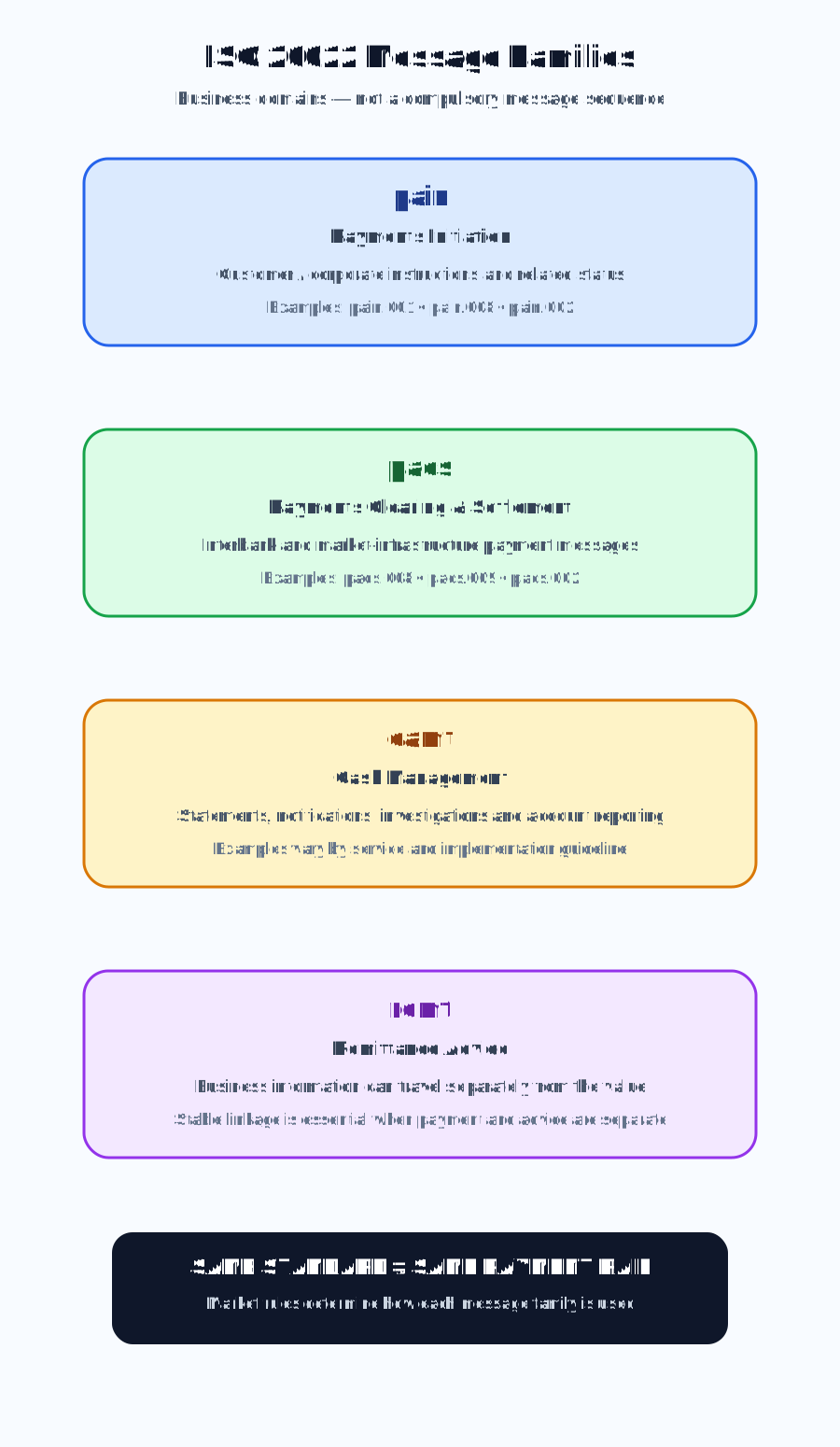
ISO 20022 message names become much easier when the learner understands the business domains instead of memorising individual codes.
pain messages generally support payment initiation and related customer-to-bank processes. A corporate can use pain.001 for customer credit-transfer initiation. pain.008 is associated with customer direct-debit initiation in markets that use it. pain.002 supports payment-status reporting in relevant implementations.
pacs messages generally support payments clearing and settlement between financial institutions or market infrastructures. pacs.008 is a customer credit transfer between financial institutions in many ISO 20022 payment systems. pacs.009 is used for financial-institution credit transfers in relevant contexts. pacs.002 is a payment status report in interbank contexts.
camt messages support cash management and related reporting, investigation and account-management functions. Examples include account statements, debit/credit notifications and various exception or investigation messages depending on the implementation.
remt messages support remittance advice as a distinct information flow. This is important conceptually because payment information and remittance information do not always have to travel in exactly the same message or at exactly the same time.
A customer-to-bank pain.001 does not magically travel unchanged through the clearing system. The bank validates and processes the customer instruction, then creates the rail-specific interbank message or file required for execution. If the route is Fedwire, the bank uses the Fedwire ISO 20022 implementation. If the route is FedNow, it uses the FedNow message specification. If the route is RTP, it uses the RTP specification. If the route is ACH, the bank may translate the customer instruction into ACH records rather than sending the pain.001 through the ACH Network.
That is the practical meaning of a canonical payment model: preserve the business meaning while allowing different external formats.
Message family is not lifecycle status
Another mistake is to infer business completion from message type alone. A pacs.002 can communicate a status, but the meaning depends on the code and context. A camt.053 statement reports booked account activity, but it is not itself the settlement mechanism. A pain.002 response does not necessarily mean the beneficiary has received funds.
Message = information event. Business state = what happened to the payment. They must be linked but not confused.
10. Fedwire after the US ISO 20022 migration
The Fedwire Funds Service completed its migration to ISO 20022 on July 14, 2025. This is a major change in the US high-value payment data environment because Fedwire moved from the previous proprietary message format to a richer ISO 20022 structure.
The value is not simply that tags changed. The new model supports richer structured information about parties, payment purpose, remittance and other business data. Federal Reserve Financial Services has explicitly encouraged institutions to use the richer data to improve automation, fraud controls, compliance and customer experience.
For a bank, however, migration does not automatically mean every internal system became ISO-native overnight. Many institutions still have payment hubs, sanctions systems, customer channels, data warehouses, accounting platforms and reporting tools that use internal canonical formats or legacy structures. The implementation challenge is therefore end-to-end data preservation.
Suppose a customer provides a rich beneficiary address and structured remittance reference. The Fedwire rail can carry suitable structured information under its implementation rules. But if the bank's internal payment hub stores only one 35-character address line or its sanctions adapter flattens the party into free text, the data value has already been lost before the wire reaches Fedwire.
The same applies on incoming payments. A receiving bank can get richer data from Fedwire, but the benefit disappears if its core or statement system truncates the remittance before the corporate customer sees it.
This creates a useful post-migration principle:
ISO 20022 adoption at the rail is only the first step; the real value comes when the bank's end-to-end architecture can ingest, preserve, screen, process, report and analyse the richer information.
The Fedwire story also shows why implementations evolve. Industry harmonisation work can lead to future adjustments in market-infrastructure data requirements. Banks should therefore avoid hard-coding only today's XML shape into business logic. The business model, usage guideline, mapping layer and validation rules should be version-controlled separately.
Chapter 16 will go deeply into Fedwire operations and message flows. Here, the essential foundation is that Fedwire is now an ISO 20022 rail and US banks should treat the migration as a data-modernisation opportunity, not only a format-conversion project.
11. FedNow and RTP: rich data in instant payments
FedNow and RTP are both instant-payment infrastructures in the United States, and both use ISO 20022-based messaging. That common standard helps create familiar business concepts across the services, but it does not make the services identical.
FedNow operating procedures describe ISO 20022 messages across value, non-value, system and account-reporting categories. RTP publishes its own message and technical specifications, including credit transfer, status, Request for Payment and other message types.
The important Chapter 5 lesson is that instant payments compress the time available for data repair.
In a batch payment, an invalid or incomplete instruction can sometimes enter a repair queue before release. In an instant-payment flow, the bank may have only seconds to validate the account, beneficiary, amount, reachability, fraud signals, compliance requirements and message structure. Data quality therefore becomes a real-time control requirement.
A receiving bank also needs to post and report quickly. If the payment arrives with a useful end-to-end reference and remittance detail, the beneficiary should ideally see that information immediately rather than waiting for an overnight reporting transformation.
Request for Payment adds another linkage problem. The request has its own identity and business context. If the payer accepts, a separate credit transfer is created. The bank and biller need to preserve the relationship:
request ID → invoice/obligation reference → payer response → payment ID → instant-network transaction → beneficiary posting → receivable closure
If the payment settles but the request reference is lost, the biller can receive money instantly and still reconcile slowly.
Instant systems also illustrate the distinction between message richness and product entitlement. A message can support structured fields, but a bank's customer channel may not expose them all. A corporate API may support more remittance than the consumer mobile app. Product teams should document what data each channel can capture and display rather than assuming every ISO field is universally available.
The practical goal is not to show customers XML. It is to use structured data behind the scenes to produce a simpler and more reliable experience.
12. ACH and ISO 20022: translation, not replacement
One of the most important accuracy points in the US payments landscape is that the ACH Network is not simply “ISO 20022 ACH.” ACH continues to use Nacha formats, rules, Standard Entry Class codes and processing models.
At the same time, many multinational corporates prefer to use ISO 20022 as a common bank-integration format. A US bank may therefore receive a corporate pain.001 credit instruction or pain.008 debit instruction and translate it into the ACH records required for execution.
Nacha has published an ISO 20022-to-ACH Mapping Guide and tools specifically to support this coexistence. The guidance covers mapping ISO 20022 initiation messages into ACH transactions and mapping ACH outcomes into ISO-style status and reporting messages for corporate customers.
This is a powerful architectural pattern:
customer format ≠ clearing format
The customer can use a standardised corporate interface while the bank converts the instruction into the format of the domestic rail.
But translation creates semantic risk.
An ISO 20022 message can contain richer party and remittance structures than an ACH record can carry for a particular transaction type. The target ACH format has specific field capacities and SEC-code rules. The bank cannot simply serialize the entire source message into ACH.
The mapping layer must therefore understand business meaning. It needs to know which source elements correspond to Company Name, Company Entry Description, Individual Name, Identification Number, addenda information or other ACH fields where relevant. It must determine which data is mandatory for the ACH use case, what is unsupported, and whether loss of data is acceptable.
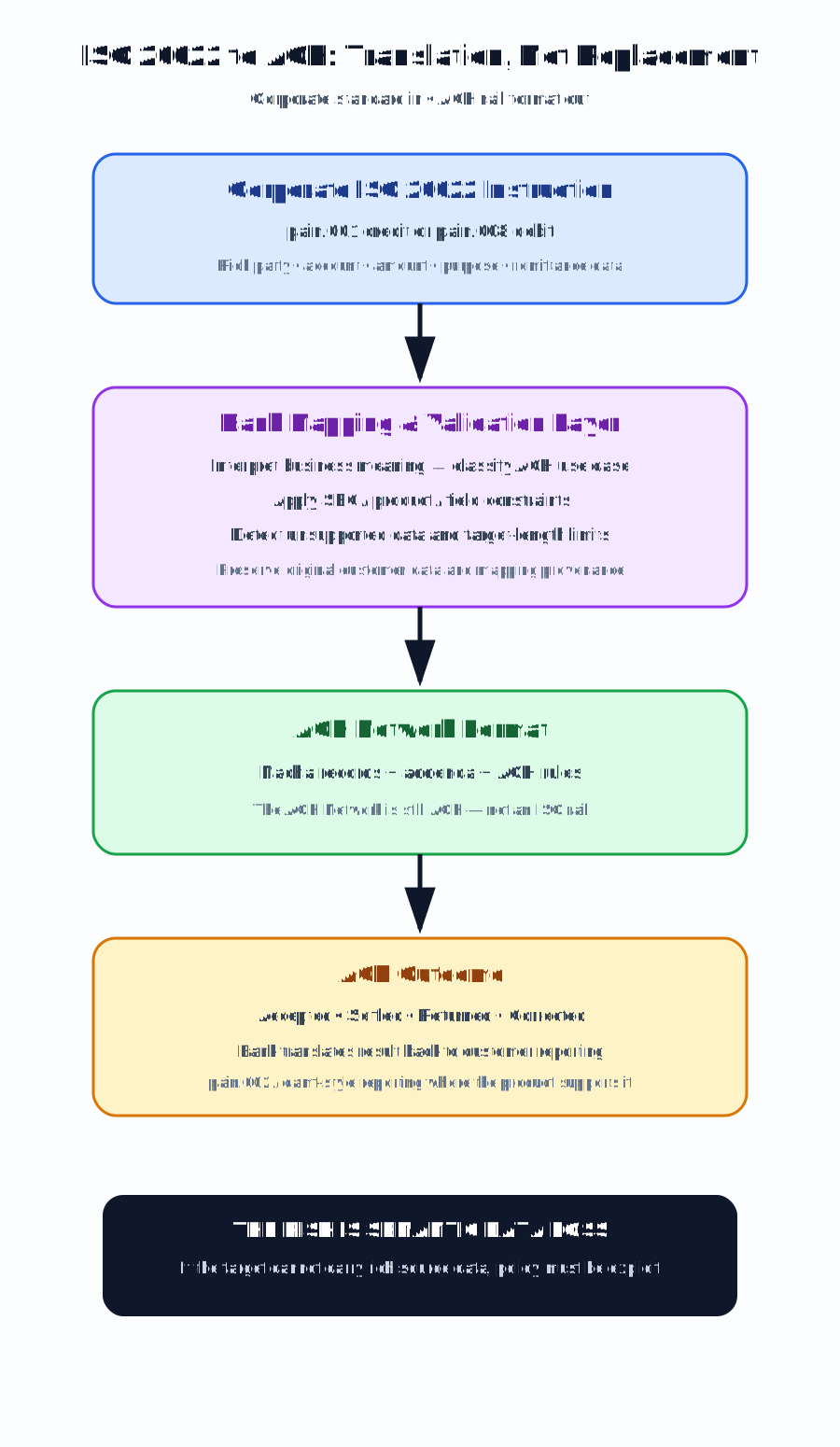
The correct design is not “ISO in, ACH out.” It is:
validate source → interpret business meaning → classify ACH use case → apply SEC/rule constraints → map fields → detect unsupported data → preserve original data → generate ACH → map outcomes back to customer reporting.
This section deliberately stops before detailed ACH field layouts and SEC-code rules. Those belong in Branches 2 and 3. The foundation you need now is that ISO 20022 can coexist with ACH through controlled translation, and that translation quality determines whether rich data survives.
13. Canonical models, mapping, truncation and data loss
Banks rarely want every internal system to understand every external payment format directly. A common architecture therefore uses an internal canonical payment model.
A corporate file, API request, ACH record, Fedwire message or instant-payment message is translated into or out of this internal model. The canonical representation provides a stable business vocabulary for the payment hub and downstream systems.
A strong canonical model is business-led. It contains concepts such as debtor, creditor, accounts, agents, amount, currency, purpose, remittance, identifiers and lifecycle state. It should not be a copy of one rail's XML schema with different field names.
Why? Because if the canonical model is shaped entirely around one rail, every other rail becomes an awkward exception. A field that supports one beneficiary address line because a legacy format had one line will cripple future structured-address processing. A single reference field will be overloaded with end-to-end ID, invoice reference and bank transaction ID.
The mapping layer should classify each transformation as one of four types.
Lossless mapping: source and target have equivalent business semantics and capacity.
Normalised mapping: the same meaning is represented differently, but can be converted safely.
Enriched mapping: the bank derives or adds data, such as routing information, internal account IDs or a bank transaction reference.
Lossy mapping: the target cannot carry all source information, so detail is truncated, combined or omitted.
Lossy mapping is not always avoidable. The danger is pretending it did not happen.
A bank should document data-loss policy. For each field, define whether unsupported data leads to rejection, truncation, alternative reporting, side-channel delivery, internal preservation or customer warning.
Preserve the original instruction
A practical control is to retain the original customer payload or a legally appropriate immutable representation alongside the normalised transaction. That allows operations to prove what the customer actually sent if a later dispute arises.
The canonical record should also preserve provenance: which fields came from the customer, which were enriched by the bank, which were transformed, and which were defaulted.
Avoid reverse-mapping fiction
If rich source data was collapsed into free text during outbound processing, a later inbound status cannot magically reconstruct the original structure from the rail. The bank may still have the original structure internally, but it should know that the rail did not carry it.
This matters to investigations. “Our database contains the invoice reference” is not proof that the beneficiary received it.
14. Data quality, fraud, sanctions, privacy and governance
Rich payment data creates both opportunity and responsibility.
Fraud systems can use structured beneficiary information, account history, purpose, transaction timing and relationship data to improve detection. Sanctions and AML processes can benefit from cleaner party names, addresses, countries and intermediary information. Operations can reduce repair. Corporates can automate reconciliation.
But more data can also create more risk if it is inaccurate or unnecessarily retained.
Data quality dimensions
A useful quality model asks whether payment data is:
complete — required elements are present;
accurate — the values represent the real parties and transaction;
consistent — related fields do not contradict one another;
valid — syntax and code values comply with the required format;
timely — reference and master data are current at execution time;
traceable — the bank can identify the source and transformations.
Schema validation addresses only part of this list.
Fraud controls need semantics
A beneficiary name change can be more meaningful than a payment amount change. A new account combined with an unusual purpose can raise risk. A Request for Payment sender identity matters because fraudulent requests can trick a payer into authorising a genuine credit transfer.
The fraud engine should therefore consume business concepts, not just opaque XML strings.
Sanctions screening and structured parties
Screening quality depends on usable party data. Flattening names and addresses can increase false positives or reduce useful context. At the same time, the bank must follow the actual legal and policy requirements for the payment type; ISO 20022 does not create a new sanctions regime by itself.
Privacy and minimisation
Rich standards can carry more data than a given transaction requires. That does not mean every field should be populated, propagated and retained forever. Banks still need privacy, retention and access controls. Sensitive information should have a business purpose, and systems should restrict who can view it.
Governance
Data ownership should be explicit. Product owns business meaning. Architecture owns canonical structure. Compliance owns applicable control requirements. Operations owns repair and investigation needs. Data teams own quality monitoring and lineage tooling. Technology owns implementation. No single team should silently redefine fields that affect all the others.
A payment-data dictionary should be versioned as carefully as a message schema.
15. Reporting, reconciliation and investigations through data lineage
Chapter 4 explained that settlement, posting and reconciliation are separate events. Chapter 5 explains the data that connects them.
A bank should be able to start from any point in the lifecycle and trace both directions.
From the customer instruction:
customer reference → bank transaction → rail message → settlement → ledger postings → reporting
From a settlement break:
settlement reference → participant position → underlying network transactions → bank transactions → customer instructions
From a customer complaint:
customer reference → instruction state → network state → settlement state → beneficiary posting → reporting → return/investigation
This is why identifiers must be preserved rather than replaced.
Reporting must preserve business meaning
A statement is not simply a list of debits and credits. Corporate customers need usable references, counterparty information, remittance and status context to reconcile their ERP. If a bank receives structured remittance but reports only WIRE CREDIT, it has thrown away value that the payment rail delivered.
Cash-management reporting can use ISO 20022 camt messages in appropriate products, but the same principle applies to CSV, BAI-style files, APIs and online statements: the content should preserve the business data needed by the customer.
Reconciliation keys should be designed, not discovered later
A project should decide before go-live which identifiers tie together customer instructions, network messages, settlement records, ledger postings and reports. If the answer is “operations will match amount, date and account,” the design is not mature.
A many-to-one settlement model needs hierarchy. Many customer transactions can roll into one clearing or settlement position. The platform should maintain the mapping from each transaction to the aggregate position.
Investigations need original and transformed data
When a beneficiary says an invoice reference was missing, operations needs to know:
- what the payer originally sent;
- what the bank's canonical model stored;
- what was sent to the rail;
- what the rail accepted;
- what the receiving bank reported if available;
- whether truncation or transformation occurred.
That is a data-lineage investigation, not merely a payment-status check.
Data observability
Modern payment operations should monitor data quality as an operational metric. Examples include percentage of payments with structured remittance, mapping-reject rates, truncation rates, missing party addresses where required, duplicate identifier rates, reconciliation breaks by missing key and customer-repair frequency.
The goal is to make data defects visible before they become customer complaints.
16. End-to-end cases, BA checklist and testing
The easiest way to prove that Chapter 5 has been understood is to follow payment meaning across different US use cases.
Case 1 — corporate supplier payment routed to Fedwire
A corporation submits a payment instruction for $4.8 million. The instruction includes the supplier legal name, account and routing information, the corporate's end-to-end reference, invoice number INV-884211, purpose information and structured remittance.
The bank authenticates the corporate channel and validates the instruction. Its canonical model preserves the customer reference and remittance as separate objects. The routing engine chooses Fedwire because of the customer's product instruction and bank rules.
The Fedwire adapter creates the ISO 20022 message according to the Fedwire usage requirements. The bank assigns its own transaction ID but does not overwrite the customer's end-to-end reference. The wire settles. The receiving bank credits the supplier and reports the incoming payment.
The strongest outcome is not merely that $4.8 million arrived. The supplier's receivables platform also receives enough structured information to apply the cash automatically to INV-884211.
If the bank's internal wire adapter had dropped the invoice reference, settlement would still succeed but customer value would be lower.
Case 2 — multinational corporate sends ISO initiation for ACH payroll
A multinational uses one global pain.001 interface for bank payment initiation. Its US payroll file is submitted through that interface.
The bank does not forward the pain.001 through the ACH Network. It validates the ISO instruction, identifies the US payroll use case, maps the data into the appropriate ACH structure, applies ACH product and rule requirements, and creates the outbound ACH file.
The bank preserves the original instruction and maps ACH status/return information back into the reporting model the corporate expects.
The lesson is clear: ISO customer interface, ACH execution rail.
Case 3 — Request for Payment and invoice reconciliation
A biller sends an instant Request for Payment for invoice A-554819. The request contains the biller identity, amount, due date and invoice reference.
The payer accepts. A separate instant credit transfer is created. The resulting payment carries or remains linked to the request and invoice references according to the service and bank design.
The biller receives the payment and automatically closes the receivable.
If the request ID and payment ID are not linked, the bank can deliver an instant user experience but still force manual reconciliation.
Case 4 — data truncation creates an exception without stopping settlement
A corporate sends a rich remittance block containing five invoice references. A legacy internal adapter supports only one short text field and silently truncates the remainder. The payment reaches the beneficiary successfully.
Three days later, the beneficiary asks which invoices were included. The sending bank can see all five in the original instruction, but the outgoing rail payload contained only the first two.
The correct investigation conclusion is not “beneficiary lost the data.” The sending bank's transformation created a lossy mapping.
The remediation may require a richer internal model or explicit customer warning. More importantly, the bank should monitor truncation rather than discovering it only through complaints.
Case 5 — incoming payment posts but statement data is weak
An incoming instant payment settles and credits the beneficiary account immediately. The bank's core posting contains the network reference and remittance. The mobile app shows only INCOMING PAYMENT because the reporting API does not map the remittance field.
The payment system is working. The customer-reporting product is not using the available data fully.
This is why data lineage must extend all the way to the channel.
BA requirement checklist
For every payment-data requirement, answer the following questions.
Business meaning
- What does each field represent in business terms?
- Who creates it?
- Who is expected to consume it?
- Is it customer-supplied, bank-enriched or derived?
Parties and accounts
- Which role is payer/debtor, payee/creditor, initiating party and ultimate party?
- Which account belongs to which party?
- Which agent or bank services each account?
- Which identifiers are rail-specific?
Amounts and dates
- What is instructed amount?
- What is settlement amount?
- What is customer debit/credit amount?
- Which currency applies to each?
- Which date is requested execution, settlement, posting, value and availability?
Remittance
- Which commercial obligation is being settled?
- Is remittance structured, unstructured or both?
- What is the maximum supported information for each route?
- What happens if the target rail cannot carry all of it?
- Does the beneficiary receive the same information the payer supplied?
Identifiers
- Which IDs must be unique?
- What is the uniqueness scope?
- Which IDs propagate end to end?
- Which are generated by the bank or network?
- How are returns and investigations linked to the original transaction?
ISO 20022
- Which implementation guideline applies?
- Which message version is supported?
- Which fields are mandatory, conditional or unsupported?
- Is the standard used at the customer interface, rail, reporting layer or all three?
- Is translation required?
Mapping
- Is each mapping lossless, normalised, enriched or lossy?
- Are length/cardinality differences documented?
- Is truncation allowed?
- Is rejection preferable to silent data loss?
- Is original customer data retained?
Controls
- Which fields feed fraud?
- Which feed sanctions/AML?
- Which data is personally sensitive?
- What retention and access controls apply?
- How is data provenance recorded?
Reporting and reconciliation
- Which fields appear on customer statements and APIs?
- Which references link settlement to ledger?
- Can operations trace the transaction from any layer?
- Can a corporate use the reporting to automate cash application?
If the team cannot answer these questions, the data design is not finished.
Testing matrix
A serious Chapter 5 test pack should test business semantics, not only XML validation.
Identity and duplicate tests should cover duplicate customer IDs, reused end-to-end references, batch retries, unique bank transaction IDs, network-reference linkage and return references.
Party tests should cover long names, multiple party roles, missing mandatory address components where applicable, special characters, legal entity versus account holder and intermediary-agent scenarios.
Account and routing tests should cover syntactically valid but unreachable destinations, mismatched routing/account data, internal accounts, external accounts and route-specific identifier validation.
Amount/date tests should cover high precision, fee treatment, different instructed and settlement concepts, future execution dates, cutoff transitions, timezone boundaries and year/month-end accounting dates.
Remittance tests should cover structured invoice references, multiple invoices, free text, maximum lengths, special characters, target-rail capacity, truncation policy and cash-application matching.
ISO tests should cover schema validity, market-guideline validity, required business fields, code lists, unsupported optional elements, version compatibility and valid XML containing invalid business data.
Translation tests should cover ISO-to-ACH mappings, unsupported source elements, SEC/use-case classification, output field lengths, preservation of original data and reverse reporting of returns/statuses.
Lineage tests should prove the path from customer instruction to network message, settlement, ledger, reporting and investigation. The tester should be able to start with any one identifier and find the related transaction in the other layers.
Negative tests should deliberately remove invoice references, corrupt party data, create conflicting fields, send overlength values, duplicate messages and break reporting mappings.
Operational tests should answer what an operations user sees when a mapping fails, whether the original payload is visible under appropriate controls, whether repair is audited, and whether the repaired value is propagated consistently.
Testing is complete only when the bank can prove both:
the payment moves correctly and the meaning of the payment survives the journey.
Professional depth: a bank-grade data model needs provenance
Most payment discussions focus on the current value of a field. Investigations often need the history of that value.
Suppose the customer entered a beneficiary name, the bank's master-data service normalised it, a sanctions process enriched country information, and a rail adapter transliterated unsupported characters. Which version was screened? Which version was sent? Which version appeared on the customer's confirmation?
A mature model therefore stores provenance where it matters. It can distinguish customerProvided, bankEnriched, normalised, derived, repaired and railFormatted values or preserve equivalent audit evidence.
This is especially important for manual repair. If operations changes a beneficiary address or remittance field, the platform should record who changed it, when, why, the previous value and whether new screening or approval was required.
Data lineage is therefore both a reconciliation feature and an audit-control feature.
Professional depth: schema-valid does not mean executable
A message can pass XML schema validation and still fail the payment product.
The amount can exceed a product limit. The routing number can be syntactically valid but not reachable on the selected rail. The creditor account can be closed. A required market-practice field can be missing even though the base ISO schema allows it to be absent. The customer can use a purpose code that the bank does not support. The payment can reference a date outside the permitted execution window.
Validation therefore has layers:
syntax → schema → market usage → product → account → business → risk/compliance → reachability → execution.
The error response should identify the failed layer clearly enough for repair. INVALID_MESSAGE is not useful if the real problem is an unreachable institution.
Professional depth: optional data can become operationally mandatory
Standards often mark fields optional because they cannot be universally mandatory across every market and use case. A bank product can still require them conditionally.
A corporate supplier product may require invoice reference even if the underlying rail does not. A high-risk corridor can require additional party information. A Request for Payment product can require biller reference. A bank can require structured beneficiary data for a specific service.
This means requirement teams should not copy schema cardinality directly into customer API rules. They need to define business conditions.
A useful rule table states:
Field → ISO cardinality → market rule → bank product rule → customer-channel rule → target-rail capacity.
That single table often reveals implementation gaps early.
Professional depth: rich data creates a reconciliation hierarchy
Large corporate payments frequently use hierarchy: one file contains multiple payment-information groups, each group contains multiple transactions, and one transaction can settle multiple invoices.
The bank's reconciliation model should preserve that hierarchy rather than flattening everything into one payment row.
A corporate may ask: “Did file PAYRUN-0901 complete?” The answer requires aggregation across all transactions. Another user may ask: “Which payment settled invoice INV-9982?” That requires drilling down from receivable to transaction. Finance may ask: “Which transactions created this settlement position?” That requires moving from settlement aggregate back to transaction level.
A good data platform supports all three directions.
Professional depth: beneficiary reporting is part of the data contract
Banks often specify initiation carefully and reporting later. That is backwards for corporate use cases.
A corporate does not gain full value from structured initiation unless the beneficiary or payer can consume meaningful reporting. The design should therefore define an end-to-end data contract:
capture → validate → route → transmit → receive → post → report.
For every important business field, ask whether it survives each boundary.
This can be represented as a preservation matrix:
| Business data | Customer capture | Internal canonical | Rail | Receiving core | Statement/API |
|---|
| End-to-end reference | yes | yes | route-dependent | yes where received | yes |
| Invoice reference | yes | yes | capacity-dependent | yes where received | should be exposed |
| Purpose | yes/optional | yes | route-dependent | route-dependent | product-dependent |
| Beneficiary name | yes | yes | yes | yes | yes |
| Structured address | product-dependent | yes | route-dependent | where received | product-dependent |
The exact values differ by rail and bank. The discipline is what matters.
Professional depth: information can travel separately from value
Not every useful business detail must be embedded in the payment message itself. Remittance advice can be a separate message or document. Corporate portals and APIs can provide supplemental remittance. EDI and ERP integrations can exchange invoice detail independently of settlement.
This architecture can be valid, but linkage becomes critical. If the payment and remittance travel separately, both sides need a stable common reference. Otherwise the beneficiary has two pieces of information it cannot reliably join.
The design question is therefore not “must all remittance be in the payment?” It is “how will the receiving party reliably associate the information with the value?”
Professional depth: data-loss policy needs severity levels
Not all data loss has the same business impact.
Losing an optional internal comment can be low impact. Losing a creditor account identifier is fatal. Losing an invoice reference may not stop settlement but can create significant receivables cost. Losing sanctions-relevant party information can create a compliance issue.
A mature mapping framework can classify fields:
critical — payment must reject if the data cannot be represented;
material — payment may proceed only under defined product policy and customer warning;
informational — can be omitted if necessary, with original retained internally;
internal-only — never intended for the rail.
This prevents one generic truncation rule from being applied to every field.
Professional depth: message versions are configuration, not business identity
ISO 20022 messages evolve. Market infrastructures adopt specific versions and usage guidelines on their own schedules. A bank should therefore avoid embedding message-version numbers into the core business identity of a payment.
The internal payment remains a credit transfer whether the rail adapter uses one ISO version today and a later version after a scheme upgrade.
Version-aware adapters should handle schema and usage differences while the canonical business model remains stable wherever possible.
This also supports regression testing. When a market infrastructure changes its message specification, teams can compare old and new mappings and identify which business fields or validations changed.
Professional depth: current US ISO adoption is a coexistence story
The US is not moving from “non-ISO” to “ISO everywhere” in one step.
Fedwire is now ISO 20022. FedNow uses ISO 20022. RTP uses ISO 20022. ACH continues with Nacha formats while supporting corporate interoperability through mapping guidance. Cards have their own network standards and data models. Checks use image and check-clearing standards. Customer channels can use proprietary APIs, ISO, NACHA files, BAI-style reporting and other formats.
The bank's strategic problem is therefore interoperability.
A strong architecture does not force one external format onto every customer and rail. It creates a clear business model, supports multiple interfaces and preserves meaning across transformations.
That is the real lesson of Chapter 5.
Final practitioner checkpoint
Before moving to Chapter 6, you should be able to explain all of the following without looking at XML:
- Why payment data and payment value must be designed together.
- The difference between party, account, agent and identifier data.
- The difference between payment reference, remittance reference and bank reference.
- Why structured remittance improves cash application.
- Why structured data can still be wrong.
- Why an end-to-end reference should not be overwritten by an internal ID.
- Why ISO 20022 is a business model and messaging standard, not a payment rail.
- The high-level roles of pain, pacs, camt and remt families.
- Why Fedwire's ISO 20022 migration is a data-modernisation opportunity.
- Why FedNow and RTP can share ISO concepts but still be different services.
- Why ACH is translated from ISO in some bank interfaces rather than becoming an ISO rail.
- What a canonical model is meant to achieve.
- The difference between lossless and lossy mapping.
- Why original customer data and provenance should be retained appropriately.
- Why schema validation does not prove a payment is executable.
- How reporting can destroy or preserve the value of rich payment data.
- How identifiers support reconciliation, duplicates and investigations.
- Why data-loss policy should depend on business criticality.
- Why ISO message versions should be adapter configuration rather than the core payment identity.
- Why the US payments data landscape is fundamentally a coexistence and interoperability problem.
If those answers are clear, the learner is ready to move from Branch 1 foundations into the detailed ACH chapters.
Additional professional depth: making payment data operational
Semantic parity matters more than field-name parity
When banks map one payment format to another, teams often create spreadsheets that say SourceField A → TargetField B. That is necessary, but it is not enough. Two fields can look similar and still mean different things.
Suppose one format has a field called CustomerReference and another has EndToEndId. It is tempting to map them directly. But first the team must ask whether the source reference is intended to survive to the beneficiary, whether it identifies the payment or the invoice, whether it is unique per transaction, and whether the target field carries the same business promise.
This is semantic parity: preserving meaning, not merely moving characters.
A robust mapping workshop therefore starts with a business sentence for every important element. For example:
EndToEndId — a transaction reference intended to identify the payment through the end-to-end chain where supported;InvoiceReference — an identifier for the commercial obligation being settled;BankTransactionId — the bank's own processing identity;NetworkMessageId — an identity used by the network or interbank message flow;CustomerAccountReference — an identifier meaningful to the payer or biller relationship.
Only after those meanings are agreed should teams map formats.
This is especially important when moving between ISO 20022 and ACH. A rich ISO field may have no exact ACH equivalent. A text field in ACH may be able to carry some characters from a richer structured source, but that does not make the fields semantically identical. The mapping specification should state whether the target field is equivalent, approximate, concatenated or merely a fallback representation.
A good rule is:
If two fields cannot be described with the same business sentence, treat the mapping as a transformation rather than a direct copy.
Remittance matching is a hierarchy, not one invoice-number lookup
Real corporate cash application is more complicated than matching one payment to one invoice.
A single incoming payment can settle one invoice, many invoices, part of one invoice, a group of invoices net of credit notes, or an account-level balance. One invoice can also be settled by several partial payments. Some customers send deductions, early-payment discounts or dispute adjustments.
A mature receivables platform can therefore use a matching hierarchy.
The first level is an exact structured reference match. If the incoming payment carries the exact invoice or creditor reference and the amount is consistent, the cash can often be applied automatically.
The second level can combine customer identity + invoice reference + amount. This helps where invoice numbers are not globally unique.
The third level can use purchase order, billing account, date and amount patterns.
The fourth level can use controlled heuristic matching, but lower-confidence matches should be reviewed rather than silently applied.
This has a direct implication for payment data design. If the bank removes customer identity or invoice structure, it forces the beneficiary farther down the matching hierarchy.
Consider a payment covering three invoices:
- INV-1001 — $40,000
- INV-1002 — $55,000
- INV-1003 — $25,000
- less credit note CN-44 — $5,000
The cash amount is $115,000. A simple amount match will not explain the composition. Structured remittance can.
The bank does not need to become the corporate's ERP, but it should avoid damaging the information that allows the ERP to do its job.
Party and address data should preserve role and structure
Names and addresses are frequently treated as generic text, yet they support routing, compliance, investigations and customer recognition.
A legal entity name is not the same as a trading name. A debtor is not automatically the initiating party. An ultimate creditor is not necessarily the account holder. A postal address contains components—street, building number, city, postal code, country—that can be more useful when represented structurally than when compressed into one line.
The practical benefit is not aesthetics. Structured components improve machine processing. A sanctions engine can distinguish a country field from part of a street name. An investigation can search a city consistently. A downstream market infrastructure can validate required country information. Customer reporting can display the information more predictably.
But structure creates a responsibility: the bank must not invent precision it does not possess.
If a legacy source gives only 12 NORTH MAIN ST CHICAGO IL US, the transformation layer should be careful about automatically asserting which token is building number, city or region unless the parsing is reliable and permitted. Converting unstructured data to structured data can be an enrichment step with uncertainty.
The bank should preserve provenance so a later user can tell whether a structured address came directly from the customer, from verified master data, or from automated parsing.
This is another reason canonical models should represent both value and source.
Character sets, transliteration and normalisation can change meaning
Payment data crosses systems with different character-set and formatting capabilities. A name containing accents, punctuation, non-Latin characters or special symbols can be accepted by the source channel but unsupported by a target system.
The worst response is silent substitution that changes the identity materially.
A bank needs explicit rules for character normalisation and transliteration. Questions include:
- Which Unicode characters are supported at customer capture?
- Which characters does the target rail allow?
- Are accents preserved, stripped or transliterated?
- How are apostrophes, ampersands and hyphens handled?
- Can a transformation cause two previously distinct names to become identical?
- Does sanctions screening use the original value, normalised value or both?
- What value is shown back to the customer?
For example, a customer name containing an accented character may be normalised safely for one downstream interface while the original is retained for reporting and audit. In another case, transliteration may be necessary to meet a rail requirement.
The important architectural principle is that normalisation is a transformation event. It should be documented and, for sensitive party data, auditable.
File, batch, payment and transaction levels must not be flattened
Corporate payment initiation often contains hierarchy.
A file can contain several logical payment groups. A group can contain hundreds or thousands of transactions. The group can share attributes such as debtor account, execution date or payment method while each transaction has its own creditor, amount and end-to-end reference.
If the bank flattens the hierarchy too early, it can lose useful control information.
A file-level control total can prove that the bank received the intended aggregate amount. A payment-information-level identifier can support batch status. A transaction-level identifier supports individual exceptions. Corporate reporting may need all three.
Imagine a file with 2,000 payroll credits. If one employee account is invalid, the corporate needs to know whether:
- the whole file failed;
- one payment group failed;
- one transaction failed;
- 1,999 settled successfully and one was returned.
A single status field cannot represent that accurately.
The data model should therefore preserve hierarchical status and counts where relevant:
file/message → payment group/batch → transaction → network event → booking.
This hierarchy also helps duplicate detection. A duplicate file is not the same as a duplicate transaction inside a legitimate new file.
Technical idempotency and business duplication are different controls
An API idempotency key helps prevent the same technical request from creating two transactions when a client retries after a timeout. It does not prove that the customer has not submitted the same economic payment through another channel.
A corporate can upload a file and then submit the same supplier payment manually. Two different API requests can contain the same invoice. A biller can receive an ACH debit and an RfP-triggered credit for the same obligation.
Payment-data design should therefore support two layers of duplicate control.
Technical idempotency asks: is this the same technical submission or retry?
Business duplication detection asks: does this new instruction appear economically identical to another payment that may already be processing or complete?
Business detection can consider debtor account, creditor, amount, execution date, invoice/reference and customer context. It should not blindly block every repeated amount because legitimate recurring payments exist.
The role of identifiers is central. Stable customer references and invoice IDs make duplicate analysis more accurate. If those values are lost during mapping, the bank becomes more dependent on weak amount/date matching.
Manual repair should never erase what the customer sent
Payment repair is sometimes necessary. A corporate can provide incomplete routing information. A legacy field can fail target validation. An operations user may need to correct permitted data before release.
The repaired transaction should not overwrite history as though the customer had submitted the corrected value originally.
A controlled repair record should preserve:
- original value;
- corrected value;
- field changed;
- reason;
- user or automated process making the correction;
- timestamp;
- approval where required;
- whether screening was repeated;
- whether customer notification is required;
- downstream value actually transmitted.
This is particularly important for beneficiary information. If a payment later becomes disputed, investigators need to know whether the customer supplied the beneficiary details or a bank user altered them.
The same applies to remittance. An operations user should not casually “clean up” free text in a way that changes invoice meaning.
A useful state distinction is:
RECEIVED_DATA → NORMALISED_DATA → REPAIRED_DATA → TRANSMITTED_DATA.
Not every bank will implement those exact objects, but it should be able to prove the chain.
A payment-data contract should include capture and display, not only transmission
A message specification often focuses on what the bank sends to a rail. The customer experience begins earlier and ends later.
For each important field, the bank should define an end-to-end data contract:
- Can the customer enter it?
- Can the channel validate it?
- Can the payment hub store it without loss?
- Can risk and compliance consume it?
- Can the selected rail carry it?
- Can the receiving bank receive it?
- Can the beneficiary's bank report it?
- Can the beneficiary actually see or retrieve it?
This reveals a common product gap: a bank advertises rich ISO 20022 support but its customer channel does not allow customers to populate the rich data, or its incoming reporting does not expose it.
The data contract should be tested from both directions.
For outbound payments, prove that customer-entered data reaches the rail correctly.
For inbound payments, prove that rich rail data reaches statements, APIs and reconciliation files correctly.
The objective is usable interoperability, not schema compliance in one adapter.
Rail selection can change the data promise
Chapter 3 explained that routing and payment method are separate from customer intent. Chapter 5 adds an important data consequence: different rails can carry different data structures and capacities.
Suppose a corporate submits one canonical instruction and allows the bank to choose between an instant payment and ACH. If both routes are functionally acceptable for value movement but only one can preserve a particular remittance structure, the route can change the beneficiary's data experience.
The product therefore needs to decide whether data preservation is part of routing eligibility.
Possible policies include:
- do not choose a rail that would lose critical remittance;
- allow a less-rich rail only if the customer opted into fallback;
- provide supplemental remittance through a separate channel;
- warn the customer before execution;
- classify the data as noncritical and permit loss under documented rules.
Routing logic should not silently downgrade data quality.
This is especially relevant to “smart routing.” A route is not optimal merely because it is cheaper or faster. It must satisfy the business data contract too.
Reporting formats can be canonical even when rails differ
A corporate treasury team often wants one reporting interface for ACH, wires, instant payments and on-us activity.
The bank can provide that common experience through a canonical reporting model, even though the underlying rails use different messages and statuses.
The challenge is to normalise without lying.
A common field such as paymentStatus can use bank-level categories, but rail-specific detail must remain available. RETURNED for ACH is not the same process as a return of funds in an instant network. COMPLETED must have a defined product meaning. Settlement references may exist for some flows and not others.
The canonical report should therefore have:
- common business fields for cross-rail usability;
- rail-specific extensions or reason data where needed;
- original customer reference;
- bank transaction ID;
- network identity where relevant;
- remittance and counterparty information;
- timestamps with defined semantics.
A good canonical layer simplifies the customer's work without erasing the differences that operations and reconciliation need.
Data retention should follow purpose, not convenience
Payment platforms can accumulate rich historical data because retaining everything feels safer. That creates cost, privacy and access-control concerns.
Different data has different retention purposes. Transaction evidence may need to be retained for legal, regulatory, dispute, accounting or contractual reasons. Temporary enrichment data may not need the same lifetime. Raw payloads can contain information that should have restricted access.
The bank's data architecture should therefore define:
- record of truth;
- retention period by data category;
- archival approach;
- masking/tokenisation where appropriate;
- who can access raw versus normalised data;
- how deletion or legal-hold requirements are managed;
- whether analytics copies are governed consistently.
ISO 20022 richness should not become an excuse for uncontrolled data replication.
Data-quality monitoring should have measurable thresholds
Teams often say “data quality is important” without defining how to know whether it is improving.
A payment-data dashboard can measure operational indicators such as:
- percentage of payments with valid end-to-end references;
- structured-remittance adoption by customer and rail;
- payments requiring manual repair;
- mapping rejects by source field;
- truncation events;
- invalid code values;
- duplicate identifiers;
- missing party data where required;
- cash-application match rates where the bank provides receivables services;
- reconciliation breaks caused by missing identifiers;
- customer inquiries caused by weak statement narratives.
Metrics should be tied to ownership. If one channel creates most overlength remittance failures, the fix belongs upstream rather than in operations. If incoming ISO data is rich but customer reports remain poor, the reporting product needs attention.
Data quality becomes manageable when defects are observable and assigned.
Practical investigation: “the payment arrived, but the invoice reference did not”
This is a useful final Chapter 5 scenario because it proves why lineage matters.
A payer sends a payment with invoice reference INV-771902. The beneficiary receives the money but says the reference is missing.
A good investigation does not immediately blame the receiving bank. It traces the field boundary by boundary.
Step 1 — Customer source. Confirm whether the payer actually supplied INV-771902, in which field, and whether it was structured or free text.
Step 2 — Channel. Confirm what the bank accepted and whether channel validation changed the value.
Step 3 — Canonical model. Confirm the field was stored in the correct semantic element.
Step 4 — Rail adapter. Inspect the mapped outgoing value. Was it copied, concatenated, truncated or omitted because the target route lacked capacity?
Step 5 — Network message. Confirm what the bank actually transmitted and what the network accepted.
Step 6 — Receiving side evidence. Where available, determine whether the receiving bank obtained the remittance.
Step 7 — Beneficiary reporting. Determine whether the receiving bank posted the data but failed to display it in statement/API reporting.
The root cause can therefore be capture, mapping, transmission or display. All four produce the same customer sentence—“I cannot see my invoice reference”—but they require different fixes.
This is why payment-data architecture must be observable end to end.
Final Chapter 5 design test
Before a payment-data design is approved, take five important fields—beneficiary name, end-to-end reference, invoice reference, purpose and one relevant party/address element—and physically trace each one through the architecture.
For each field, answer:
customer source → channel → canonical model → risk/compliance → rail mapping → network → receiving processing → posting → reporting → investigation.
Mark every transformation.
Mark every length restriction.
Mark every place the field can be lost.
Mark who owns the loss decision.
If the team cannot draw that path, it does not yet understand its payment data.
Official and primary references
Federal Reserve Financial Services — Fedwire Funds Service ISO 20022 migration completed July 2025
https://www.frbservices.org/news/press-releases/071525-iso20022-migration-announcement
Federal Reserve Financial Services — Fedwire ISO 20022 resources and upcoming releases
https://www.frbservices.org/resources/financial-services/wires/iso-20022-implementation-center
Federal Reserve Financial Services — FedNow Service resources
https://www.frbservices.org/resources/financial-services/fednow
Federal Reserve Financial Services — FedNow Service Operating Procedures
https://www.frbservices.org/resources/rules-regulations/operating-circulars.html
The Clearing House — RTP document library and message specifications
https://www.theclearinghouse.org/payment-systems/rtp/document-library
The Clearing House — RTP technical documentation
https://www.theclearinghouse.org/payment-systems/rtp/technical-documentation
Nacha — ISO 20022 integration in the United States
https://www.nacha.org/content/iso-20022
Nacha — ISO 20022-to-ACH Mapping Guide and Tools
https://www.nacha.org/content/iso-20022-ach-mapping-guide-tools
ISO 20022 — official standard and message catalogue
https://www.iso20022.org/
This application uses JavaScript for the full interactive experience. This text summary is served for accessibility and search indexing.