Payment Approval, Entitlements, Payee Maintenance and Release Controls. Bind payee maintenance, entitlements and payment approval to controlled release, with version integrity, limits and evidence-based recovery.
At 4:18 p.m., a manufacturer asks Malla Bank to release an $840,000 supplier payment. Two employees have approved it. Minutes earlier, however, an administrator changed the supplier's bank account. The approvals were recorded against the old destination, while the release screen now displays the new one. Every user logged in successfully. The bank still cannot safely conclude that the instruction about to leave is the instruction the customer authorized.
The preceding chapters followed payment execution and alternative delivery routes. This chapter examines the control boundary before release: who may act, on which account, for which purpose, against which version of the instruction, and with what evidence. It does not repeat each rail's fraud, sanctions or return rules. It explains how the bank preserves a valid decision through those services.
Authentication identifies the actor. Entitlements limit the actor's powers. Approval authorizes particular contents. Release is a separate decision to send that instruction for execution.
Allow roughly 60 minutes for the chapter, diagram walkthroughs and worked cases. The manufacturer, amounts, role names, limits and system states are fictional. Control designs are illustrative rather than mandatory configurations for every bank. Official sources were checked on October 5, 2026.
Chapter navigator
- Define the decisions that precede release
- Map customers, legal entities and delegated authority
- Authenticate people, applications and service accounts
- Build entitlements around actions and scope
- Maintain payees as controlled financial instructions
- Bind approval to the instruction that will leave
- Design dual control without creating an illusion
- Apply limits at the correct level
- Separate approval from the bank's release decision
- Preserve authority through files and APIs
- Handle scheduled payments and changing conditions
- Emergency release and operational repair
- Legal evidence and the security-procedure boundary
- Reporting, reconciliation and implementation ownership
- Worked cases and implementation decisions
- Role checklist and learning closure
1. Define the decisions that precede release
A bank should distinguish several questions that often appear as one green status. Is this the identified user or application? May that actor access the service? May it act on this legal entity's account? May it create or approve this payment? Has the exact instruction obtained the necessary authority? Can the bank release it now under its service, funding and risk requirements?
Those questions involve different evidence. A successful authentication event cannot establish that an employee has authority over a newly added subsidiary. A valid account entitlement cannot establish that a particular supplier-account change was approved. A completed approval cannot establish that sufficient settlement capacity exists. The application should retain the relationship between the decisions without treating them as substitutes.
Define the release boundary for each channel. In one service, approval queues an instruction for later bank processing. In another, the customer's final action submits directly into an execution flow. A host-to-host customer may approve internally and transmit a signed file without a second portal approval. All can be legitimate arrangements when the authority and contract are clear.
The bank's control catalogue should state the event governed by each permission. A role called payments manager is too broad to explain whether its holder can create a payee, change a limit, approve a batch or release an emergency wire. Specific actions make both entitlement review and incident investigation more reliable.
2. Map customers, legal entities and delegated authority
A corporate relationship can contain a parent company, subsidiaries, shared-service users and external providers. The bank should bind access to the relevant legal entity, accounts and services. A shared-service employee's authority for one company does not automatically extend to every account visible in the group's portal.
Delegation needs a source and a lifecycle. Record who can appoint administrators, which powers they can grant and how the bank accepts those appointments. A payroll provider may be authorized to submit a defined population without having unrestricted authority to change destinations or withdraw funds for its own purposes. The agreement should support the permissions actually configured.
Separate relationship onboarding from routine user maintenance. Corporate mandate changes may require a different process from resetting an employee's device. Help-desk staff should not be able to create financial authority merely by completing an identity-recovery call. The manufacturer's account administrator is a powerful user, but that power must have an approved scope.
Maintain an effective-date history. If authority changes during a payment's preparation, the release service needs a defined treatment for pending approvals. The implementation should not assume either that all historical approvals survive forever or that every organizational change cancels every payment. Apply the approved policy to the specific instruction and preserve the decision.
3. Authenticate people, applications and service accounts
The FFIEC's authentication guidance addresses customers, employees, third parties and systems accessing financial-institution services. It supports risk assessment, layered controls and stronger authentication where warranted; it does not prescribe one identical mechanism for every transaction. The bank should assess the actual channel and actor rather than treat a portal login as the only authentication problem.
Human users and machine identities need different handling. A portal user may use multiple authentication factors. A file channel may use certificates, controlled keys and transport security. An API client may authenticate through an agreed machine credential and authorization arrangement. Transport encryption protects a connection but does not itself prove that the underlying payment has valid business approval.
Protect credential recovery as carefully as ordinary access. A compromised help desk can undermine a strong login process by issuing a new device or resetting an account for an attacker. Record the recovery decision, any temporary restrictions and the point at which high-risk actions become available again. Do not expose sensitive authentication secrets in support logs.
Service accounts require named owners, restricted purposes and revocation procedures. A machine account should not inherit an employee's unrestricted role merely because automation is convenient. Rotation or replacement of a credential should preserve the identity of outstanding instructions so an integration change does not make earlier requests impossible to investigate.
4. Build entitlements around actions and scope
An entitlement decision combines actor, action, resource and context. The resource might be an account, payee group, legal entity, payment product or batch. Context can include amount, currency, location, time or recent changes where the bank's policy uses those attributes. The exact model is a design choice, but the decision must be enforceable beyond the screen.
A useful illustrative matrix distinguishes viewing, preparing, maintaining payees, approving, releasing and administering permissions. Some roles can combine actions under approved policy; others need separation. The system should make any incompatible combination visible rather than relying on users to remember not to exercise both powers.
Enforce the decision on the server or service performing the action. Hiding an approval button does not prevent a direct API call. A user authorized to view a subsidiary's payment should not be able to approve it by changing an account identifier in a request. Every relevant interface must apply the same scope boundary.
Test deny cases as real business scenarios. Can a payroll preparer see executive salaries outside the permitted population? Can a supplier-payment user submit against a treasury account? Can a temporary approver amend the amount? A role catalogue is useful only if the deployed services enforce what the catalogue says.
5. Maintain payees as controlled financial instructions
A payee record contains more than a name. It can include legal identity, bank destination, payment method, currency, address, purpose and supporting verification. The bank should distinguish a display-label edit from a destination change that can divert money. Both need history, but they need not carry the same approval or risk treatment.
For the manufacturer, a request to change the supplier's account should reference the existing supplier and the proposed destination. Verification should use an established independent process, not a phone number supplied in the same suspicious message. The FBI's business-email-compromise guidance is directly relevant to requests that appear to come from a trusted supplier or executive.
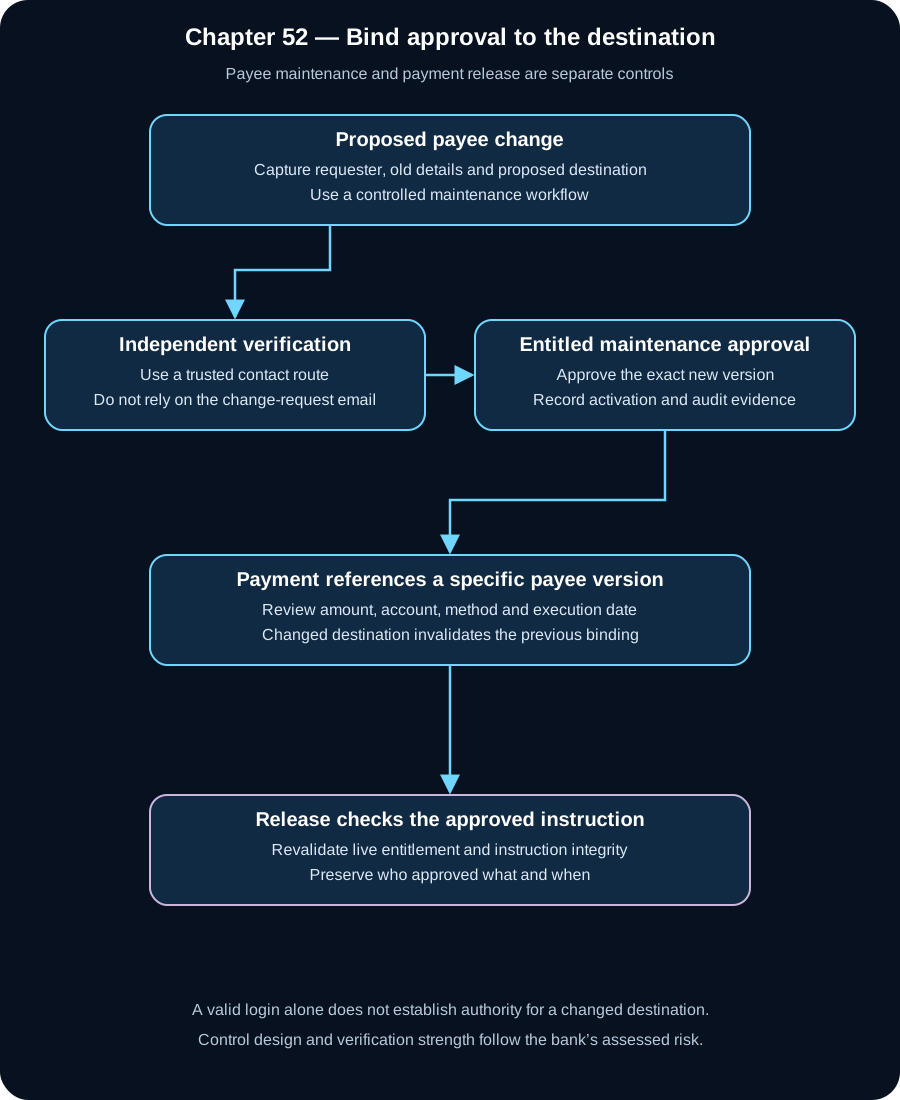
The diagram separates proposed data from effective payment data. A pending destination should not become usable simply because it was saved successfully. Once approved, record the effective version and which future instructions may use it. Do not silently redirect instructions that were already approved or released against another version.
Validation services answer specific questions. Routing-number validity, account status, ownership evidence and a name-comparison result are not interchangeable. Their availability and semantics depend on the bank and service. A positive result can support a control without proving that the underlying invoice or the person requesting the change is genuine.
6. Bind approval to the instruction that will leave
Approval should identify the contents being authorized. In an illustrative design, retain the payment identifier, version, amount, currency, debit account, destination, date and relevant supporting data. For a batch, preserve the approved population and totals. The implementation may use a digest or another integrity mechanism, but a technical hash alone does not establish business authority.
The approver needs a meaningful view of those contents. Showing only the batch name and total can conceal a substituted destination or an added item offset by a removed item of the same value. The view should highlight significant changes and give the approver appropriate access to the underlying population without unnecessarily exposing sensitive data.
A material edit after approval should trigger the approved reauthorization treatment. The policy may distinguish harmless presentation changes from financial changes, but that distinction must be explicit. The release service should not simply read the latest payee record and assume an old approval covers it.
For the $840,000 payment, preserve the old approved version and create a new version if the destination changes. The new version needs its own appropriate authority. That keeps the record explainable: the first approval was real, but it did not authorize a different destination introduced afterward.
7. Design dual control without creating an illusion
An illustrative maker-checker arrangement separates preparation from approval. Its value depends on genuine independence. Two clicks from the same person through different accounts do not supply that independence. Nor does a second approver add much protection if the screen hides the information that changed.
Define the rule precisely. It might require an approver other than the preparer, more than one approval above an internal amount threshold, or additional authority for a new payee. These are bank and customer policy choices unless a specific legal or service requirement applies. The chapter does not assert a universal US law requiring two human approvals for every payment.
Consider delegated authority and absence cover. Temporary authority should have an approved scope, start and end, and a visible effect on pending work. A senior employee's absence is not a reason to give the preparer an unrestricted release role. The contingency process should provide a legitimate alternative decision path.
Avoid designing control solely around the happy path. If the first approver leaves the company before release, or a second approval arrives after the requested date is no longer available, the service needs a defined outcome. It should not process an instruction with stale assumptions merely because the numerical approval count was reached.
8. Apply limits at the correct level
Limits can apply per payment, batch, user, legal entity, account, product or period. Those dimensions serve different purposes. A customer's agreed transaction limit differs from a user's approval authority, a bank's credit exposure limit and a rail's maximum amount. The release decision may need all of them, but it should report which one prevented execution.
A per-payment limit alone can be undermined by multiple smaller instructions. Where policy also limits aggregate exposure, the bank should count relevant pending or committed amounts, not only completed payments. Otherwise simultaneous submissions can each appear to fit within the remaining capacity while together exceeding it.
In a fictional daily control of $1 million, $700,000 already committed leaves $300,000 before considering other applicable adjustments. Two concurrent $200,000 requests cannot both rely on the same $300,000. The implementation needs an atomic reservation or equivalent coordinated decision, with defined release of capacity after a definitive failure.
Do not copy this arithmetic into a universal rules engine without defining the period and population. Time zone, business day, currency conversion, reversals, cancellations and cross-channel aggregation affect the result. An unresolved instruction should not free its limit reservation merely because a response timed out.
9. Separate approval from the bank's release decision
The customer's approval authorizes an instruction; it does not require the bank to ignore its own processing conditions. Before release, the bank needs the applicable authority, valid data, executable date, available funding or approved credit, service eligibility and required risk decisions. Their precise order can vary by architecture, but the final decision must concern one consistent instruction version.
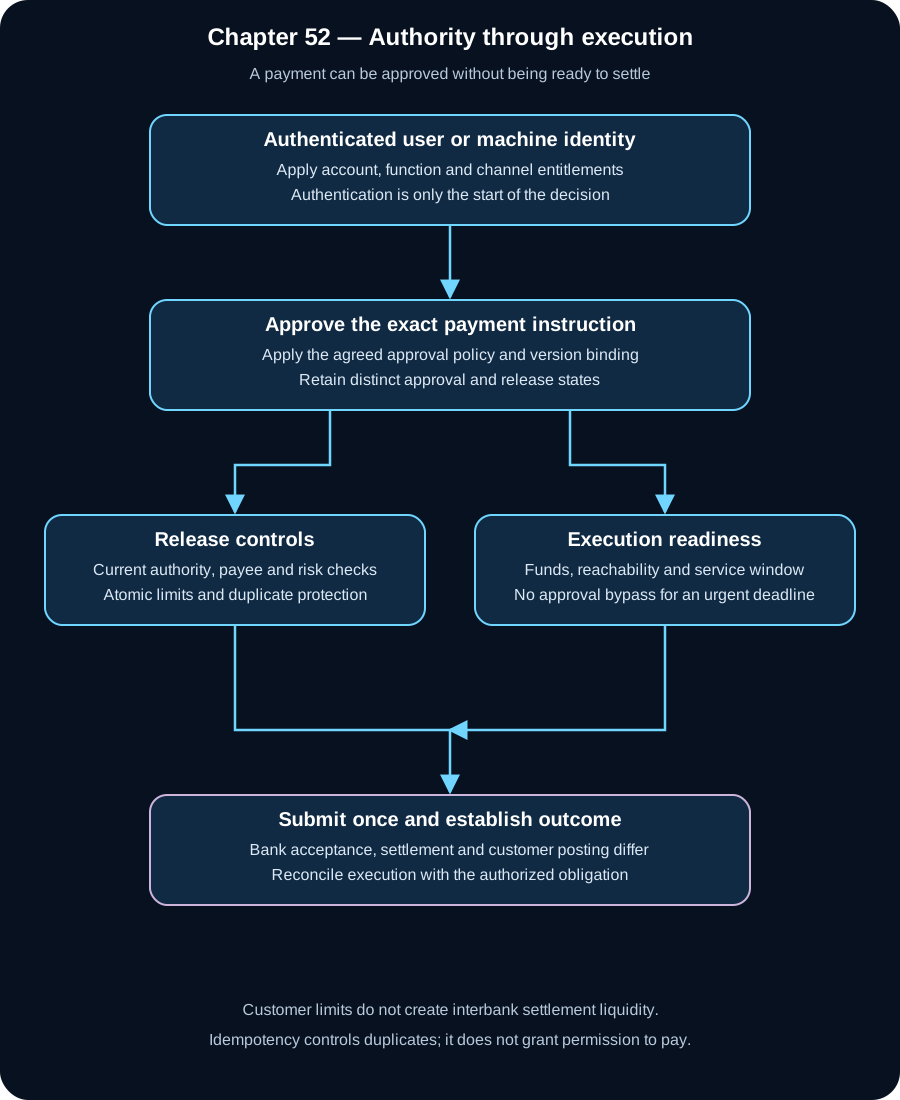
The diagram shows the final release gate and the return to repair or reapproval when a material condition fails. It does not prescribe a universal fraud-screening sequence. A compliance hold and a missing approval should remain distinct reasons even if both prevent transmission.
At release, create durable evidence of the instruction sent and the responsibility accepted by the next service. A command to a payment adapter is not yet interbank settlement. The adapter and rail can return additional states, which belong to the execution lifecycle. Chapter 53 examines the financial-finality distinction in more detail.
Control the narrow interval between checking and sending. If the bank checks version 4 but the adapter reads mutable version 5, the controls have not protected the instruction actually sent. The release design should use a stable snapshot or equivalent integrity boundary and identify any permitted transformation into the rail message.
10. Preserve authority through files and APIs
A corporate file can arrive over an authenticated connection after approval in the customer's own system. The bank's agreement should establish what authority that transmission represents and which controls remain with the bank. Requiring an additional portal approval may be appropriate for one product and incompatible with another; it should not be invented as a universal host-to-host requirement.
Keep file receipt, technical validation, business acceptance and release distinct. A positive transport acknowledgment should not be presented as approved payment execution. For batch services, retain the accepted population and the treatment of rejected entries. A corrected file must not cause successful entries from the original to be sent again.
API idempotency protects against repeated submission within the documented scope. It does not authenticate the user, verify the payee or create approval. The bank should bind the idempotency key to the intended operation and payload and handle a reused key with different financial contents according to its contract. A new key must not be used simply to escape an uncertain original result.
When translating a customer file or ISO 20022 instruction into a rail message, preserve the authorized amount, destination and relevant references. Record permitted enrichments and mapping decisions. If a required repair changes a material financial attribute, return to the appropriate authority process instead of treating all technical enrichment as automatically harmless.
11. Handle scheduled payments and changing conditions
A payment approved today for a later date has a waiting period during which circumstances can change. The payee can be suspended, account authority can expire, funds can fall, a sanction can apply or a service calendar can change. The bank should specify which conditions are checked at scheduling and which are checked again before release.
The customer also needs to know what cancel means at each stage. Removing a future instruction from a schedule is different from recalling a payment already sent. If a scheduler and release service act concurrently, the bank needs a reliable outcome that prevents both a successful cancellation confirmation and an unintended later release.
An illustrative scheduler reserves one execution instance for each due obligation. It records the approved version and obtains the current release decisions when due. A restart should resume the same instance rather than manufacture another payment because yesterday's process did not write its final status.
When the requested date becomes impossible, use the service's supported customer decision or escalation. Silently moving a tax payment, wage payment or time-sensitive supplier transfer can create harm even though the instruction remains technically valid. Approval of an amount does not necessarily authorize every later execution date or delivery method.
12. Emergency release and operational repair
Banks need contingency methods for a failed channel, an unavailable approver or a deadline-sensitive instruction. The fallback should preserve authority and traceability. A phone call to operations should not bypass the customer mandate, destination verification and duplicate checks simply because the original channel is down.
Define who can invoke the emergency process, which evidence is required and who independently verifies the action. Keep credentials and sensitive account data out of ordinary email. Where a service provides an approved offline security procedure, use that procedure and its current agreements rather than improvising one from historical practice.
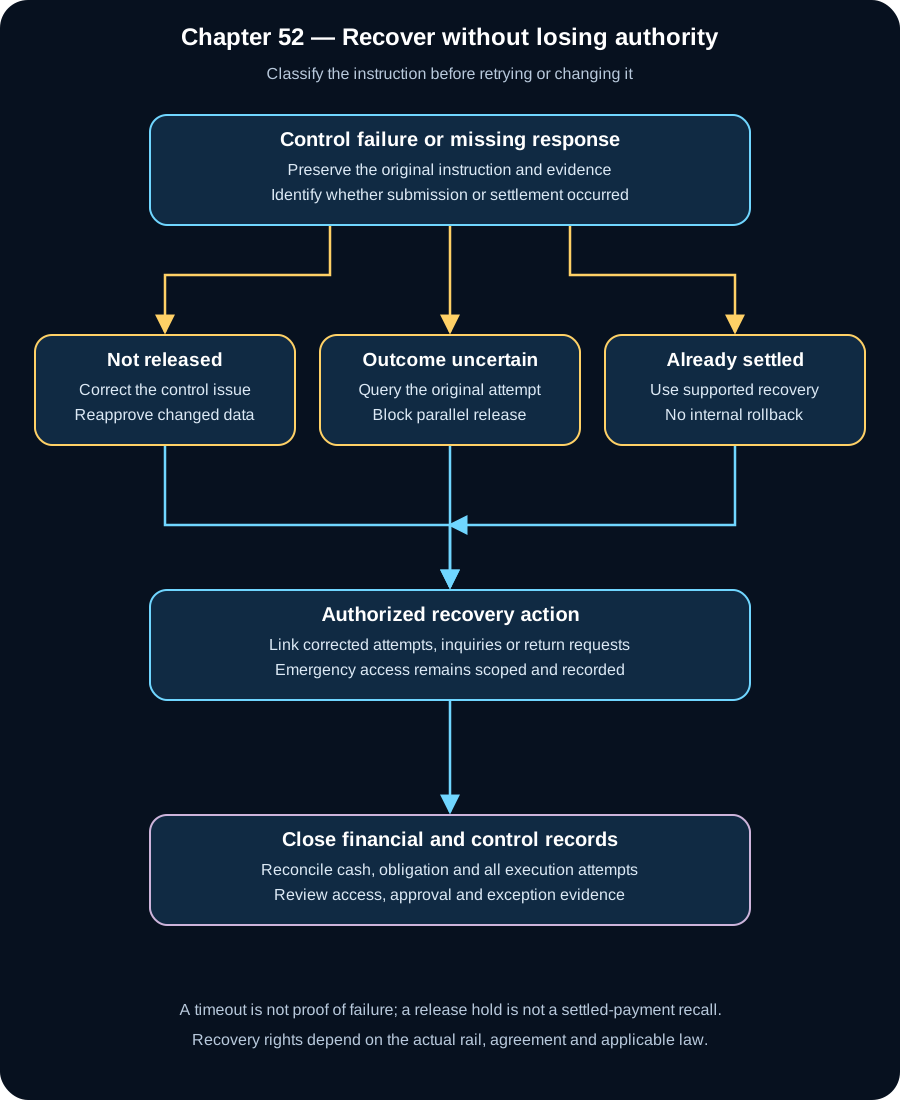
The diagram distinguishes a pre-release defect from an uncertain post-release outcome. The former can require correction and new approval. The latter requires inquiry and reconciliation before replacement. An emergency manual wire can duplicate an automated payment just as easily as an API retry.
After the incident, reconcile the contingency population with the primary system and remove temporary access. A correct manual payment can still cause a later duplicate if the original scheduled instruction remains active. The incident is not closed until financial outcomes, pending work and extraordinary permissions agree.
13. Legal evidence and the security-procedure boundary
For transfers within its scope, Article 4A addresses authorized and verified payment orders and agreed security procedures. New York's enacted Section 4-A-202 illustrates the distinction between actual authority and circumstances in which a verified order can be effective, including commercial reasonableness, good faith and compliance with agreed procedures and restrictions. Applicable law and the bank's agreement require specific legal analysis; successful login alone does not decide liability.
Security procedures and error-detection controls also have different purposes. A system can establish that a file came from the agreed source while failing to detect an erroneous amount or duplicate. The bank should identify which procedure verifies authenticity and which checks address mistakes, rather than describing every automated validation as legal authorization.
FFIEC supervisory guidance supports the design of authentication and access controls; it is not a payment-scheme rule or a universal allocation of customer loss. Network rules, bank contracts, consumer law and applicable funds-transfer law remain separate sources. Consumer protections cannot be displaced merely by calling a transaction approved or final.
The evidence package should permit the responsible team to reconstruct what occurred: identity, authority, relevant agreement, instruction version, user presentation, approval, release and later financial events. Preserve source timestamps and context. A screenshot of the current screen cannot substitute for the record of what existed when the decision was made.
14. Reporting, reconciliation and implementation ownership
Control reporting should show pending approvals, rejected authority decisions, payee changes awaiting verification, released instructions and unresolved releases. These are operational populations, not all financial postings. A payment awaiting approval should not reduce the customer's booked balance as though it had settled, although a product may apply an explicitly identified reservation or hold.
Reconcile the approved population to the released population. Every released payment should have the required evidence, and every approved payment should have an explained current state. Counts and totals can expose omissions, but item-level relationships are needed to identify a changed destination or a duplicate of the same amount.
Finance should distinguish a funds reservation, customer debit, bank control-account posting and settlement movement. Releasing a limit reservation after a definitive rejection is not a refund unless money was actually debited and requires return. Systems should not create a financial credit merely to clear an operational exception flag.
Implementation ownership spans product mandates, identity services, payment processing, operations, fraud, compliance and finance. Agree one decision record across these functions. Acceptance testing should demonstrate both an authorized release and a blocked release with a clear next action; a product that only shows success is not ready for real corporate administration.
15. Worked cases and implementation decisions
The supplier changes after approval
The $840,000 payment was approved for destination A. A legitimate administrator later verifies destination B, and the release service tries to use B. The bank must apply its material-change policy and obtain the appropriate new approval rather than reuse the old decision without checking its scope.
For the exercise, identify which version each approval covers and which contents the adapter will send. The control succeeds when the evidence binds those contents together, not merely when the payee master contains an approved record somewhere in its history.
Two payments consume the same remaining limit
The account has $300,000 of unused daily capacity under the fictional policy. Two $200,000 API requests arrive together. Each separately sees the same remaining amount. A correct implementation cannot release both solely on those independent reads.
Design the reservation and failure treatment. Then introduce a timeout for the first request and explain why its capacity cannot automatically be reused. The learner should distinguish a definite rejected reservation from an unresolved financial instruction.
An employee leaves while approvals are pending
An approver leaves the company after approving a future payment but before release. The bank must apply the approved policy for existing decisions and current release authority. Neither retaining all approvals automatically nor canceling every historical transaction is a defensible universal shortcut.
Specify the evidence the operations team needs: effective revocation, instruction version, scheduling state and contractual authority. Explain the treatment to the customer without requiring a former employee's credentials to complete or cancel the work.
A transport acknowledgment is treated as approval
The manufacturer's file-transfer tool reports success. Its treasury team assumes payroll was released, but the bank's business validation rejected the file. The transport message and payment-service message describe different events.
Prepare a completion report showing received, accepted and released populations separately. Identify the corrected submission and the duplicate controls that prevent a successful original subset from being replayed if the service supports partial acceptance.
A help-desk reset enables a new payee
An attacker persuades support to replace an administrator's authentication device, then immediately adds a destination and requests a large payment. The original login mechanism can be strong while the recovery process remains weak.
Review the reset evidence, recent-change signals, administrator powers and release controls. Propose a risk-based intervention with a legitimate recovery path for a genuine customer. Avoid making a permanent blanket hold the only way to manage every device change.
A manual contingency races the automated channel
Operations prepares a manual wire after an API timeout. The original request may already have reached the execution service. Before release, the contingency process must locate the original instruction and establish its outcome or follow an explicitly approved exceptional risk process.
Show how the business obligation, original request and manual attempt remain linked. After restoration, reconcile both channels and clear pending schedules. A successful emergency payment is not a complete recovery if the original can still release tomorrow.
16. Role checklist and learning closure
Product should define customer authority and the meaning of approval. Business analysis should specify actions, scopes, versions and state transitions. Technology should enforce the same authority at every interface and preserve instruction integrity through release. Operations should repair defects without bypassing authorization or duplicating uncertain payments. Risk and compliance should identify the relevant control and legal basis; finance should separate operational reservations from actual money movements.
The learner should now be able to challenge the statement that two approvals prove a payment is safe. The more useful question is whether the right actors authorized the exact instruction that the bank released under the conditions then applicable. Chapter 53 follows that released instruction into different settlement models and the evidence of finality.
Authoritative references
Sources checked on October 5, 2026. Internal roles, thresholds and workflows above are illustrative bank designs, not quoted regulatory mandates.
This application uses JavaScript for the full interactive experience. This text summary is served for accessibility and search indexing.