National Settlement Service and Clearing-System Settlement Models. Follow clearing-system balances through the settlement agent, NSS debit funding, final credits, rejected debits and account reconciliation.
A settlement agent sends Malla Bank a cycle report: its arrangement has two debit positions, $12 million and $8 million, and two credit positions, $15 million and $5 million. The total is balanced. One debit cannot be processed, however. The receiving banks are waiting for their credits, while one paying bank can already see money leave its Federal Reserve account. The agent needs to resolve the actual settlement state, not simply resend the balanced file.
Chapter 53 compared settlement models. This chapter examines National Settlement Service, or NSS, and the boundary between a clearing arrangement's calculated obligations and their settlement in Federal Reserve accounts. The numbers above are fictional positions for learning; they are not a real clearinghouse file or a production record layout.
The clearing arrangement calculates and owns its obligations. NSS processes settlement instructions against the designated account relationships. A balanced file, a successful submission and completed settlement are three different facts.
Allow roughly 60 minutes for the chapter, diagram walkthroughs and worked cases. Participants, values and internal systems are illustrative. Sources were checked on October 5, 2026. The current operating circular, service documentation and each arrangement's own rules govern production processing.
Chapter navigator
- Why a clearing arrangement needs a settlement service
- Participants, settlers and the settlement agent
- The settlement account and the settlers' master accounts
- Calculate positions before creating the NSS instruction
- File identity, content integrity and submission
- How posting reaches completed settlement
- A rejected debit is not a reason to resend everything
- Funding responsibilities when one settler cannot pay
- Operating windows and the meaning of the settlement day
- Extensions, disruptions and contingency coordination
- Clearing rules remain separate from NSS terms
- Security, sanctions and the underlying population
- Reconcile the arrangement, service and bank ledger
- Implementing NSS support inside a bank
- Worked cases and implementation decisions
- Role checklist and learning closure
1. Why a clearing arrangement needs a settlement service
A clearing arrangement can exchange a large population of transactions and determine what its participating institutions owe. It then needs a mechanism to discharge those obligations. NSS provides a Federal Reserve settlement service for approved arrangements, using settlement files delivered by an authorized agent. The underlying customer or market transactions remain part of the arrangement's own processing.
This separation allows an arrangement to calculate positions centrally while designated institutions settle them through their Federal Reserve account relationships. It does not mean the Reserve Banks have become the operator of every underlying payment scheme. The arrangement still needs rules for membership, transaction acceptance, calculation, disputes and participant responsibilities.
For Malla Bank, an NSS debit can represent its own position, positions settled for other participants, or the configured combination. The bank needs an allocation record explaining the amount. A master-account statement identifies the financial movement, but it may not contain the full customer or participant transaction population that produced it.
The business purpose is therefore both settlement certainty and operational coordination. The agent, settlers and participants need a shared view of the cycle so a final account movement can be reconciled back to the right obligations. Without that connection, a technically successful settlement can still leave business records unexplained.
2. Participants, settlers and the settlement agent
A participant belongs to the clearing arrangement. A settler provides the designated Federal Reserve account relationship for settling its own balance or balances for others. The settlement agent submits instructions on behalf of the arrangement under the required authority. Those roles can be performed by related organizations, but they should not be collapsed in the data model.
A smaller participant may rely on another institution as its settler. Its own account with that institution is a commercial relationship, distinct from the settler's master account at a Reserve Bank. The arrangement's net obligation, the settler's Federal Reserve posting and the participant's commercial-bank posting need connected references.
The agent needs authority to submit the agreed settlement population and to manage supported exceptions. The settler needs to understand what can be debited or credited and what information it will receive. A processor operating the technical connection does not automatically acquire the agent's legal authority or the settler's financial obligation.
Record the participant-to-settler mapping with effective dates. A participant changing its settlement bank between cycles creates a controlled relationship change, not a simple label edit. Historical cycles must retain the old mapping so returns, adjustments and investigations can still be reconciled to the institution that actually settled them.
3. The settlement account and the settlers' master accounts
NSS uses a settlement-account mechanism between the designated master-account postings. The account is associated with the settlement arrangement; it should not be drawn as an ordinary operating deposit at the agent's commercial bank. The participants' underlying customer accounts are another layer again.
Successful debit postings fund the settlement account. The credit side follows the service's funding conditions. That sequence matters because the agent can encounter a file whose debit processing has begun without the entire file reaching completed credit distribution. Treating NSS as an indivisible database transaction with no intermediate financial state would produce incorrect recovery logic.
The bank's internal ledger should distinguish its Federal Reserve asset movement from the payable or receivable relating to the clearing arrangement. If it settles for a respondent institution, the respondent's account posting is a separate entry on the settler's books. A single journal must not mix the books of the Reserve Bank, settler and participant as though they were one entity.
An operations screen can simplify these relationships while retaining the evidence. It should identify the arrangement, cycle, submitting agent, designated settler, debit or credit position and source report. Staff should not need to infer account ownership from a familiar institution name in a free-text description.
4. Calculate positions before creating the NSS instruction
The clearing arrangement establishes the population and computes its balances under its rules. NSS is not where a bank uploads arbitrary customer transactions and asks the Federal Reserve to decide which invoices, card purchases or payments should offset. The source calculation belongs upstream.
For the opening example, A owes $12 million and B owes $8 million; C is owed $15 million and D is owed $5 million. Debits and credits both total $20 million. The agent should also establish that every expected participant is represented correctly and that the calculation uses the approved cycle version.
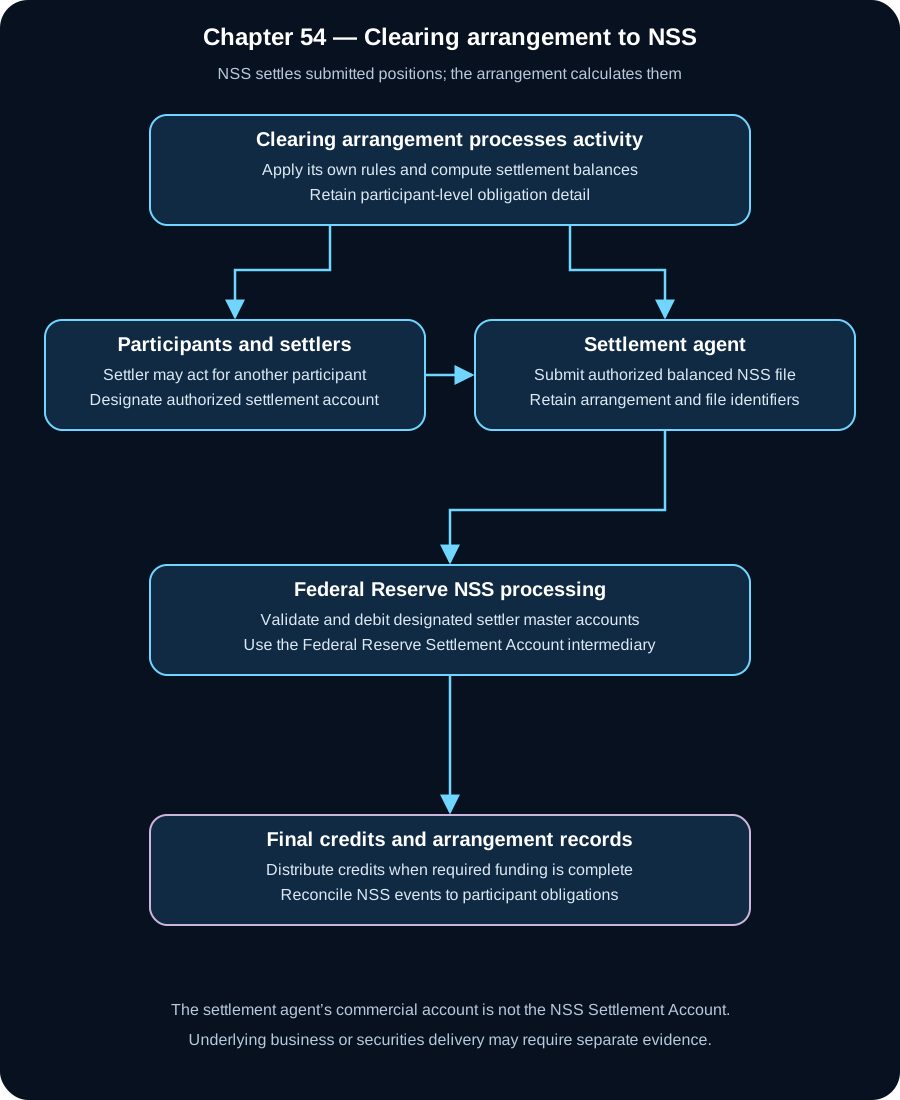
The diagram separates the calculation record, the authorized settlement instruction and the eventual account postings. It also preserves the mapping back to participants. The calculation may be based on gross or net balances as supported by the arrangement; NSS should not be described as itself performing every scheme's netting.
Balance checks are necessary but insufficient. Omitting equal debit and credit activity can leave a perfectly balanced file that is incomplete. Using the wrong participant mapping can also preserve the totals while moving money through the wrong institution. Reconcile source population, position calculation and settlement instruction before release.
5. File identity, content integrity and submission
The bank and agent need stable identities for the arrangement, settlement day, cycle and file version. Those internal identifiers should map to the current NSS specification and reports. This chapter deliberately does not invent fixed field positions, XML tags or an ISO 20022 message family for an NSS settlement file.
Retain the exact released instruction and its control totals. If an operator corrects a position after preparation, preserve the earlier version and obtain the required approval. A file name reused every day is not sufficient evidence of which contents were sent. Duplicate prevention should consider the service's actual identifiers and the bank's business-cycle identity.
Submission, acceptance and settlement notices need distinct meanings in the adapter. A successful connection confirms only its documented transport event. A validation failure should be associated with the original file and repair decision. A status inquiry should retrieve the existing instruction rather than automatically create another settlement attempt.
Production implementation requires the current participant specification, supported channel and agreed security procedures. Public product pages explain the service but do not replace operational certification. Where the public material does not establish a field or message behavior, the bank must obtain it from the service rather than infer it from a different Federal Reserve product.
6. How posting reaches completed settlement
Operating Circular 12 describes debit processing before credit distribution. Successful master-account debits and corresponding settlement-account credits are final when made. Credit positions are distributed when the settlement account is fully funded, including supported replacement funding where applicable; those postings are also final when made. The agent receives confirmation after full processing.
This means the bank must distinguish individual final postings from completion of the whole file. A paying institution can have an actual debit while credit institutions are still awaiting distribution. The agent's monitoring record should show that condition accurately, with the required amount, collected funding and unresolved debit identified.
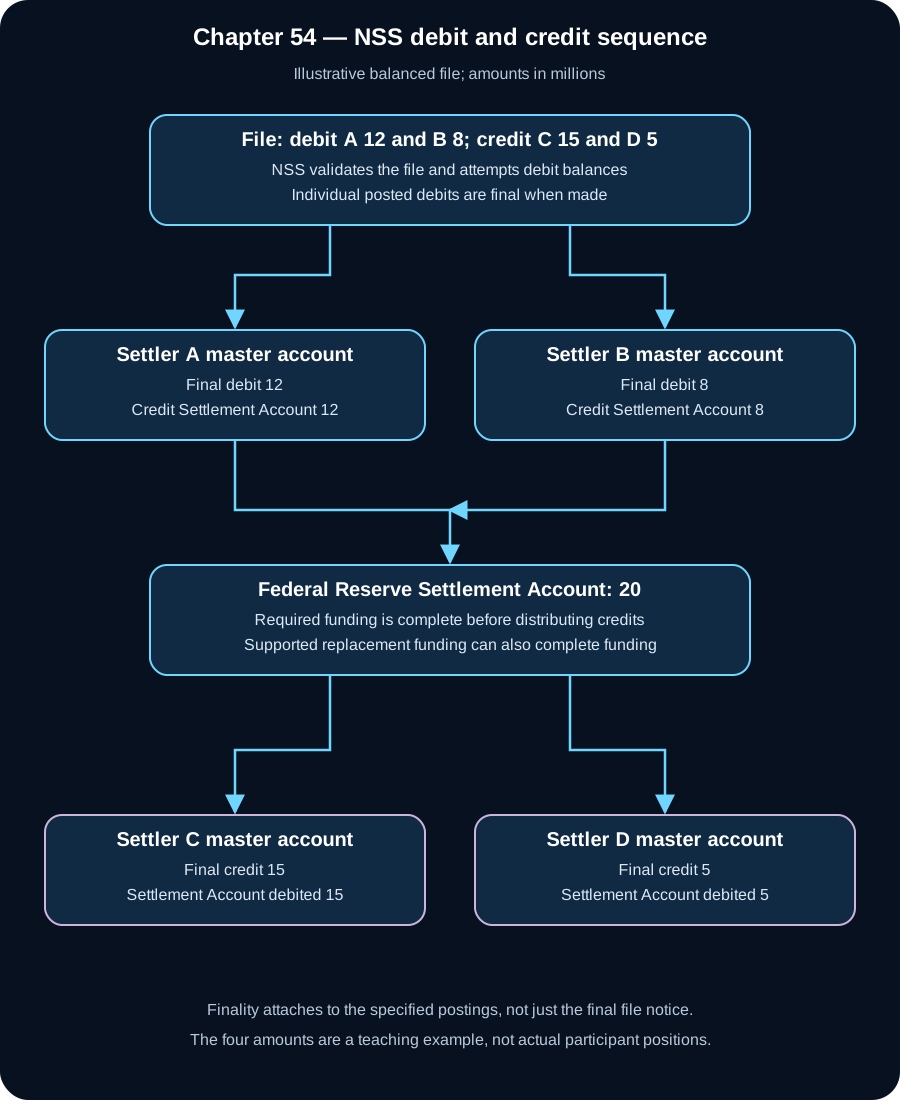
The diagram uses the opening $20 million example. It does not imply that a settler's ordinary customer credit is the NSS credit event. After NSS processing, a bank settling for others still has its own participant-account and reporting responsibilities.
A practical completion control reconciles the final service notice with the relevant account evidence and the arrangement's cycle record. It should not rely only on a single bank's statement: that bank can confirm its own posting without possessing proof of the entire arrangement's outcome. The agent and settlers hold complementary evidence.
7. A rejected debit is not a reason to resend everything
Under OC 12's supported exception process, the agent can request retry, arrange replacement funding through Fedwire, or instruct cancellation. Cancellation produces offsetting account movements for amounts already collected; it does not erase those earlier final entries. The selected notification option affects the process and should be configured from the current agreement.
Operationally, the first task is to establish exactly which debits posted and which did not. A generic file failed alert is inadequate if some money already moved. The agent needs the service state and responsible settler contacts before choosing a supported next action.
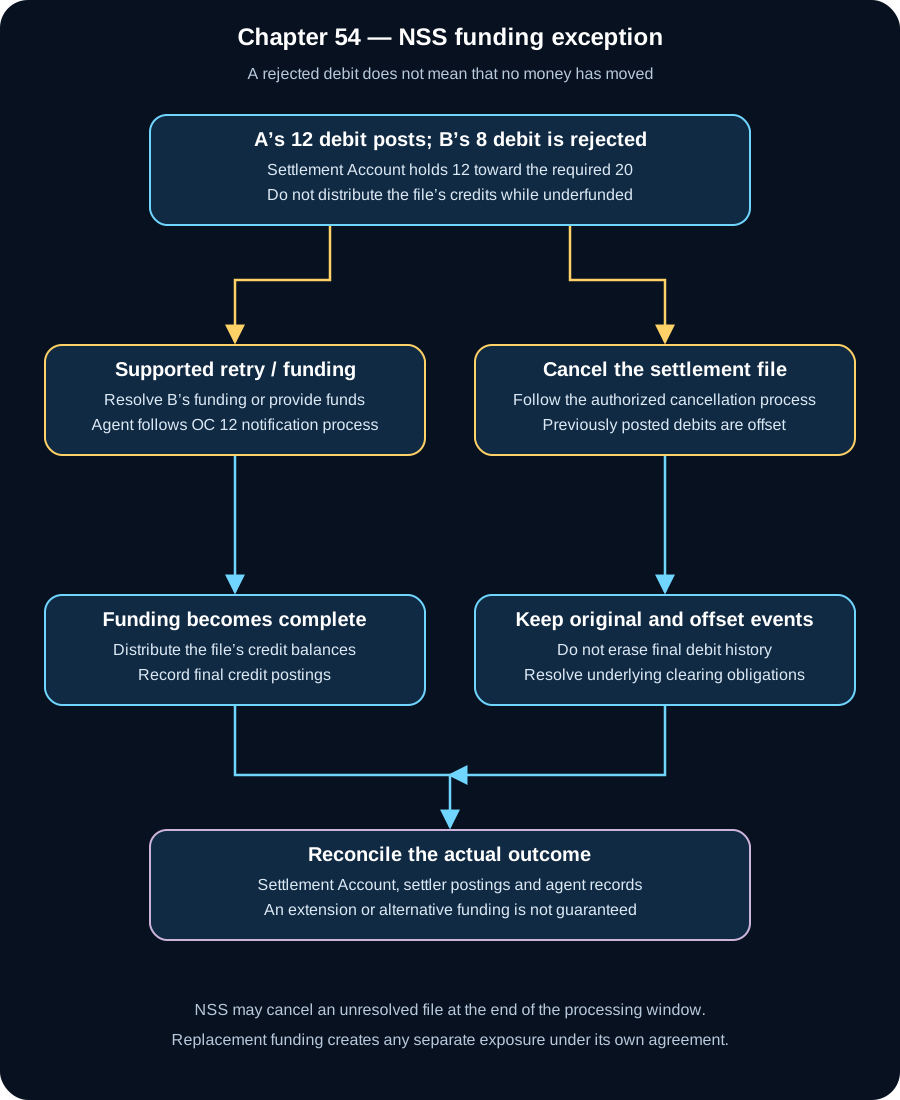
The diagram preserves the original file through resolution. It does not authorize an ordinary operator to fund another bank's obligation without the arrangement's authority and approved credit treatment. Replacement funding can create a separate claim between institutions that must be documented and reconciled.
If the agent chooses cancellation and a revised file, establish completion of the cancellation process before treating the revision as a fresh settlement. Parallel recovery attempts can otherwise collect a debit twice or leave unused replacement funding unexplained. The bank's control should operate across the automated and manual channels.
8. Funding responsibilities when one settler cannot pay
Return to A's $12 million and B's $8 million debit positions. Suppose A's debit posts but B's does not. The settlement account has $12 million against the $20 million requirement in the simplified example. C and D's expected credits are not funded in full merely because the file balances arithmetically.
The arrangement must decide through its authorized process whether B can supply funds, another approved source can fund the missing $8 million, or cancellation is appropriate. Treasury should identify actual available money and the route for moving it. An expected receipt later in the day is not already replacement funding.
If another institution supplies the $8 million, its claim against B or another party belongs to a separate contractual and accounting relationship. NSS does not decide the commercial allocation merely by accepting the supported funding movement. The agent should retain the authorization, source, financial reference and resulting obligation.
The receiving settlers also need accurate communication. They may have planned outgoing activity using the expected $15 million and $5 million receipts. Informing them promptly of an unresolved settlement lets them manage their own positions. Saying funds are on the way without identifying the unresolved cycle can conceal a material liquidity dependency.
9. Operating windows and the meaning of the settlement day
The current published NSS schedule opens file processing at 9:00 p.m. Eastern Time on the preceding calendar day and closes processing and file submission at 6:30 p.m. Eastern Time on the settlement day. The file-submission window normally opens earlier, at 7:15 p.m. on the preceding day, with a published holiday exception. Submission availability is therefore not identical to processing availability.
Use the current Federal Reserve schedule and holiday treatment in production. A bank's internal deadline can be earlier to allow calculation, approval and correction. The agent should not design its normal release for the last possible service minute and assume enough time remains to resolve a rejected debit.
The Federal Reserve announced expansion to Sundays and weekday holidays, planned for 2028 or 2029. That future expansion is not the operating calendar at this chapter's September 2026 review. Do not enable future settlement days simply because the long-term programme has been announced.
The settlement-day field and an ordinary calendar timestamp can differ when processing begins the prior evening. Reports should preserve both. A file submitted Sunday evening for a Monday settlement day should not be reconciled to Sunday's business population merely because that is the wall-clock date of submission.
10. Extensions, disruptions and contingency coordination
An extension is a supported service decision, not an entitlement created by a bank missing its own cutoff. The agent should follow current extension procedures and act on authoritative confirmation. Customer or participant commitments must not assume that a requested extension has already been granted.
Prepare for loss of the primary connection while a file is pending. The contingency team needs the original file identity, submission evidence and current service status. The first recovery action should establish whether the instruction arrived and what processing occurred, rather than create a duplicate through another channel.
Agree contact and decision ownership before an incident. A settler may be able to fund its own account, while the agent controls a file-level instruction. The bank's general customer-service team may not have authority to direct either action. A clear escalation map reduces delay without weakening the financial control.
After service restoration, reconcile contingency instructions to the main application. An operator's offline action must appear in the permanent cycle history. Suppressing alerts without restoring the financial record can leave the next shift unaware of money collected, returned or supplied from another source.
11. Clearing rules remain separate from NSS terms
OC 12 governs the Federal Reserve settlement service. The clearing arrangement's own rules determine the underlying obligations and relevant member responsibilities. Other law and agreements can govern customer transactions, commercial claims or market activity. These layers should be listed separately in the implementation requirements.
For example, settlement of a clearinghouse's cash position does not by itself prove that a supplier invoice was applied correctly or that every associated securities delivery completed. The arrangement may have separate legal finality rules for those obligations. A bank must identify the particular cash and business events being discussed.
NSS availability also does not mean every US clearing system uses it for every settlement event. Fedwire individual transfers, FedNow transfers and RTP prefunded-position settlement have their own mechanisms. A platform's choice to settle aggregate obligations through a bank does not automatically turn that process into NSS.
The bank should maintain an arrangement-specific profile identifying the source rulebook, settlement service, account structure and participant responsibilities. That allows reuse of technical components without forcing incompatible legal or financial assumptions into one generic net-settlement product.
12. Security, sanctions and the underlying population
The settlement file can contain institution-level balances rather than the full underlying customer population. It is therefore not a substitute for the participant's required transaction controls. A bank should not conclude that a balanced NSS instruction proves every underlying transaction passed appropriate sanctions, fraud or authority checks.
Protect the agent's authority and the participant mapping. An attacker who changes a settler account relationship or an aggregate position can affect large values without altering individual customer records. Apply the approved access, dual-control and integrity processes to preparation, release and contingency instructions.
Retain evidence of how the bank obtained and checked its settlement position. If the clearing arrangement provides only a total, agree the investigation access needed to explain differences and relevant risks. The bank does not need to copy every sensitive customer field into every settlement report, but it needs a reliable route to appropriate supporting evidence.
Separate a technical validation failure from a legal restriction or a funding deficiency. They may require different owners and remedies. A compliance issue in underlying activity should not be corrected by an unauthorized change to a settlement file merely to make the cycle complete on time.
13. Reconcile the arrangement, service and bank ledger
Use three linked reconciliations. First, reconcile the clearing population to participant positions. Second, reconcile those positions to the authorized settlement file and service outcome. Third, reconcile each settler's Federal Reserve movement to its own ledger and any participant-account postings. None of the three can be replaced by the others.
In the $20 million example, the final debit total and credit total should explain the cycle. If a debit was collected and later offset during cancellation, retain both movements. The net effect may be zero, but the intraday funding use and exception history were real. Deleting both entries would hide the bank's actual exposure and operational activity.
Where a settler serves respondents, reconcile the aggregate master-account movement to the individual respondent positions and any own-account share. A correct aggregate can conceal a wrong respondent allocation. Counts, identities, values and effective mapping versions matter alongside the final dollar total.
An unresolved item should carry an owner, cycle reference, amount, known financial state and next action. Avoid a generic suspense balance that grows across cycles without distinguishing missing clearing data, a pending NSS file, incomplete bank posting and a disputed participant charge. Those breaks require different evidence and remedies.
14. Implementing NSS support inside a bank
A practical service connects the clearing interface, position store, approval workflow, NSS connection, treasury position view and bank accounting. These can be separate components, but they need a shared cycle identity. An event record should preserve the original instruction and append its processing and financial outcomes.
Define recovery before automating retries. A transport retry may be safe only under the documented service behavior; a business-level resubmission can create another financial instruction. The adapter must distinguish inquiry, supported retry of an existing debit or file, cancellation and submission of a revised file. Generic retry-on-error middleware is not an adequate settlement policy.
Test a balanced but incomplete source population, a rejected debit after another debit posted, approved replacement funding, cancellation, an uncertain acknowledgment and a participant changing settlers between cycles. Finance should reproduce every test's account movements, including the cases whose final net cash effect is zero.
Operational readiness includes a current service calendar, configured notice option, authorized contacts, controlled backup access and retention of source reports. The bank should demonstrate the last unresolved cycle of an outage, not only a successful file on an ordinary morning. Chapter 55 connects these responsibilities to the broader intraday funding desk.
15. Worked cases and implementation decisions
A balanced file omits part of clearing
The expected $20 million cycle is submitted with equal debit and credit activity omitted. The remaining file still balances. The error is in the population and calculation, not something an arithmetic balance check can detect alone.
Ask the learner to reconcile the source transaction count, participant positions and approved file version. Identify which upstream control should have found the omission and how a correction must respect the current settlement state rather than overwrite a completed cycle.
One debit posts and the other is rejected
A's $12 million debit posts; B's $8 million debit is rejected. The bank's application calls the whole file failed and proposes resubmitting both positions. That ignores an actual financial movement.
Record the settlement-account funding, unresolved debit and pending credits. Select the supported agent process and explain why the original file identity must remain central. The correct answer should not assume that A's debit was provisional or never happened.
Another institution provides replacement funding
An approved institution supplies the missing $8 million through the supported funding route. The agent coordinates confirmation and the file can proceed when the required conditions are met. The funding institution now needs its own commercial claim and reconciliation.
Separate the NSS completion evidence from the agreement governing reimbursement by B. Who authorized the exposure, where is it booked and what confirms repayment? A complete technical settlement does not resolve that new inter-institution obligation automatically.
Cancellation leaves two genuine bank movements
The agent chooses supported cancellation after $12 million was collected. An offsetting movement restores the relevant position. The bank's net end-of-cycle effect is zero, but it experienced both an outgoing and returning amount.
Prepare the ledger and operations history without deleting either event. Explain the temporary liquidity effect and the evidence needed before a revised file is submitted. A zero net total does not mean there was no settlement processing to audit.
The receiving bank expects money before completion
C plans to use its expected $15 million receipt to fund another obligation. The NSS cycle is not fully funded. C's treasury forecast currently treats the receipt as confirmed available funds.
Move the amount into the appropriate expected or unresolved category and evaluate the resulting funding need. The exercise tests communication between the agent and settlers as well as the bank's forecast logic. It should not assume that C can use an unposted expected credit without another permitted funding source.
The agent loses connectivity near its deadline
The agent cannot retrieve the final response through its primary connection. Some processing may have occurred. An operator proposes using the contingency channel to send the same file again with a new identifier.
Establish the original service state through the approved recovery process first. Then show how any contingency action and subsequent restoration reconcile to one cycle. Identify the authorized decision-maker and the current service deadline; do not assume that an extension or full-file replay is automatically available.
16. Role checklist and learning closure
The clearing operator should establish the source population and obligations. The settlement agent should control the authorized file and its resolution. Settlers should fund and reconcile their designated account movements, including any participant relationships. Technology should distinguish submission, individual postings and complete processing. Finance should retain original and offsetting events. Legal and risk teams should distinguish arrangement rules, NSS terms and other obligations.
The learner should be able to explain why a balanced file can be wrong, why some debit money can move before credit distribution, and why cancellation is a financial process rather than deletion of history. Chapter 55 broadens the view to the bank's settlement accounts, expected flows, cutoffs and funding decisions throughout the day.
Authoritative references
Sources checked on October 5, 2026. The current service schedule takes precedence over hours quoted in historical guidance or older product material.
This application uses JavaScript for the full interactive experience. This text summary is served for accessibility and search indexing.