Intraday Liquidity, Cut-Offs, Settlement Accounts and Funding. Manage usable settlement liquidity, timed obligations, service cutoffs, funding transfers, eligible credit and operational stress.
Malla Bank starts the afternoon with $18 million available in the Federal Reserve account used for a group of settlement activities. Treasury expects $11 million of incoming funds and sees $23 million of committed outflows. The forecast looks comfortable if everything arrives in the expected order. Then a large receipt is delayed, an NSS cycle requires funding, and instant-payment customers continue sending money. The bank has assets and a positive end-of-day forecast, but it still needs usable funds in the right place before the next obligation falls due.
Chapter 54 followed a clearing arrangement's settlement cycle. This chapter examines the bank-wide decisions that make such settlement possible: account visibility, timing, funding capacity, release priorities, collateral and contingency action. It focuses on intraday and extended-hour payment funding rather than general balance-sheet strategy or a full regulatory liquidity-ratio course.
Liquidity is usable value in the required account, currency and time window. An expected receipt, an asset elsewhere and an unapproved borrowing option are not the same as funds available to meet the next settlement obligation.
Allow roughly 60 minutes for the chapter, diagram walkthroughs and worked cases. The bank, amounts, buffers, dashboards and decision thresholds are fictional. Sources were checked on October 5, 2026. Production limits, credit access, collateral treatment and service calendars require the institution's current agreements and official specifications.
Chapter navigator
- Start with the next obligation, not the closing forecast
- Map the accounts and positions that can actually settle
- Build a position from confirmed events and identified commitments
- Forecast flows by timing and confidence
- Keep customer cutoffs, service cutoffs and settlement times separate
- Current Fedwire and NSS windows
- Continuous payments still have funding calendars
- Daylight overdrafts and permitted intraday credit
- Collateral and funding capacity
- Prioritize release without breaking customer commitments
- Funding transfers have their own lifecycle
- Stress, outages and weekend coverage
- Monitoring, messages and financial evidence
- Reconciliation, accounting and bank implementation
- Worked cases and implementation decisions
- Role checklist and learning closure
1. Start with the next obligation, not the closing forecast
Intraday liquidity management asks whether the bank can meet its financial obligations when they arise. A positive closing balance does not establish that every earlier payment can settle. The order of receipts and outflows matters, particularly when one expected receipt funds several planned releases.
In the opening example, $18 million plus an expected $11 million less $23 million of committed outflows produces a forecast closing balance of $6 million. That arithmetic is valid only as a forecast. If all $23 million must leave before the receipt arrives, the bank has a $5 million timing gap before considering approved credit, other funding or reprioritization.
The bank should identify the obligation generating the outflow, the account it will affect and the deadline that matters. A customer wire, an NSS debit, an ACH settlement position and an institutional funding transfer can all consume liquidity, but their timing and control options differ. A single undated outgoing total hides those differences.
Treasury's role is not simply to stop payments when a balance becomes low. It is to arrange reliable funding and coordinate releases within the bank's commitments, risk appetite and applicable rules. The payment desk needs enough visibility to act early, before the only remaining options are expensive, unavailable or harmful to customers.
2. Map the accounts and positions that can actually settle
A bank may settle through its own Federal Reserve master account, a correspondent relationship, a prefunded payment-system position or another approved arrangement. Those locations should be individually identified. A corporate customer's deposit is a liability of the bank, while the bank's Federal Reserve balance is an asset; they are not the same account viewed through different screens.
A respondent bank using a correspondent needs to understand its commercial account and the correspondent's execution terms. The correspondent's Federal Reserve posting and the respondent's own account record can occur through different reporting channels. Available funds, limits and cutoff commitments must come from the actual agreement.
Prefunded system positions add another boundary. Money assigned to a particular arrangement may not be immediately usable for another obligation without a supported funding withdrawal or transfer. The bank should not sum all balances and assume the entire amount is freely available everywhere. Legal restrictions, operational windows and pending commitments can limit mobility.
Maintain an account map linking legal entity, currency, service, settlement relationship, reporting source and funding route. The map should distinguish owned balances from expected receivables and from credit capacity. That foundation makes a liquidity dashboard useful instead of turning it into a visually impressive total that treasury cannot spend.
3. Build a position from confirmed events and identified commitments
Start from an authoritative balance with a known timestamp. Add confirmed financial changes not already reflected in that balance, and subtract relevant committed or reserved outflows according to the bank's model. Keep expected receipts in a separate forecast layer. The calculation must avoid counting the same event from both a message feed and an updated account balance.
For a fictional operational view, the $18 million opening amount is confirmed. Of the $23 million committed outflows, some may already be reflected in the current balance while others are pending. Treasury must identify which before subtracting them. A dashboard that deducts settled payments twice can trigger unnecessary borrowing; one that misses pending releases can overstate capacity.
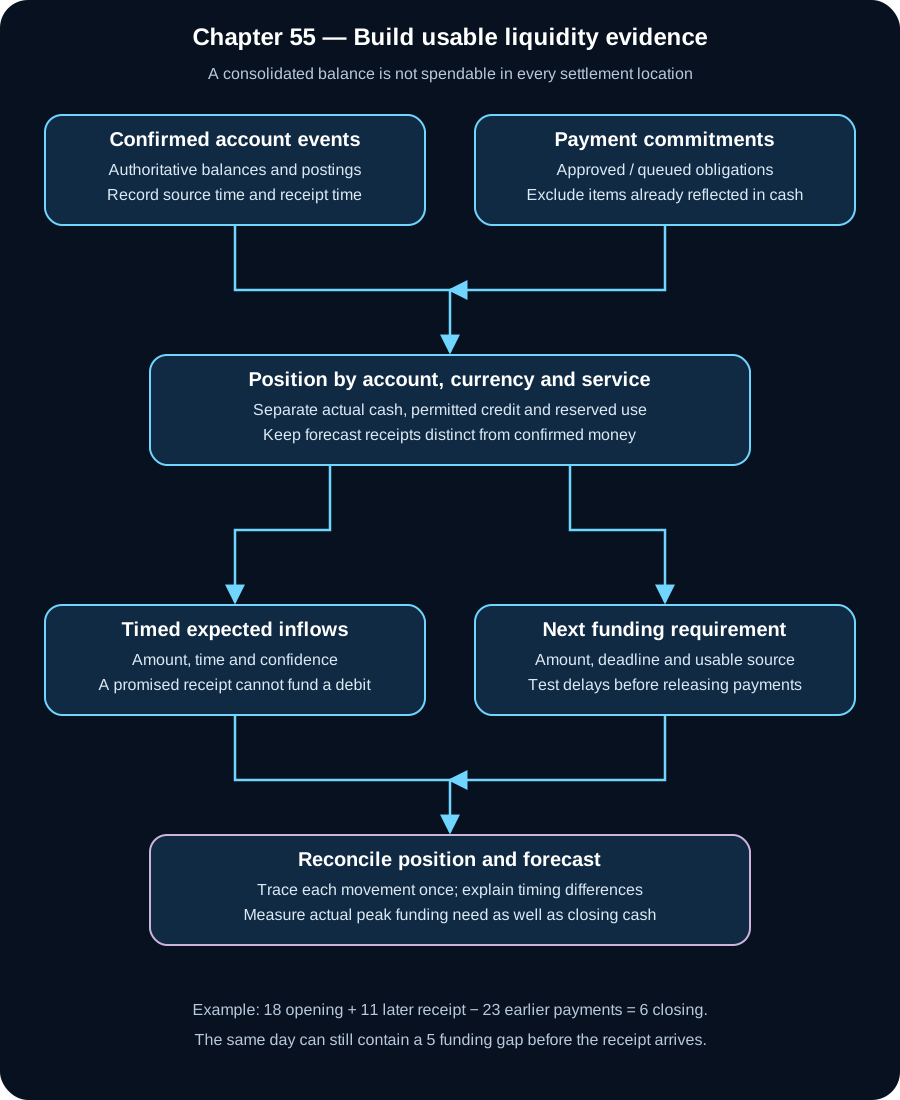
The diagram presents a decision view rather than an official account formula. Each input needs a source, timestamp and population. Different services can require different reservations or exposure measures, so the bank should document its definitions instead of imposing one simplistic formula everywhere.
Show uncertainty explicitly. A payment released with no confirmed outcome remains a potential outflow until the bank establishes what happened. Removing it from commitments because the technical request expired can permit another payment to consume the same funds. The funding view and duplicate-prevention view must agree on unresolved activity.
4. Forecast flows by timing and confidence
A forecast should distinguish scheduled obligations, highly predictable flows, customer-submitted instructions and less certain market or correspondent receipts. The categories need not imply a universal probability model. Their purpose is to show which assumptions the bank relies on and what happens if those assumptions fail.
A large expected incoming wire may be well evidenced by the counterparty's plan but still not settled. An anticipated customer deposit can be even less certain. Treasury should know whether a receipt is merely forecast, instructed, confirmed by the sending party or actually posted to the relevant account. These are different confidence levels, not interchangeable available balances.
For the expected $11 million, record the expected time, sending institution or source relationship and evidence owner. If it funds a hard deadline, identify an alternative before the expected arrival time is missed. The bank should not wait until settlement is due to discover that its funding source requires a separate approval or has an earlier cutoff.
Forecast errors should feed the operating model. Compare expected and actual time and amount, identify repeated delays and revise buffers or funding assumptions. The objective is better decisions, not a forecast that is manually edited after the event so it always appears accurate.
5. Keep customer cutoffs, service cutoffs and settlement times separate
A customer submission deadline is the bank's acceptance commitment for a product. A bank release deadline allows its processing and controls to complete. A service cutoff determines what the downstream service accepts. A settlement time or cycle determines when the account movement occurs. They can be related without being identical.
A corporate user seeing Fedwire's published final customer-transfer cutoff should not assume the bank accepts its file until that moment. The bank can have an earlier deadline for validation, sanctions review, funding and repair. Similarly, accepting a scheduled ACH file today does not mean its settlement debit occurs today.
The customer should see the applicable executable date and service terms before committing where the product allows that decision. If a deadline has passed, the bank should offer the supported next outcome rather than silently changing the date. The operational consequence can be a missed payroll, tax or supplier obligation even though the file remains technically valid.
Maintain calendars as controlled reference data. Time zone, holidays, service changes, temporary extensions and internal processing allowances must be traceable. A software deployment should not change a financial cutoff merely by replacing a hardcoded string without treasury, operations and product approval.
6. Current Fedwire and NSS windows
The published Fedwire Funds schedule operates from 9:00 p.m. Eastern Time on the preceding calendar day to 7:00 p.m. Eastern Time on the funds-transfer business day. Its customer-transfer cutoff is 6:45 p.m. Eastern Time, while bank-transfer and other message cutoffs follow the published categories. Special-purpose instructions can have earlier cutoffs; the ordinary wire schedule must not be applied to every tax or special-account instruction.
NSS processing runs from 9:00 p.m. on the preceding calendar day to 6:30 p.m. Eastern Time on the settlement day. The two services therefore do not close at the same time. A bank resolving an NSS funding problem must use the actual supported instructions and remaining time, not assume that a later general service close extends the NSS cycle automatically.
The Federal Reserve's planned expansion to Sundays and weekday holidays is expected in 2028 or 2029. It is not today's calendar. The bank should maintain the current weekday and Federal Reserve holiday treatment while tracking the announced change through a separate implementation programme.
This chapter's times are source-dated operating facts, not recommended customer submission times. Production systems should consume the current official schedule and service notices. They should also preserve the applicable business day when a service opens on the prior calendar evening, rather than allocating every event solely by local midnight.
7. Continuous payments still have funding calendars
FedNow processes instant-payment messages continuously, including weekends and Federal Reserve holidays. Its funds-transfer business day rolls at approximately 7:01 p.m. Eastern Time without interrupting transaction processing. The business-day label therefore changes before local midnight in many customer locations; reporting and reconciliation must use the service's actual cycle information.
FedNow liquidity-management transfers have their own published hours: 7:00 p.m. to 7:00 a.m. Eastern Time on weekdays, and continuously on weekends and Federal Reserve holidays. Do not infer that every funding message has the same availability as customer instant-payment messages. The actual participant and account arrangements also determine which transfers are supported.
An interbank liquidity-management transfer moves existing funds through a permitted relationship; it does not create unlimited credit or authorize a bank to debit another institution without agreement. Treasury needs a willing, authorized funding source and the correct account setup. A customer payment route should not be repurposed to bypass an unsupported institutional funding process.
For RTP, the bank should monitor its prefunded participant position and the relevant funding-agent arrangements. Its capacity can change continuously as payments arrive and leave. The general lesson is to fund the actual service position, not to assume that a 24-hour customer promise means every treasury operation or external counterparty is available around the clock.
8. Daylight overdrafts and permitted intraday credit
An institution can incur a daylight overdraft when its Federal Reserve account becomes negative during the day. The Federal Reserve's Payment System Risk policy governs intraday credit and relevant controls. Access, capacity and treatment depend on the institution and applicable arrangements; holding an account does not establish unrestricted borrowing rights.
Distinguish customer credit from central-bank intraday credit. A bank allowing a corporate customer to overdraw creates one credit relationship. The bank's own use of Federal Reserve credit is another. A customer being fully funded does not prove the bank's settlement account is adequately funded, and central-bank capacity does not authorize an otherwise unapproved customer overdraft.
Treasury should understand the institution's permitted limits, collateral position, monitoring and end-of-day obligations. A payment's technical acceptance does not establish that every policy limit has been respected. The bank remains responsible for managing its account and escalating exposures under its approved framework.
Intraday credit is not a substitute for a reliable closing funding plan. An institution expecting a late receipt should identify what happens if it fails to arrive. The permitted treatment of an end-of-day shortfall must be established through the appropriate borrowing or other approved process, not left to an assumption that daylight capacity simply continues overnight.
9. Collateral and funding capacity
Collateral can support eligible borrowing or intraday-credit arrangements, but the bank must know whether the assets are actually pledged, accepted, available and sufficient under the applicable valuation. An unencumbered security on the balance sheet is not automatically usable collateral in a particular account or facility at the moment a payment needs funding.
Lendable value can differ from market or face value because of the applicable margins and valuation treatment. The bank should use the current accepted value and consider other obligations secured by the same collateral. Counting the full asset value as new capacity while it already supports another exposure overstates available funding.
Operational preparation matters as much as nominal eligibility. Documentation, authorized contacts, asset transfer capability and testing can determine whether the bank can access a source in time. The chapter does not provide a universal haircut, borrowing rate or automatic amount because those depend on current policy and the specific asset and institution.
A practical collateral report should show location, eligibility, encumbrance, accepted value, supported obligations and the time needed for any change. Treasury and collateral operations need a common view. A spreadsheet of potentially pledgeable assets should be clearly distinguished from confirmed capacity already available for today's settlement decisions.
10. Prioritize release without breaking customer commitments
When capacity is constrained, the bank needs an approved release policy rather than ad hoc operator preference. Relevant considerations can include binding deadlines, customer commitments, service eligibility, settlement obligations and systemic dependencies. The policy must respect the actual rules and contracts, not create an informal right to delay any inconvenient payment.
A queue can help coordinate releases, but it should not conceal the customer's true status. Bank accepted, awaiting funding and released are distinct events. Staff should be able to identify the next action and whether the promised execution date is at risk. Hiding a funding hold behind an endless processing message delays both internal escalation and customer remediation.
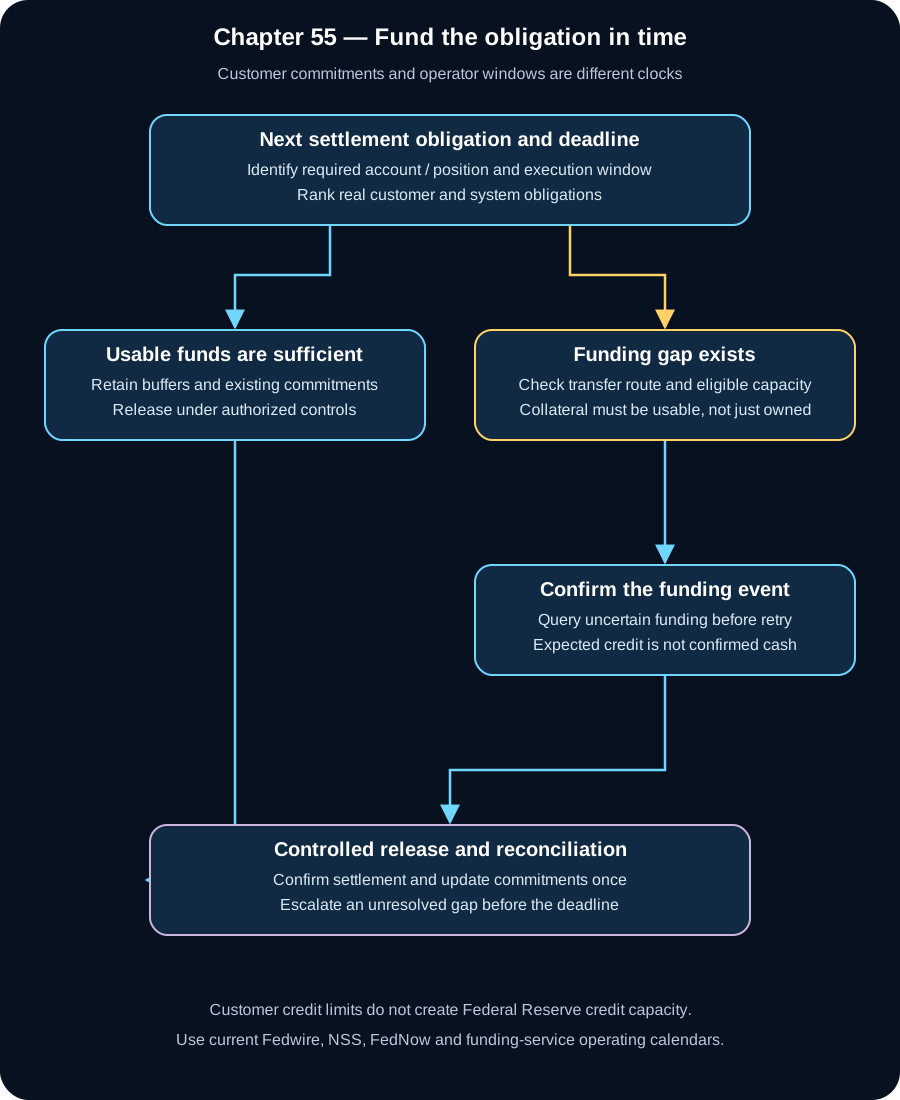
The diagram shows the decision before release. Once an instruction has left the bank and may have settled, it belongs to outcome investigation rather than ordinary queue reprioritization. Treasury must not assume it can recover capacity by deleting a record from its own queue.
Coordinate across channels. A manual treasury transfer, an automated instant-payment release and a clearing-system debit can compete for the same account resources. Separate systems that each see the same unreserved balance can overcommit the bank. The operating design needs a coordinated position or an equivalent control that accounts for those concurrent commitments.
11. Funding transfers have their own lifecycle
A funding decision is not yet a funding receipt. The bank must prepare and authorize the transfer, use the supported route, obtain the relevant financial outcome and reconcile the destination position. A treasury screen saying top-up requested should not immediately increase usable capacity unless the actual arrangement legitimately provides credit at that stage.
Retain the funding transfer's purpose and references. A movement into a prefunded system position may use another rail, but it should not be counted as a new customer payment or as unrelated revenue. The source account reduction and destination position increase must be linked to prevent double-counting during the transit interval.
If the response is lost, investigate the original transfer before repeating it. A duplicate top-up can tie up liquidity elsewhere even if no customer is paid twice. An uncertain withdrawal of prefunding can also leave the bank overstating funds in both the source arrangement and the expected destination account.
Replenishment thresholds should be internal decisions supported by the bank's flow patterns, risk appetite and available funding routes. The chapter's examples do not establish a regulatory buffer or a universal optimal balance. The objective is sufficient usable capacity with an explainable cost and exposure, rather than the largest possible idle balance everywhere.
12. Stress, outages and weekend coverage
Stress the arrival assumptions and funding dependencies, not just the total daily volume. A concentrated outgoing flow, delayed correspondent receipt, rejected NSS debit or unavailable collateral operation can produce a shortfall even when ordinary averages look safe. A service outage can also change customer behavior and cause accumulated payments to arrive together after restoration.
For extended-hour services, identify staff who can make decisions, contacts who can execute them and the funding sources actually available at that time. A weekday escalation list that reaches nobody on Sunday does not support a continuous customer product. Coverage should be proportionate to the service and institution, with clear authority and backup arrangements.
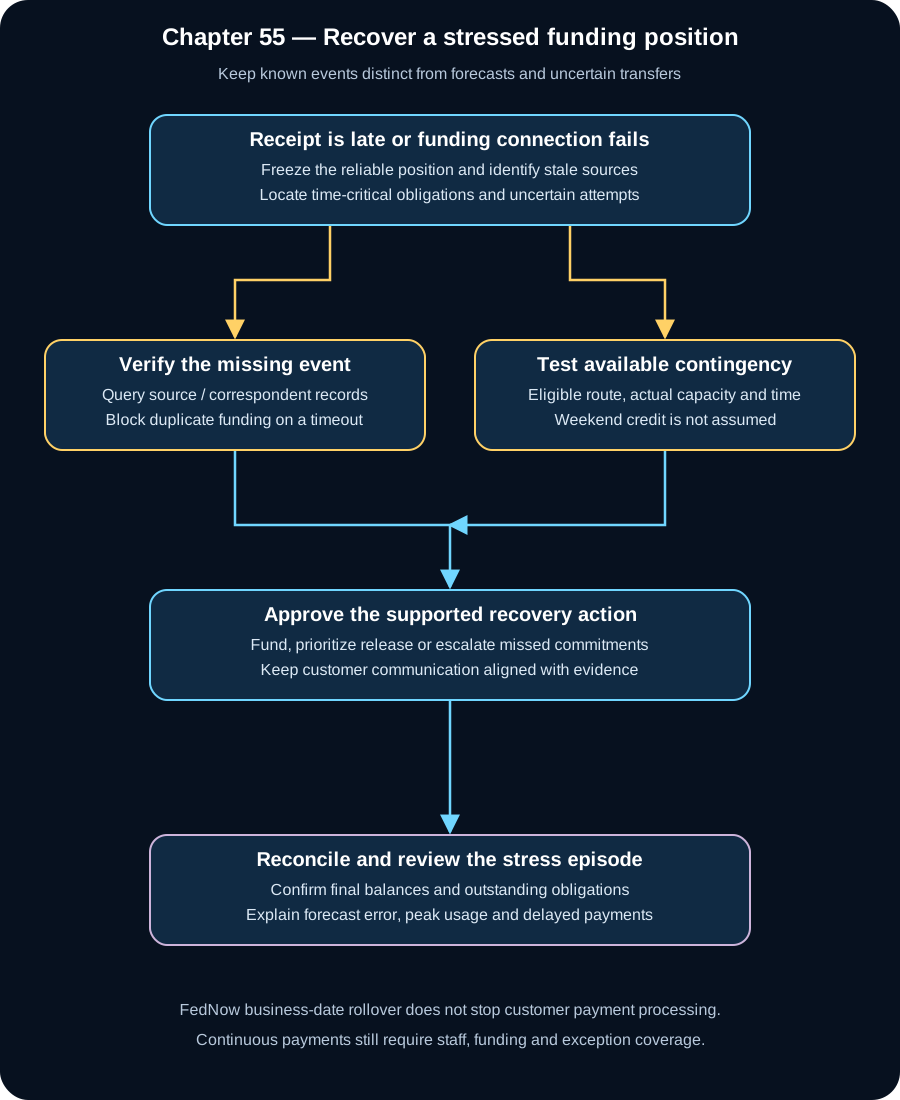
The diagram treats expected receipts as assumptions to test, not funds already held. Contingency choices need approval and confirmed outcomes. An emergency route should also preserve sanctions, authority and duplicate controls; the funding shortage itself is not permission to bypass them.
After an incident, reconcile every exceptional funding and release decision. Remove temporary access, resolve unused reservations and compare actual flows with the assumptions that failed. The lesson may be a better buffer, another funding relationship, improved reporting or earlier escalation, rather than a blanket increase in every account balance.
13. Monitoring, messages and financial evidence
A useful monitoring architecture combines authoritative account information, payment-service outcomes, committed instructions and forecast feeds. The bank should know each source's coverage and latency. A report that excludes a service or arrives after a decision can be accurate within its scope and still insufficient for current liquidity management.
Federal Reserve account information and service-specific reports can support the bank's view, alongside correspondent statements and private-system position reports. Use the current contracted formats and entitlements. An ISO 20022 report or status message must be interpreted under its service profile; a generic message-family label does not guarantee completeness across all settlement activity.
Timestamp both the financial event and the time the bank received the information. Late messages should update the correct historical event without being treated as new cash. Duplicate notifications must not increase available balance twice. A correction to a prior event needs explicit treatment rather than silent replacement of the entire position history.
Alerts should identify the account, service, amount, deadline and responsible owner. A red total without a time-to-action or funding route is difficult to use. The monitoring team needs to distinguish a real shortfall from a stale feed, but uncertainty in the feed should itself trigger the approved protective response rather than be dismissed as a cosmetic problem.
14. Reconciliation, accounting and bank implementation
Reconcile the opening balance and all actual movements to the closing balance for each account or position. Separately explain commitments, forecasts, credit use and collateral capacity. They influence decisions but are not all cash postings. A forecast receipt becoming confirmed should change its classification without creating a duplicate increase in the total.
A transfer between two of the bank's funding locations changes the composition of its assets or positions under the accounting policy. It is not income. Fees, interest and any borrowing create their own accounting entries. The bank should retain the link between the funding decision, transfer and destination capacity so finance can explain both cash and cost.
Measure operational effectiveness with defined populations: forecast timing error, funding exceptions, unresolved account differences, deadline misses and the duration of constrained capacity. Avoid ranking teams solely by lowest idle balances if that encourages unreliable customer execution. A sound metric connects efficient funding with the ability to meet obligations.
Implementation should join treasury, payments, collateral operations, finance, risk and service specialists. Demonstrate the opening $18 million scenario with a delayed $11 million receipt, competing releases and a permitted funding response. The acceptance criterion is an explainable sequence of decisions and balanced records, not merely a dashboard that eventually turns green.
15. Worked cases and implementation decisions
A positive closing forecast hides a timing gap
The bank has $18 million confirmed, expects $11 million later and must meet $23 million of earlier outflows. Its $6 million forecast closing surplus does not fund the interim $5 million gap. Identify the timing of each obligation and the available approved response.
For the exercise, prepare a timeline with actual balances after each event. Then move the expected receipt beyond the deadline. Explain which assumption failed and which funding or release decision must occur before the shortfall becomes an operational incident.
Money is available in the wrong position
The bank has cash in one account but insufficient capacity in a prefunded payment arrangement. An operator proposes using the aggregate bank-wide cash figure to approve more releases. That figure does not establish usable capacity in the relevant system.
Identify the permitted transfer, authority, operating window and confirmation needed to make the funds usable there. Record the transit state without counting the amount in both locations. Explain the customer impact if the funding route is currently unavailable.
An expected receipt is counted twice
A treasury feed marks an $11 million receipt confirmed. An account-balance update already includes it, but the dashboard adds the receipt again. The resulting view overstates funds by $11 million.
Design the reconciliation using a balance timestamp, covered event population and stable references. Then introduce a late notification of the same event. The correct outcome changes evidence completeness, not the bank's money a second time.
A cutoff is copied from the wrong service
A product team uses the general Fedwire closing time as the customer deadline for every payment, including instructions with earlier service-specific requirements. The file can arrive within that general time and still miss the required route.
Identify the customer, bank-release and downstream deadlines separately. Define how the channel shows the supported execution date and handles an unavailable date. The remedy is a correct service calendar and commitment, not a promise that every late instruction can use a faster rail.
A weekend funding plan assumes unrestricted credit
An instant-payment service experiences one-sided outflows on Sunday. The team assumes a liquidity-management transfer automatically supplies credit whenever the position is low. It has not established a funded counterparty relationship or the necessary account arrangements.
List the actual sources of usable value and the evidence needed to access each. Distinguish movement of existing funds from borrowing, and borrowing authority from a technical payment capability. Develop an escalation that works within the real available options.
A funding timeout triggers a duplicate top-up
Treasury requests $4 million of additional system funding and loses the response. The bank sends another $4 million before determining the original outcome. Both transfers later complete, leaving excess liquidity in the destination and less than planned in the source account.
Trace both transfers and the resulting account positions. Identify how inquiry, an unresolved reservation and a single funding-obligation record would have prevented the duplicate. Any recovery of excess prefunding must use the supported process and should not be booked as cash returned before it actually arrives.
16. Role checklist and learning closure
Treasury should know which balances and funding sources are usable at each deadline. Business analysis should separate account money, commitments, expected receipts, credit capacity and collateral. Technology should preserve source coverage and event identity. Operations should coordinate time-sensitive decisions across channels. Finance should reconcile actual movements without turning forecasts into cash. Risk should challenge the assumptions that make the funding plan work.
The learner should be able to explain why a solvent bank with a positive closing forecast can still face an intraday payment problem, and how disciplined funding and evidence resolve it. This completes Branch 11's progression from cross-border delivery and release authority to settlement models and usable liquidity. Chapter 56 begins the final branch with the US payment rules and regulatory map.
Authoritative references
Sources checked on October 5, 2026. The published schedules below are separate from customer cutoffs and internal treasury buffers. Future operating-day expansion is not treated as current availability.
This application uses JavaScript for the full interactive experience. This text summary is served for accessibility and search indexing.