Funds Availability, Holds, Returns and Check Fraud. Apply current funds-availability thresholds, supported holds, return deadlines, customer notices, check-fraud controls, investigations and financial corrections.
A customer deposits an $8,400 check and sees part of the balance become available. The person who sent the check then asks the customer to transfer $2,000 to someone else, saying the excess was a mistake. At the depositary bank, a fraud alert arrives after the initial credit. At the paying bank, the item may still be in its decision process. The customer needs a clear answer now, but the bank must keep availability law, check payment, return rights and fraud investigation separate.
Chapter 38 brings those decisions together. Chapter 36 established the collection lifecycle, and Chapter 37 established the image evidence. Here the focus is when funds must be available, when a hold is permissible, how an unpaid return works, and how banks prevent and investigate check fraud. The mobile-channel contract and original-paper controls are developed in Chapter 39. ACH conversion and its different consumer framework belong in Chapter 40.
Making check proceeds available is not a statement that the check is genuine. A fraud concern, in turn, is not permission to ignore availability rules or invent a return right.
For a roughly 60-minute core session, spend about 35 minutes on Sections 1–3 and Sections 5–7. For the next 10 minutes, use the chapter’s three diagrams to separate availability decisions, unpaid returns and later fraud claims. Use 10 minutes to work through one case in Section 15, then spend the final 5 minutes explaining: Why does making deposited funds available not prove that a check is genuine or finally paid? Treat these timings as a study guide. The remaining sections, additional cases and extended reference material are follow-up study; completing the whole chapter takes longer.
All cases and internal policy examples are fictional. The regulatory amounts discussed reflect the rules checked on 6 September 2026. State law, applicable federal provisions and valid account or service agreements must be applied to the actual facts.
Chapter navigator
- Four decisions that must remain separate
- Regulation CC scope and the relevant calendars
- Ordinary availability and current dollar thresholds
- Next-day categories and their conditions
- Large deposits new accounts and other exceptions
- Reasonable cause notices and customer impact
- Paying-bank returns and the separate deadlines
- Receiving returns and correcting the depositor position
- Fraud types and the evidence each requires
- Paying-bank controls and positive pay
- Depositary-bank controls and early loss prevention
- Stop payments customer duties and legal classification
- Fraud investigations sanctions and reporting
- Accounting reconciliation and operational management
- Worked cases and decision testing
- Role checklist and learning closure
1. Four decisions that must remain separate
The depositary bank decides whether to accept a deposit and when its proceeds are available. The paying bank decides how to handle the presented check. The banks process any return, adjustment or claim under the applicable rules. Fraud and financial-crime teams assess suspicious activity and the appropriate response. These decisions are connected through the same item, but they do not have one common legal basis or one common deadline.
The opening customer's available balance answers whether the bank permits use of funds under its account treatment. It does not prove the drawer authorized the check or that no later claim is possible. If the bank receives a fraud signal, it must assess the facts and the legal basis for any restriction. A generic risk score should not silently replace the funds-availability decision.
The paying bank's return responsibility is also separate from the depositary bank's hold. A longer lawful hold does not extend the paying bank's return deadline. A timely return does not prove that the depositary bank's original hold was lawful. Each institution must meet its own obligations, and the investigation should preserve evidence for both rather than treating the customer's eventual loss as the only relevant outcome.
A customer complaint can expose several issues at once. The check may be counterfeit, the bank may have sent an inaccurate availability notice, and a return may have been processed incorrectly. The bank should classify each issue and coordinate the remedy. Solving the interbank recovery does not automatically resolve an availability violation or a misleading customer communication.
A joined workflow starts with the event history
The case should identify the deposit day, channel, account, check type, amount, availability schedule, any hold and notice, presentment evidence, return information and customer withdrawals. It should also preserve the customer's explanation of how the check was obtained. These facts allow the bank to distinguish a routine unpaid deposit from a fraud scheme and to identify which controls were relevant at each point.
Suppose the customer received the check in response to an online sale. The buyer asked for an excess amount to be sent elsewhere. That story is relevant to fraud assessment, but it does not itself identify whether the check was forged, altered, drawn on a closed account or otherwise unpaid. The bank should preserve the allegation and use the instrument and account evidence to establish the payment facts.
The bank should also separate protective action from final liability. It may take a lawful, supported step to prevent further loss while investigation continues. That action should have an identified basis and scope. Staff should not describe a temporary restriction as a final finding that the customer committed fraud, or tell the customer that a suspicious-activity review guarantees reimbursement.
Internal status design should reflect these dimensions. The deposit can be posted, partly available, under review and later returned. The case can be open while the customer balance has already changed. A single status called fraudulent cannot explain which financial entries exist or what obligations remain. Linked records provide a clearer operational model than one heavily overloaded payment state.
The chapter's practical test is whether the bank can explain both what it is allowed to do and what has actually happened. That combination protects customers and gives operations a defensible basis for release, return, recovery and communication.
2. Regulation CC scope and the relevant calendars
Regulation CC contains several subparts with different purposes. Subpart B addresses funds availability and related disclosures for covered accounts and deposits. Subpart C addresses collection and return matters, including electronic checks. Subpart D addresses substitute checks. Teams should not assume that one scope statement applies identically to every part of the regulation.
A covered account for Subpart B generally includes the transaction-account categories identified in the regulation, subject to exclusions. The rules are not limited simply to consumer accounts; qualifying business transaction accounts can also be covered. Conversely, a product labelled savings or a deposit delivered as a remote image should not be assigned a Subpart B schedule without checking the applicable scope and contractual treatment. Chapter 39 addresses image-deposit availability directly. Regulation CC definitions and organization.
A business day and a banking day are not interchangeable. Regulation CC defines business days by excluding specified weekends and holidays. A banking day concerns the part of a business day when the relevant bank office carries on substantially all banking functions. The deposit's assigned banking day and the later business-day count must both be correct before a release date can be calculated.
Cut-off rules also need the correct channel. Under §229.19, the permitted cut-off cannot be earlier than 2 p.m. for the relevant bank-office deposits and noon for off-premises facilities, with the provision's specific treatment for deposits after cut-off or on nonbanking days. A bank can choose a later cut-off. These are legal boundaries, not a claim that all banks use those exact times. Regulation CC §229.19.
A calendar error becomes a customer error
Imagine a covered deposit accepted before cut-off on a Friday, with the following Monday a Regulation CC holiday. The first following business day is Tuesday. A system that simply adds one calendar day will release too early relative to its intended schedule; one that counts Monday as a business day can issue an inaccurate notice. Early availability may be the bank's choice, but it should be intentional and consistently reflected in the customer promise.
The bank should record the time zone used for the deposit and the calendar used for each calculation. A national bank may receive deposits through channels operating across several time zones. The server's UTC date is useful technical evidence but is not automatically the legally assigned deposit day. Requirements should specify the conversion and preserve the source timestamp.
Changing a customer's branch or product should not retroactively change an earlier deposit's calendar. The availability record should retain the rule version, assigned day and facts used. If a correction is necessary, the bank should show what changed and why. This makes it possible to investigate a notice that differs from the date shown later in online banking.
The bank also needs a policy for incomplete information. If the channel cannot identify the check type reliably, it should follow an approved review or default process consistent with law rather than assume a favorable or unfavorable category without evidence. The same applies to account age, customer relationships and daily deposit aggregation. Data quality is part of compliance because the schedule depends on those facts.
A useful implementation artifact is a decision record containing the applicable scope, deposit day, ordinary schedule, exception if any, released portions and notice evidence. It gives customer service a clear explanation and gives compliance a basis for testing. A release date alone does not show whether the bank reached the right result for the right reason.
3. Ordinary availability and current dollar thresholds
For an ordinary covered check deposit subject to the standard local-check schedule, funds generally must be available by the second business day after the banking day of deposit, with the first $275 of aggregate non-next-day check deposits generally available on the next business day, absent an applicable exception. The bank may provide earlier access. The current amounts became effective July 1, 2025. Federal Reserve compliance guide.
The key indexed amounts are $275 for the next-day minimum, $550 for the special cash-withdrawal provision, and $6,725 for specified new-account, large-deposit and repeated-overdraft provisions. These amounts have different functions. The $6,725 figure is not a universal check limit, and the $550 figure is not an extra amount automatically added to every next-day release. CFPB threshold adjustment rule.
The first-$275 rule concerns the customer's aggregate relevant check deposits on a banking day, not $275 from every individual check. A bank should apply the appropriate customer and account aggregation. If a customer deposits four ordinary checks, the system should not mechanically create four separate statutory minimum releases without considering the rule. More generous bank policy is possible, but it should be identified as policy.
The special cash-withdrawal provision permits different treatment for cash or similar withdrawals under its conditions. Section 229.12(d) includes a requirement concerning $550 by 5 p.m. on the day of ordinary availability, in addition to funds available under the applicable next-day provisions. Banks that use this distinction need precise channel and notice logic. Banks offering broader availability should not present a more restrictive legal option as their actual practice. Regulation CC §229.12.
Turning a rule into a release schedule
Take a fictional $2,000 ordinary covered check deposited on Monday before cut-off, with Tuesday and Wednesday ordinary business days and no exception. A bank using the standard schedule would generally make $275 available Tuesday and the remaining $1,725 Wednesday, subject to the cash-withdrawal distinction if lawfully used. The example assumes the relevant scope and conditions; it does not describe mobile-image deposits or every instrument category.
The implementation should represent these as portions of one deposit, not separate deposits. The first release changes available funds without creating another ledger credit. If the check later returns, the bank must link the return to the original $2,000 item and account for any use of the funds. A system that treats each release as a new financial credit will overstate the customer's balance.
Now add a second $500 ordinary check deposited later on the same banking day. The bank needs the customer's aggregate treatment and any policy that exceeds the minimum. It should not reset the statutory calculation merely because the customer used another branch or account. The relevant aggregation should be designed deliberately, including how joint ownership and multiple accounts are handled under the applicable provision.
Threshold updates require effective-date control. A historical deposit should be assessed using the applicable rule at the time, while new deposits use the current amounts. Updating only the customer disclosure while leaving the release engine on an older value creates a direct inconsistency. Updating the engine but not teller notices creates another. The bank should test all affected outputs together.
The customer explanation should state when each portion becomes available and any relevant condition. It should not say the check is verified simply because the first portion was released. The availability schedule is a right or product promise about use of funds, and its language should remain faithful to that purpose.
A nonproprietary ATM is a separate schedule case
Section 229.12(f) provides a fifth-business-day schedule for cash or check deposits at a nonproprietary ATM, subject to the applicable framework. The channel must therefore be classified correctly before applying a familiar branch-deposit example. Nonproprietary status depends on the regulation's ownership or operation relationship, not simply whether the customer recognizes the ATM's brand.
For an illustrative Monday banking-day deposit with no intervening holiday, the fifth following business day is the next Monday. This example assumes the relevant schedule applies and no supported exception changes it. A bank offering earlier access can do so, but its disclosure and release engine should reflect that policy accurately. The example should not be copied to a proprietary ATM or mobile-image deposit without establishing the correct treatment.
An implementation test should vary only the ATM classification while keeping the instrument and customer the same. It should also test a holiday in the sequence and a deposit after the applicable cut-off. Those small changes can produce different release dates. The customer should see the schedule for the actual deposit, while the original ledger credit and collection identity remain unchanged.
4. Next-day categories and their conditions
Certain covered check deposits qualify for next-day treatment when the specified conditions are met. The categories include Treasury checks, U.S. Postal Service money orders, Federal Reserve and Federal Home Loan Bank checks, certain state or local government checks, cashier's, certified and teller's checks, and qualifying on-us checks. The conditions differ and should not be reduced to a list of instrument names.
For example, Treasury-check treatment includes deposit into an account held by a payee. Several other categories require deposit in person to an employee, and some allow a special deposit slip requirement. State and local government checks have a location condition. Qualifying on-us treatment has its own conditions. Certain listed checks deposited other than in person generally receive second-business-day treatment under §229.10(c)(2), rather than automatically receiving the same next-day treatment. Regulation CC §229.10.
A counterfeit item can display the name of a next-day category. The bank must still identify the instrument correctly and assess any lawful exception. Staff should not promise unconditional next-day access based only on a printed label. Equally, they should not deny the required category merely because it is operationally inconvenient to identify it.
The deposit record should retain the facts used for classification: instrument type, payee-account relationship, deposit channel, location and any required special slip. The bank's rule engine can then produce an explainable schedule. If one condition is missing, the system should identify the actual treatment rather than silently falling into a generic long hold.
The same instrument can receive different deposit treatment
Consider two customers depositing similar bank-issued checks. One deposits in person into the payee's account and meets the required conditions. Another uses a channel where the relevant in-person condition is not met. The bank should apply the correct rule for each case. The difference is not evidence of arbitrary treatment if it follows the applicable provision and is accurately disclosed.
A third-party deposit creates another question. A check made payable to one person but deposited into another person's account may not satisfy the payee-account condition for a particular category. The bank also needs to assess entitlement and product acceptance. It should not treat an endorsement as automatically satisfying every availability condition without legal and policy analysis.
The application should support correction where the classification was wrong. If a teller failed to identify a qualifying instrument, the bank may need to adjust availability and address any resulting customer harm. The correction should retain the original classification, supporting evidence and changed schedule. Simply releasing the funds without a record can hide a recurring control problem.
Training should use realistic counterexamples. A retail money order is not necessarily a U.S. Postal Service money order. A business check bearing a bank's name in a memo is not a cashier's check. A state-government check deposited outside the relevant state may not meet the same category conditions. These examples teach staff to identify the facts rather than memorize a few favorable labels.
The operational goal is consistent application. The bank should make the classification process easy enough for the channel to use correctly, with review for uncertain cases. Accuracy here prevents both unnecessary customer delay and an unsupported early-availability promise that staff mistakenly describe as a legal requirement.
5. Large deposits new accounts and other exceptions
Regulation CC permits specified exceptions to ordinary availability. They include new accounts, large deposits, redeposited checks, repeated overdrafts, reasonable cause to doubt collectibility and emergency conditions. Each has its own conditions and treatment. An exception is not a general permission to hold every check for a preferred number of days.
The large-deposit provision applies to the aggregate amount exceeding $6,725 on a banking day under the rule. It does not automatically remove ordinary treatment from the entire deposit. For an $8,400 ordinary covered check with only that exception applicable, the excess is $1,675. The first $6,725 remains subject to the otherwise applicable schedule, including its relevant minimum release. The bank must use the correct aggregation and notice requirements.
New-account treatment is different. The rule defines the initial 30-calendar-day period and an exception based on qualifying prior account relationships. Certain specified checks retain treatment for the first $6,725, while the excess must be available no later than the ninth business day. Ordinary checks in a new account do not simply inherit that same ninth-day rule from this provision. The bank must apply its lawful disclosed policy and any other applicable requirements. Regulation CC §229.13.
A redeposited-check exception also has exclusions, including specified corrected missing-endorsement and no-longer-postdated cases. Repeated-overdraft treatment depends on defined account-history criteria. The bank should implement those conditions from the rule rather than replace them with a broad customer risk category. Emergency treatment requires the actual qualifying circumstances and appropriate diligence.
The exception engine needs reasons and amounts
For the $8,400 example, a well-designed decision record shows the ordinary portions and the $1,675 excess subject to the large-deposit exception. It should identify the release date for each portion and the basis for extending it. A single hold flag for the full $8,400 can conceal an unlawful result if no other exception supports that treatment.
If another check arrives later the same day, the aggregate may change. The bank needs a defined process for recalculating the applicable amounts and issuing any necessary notice. It should not create contradictory schedules across channels. The customer should be able to see the current treatment while the bank retains the earlier decision and the reason for the update.
New-account classification should use customer relationships, not only the age of the account number. A customer opening another account at the same bank may fall within the rule's prior-relationship provision. An implementation that marks every newly opened account as new for availability purposes can be wrong. The bank needs reliable ownership and historical-account data to apply the definition.
The reasonable-period provisions for specified exceptions should also be applied precisely. The regulation describes extensions associated with particular check categories, including a five-business-day extension for the standard local-check schedule, with longer periods requiring the bank to establish reasonableness. This is why an ordinary second-day schedule can become seventh-day availability under a supported exception; it is not a universal seven-day hold for every check.
Operations should review exceptions that cannot be explained from the data. A missing account-history feed is not evidence that the repeated-overdraft criteria are met. A high amount is not itself evidence of fraud. The bank can design prudent controls, but each availability restriction needs its own lawful basis and accurately stated customer effect.
Repeated overdrafts require a historical test
The repeated-overdraft exception has specific tests rather than a general definition of a risky customer. Under §229.13(d), the relevant account or combination of accounts can qualify through negative or would-have-been-negative balances on six or more banking days within the preceding six months, or through balances negative or that would have become negative by $6,725 or more on two or more banking days in that period. The provision permits the exception for six months after the last qualifying overdraft, subject to its requirements.
The would-have-been-negative language means that returned charges can be relevant even if the bank prevented an actual negative closing balance. The implementation should use the legally relevant history and calculation, not simply count how many overdraft fees appeared on a statement. Fee waivers, different fee policies and returned payments can make fee count an unreliable proxy for the required test.
A useful test customer has five qualifying banking days in the review period and no qualifying two-day large-negative pattern. The system should not invoke the exception solely because five feels frequent. Another customer may satisfy the six-day test even if the bank waived all related fees. The expected result must come from the criteria and applicable notice treatment, with the underlying dates retrievable for review.
The same discipline applies to redeposited items. The regulation excludes specified cured missing-endorsement and no-longer-postdated cases from that exception when its conditions are met. A generic redeposit flag should not automatically extend availability without looking at the recorded return reason and cure. This is an example of why accurate exception data matters beyond the original return workflow.
6. Reasonable cause notices and customer impact
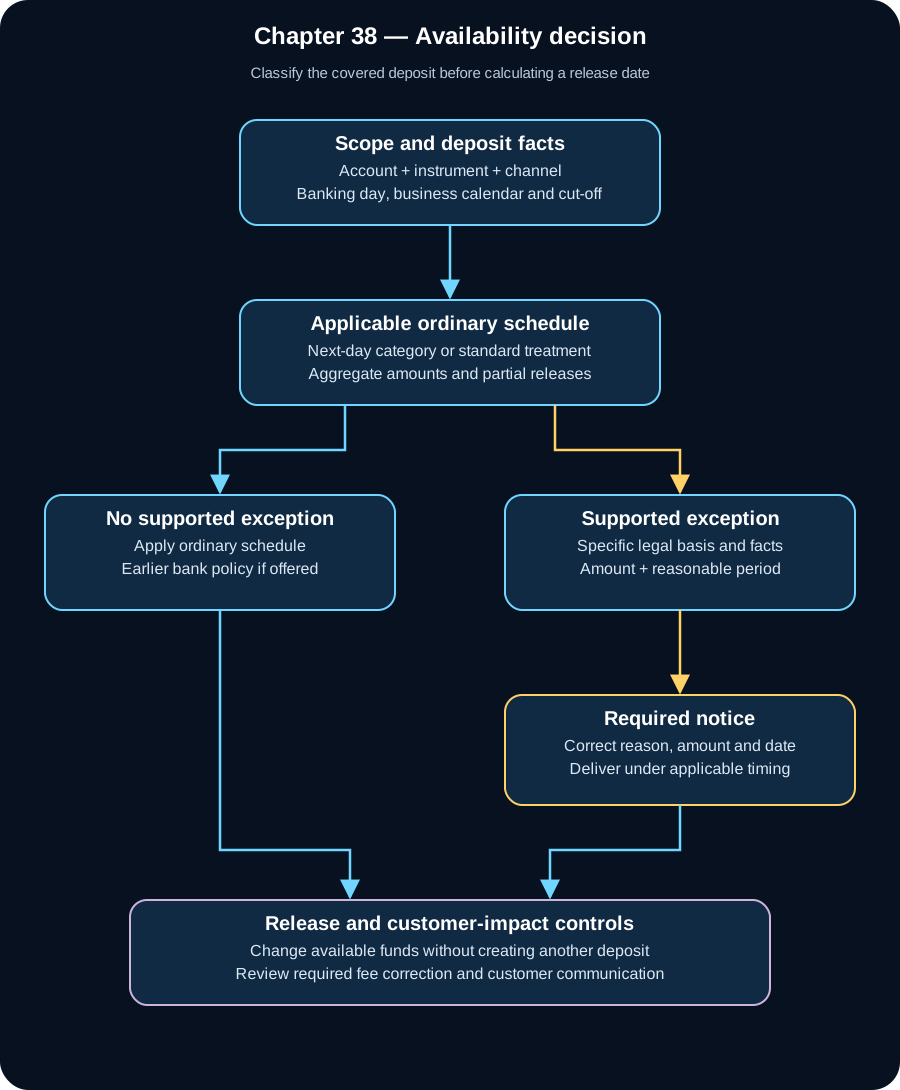
Reasonable cause to doubt collectibility requires facts supporting a well-grounded belief that the check is uncollectible. The rule does not permit that belief to rest merely on the class of check or class of depositor. The bank should retain the actual facts and the reason communicated in the notice. A generic fraud-risk label without supporting evidence is a weak basis for a decision with direct customer consequences.
Exception notices under the relevant provisions identify the account, deposit date, delayed amount, reason and availability period. They generally accompany the deposit when required, with specified later-delivery treatment where the deposit is not made in person or the relevant facts become known later. The bank should apply the exact timing and permitted alternatives in §229.13(g), including the distinct emergency notice treatment.
A hold notice is a customer document, not just an internal case note. The bank should retain what was delivered and when. If a branch prints a notice but it never reaches the customer, the system should not automatically treat delivery as established. Electronic delivery should follow the bank's applicable legal and channel requirements.
The bank should also assess fees and downstream effects where the rule requires it. A delayed availability decision can cause an overdraft or a returned payment. The reasonable-cause provision contains specific protections and notice/refund treatment in certain circumstances. Staff should not assume that correcting the release date alone resolves every resulting customer issue.
A late fraud signal needs a lawful response
Suppose a bank accepts an ordinary check before cut-off and later receives credible information that the item is counterfeit. The team should record when the information became known, what it establishes and which legal or contractual action is supported. If an availability exception is used, its conditions and notice requirements still matter. The fact that the information arrived late should be visible in the decision history.
The notice should explain the applicable reason without disclosing confidential suspicious-activity reporting or presenting an unproven allegation as fact. Customer service can say that the bank has a stated reason to doubt collection and explain the schedule. It should not reveal a SAR filing or imply that all customers in a demographic or occupation receive the same treatment.
If the concern is resolved, the bank should update the availability treatment as required by its obligations and policy. The record should show what new evidence changed the decision. Keeping a hold in place simply because the original date is convenient can be inconsistent with the actual basis or customer promise. Conversely, releasing funds does not require staff to declare the instrument immune from every later claim.
The bank should test notices for partial holds. A notice saying “your deposit is delayed” is ambiguous if only $1,675 of an $8,400 deposit is affected by the stated exception. The customer needs to understand which amount is available and when the rest will be released. The same amounts and dates should appear in the channel, statement history and support view.
Management review should examine both false positives and missed risk. An aggressive hold policy can harm customers even when it reduces immediate losses. A permissive policy can expose customers to scams if communication implies that availability proves legitimacy. The correct objective is lawful, evidence-based treatment with clear customer information and effective fraud response.
Notice timing and a downstream-fee example
For the ordinary individual exception notice under §229.13(g), the bank generally provides notice at deposit. Where the deposit is not made in person to an employee, or the relevant facts become known later, the bank must mail or deliver it as soon as practicable and no later than the first business day after the later of deposit or learning the facts. The regulation provides specific alternatives for certain nonconsumer-account and repeated-overdraft situations; a bank should use those only when their conditions apply.
Suppose the bank invokes reasonable cause after a customer's deposit and does not provide written notice at deposit. The check is eventually paid, but a customer payment was returned solely because the deposited funds were delayed. Section 229.13(e)(2) addresses resulting fees, including the specified notice-and-refund approach where used. Operations should examine the causal relationship and the required notice rather than assume that the customer's negative available balance justifies every fee.
An implementation can preserve the original schedule, revised schedule, customer notice and affected downstream charges. That evidence allows the bank to determine whether the charge would have occurred without the delay. It also allows staff to process a supported refund without asking the customer to reconstruct the bank's own posting sequence. The fee review should be linked to the availability decision, while the original check's collection result remains separately recorded.
The customer needs a usable outcome: the applicable release date, a clear explanation of the restriction and correction of any resulting charge where required. A technically accurate hold code hidden in an operations system does not meet that need. Compliance testing should inspect what the customer actually received and what happened to the account, not only whether an internal notice job completed.
7. Paying-bank returns and the separate deadlines
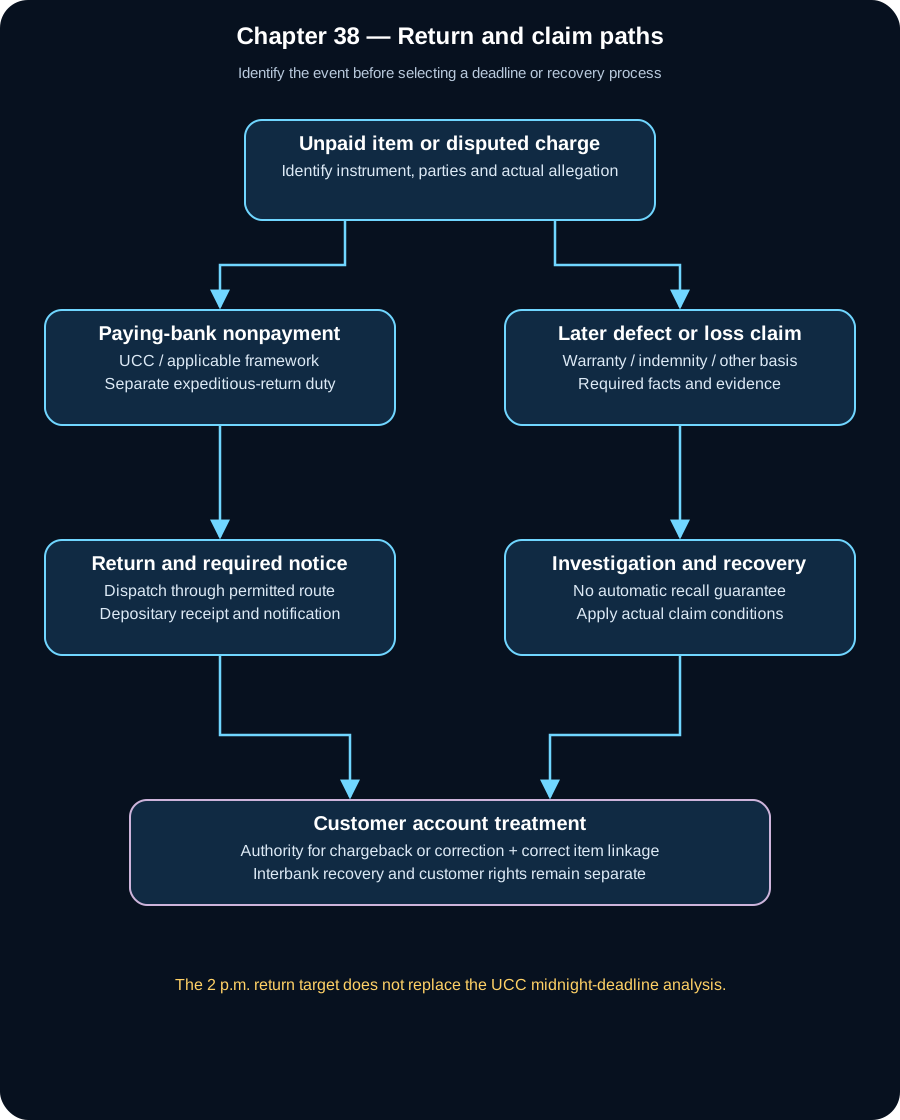
When a paying bank decides not to pay, it must consider the applicable UCC, Regulation J and Regulation CC requirements, together with valid rules and agreements. The UCC midnight-deadline framework and Regulation CC's expeditious-return requirement are different. Operations should not treat the latter as a general extension of the former.
For checks subject to the relevant expeditious-return rule, the paying bank must send the return so it would normally reach the depositary bank by 2 p.m., local time of the depositary bank, on the second business day after the banking day of presentment, with the specified next-banking-day treatment where relevant. Section 229.31 also contains exceptions and a specific extension provision. The bank must apply those conditions rather than relying on a simplified two-day slogan. Regulation CC §229.31.
The ordinary model UCC midnight deadline is tied to the bank's banking day of receipt or relevant action, not to the payee's deposit date. Final payment and permitted recovery also matter. A bank's legal implementation should identify the controlling provisions and any applicable variation. The bank should retain the receipt, decision and dispatch evidence needed to demonstrate its treatment. UCC §4-301.
A notice of nonpayment is required under §229.31(c) for a check of $5,000 or more when the paying bank determines not to pay, subject to the provision's scope. That $5,000 threshold is separate from the indexed $6,725 availability thresholds. The return can serve as the notice if it meets the requirements; the bank should not assume that a notice alone completes every return obligation.
The clock begins with the right event
A payee deposits a check on Monday, but the paying bank receives presentment on Tuesday. The return analysis must use the paying bank's relevant receipt or presentment facts, not simply add days to Monday's deposit. A depositary bank researching timeliness needs the actual evidence from the forward and return paths. An outgoing file timestamp at an intermediary may be insufficient to establish the legally relevant event.
The paying bank should organize its decision queues around the earliest applicable obligation. A high-value positive-pay exception cannot wait indefinitely for a corporate customer to respond. The agreement's default action and the bank's legal duties must be built into the workflow. If the customer misses its internal response target, the bank still needs a supported decision before its own obligations are breached.
Return creation and dispatch should be separately observable. A return record sitting in an internal queue is not necessarily a dispatched return. A successful file-generation job does not establish receipt at the next endpoint. Operations should monitor the relevant handoff and retain evidence of the service's accepted treatment, including any supported contingency used during an outage.
The return reason should reflect the established basis and the service's permitted values. The bank should not choose insufficient funds when the actual reason is a duplicate or a valid stop instruction merely because the former is familiar. Incorrect reasons can mislead the depositor, complicate recovery and create inaccurate reporting.
The bank should also distinguish timely return from later recovery. If the ordinary return route is no longer available, legal and operations should assess any valid claim or adjustment path. Labelling a late recovery request as a routine timely return does not cure the missed deadline. Accurate classification protects the integrity of the interbank process and the bank's own case evidence.
The model midnight deadline in a simple calendar
Model UCC §4-104 defines the midnight deadline by reference to midnight on the bank's next banking day following the banking day on which it receives the relevant item or notice, or from which the time for action begins. The applicable state enactment, Regulation J, Regulation CC and valid agreements must be considered for the actual transaction. This model definition is not the same as midnight on the customer's deposit day or a free-standing forty-eight-hour allowance.
Assume a paying bank receives an item on Monday, Monday and Tuesday are its relevant banking days, and no special provision changes the analysis. The model next-banking-day midnight reference points to Tuesday midnight. The bank should then separately satisfy applicable expeditious-return requirements. It should not wait until the later depositary-receipt target to begin deciding whether to pay. The two obligations address different parts of the return process.
For production, the bank needs verified receipt facts and a calendar appropriate to each requirement. A processor operating continuously can have a different technical day boundary from the legally relevant banking day. The system should preserve both and map them under an approved interpretation. Changing a batch date for operational convenience must not silently reset a legal return clock.
8. Receiving returns and correcting the depositor position
The depositary bank must be ready to receive returns and notices through the applicable arrangement. It should identify the original item, establish the financial effect and communicate with the customer under the relevant requirements. Regulation CC §229.33 addresses depositary-bank responsibilities, including acceptance, payment and customer notification. These obligations should be reflected in operations and monitoring rather than left to an unowned file inbox. Regulation CC §229.33.
A return can arrive before or after a notice of nonpayment. Both should link to the same original check. The bank must prevent a notice and return from producing two customer debits. It should also distinguish duplicate delivery of the same return from two different returned items with equal amounts. Native references and original deposit linkage are essential.
The customer's available balance may already have been used. The bank's permitted chargeback or other treatment follows the applicable law and agreement. If the result is a negative balance, the bank should record the exposure and communicate accurately. It should not describe an accounting debit as successful recovery of cash when the customer has no funds to cover it.
The original business obligation may need to be reopened by the depositor. A biller that marked an invoice paid when the check was deposited needs return information linked to the correct payment. The bank's report should support that linkage without claiming that it determines the biller's contractual rights against the payer. Chapter 40 develops the lockbox allocation consequences.
One returned item can affect several customer decisions
A customer may have scheduled rent or payroll using the available proceeds. When the deposited check returns, the bank should explain the returned item and the resulting balance effect clearly. It should also assess any fee, notice or correction obligations relevant to the case. A standard message saying “funds removed” may be insufficient where the bank previously supplied incorrect information or the customer alleges unauthorized activity.
The support view should show the original deposit, amount, returned item, reason, availability history and any prior communication. This allows staff to explain the sequence without asking the customer to reconstruct it. Sensitive fraud information can remain restricted while the financial facts are available to the staff responsible for servicing the account.
An unmatched return should enter a controlled queue. The bank should not debit a customer based on a loose match simply to clear suspense before end of day. It should use the available references and evidence to establish the correct deposit. Where a provisional internal accounting entry is needed, that entry should remain distinct from a final customer allocation.
If the bank disputes the return's timeliness or basis, the customer's treatment and the interbank claim need coordinated analysis. A pending dispute with another bank does not automatically determine what the customer is owed or when. Legal, operations and finance should identify the relevant obligations and avoid letting an unresolved bank-to-bank case disappear into the customer's balance without explanation.
The return process is complete when the received event, settlement effect, customer position and any remaining recovery are all accounted for. A file processed successfully is not enough if a customer was debited twice, an invoice remains incorrectly closed or a disputed return has no owner.
Customer notification after the return arrives
Section 229.33 requires the depositary bank's customer notification of nonpayment by midnight of the banking day following the banking day on which it received the returned check, notice of nonpayment or specified notice of recovery, or within a longer reasonable time under the provision. The workflow should therefore recognize an earlier notice instead of waiting for a later financial-return file before starting its customer-notification process. It should also avoid presenting a notice as proof that every associated financial posting has already occurred.
An illustrative timeline begins with a notice received on Tuesday and the corresponding return received Wednesday. The bank should use the Tuesday event for the notification analysis rather than treat Wednesday as the first information it received. Its matching logic must connect the later return to the earlier notice so that the customer does not receive contradictory descriptions or duplicate account corrections.
The customer's notice should identify the affected deposit and the bank's actual account treatment. If allocation is still being investigated, staff need an escalation path that respects the applicable obligation rather than leaving the notice in an unowned queue. The source return reason should remain available to support an accurate explanation, even when a customer-facing description uses simpler language.
9. Fraud types and the evidence each requires
Check fraud is not one event type. A counterfeit check may use invented or copied account information. A forged drawer signature concerns authority to issue the instrument. An alteration changes a genuine instrument's terms. A forged or missing endorsement concerns the collection entitlement. Duplicate presentment asks for payment again on the same instrument. A scam can persuade a person to deposit an apparently valuable check and send real funds elsewhere before the defect is discovered.
The classification matters because the evidence, potential rights and recovery path differ. A drawer saying “I never wrote this check” raises a different question from “I wrote it for $450, not $4,500.” A payee saying “I never received it” differs from a depositor admitting it submitted the same check through two channels. Operations should preserve the allegation in the customer's words before assigning a technical category.
FinCEN's mail-theft alert and financial trend analysis describe risks involving stolen checks, alteration, counterfeit creation and use of accounts to move proceeds. These are threat indicators, not proof that a particular customer committed a crime. A bank should use them to inform detection and investigation alongside the actual item and account facts. FinCEN mail-theft check-fraud alert, FinCEN check-fraud analysis.
The bank should also distinguish a payment-processing error from intentional fraud. An amount entered incorrectly during capture can produce the same customer complaint as an altered amount. The source image, capture history and presented record help identify the difference. Calling every mismatch fraud can distort reporting and lead staff toward the wrong recovery procedure.
An allegation should produce a focused evidence plan
For suspected alteration, the investigator may compare the drawer's issue record, the presented image and any available original or sufficient copy. It should identify exactly what changed: amount, payee, date or another term. The investigation should preserve the history of any bank data repair so that a capture correction is not mistaken for an alteration by another party.
For a forged-signature allegation, the bank needs the customer's authority context and the relevant instrument evidence. It should not assume that a matching account number proves authorization. Nor should it assume that one employee's visual impression of a signature conclusively decides the case. The bank's legal and operational process should assess the applicable facts and responsibilities.
For a duplicate, the investigator needs the separate presentments and financial effects. Identical images can support the analysis, but the bank must establish whether there were two payment demands or merely two stored copies. A rescan can produce different pixels while representing the same check. The underlying instrument and account history should guide the match.
For an endorsement concern, the bank should establish the named payee, depositor relationship, endorsements and collection path. A correctly signed drawer instruction can still be collected by someone without entitlement. The paying bank and depositary bank may need different evidence to assess their respective positions. The case should avoid reducing all authority questions to the drawer's signature.
A well-classified case gives each team a concrete task. Fraud evaluates the pattern and potential further loss. Operations reconstructs the payment. Legal assesses rights and duties. Finance records exposure and recovery. Customer service explains what is known and what remains under review. That joined approach is more useful than a broad fraud flag that no one can translate into action.
10. Paying-bank controls and positive pay
Paying-bank controls begin with the account and presented item. Depending on the product and risk model, the bank may use issue-file matching, serial and amount checks, payee matching, stop-payment data, duplicate detection, account restrictions and targeted image review. No single control establishes every fact about a check. A successful match on amount and serial number does not prove that the payee was unchanged.
Positive pay compares presented checks with information supplied under the customer's service arrangement. Payee positive pay adds a payee-related comparison where the product supports it. Reverse positive pay places a different review responsibility on the customer under the agreement. The bank should define supported fields, file timing, exception handling, customer decision deadlines and default treatment explicitly. These are product terms, not one universal legal rule.
The issue-file interface is itself sensitive. An attacker who can alter the issue file may make a fraudulent check look expected. Authentication, entitlements, file integrity, approval and change history therefore matter. A bank should not invest in sophisticated presented-item matching while leaving the source of expected payments weakly controlled.
The exception workflow must fit the bank's return obligations. A customer decision deadline should leave time for the bank to act through the supported process. If the customer misses that deadline, the agreed default and applicable law govern the next step. The system should not quietly extend a queue because a relationship manager is waiting for a call back.
A matching control can fail in several different ways
A genuine $4,600 supplier check can appear as an exception because the issue file arrived late. The correct response is to establish the current authority and product treatment, not automatically call the check fraudulent. The incident may reveal a corporate release-control problem rather than a bank image defect. The bank should retain the file receipt time and any decision made before the expected record was available.
An altered check can also match amount and serial number if only the payee changed. A product that does not compare payee data should not be marketed as preventing every payee alteration. Where payee matching is used, the bank must understand recognition limitations, name variations and exception logic. A fuzzy match is a risk decision that needs governance, not an infallible identity check.
A duplicate check can have a legitimate issue record because the original was genuinely issued. The control should therefore consider prior payment and presentment history as well as the issue file. A record marked issued should not remain perpetually eligible for repeated payment merely because the current amount and serial match.
Manual customer decisions also need integrity. The bank should record who approved an exception, what information was displayed and whether the decision arrived in time. If an operator changes the amount or image after approval, the decision may no longer relate to the item being released. Version binding is a practical control: the approval should apply to the specific evidence and values reviewed.
The bank should evaluate control effectiveness using actual outcomes. False exceptions consume customer and operations time. Missed alterations create losses. Late issue files create avoidable uncertainty. Reports should identify the causes rather than present one broad positive-pay success percentage. This helps the bank and corporate customer improve the process together.
11. Depositary-bank controls and early loss prevention
The depositary bank sees the depositor, account behavior, channel and submitted item. It can assess whether the activity fits the customer's known business or personal pattern, whether the payee relationship is plausible, whether the same instrument appears elsewhere in its records, and whether immediate withdrawal requests create concern. These controls should be proportionate and supported by the bank's legal and risk framework.
A new account receiving a large check followed by rapid outward transfers may deserve review, but the pattern alone does not prove fraud. The bank should establish the customer's explanation, source of the check and relevant account history. A business may legitimately receive a large first payment. The control should identify the evidence needed to distinguish plausible activity from an emerging loss, rather than rely on broad stereotypes.
Deposit acceptance, fraud review and funds availability should be coordinated. A product limit can determine whether the bank accepts an item through a channel. A lawful hold determines use of accepted funds. A fraud case evaluates suspicious activity. These are distinct controls. Rejecting a new deposit before acceptance is not the same as placing an unsupported hold on an already accepted covered deposit.
Customer education should explain that available funds can still be associated with an unpaid or fraudulent check. Staff should be alert when a customer is instructed to send part of the proceeds to a third party, buy goods or return an alleged overpayment. The bank should give clear, specific information and use its supported intervention process. It should avoid implying that waiting an arbitrary number of days guarantees safety.
The useful signal may be outside the check image
A counterfeit image can be visually convincing. The depositor's story, the requested onward payment and the account's behavior may reveal the risk more clearly than image quality. A customer who says an unknown employer sent a check to buy equipment from a specified vendor provides important context. The bank should preserve that explanation and assess it under its fraud procedures.
The bank should also connect channels. A check submitted by mobile and later at a branch can create duplicate exposure even if each channel's local checks pass. A shared item history can help identify the second submission. The matching process should allow review of genuine exceptions, such as a corrected item or a previously rejected capture, without assuming every repeated image is a completed prior deposit.
Original-paper controls matter especially in remote capture, but branch staff also need to recognize restrictive endorsements inconsistent with the proposed deposit. A customer presenting paper already marked for another deposit method creates a specific review question. Chapter 39 examines the RDC indemnity consequences; the depositary bank's immediate task is to preserve and assess the evidence before treating the paper as an ordinary fresh item.
Loss prevention should not depend entirely on long holds. Where availability must be provided, the bank still needs account monitoring, customer communication and prompt response to new information. A hold can delay access under a valid basis, but it cannot authenticate a check. The bank should not use the expiry of a hold as the event that marks fraud risk permanently resolved.
Operationally, the bank needs clear ownership of urgent alerts. A high-risk deposit pending review should not sit unnoticed because the check operations team assumes fraud owns it and fraud assumes the branch has already acted. The case should show who can make the decision, what deadline matters and what customer communication is required.
12. Stop payments customer duties and legal classification
A stop-payment instruction concerns a particular item or account under the applicable law and agreement. The model UCC requires sufficient description and timely receipt that gives the bank a reasonable opportunity to act before the relevant action. It also sets duration and confirmation provisions. Banks should implement the governing state's law and their valid service terms rather than assume that a customer message can always stop an item already paid. UCC §4-403.
Stopping a check does not necessarily extinguish the underlying commercial debt. A payer disputing a supplier's invoice may still have obligations outside the bank. Customer service should distinguish the bank instruction from the commercial dispute. The bank should not promise that a successful stop ends every claim the payee might have against the drawer.
Customer duties to examine statements and report unauthorized signatures or alterations can also matter. The model UCC contains rules addressing those duties and potential preclusion, with conditions and allocation issues. The bank must apply the actual law and agreement to the facts. It should not use a generic short complaint period as an automatic answer to every fraud allegation. UCC §4-406.
An ordinary check payment does not become a Regulation E electronic fund transfer solely because banks exchange its image. A check converted into an ACH debit raises a different framework, discussed in Chapter 40. The bank should classify the actual transaction rather than choose a dispute process based on whether the customer used a phone or saw an electronic image. CFPB Regulation E coverage.
A stop instruction must bind to the right item
A customer asks to stop check 1048 for $3,800. The bank should capture the account, item description, amount and other required information, authenticate the request and record receipt. If the customer enters the wrong amount, the bank needs the product's matching and servicing process. Staff should explain what information is needed without promising that an incomplete instruction will catch every possible presentment.
The system should show whether the instruction is active, expired, renewed or superseded, with the relevant effective times. A renewal should not erase the original history. If the item is later paid, the investigator needs to know which instruction was in force and whether it was received in time for the bank to act. A current active flag does not prove what the bank knew at presentment.
Official checks require different servicing analysis from ordinary customer checks. A purchaser's request to stop a cashier's check should not be processed through the ordinary account stop screen without checking the instrument's legal treatment. The bank's own obligation and any lost-instrument procedure may be relevant. The application should direct staff to the correct product workflow.
Fraud cases should preserve the distinction between customer authority and bank processing. A customer may have authorized issue but dispute an alteration. Another may deny the signature entirely. A third may have authorized payment while being deceived by a scammer. Those facts can lead to different legal questions. A broad unauthorized checkbox is not enough for a defensible determination.
The bank should coordinate customer rights and interbank recovery without making one conditional on the other unless the applicable framework supports that relationship. Failure to recover from another institution does not itself prove that the customer bears the loss. Successful recovery also does not excuse a missed customer obligation. The case must address both positions explicitly.
13. Fraud investigations sanctions and reporting
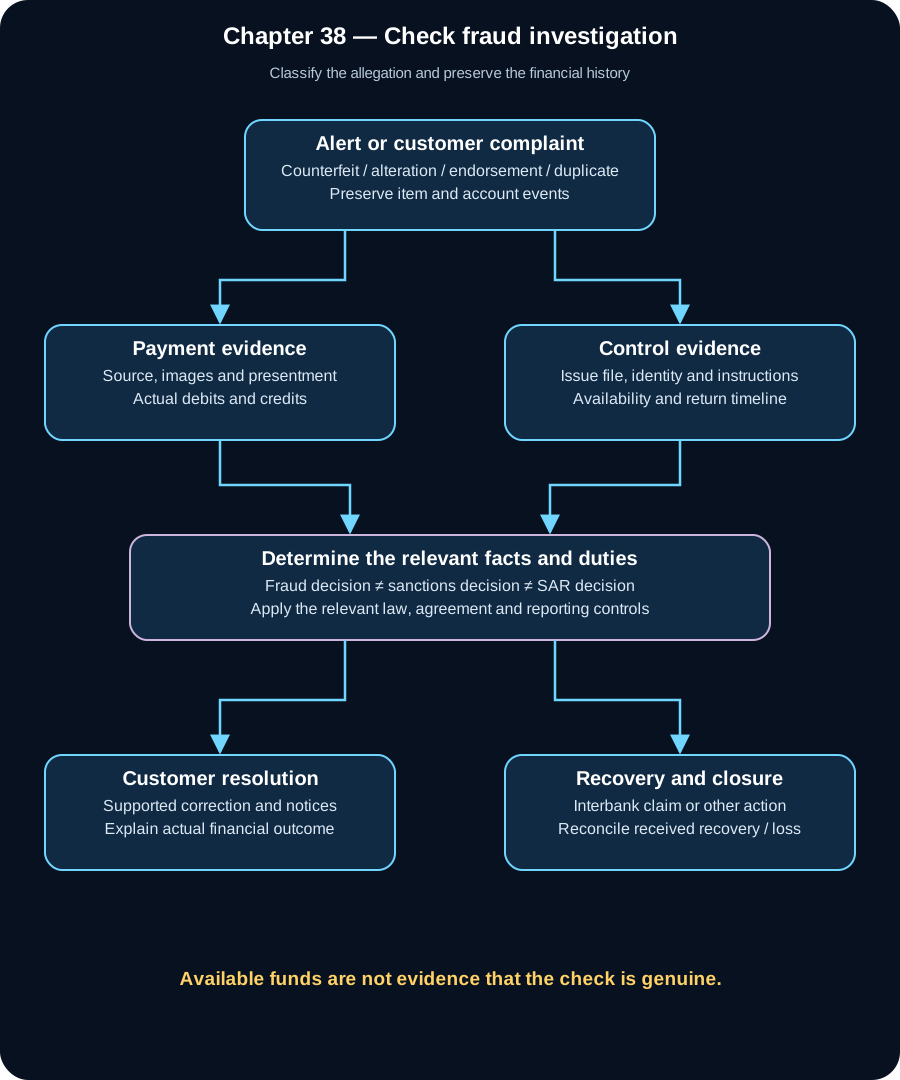
An investigation should begin with the allegation, affected item and possible further loss. The bank then gathers the evidence needed to establish the payment history and legal classification. It should preserve images, issue records, deposit information, presentment, return and adjustment references, customer communications and relevant access records. The goal is to answer specific questions, not to collect every available data field without purpose.
Fraud investigation and suspicious-activity reporting are related but distinct. The bank's BSA function assesses whether reporting obligations apply under the relevant rules and procedures. A SAR is not a return instruction, a customer notice or proof of criminal liability. SAR confidentiality must be preserved. The payment case can record the financial facts and authorized actions without exposing restricted reporting information to general support users.
Sanctions obligations also remain separate from ordinary availability holds and fraud suspicion. A potential sanctions match requires the bank's OFAC process and a determination under the applicable program. Blocking or rejecting property cannot be reduced to a generic check return code or used as a label for any suspicious deposit. The bank should preserve the actual legal basis and reporting requirements. OFAC compliance framework.
The bank should be careful about what image-derived data can support. A payee name read by optical recognition may be incomplete or wrong. Screening and investigation should use validated information and appropriate review. Passing a name through a screening tool does not establish that the check was authorized, and clearing a false-positive sanctions alert does not resolve an unrelated counterfeit concern.
A case needs one coordinated financial view
Suppose a customer receives a temporary bank credit while an alteration claim is investigated. Later, an interbank adjustment arrives. The case should identify whether the adjustment reimburses the bank for the temporary customer effect, changes a loss position or requires another treatment. It should not automatically produce another customer credit merely because money arrived through a different channel.
The same control applies when the customer receives payment directly from the drawer or another party. The bank should establish the amount and legal relevance before changing its own credit. Recovery, restitution and customer entitlement need coordinated analysis. A system that treats every incoming event as a separate reimbursement can create over-recovery and another dispute.
Evidence sharing with another bank should be focused and controlled. The request should identify the item, allegation, required records and relevant references. Sensitive information should travel through approved channels. A customer should not be asked to forward complete account statements to an unknown address simply because an investigator needs one check image.
The case should also identify residual exposure. The bank may have corrected the customer's account while its recovery remains unresolved. It may have received partial recovery but still face fees or other claimed loss. Those positions should remain visible to finance and the case owner. A zero balance in one suspense account does not prove that the whole incident is closed.
Root-cause analysis should follow the evidence. If a late issue file caused a false positive-pay exception, the corrective action differs from a missing duplicate check across channels or weak onboarding of a depositor. Management should receive the actual control failure and the affected population, with an action that addresses the cause rather than a generic instruction to be more careful.
14. Accounting reconciliation and operational management
The bank should maintain a financial history of the original deposit or payment, any return, customer correction, interbank adjustment, recovery and residual loss. These events can occur on different dates and under different authorities. The accounting policy determines the actual entries, but the case should make their business meaning and relationship clear.
For a returned deposited check, the depositary bank may reverse the collection effect and apply the permitted customer treatment. If the customer has already withdrawn the proceeds, the bank has exposure to resolve. For a paid check alleged to be unauthorized or altered, the paying bank may have a customer claim and a separate recovery claim. The bank should not use the same journal logic for every situation simply because all involve checks.
Reconciliation should prevent duplicate financial actions. A notice, return, paid-item adjustment and customer complaint can all relate to one instrument. The system needs to identify which events are informational, which are financial and which represent a claim still under review. Native references, original-item linkage and case controls are more reliable than matching solely by amount.
Operational reporting should show approaching legal or service deadlines, unallocated returns, unreleased holds, failed notices, unresolved customer corrections and recovery exposure. These measures should be defined by the bank and tested against actual events. A report that counts open cases without showing their deadlines and value may not help staff prioritize the work that matters most.
A hold release is a controlled operational event
An automated release job should reconcile the population due for release to the population actually updated. A successful job status can hide an item-level failure. The bank should identify deposits whose scheduled availability has arrived but whose customer balance remains restricted, and route them for prompt correction. This is a meaningful operational check because the customer right concerns usable funds, not the scheduler's success message.
Notice delivery needs similar monitoring. A notice can be generated but fail to print, email or appear through the approved channel. The bank should distinguish generation from delivery and investigate failures under the applicable requirements. It should retain enough evidence to explain the notice history without storing unnecessary sensitive content in general logs.
A rules change should be tested across the engine, disclosures, teller tools, mobile messages, customer service and historical reporting. The 2025 threshold adjustment illustrates why changing one numeric constant is insufficient. Daily aggregation, exception amounts and notice wording can all depend on the updated values. The bank should know which products and channels use each rule.
Management should review customer impact as well as loss prevention. An incorrect hold can cause returned payments and complaints. A misleading early-availability message can encourage a customer to act on a scam. A missed return deadline can shift exposure between banks. These are different risks, and the reporting should make their causes and remedies visible.
A complete operational close confirms that the customer position, bank settlement or recovery position, notices and remaining obligations are explained. Where a loss is accepted, that decision should have the appropriate authority and reason. Closing a case because no further response arrived is not equivalent to proving that the financial treatment is correct.
Account balances after a returned deposit
Assume a customer had $300, deposited a $2,000 check, and used $1,500 after the bank made sufficient funds available. Ignoring other transactions and fees, the ledger balance before the return is $800. If the bank has a supported basis to charge back the $2,000 returned deposit, the resulting balance is negative $1,200. The loss exposure is not automatically $2,000 of cash already paid out; the bank must examine the actual account, recovery rights and remaining funds.
The accounting process should link the chargeback to the original deposit and separately identify any customer claim that changes the result. A fraud investigation might establish facts requiring a different customer correction or loss allocation. The initial mathematical balance is therefore an operational starting point, not a final legal determination of who bears every loss.
The bank should test what happens if the return arrives after the account closes or after funds move to another account. The process needs a controlled receivable, recovery or loss treatment under the actual agreement and policy. It should not post to an unrelated open account solely because the same name appears there. The relevant authority and customer relationship must support any action.
A reconciliation should then account for the interbank debit, original collection entry, customer chargeback, any recovery and any recognized loss. If an adjustment later credits the bank, finance must determine whether it belongs to the customer, clears a receivable or offsets the bank's loss. Treating every incoming recovery as additional income can produce an incorrect position even though the bank's cash increased.
15. Worked cases and decision testing
Case A — the whole large deposit is held. A customer deposits an $8,400 ordinary covered check before cut-off. The bank invokes only the large-deposit exception and holds all $8,400. What should be challenged?
The exception applies to the aggregate amount above $6,725 under its conditions, not automatically to the whole deposit. The bank should assess the ordinary treatment of the first $6,725 and the exception treatment of the $1,675 excess. If another valid exception is asserted, it needs its own facts and treatment. The test should verify both the release amounts and the notice, rather than merely confirm that a hold was created.
Case B — a newly opened account belongs to an established customer. The engine applies new-account treatment because the account number is three days old. The customer has a qualifying prior account relationship. What data is missing?
The rule's customer-relationship test. Account creation date alone is insufficient. The bank should evaluate the relevant ownership and prior-account facts, correct the schedule where necessary and retain the basis. Regression tests should include multiple owners, prior accounts and the defined timing conditions so that the engine does not equate every new account number with the legal new-account category.
Case C — the first $275 is released from each check. A customer deposits five ordinary checks on one banking day. The engine applies the statutory minimum separately to each. Is this necessarily the required legal calculation?
No. The statutory rule concerns the aggregate relevant deposits, although the bank may choose a more generous policy. Requirements should distinguish the legal minimum from the bank's chosen benefit. The test should verify aggregation across the relevant accounts and channels, and the disclosure should accurately describe the policy actually offered.
Case D — a $5,400 check is unpaid. Staff assume no notice of nonpayment is needed because the item is below $6,725. What has been confused?
The $5,000 notice-of-nonpayment threshold and the indexed availability thresholds have different functions. The paying bank should apply §229.31(c) and the other relevant return requirements. The test should deliberately use amounts between $5,000 and $6,725 to expose this error, while keeping the depositary-bank availability calculation separate.
Case E — return prepared but not sent. The paying bank decides not to pay and creates the return record on time. A transmission failure leaves it in a queue. The dashboard shows decision completed. What remains open?
The required dispatch or delivery-related obligation under the applicable framework. The bank needs evidence of the actual return path and any permitted contingency. An internal decision timestamp does not establish that the return was made in the required manner. The incident should be escalated using the earliest applicable deadline and should preserve the facts for any later timeliness dispute.
Case F — available funds used in an overpayment scam. A customer deposits a check, sees available funds and sends part to a third party at the sender's request. The check later returns. What should the bank's investigation cover?
It should reconstruct the deposit and onward-payment facts, assess the fraud pattern, apply the correct customer-rights framework to each transaction, and review the bank's communications and controls. The check deposit and the onward transfer may have different legal treatment. The bank should not collapse them into one event or assume that availability proved the check's authenticity. Any recovery should be tracked against the actual loss and customer position.
Testing the rule and the operational result together
A useful test set includes ordinary deposits before and after cut-off, holidays, partial availability, qualifying next-day instruments, new-account exceptions, aggregated large deposits, corrected redeposits and late-arriving reasonable-cause facts. Each case should specify the scope, assumptions, amounts, dates and expected notice. The result should be checked in the customer balance and communication, not only in the rule-engine output.
Return tests should begin from actual presentment facts and include failed dispatch, delayed acknowledgement, a notice arriving before the return, duplicate delivery and an unmatched original. The expected result should identify the correct customer effect and any remaining claim. Fraud tests should vary the allegation so that counterfeit, alteration, duplicate and endorsement concerns do not all trigger the same evidence request.
Finally, test a case where the customer is corrected but interbank recovery remains open. The dashboard should not mark the whole incident financially resolved. This verifies that the bank can meet customer obligations while still managing its own exposure accurately.
16. Role checklist and learning closure
The Business Analyst defines scope, calendars, aggregation and distinct availability, payment, return and claim events. The Product Owner ensures the customer promise matches the actual policy and lawful treatment. Compliance and legal teams own interpretation of exceptions, notices, customer rights and the applicable federal and state framework, with clear separation from private service procedures.
The Architect and Developer preserve the facts needed to calculate and explain each decision. The Tester validates amounts, dates, notices and actual customer outcomes, including failed releases and late information. Operations monitors the earliest relevant obligations and prevents notices, returns and claims from generating duplicate financial effects.
Fraud and BSA teams assess suspicious activity under their own controlled processes. Treasury and finance distinguish customer corrections, settled returns, expected recoveries and actual losses. Customer service explains established facts without presenting availability as authentication or a fraud allegation as a final legal decision.
Chapter 39 moves to the channel where the customer captures the check and often retains the original paper. That changes the bank's evidence and duplicate-deposit risks, while preserving the need for accurate classification, availability promises and financial reconciliation.
A defensible check decision has the right facts, the right legal basis, the right clock and one correct financial effect.
Authoritative references
Public sources checked on 6 September 2026. The examples assume the stated account, instrument, channel and calendar conditions. UCC references describe model provisions; the applicable state's enactment and valid agreements must be considered. No single hold period, fraud-reimbursement rule or return right is asserted for all checks.
This application uses JavaScript for the full interactive experience. This text summary is served for accessibility and search indexing.