Fedwire Funds Service. A practitioner deep dive into the Fedwire Funds Service across ISO 20022 payment orders, FedLine access, RTGS settlement, operating hours, liquidity, finality, rejects, recovery, reconciliation, controls and resilience.
Fedwire is one of those payment systems that becomes much easier to understand when we stop calling every high-value payment a “wire” and instead ask what actually happens inside the bank and at the Federal Reserve.
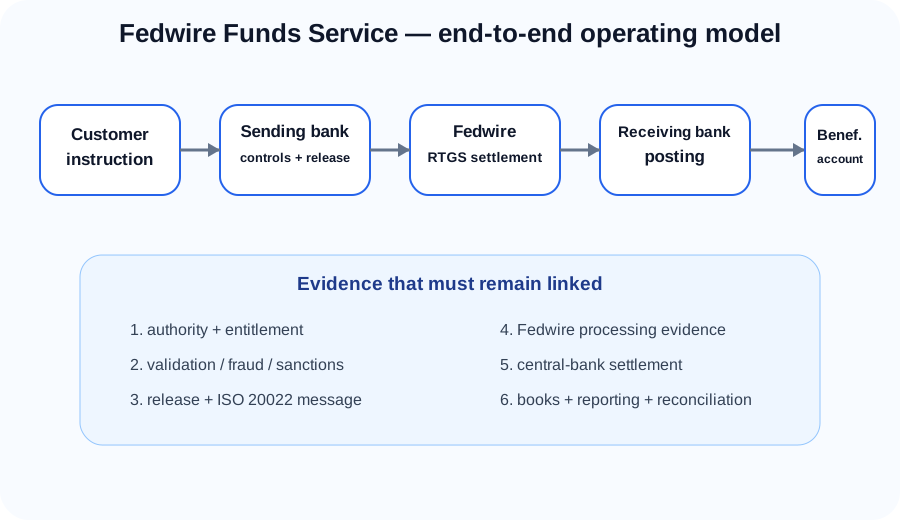
A customer may tell the bank, “Send USD 12 million to our supplier today.” The bank still has to authenticate the customer, confirm entitlement, validate the beneficiary and routing data, perform fraud and sanctions controls, decide whether Fedwire is the correct route, manage liquidity, construct the Fedwire ISO 20022 instruction, release it through an authorized Fedwire access path, receive Federal Reserve processing evidence, post the financial consequences to its own books, report the outcome to the customer and reconcile the payment against settlement evidence.
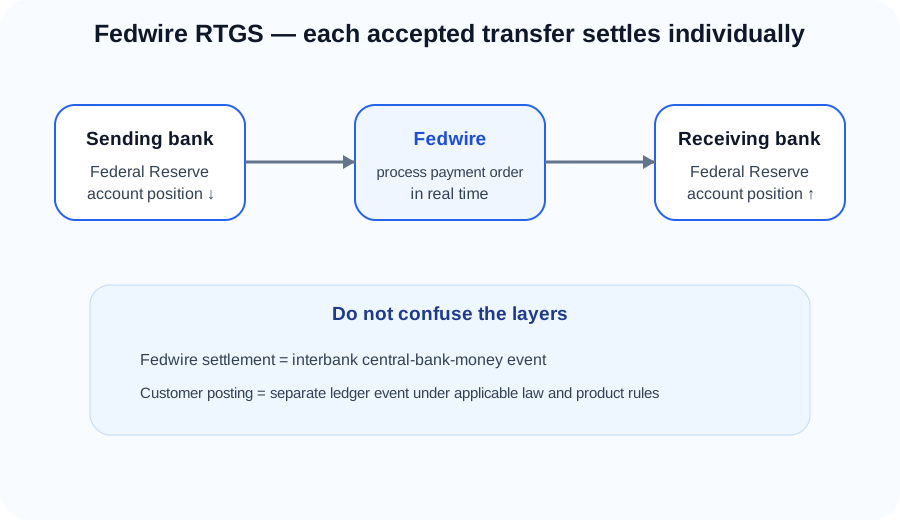
The important idea is simple: Fedwire is a real-time gross settlement service. Each accepted funds transfer settles individually in central-bank money rather than waiting for a later net settlement cycle. That makes timing, liquidity, authorization, finality and evidence central to the operating model.
This chapter follows that journey as a bank practitioner would see it. It does not try to turn Chapter 16 into Chapter 17 on CHIPS, Chapter 18 on domestic wire products or Chapter 19 on correspondent banking and SWIFT. Those topics have their own homes.
For a roughly 60-minute core session, spend about 35 minutes on Sections 1–2, Sections 4–5 and Sections 7–13. For the next 10 minutes, use the chapter’s three diagrams to identify individual central-bank settlement and the later recovery boundary. Use 10 minutes to work through one case in Section 16, then spend the final 5 minutes explaining: What can the bank still do after a Fedwire transfer has settled, and what can it no longer promise? Treat these timings as a study guide. The remaining sections, additional cases and extended reference material are follow-up study; completing the whole chapter takes longer.
Chapter navigator
- What Fedwire Funds Service actually is
- Participants, accounts and access roles
- From customer instruction to bank payment order
- Fedwire ISO 20022 message model
- Bank validation, screening, approval and release
- FedLine access and operator connectivity
- Real-time gross settlement and Federal Reserve account impact
- Operating hours, cutoffs and business-day logic
- Liquidity, daylight overdrafts and payment prioritization
- Statuses, acknowledgements, rejects and processing evidence
- Receiving-bank processing and beneficiary credit
- Finality, errors, returns and requests for recovery
- Reconciliation, accounting and reporting
- Controls, security and operational risk
- Resilience, contingency and production operations
- End-to-end cases, BA checklist and testing
1. What Fedwire Funds Service actually is
The Fedwire Funds Service is operated by the Federal Reserve Banks. Participating financial institutions use it to send and receive funds transfers for their own account or on behalf of customers, settle commercial transactions, settle positions associated with other financial arrangements, make federal tax payments and transact in federal funds.
For a learner, the most useful classification is not simply “wire transfer.” Fedwire is a central-bank-operated real-time gross settlement, or RTGS, service for U.S. dollar funds transfers.
“Real time” means qualifying accepted payment orders are processed during the operating day without waiting for a later batch cycle.
“Gross settlement” means each transfer changes settlement positions individually rather than being accumulated into a bilateral or multilateral net obligation first.
“Central-bank money” means the settlement occurs through Federal Reserve account relationships rather than only through commercial-bank nostro balances.
That combination changes the risk model dramatically compared with deferred-net systems. If Bank A sends USD 20 million to Bank B and the Federal Reserve accepts and processes the payment order, the relevant Federal Reserve account positions are affected as part of that transfer. The bank cannot treat the event as merely “a message sent” and hope finance will settle it later.
Fedwire is not SWIFT
This distinction becomes especially important in international payments.
SWIFT is principally a secure financial messaging network and standards ecosystem. Fedwire is a U.S. dollar funds-transfer and settlement service. A cross-border payment can involve SWIFT messaging between correspondent banks and later involve Fedwire for the U.S. domestic settlement leg. That does not make SWIFT the settlement system and does not make Fedwire the entire cross-border correspondent chain.
Chapter 19 handles that broader cross-border relationship.
Fedwire is not CHIPS
CHIPS is another major U.S. dollar high-value payment system, operated by The Clearing House. Its liquidity and settlement design differs from Fedwire. A bank may route different payments differently depending on reachability, correspondent arrangements, urgency, liquidity and product logic.
Chapter 17 owns that comparison and the detailed CHIPS model.
Fedwire is not FedNow
Both are Federal Reserve services, but they solve different payment problems and operate under different rule and product models. FedNow is an instant-payment service designed for 24x7x365 customer credit-transfer use cases. Fedwire is the wholesale/high-value funds-transfer infrastructure covered here.
Why banks care so much about Fedwire controls
Because settlement can be immediate and final at the interbank level, a mistake can become a genuine cash event very quickly.
A malformed beneficiary name may be repairable before release. A wrong routing number may still be caught before submission. A duplicate payment may still be stopped in the bank queue. But once an authorized Fedwire payment order has been accepted and final settlement occurs, recovery becomes a different problem. The bank may need cooperation from another institution and should not describe recovery as an automatic “reversal.”
This is why the Fedwire operating model is built around prevent before release, prove after release.
2. Participants, accounts and access roles
A Fedwire payment can involve several business and technical actors even when the customer sees only two banks.
At the customer edge there may be an originator such as a corporation, financial institution, broker-dealer, government entity or individual. That customer instructs its account-holding bank or payment provider under the bank’s product terms.
The originating financial institution performs customer and payment controls and, if Fedwire is selected, becomes the sending side of the Fedwire instruction either directly or through an authorized service-provider arrangement.
The Federal Reserve Banks operate the Fedwire Funds Service and maintain the settlement-account framework used by participants.
The receiving institution receives the Fedwire transfer and then performs its own internal posting, compliance, customer-credit and reporting processes.
The ultimate beneficiary is normally outside the Fedwire participant layer. Fedwire settles between participating institutions; the receiving bank then credits or otherwise accounts to its customer according to the underlying instruction and its legal/product obligations.
Participant does not always mean “every bank settles directly in exactly the same way”
A common training mistake is to draw every U.S. bank with a separate Federal Reserve master account and imply that every institution has identical account and settlement arrangements.
Real financial institutions can have different Federal Reserve account structures, correspondents, service providers and access arrangements. For learning purposes, separate three concepts:
Fedwire participation — whether the institution is eligible and configured to send/receive through the service.
Fedwire access — how the institution technically uses FedLine/FedPayments Manager or service-provider capabilities.
settlement account relationship — which Federal Reserve account is affected and how the institution manages that position.
These can be related without being identical.
Routing identity matters
Fedwire payments use routing information to identify financial institutions and destinations. The bank’s reference-data service should treat routing data as governed master data, not a free-text field remembered by operations.
A customer-provided routing number may need validation against product and routing directories. A routing number being syntactically valid does not prove the intended beneficiary relationship is correct.
Service providers can sit in the technical path
A participant may use a service provider for software, connectivity or payment processing. This does not remove the bank’s responsibility to understand what was submitted, what was accepted and what financial outcome occurred.
The control model should know which party owns customer validation, message construction, Fedwire transmission, acknowledgement processing, settlement reporting, archive, business continuity and incident escalation.
Internal bank actors
Inside a large institution, ownership can span:
- customer channels and treasury-services teams;
- payment orchestration or high-value payment hub;
- fraud and sanctions controls;
- liquidity/treasury;
- Fedwire gateway/connectivity operations;
- core/accounting systems;
- reconciliation and finance;
- investigations/operations;
- customer servicing;
- infrastructure/security teams.
A strong design does not hide those boundaries. It links them through shared payment identifiers and evidence.
3. From customer instruction to bank payment order
A Fedwire payment starts before Fedwire.
Imagine a corporate treasury user enters a USD 8.5 million supplier payment in its bank’s portal. The payment includes debit account, requested execution date, beneficiary bank routing information, beneficiary account, beneficiary name, remittance/reference information and perhaps purpose or intermediary data depending on the use case.
The bank should first treat this as a customer instruction, not as an already-valid Fedwire payment order.
Step 1 — identify the customer and channel
The bank needs to know which legal customer submitted the request and through which controlled channel. A portal user, host-to-host file and API client can all represent the same customer but create different authentication evidence.
Chapter 15 covered those channel mechanics. Chapter 16 consumes the accepted customer instruction.
Step 2 — confirm authority and account entitlement
The bank checks whether the user/system may act for the customer, whether the debit account is in scope, whether approval requirements are satisfied and whether the payment product is allowed.
This is not the same as sanctions screening. Entitlement asks whether the customer is allowed to instruct the bank. Compliance asks whether the payment can legally or safely proceed.
Step 3 — validate payment data
The bank validates required fields, routing information, account structure where possible, amount/currency, dates, service selection and cross-field rules.
Validation should distinguish:
MISSING_REQUIRED_DATA
from
INVALID_FORMAT
from
UNSUPPORTED_PRODUCT
from
ROUTING_NOT_REACHABLE
from
BUSINESS_RULE_FAILURE.
A generic “wire failed” status is not useful enough for operations or customers.
Step 4 — route to the correct rail
A high-value USD payment is not automatically Fedwire. The routing engine can consider customer product, urgency, counterparty reachability, bank strategy and operational conditions.
The exact routing algorithm is bank-specific. Chapter 17 covers CHIPS and Chapter 18 covers the domestic wire product layer. Here, once the routing decision is Fedwire, the bank prepares a Fedwire-compatible instruction.
Step 5 — create bank payment identity
The bank should assign a stable payment identifier before external release. That identifier should survive retries, operator acknowledgements, accounting, customer reporting and investigations.
A useful lineage can be:
customer instruction ID → bank payment ID → Fedwire message ID/reference → settlement/accounting event → customer report.
The specific identifiers vary by architecture, but the chain should not be lost.
Step 6 — move from prepared to releasable
A payment can be valid but not yet releasable. It may be waiting for customer approval, fraud review, sanctions review, funding/liquidity decision or future execution time.
The state model should make that explicit.
For example:
RECEIVED → VALIDATED → APPROVED → CONTROLLED → READY_FOR_RELEASE → RELEASED.
Do not collapse every pre-release state into PENDING.
4. Fedwire ISO 20022 message model
Fedwire Funds Service migrated to ISO 20022 on July 14, 2025. That means current Fedwire participants work with ISO 20022 business-message structures rather than the legacy FAIM proprietary funds format.
The migration is important, but ISO 20022 should not be taught as “XML replaced the old wire file.” ISO 20022 gives the payment a richer structured business model.
Core customer and bank transfers
Fedwire uses ISO 20022 messages such as pacs.008 for customer credit transfers and pacs.009 for financial-institution credit-transfer use cases, with local-instrument conventions that identify Fedwire business usage.
Returns use pacs.004 in applicable scenarios. Fedwire also supports nonvalue/investigation and request messages within its ISO 20022 implementation.
The exact permitted fields and local rules come from Federal Reserve format documentation. A bank should not assume that every element allowed by the generic ISO standard is allowed or meaningful in Fedwire.
Business Application Header
ISO 20022 implementations commonly use a Business Application Header to identify the message context. For developers and BAs, the important point is that the application header and business document together form the operator-facing message package.
Do not map customer input directly to XML paths without first defining business meaning.
A better mapping model is:
customer data → canonical payment model → Fedwire business rules → ISO 20022 message.
Structured data improves controls only if banks preserve it
ISO 20022 can carry richer party, address, agent and remittance information. That can improve screening, investigation, reconciliation and customer reporting.
But the benefit disappears if the bank truncates structured data into an old internal 35-character free-text model and never modernizes downstream systems.
A Fedwire program therefore needs end-to-end data preservation, not only gateway conversion.
Message identity and business identity are different
If a bank resends a technical message after a connectivity problem, it must understand whether the business payment already exists.
A new transport message identifier should not automatically create a new customer payment.
The system needs clear concepts for:
business payment ID
customer instruction ID
Fedwire message ID
related previous message ID
operator reference/evidence.
That distinction becomes critical in duplicate prevention.
Current-release freshness
The 2025 ISO 20022 cutover is complete. As of 5 October 2026, Federal Reserve Financial Services has rescheduled the Fedwire release previously planned for November 2026 to November 2027. The exact implementation date is to be announced in fall 2026, and final usage guidelines are intended for MyStandards in November 2026. Do not invent an implementation day or teach the release as current.
Message-specific Fedwire cutoff categories
The current FRFS schedule is message-specific rather than one universal 7:00 p.m. cutoff:
| Cutoff | Published scope |
|---|
| 5:00 p.m. ET | Treasury tax-payment routing and special-account messages |
| 6:45 p.m. ET | Core customer transfers, customer drawdown requests/transfers and their returns |
| 7:00 p.m. ET | Core bank transfers, cover payments, bank drawdown messages, returns, return requests/responses and investigations |
| 7:15 p.m. ET | Selected status, account-reporting and retrieval messages |
The listed minute is inclusive, and FRFS may extend a cutoff under Operating Circular 6. A bank's customer/product cutoff remains a separate control.
5. Bank validation, screening, approval and release
The safest Fedwire payment is the one whose problems are identified before release.
A bank’s exact control order varies by architecture, but several control families usually matter.
Customer and entitlement controls
Who instructed the payment? Which customer/entity? Which debit account? Was the user or machine credential authorized? Were required approvals completed?
These questions should be answered with evidence from the channel and entitlement systems.
Payment validation
The bank checks amount, currency, execution date, routing information, account details, message-field consistency and product eligibility.
Some fields may be mandatory because of the Fedwire message specification. Others are mandatory because of the bank’s product or compliance policy. Those sources should not be confused.
Fraud controls
High-value payments need risk controls appropriate to the bank’s customer and product model. Signals can include unusual amount, changed beneficiary, unusual device/channel behavior, payment velocity, deviation from historical patterns or compromised-user indicators.
The exact rule thresholds are bank policy and risk appetite. A training chapter should never invent a universal dollar threshold at which a payment “must” be manually approved.
Sanctions and compliance screening
Wire payments may require sanctions and AML-related controls. Chapter 20 owns the deep sanctions/wire-control treatment. Here, the important architecture point is that the bank should know whether required controls completed successfully before Fedwire release and preserve the decision evidence.
A sanctions-screening service being unavailable should not silently convert to “screening passed.” Degraded-mode policy must be explicit.
Funding and liquidity controls
A customer may have sufficient account funds while the bank still needs to manage Federal Reserve settlement liquidity. Those are different layers.
Customer funds control asks whether the customer can pay.
Bank liquidity control asks whether the institution can support the central-bank settlement position.
Maker-checker and release authority
Banks often apply approval/release controls based on product, customer configuration and risk. The exact number of approvers or monetary threshold is institution-specific.
The functional requirement should describe the principle:
instruction authority → payment approval → control completion → release authority.
Release is the irreversible-risk boundary
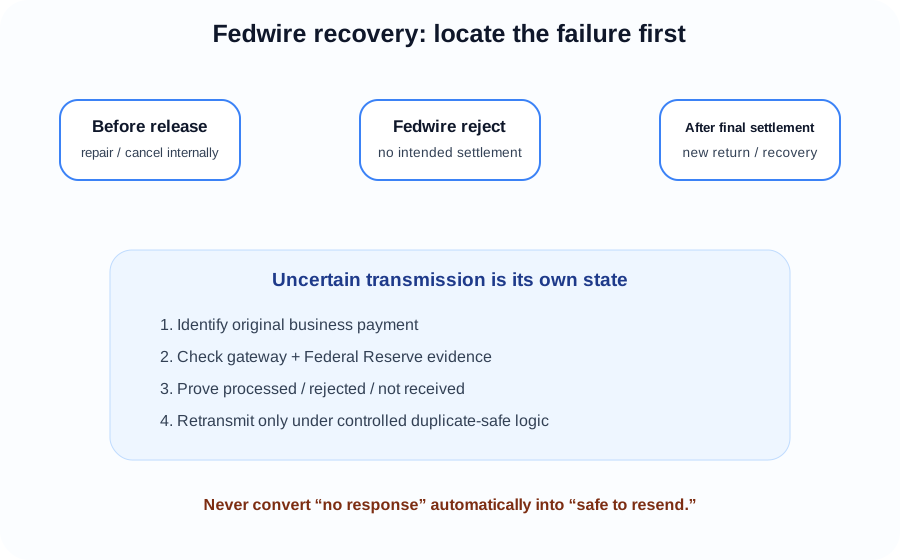
Before release, the bank can normally repair or cancel an internal queued payment according to its product rules.
After release to Fedwire, the bank should no longer describe the payment as simply editable. The external payment order and settlement lifecycle has started.
That is why user interfaces should visually distinguish READY FOR RELEASE from RELEASED TO FEDWIRE.
6. FedLine access and operator connectivity
Fedwire Funds Service participants access the service through Federal Reserve Financial Services connectivity solutions such as FedLine Direct and FedPayments Manager – Funds through FedLine Advantage, depending on their operating model.
Chapter 15 explained generic payment connectivity. Chapter 16 now focuses on what connectivity means for a Fedwire release.
FedLine Direct
FedLine Direct supports computer-to-computer connectivity suitable for automated/high-volume environments. A bank’s payment application or service-provider setup can transmit Fedwire messages and receive responses through the configured connection.
The bank should distinguish:
payment created internally
message queued for gateway
message transmitted through FedLine
Federal Reserve received/processed
business settlement completed.
A successful local socket or transport event is not the same as Fedwire acceptance.
FedPayments Manager – Funds
FedPayments Manager provides browser/application capabilities through FedLine Advantage, including payment creation/management and operational functions depending on the institution’s setup.
Banks can use different access paths for primary processing, backup or manual operations.
Service providers
A bank can use an approved service provider for parts of the Fedwire access stack. The operating model should still preserve clear responsibility for security, message construction, transmission, acknowledgements, incident handling and reconciliation.
Connectivity health versus payment health
A common production mistake is to declare the service healthy because the FedLine connection is green.
The better health model asks:
Can we connect?
Can we authenticate?
Can we transmit?
Are acknowledgements returning?
Are payments being processed?
Are inbound messages arriving?
Is settlement evidence consistent?
One green connection indicator cannot answer all of those questions.
7. Real-time gross settlement and Federal Reserve account impact
This is the heart of the chapter.
Suppose Bank A sends a valid Fedwire customer transfer to Bank B. Once the payment order is accepted and processed by the Federal Reserve, the settlement effect occurs through the relevant Federal Reserve account positions.
Fedwire does not wait until the end of the day and then calculate one net bilateral balance between Bank A and Bank B.
Each payment settles gross.
Why gross settlement matters
If a bank sends 1,000 Fedwire payments totaling USD 15 billion and receives 900 payments totaling USD 14.5 billion, it cannot simply assume its settlement requirement is the net USD 500 million at end of day.
The timing of each outgoing and incoming transfer matters because settlement occurs continuously during the operating period.
That creates an intraday-liquidity problem.
Settlement evidence versus customer posting
The Federal Reserve settlement event and the bank’s customer ledger event are related but separate.
On the sending side, the bank may debit or reserve the customer account before Fedwire release depending on its product and accounting model.
On the receiving side, the Federal Reserve can settle the interbank transfer before the beneficiary’s customer account is credited by the receiving bank.
Therefore:
FEDWIRE_SETTLED
should not automatically be interpreted as
BENEFICIARY_ACCOUNT_CREDITED.
Settlement versus accounting representation
The bank may create internal postings to settlement/control accounts, customer accounts and fee accounts. Finance then reconciles those postings to Fedwire/Federal Reserve evidence.
The exact GL names differ by bank. The principle is that one business transfer can create multiple accounting events but should retain one traceable economic lineage.
8. Operating hours, cutoffs and business-day logic
Current Fedwire Funds Service operating hours are 22 hours for each funds-transfer business day.
The funds-transfer business day begins at 9:00 p.m. Eastern Time on the preceding calendar day and ends at 7:00 p.m. Eastern Time.
That means the label “Monday Fedwire business day” can begin on Sunday evening.
Business date is not the same as calendar timestamp
A payment transmitted at 10:30 p.m. ET on Sunday evening can belong to Monday’s funds-transfer business day.
Systems should therefore preserve:
calendar timestamp
time zone
Fedwire business date
requested execution date
settlement date.
Without those fields, reporting and reconciliation can assign the payment to the wrong day.
Not every message type shares one universal cutoff
Fedwire has different cutoffs for particular message categories. For example, customer-transfer and certain other categories have cutoffs before the overall 7:00 p.m. closing time, while other message types can process later according to the published schedule.
A bank should therefore model cutoffs by message/business service, not one hardcoded FEDWIRE_CUTOFF = 19:00 rule.
Bank customer cutoff is earlier than operator cutoff
Most banks need time for validation, approvals, compliance, queueing, message construction and safe transmission. Therefore a bank’s customer cutoff can be earlier than the Federal Reserve cutoff.
That earlier time is a bank product/operating policy, not a Federal Reserve universal rule.
Extensions exist
Federal Reserve Banks can extend operating hours in certain circumstances under published procedures. Operations should not assume that a nominal cutoff is always the final actual close during an incident or market event.
Systems should be able to ingest extension status rather than requiring emergency code changes.
Future six-day operations are not current
The Federal Reserve has announced intent to expand Fedwire operating days to Sunday through Friday, including weekday holidays, with implementation planned for 2028 or 2029. The current production model in September 2026 remains the existing funds-transfer business-day schedule.
Do not design a 2026 training example as if the future six-day model is already live.
9. Liquidity, daylight overdrafts and payment prioritization
RTGS makes liquidity visible.
A bank can have profitable customers and sufficient total balance-sheet liquidity and still face an intraday settlement-pressure problem if many large outgoing Fedwire payments arrive before large incoming payments.
Customer funds are not bank settlement liquidity
This distinction deserves repetition because it causes real design mistakes.
Customer A may have USD 50 million in its deposit account and request a USD 40 million wire. That supports the customer-funds decision.
The bank must still manage the effect of the outgoing Fedwire transfer on its Federal Reserve settlement position.
Liquidity sources and policy
Banks can manage intraday liquidity through their own balances, incoming payments and other approved liquidity arrangements. Daylight overdraft and payment-system-risk policy is governed by Federal Reserve requirements and bank treasury policy.
Chapter 55 later gives intraday liquidity a dedicated cross-rail treatment. Here, the key lesson is functional: Fedwire release can have immediate settlement-liquidity consequences.
Queueing and prioritization
A bank may hold valid payments internally before release because they are future-dated, awaiting approvals, under review or being sequenced for liquidity/operational reasons.
Prioritization should be explicit and governed.
Examples of factors a bank may consider include:
- customer/product priority;
- contractual cutoff;
- market settlement obligation;
- tax/security-related deadline;
- available liquidity;
- downstream service health;
- manual investigation status.
The bank-specific algorithm should never be presented as a Fedwire rule.
Gridlock thinking
In an RTGS system, simultaneous participants withholding payments to conserve liquidity can create broader payment delays. Banks therefore monitor queues, incoming expectations and market obligations closely.
Fedwire itself is designed for real-time gross settlement; Chapter 17 will show how CHIPS uses a different liquidity-efficient design.
Treasury visibility
Treasury needs more than a daily net number. Useful operational views can include:
opening Federal Reserve position
outgoing Fedwire settled value
incoming Fedwire settled value
queued outgoing value
expected incoming value
large upcoming obligations
available liquidity buffer.
Exact metrics depend on the bank, but they should be based on settlement evidence rather than only customer payment statuses.
10. Statuses, acknowledgements, rejects and processing evidence
Status design is one of the most important BA topics in high-value payments.
A bank should not expose one generic SENT state for everything after release.
Internal pre-release states
Examples can include:
RECEIVED
VALIDATED
AWAITING_APPROVAL
AWAITING_SCREENING
READY_FOR_RELEASE.
External processing states
After release, the bank may need to distinguish:
TRANSMITTED_TO_FEDWIRE
FEDWIRE_ACCEPTED/PROCESSED
FEDWIRE_REJECTED
SETTLED
RETURN/RECOVERY_EVENT_RECEIVED.
The exact names are implementation choices. What matters is mapping them to real evidence.
Transport acknowledgement is not settlement
A gateway can confirm successful network transmission before the Federal Reserve has processed the message.
Therefore the system should store the evidence type behind a state change.
For example:
transport_ack_id
operator_message_status
Fedwire reference
settlement/account event.
Rejections
A payment order can be rejected before settlement for format, security, account/authorization or other applicable reasons under Federal Reserve rules and processing controls.
A rejected payment is different from a settled payment that later needs recovery.
The receiving institution normally should not be treated as having received a payment that Fedwire rejected on the sending side.
Nonvalue messages
Fedwire also processes nonvalue message types used for requests, reports and other functions. A nonvalue message moving through the Fedwire service does not itself mean money moved.
This distinction becomes important for investigations and drawdown/request use cases.
11. Receiving-bank processing and beneficiary credit
Once the receiving bank receives a Fedwire transfer, its work begins.
The Federal Reserve has settled the interbank obligation, but the receiving institution still needs to interpret and process the payment correctly.
Receive and validate
The receiving bank validates that the message is technically consumable and routes it to the correct internal service/accounting flow.
Compliance and risk controls
Depending on the institution’s legal and policy obligations, inbound payments may require sanctions, AML or fraud-related controls before final customer use/credit treatment.
Chapter 20 will go deeper into wire controls.
Account matching and posting
The bank identifies the beneficiary account or internal destination and creates the customer posting.
If the account is not valid, closed, blocked or otherwise unable to receive the payment, operations may need an exception/recovery path.
The bank should not silently keep an unmatched high-value incoming transfer without ownership and ageing controls.
Beneficiary credit is an internal bank event
Fedwire settlement does not by itself prove the final beneficiary has seen the funds.
A sending bank normally has direct evidence of its own Fedwire transfer and settlement, not omniscient visibility into the receiving bank’s customer ledger.
Customer reporting should therefore avoid claims it cannot prove.
Remittance and structured data
ISO 20022 information should be preserved through the receiving bank’s posting and reporting path wherever relevant. Corporate beneficiaries may rely on structured references for cash application.
A bank that receives rich data but exposes only amount/date loses much of the business value of the ISO migration.
12. Finality, errors, returns and requests for recovery
Fedwire’s finality is one of its defining characteristics.
Regulation J and Operating Circular 6 form the core legal framework for funds transfers through Fedwire. At the interbank level, Fedwire settlement is designed to be final and irrevocable when the applicable finality conditions are met.
That does not mean every human or business dispute disappears.
Finality does not mean “no later money movement is possible”
If a sender makes an error or fraud is discovered, the parties can still communicate and a receiving institution may send funds back through a new payment transaction when appropriate.
The important distinction is that the original settled Fedwire transfer is not casually “unsettled” as if a database row were deleted.
Error before release
If the bank detects an incorrect beneficiary or amount before Fedwire release, the safest action is usually to stop/repair/cancel the internal instruction according to bank policy.
Error after release but before certainty
If transmission is uncertain, the bank must first determine whether Fedwire received and processed the payment. Blindly submitting a second payment can create a duplicate.
Recovery should begin with evidence lookup.
Return requests and recovery communication
Fedwire ISO 20022 supports message constructs for return requests and payment-return processes. A request for another institution to return funds is not the same thing as a guaranteed automatic reversal of final settlement.
The receiving bank may need to investigate available funds, customer circumstances, legal obligations and fraud context.
Actual return
If funds are returned, that return is a new financial event linked to the original transfer.
The bank should preserve:
original payment
return request/investigation messages
return payment
settlement of return
customer accounting
case outcome.
Do not overwrite the original settled payment status to FAILED and lose history.
13. Reconciliation, accounting and reporting
High-value payment reconciliation should prove the journey across customer instruction, Fedwire processing, Federal Reserve settlement, internal books and customer reporting.
Sending-side reconciliation
A useful chain is:
payments released to Fedwire
messages transmitted
Fedwire processed/accepted
Fedwire rejected
settlement-account impacts
customer debits
fees
customer status/reporting.
Every released payment should have a known outcome.
Receiving-side reconciliation
The receiving bank can reconcile:
Fedwire inbound transfers received
settlement evidence
customer credits/postings
returns/recovery cases
suspense/unmatched items
customer reporting delivered.
Gross reconciliation matters
Because Fedwire settles gross, reconciliation should preserve individual transfer evidence. A daily net debit/credit total is useful for finance but insufficient to prove that every high-value payment was handled correctly.
Settlement account versus customer GL
The bank may use internal clearing/control accounts between Federal Reserve settlement and customer postings. Every temporary account should have clear ownership and ageing controls.
A zero net balance does not prove that payment-level mapping is correct.
Fees are separate
Fedwire network/service fees and customer wire-pricing fees are separate business/accounting events from the principal payment amount.
Do not make customer fee reconciliation part of the principal settlement amount.
Reporting
Customers may need status, value date, bank reference, beneficiary details, remittance information and return/recovery information.
Operations may need queue, rejection, cutoff and repair reports.
Treasury needs settlement and liquidity views.
Finance needs Federal Reserve account and GL reconciliation.
Compliance needs screening and audit evidence.
One payment therefore supports several reporting audiences without changing its underlying truth.
14. Controls, security and operational risk
Fedwire combines high value, speed and final settlement. Controls should therefore focus heavily on release authority, message integrity and evidence.
Access security
FedLine access, certificates, tokens/credentials and administrative permissions should follow Federal Reserve and bank security requirements.
Credentials used to send payments should have controlled ownership, rotation, revocation and least-privilege treatment.
Segregation of duties
The person who maintains beneficiary/routing reference data should not automatically have unlimited authority to release high-value payments. The exact segregation model is bank policy, but sensitive actions should not collapse into one uncontrolled role.
Duplicate prevention
Duplicate control should operate at business-payment level, not only by technical message ID.
Signals can include:
same customer reference
same debit account
same beneficiary
same amount
same requested date
same original business payment ID.
The rule logic is bank-specific. The principle is to detect accidental replay without blocking legitimate recurring obligations.
Change controls
Changes to Fedwire routing tables, message mappings, release rules, sanctions integration, FedLine endpoints or ISO schemas are high-impact changes.
Production rollout should include versioned configuration, peer review, testing and rollback/contingency.
Audit evidence
For a released payment, the bank should be able to show:
who/what instructed
what data was received
which validations/approvals passed
which compliance decisions applied
who/what released
what Fedwire message was sent
what Federal Reserve response/evidence returned
how accounts were posted
what was reported to customer.
That is much stronger than one application log saying WIRE SUCCESS.
15. Resilience, contingency and production operations
A Fedwire operating model needs a tested answer to “What if the normal path fails at 6:30 p.m. ET and critical payments remain?”
Layer the failure
The problem can be:
- customer channel outage;
- bank payment-engine outage;
- compliance service outage;
- Fedwire gateway problem;
- FedLine connection issue;
- service-provider outage;
- Federal Reserve service event;
- customer posting/reporting failure.
Each failure needs a different recovery strategy.
Do not confuse restored connectivity with recovered payments
After service returns, operations must reconcile the affected population:
not received
received but not created
created but not released
released with uncertain transmission
Fedwire processed
Fedwire rejected
requires controlled resend.
Only then should the incident be considered financially recovered.
Contingency access
Federal Reserve Financial Services provides contingency options for eligible Fedwire participants, including FedPayments Manager – Funds contingency capabilities for last-resort scenarios. These are not substitutes for a bank’s normal resilient architecture and may have operational limits.
The bank should pre-register/test applicable contingency arrangements and know who is authorized to invoke them.
Prioritize critical payments
During contingency, banks may need to prioritize a limited set of critical payments. The selection criteria should be pre-governed and bank-specific.
Do not invent a universal over $10m = critical rule. Criticality may depend on market settlement, customer obligation, tax deadline, liquidity effect and contractual commitments.
Failover and failback
A backup FedLine or payment path should preserve the same business payment identity. Switching paths must not create a new payment simply because the transport route changed.
Failback should also be tested so both primary and backup paths do not become simultaneously active and duplicate transmissions.
Operational daybook
A mature Fedwire operations team tracks:
service open/close
queue health
high-value/urgent payment population
rejects
manual repairs
liquidity alerts
extensions
connectivity incidents
contingency actions
unreconciled items.
That daybook is part of payment control, not administrative decoration.
16. End-to-end cases, BA checklist and testing
The best way to test understanding is to follow realistic scenarios.
Case 1 — ordinary corporate Fedwire payment
A corporate customer sends USD 4 million to a domestic supplier.
The bank authenticates the corporate channel, validates entitlement and payment data, completes required approvals and risk/compliance controls, selects Fedwire, creates the ISO 20022 customer-transfer message, releases it through the configured Fedwire access path, receives Federal Reserve processing evidence, records settlement impact, debits the customer account according to its accounting model and publishes the bank payment status.
The receiving bank receives the transfer, performs its own controls and credits the beneficiary.
The sending bank reconciles customer instruction, Fedwire evidence, settlement, accounting and reporting.
Case 2 — bad routing number before release
The payment fails reference-data validation.
Correct outcome: REJECTED/REPAIR_REQUIRED_BEFORE_RELEASE.
There is no Fedwire settlement to reverse because the payment never left the bank.
Case 3 — gateway timeout after release request
The payment engine sent a release request to the Fedwire gateway but did not receive a response before timeout.
Wrong action: automatically create and send a second payment.
Correct control: query/reconstruct evidence using stable payment/message identifiers. Determine whether Fedwire processed the original. Resend only under controlled logic that proves a second financial execution will not be created.
Case 4 — Fedwire reject
The Federal Reserve rejects the message before settlement.
The bank records the operator rejection reason, prevents the payment from being reported as settled, repairs/recreates according to policy and ensures customer/accounting treatment matches the true outcome.
Case 5 — settled payment, customer says beneficiary is wrong
The bank verifies that Fedwire settlement occurred.
It should not simply change the status to CANCELLED.
Operations opens a recovery/investigation case, communicates with the receiving institution using applicable Fedwire/industry processes and records any returned funds as a separate linked financial event.
Case 6 — inbound Fedwire cannot post
The receiving bank has central-bank settlement evidence but cannot match the beneficiary account.
The item goes to controlled exception/suspense handling with owner, value, age and next action. If a return is eventually sent, that return is reconciled separately.
BA requirement checklist
A Business Analyst should be able to answer:
- What is the customer instruction and which fields are mandatory?
- Which internal service decides Fedwire routing?
- What exact evidence proves customer authority?
- What exact evidence proves sanctions/fraud controls completed?
- What is the business payment ID and how is it linked to Fedwire message IDs?
- Which Fedwire ISO 20022 business messages/local instruments are in scope?
- Which FedLine access path is primary and which is contingency?
- What are the product cutoff and relevant Fedwire message cutoff?
- How are time zone and Fedwire business date represented?
- What is the bank’s liquidity/release control?
- What status is shown before release, after transmission, after operator processing and after settlement?
- How are Fedwire rejects represented?
- How are uncertain-delivery retries prevented from duplicating payments?
- How are returns/recovery messages linked to the original transfer?
- Which accounts/GL postings are created?
- How is settlement reconciled?
- What customer reporting is available?
- What happens if the normal Fedwire connection fails?
- What evidence proves incident recovery is complete?
Testing model
Functional testing should include valid customer and bank transfers, malformed/missing mandatory fields, invalid routing, unauthorized debit account, approval failures, sanctions/fraud hold scenarios, Fedwire rejects, successful settlement, inbound posting, returns and investigation messages.
Integration testing should prove channel → payment hub → controls → Fedwire gateway → Federal Reserve test environment → inbound response → accounting → reporting.
Nonfunctional testing should include peak high-value volume, message bursts near cutoff, latency, queue growth, gateway restart, connection loss, duplicate transport delivery, data persistence, audit-log performance and reconciliation completeness.
Resilience testing should include primary FedLine failure, backup activation, uncertain in-flight messages, contingency procedures, failback and post-recovery reconciliation.
Security testing should include unauthorized users, expired/revoked credentials, entitlement changes, key/certificate rotation, privileged operations and audit evidence.
Data testing should verify ISO 20022 structured party/address/remittance data is preserved through mapping, screening, storage, reporting and investigations without silent truncation.
Reconciliation testing should prove that every externally released Fedwire payment resolves to exactly one controlled settlement outcome or known rejection/exception, and that all financial postings can be linked back to Federal Reserve evidence.
Final operating model
A bank-grade Fedwire process can be summarized as:
customer intent → authority → validation → risk/compliance → routing → liquidity/release decision → ISO 20022 message → FedLine/Fedwire processing → central-bank settlement → receiving-bank processing → accounting/reporting → reconciliation → exception/recovery if needed.
The most important habit for anyone working with Fedwire is to stop saying simply “the wire was sent.” Ask instead: what was released, what did Fedwire process, what settled, what was posted, what can we prove, and what still remains under bank control?
Authoritative references
- Federal Reserve Financial Services — Fedwire Funds Service
https://www.frbservices.org/financial-services/wires
- Federal Reserve Financial Services — Fedwire Funds Service and National Settlement Service Operating Hours
https://www.frbservices.org/resources/financial-services/wires/operating-hours.html
- Federal Reserve Financial Services — Fedwire Funds Service Resources
https://www.frbservices.org/resources/financial-services/wires
- Federal Reserve Financial Services — Operating Circulars / Operating Circular 6
https://www.frbservices.org/resources/rules-regulations/operating-circulars.html
- Federal Reserve Board — Regulation J
https://www.federalreserve.gov/frrs/regulations/reg-j-collection-of-checks-and-other-items-by-federal-reserve-banks-and-funds-transfers-through-fedwire.htm
- Federal Reserve Board — Commentary on Regulation J
https://www.federalreserve.gov/frrs/regulations/commentary-on-regulation-j.htm
- Federal Reserve Financial Services — Fedwire Funds Service ISO 20022 Implementation Center
https://www.frbservices.org/resources/financial-services/wires/iso-20022-implementation-center
- Federal Reserve Financial Services — Fedwire Funds Service ISO 20022 FAQ
https://www.frbservices.org/resources/financial-services/wires/faq/iso-20022
- Federal Reserve Financial Services — Completed ISO 20022 Migration
https://www.frbservices.org/news/press-releases/071525-iso20022-migration-announcement
- Federal Reserve Financial Services — FedLine Direct
https://www.frbservices.org/fedline-solutions/fedline-direct.html
- Federal Reserve Financial Services — Fedwire Funds Service Setup
https://www.frbservices.org/financial-services/wires/service-setup
- Federal Reserve Financial Services — Fedwire Funds Service/NSS Expansion of Operating Days
https://www.frbservices.org/resources/financial-services/wires/expand-operating-days
This application uses JavaScript for the full interactive experience. This text summary is served for accessibility and search indexing.