FedNow Credit Transfers. A practitioner deep dive into FedNow customer credit transfers across pacs.008 initiation, receiver pacs.002 decisions, 20-second service timeout, Federal Reserve RTGS settlement, ACWP and posting statuses, returns, reconciliation, reporting, controls and 24x7 bank operations.
FedNow credit transfers are not simply “the Federal Reserve version of RTP.” They are their own instant-payment service with their own legal framework, participant profiles, message flow, settlement model, timeout logic, operating-day conventions, risk controls, reporting tools and operational expectations.
Chapter 21 established the U.S. instant-payments landscape. Chapter 22 went deeply into RTP. Chapter 23 now follows a FedNow Customer Credit Transfer from customer intent through sender-bank controls, FedNow processing, receiver-bank decisioning, real-time gross settlement, beneficiary posting, status, exception handling and reconciliation.
The focus is deliberately practical. A learner should understand not only what pacs.008 means, but what a real bank must do before sending it, what the FedNow Service does with it, what the receiving bank must do inside the service timeout, what ACTC, ACSC, ACWP, ACCC, PDNG, BLCK and RJCT mean in context, how a payment can settle while posting is still controlled, how a 20-second network timeout changes the state model, how customer posting and accounting relate to Federal Reserve settlement, and how a bank proves the transaction later.
The Federal Reserve describes FedNow as a 24x7x365 interbank real-time gross settlement service with integrated clearing functionality. It settles obligations by generating entries to Federal Reserve Bank Master Accounts. The current public Operating Procedures are Version 3.6, April 2026, effective April 28, 2026. Operating Circular 8, together with subpart C of Regulation J, governs funds transfers through the FedNow Service.
For a roughly 60-minute core session, spend about 35 minutes on Sections 1–5, Sections 6–10 and Sections 11–13. For the next 10 minutes, use the chapter’s three diagrams to distinguish FedNow receiver decisions, settlement and bank accounting. Use 10 minutes to work through one case in Section 16, then spend the final 5 minutes explaining: Which evidence should trigger customer reporting, and which evidence should trigger an investigation? Treat these timings as a study guide. The remaining sections, additional cases and extended reference material are follow-up study; completing the whole chapter takes longer.
Chapter navigator
- What a FedNow Customer Credit Transfer actually is
- Legal framework, participants and participation profiles
- The end-to-end FedNow credit-transfer journey
- Sending-bank initiation, authority, validation and release controls
- FedNow message architecture and transaction identity
- FedNow service validation, routing and the payment timeout clock
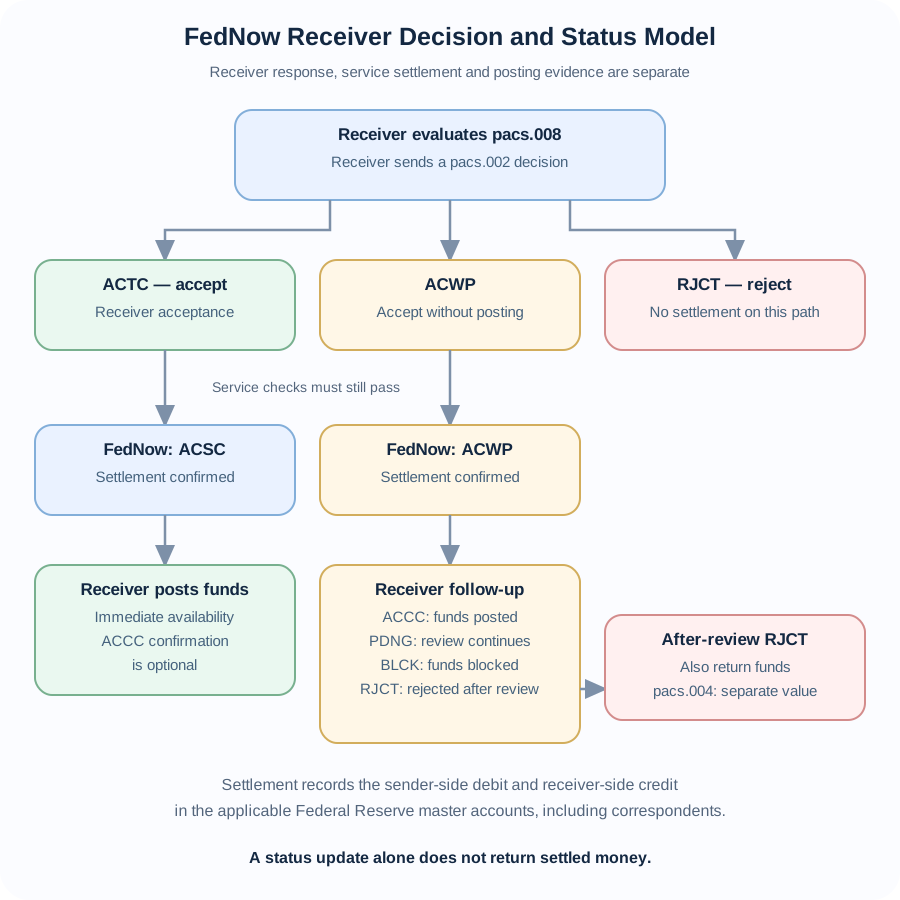
- Receiver-bank processing and pacs002 response logic
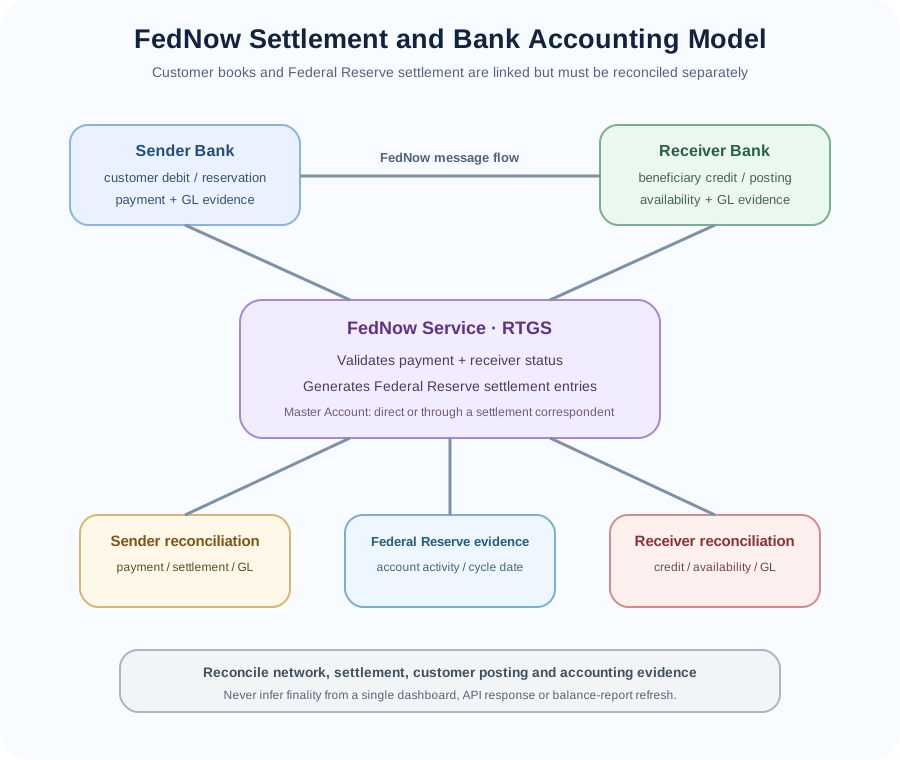
- Settlement, finality and Federal Reserve account entries
- Accept without posting, posting confirmation and controlled availability
- Limits, risk mitigation and bank control design
- Statuses, unknown outcomes, rejects and safe recovery
- Return requests, payment returns and post-settlement exceptions
- Accounting, reconciliation and reporting
- 24x7 operations, resilience, service providers and support
- Real-bank implementation, data ownership and testing
- End-to-end cases, BA checklist and authoritative references
1. What a FedNow Customer Credit Transfer actually is
A FedNow Customer Credit Transfer is a customer payment initiated by a sending financial institution through the FedNow Service using the ISO 20022 pacs.008 message. It is a credit-push payment. The payer, or a party authorized to act for the payer, instructs the sender bank to send funds to a beneficiary at another participating financial institution.
The key word is push. The receiving institution does not pull funds from the payer. That matters for fraud, customer authority, legal rights and operational recovery. The sending bank must be comfortable with the payment before release because instant payments are designed to settle in seconds, not sit in a batch waiting for later intervention.
A practical flow is:
customer intent → authentication → account and entitlement checks → beneficiary and amount validation → fraud/compliance controls → FedNow reachability → sender release → pacs.008 → FedNow validation → receiver-bank decision → pacs.002 → Federal Reserve settlement → receiver posting → beneficiary availability → sender status → reconciliation and reporting.
The Federal Reserve's public procedures define value messages to include pacs.008 Customer Credit Transfer, pacs.004 Payment Return and pacs.009 Financial Institution Credit Transfer for liquidity management. Chapter 23 is about the first of those: the customer credit transfer.
What makes FedNow architecturally distinctive
FedNow combines real-time message processing with real-time gross settlement on Federal Reserve books. When the service settles a payment, it makes accounting entries to the appropriate Federal Reserve Master Accounts or settlement-account relationships. That means the network does not rely on a private prefunded joint account structure like RTP. The settlement model is fundamentally different even though both services deliver instant account-to-account payments.
That difference affects treasury, correspondent models, account balances, liquidity monitoring and operational evidence.
It also affects the way a bank should describe success. “The message left our gateway” is not success. “FedNow received the message” is not success. The bank needs the authoritative service outcome, settlement evidence and receiving-side state.
Fast is not the same as complete
A customer may receive confirmation within seconds, but internally several states still exist. The payment can be technically accepted, routed to the receiver, accepted by the receiver, settled by FedNow, posted by the receiver, displayed to the beneficiary and reconciled by both banks at different points in the sequence.
The purpose of the chapter is to keep those layers distinct.
2. Legal framework, participants and participation profiles
FedNow does not operate only through “sending bank” and “receiving bank.” A production implementation can involve participants, correspondents, respondents, settlement agents, service providers, liquidity providers, connection parties and authorized connection profiles.
Operating Circular 8 governs funds transfers through FedNow together with subpart C of Regulation J. The FedNow Service Operating Procedures then provide detailed operational expectations, requirements and guidance.
FedNow Participant
A FedNow Participant is a financial institution authorized by a Federal Reserve Bank to send, receive or settle messages through the service.
The participant can be configured for different participation types. For customer credit transfers, the public messaging chart distinguishes at least:
- Credit Transfer Receive Only;
- Credit Transfer Send and Receive;
- Send/Receive with Receive Request for Payment.
A receive-only institution can receive customer credit transfers but cannot originate pacs.008 customer credit transfers. A send/receive institution can do both.
Participation should therefore be modeled as a capability profile, not as one Boolean called fednow_enabled.
Correspondent and respondent
A Correspondent is a financial institution that maintains a Master Account with a Federal Reserve Bank and agrees to maintain a Settlement Account for another FedNow Participant.
A Respondent uses the Settlement Account of a Correspondent to settle FedNow transactions.
This creates an important design principle: the bank that owns the customer relationship and the institution whose Federal Reserve account is used for settlement may not always be the same legal entity.
For a respondent bank, the architecture must therefore retain:
participant_rtn
settlement_agent_or_correspondent
settlement_account_relationship
customer_account_owner
network_transaction_reference
federal_reserve_settlement_evidence.
Service Provider and connection roles
A Service Provider may be authorized by a participant to initiate, transmit or receive messages, operate or manage the electronic connection, select certain security procedures or processing options, or access participant information through FedNow.
That does not remove the participant's responsibilities. A processor may run the connectivity stack while the bank still owns customer eligibility, limits, fraud controls, posting, accounting and customer communication.
The public participant page also distinguishes live financial institutions, settlement agents, liquidity providers and certified service providers. Those lists are updated over time, so reachability data must be treated as governed and refreshable rather than permanently coded.
Authorized Connection Profile
The FedNow operating model includes an Authorized Connection Profile, which defines connectivity settings used to process and manage messages for one or multiple routing transit numbers.
Banks using a shared processor or enterprise gateway should treat this as controlled configuration. A connection change can affect multiple RTNs at once, so change management, certificate management and routing ownership are production concerns, not purely infrastructure matters.
3. The end-to-end FedNow credit-transfer journey
A clean way to understand FedNow is to follow one $2,500 payment from a customer at Sender Bank to a beneficiary at Receiver Bank.
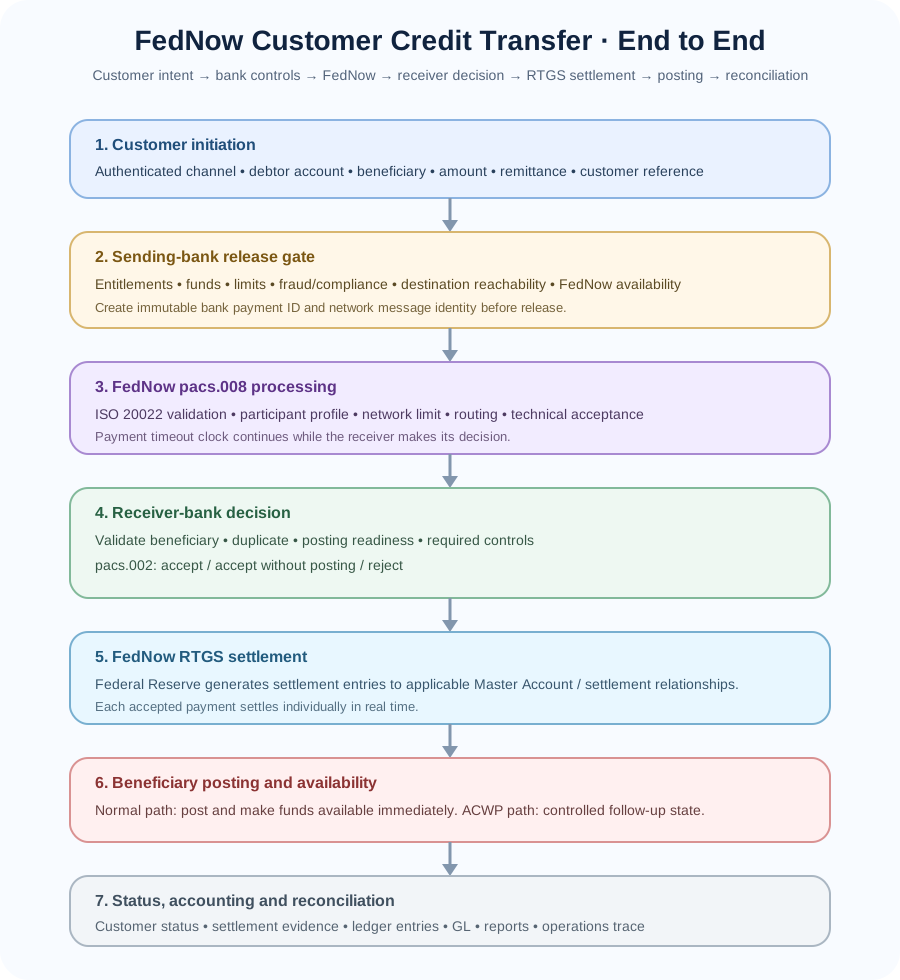
Stage 1 — customer initiation
The customer initiates through mobile banking, online banking, a corporate portal, an API or another authorized bank channel.
The channel captures the debtor account, amount, beneficiary details, remittance information and any customer references. The bank authenticates the user or calling application and verifies entitlements.
Stage 2 — bank eligibility and controls
The sending bank validates that the account is open, eligible and sufficiently funded, the customer is authorized, the amount is within bank limits, required beneficiary information is present, the receiving institution is currently reachable for the intended FedNow capability, and required fraud/compliance controls are complete.
The bank should create an immutable internal payment identity before external release.
Stage 3 — pacs.008 creation and release
The canonical payment is transformed into the FedNow ISO 20022 Customer Credit Transfer message, pacs.008.
The message carries the network-facing transaction data needed by FedNow and the receiving institution. Internal customer context that does not belong in the network message should remain linked through bank identifiers and audit evidence rather than being lost.
Stage 4 — FedNow validation
FedNow validates the message against service rules, participant profiles, network limits and technical requirements. A technically accepted message proceeds to the receiving institution.
Stage 5 — receiver-bank decision
The receiving institution performs its own validation and decides whether to:
- accept the payment;
- accept without posting;
- reject the payment.
The participant payment status message pacs.002 communicates that decision.
Stage 6 — service settlement
If the payment reaches an acceptable state within the service timeout, FedNow settles the obligation by making the applicable entries to Federal Reserve accounts.
This is real-time gross settlement. Each payment is settled individually rather than being accumulated into a later deferred-net position.
Stage 7 — beneficiary posting
The receiving bank posts the funds to the beneficiary account when its acceptance state permits posting. The customer should have full access to settled funds immediately when the payment is accepted for posting under the service expectations.
Stage 8 — status and evidence
The sending bank updates the customer-visible status only after it has authoritative evidence. Both banks retain message, settlement, ledger and reconciliation references.
A real system should be able to reconstruct the journey years later without relying on one screen or one message copy.
4. Sending-bank initiation, authority, validation and release controls
The sending side owns the strongest preventative controls because once the payment settles, recovery is a separate process.
Authentication and authority
For a retail customer, authority may come through an authenticated digital banking session with device trust, multifactor authentication and behavioral monitoring.
For a business customer, authority can involve maker-checker approval, payment limits, account-level entitlements, API certificates, delegated roles or host-to-host credentials.
The payment record should preserve evidence such as:
channel
authenticated_party
authentication_strength
device_or_api_identity
approval_chain
entitlement_result
fraud_decision_reference.
Account and product checks
The bank should validate the source account, available funds, currency, product eligibility, customer segment, transaction limit and any internal restrictions.
The current FedNow network maximum for a pacs.008 is $10,000,000. The public April 2026 Operating Procedures state that the service default for customer credit transfers is $100,000, and participants can configure their limit up to the network maximum.
A bank may of course set a much lower product or customer limit.
That distinction is important:
network maximum ≠ bank product limit ≠ customer limit ≠ channel limit ≠ risk limit.
The effective limit is the most restrictive applicable rule.
Reachability
The sending bank must ensure that the receiving routing number is currently enabled for the required FedNow participation capability.
The Federal Reserve publishes participant and RTN information and also supports a Participant List capability. Banks should maintain fresh reachability rather than assuming that yesterday's participant list is sufficient forever.
Fraud and financial crime
Controls need to be low-latency and pre-release. Typical bank design can include account-takeover detection, device risk, customer behavioral analytics, payee novelty, velocity, amount anomalies, mule indicators, beneficiary risk, sanctions screening and policy-specific payment restrictions.
The architecture should not collapse those results into one generic pass/fail flag. Operations may later need to know which control approved the payment and under what version of policy.
Final release gate
Before the external send, the bank should have one explicit release decision:
CUSTOMER_AUTHORIZED = true
ACCOUNT_ELIGIBLE = true
FUNDS_OK = true
LIMITS_OK = true
REACHABILITY_OK = true
FRAUD_OK = true
COMPLIANCE_OK = true
FEDNOW_AVAILABLE = true
Only then should the network adapter transmit the value message.
5. FedNow message architecture and transaction identity
FedNow is an ISO 20022 service. A bank should understand which messages move value, which carry status, which support exceptions and which support reporting.
For Chapter 23, the important message family is:
pacs.008 — Customer Credit Transfer.
pacs.002 — payment status messages used across technical acceptance, receiver decisioning, settlement and posting states.
pacs.004 — Payment Return.
camt.056 — Return Request.
camt.029 — response to a return request and other supported investigation responses.
pacs.028 — Payment Status Request.
camt.026, camt.028 and camt.029 — information request and response flows.
camt.060, camt.052, camt.054 — account-reporting requests, reports and debit/credit notifications where applicable.
admi.002, admi.004, admi.006, admi.007, admi.011, admi.998 — service/system messaging used for rejects, broadcasts, retrieval, acknowledgements, responses and participant information.
The exact implementation details and field rules belong to the Federal Reserve's FedNow ISO 20022 specifications and must be taken from the current technical documentation during implementation.
Identity must survive every system hop
A bank should retain at least:
bank_payment_id
channel_reference
message_id
instruction_id
end_to_end_id
transaction_id
network_reference
settlement_reference
customer_debit_reference
beneficiary_credit_reference.
The exact FedNow message fields used for each role depend on the implementation specification, but the architectural point is durable: internal identity and network identity must be linked, not overwritten.
Message signing and integrity
FedNow Operating Procedures contain a dedicated message-signing section. Participants and service providers need secure connection, certificate and message-integrity controls consistent with the Federal Reserve service framework.
A bank should therefore treat keys, certificates and signing configuration as payment-production assets. Certificate expiry can become a payment outage.
6. FedNow service validation, routing and the payment timeout clock
One of the most important FedNow-specific concepts is the payment timeout clock.
The public April 2026 Operating Procedures state that the maximum allowable time for a pacs.008, pacs.004 or pacs.009 transaction to settle or be rejected is 20 seconds.
That does not mean every payment should take 20 seconds. The service is designed for immediate processing. The timeout is an outer processing boundary.
What happens before the receiver sees the payment
FedNow validates the incoming message. Examples of checks can include message structure, participant capability, value limits, processing state and other service validations.
If a message fails service validation, it can be rejected without completing the end-to-end payment.
If it passes, the receiver gets the payment message and must respond within the allowable time.
The receiver does not have unlimited investigation time
The receiving institution must be prepared to make its acceptance decision quickly.
The April 2026 Operating Procedures show that the receiver should send a participant pacs.002 response before the configured reserved response time expires. If it does not respond within the service timing boundary, the FedNow Service rejects the payment.
This is a fundamental architecture requirement. A receiving bank cannot route an incoming FedNow payment into a traditional manual queue and expect an analyst to respond ten minutes later.
Technical acceptance versus business acceptance
A message can pass technical validation before the receiving bank decides whether the payment can be accepted for posting.
The system should therefore keep technical state and financial state separate.
Example:
TECHNICALLY_VALIDATED
is not the same as
RECEIVER_ACCEPTED
and neither is the same as
SETTLED
or
BENEFICIARY_POSTED.
That state separation is essential for status, retries and reconciliation.
7. Receiver-bank processing and pacs002 response logic
The receiver bank is where FedNow differs most visibly from batch payment processing.
The receiving institution must be able to process incoming payments continuously and make a timely decision.
The public ISO messaging chart in the April 2026 Operating Procedures identifies several important pacs.002 statuses for customer credit transfers.
ACTC — receiver acceptance
For a FedNow customer credit transfer, the receiver sends pacs.002 ACTC to accept the payment. It is an alternative to ACWP or RJCT, not a preliminary status before that decision. Settlement still has to succeed.
ACSC — Accepted and Settled
ACSC represents the service's accepted-and-settled status in the customer credit-transfer messaging model.
A sending bank should treat this as an authoritative network financial milestone, not merely an API success code.
RJCT — Rejection
RJCT means the payment did not proceed successfully. The reason information matters because the sending bank must distinguish customer-correctable data issues from participant capability issues, service errors or other causes.
The receiving bank must use the appropriate rejection reason when it is the rejecting party.
ACWP — Accept Without Posting
ACWP is one of the most important operational states.
The receiving institution can indicate that the payment is accepted without immediate posting. This is not a casual “we are busy” status. It is an exception path that requires controlled follow-up.
FedNow confirms settlement on this path with ACWP. The receiver later reports ACCC, PDNG, BLCK or RJCT. A post-settlement RJCT also requires a return of funds; the status message does not move money. The supported financial return is pacs.004.
ACCC — confirmation of posting
The public messaging chart identifies ACCC as confirmation of posting. After ordinary ACSC settlement, this additional confirmation is optional; the receiver’s funds-availability obligation still applies.
This is valuable because it separates settlement from the receiving core's posting confirmation.
PDNG and BLCK
PDNG and BLCK can be used in the post-ACWP lifecycle to indicate pending or blocked conditions as supported by the service rules.
A bank should model these explicitly rather than map everything after ACWP to “pending.”
8. Settlement, finality and Federal Reserve account entries
FedNow settlement is real-time gross settlement.
The Federal Reserve Operating Procedures describe the service as settling interbank obligations by generating entries to Federal Reserve Bank Master Accounts.
Direct settlement
Where the participant settles using its own applicable Federal Reserve account structure, the service posts the debit and credit associated with the payment through the Federal Reserve settlement framework.
Correspondent settlement
A respondent may use a correspondent's settlement account arrangement. In that case, the customer-facing sender or receiver and the settlement-account holder can be different institutions.
Reconciliation must therefore prove both:
customer ownership and settlement ownership.
Gross, not deferred net
Each accepted FedNow payment settles individually. It is not held for a future batch settlement cycle.
This has major liquidity implications. A high outbound volume can reduce the bank's Federal Reserve account position in real time, while incoming activity can increase it.
Settlement and customer posting
Interbank settlement and beneficiary posting are related but different.
A complete transaction model should carry at least:
FEDNOW_SETTLED
and
BENEFICIARY_POSTED.
A payment can be financially settled while a controlled receiving-side posting state still needs to be resolved.
Finality
The legal and operational finality treatment is governed by Regulation J, OC 8 and the FedNow terms. A bank should not design post-settlement handling as if the original transfer can simply be deleted or reversed internally.
Returns are new value messages, discussed later in this chapter.
9. Accept without posting, posting confirmation and controlled availability
Accept without posting deserves its own section because it is easy to misunderstand.
A receiving bank might determine that the payment can be accepted by the service but cannot yet be posted normally to the customer's available balance.
The bank then needs a controlled state machine, not a generic exception queue.
A practical internal model can be:
RECEIVED
VALIDATED
ACWP_SENT
SETTLED
POSTING_REVIEW
then one of:
POSTED_ACCC
PENDING_PDNG
BLOCKED_BLCK
or a subsequent return/recovery path if the funds ultimately cannot be applied according to the applicable procedures.
Why this matters to customer service
Suppose the sender sees that FedNow has settled but the beneficiary says the money is not available.
If operations only has a generic “successful” flag, the investigation becomes confusing.
The bank needs to know:
- receiver response state;
- settlement state;
- posting state;
- hold/block reason where appropriate;
- follow-up status messages;
- whether a payment return was later created.
Immediate funds availability remains the normal service expectation
FedNow is designed to enable end customers to receive immediate access to funds. ACWP is therefore an exception control state, not the normal processing path.
The receiving bank should monitor ACWP inventory closely because unresolved items represent settled money that has not reached ordinary customer availability.
10. Limits, risk mitigation and bank control design
The April 2026 Operating Procedures provide a clear network-limit framework.
For Customer Credit Transfers:
- network maximum: $10,000,000;
- default participant value setting: $100,000;
- participants can configure their limit up to the network maximum.
For Payment Returns:
- network maximum: $10,000,000.
For Liquidity Management Transfers:
- network maximum: $10,000,000;
- default value setting: $2,500,000.
Chapter 23 focuses on customer credit transfers, but these adjacent limits matter for operational context.
Correspondent Net Send Limit
FedNow Operating Procedures contain risk-mitigation controls for correspondent/respondent structures, including Correspondent Net Send Limit concepts.
A respondent cannot assume unlimited access to a correspondent's settlement position. The settlement relationship needs explicit financial risk controls.
Fraud mitigation tools
The Operating Procedures identify FedNow fraud-mitigation features including participant negative-list functionality, account-activity thresholds and network-intelligence capabilities.
The Federal Reserve also launched a Network Intelligence API in April 2026 to provide network-level data insights supporting participant risk-mitigation processes.
A bank should combine service-level tools with its own fraud controls. FedNow does not replace the bank's responsibility to assess the customer, account, device, payee and transaction.
Layered limit model
A mature bank evaluates:
NETWORK_LIMIT
PARTICIPANT_CONFIGURED_LIMIT
PRODUCT_LIMIT
CUSTOMER_LIMIT
CHANNEL_LIMIT
RISK_LIMIT
CORRESPONDENT_LIMIT
and, where relevant,
TREASURY_OR_LIQUIDITY_LIMIT.
The payment proceeds only when every required layer permits it.
11. Statuses, unknown outcomes, rejects and safe recovery
Instant payments become dangerous when a bank treats a timeout like a reject.
A reject is known. A timeout can mean the bank does not yet know.
Known reject
If FedNow sends an authoritative rejection, the payment did not settle through that attempt. The bank can release any reservation, update the customer and permit controlled correction/retry according to the reason.
Service timeout
The public operating procedures state that the FedNow transaction timeout is 20 seconds. If the payment timeout clock expires before the payment can settle, the service rejects the payment and sends the corresponding status according to the service flow.
Where the authoritative service rejection is received, the bank has a known non-settled outcome.
Bank/provider timeout before authoritative outcome
This is different.
If the bank's own gateway or processor loses connectivity and the bank cannot tell whether FedNow settled the transaction, the internal state must be:
UNKNOWN_EXTERNAL_OUTCOME
not
REJECTED.
The bank should query/retrieve status using supported FedNow mechanisms before attempting another value transfer.
Safe resend rule
If FedNow explicitly rejects the pacs.008 because the payment timeout expired and a new payment is appropriate, the public Operating Procedures state that the sender should use a new unique message ID.
That is a critical duplicate-control requirement.
Why automatic fallback is unsafe
A bank must not automatically send the same payment over another rail simply because its FedNow API call timed out.
If FedNow actually settled but the response was lost, a fallback transfer could duplicate the payment.
Chapter 25 will go deeper into cross-rail fallback policy. Chapter 23 establishes the core rule: resolve financial state before creating another value event.
12. Return requests, payment returns and post-settlement exceptions
FedNow supports post-settlement exception handling using separate messages.
A sender can send a camt.056 Return Request asking for a previously settled customer credit transfer to be returned.
The public April 2026 procedures state that a return request generally should be sent within 60 calendar days from settlement, although fraud and certain RFP-warranty use cases have specific treatment outside that general guideline.
The receiving participant can respond using camt.029 with statuses such as accepted, rejected, pending investigation or partially executed according to the applicable process.
If funds are returned, the return is sent using a new pacs.004 Payment Return.
That distinction matters:
return request ≠ return of money.
A camt.056 asks.
A camt.029 responds to the request.
A pacs.004 moves returned value.
Full or partial return
The FedNow procedures allow a participant honoring a return request to return a full or partial amount of the original customer credit transfer.
The bank should therefore link returned amounts to the original payment while preserving a separate return-payment identity.
Receiver cannot apply funds
A payment return can also be initiated without first receiving a return request, for example when the receiving participant cannot apply funds it previously received after an accept-without-posting path.
Again, the original payment remains part of the immutable history. The return is a new financial event.
Fraud reporting
FedNow procedures also use return-request and payment-return messaging in fraud-reporting scenarios. Chapter 26 will cover fraud and return-of-funds requests more deeply; Chapter 23 keeps the core operational mechanics necessary to understand the credit-transfer lifecycle.
13. Accounting, reconciliation and reporting
A real FedNow implementation is incomplete until it proves the money end to end.
Sending-bank accounting chain
A sending institution should be able to trace:
customer instruction → payment ID → customer debit/reservation → pacs.008 → FedNow settlement → Federal Reserve account effect → network status → GL posting → reconciliation result → customer confirmation.
Receiving-bank accounting chain
The receiver should be able to trace:
incoming pacs.008 → receiver decision → FedNow settlement → beneficiary credit → funds availability → posting confirmation → GL/accounting → reconciliation.
Settlement-account reconciliation
Because FedNow settles on Federal Reserve accounts, treasury and finance need to reconcile customer-payment activity against Federal Reserve account activity.
The Operating Procedures include reporting support through account reporting requests and camt.052/camt.054 messages, as well as FedNow Service and Accounting Reports and an Adhoc Query Tool.
Business-day complexity
FedNow operates continuously, but the FedNow Service Funds Transfer Business Day rolls around approximately 7:01 p.m. ET.
This means a payment at 8:00 p.m. Monday calendar time can belong to Tuesday's FedNow service business day.
A bank should therefore store at least:
event_timestamp_utc
event_timestamp_local
fednow_cycle_date
bank_business_date
ledger_posting_date.
Do not derive all four from one date field.
Balance-report timing
The public procedures note that FedNow account balance reporting can have short availability gaps around rollover and may have up to a one-minute delay in FedNow activity even though FedNow transactions themselves settle in real time.
This is a practical treasury lesson: reporting latency does not change payment finality.
14. 24x7 operations, resilience, service providers and support
FedNow support is available 24x7x365, but not every surrounding operational activity is equally available at every hour.
The public procedures note, for example, that some correspondent-relationship changes, mergers and account-opening/closing activities are tied to standard business-day support windows.
A bank therefore needs to distinguish:
transaction processing availability from administrative change availability.
Receiving path must be always on
If the institution offers receive capability, the receiving account platform, fraud/compliance decisioning, posting, notifications and exception logic must support continuous processing.
A maintenance window that takes down the core ledger every Sunday at 02:00 is incompatible with a genuine always-on receiving proposition unless the bank has a controlled resilient design.
Service-provider operating model
Participants using a service provider should define clear ownership for:
- network connection;
- message validation;
- queue monitoring;
- certificate management;
- participant-profile configuration;
- fraud tooling configuration;
- incident detection;
- retrieval/status queries;
- raw message evidence;
- replay/idempotency controls;
- escalation to Federal Reserve support.
“Processor handles FedNow” is not a sufficient operating model.
Broadcasts, acknowledgements and connectivity
FedNow system messaging includes broadcast, acknowledgement, retrieval and participant-list messages. Operations should monitor those channels rather than focus only on pacs.008 and pacs.002.
Service warnings, connection issues or participant-profile changes can affect payment availability before the first customer reports a problem.
15. Real-bank implementation, data ownership and testing
The most maintainable bank architecture keeps a common instant-payment core and a FedNow-specific edge.
The common core can own:
- customer payment identity;
- authentication evidence;
- account eligibility;
- limits;
- fraud/compliance results;
- customer status;
- accounting and reconciliation hooks;
- operational case identity.
The FedNow adapter can own:
- FedNow message transformation;
- participant/RTN capability handling;
- service-specific status mapping;
- service timeout logic;
- connection queues;
- signing/connectivity requirements;
- Federal Reserve references;
- FedNow reporting interfaces.
State machine
A practical internal state model might be:
CAPTURED
AUTHORIZED
VALIDATED
CONTROLLED
FEDNOW_ELIGIBLE
RELEASED
TECHNICALLY_ACCEPTED
RECEIVER_ACCEPTED
SETTLED
BENEFICIARY_POSTED
RECONCILED.
Exception branches include:
REJECTED_BEFORE_SEND
FEDNOW_REJECTED
RECEIVER_REJECTED
ACCEPT_WITHOUT_POSTING
UNKNOWN_EXTERNAL_OUTCOME
RETURN_REQUESTED
PAYMENT_RETURNED
RECONCILIATION_BREAK.
Testing must include financial state, not only API response
A credible test suite includes:
- successful send/receive;
- receive-only destination;
- amount above participant configured limit;
- amount above network maximum;
- insufficient funds;
- fraud decline;
- unreachable RTN;
- malformed message;
- receiver
RJCT;
- receiver
ACWP then ACCC;
- receiver
ACWP then PDNG/BLCK;
- service timeout with authoritative reject;
- bank/provider timeout with unknown outcome;
- duplicate client retry;
- new unique message ID after authoritative timeout reject;
- correspondent settlement limit issue;
- Federal Reserve cycle-day rollover;
- account balance-report delay around rollover;
- return request and accepted return;
- partial payment return;
- service provider failover;
- certificate expiry/rotation;
- participant-list change;
- reconciliation break.
Testing should prove the accounting entries and customer outcomes, not only that ISO messages were exchanged.
16. End-to-end cases, BA checklist and authoritative references
Case 1 — normal $750 consumer payment
A customer at Sender Bank sends $750 to a beneficiary at Receiver Bank.
The sender authenticates the customer, validates account eligibility, checks funds, applies fraud/compliance controls, confirms the receiving RTN is FedNow-enabled and releases a pacs.008.
FedNow validates the message and passes it to Receiver Bank.
Receiver Bank validates the beneficiary account and returns the appropriate accepting pacs.002 status within the service timing requirement.
FedNow settles the payment through Federal Reserve account entries.
Receiver Bank posts the $750 to the beneficiary, confirms posting as required by its flow and makes funds available.
Sender Bank receives the authoritative service status, finalizes the customer debit, updates the digital channel and reconciles the Federal Reserve settlement evidence.
Case 2 — receiver accepts without posting
The receiving bank cannot immediately make funds available under a controlled exception condition.
It responds ACWP within the required timing window.
The service flow can continue to settlement according to the applicable procedure, while the receiver maintains a separate posting-control state.
The receiver subsequently sends the appropriate follow-up status and either posts the funds or follows the supported return path if the funds cannot be applied.
The operations lesson is that settlement and posting are separate fields.
Case 3 — authoritative service timeout reject
The receiver does not complete its response within the FedNow payment timeout boundary.
FedNow rejects the payment due to timeout and sends the corresponding rejection status.
Sender Bank now has authoritative evidence that the attempt did not settle.
If the customer wants the payment retried, a new payment attempt should use a new unique message ID.
Case 4 — the dangerous unknown
Sender Bank transmits a valid pacs.008, but its network connection drops before it receives the service result.
The internal state must be UNKNOWN_EXTERNAL_OUTCOME.
The bank does not automatically resend.
It uses supported status/retrieval mechanisms and reconciles service evidence to determine whether the original payment settled.
This is one of the most important implementation lessons in the chapter.
BA checklist
A Business Analyst should be able to answer all of these before signing off a FedNow credit-transfer implementation:
- What participation type is enabled for each RTN?
- Who owns the customer account and who owns the settlement account?
- Is the institution direct or correspondent/respondent for settlement?
- What service provider is involved?
- What is the bank's configured FedNow amount limit?
- What lower product/customer/channel limits apply?
- How is receiving RTN reachability refreshed?
- What fraud and compliance checks occur before release?
- What creates the immutable bank payment identity?
- How are
pacs.008 and all pacs.002 statuses mapped internally?
- What does the bank do with
ACTC, ACSC, ACWP, ACCC, PDNG, BLCK and RJCT?
- What happens when the 20-second service timeout expires?
- What happens when the bank has no authoritative service response?
- How does the bank prevent duplicate resubmission?
- How are Federal Reserve settlement entries reconciled?
- How is the FedNow cycle date stored separately from calendar date?
- How are ACWP items monitored to closure?
- How are
camt.056, camt.029 and pacs.004 linked to the original payment?
- What reports and account messages feed treasury and reconciliation?
- What is the service-provider incident model?
- What happens when certificates, connectivity or participant data changes?
- Which tests prove end-to-end financial integrity rather than just message exchange?
Authoritative references
Federal Reserve Financial Services — FedNow Service Resources: https://www.frbservices.org/resources/financial-services/fednow
Federal Reserve Financial Services — Operating Circulars / Operating Circular 8: https://www.frbservices.org/resources/rules-regulations/operating-circulars.html
Federal Reserve Financial Services — FedNow Service Operating Procedures, Version 3.6, April 2026: https://www.frbservices.org/binaries/content/assets/crsocms/resources/rules-regulations/042826-fednow-service-operating-procedures.pdf
Federal Reserve Financial Services — FedNow Service Operating Hours: https://www.frbservices.org/resources/financial-services/fednow/operating-hours
Federal Reserve Financial Services — FedNow Service Participants and Service Providers: https://www.frbservices.org/financial-services/fednow/organizations/
Federal Reserve Financial Services — FedNow Service 2026 Fee Schedule: https://www.frbservices.org/resources/fees/fednow-2026
Federal Reserve Financial Services — Network Intelligence API announcement, April 28, 2026: https://www.frbservices.org/news/communications/045826-network-intelligence-api
This application uses JavaScript for the full interactive experience. This text summary is served for accessibility and search indexing.