Domestic Wire Collections and Payments. A practitioner deep dive into domestic wire products across customer authority, beneficiary and routing data, Fedwire/CHIPS/on-us routing, settlement, posting, exceptions, reconciliation, reporting, controls and resilience.
A domestic wire looks simple from the customer side. A business enters a beneficiary, a routing number, an account number and an amount, approves the instruction, and expects the money to arrive the same day. Inside a bank, however, a domestic wire is a tightly controlled high-value payment process. It connects customer authority, bank security procedures, beneficiary and routing data, payment controls, rail selection, settlement, account posting, reporting, reconciliation and exception handling.
That is the focus of Chapter 18.
Chapter 16 explained the Fedwire Funds Service itself: Federal Reserve access, ISO 20022, real-time gross settlement, operating hours, liquidity and finality. Chapter 17 explained CHIPS: direct participation, ISO 20022, liquidity-efficient settlement, queues and finality. Chapter 18 moves one layer up. It explains how a bank turns those infrastructures into a domestic wire product for customers and internal bank users.
The practical model is:
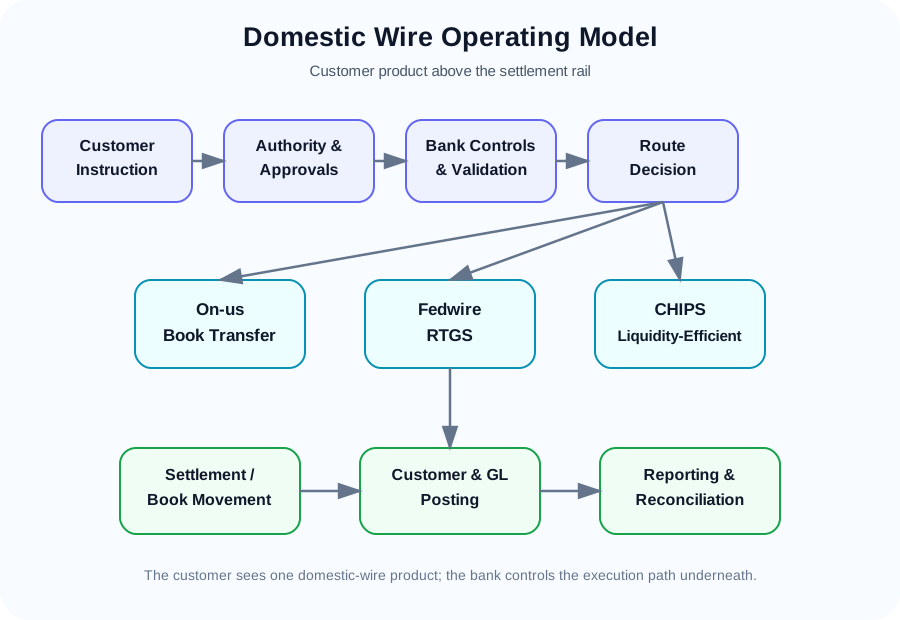
customer or bank need → authority and security procedure → payment capture → validation and enrichment → beneficiary and routing checks → bank controls → rail decision → controlled external release → settlement → receiving-bank posting → customer reporting → reconciliation → exception or investigation if needed.
Domestic wire processing is therefore not synonymous with one network. A domestic U.S. dollar wire may use Fedwire, may use CHIPS where the institutions and bank product support it, or may become an on-us book transfer when both accounts are held within the same banking group. The customer still experiences one domestic wire product, while the bank manages the settlement path underneath.
For a roughly 60-minute core session, spend about 35 minutes on Sections 2–4, Sections 6–10 and Sections 12–13. For the next 10 minutes, use the chapter’s three diagrams to connect customer instructions, route choice and confirmed financial state. Use 10 minutes to work through one case in Section 16, then spend the final 5 minutes explaining: How should operations respond when a domestic wire's external outcome is uncertain? Treat these timings as a study guide. The remaining sections, additional cases and extended reference material are follow-up study; completing the whole chapter takes longer.
Chapter navigator
- What a domestic wire actually is
- Participants, roles and the bank operating model
- Customer initiation and instruction capture
- Authority, authentication, entitlements and security procedures
- Beneficiary, bank and routing data
- Validation, fraud, sanctions and pre-release controls
- Choosing on-us, Fedwire or CHIPS
- Outbound domestic wire end to end
- Inbound domestic wire end to end
- Clearing, settlement, finality and customer posting
- Statuses, acknowledgements and payment truth
- Rejects, repairs, cancellations, amendments and recovery
- Accounting and reconciliation
- Reporting, servicing and cash visibility
- Controls, cut-offs, resilience and production operations
- End-to-end cases, BA checklist and testing
1. What a domestic wire actually is
A domestic wire is a high-value electronic credit transfer in U.S. dollars in which the originator instructs a bank to send funds to a beneficiary through a U.S. wire-payment path. The word domestic describes the payment context: the transfer is being executed within the U.S. domestic wire environment rather than being treated as a cross-border correspondent payment. The word wire describes the high-value bank transfer product, not one single technical message or one single settlement engine.
For a learner, the most important starting point is to separate the customer product from the settlement rail.
A corporate treasury user may choose “Domestic Wire” in a banking portal. That product can be governed by customer agreements, bank cut-offs, approval rules, fee arrangements, beneficiary setup, transaction limits and servicing commitments. The bank then decides how the payment is executed. Depending on the relationship and configuration, the underlying path may be Fedwire, CHIPS or an internal on-us transfer.
This is different from ACH credit. Both are push payments, but the operating models are different. ACH is designed around batch or intraday ACH-network processing, ACH settlement, specific return frameworks and lower-cost mass-payment use cases. Domestic wires are generally used when value, urgency, certainty of same-day processing, legal treatment, treasury need or counterparty expectation makes a high-value wire path appropriate.
This is also different from an instant payment. FedNow and RTP are separate instant-payment systems with their own rule frameworks, limits, message flows and 24/7 operating models. A customer may use an instant payment for some urgent transfers, but that does not convert the transaction into a wire.
The wire product has four layers
A useful bank model has four layers.
Layer 1 — customer instruction. Who wants to pay whom, how much, when and why?
Layer 2 — bank decision. Is the instruction authorized, valid, compliant, funded and eligible for the domestic wire product?
Layer 3 — execution path. Which internal or external high-value route should carry the payment?
Layer 4 — financial outcome. Was the payment settled, posted, reported and reconciled?
When these layers are collapsed into one status called SENT, operational confusion follows.
Domestic wire is a credit-push model
The wire is normally initiated by the payer/originator side. The originator’s bank sends a payment order through the selected path so the beneficiary’s bank can receive the transfer and credit the beneficiary under the applicable legal and operational framework.
A collection use case can still use a domestic wire. For example, a corporate may ask customers to remit invoice payments to its concentration account by wire. The corporate is “collecting,” but the payment direction is still a payer-initiated credit push. The collector does not pull funds from the payer’s account merely because the business purpose is collection.
That distinction matters for requirements. A domestic wire collection service is usually about receiving and identifying inbound credits, not creating debit authority over the remitter’s account.
High value does not mean there is a universal minimum amount
Banks and customers often associate wires with high-value payments, but a generic domestic-wire training chapter should not invent a universal minimum payment size. Banks may have product pricing, channel limits, approval thresholds or internal routing economics. Those are bank-specific decisions.
The correct principle is that domestic wires are a high-value payment capability designed for controlled same-day bank transfer execution, not that every wire must exceed an arbitrary amount.
2. Participants, roles and the bank operating model
A domestic wire can involve more actors than the portal screen shows.
The originator is the person or organization that ultimately instructs the funds transfer. In a corporate-payment case, this is the corporate customer. The originator’s bank receives the customer instruction and creates or transmits the relevant payment order. The beneficiary is the intended receiver of funds. The beneficiary’s bank receives the transfer for credit to the beneficiary. An intermediary bank may exist in some payment paths, although a straightforward domestic Fedwire payment often reaches the beneficiary’s bank directly when that institution is reachable.
Inside the originator’s bank, responsibility is distributed across teams and systems.
The channel authenticates the user and captures the payment. An entitlement service determines whether the user is allowed to create or approve that type of payment. A payment hub or orchestration layer validates, enriches and routes it. Fraud and sanctions controls assess risk. Limits and balance controls determine whether the payment may proceed. Treasury monitors liquidity. A network gateway creates and exchanges the rail-specific instruction. Core banking or ledger systems perform customer and internal accounting. Reconciliation compares external settlement evidence with internal books. Operations handles exceptions. Customer service handles enquiries.
No single architecture is mandatory. The important point is the functional ownership.
Sending bank versus originator’s bank
In simple examples the originator’s bank is also the sending bank into the external wire system. In more complex service-provider arrangements or correspondent models, the institution directly connected to the external system may not be the bank that originally accepted the customer instruction.
A bank data model should therefore avoid assuming that every “sender bank” field means the same business role.
Receiving bank versus beneficiary’s bank
Likewise, the receiving institution on the external network may act directly as beneficiary’s bank or may process on behalf of another relationship. Chapter 19 will go deeper into correspondent structures. For Chapter 18, the implementation lesson is that external network role and customer-account role should not be merged carelessly.
Internal teams need a shared payment identity
The same payment should be traceable across channel, payment hub, compliance, network, settlement, ledger, reporting and case-management systems.
A useful lineage is:
customer_instruction_id → bank_payment_id → route_decision_id → external_message/reference → settlement_event → accounting_entries → customer_report → investigation_case_if_any.
If each system creates unrelated identifiers with no correlation, domestic-wire investigation becomes manual and error-prone.
Real-bank responsibility map
Product owns the customer promise. Payments operations owns operational control. Treasury owns funding and liquidity decisions. Compliance and fraud functions own their decisions and escalation policies. Technology owns platform reliability and technical recovery. Reconciliation or finance owns financial control. Customer service owns communication but should never invent payment status.
This ownership model becomes particularly important when a payment is delayed. “The wire is pending” is not enough. The bank should know whether it is pending customer approval, sanctions review, balance release, rail transmission, external settlement, beneficiary posting or reconciliation.
3. Customer initiation and instruction capture
A domestic wire may enter through online banking, a corporate portal, host-to-host file, API, branch or assisted banking process, or another controlled channel. Chapter 15 explained connectivity patterns; Chapter 18 focuses on what the bank must capture and preserve once the instruction enters the domestic-wire product.
The first objective is not to construct a Fedwire or CHIPS message. It is to create a valid business payment instruction.
At minimum, the bank normally needs to know the debit account, payment amount and currency, requested execution date, beneficiary identity, beneficiary account information, beneficiary-bank routing information and any payment-purpose or remittance data required by the product. Corporate channels may also include customer references, invoice information, beneficiary templates, payment priority, cost-center data and approval metadata.
Capture the customer’s intention before enrichment
Suppose a customer enters routing number X, beneficiary account Y, beneficiary name Z, amount $850,000 and requested date today. The bank may enrich routing number X with bank name, participant status and internal route options. That enrichment must not overwrite the original customer-entered data without audit history.
The bank should be able to answer:
- What did the customer submit?
- What did the bank enrich?
- What did the bank change through repair?
- Who approved the final instruction?
- What was sent externally?
Those are different facts.
Beneficiary templates reduce entry effort but increase control importance
Corporate customers often maintain saved beneficiaries. A wire template may hold bank routing, beneficiary account, beneficiary name and other static attributes. This improves straight-through processing but creates a high-risk change point. Fraudsters often target beneficiary maintenance rather than the final payment screen.
A bank-grade product therefore treats beneficiary creation/change and payment approval as separate controlled activities where the customer agreement and bank design require it.
Future-dated wire instruction
If a customer creates a wire today for tomorrow, the instruction should remain in a scheduled state until it becomes eligible for today’s processing cycle. It should not be shown as externally sent merely because it has passed customer approval.
A practical state can be:
CAPTURED → CUSTOMER_APPROVED → BANK_ACCEPTED_FOR_FUTURE_DATE → SCHEDULED → ELIGIBLE_FOR_RELEASE.
Duplicate capture control
Channels should detect obvious duplicate submission, but duplicate control cannot rely only on same amount and beneficiary. Two legitimate wires may have identical values. Strong duplicate detection combines stable customer references, request IDs, idempotency keys for APIs, file control data, timestamps and business context.
A duplicate-warning outcome is not automatically a rejection. The customer may be allowed to confirm a genuinely repeated payment under bank policy.
4. Authority, authentication, entitlements and security procedures
Domestic wire controls begin with a distinction that many implementations blur.
Authentication asks: who is interacting with the bank?
Entitlement asks: what is that user allowed to do?
Authorization/approval asks: has the payment been validly approved under the customer’s agreed authority model?
Security procedure asks: what agreed method is used to verify payment orders or communications relating to them and detect unauthorized or erroneous instructions?
These ideas overlap operationally but are not interchangeable.
Article 4A, as incorporated into Regulation J for Fedwire transfers, gives security procedures an important legal role. A security procedure can include algorithms, codes, identifying words or numbers, encryption, callback procedures or similar devices. A signature comparison by itself is not necessarily the entire security procedure contemplated by Article 4A.
The practical banking lesson is that a domestic-wire platform should preserve evidence of the security and authorization path used for the customer instruction.
Corporate maker-checker
A corporate may require one user to create a wire and two different users to approve it. The bank may enforce this through customer-configured entitlements. The wire should not become releasable until the approval matrix is satisfied.
The approval evidence should include user identities, roles, timestamps, approval sequence, payment version and any relevant authentication context.
If the beneficiary or amount changes after approval, the bank should define whether approval must be reset. In most controlled designs, a material change to approved payment data invalidates the prior approval state.
Channel authentication is not payment approval
A user logging in with multifactor authentication does not automatically mean every wire they create is authorized. The user may have create-only rights. Conversely, a payment approved by authorized users can still be held by the bank for sanctions, fraud or balance controls.
Security procedure and customer agreement
Banks should not hardcode one generic “commercially reasonable” procedure for every customer profile. Article 4A considerations can depend on the customer, payment pattern, alternatives offered and the agreed security procedure. Legal interpretation belongs to the bank’s counsel and policy functions.
For the BA, the requirement is more concrete: store the applicable agreement/security-procedure profile, enforce the configured controls, preserve evidence and make overrides auditable.
Out-of-band verification
For unusual beneficiary changes, high-risk activity or exception cases, a bank may use callback or other out-of-band verification according to its policy. That is a bank control, not a universal legal requirement for every domestic wire.
The control must avoid using contact details supplied only in the suspicious instruction itself. The verification source should come from trusted customer master data or another approved source.
5. Beneficiary, bank and routing data
Domestic wire routing depends heavily on identifiers. For Fedwire, the Federal Reserve E-Payments Routing Directory provides routing information for Fedwire Funds Service participants and is synchronized with Federal Reserve routing databases. Banks commonly maintain their own governed copy or derived routing reference data for straight-through processing.
A routing number is not merely display text. It can determine where a payment is sent.
Number and name are not equivalent controls
Regulation J and Article 4A contain important rules about reliance on identifying numbers. At the Federal Reserve level, a Reserve Bank may rely on a routing number identifying an intermediary bank or beneficiary’s bank even if a name points elsewhere, when it does not know of the inconsistency. Similar identifying-number concepts exist for beneficiary identification in the applicable legal framework.
The implementation lesson is not “ignore the name.” The lesson is that routing numbers and account numbers are legally and operationally significant data elements. Banks should validate them carefully and must not assume that a name mismatch will automatically stop a payment at the settlement infrastructure.
Routing reference-data lifecycle
A bank should know:
routing number → participant institution → current reachability → effective date → supported rail → internal correspondent relationship if relevant → status/closure information → source/version.
Reference data should be effective-dated. A routing number that becomes inactive tomorrow should not break historical payment reconstruction.
Beneficiary account data
The beneficiary account is usually supplied by the originator. The originator’s bank generally does not have direct access to the beneficiary bank’s core-account records simply because it knows the routing number.
Therefore, “account validation” in domestic wires needs careful wording. A bank may perform format, known-account, fraud-network or third-party validations where available, but it should not promise universal real-time beneficiary account ownership verification unless the product actually provides such a service.
Name matching is not universally deterministic
Beneficiary name may be important for customer confirmation, sanctions screening, fraud analytics and receiving-bank processing. But U.S. domestic wire execution should not be taught as if there is a universal scheme-level Verification of Payee service that guarantees name-to-account matching before every wire.
Banks may implement proprietary checks, warning services or account validation tools. Those are product/control choices and should be labeled as such.
Routing enrichment must preserve lineage
If customer input says 0210... and the routing engine enriches that to a particular participant plus Fedwire eligibility, the output should be traceable to the reference-data version used at decision time.
That becomes important when a payment is investigated weeks later after the directory has changed.
6. Validation, fraud, sanctions and pre-release controls
A domestic wire is typically irrevocable or very difficult to recover after final settlement, so the strongest controls occur before release.
Banks design the exact sequence differently, but a robust control model normally covers several questions.
Is the instruction structurally valid? Required fields, amount, currency, date and identifiers must be usable.
Is the customer authorized? The account and product must allow this wire, and the approval model must be complete.
Are funds available or credit arrangements valid? The bank must decide whether the customer debit can be honored.
Does the payment violate limits? Customer, user, account, channel or product limits may apply.
Does the payment present fraud risk? New beneficiary, unusual amount, device change, velocity, account takeover signals and behavior patterns can matter.
Does the payment require sanctions/compliance review? Names, banks, geographies and payment purpose can trigger controls according to law and bank policy.
Is the route valid and reachable? The receiving institution must be reachable through the selected path.
Fraud hold and sanctions hold are different states
A fraud review should not be stored as a generic “compliance hold,” and a sanctions alert should not be labeled simply “fraud.” Different teams, evidence, decision rules and reporting obligations may apply.
Useful states can include:
FRAUD_REVIEW
SANCTIONS_REVIEW
LIMIT_REVIEW
FUNDING_REVIEW
DATA_REPAIR.
The customer-facing message can be simpler, but the internal state must remain precise.
Pre-release control evidence
For each released wire, the bank should be able to prove which control version was applied and what outcome was reached. That does not mean storing every model feature forever without governance. It means retaining enough evidence to explain the decision under the bank’s audit and legal requirements.
Do not use retries to bypass business controls
If a payment is held because sanctions screening is incomplete, a technical retry should not send it through another interface or route. Rail fallback is not a way to bypass an unresolved business decision.
Separation of duties
Manual repair, release override, limit override and contingency execution should have clear authority. A production support engineer fixing connectivity should not automatically gain authority to approve a customer wire.
7. Choosing on-us, Fedwire or CHIPS
Routing is one of the most important differences between a domestic wire product and a domestic wire rail.
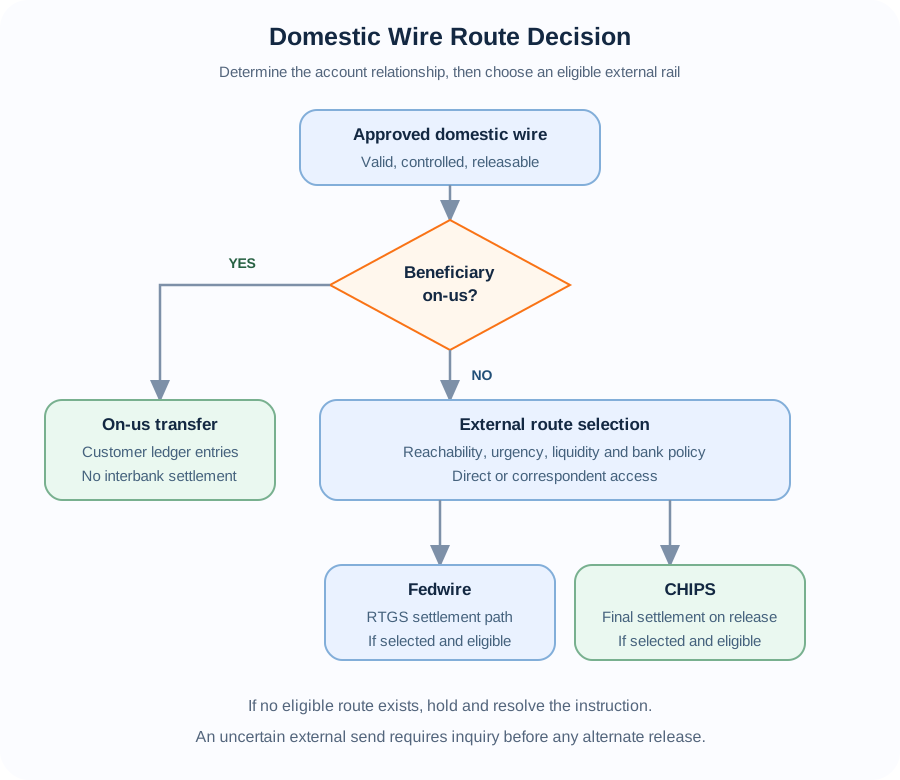
A bank may first determine whether the beneficiary relationship is on-us. If both debit and credit accounts are maintained within the same legal and operational booking environment, an internal book transfer may complete without external interbank settlement. Group-on-us arrangements can be more complicated and should be modeled according to the bank’s legal-entity structure rather than assumed.
If external settlement is required, Fedwire is a major domestic wire path. CHIPS can also support domestic high-value U.S. dollar payments for participating institutions and relationships.
Rail selection criteria
A bank may consider:
- receiving-bank reachability;
- customer product promise;
- urgency and requested execution time;
- participant/correspondent relationship;
- liquidity and treasury strategy;
- bank fees and commercial routing policy;
- network availability;
- payment type and message-data needs;
- contingency state;
- customer instruction or contract where applicable.
These are not universal scheme rules. They are bank routing considerations.
Route before message construction
A common architecture mistake is to build a Fedwire-specific message too early. The bank should first create a rail-neutral payment object, complete the business decision, choose the route, and then build the route-specific message.
That makes contingency and cross-rail reporting much safer.
Point of no return
Before external release, rerouting may be straightforward if the payment remains fully controlled by the sending bank. After release, the bank must know the external outcome before using another rail.
A safe conceptual rule is:
NOT_EXTERNALLY_RELEASED → route may be changed under policy
EXTERNAL_REJECT_CONFIRMED → controlled reroute may be possible
OUTCOME_UNCERTAIN → do not send again blindly
SETTLED → do not reroute; recovery is a separate process.
Customer should not need to understand treasury routing
The customer may care that the payment is a domestic wire, the expected processing date, fees and status. The bank generally should not expose every internal liquidity or routing optimization decision unless the product promises a specific rail.
But the bank must preserve the route internally for audit, reconciliation and servicing.
8. Outbound domestic wire end to end
Consider a corporate customer paying $3.2 million to a domestic supplier.
Step 1 — capture
The payment enters through an approved channel. The bank records the original instruction and creates a stable bank payment ID.
Step 2 — customer authority
The channel and entitlement layer verifies that the users are entitled to create and approve the payment. The customer’s configured approval policy is satisfied.
Step 3 — payment validation
The bank validates debit account, amount, currency, requested date, beneficiary details, routing data and product eligibility.
Step 4 — financial controls
Available-balance, credit-line or other account funding logic is applied according to product design. A wire should not be assumed “funded” merely because it passed syntactic validation.
Step 5 — risk and compliance controls
Fraud and sanctions/compliance controls run. Any unresolved alert moves the payment to the correct review queue.
Step 6 — route decision
The routing engine decides on-us, Fedwire or CHIPS according to bank rules and reachability.
Step 7 — external message creation
If an external wire is required, the bank maps the canonical payment into the relevant ISO 20022 usage rules. Since both Fedwire and CHIPS now use ISO 20022, the conceptual data model is richer than the old wire-format era, but each service still has its own implementation and usage requirements.
Step 8 — controlled release
The gateway transmits the payment. The bank records the outbound technical event separately from the business status.
Step 9 — network acceptance/settlement
The external rail validates and processes the instruction under its rules. Fedwire settles accepted transfers individually in central-bank money. CHIPS uses its liquidity-efficient settlement model. Chapter 16 and Chapter 17 cover those mechanics in depth.
Step 10 — bank financial posting
The sending bank finalizes the appropriate customer and internal accounting based on its architecture and the confirmed payment state.
Some banks may reserve or debit the customer earlier in the lifecycle and finalize later. Others use different posting designs. Training content should not pretend there is one mandatory internal ledger sequence.
Step 11 — customer reporting
The customer receives a truthful outcome such as processed/settled according to the bank’s reporting model, with references needed for servicing and reconciliation.
Step 12 — reconciliation
External settlement evidence, payment records, customer posting and GL entries are reconciled.
A wire is operationally complete only when the bank can account for both the payment outcome and its financial records.
9. Inbound domestic wire end to end
Inbound processing is not simply the outbound flow reversed.
The receiving bank starts with an external payment received through Fedwire, CHIPS or another configured wire relationship. It must interpret the message, identify the beneficiary account, apply controls, post the credit, report it and reconcile the financial impact.
Step 1 — receive and authenticate the network message
The wire gateway receives the external instruction through the approved network connection. Technical receipt is logged with external identifiers and timestamps.
Step 2 — validate the message
The bank validates message structure and required business data. A network-accepted instruction can still create an internal exception if the beneficiary account cannot be resolved or internal data rules fail.
Step 3 — identify the beneficiary relationship
The bank resolves beneficiary account and servicing entity. This is one reason account-number quality matters.
If the account is closed, blocked, invalid or cannot be identified, the receiving bank needs an exception path governed by applicable law, rail rules and bank policy.
Step 4 — compliance and fraud controls
Inbound wires can also trigger sanctions or fraud monitoring. The fact that another bank sent the payment does not remove the receiving bank’s own compliance responsibilities.
The exact point at which funds are blocked, rejected, returned or held depends on the legal/control scenario. Chapter 20 will cover wire controls and sanctions in more depth.
Step 5 — customer posting
When the payment is accepted for the beneficiary and internal controls permit, the bank credits the beneficiary account under its posting rules.
External settlement and customer posting remain separate events. Settlement can be final between banks while customer posting is still being completed internally.
Step 6 — remittance and reference preservation
The receiving bank should preserve payment references, originator information, remittance data and external identifiers needed for the beneficiary’s cash application and investigation.
A corporate receiving hundreds of wires may depend on this data to match receipts to invoices.
Step 7 — customer reporting
The beneficiary sees the credit through statements, intraday reporting, API notifications or other bank services.
Step 8 — reconciliation
The bank reconciles inbound settlement value to customer and GL posting. Any difference becomes a controlled break.
10. Clearing, settlement, finality and customer posting
Domestic wire terminology is often imprecise. A customer may say “the wire cleared,” while the bank needs to know exactly which event occurred.
For Fedwire, an accepted payment order settles on the books of the Federal Reserve Banks. Fedwire is a real-time gross settlement system, so transfers settle individually. Regulation J and Operating Circular 6 govern the Fedwire funds-transfer framework.
For CHIPS, settlement occurs under the CHIPS rules using its liquidity-saving mechanism. Once a CHIPS payment is released and settled, CHIPS describes that settlement as final and irrevocable.
An on-us domestic transfer does not require interbank settlement because the bank controls both sides of the book movement, although legal-entity and group structure can make “on-us” more complex than it appears.
Final settlement is not the same as beneficiary posting
A Fedwire transfer can settle between banks before the receiving bank has completed customer credit posting. A CHIPS payment can likewise have final settlement while the beneficiary bank is still performing internal processing.
So the bank should distinguish:
INTERBANK_SETTLED
from
BENEFICIARY_ACCOUNT_CREDITED.
Finality is not the same as impossibility of later recovery
Final settlement means the original interbank settlement is not simply undone as though it never happened. If the originator made an error or fraud is discovered after settlement, the banks may pursue a return, reversal-like compensating payment, recall/recovery request or other legally supported process depending on the facts and rail rules.
The new movement is a separate event linked to the original payment.
Customer debit timing
The sending bank’s customer debit can occur at different internal stages depending on ledger design. A bank may reserve funds before release, debit on release, post final accounting on settlement confirmation, or use combinations of memorandum and ledger entries.
The BA requirement is to define the exact accounting state transition. “Debit the customer” is not sufficient.
Collections view
For a corporate receiving domestic-wire collections, the business success point is often not merely interbank settlement. The corporate may need:
wire received → beneficiary account credited → remittance delivered → receivable matched → cash visible.
That is why payment operations and receivables operations must share identifiers.
11. Statuses, acknowledgements and payment truth
Domestic wires cross many systems, so status design is critical.
A useful state model separates customer lifecycle, bank processing, external rail state, settlement state, posting state and reconciliation state.
One possible internal model is:
RECEIVED
AWAITING_CUSTOMER_APPROVAL
BANK_VALIDATION
CONTROL_REVIEW
READY_FOR_ROUTE
READY_FOR_RELEASE
EXTERNALLY_RELEASED
EXTERNAL_ACCEPTED_OR_QUEUED
SETTLED
BENEFICIARY_POSTED where observable
RECONCILED.
These are conceptual states, not mandatory scheme codes.
Technical acknowledgement is not settlement
A gateway may confirm that a message was successfully transmitted. That does not prove that the external rail accepted or settled the payment.
Similarly, a local MQ acknowledgement proves only that a message moved between internal components.
The bank needs a status-evidence hierarchy.
Unknown outcome must be explicit
If the bank transmitted a wire and lost connectivity before receiving authoritative external outcome, the correct state is not automatically FAILED.
Use a state such as:
OUTCOME_UNCERTAIN.
That state should block blind retry and trigger external verification/reconciliation.
Customer statuses should be simple but truthful
The customer does not need 25 internal states. A customer-facing model may use pending, processing, completed and rejected/cancelled with explanatory detail.
But completed should map to a defined bank truth. Is it external settlement? Beneficiary posting? Bank acceptance? The product team must decide and document that meaning.
Status timestamps matter
Store timestamps for customer submission, approvals, bank acceptance, control completion, route selection, external send, external acceptance, settlement, posting and reconciliation where available.
This supports SLA measurement and investigation without changing the payment itself.
12. Rejects, repairs, cancellations, amendments and recovery
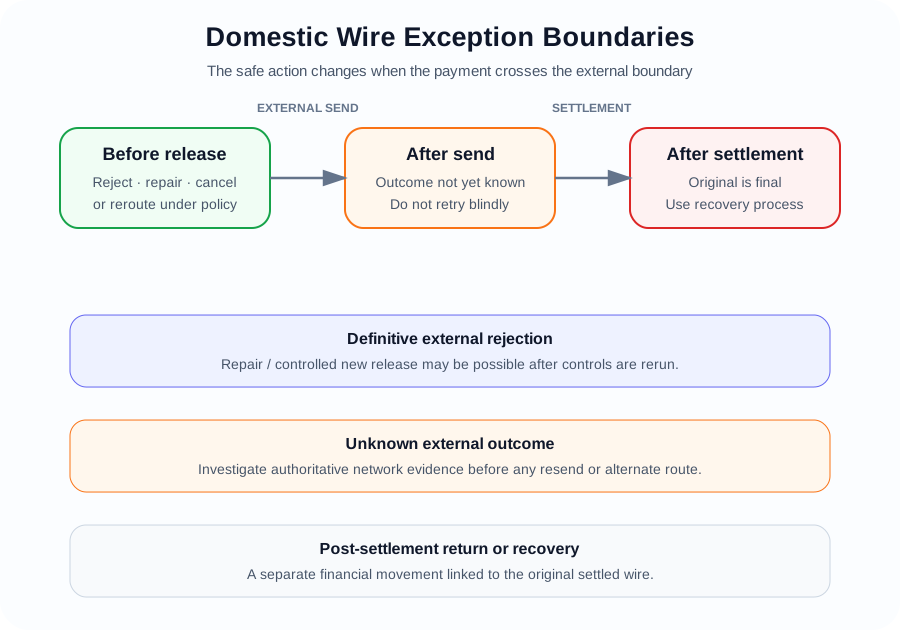
Domestic wire exception handling depends heavily on where the payment is in the lifecycle.
Before external release, the bank controls the payment and may be able to reject, repair, cancel or reschedule it under its customer agreement.
After external release but before confirmed settlement, the bank must follow the applicable network and legal process. It cannot assume it still has unilateral control.
After settlement, recovery usually requires a new compensating process or cooperation from downstream parties. The original settled payment should not be rewritten as though settlement never occurred.
Reject before release
Examples include invalid routing data, insufficient authority, failed customer approval, product ineligibility or unresolved control failure.
The payment can be rejected with a precise reason and no external settlement impact.
Repair before release
A repairable defect may be corrected by an authorized operations process. The bank should record original value, corrected value, operator, reason, approval if required, and whether customer reapproval is necessary.
Changing beneficiary account after customer approval is fundamentally different from fixing letter case in a non-material field.
External rejection
If the selected external rail definitively rejects the instruction, the bank should capture the authoritative reject evidence. The route engine may then determine whether repair or alternate routing is permitted.
The payment must not be resubmitted automatically if the reason implies a business-control failure that remains unresolved.
Cancellation and amendment
Article 4A and Regulation J provide legal concepts for cancellation and amendment of payment orders. Operational success depends on timing and acceptance state; a cancellation request should never be presented to a customer as guaranteed merely because the bank accepted the request for processing.
A good customer status is:
CANCELLATION_REQUESTED
followed by
CANCELLED_BEFORE_SETTLEMENT
or
CANCELLATION_UNSUCCESSFUL_ALREADY_SETTLED/TOO_LATE.
Post-settlement recovery
Suppose a customer sent funds to the wrong account. Once the wire is finally settled, the sending bank cannot simply delete the payment. It may send a recovery/return request, contact the receiving bank and follow applicable legal and network procedures.
If funds are returned, that is a separate credit back to the originator linked to the original payment.
Fraud recovery
Fraud recovery can be time-critical, but urgency does not justify corrupting payment state. Preserve the original settlement evidence and open a fraud/recovery case. Any returned funds should be reconciled as a new financial event.
13. Accounting and reconciliation
Domestic wires are financially significant, so reconciliation is not a back-office afterthought. It is part of the payment control design.
For an outbound wire, a complete financial picture can include customer debit or reservation, fee entries, external settlement impact, internal settlement-account or due-to/due-from entries, and final GL posting.
For inbound wires, it can include external settlement receipt, customer credit and internal balancing entries.
Exact journal design is bank-specific. The invariant is that the bank must reconcile the customer-level payment to the external financial outcome and internal books.
Four-way reconciliation model
A strong reconciliation model compares at least four evidence layers:
- payment instruction — what the bank intended to send or receive;
- external rail outcome — what actually settled or was rejected;
- customer posting — what was debited or credited;
- general ledger/settlement books — how the bank recorded the financial effect.
For receiving-side collections, a fifth layer may be customer cash-application reporting.
Settlement mismatch
If Fedwire confirms settlement but the bank has no matching outbound accounting, that is not a reason to resend the wire. It is a financial-control break requiring internal posting recovery.
If the bank debited the customer but no external payment was ever released and policy requires restoration, that is another break type.
Duplicate reconciliation
Duplicate wires can arise from customer duplication, internal reprocessing or unsafe retry. Reconciliation should detect duplicate external references and also business-level duplication patterns.
The investigation should answer whether both payments were genuinely authorized, whether both settled, and whether customer reporting represented them correctly.
Fees
Wire fees may be charged separately or as part of account pricing. Reconciliation should not mix fee accounting with principal settlement. A payment can settle correctly while a fee posting fails.
Reconciliation ownership and close
End-of-day control should classify every domestic wire into a known outcome population:
settled and reconciled
rejected/cancelled before external settlement
externally settled but internal break
outcome uncertain
exception/recovery open.
An unresolved population should remain visible with owner and aging.
14. Reporting, servicing and cash visibility
Domestic-wire reporting serves different users.
The originator wants to know whether the payment was accepted, processed and completed. The beneficiary wants to know that funds were credited. Corporate treasury wants cash position, payment references and value-date information. Operations wants network and exception states. Finance wants settlement and accounting totals. Audit wants evidence. Customer service wants a timeline that can be explained without exposing sensitive internal controls.
Outbound customer reporting
A strong outbound report includes the customer reference, bank payment reference, amount, beneficiary, requested date, processing status and relevant wire reference according to the bank’s product design.
Do not expose raw internal errors such as NullPointerException or gateway socket status. Translate technical failures into meaningful operational outcomes.
Inbound collections reporting
For a corporate receiving domestic wire collections, remittance quality can be as important as speed. A $5 million credit with no usable reference can create a receivables exception even though the payment settled perfectly.
Banks should preserve and deliver the structured remittance and party data they receive to the extent supported by the product and channel.
Intraday reporting
Treasury customers may consume intraday balance and transaction reporting through APIs, files or portals. The bank must define whether an inbound wire appears when external settlement occurs or only after customer posting.
The reporting timestamp and status should make that distinction clear.
Customer enquiry timeline
A servicing screen should show a single ordered timeline:
10:02 instruction received
10:05 approvals complete
10:06 bank controls complete
10:07 route selected
10:08 released externally
10:09 settlement confirmed
10:10 accounting complete
10:11 customer report published.
The exact times are illustrative, not service-level promises.
Collections cash application
A corporate receivables team may match inbound wires using amount, originator name, account, invoice reference, remittance, customer-defined reference or virtual-account structure. Payment reporting should preserve enough data to support that matching instead of reducing the transaction to amount and date.
15. Controls, cut-offs, resilience and production operations
Domestic wires are time-sensitive, financially material and difficult to reverse after settlement. Production operations therefore needs strong preventive and detective controls.
Cut-offs are product controls, not the same as rail close
Fedwire and CHIPS have network operating schedules. A bank can impose earlier customer cut-offs to allow time for approvals, screening, funding, repair and operational control.
A bank should not tell customers that its internal cut-off is “the Fedwire closing time” unless that is actually the product rule. Network hours and customer product hours are different layers.
Current schedule should be governed reference data
Operating hours change over time. Fedwire currently operates 22 hours each business day, from 9:00 p.m. Eastern Time on the preceding calendar day to 7:00 p.m. Eastern Time, subject to the official operating schedule and possible extensions. The Federal Reserve has also announced future expansion of operating days. Chapter 16 covers the infrastructure detail.
The bank should store cut-offs and calendars as effective-dated reference data rather than hardcode them in application logic.
Resilience layers
Domestic-wire resilience includes:
- channel resilience;
- payment-hub resilience;
- sanctions/fraud service resilience;
- network-gateway resilience;
- Fedwire/CHIPS contingency processes;
- ledger resilience;
- reporting resilience;
- reconciliation recovery.
A green network connection is not enough if the bank cannot post or reconcile.
Fedwire contingency
Federal Reserve Financial Services provides contingency mechanisms, including FedPayments Manager – Funds contingency options for eligible customers, with specific controls and authorization requirements. A bank’s contingency procedure should be pre-designed, tested and restricted to authorized staff.
Contingency is not “manually send the wire again.” The bank must first establish the payment’s current external state and prevent duplicates.
Business continuity and unknown outcomes
A disaster-recovery test should include payments that are:
not yet released
released with confirmation
released with unknown outcome
settled but not posted
posted but not reported.
Recovery action differs for every state.
Operational dashboards
A useful domestic-wire dashboard should include payment count/value by stage, oldest pending payment, control-review queues, externally released but unsettled/unknown items, settlement-confirmed items awaiting accounting, reconciliation breaks, cut-off proximity and network/connection health.
Change management
ISO 20022 usage rules, network schedules, routing data and bank product controls evolve. Changes should be effective-dated, regression tested and deployed with clear operational readiness.
A new optional ISO field should not silently become mandatory because one internal system accidentally enforces it.
16. End-to-end cases, BA checklist and testing
The best way to confirm Chapter 18 understanding is to test complete operating stories.
Case 1 — standard outbound Fedwire domestic wire
A corporate submits a same-day domestic wire to a reachable beneficiary bank. Customer approvals are complete. Fraud and sanctions controls pass. Funds are available. Routing selects Fedwire. The external message is released and settlement is confirmed. Customer debit, GL and reporting complete. Reconciliation closes with no breaks.
The BA should be able to trace every identifier and state transition.
Case 2 — domestic wire routed through CHIPS
The customer submits the same domestic product, but bank routing selects CHIPS because the receiving institution, customer product and routing policy support that path. The customer should not receive an inaccurate “Fedwire sent” status. Internal reporting should record CHIPS, and settlement evidence should reconcile to CHIPS.
Case 3 — on-us domestic transfer
Both accounts are held in the same bank booking environment. Routing chooses internal transfer. No external rail message is created. Customer reporting can still present the transaction as the appropriate bank product while reconciliation proves both ledger sides.
Case 4 — beneficiary routing error before release
The routing number fails reference-data validation. The wire enters repair. An authorized operator corrects the routing data using trusted evidence. Because the change is material, the bank’s configured approval policy determines whether customer reapproval is needed. Only then can it proceed.
Case 5 — external reject
The bank releases the payment but receives a definitive external reject. The payment is not settled. The error is repairable. After the underlying cause is corrected and controls are rerun, the bank may create a controlled new release according to policy. It must not reuse an uncertain technical transaction as though nothing happened.
Case 6 — connection fails after send
The gateway records local transmission but loses connectivity before authoritative outcome. The payment becomes OUTCOME_UNCERTAIN. Automatic retry and alternate-rail routing are blocked. Operations verifies the external state before any re-execution.
Case 7 — settled externally, posting fails
Settlement is confirmed, but the customer debit or receiving-side customer credit posting fails internally. The wire must not be resent. The incident is an internal accounting/posting recovery with high-priority reconciliation ownership.
Case 8 — fraud discovered after settlement
The original payment remains settled. Fraud operations opens a recovery case and contacts the relevant bank under the applicable process. Any returned funds become a linked compensating transaction.
BA checklist
A complete domestic-wire requirement should answer:
- What exactly is the product: domestic wire, internal transfer or rail-specific service?
- Who is the originator and beneficiary?
- Which channels can initiate it?
- What customer security procedure and approval model applies?
- Which data fields are mandatory at customer level?
- Which fields are enriched by the bank?
- How are routing numbers validated and versioned?
- What fraud, sanctions, limit and funding controls apply?
- What makes the payment eligible for Fedwire, CHIPS or on-us routing?
- What is the point of no return for rerouting?
- What does each internal and customer status mean?
- Which event means settlement?
- When are customer and GL postings created/finalized?
- What are the reject, repair, cancellation and recovery paths?
- What is reconciled against what?
- What reports and references are delivered to customers?
- What cut-offs and calendars are product-specific versus rail-specific?
- How is unknown outcome handled?
- What is the contingency and DR process?
- What evidence is retained for audit and investigation?
Developer checklist
Developers should verify idempotency, immutable payment identity, versioned beneficiary and routing data, explicit state transitions, safe retry, effective-dated rules, network correlation, accounting-event uniqueness and audit history.
Do not implement a single boolean such as wireSent=true. That loses too much lifecycle truth.
Tester checklist
Testing should cover:
- valid outbound Fedwire route;
- valid outbound CHIPS route where supported;
- on-us route;
- invalid routing number;
- beneficiary data defect;
- insufficient authority;
- failed approval matrix;
- fraud hold;
- sanctions hold;
- limit failure;
- insufficient funds or credit decision;
- future-dated instruction;
- customer cut-off breach;
- external reject;
- cancellation before release;
- cancellation requested after external release;
- unknown external outcome;
- duplicate API request;
- duplicate file submission;
- failover during transmission;
- settled but customer posting failed;
- customer posted but reporting failed;
- reconciliation mismatch;
- inbound closed/invalid beneficiary account;
- inbound compliance hold;
- recovery request after settlement;
- daylight-saving and holiday-calendar behavior;
- routing-directory effective-date change;
- ISO 20022 optional/structured data preservation;
- high-volume backlog recovery without duplicates.
Closing principle
A domestic wire is not complete because a network message left the bank. It is complete when the bank can prove that the instruction was authorized, validated and correctly routed; the external financial outcome is known; customer and internal books reflect that outcome; the customer received truthful reporting; and reconciliation can close the payment without ambiguity.
That is the domestic-wire operating model a bank can actually run.
Authoritative references
This application uses JavaScript for the full interactive experience. This text summary is served for accessibility and search indexing.