Cross-Rail Exceptions, Investigations, Audit Evidence and Customer Communication. Resolve cross-rail exceptions using linked payment attempts, accurate recovery mechanisms, legal clocks, financial evidence and clear customer communication.
A supplier tells Malla Bank's corporate customer that an $18,000 payment is missing. The customer's portal shows submitted, the original bank response is incomplete, and an employee proposes sending an instant payment instead. Meanwhile, a separate debit remains visible on the customer's account. The urgent business need is real, but switching rails before establishing the first attempt's outcome could pay the supplier twice.
Chapter 59 connected monitoring, reconciliation and accounting. This final chapter follows the cases that cross those boundaries: missing receipts, uncertain execution, returns, recovery requests, disputes, manual contingencies and contradictory evidence. The aim is to resolve the business obligation without losing the distinct rules and financial histories of the methods used.
Investigate the original attempt before creating another financial instruction. Keep the obligation, each payment attempt, the customer claim and every recovery event linked, while applying the correct rules to each leg.
Allow roughly 60 minutes for the chapter, diagram walkthroughs and worked cases. The bank, customer situations, amounts and case designs are fictional. Sources were checked on October 5, 2026. Actual recovery rights, messages, deadlines and evidence requirements depend on the rail, legal framework and agreements in force.
Chapter navigator
- Define the problem in the customer's terms and the bank's evidence
- Classify exceptions by the event that actually occurred
- Stabilize uncertain execution before choosing a fallback
- Build the case around linked identities and evidence
- Assign ownership across the payment chain
- Use rail-specific information and recovery messages accurately
- Apply ACH return and reversal rules to their intended purposes
- Coordinate card, check and provider exceptions without flattening them
- Separate requests, consent, restrictions and returned funds
- Reconcile every financial consequence of the case
- Manage deadlines as a set of obligations
- Communicate what is known, what remains open and what happens next
- Preserve audit evidence that can reproduce the decision
- Close the case without leaving a live risk behind
- Worked cases and implementation decisions
- Role checklist and learning closure
1. Define the problem in the customer's terms and the bank's evidence
A customer says the payment is missing. That statement can mean the instruction never reached the bank, validation failed, settlement did not occur, the receiving bank has not posted, or the supplier received funds but cannot apply them. It can also concern an incorrect destination, duplicate, unauthorized debit or misleading status. The bank should locate the break rather than assume every complaint requires a recall.
Begin with the intended outcome: who should receive what value, for which obligation and by when. Then identify the actual payment attempts and account entries. A supplier invoice, insurance claim or payroll obligation can have several technical attempts without creating several legitimate entitlements to payment.
The opening $18,000 case requires the original instruction, customer debit, release evidence and receiving-side information where available. The employee's proposal to use an instant method is a possible later action, not evidence that the first payment failed. Urgency should accelerate fact-finding and authorized decisions rather than replace them.
Record the customer's words and the bank's interpretation separately. An internal category such as beneficiary claims nonreceipt can help routing, but it should not erase an allegation about amount, authority or timing. The case may require more than one workstream, including a consumer-protection assessment where applicable.
2. Classify exceptions by the event that actually occurred
A reject indicates that a particular instruction was not accepted at a defined stage. The bank must identify that stage and whether any other financial leg already occurred. A file validation reject, network reject and customer-posting failure do not necessarily have the same money position.
A return is a subsequent financial event under the applicable service. A reversal is a defined corrective mechanism where the rules permit it. Cancellation can concern a pending instruction; a request for return of settled funds seeks cooperation or action under the relevant framework. A dispute concerns an asserted right or problem and is not itself a transfer of money.
An investigation requests or assembles information. It can establish success, failure, an incorrect transaction or continuing uncertainty. Opening a case does not stop all payment processing, and closing a technical ticket does not establish that a business obligation was resolved.
Use explicit terms in the case model and customer interface. A generic reversed flag can conceal whether the bank canceled a schedule, received a financial return, posted a customer correction or merely sent a request. Each event needs its own reference, time, amount where relevant and evidence of completion.
3. Stabilize uncertain execution before choosing a fallback
An uncertain outcome is a real operational state. It can arise when a response is lost after submission, when reports are delayed or when a provider's status conflicts with account evidence. It should not be converted into failed solely because a timer expired.
Identify the last confirmed event and the authoritative source for the next one. Query the original attempt through the supported service or counterparty process. Preserve reservations and pending exposure according to the bank's controlled model until the outcome is sufficiently established. A new request identifier does not make a second payment safe if the first may already have settled.
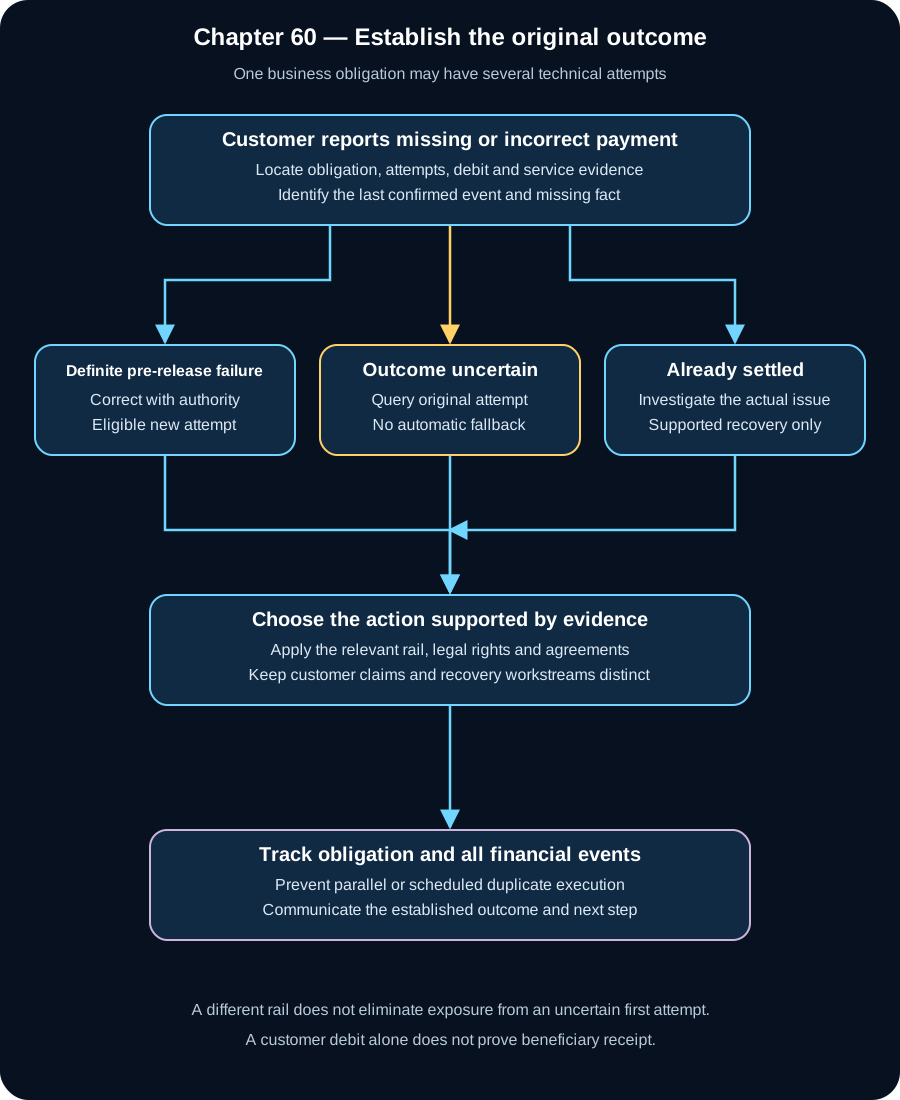
The diagram prevents uncertainty from flowing directly into a replacement. A definite pre-release failure can permit an authorized corrected attempt. A settled payment requires an appropriate post-settlement route. An unresolved attempt needs further evidence or the institution's explicitly governed exceptional decision, with the exposure understood.
Contingency procedures should include both automated and manual channels. A help desk that can issue an urgent wire without seeing a pending API instruction can defeat otherwise sound duplicate controls. The business obligation must remain visible across every route the institution can use to satisfy it.
4. Build the case around linked identities and evidence
The case record should link the business obligation, original customer instruction, file and batch where relevant, bank execution reference, network reference, ledger entries and subsequent recovery messages. These relationships should survive channel changes and vendor handoffs. One case can contain several attempts, and one incident can affect many cases.
Retain original and normalized data separately where transformation matters. A display name, shortened reference or enriched address can differ from what the bank received and transmitted. Investigators need the relevant original instruction to establish the destination and data actually used, not merely the latest corrected version.
Sequence events using source timestamps and receipt timestamps. A report received later can describe an earlier settlement. Clock differences, time zones and service business dates should be visible rather than silently reordered by the case application's local time. Otherwise the bank can mistakenly conclude that a cancellation preceded release when the authoritative records show the opposite.
Evidence should have provenance: source system, retrieval time, responsible party and relevant version. A copied screenshot may support an investigation but should not be the only record when structured service or account evidence exists. The aim is a reproducible explanation, not a large attachment folder that no reviewer can navigate.
5. Assign ownership across the payment chain
The originating bank may control the customer instruction and know the release outcome. An intermediary may hold a corresponding account movement or forwarding record. The receiving institution knows its own posting and account restrictions. A provider may know its internal allocation or withdrawal state. No single party necessarily possesses the whole story at the first contact.
Choose the inquiry recipient based on the missing fact. Asking the receiving bank to explain an instruction that never left the originator wastes time. Asking an ACH operator to identify a supplier's invoice allocation asks it to solve a business application issue outside its role. The case owner should identify which participant can supply the evidence needed next.
Within Malla Bank, one accountable owner should coordinate the customer outcome while specialist teams perform their tasks. The customer should not be required to reconcile contradictory answers from wire operations, fraud support and accounting. Internal ownership can be distributed without distributing the responsibility to provide a coherent response.
Set escalation against the real deadline and exposure. A pending legal notice, an approaching network window and a supplier's commercial deadline are different clocks. Record them separately so that an apparently routine investigation does not miss a mandatory action while waiting for a counterparty's reply.
6. Use rail-specific information and recovery messages accurately
For Fedwire, current ISO 20022 guidance identifies camt.056 for requesting return of a previously settled payment and camt.029 for refusing that request. A pacs.004 carries a payment return. The request and refusal are not themselves the transfer of funds back. Current documentation also identifies camt.110 and camt.111 investigation messages; production use requires the service specification.
RTP provides its own request-for-return and response mechanisms, including camt.056 and camt.029 in its technical documentation. That does not mean every Fedwire return message or field can be copied into RTP. The actual financial return must follow the network's supported procedure and current participant specification.
A shared ISO family does not establish identical versions, reason codes or use cases. Fedwire's published guidance, for example, describes pacs.028 for status requests concerning previously sent drawdown requests; it should not be casually taught as a universal Fedwire customer-payment tracking message. Implement the inquiry the service actually supports.
Adapters should preserve the original payment references and distinguish message acceptance from the requested business result. An accepted return request means the request reached a defined stage. It does not prove that another bank agreed, that funds are available, or that a financial return has settled.
7. Apply ACH return and reversal rules to their intended purposes
An ACH return and an ACH reversal are different mechanisms with different roles and conditions. The RDFI's return reason, applicable timeframe and evidence must fit the actual circumstance. An originator's request for help does not create an unrestricted right to debit a recipient again or compel a return through any convenient code.
Nacha permits reversals for defined erroneous entries, not because an originator failed to fund or changed its mind. The required timing is transmission so the reversal is made available to the RDFI within five banking days following the erroneous entry's settlement date. The current public guidance also states that IAT entries cannot be reversed. The bank must apply the full current rule conditions, not just the five-day figure.
A cross-rail case can tempt staff to misuse a reversal. If a supplier payment was sent twice through different methods, the business duplication does not automatically mean every original ACH entry qualifies for every corrective mechanism. Identify how the error occurred, which instruction was erroneous and the authorized recovery route.
Customer protections remain a separate workstream. A consumer's legal error claim should not be denied solely because the ordinary network return opportunity is unavailable. Chapter 57 described that distinction; the case system must preserve it when an ACH specialist records that a particular recovery route cannot be used.
8. Coordinate card, check and provider exceptions without flattening them
A card refund, chargeback and authorization reversal concern different events. The issuer's customer duties, the merchant's commercial obligations and the network's financial adjustments need separate records. A merchant's promise to refund is not evidence that a refund has posted, and a chargeback decision should not be described as cancellation of the original authorization.
For checks, stopping an unpaid instrument, investigating a returned item and pursuing an applicable warranty or other claim are different actions. A stop-payment request does not guarantee that an item already paid will be undone. Verify issue, presentment, payment and any later adjustment before authorizing a replacement instrument or another payout method.
Provider balances add further financial legs. A wallet receipt, provider withdrawal and receiving-bank credit can have different references and outcomes. An app marked completed may refer only to an internal balance transfer. Ask which event the provider confirms and obtain evidence for the missing external leg before concluding that the bank lost the money.
Keep the original method visible even when a later recovery uses another one. A card-funded purchase refunded through an external bank transfer requires careful reconciliation of the original claim, authorized refund and any still-active network dispute. A change of method must not allow two teams to compensate the same obligation independently.
9. Separate requests, consent, restrictions and returned funds
Recovery can depend on the receiving institution's review, available funds, required customer authority, legal restrictions and the applicable rules. The requesting bank should state the actual reason and supply the required evidence. It should not promise that a request will force the recipient institution to debit an account in every case.
A response agreeing to act and the actual return settlement can occur as distinct events. Track amount, currency, fees where applicable and references. Partial recovery should remain partial in the case and customer explanation. An $18,000 request followed by an $11,000 return leaves a $7,000 difference requiring its own treatment; it is not a fully recovered payment.
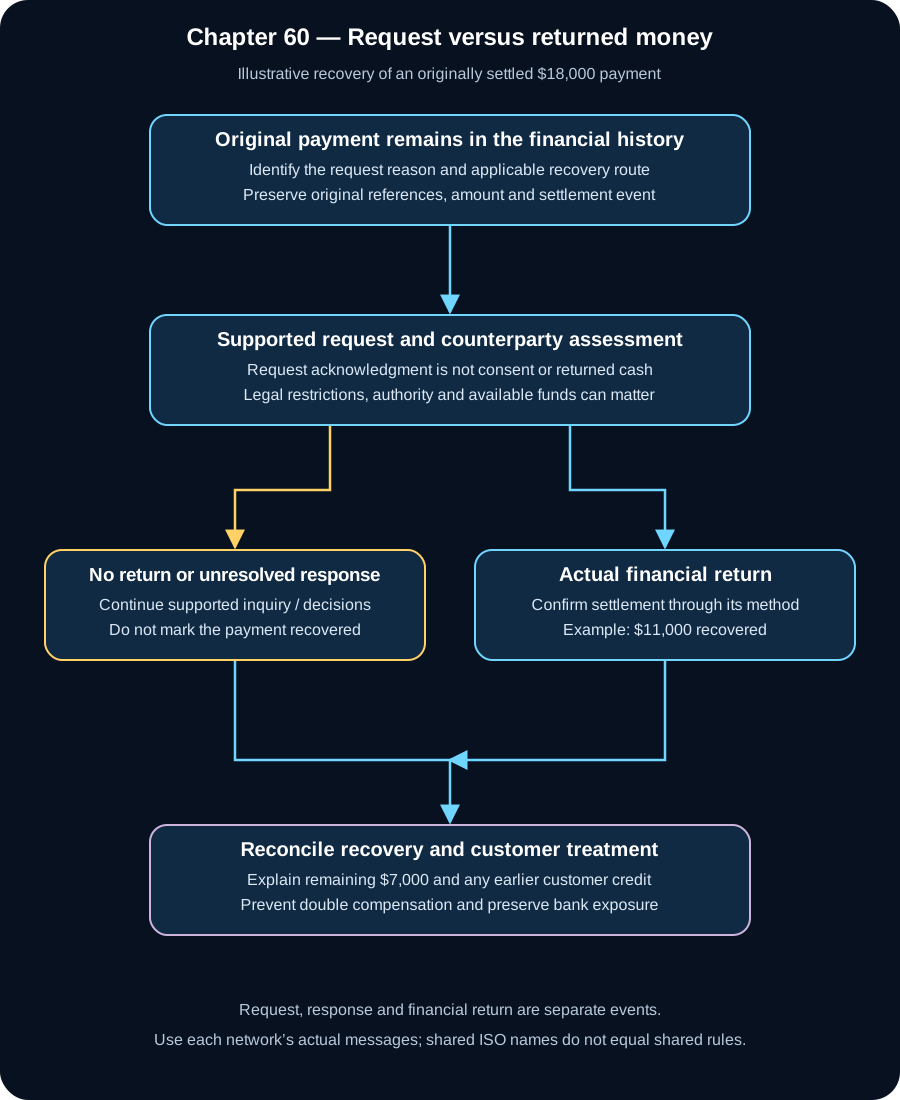
The diagram shows the money returning through the supported method only after the required action occurs. The original settlement remains part of the history. A bank's goodwill credit or legally required customer correction can occur independently, with the institution's own exposure recorded appropriately.
Sanctions and other legal restrictions can constrain recovery. Blocked property must not be sent back merely to satisfy an urgent request. Chapter 58 explained the relevant disposition distinction; the investigation owner should obtain the specialist decision and provide the customer only the information that can properly be disclosed.
10. Reconcile every financial consequence of the case
A case can generate an original debit, a customer correction, a fee refund, a recovered amount, a manual adjustment and a remaining loss. Those events need connected records, not one mutable case amount that overwrites earlier values. Finance must be able to explain both the customer's balance and the bank's economic position.
Suppose the bank corrects the customer's $18,000 debit under the applicable decision and later recovers $11,000 from another institution. The recovery does not automatically justify crediting the customer another $11,000. It may reduce the bank's recovery exposure under its approved accounting treatment. The correct journal depends on how the original correction was booked and any other rights or obligations.
If the customer was not previously credited, the treatment can differ. The bank must establish who is entitled to the recovered amount and what remains outstanding. Avoid using a generic recovery-credit routine that ignores earlier compensation, merchant refunds or provider adjustments.
Close operational reservations separately from booked money. Releasing a pending hold is not the same as refunding a settled debit. A returned payment can restore funds while leaving the original supplier obligation unpaid. The case should identify both the financial position and whether the business still needs an authorized replacement payment.
11. Manage deadlines as a set of obligations
Each case can have a legal notice or investigation deadline, a scheme action window, a service cutoff, a counterparty response expectation and a customer communication commitment. These should not be merged into one generic SLA. Missing one can have a different consequence from missing another.
Calculate each clock from its correct trigger and calendar. Settlement date, statement transmission, customer notice receipt and initial detection of reportable facts are not interchangeable. The bank should retain the source provision and decision behind the calculation, particularly where business days and calendar days differ.
A counterparty delay does not automatically suspend the bank's legal obligations. Operations may need to make a customer determination or provide a required notice while recovery remains unresolved. Likewise, an internal promise to update the customer tomorrow should be honored even if the final investigation result is not yet available.
Escalation should specify the decision needed. A message saying case overdue is less useful than identifying that provisional-credit assessment, return eligibility or an account-restriction decision is due. The case owner should direct the issue to the team with the authority to act, while keeping the original clock intact.
12. Communicate what is known, what remains open and what happens next
A useful first response confirms the issue and the bank's immediate action without promising an unverified outcome. For the opening case, the bank could explain that it is checking the original $18,000 transfer before arranging any replacement, because sending again could duplicate the payment. That is clearer than saying the transaction is being processed when the current state is uncertain.
Later updates should identify the evidence established and the next step. If the bank has confirmed settlement to the receiving institution but not beneficiary posting, say so in suitable customer language. If the beneficiary received the funds and the issue is invoice allocation, explain the reference information available to help the customer resolve that stage.
Avoid internal codes as the entire explanation. A return reason can inform staff, but the customer needs its practical meaning and any safe corrective action. Do not tell a customer to resend to the same destination when the reason remains unresolved, or imply that a recall request is a guaranteed cancellation.
Communication must respect privacy and confidentiality. Share only appropriate information about other customers, investigations and legal restrictions. A bank can remain candid about the payment status and next update without disclosing confidential SAR information or making unsupported allegations about the recipient.
13. Preserve audit evidence that can reproduce the decision
An audit trail should establish the instruction received, authority, control decisions, release, service outcome, account movements and subsequent case actions. It should identify actors, relevant timestamps and material changes. A final case summary is useful, but it cannot replace the underlying evidence where the conclusion is challenged.
Preserve original messages and reports under the applicable retention schedule and access controls. Record how extracts were produced and keep their relationships to the source. If evidence is corrected or supplemented, retain the earlier version and the reason. The institution should not silently rewrite the event history to match the final outcome.
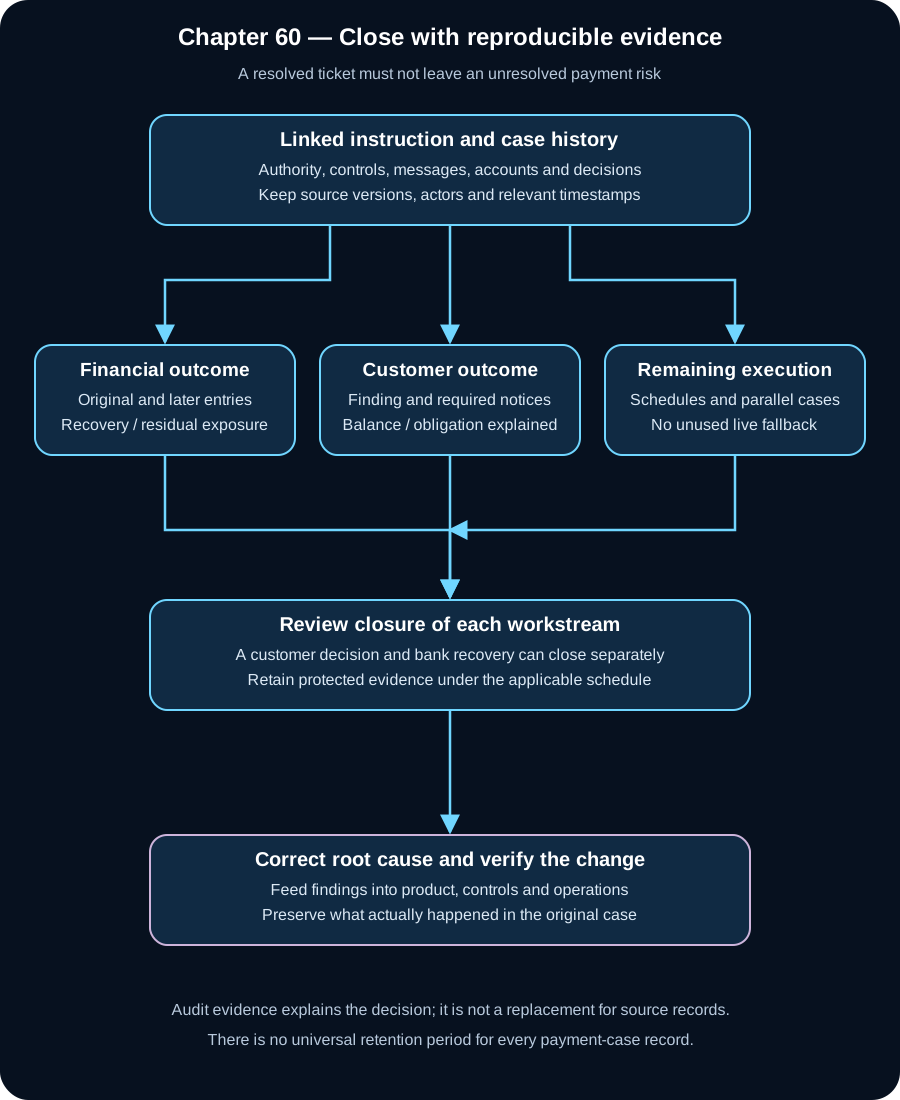
The diagram makes closure reviewable. An auditor should be able to follow the basis for a decision without relying solely on an employee's memory. At the same time, evidence access must remain proportionate; a general operations user does not need unrestricted access to confidential financial-crime materials.
There is no universal retention period for every payment case. Consumer compliance, BSA, OFAC, contractual records and litigation holds can impose different requirements. Apply the record-specific schedule and preserve material subject to a hold. A seven-year rule copied from another application is not sufficient justification for deletion or indefinite retention.
14. Close the case without leaving a live risk behind
Closure should confirm the actual financial outcome, the status of the business obligation, completion of required customer communication and resolution of pending instructions. A payment can be recovered while the supplier remains unpaid. A customer can be corrected while the bank still has an open recovery claim. The institution should identify which workstream is closed and which continues.
Check for stale schedules, parallel cases, outstanding return requests and manual actions. If the original payment eventually settles after a replacement was sent, the bank needs a controlled duplicate-resolution process rather than two separately closed success tickets. Shared obligation references make that relationship discoverable.
Capture root cause at the level that enables correction. Missing evidence, ambiguous provider statuses, incorrect beneficiary data, broken idempotency and slow escalation require different changes. Do not classify every incident as human error when the interface allowed a foreseeable unsafe action or hid the original payment state.
Feed material findings into the product, control and operations processes established in Chapters 56–59. Validate that the correction addresses the affected population and does not introduce a new release or reporting problem. A case is most useful to the bank when its evidence improves future decisions without distorting what happened in the original transaction.
15. Worked cases and implementation decisions
An uncertain transfer is about to be replaced through another rail
The $18,000 original transfer has an incomplete response, a customer debit and no confirmed failure. An employee wants to send an instant payment to meet the supplier's deadline.
Identify the authoritative outcome inquiry and block an uncoordinated replacement. Explain the current uncertainty to the customer and the decision needed if the original cannot be resolved promptly. A different rail does not eliminate duplicate exposure.
A return request is accepted but no funds arrive
The case system receives an acknowledgment for a recovery request and marks the entire $18,000 recovered. No corresponding financial return appears in the service or account records.
Correct the distinction between request acknowledgment and money received. Identify the next counterparty inquiry and the account evidence that would establish recovery. Do not post a customer refund solely from a non-financial message.
Partial recovery follows a full customer correction
Malla Bank has already corrected the customer's $18,000 debit. It later receives $11,000 linked to the original payment. The recovery adapter proposes another customer credit.
Reconcile the prior correction and recovered amount on the bank's books. Identify the remaining $7,000 exposure and any continuing claim. Explain why the new receipt does not automatically create a second customer entitlement.
An ACH reversal is proposed because the sender cannot fund
An originator's payment has settled, but its funding arrangement fails. Staff suggest using a reversal simply to undo the exposure.
Apply the permitted-error conditions and distinguish funding failure from an erroneous entry. Identify supported recovery and credit-risk actions under the actual agreement. The five-banking-day timing rule does not create a general right to reverse any inconvenient payment.
The beneficiary was credited but the invoice remains open
The receiving bank confirms the supplier's account credit. The supplier's receivables team cannot allocate it because the remittance reference was omitted from its import.
Move the investigation to the business-application boundary with appropriate evidence. Provide usable payment references and remittance information. Do not resend or recall a correctly delivered payment solely because an invoice system still shows outstanding.
The case closes while a duplicate attempt remains scheduled
An operator resolves the original payment and informs the customer. A separate manual fallback, prepared during the investigation, remains queued for later release.
Review all attempts linked to the obligation, cancel or suppress the unused instruction through the supported process and preserve that evidence. Closure should demonstrate that the bank has removed the remaining duplicate risk, not merely explained the first payment.
16. Role checklist and learning closure
The case owner should coordinate the customer's issue and preserve all relevant clocks. Payment specialists should apply the correct inquiry and recovery mechanism. Finance should reconcile original entries, corrections and recovered funds. Legal, consumer compliance and financial-crime teams should determine their distinct obligations. Technology should maintain linked identities, reliable states and protected evidence. Customer service should explain the known outcome and next action without promising an unsupported recovery.
The sixty-chapter USA programme now reaches an end-to-end operating conclusion. The learner should be able to follow a payment from purpose and authority through messaging, clearing, settlement, posting and reporting, then explain what the bank does when those stages disagree. The practical test is whether the learner can locate the money, identify the responsible party, apply the correct rule and communicate an evidenced outcome without creating another problem.
Authoritative references
Sources checked on October 5, 2026. Requests, responses and financial returns must follow the current rail-specific specification and applicable legal conditions.
This application uses JavaScript for the full interactive experience. This text summary is served for accessibility and search indexing.