Cross-Border USD Payments, Correspondent Banking and SWIFT. A practitioner deep dive into cross-border USD payments across correspondent banking, nostro/vostro accounts, SWIFT CBPR+, serial and cover methods, settlement, UETR tracking, reconciliation, reporting and investigations.
Cross-border U.S. dollar payments become confusing when three different things are treated as if they were the same: the customer payment, the bank-to-bank messaging chain, and the movement of settlement balances between banks. Chapter 19 separates them.
A corporate customer may simply say, “Pay USD 2 million to our supplier in Singapore.” The sending bank then has to decide which bank relationships can deliver those dollars, which institutions need to receive payment messages, where the actual USD balances will move, what correspondent accounts are involved, whether the payment will travel serially or use cover, how fees and foreign-exchange boundaries are handled, what compliance checks apply, what evidence proves progress, and how the bank will explain the final result to its customer.
The practical model is:
customer instruction → bank validation and authority → correspondent-route construction → SWIFT/CBPR+ message creation → serial or cover execution → intermediary/correspondent processing → USD settlement through accounts or market infrastructure → beneficiary-bank receipt and posting → confirmation/tracking → reconciliation → investigation if the chain does not complete as expected.
Chapter 16 explained Fedwire itself. Chapter 17 explained CHIPS and liquidity-efficient USD settlement. Chapter 18 explained the domestic wire product. Chapter 19 now explains how U.S. dollar payments cross banking and jurisdictional boundaries through correspondent relationships and SWIFT messaging. Chapter 20 will go deeper into beneficiary validation, sanctions controls and recalls, so this chapter explains those control handoffs without duplicating the next chapter.
For a roughly 60-minute core session, spend about 35 minutes on Sections 1–2, Sections 5–9 and Sections 12–13. For the next 10 minutes, use the chapter’s three diagrams to trace message paths separately from correspondent account movements. Use 10 minutes to work through one case in Section 16, then spend the final 5 minutes explaining: What additional evidence is needed when a message is delivered but beneficiary credit is unconfirmed? Treat these timings as a study guide. The remaining sections, additional cases and extended reference material are follow-up study; completing the whole chapter takes longer.
Chapter navigator
- What a cross-border USD payment actually is
- Correspondent banking, nostro and vostro relationships
- Participants and roles across the payment chain
- From customer instruction to correspondent route
- SWIFT, FINplus, CBPR+ and ISO 20022
- Serial customer-credit-transfer method
- Cover payment method and pacs.009 COV
- Settlement: where the USD money actually moves
- FX, charges, value dates and amount integrity
- Statuses, UETR, gpi tracking and payment truth
- Receiving-bank processing and beneficiary credit
- Exceptions, rejects, returns and investigations
- Accounting, nostro reconciliation and proof of settlement
- Reporting, cash visibility and customer servicing
- Controls, resilience and real-bank operating design
- End-to-end cases, BA checklist and testing
1. What a cross-border USD payment actually is
A cross-border USD payment is a funds-transfer process in which U.S. dollars are sent between parties whose banks, accounts, legal jurisdictions or correspondent relationships span more than one country. The customer may think of it as one payment, but the banks may execute several linked bank-to-bank steps before the beneficiary can use the funds.
The first important lesson is that cross-border does not necessarily mean the USD settlement itself happens outside the United States. A foreign bank can hold a U.S. dollar account with a correspondent bank in New York. When the foreign bank receives a USD payment for one of its customers, settlement may involve a credit to that correspondent account in the United States, followed by the foreign bank crediting its customer on its own books. The economic service is cross-border, while a crucial settlement movement may still occur through a U.S. account relationship or U.S. payment infrastructure.
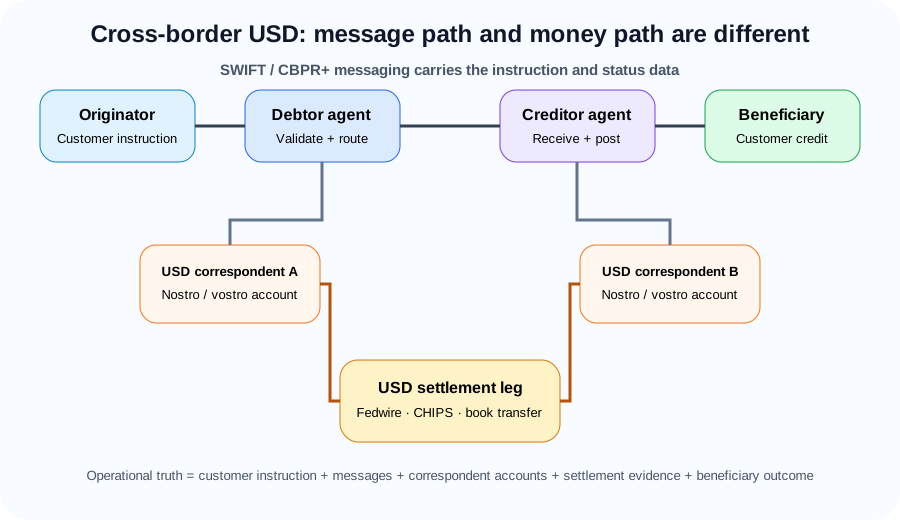
The second lesson is that SWIFT is not the settlement asset. SWIFT transports standardized financial messages and provides transaction-management and tracking capabilities. The actual money moves because banks debit and credit accounts, and because participating banks settle through systems such as Fedwire or CHIPS where those systems are used. A payment can therefore have successful SWIFT message delivery while the underlying financial settlement is still pending or later encounters a problem.
The third lesson is that cross-border payments are usually a chain of legal and operational relationships. The originator does not necessarily have an account with the beneficiary’s bank. The originator’s bank may not have a direct account relationship with the beneficiary’s bank either. Correspondent banks bridge those gaps.
A human way to picture it is this. A U.S. manufacturer wants to pay a Korean supplier in USD. The manufacturer’s U.S. bank knows the supplier bank’s SWIFT identity, but the two banks do not maintain settlement accounts with each other. The U.S. bank may therefore use a New York correspondent that has a USD account relationship with the Korean bank. The payment message tells the chain what to do. The correspondent-account movements create the financial result.
That is why Chapter 19 repeatedly separates five questions:
What did the customer instruct?
Which banks need to exchange messages?
Which banks actually hold accounts for one another?
Where will USD settlement occur?
What evidence proves that the beneficiary was ultimately credited?
Cross-border USD is still a credit-push payment
The payer or payer’s bank initiates a credit transfer. The beneficiary is not pulling money from the originator’s account. This matters even where the business context is a collection. A supplier may ask a buyer to “remit by USD wire,” but the payment remains a payer-initiated credit push.
One customer payment can create several bank-to-bank instructions
A single customer instruction may generate a customer-credit-transfer message, one or more interbank payment instructions, status or confirmation messages, account notifications, reconciliation entries and investigation messages. Those messages are related but they are not interchangeable.
A bank-grade data model should therefore keep a stable business payment identity and link all technical messages to it rather than treating each message as a separate customer payment.
2. Correspondent banking, nostro and vostro relationships
Correspondent banking exists because no bank has direct accounts with every other bank in every currency and jurisdiction. Through a correspondent relationship, one bank provides payment, clearing, liquidity, account or related services to another bank.
Suppose Bank A in India wants to send USD on behalf of its customer but does not maintain a U.S. Federal Reserve account and is not a direct participant in the U.S. high-value systems. Bank A may maintain a U.S. dollar account with Bank B in New York. Bank B is Bank A’s USD correspondent.
From Bank A’s perspective, its account held with Bank B is its nostro account: “our money with you.” From Bank B’s perspective, that same account is a vostro account: “your money with us.” These are two views of the same account relationship, not two separate accounts.
This distinction is basic but operationally powerful. Treasury at Bank A monitors the nostro as an external asset and funding position. Operations at Bank B services the vostro as a customer-bank account. The same underlying balance has different internal ownership, accounting treatment and monitoring responsibilities on each side.
Correspondent accounts create reach
If Bank A has a USD account with Bank B, and Bank B can reach Bank C through Fedwire, CHIPS or another correspondent relationship, Bank A can use Bank B to extend its USD payment reach. The chain can become longer when direct relationships do not exist.
Longer chains create more potential points for delay, charges, compliance review and data transformation. They also create more reconciliation work because each bank sees only the parts of the chain relevant to its own role.
Nested relationships
A correspondent can itself provide services to respondent banks that serve other institutions. This can create nested correspondent activity. A bank processing a cross-border USD payment therefore needs to understand not just the institution immediately sending the message but, where required by rules and risk controls, the underlying parties and institutions represented in the transaction.
Chapter 20 will go deeper into the control implications. For Chapter 19, the key operating lesson is that correspondent architecture affects routing, message population, screening, fees, investigation ownership and settlement evidence.
Nostro liquidity is not the same as customer balance
A customer may have sufficient funds at its own bank while the bank itself has insufficient USD liquidity in the relevant nostro. Conversely, the bank may have abundant correspondent liquidity while the customer instruction is blocked for approval or compliance reasons.
A cross-border payment engine should never treat customer funds and bank settlement liquidity as the same control.
Reconciliation begins before payment execution
A bank should know which external statement or notification will prove a debit or credit to each nostro account before it sends production payments through that route. If a new correspondent route is configured but nobody has designed statement ingestion and reconciliation, the route is not operationally complete.
3. Participants and roles across the payment chain
A cross-border USD payment can involve the originator, originator’s bank, one or more intermediary banks, correspondent banks, the beneficiary’s bank, the beneficiary, SWIFT, and one or more payment-market infrastructures. Some banks can play multiple roles in the same transaction.
The originator is the party that instructs the payment. The debtor agent is generally the financial institution serving the debtor in the customer-credit-transfer message. The creditor agent serves the beneficiary. Intermediary agents sit between them when the route requires additional banks.
In a correspondent chain, it is also useful to identify the account-servicing bank for each bank-to-bank settlement relationship. The institution sending a SWIFT message is not automatically the institution whose account is being debited in the next settlement step.
Messaging roles and account roles are related but not identical
Imagine Bank A sends a pacs.008 to Bank D, while funds are settled through Bank B and Bank C using a cover payment. Bank A and Bank D are the debtor agent and creditor agent in the underlying customer payment. Bank B and Bank C are cover agents in the settlement chain. Trying to squeeze all four institutions into generic sender_bank and receiver_bank fields loses critical meaning.
A bank canonical model should preserve roles such as:
- debtor;
- debtor agent;
- instructing agent;
- instructed agent;
- intermediary agents;
- creditor agent;
- creditor;
- reimbursement/cover agents where applicable;
- account owner and account servicer;
- settlement system participant.
Not every payment uses every role. The model must support the roles without inventing participants that do not exist.
Direct relationship versus reachability through a correspondent
A beneficiary bank can be reachable for messaging but not directly reachable for settlement. SWIFT reachability answers whether messages can be exchanged. Settlement reachability answers whether the banks can actually discharge the financial obligation directly or through correspondents. These are different questions.
Real-bank ownership
Product owns the cross-border USD service promise. Correspondent-banking management owns the commercial and account relationship with respondent/correspondent banks. Treasury owns USD liquidity and nostro funding. Payments operations owns processing and exception control. Financial crime teams own their risk decisions. Technology owns interfaces, message transformation and resilience. Reconciliation/finance owns proof that external balances match internal books. Customer service owns communication but must use authoritative payment status.
When one of these roles is unclear, cross-border incidents become slow because teams investigate the wrong layer.
4. From customer instruction to correspondent route
The bank should first capture the customer’s business instruction, then decide how to execute it. It should not force the customer to understand the internal correspondent chain unless the product genuinely requires route-specific input.
A typical instruction includes the debit account, amount, currency, requested execution date, beneficiary name and account, beneficiary-bank identification, purpose/remittance data, customer reference and any required intermediary-bank information.
Step 1 — validate the business instruction
The bank checks product eligibility, account authority, required data, amount/currency/date consistency and customer-specific restrictions. It also determines whether FX is required. If the customer has instructed USD to a USD account, FX may not apply at all. If the beneficiary ultimately requires another currency, the bank must determine where conversion occurs and who owns that decision.
Step 2 — identify the beneficiary bank and currency route
The bank resolves the creditor-agent identity and determines whether it has a direct account relationship, a preferred correspondent route, or a market-infrastructure route that reaches the receiving institution.
Step 3 — construct the bank chain
Routing logic can consider currency, correspondent agreements, account availability, cut-offs, fees, liquidity, country restrictions, service level, historical performance and customer instructions. The exact algorithm is bank-specific.
A good implementation stores not only the selected route but also the version of routing/reference data used to select it.
Step 4 — decide serial or cover method where applicable
For customer credit transfers, banks may use the serial method or the cover method depending on relationships, market practice and risk boundaries. This is not a cosmetic message choice. It changes which banks receive the customer-payment instruction and which banks carry the settlement leg.
Step 5 — create network messages from a canonical payment object
The original customer instruction should remain intact. The payment engine maps it into the relevant CBPR+ messages, preserving party, account, agent, amount, remittance, purpose and identifier data as required.
Step 6 — release only after all required controls are complete
Cross-border routing should not bypass customer authorization, sanctions, fraud, account, limit or liquidity controls. The sequence can differ by bank architecture, but the bank must preserve the evidence.
Routing is a financial decision, not just a BIC lookup
A valid BIC does not prove that an institution is the correct correspondent for a transaction. The route has to make sense commercially, operationally and financially.
A dangerous implementation pattern is:
beneficiary BIC found → send message.
A better model is:
beneficiary relationship resolved → eligible routes identified → correspondent/account path validated → settlement method chosen → controls complete → external message released.
5. SWIFT, FINplus, CBPR+ and ISO 20022
SWIFT provides secure financial messaging services used by financial institutions worldwide. For cross-border payment instructions, the current operating model is now fundamentally ISO 20022 based.
The coexistence period between legacy MT and ISO 20022 payment-instruction messages for CBPR+ ended on 22 November 2025. In 2026, a bank should therefore design new cross-border payment processing around the CBPR+ ISO 20022 model rather than teaching MT103/MT202 COV as the live target architecture. Legacy MT terminology remains useful because many bankers still use it conversationally and historical records still exist, but the production message direction has changed.
FINplus and CBPR+
CBPR+ means Cross-Border Payments and Reporting Plus. It defines market-practice usage of ISO 20022 for cross-border payment and reporting messages over SWIFT. FINplus is the SWIFT service used to exchange these ISO 20022 messages.
The message standard itself does not create settlement or legal finality. It expresses business information. The rights and obligations for any domestic Fedwire leg, for example, are governed by the relevant legal and system framework rather than by ISO 20022 terminology alone.
Core message families relevant to Chapter 19
A customer credit transfer is commonly represented by pacs.008 in the interbank customer-payment chain.
A financial-institution credit transfer uses pacs.009. For a cover payment supporting an underlying customer credit transfer, the dedicated pacs.009 COV variant is used.
A payment return uses pacs.004 in the ISO 20022 model. Status and exception/investigation messages depend on the business situation and current CBPR+ roadmap. Account reporting can include camt.052, camt.053 and camt.054, among others.
The learner should not memorize messages without understanding the business roles. The right question is not “what is the ISO equivalent of MT103?” It is “what business instruction or reporting event does this message represent in this payment chain?”
2026 data-quality milestone
As of 5 October 2026, the relevant CBPR+ address milestone is future-effective on 14 November 2026. From that date, town and country must be in designated fields for the relevant payment messages; payments containing unstructured addresses will be NAKed at network level, subject to the listed reporting-message exceptions. Banks must treat this as a future-effective rule until that date, not as a requirement that was already mandatory throughout 2026.
The implementation lesson is broader: cross-border payment platforms need versioned message rules and effective-dated validations. Standards change without changing the customer’s economic intention.
Data must survive the whole chain
ISO 20022 gives the industry richer structure, but a bank can still destroy that value internally by flattening data into legacy fields. The bank should test party names, addresses, agent identifiers, remittance, purpose and identifiers through:
customer channel → canonical model → compliance → routing → CBPR+ message → correspondent processing → archive → customer reporting.
A message that is schema-valid but semantically damaged is not a high-quality payment.
6. Serial customer-credit-transfer method
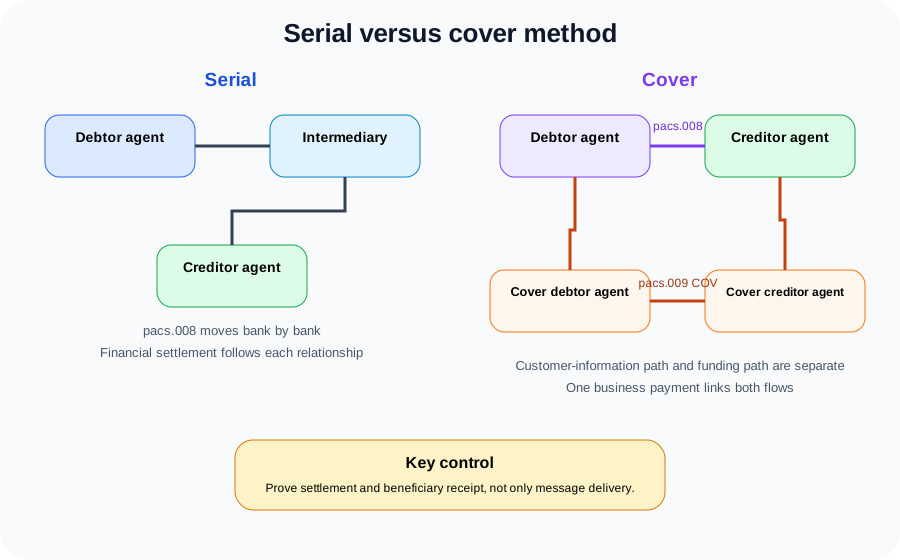
In the serial method, the customer credit-transfer instruction itself moves through the chain of financial institutions toward the beneficiary’s bank. Each intermediary receives the payment instruction and forwards the relevant payment instruction to the next bank.
The practical idea is:
one customer-payment chain, forwarded bank by bank, with settlement occurring through the account relationships used by those banks.
Consider this simplified chain:
Customer A → Bank A → Correspondent B → Correspondent C → Bank D → Customer D.
Bank A sends a pacs.008 toward Correspondent B. Correspondent B processes the instruction and forwards the payment onward according to its relationship and route. Each bank must know which account it should debit or credit and what the next settlement relationship is.
Why serial is operationally intuitive
The messaging chain and the financial route are broadly aligned. The bank receiving the customer-payment instruction is also involved in the next financial step. This can simplify linkage between message processing and account movement.
But the route can be long. Every intermediary may introduce processing time, controls, local cut-offs, charges or repair risk. Data quality therefore matters at the first bank because defects can multiply as messages are transformed or enriched along the chain.
Settlement at each link
The serial method does not mean one giant global settlement event. Each pair of banks settles according to its relationship. One leg could be an internal correspondent-account movement, another could use Fedwire, another could use CHIPS, and the beneficiary bank could then credit the customer on its own ledger.
This is why the phrase “SWIFT settled the payment” is wrong.
Status truth in a serial chain
Bank A may know that its message was accepted by Correspondent B. That does not prove that Bank D credited the beneficiary. Tracking and confirmations improve visibility, but internal bank statuses should still distinguish:
MESSAGE_DELIVERED_TO_NEXT_BANK
NEXT_BANK_ACCEPTED
INTERBANK_SETTLEMENT_CONFIRMED
BENEFICIARY_BANK_RECEIVED
BENEFICIARY_CREDIT_CONFIRMED.
The exact labels are bank-specific. The separation is essential.
Intermediary change or repair
If an intermediary determines that the next route is unavailable or incorrect, the payment may be repaired, rerouted where permitted, rejected or returned depending on the point in the chain and applicable rules. The original bank must preserve enough lineage to understand what happened rather than creating a new unrelated payment object.
7. Cover payment method and pacs.009 COV
The cover method separates the customer-information path from the funding/settlement path.
The debtor agent sends the underlying customer credit-transfer instruction, pacs.008, toward the creditor agent. Separately, it initiates a pacs.009 COV through the correspondent/cover chain to move the funds needed to settle that underlying customer payment.
This creates two linked flows:
customer-payment information:
Debtor Agent → Creditor Agent via pacs.008
cover/funding movement:
Debtor Agent → Cover Debtor Agent → … → Cover Creditor Agent via pacs.009 COV and the relevant settlement arrangements.
The cover message is not a generic interbank transfer. Current SWIFT/PMPG guidance is explicit that pacs.009 COV is used to move funds related to one underlying customer credit transfer. Other financial-institution credit transfers use the appropriate pacs.009 core model rather than misusing COV.
Why cover exists
The debtor agent and creditor agent may want to exchange the customer-payment instruction directly even though they do not have a direct settlement-account relationship. The cover chain supplies the funding through correspondents that do have the required account relationships.
Same business payment, linked evidence
The pacs.008 and pacs.009 COV must be treated as components of one economic customer payment. SWIFT guidance uses the UETR to link the underlying and cover flows. A bank should preserve that correlation internally.
A useful lineage is:
customer_instruction_id → bank_payment_id → pacs.008/UETR = pacs.009_COV/UETR → cover_settlement_event → creditor-agent receipt → beneficiary credit (one UETR carried by both linked messages).
Cover introduces synchronization risk
The creditor agent can receive the pacs.008 before the cover funds are confirmed. The cover can arrive before or after the customer message depending on processing and network conditions. The receiving bank therefore needs a controlled policy for when it credits the beneficiary and how it handles missing or delayed cover.
A bank must not automatically treat “pacs.008 received” as “funds definitely available.” Likewise, receipt of cover without the matching customer-payment information is an exception population that needs investigation.
Reconciliation of cover
The creditor side may reconcile cover through account notifications or statements such as camt.054/camt.053 depending on its servicing arrangements. The important point is that the beneficiary bank must be able to connect the funding credit with the underlying customer transfer.
Cover is not inherently suspicious
Cover payments are a legitimate correspondent-banking method. They need strong transparency because the settlement chain and customer-information chain are separate. The control problem is not “cover equals bad”; it is ensuring that required underlying customer information is preserved and available to institutions performing their obligations.
8. Settlement: where the USD money actually moves
The most important technical principle in this chapter is:
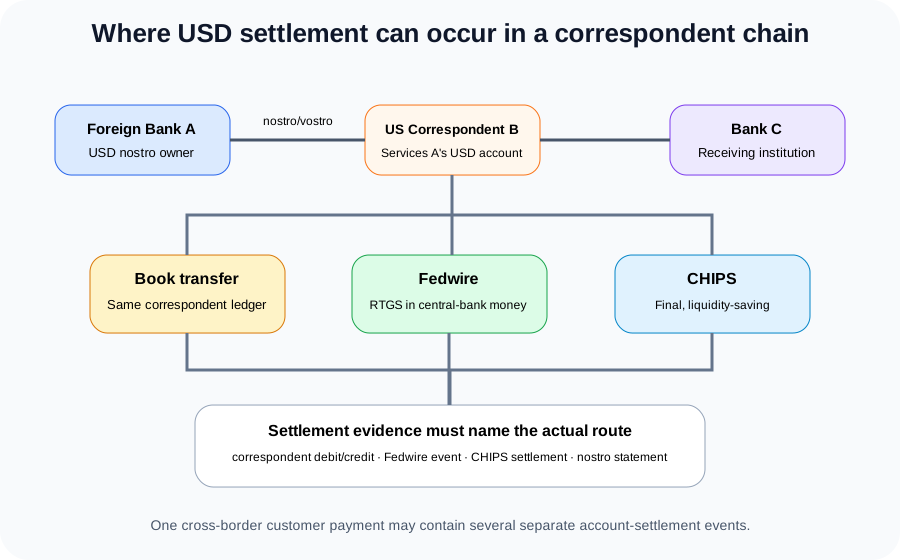
SWIFT moves messages. Banks and payment systems move account balances.
A cross-border USD payment settles when the relevant banks’ financial obligations are discharged through account movements or settlement-system finality under the applicable arrangements.
Correspondent-account settlement
If Bank A holds a USD account with Bank B, Bank B can debit Bank A’s account and credit another account on its own books, or use an external payment system to reach another bank. That debit is a real financial movement even though no physical dollars travel anywhere.
The BIS describes modern correspondent banking in essentially this way: cross-border payments involve a chain of account updates across institutions and jurisdictions. That is a more accurate mental model than imagining digital dollars physically crossing a border.
Fedwire leg
A U.S. correspondent may use Fedwire to transfer reserve-backed value to another U.S. bank or branch as part of the larger cross-border transaction. Chapter 16 covered the Fedwire mechanics. In Chapter 19, Fedwire is one possible settlement leg inside a broader correspondent journey.
CHIPS leg
Likewise, a correspondent may use CHIPS for eligible high-value USD settlement. Chapter 17 covered CHIPS matching, liquidity efficiency and finality. Here the important point is that a CHIPS settlement event may be one financial link in an international customer-payment chain.
On-us correspondent movement
Two banks’ accounts may be held by the same correspondent. The correspondent can sometimes settle the financial obligation on its own books without an external wire-system movement. This is a book-transfer settlement event at the correspondent, not “no settlement.”
Finality is local to the settlement event
One leg can be final while the customer payment still requires later downstream processing. If Bank B has received final settlement through Fedwire, that fact should not be reversed conceptually just because Bank C later has a beneficiary-account issue. Recovery then requires a new controlled financial action, return or agreement rather than pretending the original settlement never occurred.
Settlement proof should be rail/account specific
A bank should know what evidence proves each route:
- Fedwire settlement reference/event;
- CHIPS settlement confirmation;
- correspondent-account debit/credit notification;
- nostro statement entry;
- on-us ledger posting.
A generic status called SETTLED without source evidence is weak operational design.
9. FX, charges, value dates and amount integrity
Cross-border USD payments often intersect with FX and charges, but neither should be assumed.
If the originator sends USD from a USD account and the beneficiary receives USD into a USD account, there may be no FX at all. If the originator pays from EUR but instructs USD, the sending bank may convert EUR to USD before execution. If the beneficiary expects local currency, the beneficiary bank or an intermediary may perform conversion depending on the product and instruction.
A bank should model at least:
customer debit currency/amount
instructed payment currency/amount
interbank settlement currency/amount
beneficiary credit currency/amount
exchange rate and FX reference where conversion occurs
fees/charges and who bears them.
These fields may coincide, but the data model should not assume they always do.
Charges can change the delivered amount
Cross-border payments can involve sender-bank fees, correspondent charges or beneficiary-bank fees depending on product terms and charge arrangements. The bank should be able to explain whether charges were taken separately or deducted from the transferred amount.
Customer reporting should therefore avoid implying that instructed amount equals beneficiary-credit amount when the product allows intermediary deductions or downstream FX.
Value date is not just a display field
Banks use value dates for accounting, interest, liquidity and correspondent settlement. A message date, bank execution date, settlement date and beneficiary value date may differ. Systems should preserve each business date explicitly rather than reusing one date field everywhere.
FX timing creates risk
If FX is booked before the payment is released and the payment later fails, the bank still has an FX position or customer contract to manage. The payment engine should not silently cancel or reverse an associated FX trade unless the product and treasury process explicitly support that action.
Amount reconciliation must be multi-layered
A bank should reconcile:
customer debit
against
payment principal + customer fee + FX effects where applicable,
then reconcile the interbank principal to the external settlement evidence, and finally reconcile beneficiary or downstream reporting where available.
A difference may be legitimate because of charges. It should still be explainable.
10. Statuses, UETR, gpi tracking and payment truth
Cross-border payments create more status ambiguity than domestic transfers because multiple institutions observe different parts of the journey.
The Unique End-to-End Transaction Reference (UETR) is a 36-character unique reference carried in SWIFT payment instructions and used to link and track a payment through the chain. It should be preserved from the first external payment instruction through downstream processing rather than regenerated by every intermediary.
Swift gpi and related tracking capabilities provide much better visibility into where a payment is, including confirmations and rejection/hold information. But the bank still needs its own internal state model.
A practical status ladder can be:
CUSTOMER_RECEIVED
BANK_VALIDATED
ROUTE_SELECTED
RELEASED_TO_SWIFT
SWIFT_DELIVERED
INTERMEDIARY_PROCESSING
SETTLEMENT_PENDING
SETTLEMENT_CONFIRMED
CREDITOR_AGENT_RECEIVED
BENEFICIARY_CREDIT_CONFIRMED
RECONCILED.
These are illustrative internal states, not mandatory SWIFT codes.
Message delivery is not beneficiary credit
A technically delivered FINplus message only proves that the message reached the next messaging endpoint under the network service. It does not prove that the next bank accepted the payment commercially, settled it, or credited the beneficiary.
On hold is not failed
A bank or correspondent may place a payment on hold for investigation or control review. Customer channels should not collapse a hold into FAILED. A failed status may cause the customer to send a replacement and create a duplicate exposure while the original payment still exists.
UETR is a correlation key, not a settlement receipt
The UETR helps trace the transaction. It does not itself prove settlement. The bank still needs settlement evidence from the relevant correspondent account or payment system.
Cover-payment status requires two dimensions
For cover payments, the underlying pacs.008 flow and the pacs.009 COV funding flow can progress at different speeds. A robust state model may therefore track:
UNDERLYING_MESSAGE_STATE
and
COVER_FUNDING_STATE
before deriving the customer-facing outcome.
11. Receiving-bank processing and beneficiary credit
The beneficiary bank has its own controls and account-processing responsibilities. The sending bank cannot assume that an incoming payment is automatically posted simply because the interbank message arrived.
The creditor agent may need to validate the beneficiary account, apply sanctions or fraud controls, resolve beneficiary information, match incoming cover where the cover method is used, calculate charges or FX where applicable, and post the customer account.
Beneficiary-account resolution
If the account identifier is invalid, closed, restricted or incompatible with the payment, the receiving bank may not be able to post. The handling depends on applicable law, scheme rules, correspondent agreements and bank policy.
Chapter 20 will go deeper into beneficiary validation and related controls. Chapter 19 focuses on the operational result: the payment may be externally received while customer posting remains unresolved.
Posting is separate from interbank settlement
Suppose the receiving bank has already received final USD settlement but its core banking system is temporarily unavailable. The bank now has the money, yet the beneficiary account is not credited. This is an internal posting incident, not an unsettled cross-border payment.
Operations should therefore distinguish:
INTERBANK_SETTLED
from
BENEFICIARY_POSTED.
Advice and reporting
The beneficiary bank may generate account notifications or statement entries for its customer. Where the bank participates in gpi/confirmation obligations, it may also update the payment tracker with the relevant customer-credit status.
Collections perspective
For a corporate receiving cross-border USD collections, the payment is only operationally useful when the corporate can identify the remitter and apply the credit to the correct receivable. Remittance preservation is therefore part of the collection product, not decorative message data.
A receiving bank should preserve originator references, remittance information and UETR so the corporate can reconcile cash quickly.
12. Exceptions, rejects, returns and investigations
Cross-border exceptions can occur before release, during messaging, at a correspondent, during settlement, at the beneficiary bank or during customer posting. The response depends on where the payment is and whether any financial settlement has already occurred.
Pre-release failure
If the bank detects invalid data, insufficient authority, a sanctions hit or a routing problem before external release, the payment can normally be repaired or rejected internally without any external financial recovery.
Network/message rejection
A CBPR+ message can fail network or usage validation. The bank should store the exact rejection reason and keep the payment in a state that permits controlled repair where appropriate. It should not create a fresh customer payment unless that is genuinely required.
Intermediary rejection
An intermediary may reject because it cannot process the route, account relationship, message content or control outcome. The sending bank must determine whether the payment has been financially settled to that intermediary and what return/recovery mechanism applies.
Return after settlement
Once funds have settled to a bank, sending value back is a new financial movement. A return is not the same as deleting the original transfer. The original settlement evidence remains valid and the return must have its own identifiers, accounting entries and reconciliation.
Cancellation and recall requests
A customer may ask the sending bank to stop or recall a payment. Whether that can succeed depends heavily on payment state and the cooperation/rights of downstream institutions. Chapter 20 will treat recalls in depth. The key Chapter 19 rule is: a recall request is not proof that settled funds have been recovered.
Unknown outcome is its own state
If connectivity fails after the bank sent a message but before it received a reliable response, the payment is not automatically failed. The bank should investigate SWIFT delivery, correspondent status and settlement evidence before retrying or routing through another path.
Blind retry is one of the most dangerous cross-border operational mistakes because it can duplicate a high-value payment.
Investigation ownership
The originating bank owns the customer relationship but may need information from intermediaries and correspondents. A case should preserve the original instruction, all external message references, UETR, settlement evidence, tracker statuses, bank-to-bank correspondence, accounting entries and customer communication.
The investigation should answer a concrete question: Where is the payment, what financial movement has occurred, which bank currently controls the funds, and what next action is valid?
13. Accounting, nostro reconciliation and proof of settlement
Cross-border payment processing is incomplete until the bank’s internal books agree with external correspondent balances.
For the sending bank, the customer debit may post before or at external release depending on product design. Separately, the bank records the impact on its USD settlement account or correspondent nostro. Fees and FX create additional postings.
A simplified accounting story might be:
debit customer account
credit outgoing payment/settlement control account
then, when external settlement is confirmed:
debit outgoing settlement control
credit USD nostro/correspondent asset.
Actual ledger architecture varies by bank, so training content should focus on the accounting relationship rather than invent one mandatory chart of accounts.
Three-way reconciliation
A strong model reconciles three populations:
Payment engine truth — what payments the bank believes it sent or received.
External truth — correspondent statements, Fedwire/CHIPS evidence, SWIFT/account notifications.
Ledger truth — what the bank actually booked.
If any one of those disagrees, the bank has a break even if the customer has not yet complained.
Nostro statements are critical evidence
End-of-day camt.053 statements and intraday/credit-debit notifications such as camt.052/camt.054 can support reconciliation depending on the correspondent service. A bank should ingest them systematically rather than rely on manual portal screenshots.
Reconcile by more than amount
Matching only on amount can pair the wrong items. Useful keys include account, currency, value date, amount, message/reference identifiers, UETR, correspondent reference and direction. Matching logic should tolerate legitimate correspondent references while preserving a deterministic audit trail.
Suspense and unmatched items
An external nostro debit with no internal payment should be high priority. So should an internal payment marked settled with no matching external debit. Suspense items require ownership, ageing, reason codes and controlled resolution.
Cover-payment reconciliation
The receiving side must link the cover credit to the underlying customer payment. If the pacs.008 and cover arrive separately, reconciliation logic needs identifiers that connect them. Missing linkage should create an explicit exception rather than being solved by amount-only matching.
14. Reporting, cash visibility and customer servicing
Cross-border USD payment reporting serves several audiences: the payer, beneficiary, corporate treasury, bank operations, correspondent management, finance, treasury and risk teams.
The payer wants to know whether the instruction was accepted, whether it has left the bank, where it is in the chain and whether the beneficiary was credited. The receiving corporate wants to identify the remitter and apply cash. Treasury wants to understand correspondent balances and expected outflows. Operations wants exceptions and ageing. Finance wants reconciled books.
Customer reporting must use truthful milestones
Avoid customer statuses such as COMPLETED when the bank only knows the message was delivered to an intermediary. Better reporting can distinguish:
Accepted by bank
Sent to correspondent
In processing
Interbank settlement confirmed
Beneficiary-bank receipt confirmed
Beneficiary credited.
Not every bank can expose every milestone, but whatever is shown must correspond to evidence.
Tracking improves cash visibility
UETR-based tracking and payment confirmations allow corporate treasurers to see inbound and outbound progress much more precisely than traditional “we sent the wire” reporting. This improves expected cash forecasting and reduces manual enquiry volume.
Corporate collections need remittance continuity
For inbound cross-border USD collections, a corporate may receive hundreds of payments into one concentration account. If remittance and payer references are lost, cash application becomes manual even when settlement is perfect.
The receiving bank should therefore deliver structured transaction reporting that preserves enough payer and reference data for matching to invoices or receivables.
Bank MI
Useful operational MI can include:
- payments by corridor and correspondent;
- average time to intermediary acceptance;
- average time to beneficiary confirmation;
- hold and reject rates;
- repair reasons;
- nostro break count/value;
- unmatched cover population;
- investigation ageing;
- manual intervention rate;
- data-quality rejection rate;
- correspondent service performance.
The point of MI is action. A dashboard that shows a high reject rate but cannot identify the failing route or data field is not enough.
15. Controls, resilience and real-bank operating design
Cross-border payment control is layered because no one system owns the entire journey.
The customer channel controls authentication and entitlement. The payment engine validates the business instruction. Routing controls choose permitted correspondents. Financial-crime services perform screening and monitoring. Treasury controls USD liquidity. SWIFT interfaces control message integrity and network exchange. Correspondent operations monitor settlement accounts. Reconciliation proves the financial result.
Separate control decision from transport success
A payment can be fully authorized but fail in network transport. A message can be delivered successfully while the payment is later held by the correspondent. These are different failures and need different recovery actions.
Reference-data governance
BICs, correspondent accounts, routing preferences, country rules, calendars, cut-offs and message versions are all production reference data. Changes should be effective-dated, approved and auditable.
A correspondent account closed on Friday should not still be selected automatically on Monday because a routing cache was not refreshed.
Connectivity resilience
Banks need redundant SWIFT connectivity or an approved service architecture, but network resilience does not remove duplicate risk. After failover, the bank must know which payments were definitely sent, which were definitely rejected, and which have uncertain outcome.
Correspondent outage
If a preferred correspondent is unavailable, automatic rerouting may be permitted before external release. After uncertain transmission or financial settlement, rerouting requires much more caution. The point of no return must be defined in the state model.
Business-day and timezone control
A U.S. bank, European customer, Asian beneficiary and New York correspondent may all be operating in different calendars and time zones. Customer cut-off, correspondent cut-off, Fedwire/CHIPS operating window and beneficiary-bank local business day should be stored as governed calendar rules rather than hardcoded UTC offsets.
Standards change control
The end of CBPR+ coexistence in November 2025 and the structured/hybrid-address milestone in November 2026 demonstrate why standards releases are operational events. Banks need MyStandards/readiness testing, message-schema validation, end-to-end regression, correspondent coordination and controlled production cutover.
Data retention and audit
Cross-border payments can be investigated long after execution. The bank should preserve original customer data, normalized data, external messages, control outcomes, UETR, settlement evidence, account statements, repairs, returns, correspondence and customer communication according to applicable retention rules.
16. End-to-end cases, BA checklist and testing
A practitioner chapter should finish by proving that the operating model works under realistic cases, not just the happy path.
Case 1 — straightforward serial USD payment
A U.S. corporate sends USD 750,000 to a supplier in Europe that maintains a USD account with its local bank. The originator’s bank selects a serial route through one correspondent.
The test should prove customer approval, payment validation, pacs.008 creation, UETR preservation, intermediary processing, correspondent settlement, beneficiary-bank receipt, customer credit confirmation, accounting and reconciliation.
The expected result is one business payment with a continuous evidence chain, not several disconnected “messages.”
Case 2 — cover payment
A U.S. bank sends the underlying pacs.008 directly to the creditor agent but settles through two cover correspondents using pacs.009 COV.
Test that the same business payment links both flows, the UETR is preserved appropriately, the creditor side can reconcile the cover, and customer reporting does not declare completion merely because the underlying message arrived.
Case 3 — delayed cover
The creditor agent receives the pacs.008 but cover funding is late. The payment should enter a controlled waiting/exception state according to bank policy. It must not create an automatic duplicate request. Once cover arrives, the bank links it to the underlying transfer and completes posting/reconciliation.
Case 4 — cover received, customer message missing
The cover credit hits the correspondent account but the creditor agent cannot match the underlying customer transfer. The item should appear as unmatched funding with value, currency, reference and correspondent ownership. Operations investigates using UETR/message references rather than manually guessing from amount.
Case 5 — SWIFT delivered, correspondent held payment
The customer sees “sent,” but the correspondent has placed the payment on hold. Customer servicing should see that the message was delivered but the financial outcome remains pending. No alternate payment should be created without controlled decisioning.
Case 6 — external settlement succeeded, internal posting failed
The bank has a nostro debit and the correspondent confirms settlement, but the internal ledger update fails. This is a financial-control incident. Recovery must book the internal state without retransmitting the cross-border payment.
Case 7 — FX trade booked, payment rejected
The customer funds a USD payment from EUR. FX is executed, then the payment fails validation downstream. The payment case and FX position must be managed as related but separate objects. The system must not silently undo the FX trade.
Case 8 — correspondent route unavailable before release
The preferred correspondent is unavailable before external transmission. The routing engine may select an approved alternate route according to policy. The payment keeps the same customer instruction ID and records a new route decision.
Case 9 — connection loss after send
The gateway transmits a high-value pacs.008 but loses connectivity before reliable delivery status. Mark the payment outcome uncertain. Query SWIFT/network evidence and downstream status before any resend. Test that a blind failover does not create a duplicate.
Case 10 — November 2026 address validation
Before the effective standards release, the bank accepts address formats still permitted at that time. After the effective date, the same unsupported unstructured format should fail the applicable CBPR+ validation while structured/hybrid forms pass. This proves the rule is effective-dated rather than permanently hardcoded.
BA requirements checklist
A BA working on cross-border USD should be able to answer:
- What exact customer product is being offered?
- Which currencies and corridors are supported?
- Which correspondent accounts can be used?
- How are serial and cover methods selected?
- Which ISO 20022/CBPR+ usage rules apply?
- Which identifiers are preserved end to end?
- Where can FX occur?
- How are charges represented and reported?
- What proves external settlement for every route?
- How are UETR and tracker updates stored?
- What states are customer-visible?
- What is the point of no return for rerouting/retry?
- How are unmatched pacs.008/cover items handled?
- How is nostro reconciliation performed?
- What evidence is retained for investigations?
- Which future-dated standards changes are already configured but not yet effective?
Developer checklist
Developers should verify canonical party/agent roles, deterministic message mapping, schema/version control, UETR persistence, idempotency, routing/reference-data effective dating, ledger-event integrity, asynchronous status correlation, cover matching, immutable external evidence and safe replay behavior.
Tester checklist
Testing must cover serial and cover paths, multiple intermediaries, invalid route data, closed correspondent accounts, message rejection, downstream hold, delayed cover, missing cover, missing pacs.008, partial system outage, duplicate delivery, unknown outcome, FX linkage, charge differences, holiday/timezone boundaries, standards-version changes, nostro breaks and reporting failures.
Operations checklist
Operations needs dashboards that show payment identity, UETR, current bank/network/settlement state, correspondent route, amount/currency, age, control holds, latest external evidence, nostro impact and case owner. A queue labelled only cross-border exceptions is not enough.
Final learning point
A cross-border USD payment is not “a SWIFT message going overseas.” It is a coordinated sequence of customer authority, bank-to-bank messaging, correspondent-account relationships, settlement events, posting, reporting and financial control.
The most reliable mental model is:
message tells banks what to do; account relationships and payment systems move the financial value; identifiers and reconciliation prove that all parts still belong to the same customer payment.
Authoritative references
-
Swift — ISO 20022 for Financial Institutions / CBPR+ roadmap
https://www.swift.com/standards/iso-20022/iso-20022-financial-institutions-focus-payments-instructions
-
Swift — ISO 20022: A new era for global payments
https://www.swift.com/news-events/news/iso-20022-new-era-global-payments
-
Swift — ISO 20022 in bytes for payments: The journey continues
https://www.swift.com/pt/node/310528
-
Swift — ISO 20022 in bytes for payments: Call-to-action for November 2026
https://www.swift.com/ru/node/310589
-
Swift — What is a Unique End-to-end Transaction Reference (UETR)?
https://www.swift.com/ru/node/310011
-
Swift — Swift gpi
https://www.swift.com/ru/node/309931
-
Swift Payments Market Practice Group — Document centre
https://www.swift.com/standards/market-practice/payments-market-practice-group-2024/document-centre
-
Swift/PMPG — Cover Payments Market Practice Guidance (April 2026)
https://www.swift.com/swift-resource/252248/download
-
BIS CPMI — Correspondent banking, final report
https://www.bis.org/publications/correspondent-banking-final-report
-
BIS — Annual Economic Report 2025, next-generation monetary and financial system
https://www.bis.org/publications/aer-2025/next-generation-monetary-financial-system
-
Federal Reserve — Regulation J, Funds Transfers through Fedwire
https://www.federalreserve.gov/frrs/regulations/regulation-j-collection-of-checks-and-other-items-by-federal-reserve-banks-and-funds-transfers-through-fedwire.htm
-
Federal Reserve — Uniform Commercial Code Article 4A, Funds Transfers
https://www.federalreserve.gov/frrs/regulations/uniform-commercial-code-article-4a-funds-transfers.htm
This application uses JavaScript for the full interactive experience. This text summary is served for accessibility and search indexing.