Cross-Border Alternatives: Remittance Transfers, IAT and Stablecoins. Trace remittance promises, IAT domestic and foreign legs, stablecoin funding and redemption, customer rights and cross-border reconciliation.
Elena wants her mother abroad to receive local currency for a household expense. Her bank offers a remittance service; another provider advertises a local bank payout; a third describes a dollar stablecoin transfer. Each begins with Elena paying dollars. That similarity tells the bank very little about who holds the money next, what the recipient receives, or which event proves delivery. A fast instruction can still depend on a slower funding, conversion or cash-out leg.
Chapter 50 separated the obligation to pay from the selected delivery method. This chapter carries that distinction across borders. Remittance transfer is a regulatory and customer-service concept, IAT is an ACH classification and format, and a stablecoin is a digital asset used within a particular arrangement. They are not three mutually exclusive payment networks. A service can combine more than one of them.
Follow the customer's promised outcome through every financial leg. A domestic debit, an international instruction and a token transfer can each complete without the recipient yet receiving the promised spendable money.
Allow roughly 60 minutes for the chapter, diagram walkthroughs and worked cases. People, amounts, exchange rates and internal designs are fictional. Sources were checked on October 5, 2026. Announced changes are identified by effective date; production services require current corridor, provider and legal specifications.
Chapter navigator
- Classify the promise before comparing the route
- Participants and the accounts between them
- Remittance-transfer coverage and disclosures
- Follow a bank-funded remittance to foreign payout
- What makes an ACH entry an IAT
- IAT data, gateways and the US ACH leg
- Corridor capability and the FedGlobal transition
- Stablecoins and the claim behind the token
- Issuance, transfer, redemption and bank settlement
- Funding, foreign exchange and liquidity exposure
- Fraud, sanctions and information continuity
- Stablecoin law and provider responsibilities
- Cancellation, errors and cross-border recovery
- Reconciliation and bank implementation
- Worked cases and implementation decisions
- Role checklist and learning closure
1. Classify the promise before comparing the route
Begin with the payer, purpose, destination and promised asset. Elena is a consumer in the United States arranging a personal transfer to a designated recipient abroad. A manufacturer paying an overseas supplier presents a different regulatory classification even when it uses the same provider. A US recipient receiving an incoming international payment is another case. The words international payment alone do not establish the applicable consumer duties.
The destination also needs precision. Receiving foreign bank deposits, collecting local cash, receiving an internal wallet balance and controlling dollar tokens are different outcomes. The sender may care only about how much the family can spend, but the bank must translate that objective into a supported service. An available dollar token balance does not automatically satisfy a promise to deliver local currency into a bank account.
A comparison should therefore identify total payer cost, recipient amount and currency, supported destination, expected availability, cancellation and error handling. An advertised transfer fee alone omits foreign-exchange pricing and possible conversion or withdrawal costs. Some costs require specific disclosure treatment; others still matter to product suitability and customer understanding.
Keep the route configurable without changing the promise silently. If a payout partner becomes unavailable, an alternative route may require a new quote or customer decision. The bank cannot assume that any mechanism capable of moving equivalent value is an acceptable substitute for the service Elena purchased.
2. Participants and the accounts between them
A remittance provider contracts with the sender and arranges delivery. Its agents may collect funds or pay recipients. Funding banks, correspondent banks, gateway operators, foreign processors and receiving institutions can perform separate financial tasks. The provider remains a business and compliance role; it is not necessarily the institution holding every settlement account.
Map the accounts used by the actual arrangement. Elena's bank account can be debited to fund the provider. A provider may maintain a prefunded account with a foreign payout partner. The partner can credit a local recipient before the provider's next replenishment reaches that account, if the contract and available balance permit it. The customer transfer and the provider's aggregate replenishment are then distinct transactions.
That model needs an exposure owner. If the provider advances payout before collecting Elena's funding, it bears or allocates a funding risk under its agreement. If the payout partner holds a large prefunded balance, the provider has an asset and counterparty exposure there. Calling the model local-to-local does not remove either relationship.
Operations should know which participant can confirm funding, foreign-exchange execution, payout acceptance and recipient delivery. A domestic bank statement may confirm only the first leg. The provider's case record must connect the remaining evidence so the customer is not asked to reconstruct the international chain herself.
3. Remittance-transfer coverage and disclosures
Regulation E Subpart B covers qualifying remittance transfers requested by a consumer in a state primarily for personal, family or household purposes to a designated recipient abroad, when supplied by a covered provider. Section 1005.30 contains exclusions and the normal-course-of-business assessment. Its safe harbor uses 500 or fewer transfers in both the previous and current calendar years, not the older 100-transfer threshold. Exceeding it requires the prescribed assessment and transition treatment rather than a simplistic label change.
The bank should keep coverage separate from transport. A qualifying transfer can use different underlying methods, and a bank-account funding debit can create additional duties under other applicable provisions. A provider should not assume that using a partner, a corporate settlement account or newer technology automatically avoids the remittance framework. Product counsel must classify the actual service.
Section 1005.31 governs prepayment and receipt information, including relevant amounts, fees, exchange-rate information, recipient funds and availability, with detailed treatment of particular charges and estimates. The implementation should retain the disclosure version presented to Elena and the quote she accepted. An overwritten rate table is poor evidence of what the customer was promised.
In an illustrative quote, Elena pays $505: $500 of transfer amount plus a separately stated $5 provider fee. At an invented rate of 17 local units per dollar and with no further deductions in this example, the recipient amount is 8,500 local units. The example is arithmetic, not a market rate or a universal disclosure template. Production calculations must reflect the actual charges and applicable disclosure rules.
4. Follow a bank-funded remittance to foreign payout
Suppose the provider accepts Elena's instruction and collects the approved funding amount. It sends a payout instruction to its foreign partner, which validates the recipient and pays through a supported local mechanism. The provider then receives delivery evidence. These events should remain identifiable even if a single app screen combines them into a progress indicator.
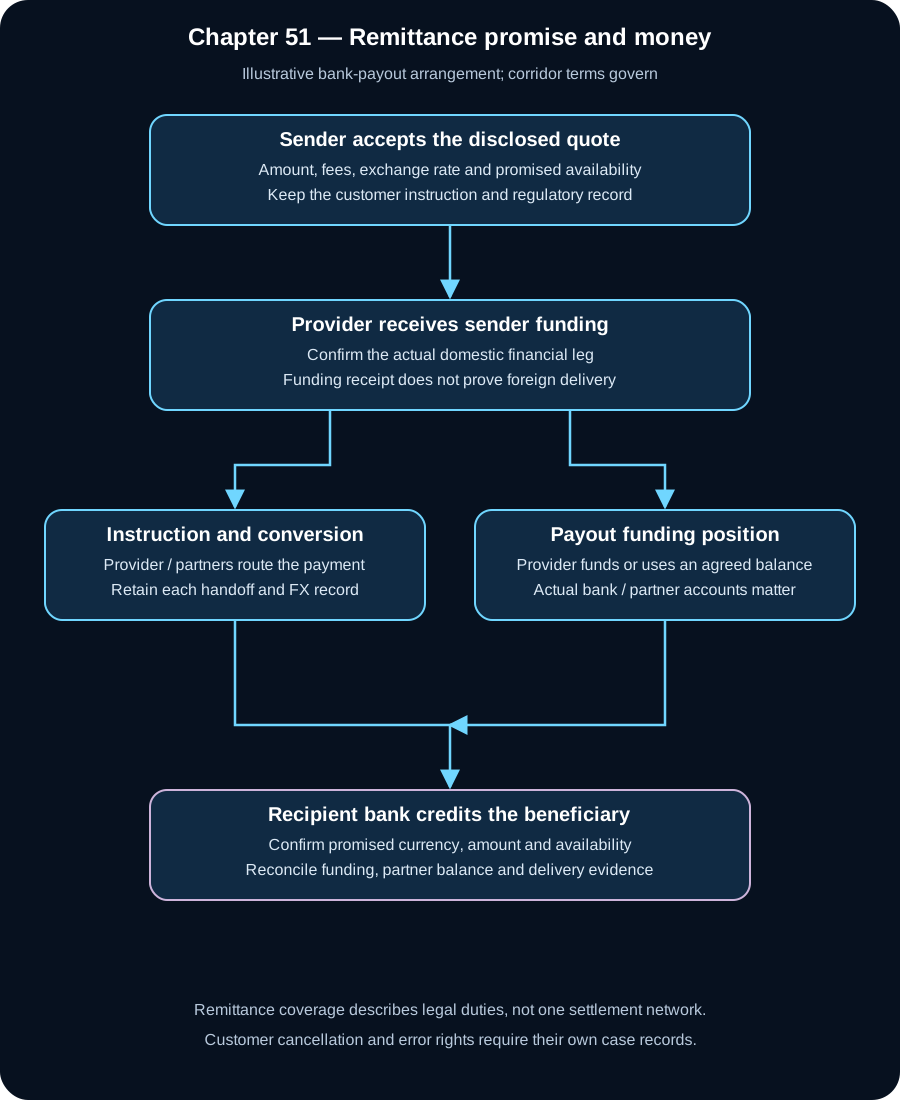
The diagram illustrates a prefunded payout arrangement. The foreign partner uses the provider's available position according to their agreement. Replenishing that position is a separate institutional payment; it should not be mistaken for the original retail remittance. Other arrangements use different funding sequences, so the bank must confirm its actual model.
At each boundary, ask what the receiving participant accepted. A successful API acknowledgment might accept the request for validation. A payout reference might identify a scheduled bank transfer. A cash-pickup notification might say funds are ready, although the recipient has not collected them. Customer communication should use those meanings accurately.
Reconciliation connects Elena's instruction to funding, the accepted quote, payout amount, partner balance movement and delivery outcome. If an aggregate foreign account debit covers hundreds of remittances, preserve the item population. Matching only the batch total cannot establish that Elena's mother received her share.
5. What makes an ACH entry an IAT
An International ACH Transaction, or IAT, is the relevant ACH entry classification for an international payment meeting Nacha's definition. It is not determined simply by the customer's nationality, the appearance of a foreign address, the currency of the US entry or the location of the website. The bank must understand the financial agencies and the actual payment arrangement.
Nacha's revised IAT definition is effective September 18, 2026. It defines IAT as the U.S. ACH Network component of an international payment transaction and covers transactions involving an account, sender, receiver or facility of a financial agency outside the United States. An IAT cannot be a Same Day Entry. Apply the effective definition to entries originated on or after its effective date under the applicable Nacha rule and implementation guidance; preserve a versioned transition record for historical entries. Do not use customer nationality, a foreign address, currency or website location as a proxy for classification.
The practical classification question can require information beyond the domestic ACH instruction. A provider may use a US account while the underlying arrangement includes a foreign financial agency. Conversely, an unrelated earlier or later international transaction should not automatically determine the classification of every domestic payment involving that customer. Obtain the relevant facts and apply the rules to the actual transaction relationship.
Document the conclusion and its source evidence. If a customer cannot explain a provider's funding chain, the bank needs an escalation process and appropriate contractual information. Selecting a domestic SEC code merely because it requires fewer fields is not a valid classification method.
6. IAT data, gateways and the US ACH leg
An IAT entry carries structured information about the parties and financial institutions through its entry and required addenda. Nacha's IAT guidance describes seven mandatory addenda records. Required fields and any additional records must follow the current rules and the bank's implementation guide. A domestic CCD entry with a foreign address inserted into free text is not an equivalent substitute.
The originating and receiving depository financial institutions retain their ACH roles on the US leg. A gateway operator connects the ACH network with the cross-border arrangement. The gateway does not convert the entire international payment into a Federal Reserve account-to-account transfer, and the foreign recipient is not necessarily the account holder named in the domestic funding leg.
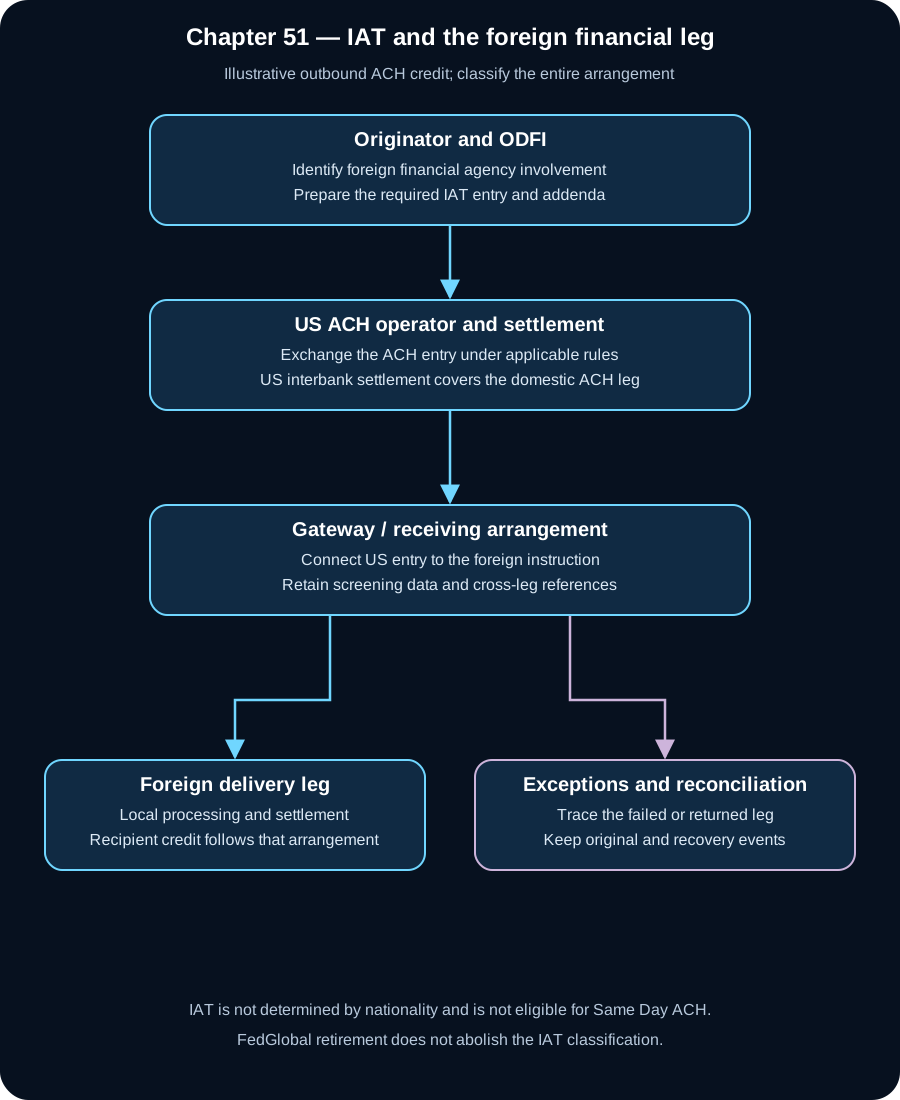
The diagram follows an illustrative outbound route and separates data continuity from settlement. US ACH settlement follows the relevant operator and account relationship. Foreign processing and recipient payment follow the supported corridor. An ACH trace identifies a US entry; a foreign payout reference may be needed to investigate delivery beyond the gateway.
IAT entries are not eligible for Same Day ACH. A provider should not promise Same Day eligibility merely because the dollar amount is below the domestic service limit. Nacha has also announced optional date-of-birth and foreign-financial-agency field changes for March 19, 2027. Those are future format changes at this review date, requiring versioned mapping and receiving-side readiness rather than invented current fields.
7. Corridor capability and the FedGlobal transition
A valid IAT format does not establish that a bank supports the destination country, payout type or currency. The service catalogue must identify available corridors, partner relationships, required recipient data, calendars, limits and return procedures. A bank should verify both its US origination capability and the foreign arrangement before offering a customer commitment.
FedGlobal is particularly important to date correctly. Federal Reserve Financial Services announced its discontinuation by year-end 2026 and says the service is no longer accepting new signups. The published transition notice says forward FedGlobal ACH items to Mexico or Panama will be accepted until November 20, 2026, with return flows maintained under the applicable arrangements. A new-bank implementation should not be taught to enroll in a service that has closed new enrollment.
This does not abolish IAT or all international ACH services. It affects the particular Federal Reserve service and its transition. A bank using another gateway must evaluate that provider's supported arrangements independently. A replacement service should be approved and tested, not inferred from an old country list or from the continued existence of the IAT format.
For an exiting provider, preserve historical references and the process for late returns, questions and refunds. Stopping forward origination does not complete outstanding customer obligations. Treasury must also reconcile any residual partner balances and approved repatriation of unused funds.
8. Stablecoins and the claim behind the token
A dollar payment stablecoin seeks to maintain a dollar-denominated value, but its legal and operational characteristics come from its issuer, terms and applicable framework. A token is not automatically a deposit at an insured bank, a Federal Reserve liability or a claim directly redeemable by every holder on identical terms. Identify the issuer and the holder's rights before discussing payment speed.
A bank should distinguish holding the token from holding a custodial account that records an entitlement to tokens. In a self-custodied arrangement, control of the relevant keys affects the ability to transfer. In a custodial arrangement, the provider's account records and controls add another relationship. A wallet address is not a verified legal identity merely because it is syntactically valid.
The underlying network matters too. A token on one blockchain is not automatically interchangeable operationally with an apparently similar token on another chain. Supported contracts, addresses, custody, transaction fees and confirmation policies must be specified. Bridges can add further technical and counterparty dependencies; they should not appear in a production route simply because a token symbol matches.
For Elena's service, the key question is whether the recipient wants tokens or local bank money. If the promise is local money, the token is an intermediate asset and the service still needs a conversion and payout arrangement. Its customer disclosure and completion record should not stop at the blockchain transaction.
9. Issuance, transfer, redemption and bank settlement
An illustrative provider obtains tokens through an issuer or another supported source, transfers them to a receiving provider, and the receiving provider converts or redeems value before paying the recipient locally. These are separate financial and operational legs. A secondary-market purchase is not necessarily new issuance, and a sale to another holder is not necessarily redemption with the issuer.
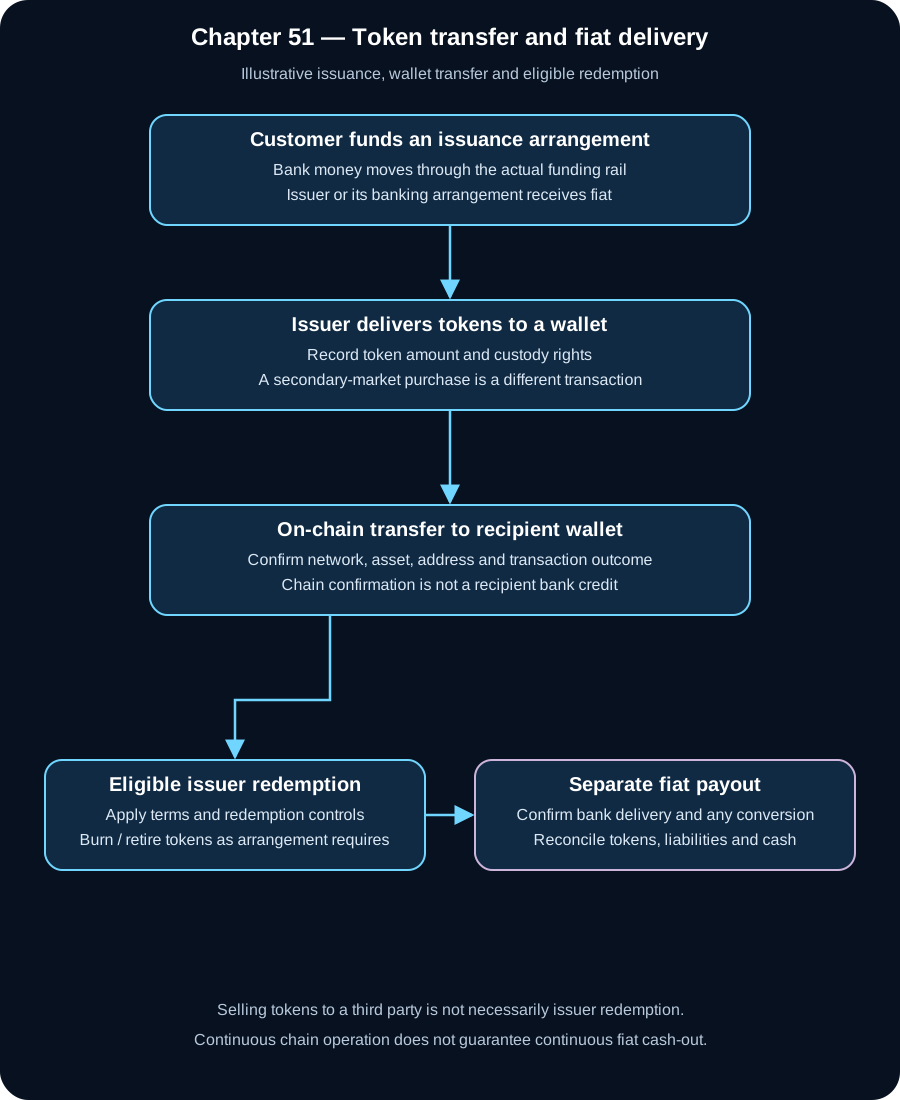
On-chain transfer changes the recorded control or ownership position under the relevant arrangement. It does not inherently move dollars between two bank accounts at the same instant. Bank money moves when the associated issuance, purchase, redemption, funding or payout processes require it. The exact accounts and timing must be documented for the chosen product.
A transaction hash supplies network evidence. It does not alone establish the intended recipient's identity, the enforceability of redemption rights, completion of sanctions review or availability of local currency. The bank needs an agreed policy for recognizing the network event and linking it to its own accounting and customer outcome.
If a receiving provider pays local money before redeeming tokens, it uses liquidity or credit within its arrangement. If it waits for redemption, bank and issuer operating hours may determine delivery. A continuously operating blockchain therefore does not establish continuous fiat redemption or a universal end-to-end service time.
10. Funding, foreign exchange and liquidity exposure
Model the balances separately: collected customer funds, money with payout partners, tokens controlled or held in custody, redemption receivables and amounts owed to customers. Aggregating them into one available-dollar figure can hide restrictions and conversion dependencies. A token position and a bank balance may have similar quoted values but different immediate uses.
The foreign-exchange commitment also needs an owner. If the provider promises 8,500 local units at quote acceptance, a later rate movement does not make the original disclosure disappear. The provider must manage its contractual exposure and any lawful adjustment or cancellation process. Treasury pricing, hedging and funding decisions should remain connected to the customer quote without exposing internal hedging details in the customer journey.
A weekend can expose several clocks. The token network may operate while the issuer's redemption desk, the receiving bank or the foreign currency market has limited availability. A provider can bridge the interval with prefunding only where the actual arrangement permits and funds it. The chapter does not assume a bank can obtain new central-bank credit simply because customer transfers continue.
Stress the corridor rather than only the payment API. Test delayed funding, a payout-partner outage, a token price deviation, restricted redemption and a local holiday. For each, identify which obligation remains payable and what evidence allows a revised customer commitment.
11. Fraud, sanctions and information continuity
Fraud controls need to address the sender, recipient, agent and any changes to the destination. A legitimate sender can be deceived, and a legitimate payout instruction can be intercepted. A stablecoin address change deserves the same financial seriousness as a changed bank account, with additional checks for the actual network and asset.
OFAC's virtual-currency guidance makes clear that sanctions obligations are not removed by using digital assets. Screening an address against a list is not the entire compliance program. Relevant party information, geography, ownership and transaction context still matter. The bank should obtain sufficient information and escalation support for its role rather than treating the blockchain as self-verifying compliance evidence.
For IAT, preserve required originator, receiver and financial-agency information through transformations. Truncating a required field to fit a domestic interface can weaken both processing and screening. Failed or incomplete data should reach a controlled repair process, with the original instruction retained and the effect of changes assessed.
A sanctions block, a rejected payment, an operational hold and an ordinary return are distinct outcomes. Do not automatically refund or retransmit property subject to a legal restriction. Compliance determines the required treatment, while operations preserves the financial position and customer communication that can appropriately be provided.
12. Stablecoin law and provider responsibilities
The GENIUS Act was enacted on July 18, 2025, but the OCC and Treasury implementation materials available on 5 October 2026 remain proposed rules, not final operating rules. Treasury describes January 18, 2027 as the expected statutory effective date and separately describes a July 18, 2028 restriction on offering or selling payment stablecoins to persons in the United States. Neither date should be taught as a current final licensing, reserve, custody or redemption implementation rule. The bank needs current legal confirmation of issuer status, permitted activity, applicable transition periods and its own authority; public enactment and current product approval are different evidence.
FinCEN's convertible-virtual-currency guidance explains that relevant business models can involve money transmission and associated BSA duties. Its application depends on the activity and applicable exceptions. A provider's technical description as software, wallet or settlement infrastructure does not itself settle regulatory classification. State requirements and foreign-country requirements also need their own analysis.
Maintain a source register connecting each functional requirement to legislation, final regulation, proposed change, supervisory guidance, network rule or contract. That makes implementation changes reviewable when a proposal becomes final or a provider changes its service. It also prevents a developer from turning an anticipated legal outcome into a production eligibility flag.
13. Cancellation, errors and cross-border recovery
For covered remittances, Section 1005.34 provides a cancellation process for qualifying requests received within 30 minutes after payment, subject to identification requirements and the funds not already being picked up or deposited into the recipient's account. The required refund generally must be made within three business days and includes the prescribed fees and taxes. Transfers scheduled in advance have additional rules. This is not a guarantee that every completed international payment can be recalled for 30 minutes.
Section 1005.33 generally allows an error notice within 180 days of the disclosed availability date. The provider must investigate promptly, determine the result within 90 days and report it within three business days after completing the investigation. Error categories, exceptions and remedies matter; support should not apply one automatic refund outcome to every complaint.
In implementation, distinguish the consumer's case clock from a partner's investigation target or an ACH return deadline. They can concern the same transaction without sharing a deadline. Preserve the customer's notice even when the foreign partner has not responded, and assign responsibility for the applicable legal action separately from recovery of provider funds.
A token transfer may be technically irreversible under the chosen network while a provider still owes a customer remedy. Conversely, a return of tokens to the wrong address can create a new error. Recovery must use the approved provider, custody and legal process, with the original transfer and every subsequent financial event retained.
14. Reconciliation and bank implementation
Use one customer instruction linked to multiple financial legs, not one mutable paid flag. Preserve the accepted quote, disclosures, funding outcome, gateway or provider references, token evidence where relevant, foreign payout status and customer case. Each event should state its source and meaning so operations can distinguish evidence from inference.
A generic provider ledger can record money owed to customers and assets held with banks or partners. On a completed payout, the relevant obligation is discharged under the accounting policy. A transfer to a foreign prefunding account changes the location of an asset; it does not pay every customer in the forecast. A token redemption awaiting bank receipt requires its own supported accounting treatment rather than immediate recognition as unrestricted bank cash.
Reconcile in both currencies and at item and batch level. A dollar control can balance while local-currency payouts are misallocated. Separate fees, conversion differences, returned amounts and timing differences, with approval for manual corrections. Never delete the original rate or transaction reference merely to make a net amount match.
Before launch, demonstrate a complete investigation across organizational boundaries. The bank should obtain partner evidence without exposing full customer records in unsecured messages. Its exit plan must preserve access to historical transactions, late returns and outstanding redemption or payout obligations after new business stops.
15. Worked cases and implementation decisions
A fast domestic debit is mistaken for delivery
Elena's account is debited $505, but the foreign payout remains under review. The domestic debit establishes funding, not receipt of 8,500 local units. Locate the provider and foreign-leg evidence and compare the delay with the actual disclosed availability and applicable error rules.
For the exercise, prepare the customer explanation and the internal case record. Identify what the bank knows, what the provider must establish and which deadline continues while the partner investigates. Do not advise a second remittance merely because the recipient has not yet seen the first.
A US account hides an international arrangement
A business submits a domestic ACH file to a provider's US account, while its service agreement indicates a related foreign financial-agency leg. The file's domestic routing details alone do not resolve IAT classification. Obtain the transaction facts and have the applicable rule assessment completed.
Explain which missing information would change the conclusion. Then design a controlled classification decision with evidence, an effective rule version and a repair path. The exercise should not end with either all provider payments are IAT or none are IAT.
An IAT project uses a future field too early
A specification copied from the March 2027 amendment adds date of birth to a current production mapping without checking the receiving arrangement. The team must distinguish the announced enhancement from the currently effective format and plan the transition.
Ask the learner to identify the configuration date, receiving-side compatibility test and source owner. Preserve useful future requirements in the change plan; do not present them as today's mandatory payload or discard them because they are not yet effective.
A token arrives but cash-out is unavailable
The receiving provider has the expected tokens, but its local bank payout route is closed for a holiday. If the service promised local bank money, the on-chain event has not alone fulfilled that promise. Determine whether approved local prefunding can support payout or whether the customer outcome needs escalation.
Draw the positions before and after redemption and local payment. Identify token ownership, bank cash and the customer obligation separately. No step should create spendable local money merely by changing a token transaction to confirmed.
The sender cancels before foreign delivery
A covered sender requests cancellation 20 minutes after payment. The transfer is identifiable and has neither been collected nor deposited into the recipient's account. Apply the supported cancellation and refund requirements while coordinating the foreign instruction so it cannot later pay unexpectedly.
Contrast that with a case where recipient deposit already occurred. The legal and operational analysis changes; the application must not promise the same cancellation outcome from the elapsed timer alone. Preserve both the request time and delivery evidence.
A corridor closes while returns remain possible
A bank migrates away from FedGlobal ahead of the published forward-item deadline. New instructions use the approved replacement, but a prior transaction later returns through the original arrangement. The old reference and financial path must remain recognizable.
Prepare a migration checklist covering residual balances, customer refunds, partner contacts and report retention. Successful migration means both new payments and old obligations can be resolved; switching the origination endpoint alone is insufficient.
16. Role checklist and learning closure
Product should describe the asset and delivery outcome the customer is buying. Business analysis should classify the customer service and every underlying leg without confusing remittance law, IAT rules and token mechanics. Technology should preserve references, versions and financial evidence across providers. Operations should distinguish missing funding, missing payout and a customer error claim. Treasury and finance should identify where money or tokens are held and what remains owed.
The learner should be able to explain why a domestic bank debit, an IAT entry and a confirmed token transaction can all be valid evidence without proving the same thing. Chapter 52 returns to the bank's control boundary: who may create, change, approve and release an instruction before any of those routes moves value.
Authoritative references
Sources checked on October 5, 2026. Future IAT amendments, service discontinuation dates and proposed stablecoin regulations are distinguished from current operating requirements.
This application uses JavaScript for the full interactive experience. This text summary is served for accessibility and search indexing.