Consumer Protection in USA Payments and Collections. Apply consumer payment protections through disclosure, authority, error notice, investigation, balance correction and communication, separately from network recovery.
Nina calls Malla Bank after seeing a $640 electronic debit she does not recognize. The payment has already settled. A support agent can see a successful authentication event and a closed network recovery window, but neither fact alone answers Nina's complaint. The bank must establish what happened, identify the applicable consumer protections and act within the correct process. Its ability to recover money elsewhere is a related task, not the starting condition for helping her.
Chapter 56 mapped legal and service obligations. This chapter follows consumer protection through product setup, payment authority, customer notice, investigation, correction and communication. It concentrates on the bank's customer-facing duties across relevant payment types rather than repeating each network's detailed exception rules.
A settled payment can still require investigation or a customer correction. Determine coverage and the facts of the claim, keep the legal clock running, and record customer relief separately from interbank recovery.
Allow roughly 60 minutes for the chapter, diagram walkthroughs and worked cases. Customers, amounts and internal systems are fictional. Sources were checked on October 5, 2026. The legal examples are simplified; the applicable regulation, official interpretations and actual product facts govern each case.
Chapter navigator
- Identify the protected relationship before choosing a workflow
- Explain the service before the customer uses it
- Keep recurring authority, stopping payment and canceling a contract separate
- Establish who initiated the transfer and with what authority
- Receive the notice without creating an artificial barrier
- Apply the correct investigation clock
- Provisional credit is a real customer balance event
- Investigate evidence rather than treating a signal as a verdict
- Determine consumer liability under the actual conditions
- Credit-card disputes require their own legal and network paths
- Checks, availability and electronic conversion
- Remittances, prepaid products and compulsory use
- Overdraft, fees and the customer's actual balance
- Communicate the determination and retain the evidence
- Worked cases and implementation decisions
- Role checklist and learning closure
1. Identify the protected relationship before choosing a workflow
The first classification concerns the person, account and transaction. Regulation E generally addresses covered electronic transfers involving consumer asset accounts. Regulation Z supplies relevant credit-card protections. Check collection and deposit availability have different frameworks, while qualifying international remittances have specific Regulation E Subpart B requirements. A channel label such as app payment does not identify the whole legal position.
Consumer purpose matters. A natural person can act for a business, and the same bank can hold both personal and business accounts. The service should retain the facts needed for the appropriate determination. Staff should not infer account purpose from payment size or assume that a small-business payment becomes a consumer transfer because the owner used a phone.
Coverage also depends on the actual mechanism. Electronic check-image collection is not the same as converting check information into an ACH transfer. Fedwire and similar primarily interbank or business transfer systems have a Regulation E coverage exclusion, but qualifying remittances require a separate Subpart B assessment. Those distinctions prevent both false promises and wrongful denial of protection.
The bank should make classification a reviewable decision rather than an opaque product code. When facts are unclear, preserve the notice and obtain the required specialist assessment promptly. A customer should not have to understand the network before the bank records a complaint about money missing from an account.
2. Explain the service before the customer uses it
A customer needs to understand what the bank will do, when money may leave, the charges that apply and how to report a problem. Required disclosures depend on the product. The operational aim is to make the actual service understandable while preserving the prescribed legal content and delivery evidence.
A payment confirmation should distinguish submitted, scheduled, released and delivered where those states differ. A bank that labels an instruction paid immediately after receipt can create a misleading customer expectation even if its internal logs are accurate. Likewise, a promise of instant delivery needs the service's real eligibility and availability conditions rather than an unqualified marketing phrase.
Store the disclosure version associated with the customer's enrollment or transaction. When a fee, service condition or notice changes, the institution needs evidence of what was presented and when. A current website screenshot does not establish what Nina saw months earlier when she authorized a recurring collection.
Design accessibility and support around the actual customer journey. Important payment details should not disappear behind a tooltip that cannot be opened on a phone. Clear language does not mean removing material conditions; it means explaining those conditions where the customer can act on them, with required formal disclosures available in the prescribed form.
3. Keep recurring authority, stopping payment and canceling a contract separate
For preauthorized electronic debits from a consumer account, Section 1005.10 requires written or similarly authenticated authorization and a copy for the consumer. It also addresses advance notice of varying amounts, subject to permitted arrangements. A saved account number by itself does not demonstrate authority for every future collection.
The same section provides a stop-payment right for a qualifying preauthorized transfer when notice reaches the institution at least three business days before the scheduled date. The institution can require written confirmation within 14 days under the specified notice conditions. These are legal conditions, not a universal instant cancellation feature for all payment types.
Operationally, distinguish the customer's instruction to stop a debit from revocation of a collector's authority and from termination of the underlying service or debt. Stopping an insurance debit does not necessarily cancel the insurance contract or extinguish a premium obligation. The bank should explain its action without purporting to decide the separate commercial contract.
A reliable design links the stop instruction to the relevant merchant or originator, account, covered payment population and effective conditions. It also tells staff what to do if the debit arrives under changed descriptors. The customer should not receive a confident stopped message while the actual control only blocks an obsolete record identifier.
4. Establish who initiated the transfer and with what authority
An unauthorized EFT analysis requires facts about initiation and actual authority. A fraudster can obtain credentials through deception and then initiate a transfer. CFPB's EFT FAQs explain that such third-party initiation can be an unauthorized EFT. Successful authentication is evidence about access, not conclusive evidence that the consumer authorized the transaction.
A consumer who personally initiates a payment after being deceived presents a different factual question. Do not automatically classify every scam payment as unauthorized, and do not automatically reject every scam-related claim as authorized. Establish the sequence, actor, scope of authority and relevant protection or scheme reimbursement arrangement without promising a universal outcome.
The distinction should shape evidence collection. Device and session records can help identify who accessed the account; customer statements and payment instructions help explain what they intended or permitted. Staff should avoid leading questions that force a complex event into the answer needed by an existing rejection code.
Nina's $640 complaint could involve account takeover, an unfamiliar merchant descriptor, a duplicate or a collection outside the authorization. Those are different possibilities. The bank should investigate the actual allegation rather than stop at the first log showing a correct password. Its fraud model and its legal determination have different functions.
5. Receive the notice without creating an artificial barrier
A customer report should enter a process that preserves the substance and receipt time. Under Section 1005.11, qualifying error notices can be oral or written. The ordinary notice period is tied to the statement first reflecting the error, generally 60 days after it is sent. A service center should therefore capture the relevant statement and notice events rather than count only from settlement.
The official interpretations explain that an institution must begin investigating an oral notice promptly; it cannot wait for a signed statement before starting. Written confirmation can affect provisional-credit treatment under specified conditions, but that is not permission to postpone the investigation itself. A police report or merchant contact should not become an invented prerequisite to receiving a qualifying EFT error claim.
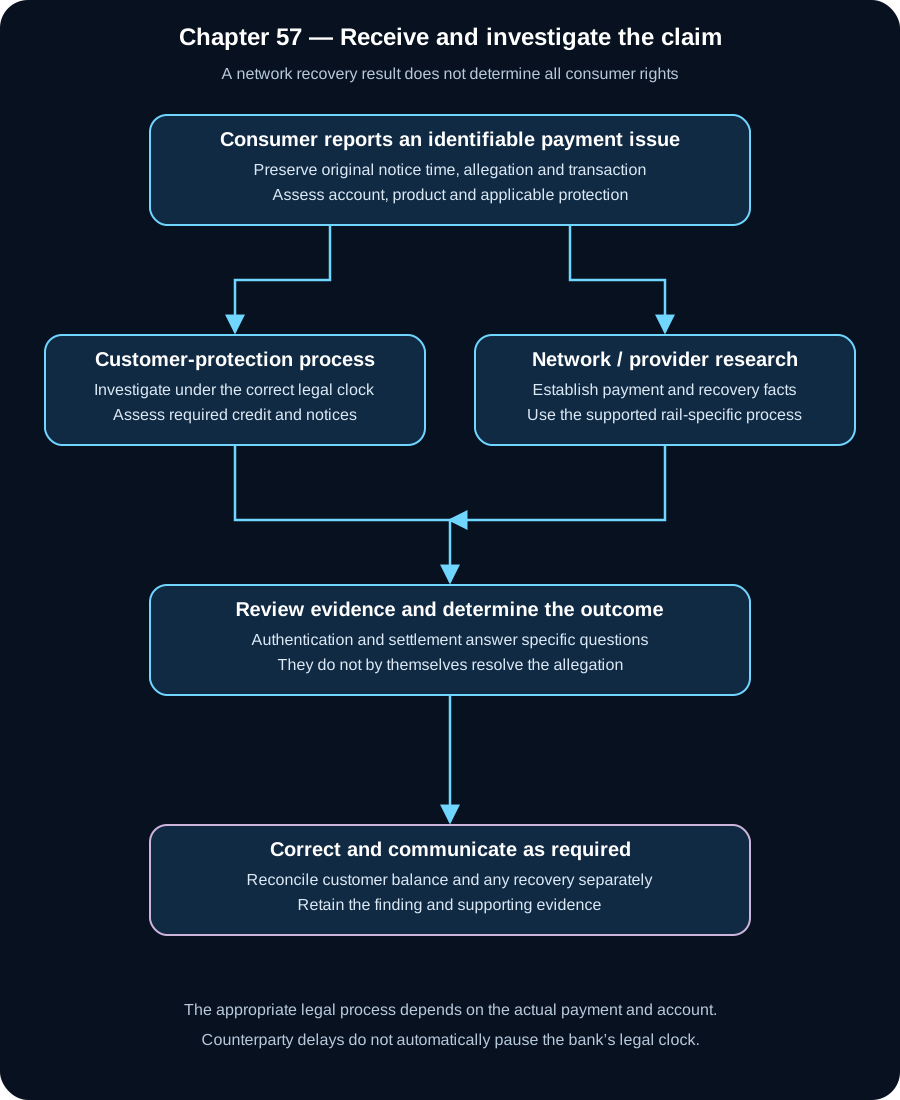
The diagram keeps intake, legal assessment and recovery connected without making them sequential dependencies. The bank may need more facts from Nina, but it should distinguish useful questions from conditions that the applicable rule does not permit it to impose.
Record what is missing and who will obtain it. If the consumer cannot identify an exact transaction reference, use the available account, amount, date and description to locate the activity. The aim is to investigate an identifiable issue, not require the customer to reproduce an internal payment identifier that was never shown to them.
6. Apply the correct investigation clock
For the ordinary Section 1005.11 process, investigate promptly and determine the result within ten business days. If the investigation needs longer, the rule permits up to 45 calendar days when its conditions, including applicable provisional credit, are met. Results are reported within three business days after completion; an established error is corrected within one business day after determination.
Specified circumstances modify those periods: a qualifying new-account transfer can use 20 rather than ten business days; certain new-account, point-of-sale debit-card and transfers not initiated within a state as defined in Regulation E can use 90 rather than 45 days. These are defined extensions, not a discretionary 90-day allowance for every difficult complaint.
Build the clock from the legally relevant receipt event and applicable business-day definition. Internal queue transfer, vendor referral and reassignment do not create a fresh notice date. The bank should be able to explain which rule path it selected and why, especially where more than one date or product relationship appears in the case.
A practical dashboard should show the next required action rather than only final due date. It can identify investigation progress, a provisional-credit decision and communication tasks separately. A case that is comfortably inside its final investigation limit can still miss an earlier customer-credit or notice obligation.
7. Provisional credit is a real customer balance event
Provisional credit allows the customer to use funds while the bank continues the applicable investigation. Under the ordinary extended process, the institution informs the consumer within two business days after the credit and provides full use, subject to the rule's specified provisions. It is not merely a case-system status or an invisible reserve.
If Malla Bank credits Nina $640 provisionally, the customer's deposit liability increases on the bank's books. The corresponding debit follows the bank's approved accounting treatment for the claim; the original payment is not thereby reversed at the other institution. This accounting example describes the bank's own books and does not prescribe a universal chart of accounts.
The customer should understand whether the credit is provisional or final. Operations and finance should prevent a final correction from adding the same $640 a second time when the provisional amount is already present. Converting status and posting new money are different actions that must not be confused in an interface.
If the bank finds no error or a different error, it must follow the applicable explanation, documentation and provisional-credit reversal requirements. The Section 1005.11 process includes protections associated with debiting provisional credit. Staff should use the current prescribed notices and conditions rather than silently removing funds because a recovery request was declined.
8. Investigate evidence rather than treating a signal as a verdict
A reasonable investigation should address the allegation. Authentication logs, authorization records, account history, transaction details, relevant third-party records and the customer's explanation can all matter. Their value depends on the question being asked. Proof that a device was recognized does not itself establish that the transaction amount was correct or that a recurring debit remained authorized.
Distinguish absence of evidence from evidence of absence. A processor's inability to retrieve a record does not demonstrate that Nina approved the payment. Conversely, a customer's uncertainty about a merchant description does not itself prove fraud. The institution should identify what the available evidence establishes and where it remains incomplete.
A network response can inform the investigation without controlling the legal result. A return request declined because funds are unavailable says something about recovery, not necessarily about the legitimacy of the original transfer. A merchant's document should be assessed for relevance rather than accepted solely because it arrived through the expected channel.
The decision record should explain the factual finding in understandable terms and retain its sources. Reviewers should be able to distinguish the investigator's reasoning from automated recommendations. Where the bank corrects an error without completing an investigation, it must still meet the applicable requirements of that chosen resolution path.
9. Determine consumer liability under the actual conditions
Regulation E's liability provisions distinguish notice of a lost or stolen access device, reporting delays and later unauthorized transfers. The familiar $50 and $500 figures are conditional limits, not automatic deductibles on every claim. Required disclosures, accepted-device conditions, the timing of notice and the institution's required showing matter.
The 60-day statement-related rule for certain later unauthorized transfers is also not a blanket forfeiture of all rights concerning every earlier transfer. Section 1005.6 requires the applicable causal and timing analysis. The bank should not convert a late report into an automatic full-loss decision without applying the provision that actually governs the facts.
Consumer negligence does not permit the institution to impose greater liability than Regulation E allows. This matters where a customer shared information during deception. Staff can offer security advice while still applying the legal test correctly; a warning that the customer should have been more careful is not a substitute for that test.
Implement liability decisions separately from fraud classification and recovery status. A bank may choose customer-favorable terms beyond the legal minimum, but those terms should be accurately described and consistently applied. Neither an internal risk score nor a network's zero-liability marketing phrase should replace the relevant statutory and contractual analysis.
10. Credit-card disputes require their own legal and network paths
Regulation Z's billing-error process has different triggers and periods from Regulation E. For a qualifying written notice received within 60 days after the first statement showing the alleged error, Section 1026.13 generally requires acknowledgment within 30 days unless resolved sooner, and resolution within two complete billing cycles, never more than 90 days. The actual notice and error conditions must be applied.
A network chargeback is a mechanism between card participants. It can support the issuer's recovery, but its reason codes and evidence windows do not replace Regulation Z. Unauthorized-use liability under Section 1026.12 is another analysis, with its own conditions. The familiar maximum of $50 is not permission to charge that amount automatically in every case.
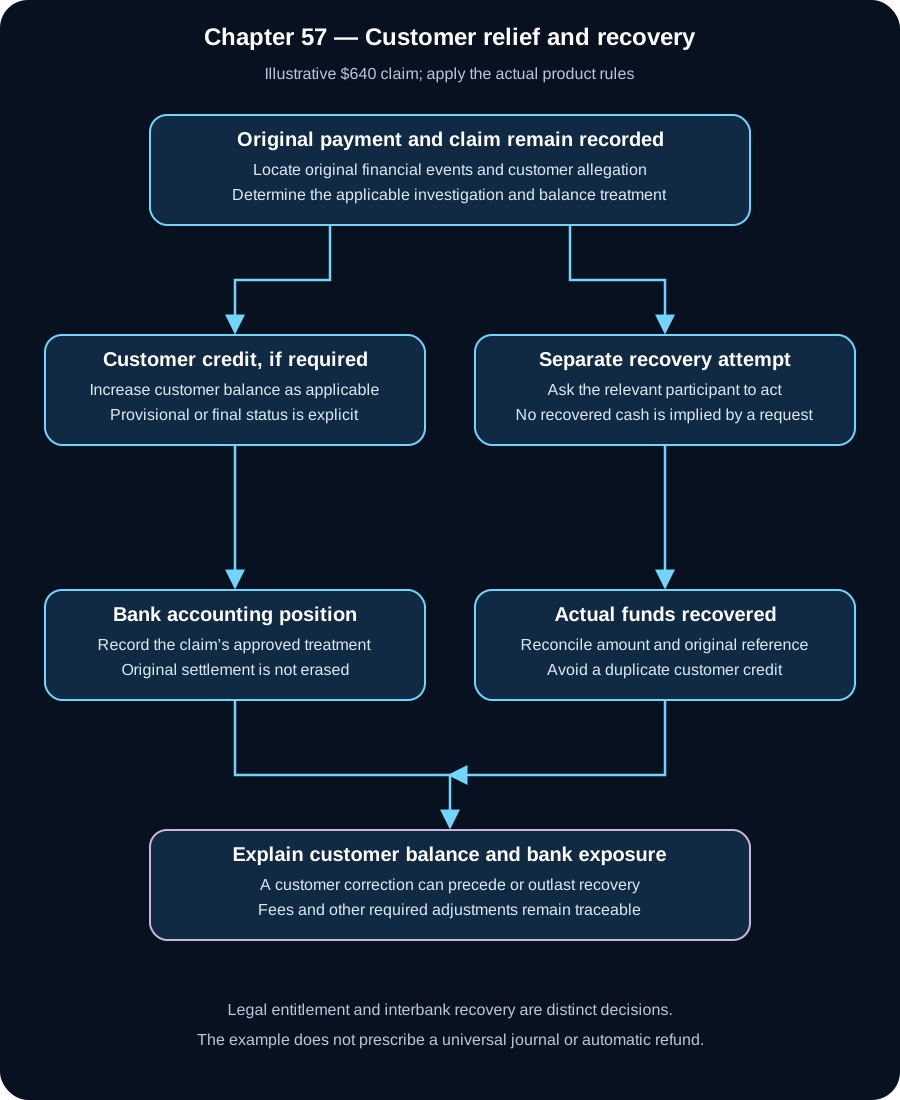
The diagram applies conceptually across products while preserving their different rules. The bank needs separate records for the customer's balance treatment, the dispute decision and any amount recovered from an acquirer or another institution. A merchant refund received during the process must also be reconciled to avoid duplicate customer compensation.
Use credit-card-specific customer communication. Explain treatment of the disputed amount under the applicable billing-error process, and avoid presenting debit-account provisional credit as the universal model. A combined banking app can share visual design while still showing the correct legal and financial meaning for each product.
11. Checks, availability and electronic conversion
Availability of a deposited check is not proof that it cannot be returned or that every associated claim has ended. Regulation CC governs relevant availability, collection and substitute-check matters, with conditions and exceptions. Chapter 38 covered holds and check fraud; the consumer-protection concern here is whether the bank accurately applies and explains the applicable treatment.
The inflation-adjusted Regulation CC dollar thresholds changed on July 1, 2025. A bank should use the current schedule rather than old $225 or $5,525 figures in a customer notice. This chapter does not reproduce a universal release timetable because check type, account and deposit circumstances can change the result.
Check conversion needs a separate classification. Using check information to initiate a covered electronic transfer is different from collecting a check image. The bank should retain the transaction type and source evidence so a dispute enters the appropriate workflow. Scanning a document does not, by itself, turn its collection into an EFT.
A customer asking whether funds are safe to spend needs an accurate explanation of availability and possible later return, without being told that the bank has no responsibilities. The operating response should identify the actual deposit and claim rather than rely on a generic disclaimer printed on every receipt.
12. Remittances, prepaid products and compulsory use
Qualifying remittances have their own disclosure, cancellation and error-resolution rules under Regulation E Subpart B. The domestic EFT ten/45-day investigation model should not be copied into every remittance case. Chapter 51 described the remittance-specific financial legs and customer rights; here the bank needs a reliable referral and case classification that preserves the original notice.
Prepaid accounts can have modified information and error-resolution provisions under Section 1005.18, including conditions related to identity verification for certain accounts. A stored balance in an app is not enough to determine whether every prepaid provision applies. Establish the provider, account type, access arrangement and applicable disclosures before selecting the process.
Section 1005.10 also restricts compulsory use of preauthorized electronic repayment of credit, subject to stated exceptions, and addresses requiring a particular institution for receipt of employment or government-benefit payments. Product design should distinguish a genuinely available payment choice from an enrollment flow that makes a prohibited method effectively mandatory.
For all three areas, the bank should provide an accessible route to help. A customer transferred from card support to a wallet provider and then to remittance operations should not lose the history of the notice. Internal specialization is useful only when the handoff preserves facts, responsibilities and applicable clocks.
13. Overdraft, fees and the customer's actual balance
Regulation E's overdraft opt-in provisions concern fees for paying ATM and one-time debit-card transactions under the specified conditions. They are not a universal opt-in rule for every ACH debit, check or recurring transaction. The bank needs the correct transaction classification and evidence of the applicable customer election.
A disputed debit can also produce related fees or interest consequences. When correcting an EFT error, the official interpretations require attention to applicable interest and fees attributable to the error. The bank should identify these effects from the actual ledger rather than credit only the principal and leave the customer economically short.
Explain available balance, booked balance and provisional credit consistently across channels. A customer who receives a notice saying funds are usable should not find the same amount locked by a stale hold. The case application, core account and customer-facing balance need to agree on the effect of the correction.
Fee remediation must be traceable. Record the original fee, the reason for correction and the linked customer case. A manual credit entered only as goodwill can obscure whether the institution met a required error correction and make later quality review unreliable.
14. Communicate the determination and retain the evidence
A useful response explains the identified transaction, the bank's finding, the balance effect and any applicable next step or documentation right. It should not say the payment was successful when the customer's allegation concerned authority. Network completion answers a different question.
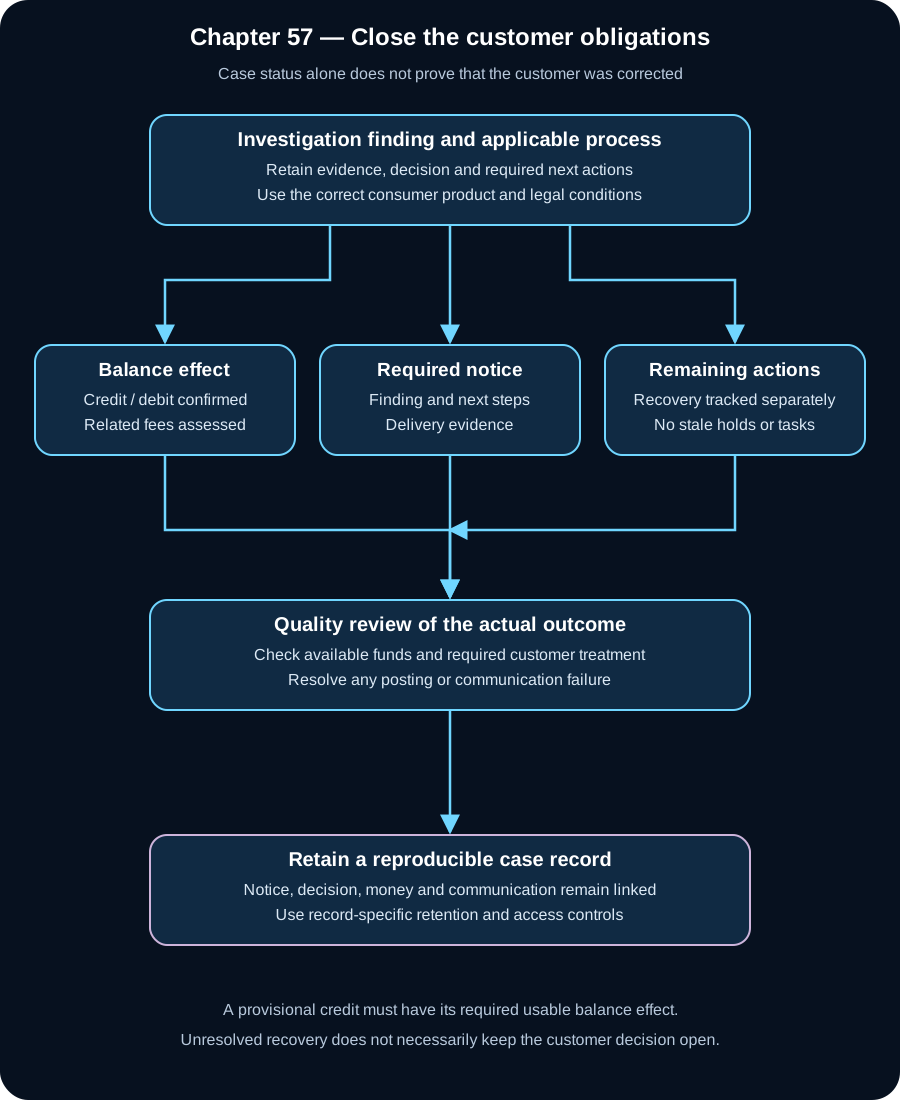
The diagram treats closure as a set of completed obligations. A case marked resolved can still be incomplete if the credit did not post, the required notice failed or a related fee remained uncorrected. Quality review should sample the actual customer and financial outcomes rather than only the investigator's chosen status.
Retain notices, evidence, decisions and financial events under the applicable retention requirements and legal holds. Regulation E generally requires evidence of compliance for at least two years, with relevant extensions in enforcement circumstances. That period is not a universal deletion rule for every associated payment, sanctions or litigation record.
Customer communication must also respect confidentiality. The bank can explain the payment issue and permitted account action without disclosing a SAR or information that would reveal its existence. Do not use confidentiality as an excuse to provide no useful explanation at all; specialist teams should determine what can appropriately be said.
15. Worked cases and implementation decisions
Authentication succeeded but a fraudster initiated the transfer
Nina disclosed a verification code to someone impersonating bank staff, who then initiated the $640 EFT. The case screen proposes denial because the code was valid.
Identify the initiator and actual authority, apply the relevant CFPB guidance and start the proper investigation. Explain why security advice and the legal determination are separate tasks. Do not promise an outcome without the required factual assessment.
Written confirmation has not arrived
A consumer gives an identifiable oral error notice. The bank requests written confirmation, but the investigator waits to begin until it arrives.
Correct the workflow so the investigation starts promptly. Assess provisional credit under the actual conditions separately. Preserve the original notice date; moving the work item into a different queue does not restart it.
Recovery fails while the claim remains valid
The receiving institution cannot return the disputed funds. Malla Bank nevertheless determines that the consumer is entitled to correction under the applicable process.
Show the customer credit and the bank's separate recovery or loss treatment. Explain why the original interbank settlement remains in history and why a recovery refusal does not itself determine consumer liability.
A merchant refund arrives after provisional credit
A $90 card-related claim has a provisional customer credit. A merchant refund later posts against the same purchase. Staff are about to make the provisional credit final without checking the refund.
Reconcile the two events under the correct product workflow, explain the resulting balance and send the required communication. Avoid either double compensation or an unexplained debit that leaves the customer unsure which transaction was corrected.
A check-image claim enters the EFT workflow
A deposited check is returned, and the system classifies the case as electronic because the image was transmitted digitally. The actual transaction was check collection, not ACH conversion.
Identify the instrument and applicable check framework before deciding the claim. Then compare the result with an authorized check-conversion EFT. The exercise tests legal classification rather than image-file handling.
A provisional credit is visible but unusable
The customer receives a timely provisional-credit notice, yet a hold in the core account prevents use of the funds. The case team sees a successful credit status and closes its task.
Trace the ledger, hold and available-balance events. Determine the required correction and whether related fees arose. Completion requires the promised financial effect, not only a successful journal or notice record.
16. Role checklist and learning closure
Product should design accurate disclosures and payment choices. Customer service should recognize and preserve qualifying notices. Investigators should assess authority and errors using relevant evidence. Compliance should establish the applicable legal process and clocks. Finance should reconcile customer credits, fees and recoveries. Technology should maintain the original notice, product-specific workflow and actual balance effect across every channel.
The learner should now be able to explain why final settlement, authentication and network recovery are important facts but not substitutes for a consumer-protection determination. Chapter 58 turns to fraud, AML, sanctions and data controls, keeping their different purposes and permitted actions visible throughout payment processing.
Authoritative references
Sources checked on October 5, 2026. The ordinary timelines above are qualified summaries; use the current text and official interpretations for exceptions and individual cases.
This application uses JavaScript for the full interactive experience. This text summary is served for accessibility and search indexing.