CHIPS and Liquidity-Efficient USD Settlement. A practitioner deep dive into CHIPS high-value USD settlement across participation, ISO 20022, liquidity funding, matching and offsetting, queues, prioritisation, finality, recovery, reconciliation and resilience.
CHIPS becomes much easier to understand when we stop describing it as simply “another wire system” and instead look at the problem it is designed to solve. Banks need to move enormous values of U.S. dollars every business day, often for correspondent banking, institutional, treasury and commercial activity. If every payment consumed fresh settlement liquidity in a pure gross-settlement model, the amount of funding tied up during the day could become very large. CHIPS is designed to settle high-value U.S. dollar payments with finality while using liquidity efficiently.
That is the heart of Chapter 17.
Chapter 16 explained Fedwire Funds Service and real-time gross settlement. CHIPS is different. It is operated by The Clearing House, not the Federal Reserve, and it uses a liquidity-saving settlement design that continually evaluates payment instructions, available funding and offsetting opportunities. Some payments can settle very quickly. Others may remain pending while the system looks for a settlement combination that uses liquidity more efficiently. Once a CHIPS payment settles, the settlement is final under the CHIPS rules.
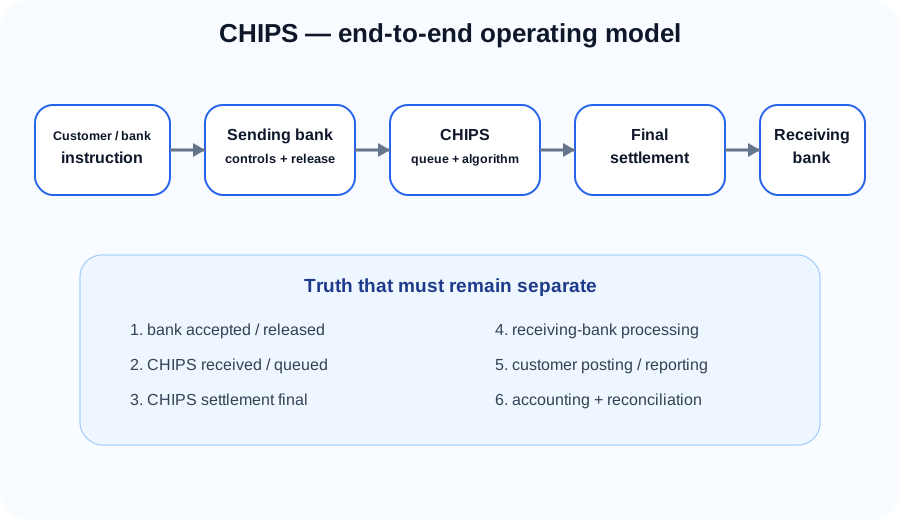
The practical bank story is therefore not simply send → settle. It is:
customer or bank instruction → bank validation and release → CHIPS payment instruction → participant controls and prioritisation → CHIPS liquidity/offsetting logic → settlement with finality → receiving-bank processing → accounting/reporting → reconciliation and exception handling.
The chapter also keeps three boundaries clear. Chapter 17 explains the CHIPS infrastructure and settlement model. Chapter 18 will explain domestic wire products and customer-facing usage. Chapter 19 will explain cross-border correspondent banking and SWIFT. Those concepts interact with CHIPS, but they are not the same topic.
For a roughly 60-minute core session, spend about 35 minutes on Sections 1–5, Sections 6–10 and Sections 11–15. For the next 10 minutes, use the chapter’s three diagrams to follow funding, queued instructions and final settlement. Use 10 minutes to work through one case in Section 16, then spend the final 5 minutes explaining: How would you distinguish a payment waiting for settlement from one requiring post-settlement recovery? Treat these timings as a study guide. The remaining sections, additional cases and extended reference material are follow-up study; completing the whole chapter takes longer.
Chapter navigator
- What CHIPS actually is and why it exists
- Participants, reachability and correspondent relationships
- From customer or bank instruction to a CHIPS payment
- CHIPS ISO 20022 message model and payment data
- Bank controls before CHIPS release
- Liquidity funding and the CHIPS account model
- Liquidity-saving logic: matching, offsetting and settlement
- Prioritisation, queue behaviour and intraday control
- Operating day, processing window and settlement timing
- Statuses, acknowledgements and settlement evidence
- Receiving-bank processing and customer credit
- Finality, errors, returns and recovery requests
- Reconciliation, accounting and reporting
- Liquidity, treasury and real-bank routing decisions
- Controls, resilience and production operations
- End-to-end cases, BA checklist and testing
1. What CHIPS actually is and why it exists
CHIPS stands for the Clearing House Interbank Payments System. It is operated by The Clearing House and is a private-sector high-value U.S. dollar clearing and settlement system used by major financial institutions for domestic and cross-border wire activity.
The current network is highly concentrated in institutions with significant high-value U.S. dollar flows. The Clearing House describes CHIPS as having 43 direct participants, processing more than 630,000 transactions per business day and clearing and settling more than $2 trillion in average daily value. Those numbers matter because they show why liquidity design is not a technical footnote. When trillions of dollars of payments move through a system each day, the difference between gross funding and liquidity-efficient settlement can materially change a bank’s intraday funding requirement.
The essential concept is:
CHIPS provides final settlement while reducing the amount of liquidity participants need to commit relative to a simple payment-by-payment gross model.
That does not mean payments are merely “netted at the end of the day.” CHIPS performs continuous intraday processing and settlement. The system evaluates queued and newly submitted payments against participant funding and offsetting opportunities. It can settle individual payments or groups of payments when its settlement conditions are met.
This is why describing CHIPS as only a deferred-net system is misleading. It has a liquidity-saving algorithm and continuous settlement design. The network is designed to achieve settlement finality during the operating day while efficiently reusing liquidity.
CHIPS is not Fedwire
Fedwire is operated by the Federal Reserve Banks and uses a real-time gross settlement model. Each accepted Fedwire transfer settles individually in central-bank money as the transfer is processed.
CHIPS is operated by The Clearing House. Its value proposition includes liquidity efficiency through matching and offsetting. A bank may therefore route eligible high-value U.S. dollar payments through CHIPS when reachability, product rules, urgency, correspondent relationships and liquidity strategy support that choice.
This does not make one system universally “better.” They solve related but different operating problems and can provide complementary resilience to the U.S. high-value payment ecosystem.
Why liquidity efficiency matters
Suppose Bank A owes Bank B $90 million, while Bank B has payments totaling $82 million going back toward Bank A or toward other participants in a settlement combination. A pure gross model could require large amounts of separate funding before both directions complete. A liquidity-saving mechanism looks for ways to settle obligations using offsetting flows so less incremental funding is required.
The Clearing House reported a 26:1 liquidity-efficiency ratio for 2025, meaning roughly $1 of funding supported about $26 of settled payment value. That figure is a network performance measure, not a guarantee that every participant or every payment receives exactly the same ratio.
The correct learning point is that CHIPS is designed to recycle liquidity.
2. Participants, reachability and correspondent relationships
A CHIPS payment can involve more business roles than the simple sender-bank/receiver-bank diagram suggests.
At the customer edge, a corporate, financial institution, broker-dealer, investment manager or other client may instruct its bank to make a high-value U.S. dollar payment. The client may have no direct relationship with CHIPS. Its bank decides how to route the payment.
A CHIPS participant is an institution admitted to the network under the CHIPS rules and operating framework. Participants connect to the system, send and receive payment instructions, contribute and manage funding, and receive settlement and operational information.
The beneficiary’s bank may itself be a CHIPS participant, or the payment may involve correspondent relationships through participants that provide U.S. dollar clearing services for other institutions. This is one reason CHIPS has historically played an important role in cross-border U.S. dollar payments.
Direct participation is not the same as customer reach
A bank does not need every possible beneficiary bank to be a direct CHIPS participant for CHIPS to be commercially relevant. Correspondent banking extends reach beyond direct participants.
For a payment architect or BA, separate:
network participant — the institution directly connected to CHIPS;
correspondent customer — another bank using the participant’s U.S. dollar clearing service;
originating customer — the corporate or institution that instructed the payment;
beneficiary customer — the final customer intended to receive the funds.
These roles affect data, fees, screening, reporting and investigations.
CHIPS UID and routing references
CHIPS historically uses identifiers and routing data that support participant and customer routing. Banks should treat relevant CHIPS routing and correspondent reference data as governed master data.
A technically valid identifier does not prove that the selected route is commercially correct. The payment engine needs a routing decision based on current participant reachability, correspondent arrangements and product configuration.
Participant operations extend beyond payment sending
A participant must manage:
- connectivity and security;
- funding and liquidity controls;
- payment release and prioritisation;
- inbound and outbound monitoring;
- settlement evidence;
- reconciliation;
- business continuity;
- rule changes and testing;
- operational contacts and incident escalation.
This is why CHIPS cannot be implemented as a single outbound message adapter.
3. From customer or bank instruction to a CHIPS payment
CHIPS processing begins after the bank has a valid business reason to send a payment through CHIPS.
Imagine a global corporate instructs its U.S. dollar clearing bank to pay $25 million to a supplier whose receiving institution can be reached efficiently through CHIPS. The customer instruction may arrive through a portal, file or API. Chapter 15 covered channel connectivity. Chapter 17 starts when the bank has converted that instruction into a controlled payment object.
Step 1 — establish instruction identity
The bank should preserve a stable customer instruction ID and create a bank payment ID. Those identifiers must remain linked to the external CHIPS message and settlement evidence.
A practical lineage is:
customer_instruction_id → bank_payment_id → CHIPS_message_id/reference → settlement_event → accounting entries → customer report.
Step 2 — validate the payment product
The bank confirms that the requested payment type, amount, date, currency and beneficiary route are supported.
A high-value U.S. dollar payment is not automatically a CHIPS payment. The routing engine may also consider Fedwire or an internal book transfer depending on the actual payment relationship.
Step 3 — validate participant and correspondent reachability
The bank determines whether the receiving side can be reached through the intended CHIPS route. This can involve participant directories, correspondent setup and internal routing tables.
Step 4 — apply business and compliance controls
The bank performs entitlement, account, fraud, sanctions, limit and other controls appropriate to the payment and customer.
The order of controls can vary by architecture. What must not vary is the evidence: operations should know which controls were completed before release.
Step 5 — route and schedule
Once CHIPS is selected, the payment enters the bank’s high-value processing queue. It may be released immediately or scheduled for a target time depending on customer instructions, product cutoff, liquidity strategy and operational controls.
Step 6 — create the CHIPS instruction
The bank maps its canonical payment model into the CHIPS ISO 20022 usage rules. The message should preserve the business meaning of parties, agents, accounts, remittance and identifiers.
Step 7 — release under controlled authority
The bank releases the payment to CHIPS through its approved participant connection.
A truthful state model distinguishes:
CUSTOMER_RECEIVED
BANK_VALIDATED
ROUTE_SELECTED_CHIPS
READY_FOR_RELEASE
RELEASED_TO_CHIPS
CHIPS_ACCEPTED_OR_QUEUED
CHIPS_SETTLED.
The exact labels are bank-specific. The separation is not.
4. CHIPS ISO 20022 message model and payment data
CHIPS migrated to ISO 20022 on the April 8, 2024 banking day. That was an important modernization because it moved CHIPS high-value messaging to a structured international business-message standard used across many major payment infrastructures.
ISO 20022 should not be taught as a cosmetic format conversion. It changes how party, agent, account, remittance and payment-purpose information can be represented and preserved.
Business meaning first
A bank should map:
customer instruction → canonical business payment → CHIPS usage rules → ISO 20022 message.
It should not begin by asking which internal database column maps to which XML tag.
For each significant data element, the analyst should know:
- who supplied it;
- whether the bank enriched it;
- whether it is mandatory for the CHIPS use case;
- whether it affects routing or screening;
- whether it must be returned in customer reporting;
- whether downstream systems preserve it without truncation.
Structured party data
Richer structured party data can improve sanctions screening, investigations and automation, but only if the bank preserves it throughout the processing chain.
A gateway that receives structured ISO 20022 data and immediately flattens it into legacy free text destroys part of the modernization benefit.
Message identity versus payment identity
The bank should not confuse technical message IDs with the underlying business payment.
A technical resend may create a new message envelope. That does not necessarily mean a new customer payment should be created.
This distinction is especially important when a timeout occurs between the bank and CHIPS. Before resending, the bank needs to determine whether the earlier message reached the network and whether the payment has already settled.
5. Bank controls before CHIPS release
Liquidity efficiency does not reduce the need for strong pre-release controls. If anything, the speed and finality of high-value settlement make pre-release discipline more important.
Customer authority
The bank confirms that the customer or correspondent is authorized to instruct the payment and that account entitlements are satisfied.
Payment validation
Required fields, amount, currency, dates, destination, beneficiary data and routing references are checked before external release.
Fraud controls
The bank may evaluate beneficiary changes, unusual payment values, unusual timing, device/channel signals, velocity, customer behavior and other indicators. The exact model is bank-specific.
Sanctions and compliance
High-value and cross-border U.S. dollar payments can involve several parties and financial institutions. Screening should therefore use the best available structured data and preserve screening evidence.
Chapter 20 will cover wire controls and sanctions in deeper detail. Here, the important point is that a CHIPS payment should not be released merely because the network would technically accept the message.
Duplicate prevention
Duplicate controls should look at business identity, not only message bytes.
A duplicated payment can arise from:
- customer resubmission after uncertain status;
- internal replay after a timeout;
- operator requeue;
- contingency failover;
- manual operations action.
A robust duplicate key can combine customer reference, bank payment ID, amount, currency, beneficiary and business date according to bank design.
Release authority
High-value payment release should be controlled through entitlements, maker-checker models where applicable, service accounts and operations permissions.
Manual release tools require the same governance as automated APIs.
6. Liquidity funding and the CHIPS account model
CHIPS liquidity efficiency begins with participant funding.
Participants provide funding to support CHIPS settlement. The Clearing House’s public materials explain that CHIPS can settle trillions of dollars of payment value using a much smaller funding base because liquidity is continuously reused through its settlement algorithm.
The practitioner distinction is:
funding available to CHIPS ≠ total payment value submitted to CHIPS.
If a participant submits $80 billion of payments during the day, it does not necessarily need to place $80 billion of fresh cash into the network. Incoming payments, offsetting payment obligations and the settlement algorithm allow liquidity to circulate.
Funding is a treasury decision
A participant treasury team decides how much liquidity to make available within the CHIPS framework and may adjust its position during the day according to the rules and operating tools.
Too little liquidity can delay settlement of outgoing payments. Too much liquidity can create unnecessary opportunity cost.
The aim is not “minimum cash at all costs.” It is controlled liquidity that supports customer obligations, settlement certainty and intraday risk appetite.
Supplemental funding
The Clearing House describes participants as being able to inject supplemental funds dynamically. Operationally, that means a participant can respond when queued payments, market conditions or customer urgency require additional settlement capacity.
Liquidity dashboards
A bank should monitor more than one number. Useful measures can include:
opening/funded position
outgoing submitted value
incoming settled value
outgoing settled value
queued outgoing value
high-priority queued value
available settlement liquidity
expected incoming flows.
These measures belong to a treasury-operational view rather than a customer payment screen.
7. Liquidity-saving logic: matching, offsetting and settlement
This is the part of CHIPS that most clearly distinguishes it from a straightforward RTGS model.
The system continuously evaluates payments and attempts to settle them using available funding and offsetting relationships among participants.
The exact proprietary algorithm is not something a bank BA needs to reproduce. What the BA must understand is the business behavior created by the algorithm.
Payment-by-payment settlement can occur
If sufficient conditions exist, an individual payment can settle without waiting for a large batch.
Offset settlement can occur
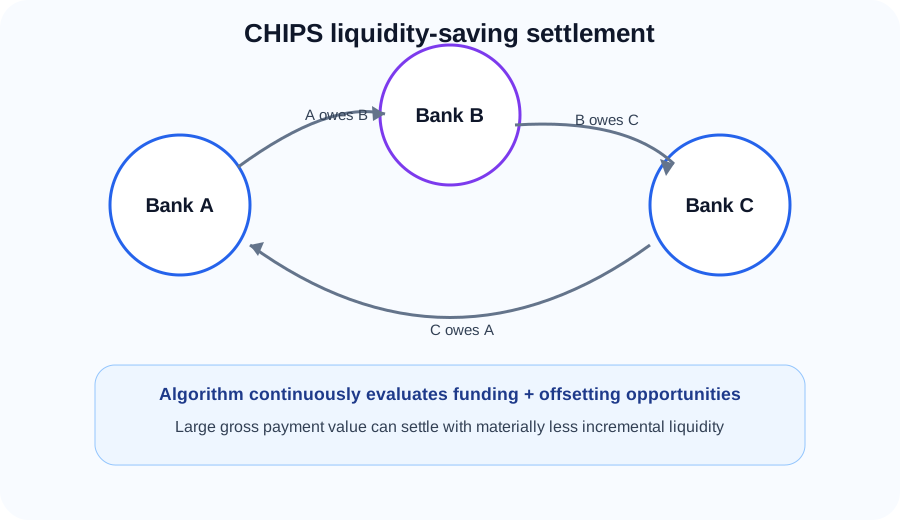
The system can identify payments that offset each other and settle combinations using less net liquidity than would be required if each payment had to be fully funded independently.
Imagine three participants:
Bank A owes Bank B $50 million.
Bank B owes Bank C $47 million.
Bank C owes Bank A $45 million.
A naive gross view sees $142 million of payments. A liquidity-saving view sees a circular set of obligations that can potentially settle with a much smaller net funding requirement, subject to system rules and participant positions.
This does not mean the underlying customer payments disappear into one net accounting record. Each payment retains its identity and final settlement outcome.
Continuous evaluation matters
A payment that cannot settle at 10:05 may become settleable at 10:06 because:
- an incoming payment increased a participant’s position;
- another queued payment created an offsetting combination;
- a participant added supplemental funding;
- priority/control settings changed according to permitted rules.
That is why QUEUED is not the same as FAILED.
Liquidity can be recycled
Once incoming value settles to a participant, that value can support its outgoing settlement activity. This recycling effect is a major source of efficiency.
8. Prioritisation, queue behaviour and intraday control
Liquidity-saving systems need queue management because not every submitted payment settles at exactly the moment it enters the network.
A participant can have ordinary payments, time-sensitive payments and payments whose settlement is constrained by available liquidity or offsetting opportunities.
Priority is not a guarantee
A bank may prioritize an urgent payment, but priority does not create liquidity by itself. Settlement still depends on applicable system conditions.
Operational design should therefore distinguish:
priority requested
from
priority applied
from
payment settled.
Queue ageing
Treasury and operations should monitor queued payments by age and business importance.
A single $500 million institutional payment nearing a contractual deadline may deserve more attention than hundreds of lower-priority routine payments.
Customer transparency
Customer reporting should be careful with queue states. A customer generally does not need the internal details of the CHIPS liquidity algorithm, but the bank should not tell the customer “settled” while the payment remains queued.
A practical model can expose processing until external settlement is confirmed.
Release strategy
Some banks may deliberately time payment release to balance customer needs and liquidity. This is a bank operating choice within product commitments and network rules, not a universal CHIPS requirement.
BA requirements should therefore specify whether scheduling is customer-driven, treasury-driven, cutoff-driven or automatic.
9. Operating day, processing window and settlement timing
The Clearing House currently describes CHIPS as having a 21-hour processing window. This provides broad coverage for domestic and international U.S. dollar payment activity while still maintaining a defined business-day operating model.
The exact opening, closing, funding and cutoff times should be taken from current CHIPS operating documentation rather than hardcoded from old training slides because operating schedules can change.
Bank cutoff is not CHIPS cutoff
A corporate customer may have to submit a payment significantly earlier than the network’s final acceptance time because the bank needs time for:
- validation;
- sanctions/fraud controls;
- approval;
- routing;
- liquidity management;
- message construction;
- transmission and recovery margin.
Therefore:
customer cutoff ≠ internal bank release cutoff ≠ CHIPS processing boundary.
Business date needs explicit handling
Banks should assign a CHIPS business date based on the network’s operating calendar and processing rules. Do not infer it solely from a server’s UTC date.
Time-zone discipline
High-value U.S. dollar payment operations are global. A customer in Singapore, London or Frankfurt may submit into a U.S. operating day. Systems should store timestamps with clear timezone context and display local/customer time separately from network operating time.
10. Statuses, acknowledgements and settlement evidence
A CHIPS payment travels through several states, and the most important design rule is that each state should correspond to real evidence.
A bank can maintain states such as:
BANK_ACCEPTED
RELEASED_TO_CHIPS
CHIPS_RECEIVED
QUEUED
SETTLED
REJECTED.
The actual CHIPS message/status vocabulary must follow current implementation documentation. These labels illustrate a bank-side business model, not official network codes.
Received is not settled
A communication acknowledgement proves technical receipt or acceptance at one layer. It does not automatically prove settlement finality.
Queue evidence
If a payment remains queued, the bank should know why it has not reached settlement. The network may not expose every detail of proprietary algorithm behavior, but the participant should have enough operational visibility to understand its position, queue and funding state.
Settlement evidence
Once CHIPS confirms final settlement, the bank can move the external settlement state to SETTLED and create the corresponding accounting and customer-reporting events.
Message/status lineage
Evidence should link:
bank payment ID
CHIPS message/reference
transmission timestamp
network status history
settlement timestamp
accounting event
customer report.
This chain becomes essential during investigations.
11. Receiving-bank processing and customer credit
CHIPS settlement occurs between participating financial institutions. Customer posting is a separate step inside the receiving institution.
That distinction is crucial.
A CHIPS payment can be settled between banks while the receiving bank still performs internal processing before crediting the beneficiary account.
Receiving-bank validation
The receiving institution identifies the beneficiary relationship, validates account routing and applies internal controls.
Compliance screening
Depending on the payment and institution, inbound data may be subject to sanctions, fraud, AML or other controls.
Posting
Once the receiving bank determines the payment can be posted, it credits the customer account or books the funds according to the relevant account/product model.
Reporting
Customer reporting can then show the incoming wire and remittance information.
The status distinction is:
CHIPS settlement finality ≠ proof of beneficiary account posting.
This is the same kind of conceptual separation introduced in Chapter 4, now applied specifically to CHIPS.
12. Finality, errors, returns and recovery requests
Finality is one of the most important CHIPS concepts.
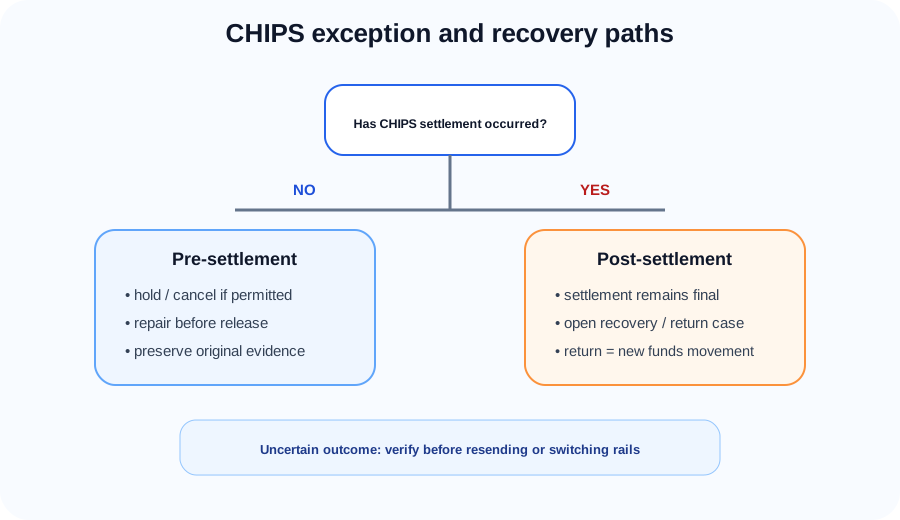
Once a payment settles in CHIPS under the rules, settlement is final and irrevocable at the network level. A sender cannot simply “reverse the CHIPS settlement” because the customer made a mistake.
Pre-settlement error
If an error is detected before the payment settles, the bank may have options to hold, cancel or correct according to the payment’s current state and CHIPS rules.
Post-settlement error
If the payment has already settled, recovery requires a new business process. The sending bank may contact the receiving bank and request return of funds, or use applicable message/process mechanisms.
The receiving bank may need to investigate whether funds remain available, whether the beneficiary has been credited and whether legal or fraud considerations apply.
Return is a new payment movement
A returned wire should be understood as a new movement of funds linked to the original payment, not as erasure of the settled transaction.
This distinction protects accounting integrity.
Fraud-induced payments
If the customer was deceived into authorizing a payment, the original transfer may still have been technically authorized and validly settled. Fraud recovery and network settlement validity are separate questions.
Chapter 20 will examine these wire-control and recall topics in more depth.
13. Reconciliation, accounting and reporting
A bank should be able to prove that every CHIPS payment moved through the expected financial and operational states.
A strong reconciliation model includes several populations.
Customer-to-bank reconciliation
What did customers instruct versus what did the bank accept, reject, hold or cancel?
Bank-to-CHIPS reconciliation
What did the payment hub release versus what did CHIPS receive and settle?
Settlement reconciliation
What CHIPS settlement evidence exists, and how does it map to the bank’s financial position?
Ledger reconciliation
Do customer-account and general-ledger postings reflect the settled payments correctly?
Reporting reconciliation
Do customer statements, advices and operational reports match actual payment states?
A practical equation is:
released to CHIPS = settled + rejected + queued/unresolved.
At controlled close, unresolved items should be understood and owned.
Accounting timing
The bank should define when it debits the originating customer, when it recognizes the external settlement, and when it books fees. These can be separate events.
Returned funds
If funds are later returned, the accounting model should link the return to the original payment rather than rewriting history.
Liquidity reporting
Treasury reporting should distinguish funded liquidity, incoming settlement, outgoing settlement and remaining queued exposure.
14. Liquidity, treasury and real-bank routing decisions
CHIPS is not only an operations platform. It is a treasury instrument.
The Clearing House’s current public material describes a 26:1 liquidity-efficiency ratio in 2025. In 2024 it reported 29:1. The difference is a useful lesson: liquidity efficiency changes with participant behavior and market conditions. It is not a fixed constant embedded in the network.
Route economics
When both CHIPS and Fedwire can reach the destination, a bank may consider:
- urgency;
- customer product commitments;
- counterparty reachability;
- settlement finality needs;
- liquidity cost;
- expected incoming flows;
- operational conditions;
- network availability;
- correspondent arrangements.
The exact routing policy is institution-specific.
Funding buffers
A bank may choose to hold more CHIPS funding than the mathematical minimum because resilience and settlement certainty matter. The 2025 CHIPS report explicitly connects liquidity behavior with prudential choices by bank treasurers.
Stress conditions
During market stress, incoming flows can become less predictable. Queue behavior and liquidity buffers therefore need stress scenarios.
A good treasury test asks:
- what if expected incoming value falls sharply?
- what if a major counterparty delays payments?
- what if the bank suddenly receives large urgent outgoing instructions?
- what if one high-value payment is prioritized?
- what if CHIPS or another high-value route is unavailable?
Resilience between high-value rails
CHIPS can provide a private-sector high-value path alongside Fedwire. Contingency planning may consider whether eligible payments can be rerouted when one service has a major disruption.
But contingency routing is not simply changing a flag. The receiving institution, message data, liquidity, customer contract and reconciliation path must all support the alternate rail.
15. Controls, resilience and production operations
CHIPS operations need strong controls because high value, settlement finality and global customer impact create material operational risk.
Connectivity controls
Participant connectivity should be authenticated, encrypted, monitored and resilient. Certificates, keys and endpoint changes need controlled lifecycle management.
Dual control and privileged access
Manual payment release, priority changes, supplemental funding and replay/resend actions can carry significant risk. Privileged operations should be governed under bank policy.
Monitoring
A production dashboard should show:
- connectivity health;
- submitted payment count/value;
- settled count/value;
- queued count/value;
- priority queue;
- funding/liquidity position;
- rejects;
- ageing;
- settlement evidence ingestion;
- reconciliation breaks.
Incident classification
A useful incident taxonomy separates:
CUSTOMER_CHANNEL
BANK_PAYMENT_ENGINE
CHIPS_CONNECTIVITY
CHIPS_NETWORK
LIQUIDITY/FUNDING
SETTLEMENT_EVIDENCE
CUSTOMER_POSTING/REPORTING.
This prevents statements such as “CHIPS is down” when the real issue is an internal bank gateway.
Resilience and contingency
Banks should test primary/secondary connectivity, backup operations, key staff unavailability, message backlog recovery, liquidity recovery and reconciliation after incident restoration.
A failover test is incomplete if the bank cannot prove which payments were already settled before the failover.
Disaster recovery
The Clearing House publishes mandatory testing and disaster-recovery resources for CHIPS participants. Banks should treat participation in such testing as part of the operating model, not a one-time technical certification.
16. End-to-end cases, BA checklist and testing
Chapter 17 should leave a practitioner able to reason about CHIPS behavior rather than memorize a definition.
Case 1 — ordinary high-value corporate payment
A corporate customer instructs $30 million to a beneficiary bank reachable through CHIPS.
The sending bank authenticates the customer, validates the debit account, runs compliance/fraud checks, selects CHIPS, creates the ISO 20022 instruction and releases it.
CHIPS receives the payment. Available funding and offsetting conditions support quick settlement. Settlement becomes final. The sending bank books its financial events. The receiving bank processes the incoming payment and credits the beneficiary. Both banks reconcile network and ledger evidence.
The key checkpoints are:
customer authority
route decision
message correctness
CHIPS settlement evidence
customer posting
reconciliation.
Case 2 — payment remains queued
The bank releases a large payment, but it does not settle immediately.
Operations should not label it failed. Treasury reviews queue and liquidity position. Incoming value or supplemental funding later improves the settlement condition. The payment settles.
Testing must prove that customer reporting remained truthful while the payment was queued.
Case 3 — timeout after transmission
The bank transmits a payment but loses the response.
The dangerous action is blind resend.
The safe process is:
- preserve original payment and message identity;
- query available CHIPS/network evidence;
- determine whether the original was received or settled;
- resend only under controlled recovery rules if the original definitely did not execute;
- reconcile all resulting evidence.
Case 4 — customer asks for recall after settlement
The payment has already settled with finality.
The bank explains that the original settlement cannot simply be undone. It initiates the applicable recovery/request process toward the receiving bank. The case remains linked to the original payment and any returned funds are booked as a separate movement.
Case 5 — liquidity stress
Large outgoing payments arrive while expected incoming flows are delayed.
Treasury sees a growing queue. Priority payments are identified. The bank can consider supplemental funding and routing decisions consistent with policy. Operations monitors customer commitments and settlement ageing.
Case 6 — CHIPS route unavailable
The bank’s CHIPS connection or network route is unavailable during a critical period.
The bank assesses whether eligible payments can use a contingency path such as Fedwire. Before rerouting, it confirms the CHIPS payment did not already settle, rebuilds rail-specific message data, re-runs required routing controls, and preserves one business payment identity across the route change.
BA requirement checklist
A BA should be able to answer:
- What business events create a CHIPS-eligible payment?
- How does the bank determine CHIPS reachability?
- What data is required before release?
- Which controls must be complete before external submission?
- What identifies the business payment versus the CHIPS message?
- What states exist before and after CHIPS acceptance?
- How is queue state represented?
- How is priority represented?
- What funding information is available to treasury?
- How does the bank detect duplicate or uncertain transmission?
- What proves final settlement?
- What does the receiving bank do after settlement?
- How are returns/recovery requests linked to the original?
- How are customer books and GL reconciled?
- What happens during CHIPS connectivity failure?
- What happens during liquidity stress?
- How are ISO 20022 versions governed?
- How are rule/calendar changes released and tested?
Functional testing
Functional tests should include:
- valid customer payment routed to CHIPS;
- invalid participant/routing data;
- sanctions/fraud hold before release;
- duplicate customer instruction;
- CHIPS reject;
- payment entering queue;
- payment leaving queue after incoming liquidity;
- priority change where supported by bank policy;
- settlement confirmation;
- receiving-bank posting;
- post-settlement recovery request;
- return of funds linked to original;
- customer reporting before and after settlement;
- end-of-day reconciliation.
Negative and resilience testing
Test:
- corrupted message;
- expired certificate;
- connection timeout;
- uncertain send outcome;
- duplicate technical delivery;
- service failover;
- delayed status/evidence feed;
- treasury funding feed failure;
- queue spike;
- major incoming-flow shortfall;
- restart with unresolved payments;
- failback to primary connectivity.
Non-functional testing
A high-value payment platform should test throughput, latency, security, resilience, recovery time and observability. But the most important metric is not API response speed. It is whether the bank can preserve one correct financial outcome under stress.
Final practitioner takeaway
CHIPS is best understood as a high-value U.S. dollar settlement system that combines payment finality with liquidity efficiency.
Its strength comes from the interaction of participant funding, continuous evaluation, matching and offsetting, priority controls, structured ISO 20022 data and disciplined bank operations.
The operational truth is:
submitted ≠ received ≠ queued ≠ settled ≠ beneficiary posted ≠ reconciled.
And the treasury truth is:
payment value ≠ funding requirement.
A strong CHIPS implementation keeps both truths visible at the same time.
Authoritative references
This application uses JavaScript for the full interactive experience. This text summary is served for accessibility and search indexing.